Showing posts with label sugar bowl. Show all posts

Wednesday, August 3, 2022

August 3, 1975: The Superdome Opens

August 3, 1975: The Louisiana Superdome opens in downtown New Orleans. Trumpeter Al Hirt and clarinetist Pete Fountain, both based in that city known as the birthplace of jazz, perform at the opening concert.

The "Big Mushroom" was designed to take the place of Tulane Stadium, on the campus of Tulane University, as the home of the school's football team, and of the NFL's New Orleans Saints, and of 2 of college football's most popular games, the Sugar Bowl and the historically black schools' Bayou Classic. On the very day of the Superdome's dedication, Tulane Stadium was condemned. It was demolished in 1979.

Between August 28 and September 14, 1975, the Superdome continued to celebrate its grand opening, with appearances by Bob Hope, Telly Savalas, Dorothy Lamour, Karen Valentine, and Raquel Welch. The Allman Brothers, The Marshall Tucker Band, Wet Willie, The Charlie Daniels Band, The O'Jays, The Isley Brothers, The Temptations, Donald Byrd and the Blackbyrds, and the Ringling Brothers and Barnum & Bailey Circus also performed. On October 3, Johnny Cash led a concert that included his wife June Carter, Waylon Jennings and his wife Jessi Colter, and Merle Haggard.

The 1st football game in the Superdome was on August 6, an exhibition game in which the Saints lost to the Houston Oilers, 13-7. Their 1st regular-season game in the building was on September 28, a 21-0 loss to the Cincinnati Bengals. Tulane's dome debut was better, a 14-3 win over the University of Mississippi.
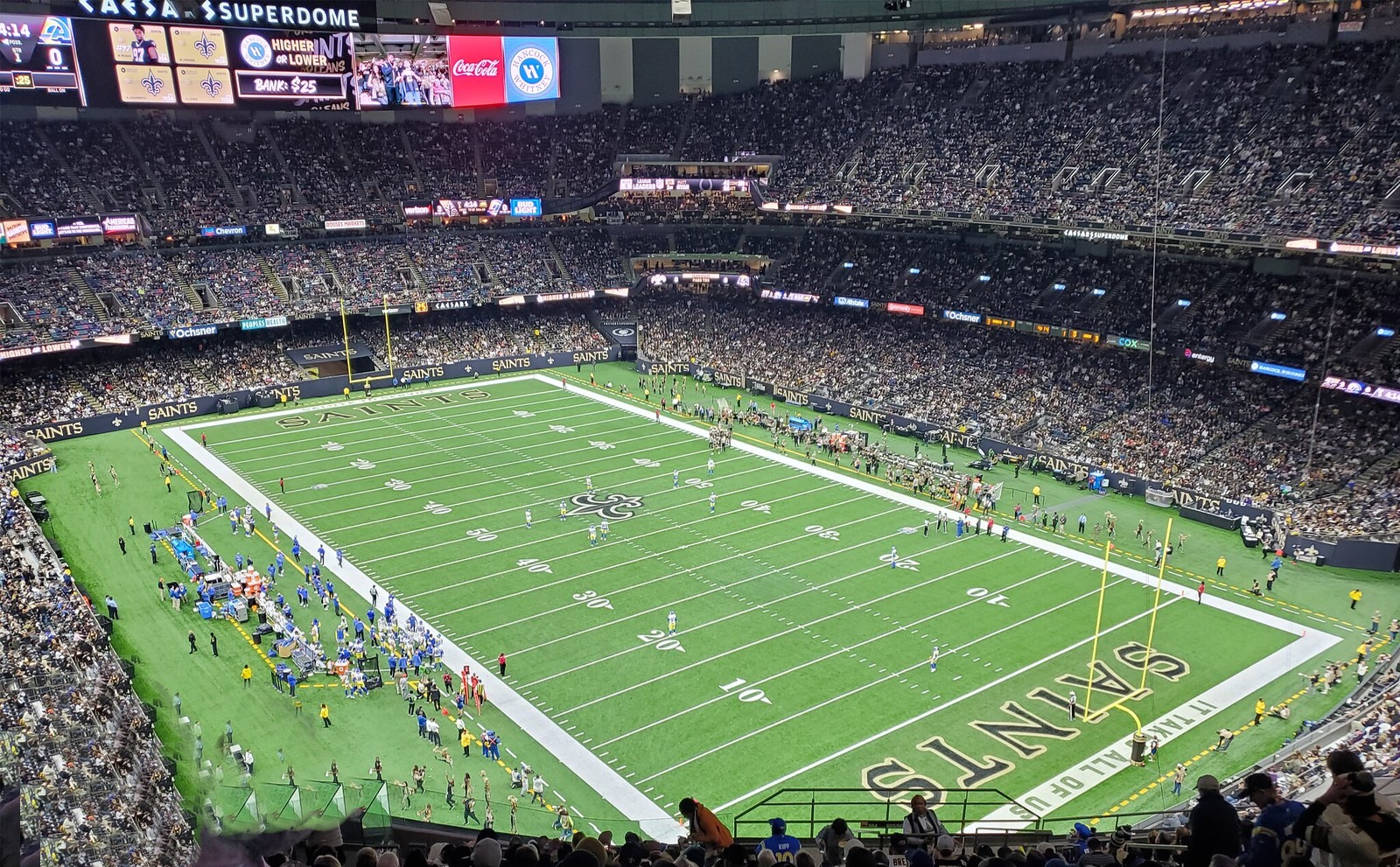
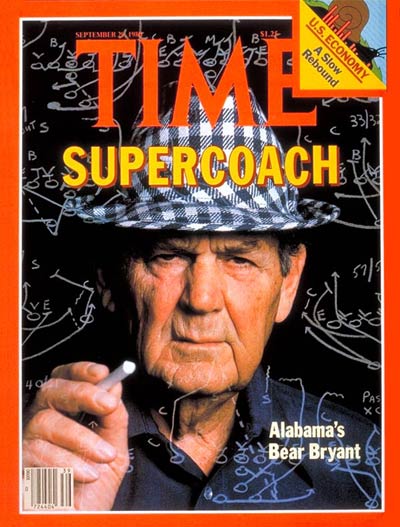
On November 29, the Bayou Classic was played there for the 1st time. The Grambling State University Tigers defeated the Southern University Jaguars, 33-20. And on December 31, New Year's Eve, the Sugar Bowl was first held there. Alabama beat Penn State, 13-6. 'Bama coach Paul "Bear" Bryant was not wearing his famous houndstooth hat. When asked why, he said, "My mama told me never to wear a hat indoors." He had never coached a game under a dome before.

With the closing (but not, as of this writing, the demolition) of the Astrodome in Houston, the Superdome is the oldest actively used domed stadium in the United States. It has hosted the Super Bowl more times than any other venue:

1. 1978, Super Bowl XII: Dallas Cowboys 27, Denver Broncos 10.
2. 1981, Super Bowl XV: Oakland Raiders 27, Philadelphia Eagles 10.
3. 1986, Super Bowl XX: Chicago Bears 46, New England Patriots 10.
4. 1990, Super Bowl XXIV: San Francisco 49ers 55, Denver Broncos 10.
5. 1997, Super Bowl XXXI: Green Bay Packers 35, New England Patriots 21.
6. 2002, Super Bowl XXXVI: New England Patriots 20, St. Louis Rams 17.
7. 2013, Super Bowl XLVII: Baltimore Ravens 34, San Francisco 49ers 31.

It is scheduled to host for an 8th time, Super Bowl LIX, to conclude the 2024 NFL season. (UPDATE: The Philadelphia Eagles beat the Kansas City Chiefs, 40-22.)

It has hosted 6 NCAA Final Fours:

1. 1982, North Carolina over Georgetown.
2. 1987, Indiana over Syracuse.
3. 1993, North Carolina over Michigan.
4. 2003, Syracuse over Kansas.
5. 2012, Kentucky over Kansas.
6. 2022, Kansas over North Carolina.
The NBA's New Orleans Jazz played there from 1975 until their 1979 move to Salt Lake City, as the Utah Jazz. Muhammad Ali regained the Heavyweight Championship of the World from Leon Spinks there in 1978, and Sugar Ray Leonard regained the Welterweight Championship from Roberto Duran there in 1980.

It also hosted some preseason baseball games: Minnesota vs. Houston in 1976; the New York Yankees vs. Baltimore in 1980; the Yankees vs. the New York Mets, Philadelphia and Pittsburgh in 1981; the Yankees vs. Montreal and Texas in 1982; the Yankees vs. Montreal and Toronto in 1983; Philadelphia vs. St. Louis in 1984; San Francisco vs. Oakland in 1989; Los Angeles vs. Oakland in 1991; the Mets vs. Oakland in 1993; the Yankees vs. Boston in 1994; and the Chicago Cubs vs. Minnesota in 1999.
Baseball doesn't look right in the Superdome, does it?

The Class AAA New Orleans Pelicans played their home games there in 1977. New Orleans tried to get the Oakland Athletics to move there in 1979, and the Pittsburgh Pirates for 1982, but were unsuccessful.

It has also hosted a Mass by Pope John Paul II in 1987, and the 1988 Republican National Convention, which nominated George H.W. Bush for President.

In 2005, Hurricane Katrina nearly ruined New Orleans, including causing serious damage to the Superdome. It was used as a shelter for those who had lost their homes, with disastrous results. The Saints split their home games that season between Tiger Stadium on the Louisiana State campus in Baton Rouge and the Alamodome in San Antonio; Tulane used 5 different smaller college stadiums in Louisiana; the Bayou Classic was moved to what's now named NRG Stadium in Houston; and the Sugar Bowl to the Georgia Dome in Atlanta. The Superdome reopened the following September 25.

Current seating capacity is 73,208. The post-Katrina renovation of 2005-06 was designed solely to make it usable again. Another renovation was undertaken in 2011, to do some modernization -- which also ended the building's baseball capability. There has been talk of a new domed stadium to replace it, but no plans are underway.

Naming rights were sold in 2011, making it the Mercedes-Benz Superdome. The 2017 move of the Saints' arch-rivals, the Atlanta Falcons, to the new Mercedes-Benz Stadium confused matters, and Mercedes-Benz allowed their naming rights on the Superdome to lapse. In 2021, it became the Caesars Superdome, with the rights bought by the Caesars casino company.

The New Orleans Arena opened next-door in 1999. Since 2014, it has been named the Smoothie King Center. Since 2002, it has been home to the NBA team known as the New Orleans Hornets until 2013, and the New Orleans Pelicans ever since.
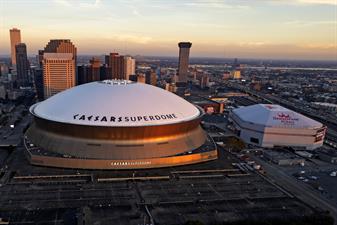
*

August 3, 1975 was a Sunday. These baseball games were played that day:

* The New York Yankees split a doubleheader with the Cleveland Indians at Shea Stadium, where they groundshared with the Mets while Yankee Stadium was being renovated. The Yankees won the opener, 12-1. George "Doc" Medich went the distance as the winning pitcher. Bobby Bonds, in perhaps his best game in his lone season as a Yankee, went 3-for-5 with 2 RBIs.

The Indians won the nightcap, 3-2. Larry Gura went 7 strong innings, but Dick Tidrow blew the game in the 8th inning. Rico Carty, who always seemed to hit the Yankees well, went 4-for-4 with a home run and 2 RBIs. Frank Robinson, in his 1st season as Major League Baseball's 1st black manager, was not yet retired as a player, but did not put himself into either game.

* The New York Mets were swept by the Pittsburgh Pirates, 5-4 and 4-3 at Three Rivers Stadium in Pittsburgh. The 1st game went 15 innings, when ex-Met Duffy Dyer hit a home run off Bob Apodaca, who pitched 4 innings in relief of Tom Seaver. Willie Stargell went 1-for-5 with 2 walks in the 1st game, and did not play in the 2nd game.

* The Philadelphia Phillies beat the Montreal Expos, 5-4 at the Olympic Stadium in Montreal. Tommy Hutton singled Mike Schmidt home with the winning run in the top of the 10th inning. Schmidt went 3-for-5 with a home run. Tug McGraw was the winning pitcher, in relief of Steve Carlton.

* The Boston Red Sox beat the Detroit Tigers, 6-4 at Fenway Park in Boston. Carl Yastrzemski went 0-for-4 with a walk, but Denny Doyle, Rick Burleson and Cecil Cooper hit home runs.

* The Milwaukee Brewers beat the Baltimore Orioles, 4-1 at Memorial Stadium in Baltimore. Hank Aaron went 1-for-4 with an RBI. Robin Yount went 1-for-3 with an RBI. Brooks Robinson went 0-for-3.

* A doubleheader between arch-rivals was split at Wrigley Field in Chicago. The Chicago Cubs won the 1st game, 6-3. The St. Louis Cardinals won the 2nd game, 7-4.

* The Minnesota Twins swept a doubleheader from the Chicago White Sox, 7-4 and 12-9 at Metropolitan Stadium in the Minneapolis suburb of Bloomington, Minnesota. Over the 2 games, Rod Carew went 3-for-7 with 2 walks and 3 RBIs.

* The Kansas City Royals beat the Oakland Athletics, 5-0 at Royals Stadium (now Kauffman Stadium) in Kansas City. Paul Splittorff allowed only 1 hit, a single by Claudell Washington in the 1st inning. George Brett went 2-for-4 with 3 RBIs. Reggie Jackson went 0-for-3.

* The California Angels beat the Texas Rangers, 6-4 at Arlington Stadium in the Dallas suburb of Arlington, Texas. Nolan Ryan started for the Angels, but pitched only 5 innings. The Angels' bullpen blew the lead, but they scored 2 runs in the top of the 9th to win it.

* The Atlanta Braves beat the San Diego Padres, 5-1 at San Diego Stadium (later renamed Jack Murphy Stadium and Qualcomm Stadium).

* The Cincinnati Reds beat the Los Angeles Dodgers, 3-1 at Dodger Stadium in Los Angeles. Pete Rose went 0-for-4. Johnny Bench did not play.

* And a doubleheader was split at Candlestick Park in San Francisco. The San Francisco Giants won the 1st game, 5-4. The Houston Astros won the 2nd game, 10-9.

Sunday, January 2, 2022

January 2, 1956: The 1st Integrated Bowl Game In the South

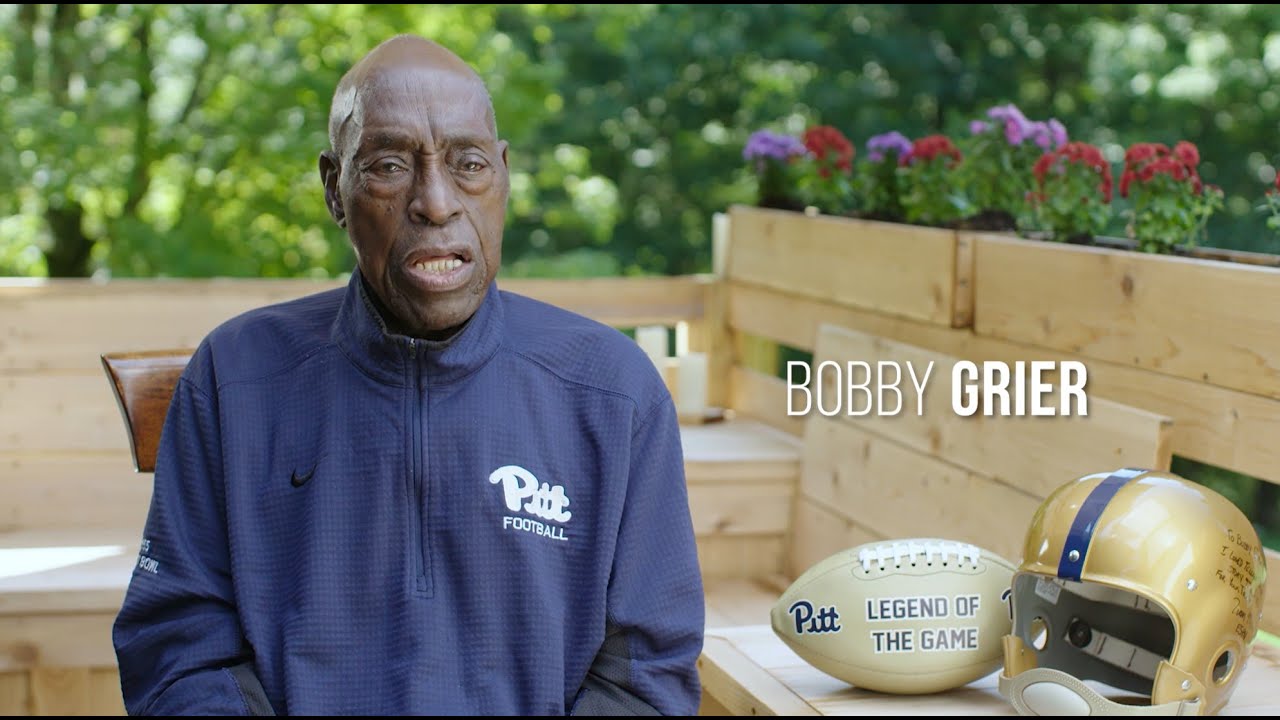
Bobby Grier

January 2, 1956: The college football season comes to an end, with the traditional New Year's Day bowl games, pushed back a day because January 1 was a Sunday.

This Monday saw the playing of the Sugar Bowl, at Tulane Stadium in New Orleans. The Georgia Institute of Technology, a.k.a. Georgia Tech, entered the game at 8-1-1, having lost to Auburn and been tied by Tennessee; however, they had beaten the University of Miami, Florida and Duke, each of them ranked at the time. Tech came in ranked Number 7.

However, they were only 3rd in the Southeastern Conference. Mississippi, instead of accepting the usual invitation given by the Sugar Bowl to the SEC Champions, instead accepted an invitation to play in the Cotton Bowl. "Ole Miss" and Tech did not play each other that season. Auburn, who finished 2nd, were not invited by the Sugar Bowl, and ended up losing the Gator Bowl to the 5th-place team in the SEC, Vanderbilt. (Tennessee finished 4th.) So the Sugar Bowl invited Georgia Tech.

Their opponents were the University of Pittsburgh. An Independent, Pitt were only 7-3, losing to Oklahoma, Navy and Miami. However, they had beaten ranked teams Duke and West Virginia, and teams from other regions, Nebraska and the University of California. They came into the game ranked Number 11.

Pitt's best player was Bobby Grier, a fullback and a linebacker, as most college football teams were still sending players to play what was known as "single-platoon football," the same players playing on both offense and defense. Grier, a native of the football-mad town of Massillon, Ohio, was black.

Segregationists didn't want Grier to play in the Sugar Bowl. Governor Marvin Griffin of Georgia sent a telegram to Tech's Board of Regents, in an attempt to pressure the school's president, Blake Van Leer, to pull the team out of the game. Van Leer was already catching heat for pushing through a vote to allow women in Georgia Tech.

But Van Leer, who had held the office since 1944, refused to be bullied by the ignorant redneck Governor: He told a meeting of the Faculty Senate, "Either we're going to the Sugar Bowl, or you can find yourself another damn president of Georgia Tech." The Senate gave him a standing ovation.

This was one month after Rosa Parks refused to stand up on a bus in Montgomery, Alabama, with the bus boycott ongoing; 4 months after the murder of 14-year-old Emmett Till in Money, Mississippi; and a year and a half after the U.S. Supreme Court struck down public school segregation in the case of Brown v. Board of Education of Topeka, Kansas.
Grier, supported by his white teammates 

As it turned out, there was no law that could prevent Grier from playing in the game, and, for the 1st time, a bowl game in the South had a black player in it.

Georgia Tech won the game, 7–0. The margin of victory mostly resulted from a disputed pass interference penalty, in the 1st quarter. It was called on Grier, giving Georgia Tech a 1st and goal on the Pitt 1-yard line. The Yellow Jackets scored the game's only touchdown on the next play. Photographic evidence later strongly indicated the referee's call was incorrect.

The irony of the bad call is that it was made by referee Rusty Coles, who was from the Pittsburgh area, and who had no objective in making the wrong call, but simply made a mistake, which he admitted after seeing the game films.

Grier finished the game as its leading rusher with 51 yards. After the game, he protested the pass interference call, but praised the Georgia Tech players, saying, "They were good sportsmen, perhaps the best I've played against all season. They played hard, but clean. It was a good game. But believe me. I didn't push that man."

As it turned out, the State of Georgia needed to find a new president of Georgia Tech, anyway: Blake Van Leer died of a heart attack on January 24, 1956, just 22 days after the game. Edwin D. Harrison was named the new president. In 1960, he oversaw a vote by an overwhelming majority of Tech students to endorse the integration of qualified applicants, regardless of race.

Bobby Grier did not play professional football. Instead, he enlisted in the U.S. Air Force, and later served as an administrator at a community college in the Pittsburgh area. As of January 2, 2022, he is still alive.
UPDATE: Later in 2022, Grier was elected to the Pitt Athletics Hall of Fame. He died in 2024.

*

January 2, 1956 was, as I said, a Monday. These other bowl games were played that day:

* Oklahoma beat Maryland, 20-6, in the Orange Bowl, at Burdine Stadium in Miami. In 1959, the stadium was renamed the Orange Bowl. This was, effectively, the National Championship Game: Oklahoma, in the middle of their 47-game winning streak, still a college football record, were ranked Number 1, and had won the Big Seven Conference title; while Maryland were ranked Number 3, and had won the Atlantic Coast Conference title.

Oklahoma were favored by 7 points. If Maryland had pulled the upset, it's likely that they would have been awarded the National Championship, regardless of whether Number 2 Michigan State won the Rose Bowl. At the very least, there could have been a split in the polls. But Oklahoma won, making the Rose Bowl academic.

* Michigan State did their part, beating the University of California at Los Angeles, 17-14, in the Rose Bowl, in the stadium of the same name in the Los Angeles suburb of Pasadena, California. Michigan State were ranked Number 2, and Champions of the Big Ten Conference. UCLA were ranked Number 4, and Champions of the Pacific Coast Conference. But Oklahoma's 2-touchdown win put the National Championship out of reach for Michigan State.

* Mississippi beat Texas Christian University, 14-13, in the Cotton Bowl, in the stadium of the same name in Dallas. As previously stated, Ole Miss were the SEC Champions, and went into the game ranked Number 10. TCU were the Champions of the Southwest Conference, and were ranked Number 6.

* Wyoming beat Texas Tech, 21-14 in the Sun Bowl, at Kidd Field in El Paso, Texas. Wyoming finished 4th in the Skyline Conference, while Texas Tech were the Champions of the Border Conference.

* Juniata College and Missouri Valley College played to a tie, 6-6 in the Tangerine Bowl, in the stadium of the same name in Orlando, Florida. The Tangerine Bowl game was a showcase for what were then called "small college" teams. Both the game and the stadium would become bigger, and become known as the Citrus Bowl.

Juniata, of Huntingdon, Pennsylvania, then an Independent, now competes in NCAA Division III. Missouri Valley, of Marshall, Missouri, were the Champions of the Missouri College Athletic Union, and now compete in the NAIA -- for all intents and purposes, NCAA Division IV.

Saturday, January 1, 2022

January 1, 1979: "You Better Pass"

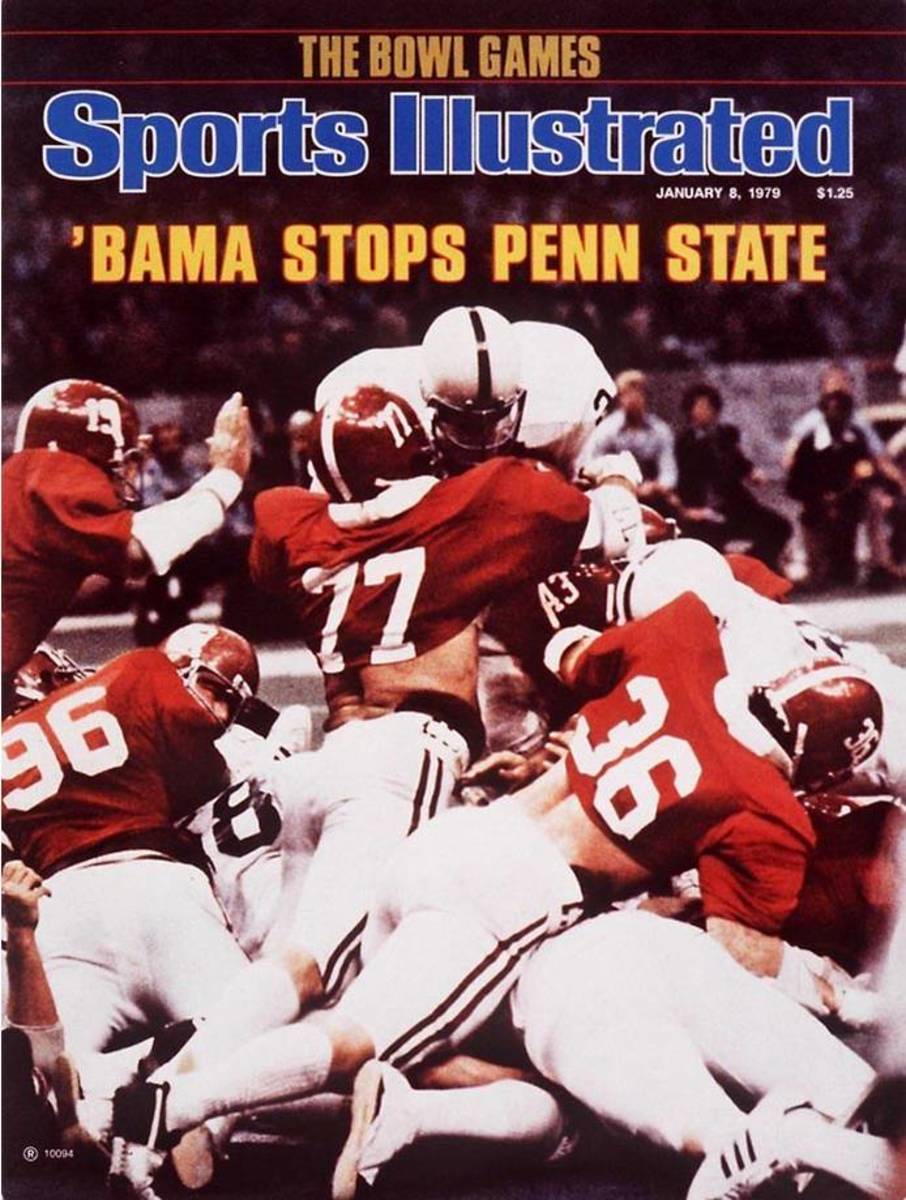
January 1, 1979: The Sugar Bowl is played at the Louisiana Superdome in New Orleans. It will decide the National Championship, as Number 1 Pennsylvania State University, then an independent, play Number 2 University of Alabama, Champions of the Southeastern Conference.

It is the 1st college football game I can remember watching on television. ABC showed a picture of Alabama coach Paul "Bear" Bryant. Then, they showed the Penn State coach, Joe Paterno. At the time, I had no idea that Bryant had once played end, both ways, for 'Bama, and that Paterno had played quarterback and defensive back for Brown University, an Ivy League school.

But, with ABC's college football anchor Keith Jackson describing Bryant and his achievements, and his craggy, weather-beaten image, I got the impression that his was what a football coach should look like. One look at Paterno, however, with his dark blue jacket, his jet-black hair, his sunglasses (even indoors at the Superdome), his big nose, his gritted teeth, and his hunched-over appearance, I thought even then, at the age of 9, that he looked like a rat. The rest of his life only increased that perception to me.

Alabama, as the SEC Champions in the Sugar Bowl, had the first choice of uniforms, and wore their "Crimson Tide" jerseys with their crimson red helmets with their uniform numbers on the side, and looked great coming onto the field. Penn State wore all white, including plain white helmets with a navy blue stripe down the middle, no logo at all. I didn't know yet that there was such a thing as high school football, but, in hindsight, Penn State looked like a high school team. They looked so plain. This was the Number 1 team in the country? I was sure Alabama were going to clobber them.

It didn't work out that way: The game was scoreless until late in the 1st half, when Jeff Rutledge threw a 30-yard touchdown pass to Bruce Bolton, putting the Tide up, 7-0. In the 3rd quarter, Penn State's defense stopped a 'Bama drive, and Alan McElroy missed a field goal to keep it a one-score game. This led to Chuck Fusina throwing a 17-yard touchdown pass to Scott Fitzkee to tie the game, 7-7.

Lou Ikner fielded a Penn State punt, and took it 62 yards, giving 'Bama a 1st-and-goal on the 8. After 2 stops on runs, Bryant and his offensive coordinator, Mal Moore, guessed that Paterno would now be expecting a pass. So the Bear called an option left, and Rutledge took it, and fooled the entire Nittany Lion defense, except for one defender. Seeing that defender take the bait, Rutledge pitched to Major Oglivie, and he scored the go-ahead touchdown. It was 14-7 Tide.

Early in the 4th quarter, on its own 22-yard line, Rutledge tried another pitch to Oglivie. This was a mistake, as Oglivie wasn't expecting it, and Penn State recovered a fumble. The Lions marched down the field, until they had 1st & goal on the 'Bama 8-yard line.

On 1st down, a run gained 2 yards. 2nd & goal on the 6: Fusina threw a pass to Fitzkee, who looked like he was going to score, until 'Bama cornerback Don McNeal came out of nowhere to knock Fitzkee out of bounds. 3rd & goal on the 1: Matt Suhey ran straight ahead, and tried a jump for the touchdown, but was hit by Curtis McGriff and Rich Wingo.

4th & goal. About 6 minutes left in the game. Fusina asked the referee how far the ball was from the goal line. Alabama defensive tackle Marty Lyons overheard, and said, "About a foot. You better pass." It was complete confidence in his teammates on this goal-line stand.

Paterno called a running play. Fusina gave the ball to Mike Guman. Barry Krauss hit him. So did Murray Legg. No gain. Penn State turned the ball over on downs. It remains the most famous goal-line stand in the history of college football, and it's hard to think of a more consequential one in the NFL.

Penn State held Alabama, and the punt snap was botched, resulting in Woody Umphrey shanking it. Penn State had the ball on the Alabama 30. Except the Nittany Lions were caught with 12 men on the field, and that gave Alabama an automatic 1st down. Paterno was not only losing the game, because he was being outcoached by Bryant, he was losing control.

The Tide were able to run the clock down, and the Lions had a little over a minute left when they got the ball back. They couldn't convert, and Alabama won, 14-7. The Crimson Tide were National Champions.

Bryant would lead Alabama to one more National Championship the next year, and become major college football's all-time winningest coach. He was once asked when he would retire, and he said, "Quit coaching? I'd croak in a week." He was too close to being right: He retired after the 1982 season, and died a month later.

Eventually, he was surpassed by Bobby Bowden of Florida State. Paterno, who had already had a few close calls for the National Championship, finally won one in 1982, and won another in 1986, and surpassed Bowden, and remains the winningest coach in the NCAA's Football Bowl Subdivision (formerly known as Division I-A). In 2011, dying of cancer, his regime collapsed in the most disgusting scandal in the history of college sports.

Chuck Fusina and Scott Fitzkee won 2 professional football championships -- not in the NFL, but in the USFL, with the 1984 Philadelphia Stars and the 1985 Baltimore Stars, under head coach Jim Mora. At that time, you could talk to Mora about Playoffs. But in the NFL, Fusina and Fitzkee were never more than backups.

Jeff Rutledge was also a career backup, "winning" 2 Super Bowl rings as the 3rd-string quarterback on the New York Giants. He became a quarterbacks coach, including with the Arizona Cardinals. Curtis McGriff was his teammate on the Giants, but was released before their 1st Super Bowl win.

Matt Suhey was the secondary running back on the Chicago Bears, behind Walter Payton, and helped them win Super Bowl XX. Mike Guman backed up Eric Dickerson on the Los Angeles Rams.

Marty Lyons became a star with the New York Jets' "New York Sack Exchange." Don McNeal starred with the Miami Dolphins, helping them reach 2 Super Bowls -- reaching 1 of them by beating Lyons' Jets in an AFC Championship Game. Rich Wingo played for the Green Bay Packers. Barry Krauss had a long NFL career, mostly with the Colts, and was with them when they moved from Baltimore to Indianapolis. Major Oglivie and Murray Legg never played pro ball, and found success in related businesses, Oglivie in concrete and Legg in construction.

*

January 1, 1979 was a Monday. The other traditional New Year's Day bowl games were as follows:

* Number 3 University of Southern California beat Number 5 Michigan, 17-10 in the Rose Bowl, in the stadium of the same name, in the Los Angeles suburb of Pasadena, California. USC running back Charles White, who would win the Heisman Trophy the next year, jumped over the Michigan line for the winning touchdown. The instant replay showed that he had fumbled the ball before crossing the plane of the goal line. No replay appeal in those days, and USC won.

* Number 4 Oklahoma beat Number 6 Nebraska, 31-24, in the Orange Bowl, in the stadium of the same name, in Miami. Nebraska had beaten arch-rival Oklahoma for the Big Eight Conference title, but then lost to Missouri the next week. So a rematch was set up in the Orange Bowl, and Oklahoma won it.

* And Number 10 Notre Dame beat Number 9 University of Houston, 35-34, in the Cotton Bowl, at the stadium of the same name in Dallas.

Baseball was out of season. The NFL was between its Conference Championships and Super Bowl XIII, which the Pittsburgh Steelers would win over the Dallas Cowboys, 35-31.

There was 1 game in the NHL: The Los Angeles Kings beat the Colorado Rockies, 5-3 at The Forum outside Los Angeles in Inglewood, California.

And there was 1 game in the World Hockey Association. A national side from Czechoslovakia was permitted to compete, and they played the Winnipeg Jets to a 3-3 tie at the Winnipeg Arena.

January 1, 1959: The Cuban Revolution

Fulgenico Bastista, murdering oppressive dictator
January 1, 1959: Fulgencio Batista, President of Cuba since 1952, flees the capital of Havana, ahead of the advancing forces of rebel leader Fidel Castro. After 2 years of revolution, Batista accepts what is now inevitable.
At 3:00 in the morning, he gets on a plane for the Dominican Republic, where his fellow fascist dictator, Rafael Trujillo, had promised him asylum. Batista named a successor, Judge Carlos Manuel Piedra. At 5:00 AM, Piedra announced a ceasefire, allowing Castro and his forces to enter the capital.
Batista had also been President from 1940 to 1944. Americans have been fed this romantic version of what Cuba was like before Castro's Communist dictatorship, which has now survived him. Movies like The Godfather Part II made Cuba look like an island paradise, guided by American organized crime. In fact, it was a fascist dictatorship. Batista was no better than Castro.
Batista spent the rest of his life in other fascist dictatorships: First the Dominican Republic, then Portugal, and finally Spain, where he died in 1973, at the age of 72.
For the record: While Castro loved baseball, he was never considered a serious prospect by any major league team. Usually, when people tell the story that he was, the team that was considering him was either the Yankees or the Washington Senators. He was scouted, but no effort was ever made to sign him.
Fidel Castro, murdering oppressive dictator
It's a story made up by right-wingers who want to believe that, if only he had been signed by an American baseball team, Cuba would have been free. Cuba was not free under Batista.
It's also worth noting that Slobodan MiloÅ¡ević of Serbia killed more people in 10 years, and Augusto Pinochet of Chile killed more people in 16 years, than Fidel Castro of Cuba did in 58 years, but American conservatives never lifted a finger to stop MiloÅ¡ević or Pinochet.
*
January 1, 1959 was a Thursday. It was the off-season for Major League Baseball. The National Football League had concluded its season 4 days earlier, when its Championship Game was won in an overtime classic by the Baltimore Colts over the New York Giants at Yankee Stadium. The National Basketball Association was in season, but had no games scheduled on the day.
The National Hockey League had 2:
* The New York Rangers beat the Boston Bruins, 5-2 at the Boston Garden. Les Colwill scored 2 goals for the Broadway Blueshirts, and Lou Fontinato, Camille Henry and future Toronto Maple Leafs star Eddie Shack each added 1.
* The Montreal Canadiens played the Chicago Black Hawks to a tie, 2-2 at the Chicago Stadium.
* The other two members of the "Original Six," the Toronto Maple Leafs and the Detroit Red Wings, were not scheduled.
Being New Year's Day, college football bowl games were played:
* The Rose Bowl, at the stadium of the same name, in the Los Angeles suburb of Pasadena, California, was won by the University of Iowa, ranked Number 2, 38-12 over the University of California, ranked Number 16.
* The Orange Bowl, at the stadium of the same name, in Miami, was won by the University of Oklahoma, ranked Number 5, 21-6 over Syracuse University, ranked Number 9.
* The Cotton Bowl, at the stadium of the same name, in Dallas, ended in a 0-0 tie between the Air Force Academy, ranked Number 6, and Texas Christian University (TCU), ranked Number 10.
* And the Sugar Bowl, at Tulane Stadium, in New Orleans, was won by Louisiana State University, ranked Number 1, 7-0 over Clemson University, ranked Number 12. This gave the LSU Tigers, undefeated going into the game, the National Championship.

January 1, 1953: The Death of Hank Williams

January 1, 1953: Hank Williams dies from his excesses. The King of Country Music has thus occasionally been called "the first dead rock star."

Hiram Williams (no middle name) was born on September 17, 1923 in Mount Olive, Alabama. By 1937, he had dropped out of school to sing country songs on an Alabama radio station. At that time, he started calling himself Hank, because he thought, "It sounded more like a hillbilly and Western star than 'Hiram.'" World War II delayed his rise: A back injury gave him a medical deferment, but his entire band got drafted.

On April 21, 1947, 6 days after Jackie Robinson re-integrated baseball, Hank went into Castle Studio in Nashville, and recorded "Move It On Over." It was his 1st hit, and some historians have called it "the first rock and roll record." A much harder, louder version was done 30 years later by George Thorogood.

More hits followed. In 1948: "I Saw the Light" and "Mansion On the Hill." In 1949: "Lovesick Blues" and "I'm So Lonesome I Could Cry." In 1950: "I Just Don't Like This Kind of Living" and "Long Gone Lonesome Blues." In 1951: "Cold, Cold Heart," which would be covered by Tony Bennett and make both men big stars outside the South; "Hey, Good Lookin'"; and "(I Heard That) Lonesome Whistle."

And in 1952 alone: "Honky Tonk Blues," "Jambalaya (On the Bayou)," "Settin' the Woods On Fire," "You Win Again" and "I'll Never Get Out of This World Alive."

That last song was still Number 1 on the country charts as the calendar year came to a close. He was certainly acting as if he believed it. That back injury I mentioned? It kept bothering him, and, as we would say today, he self-medicated, becoming addicted to alcohol and painkilling pills. He missed so many scheduled shows at the Grand Ole Opry in Nashville that he was fired.

On New Year's Eve, December 31, 1952, Hank was scheduled to perform at the Municipal Auditorium in Charleston, West Virginia. He never showed up. This time, though, it wasn't his fault: The Nashville airport was closed due to an ice storm. He hired a college student, aptly named Charles Carr, to drive him, but by the time they reached Knoxville, Tennessee, it was clear that there was no chance they could make it in time, so Carr called the Auditorium and let them know.

So Hank, already drunk, and having taken a sedative and received an injection of morphine, told Carr to take him to the location of his next concert, a New Year's Day show in Canton, Ohio. When they crossed the State Line into Bristol, Virginia, shortly after midnight, making it January 1, 1953, Carr found an all-night restaurant, and asked Hank if he wanted to eat. He said he didn't. That would be the last anyone would hear from him.

Carr got food for himself, and got back in the car. He didn't check on Hank, so Hank may already have been dead. Carr started off again, and got to Oak Hill, West Virginia, to get gas. Only then did he realize that Hank was dead, and had been for long enough for rigor mortis to have set in. An autopsy at Oak Hill showed hemorrhages in his heart and neck. He was only 29 years old.

He was buried at the Oakwood Annex Cemetery in Montgomery, the capital of Alabama. Following his death, he had 3 straight Number 1 hits on the country chart: "Kaw-Liga," "Your Cheatin' Heart" and "Take These Chains from My Heart."

Hank's legacy is huge. Before Johnny Cash, Hank was the country singer, the personification of the music. Many is the singer who has asked, "Are you sure Ol' Hank done it this way?" His songs have been covered by innumerable singers. For example, B.J. Thomas' 1st hit was a 1965 cover of "I'm So Lonesome I Could Cry." Singers as disparate as Bronx doo-wopper Dion DiMucci and the blues-influenced Londoner Mick Jagger have cited Hank as an influence on their rock and roll songs.

And in The Doors' song "Five to One," Jim Morrison invoked the song that was topping the charts when Hank died: "Five to one, baby, one in five, no one here gets out alive."

And as long as we're talking legacy: On May 26, 1949, Hank's son was born in Shreveport, Louisiana: Randall Hank Williams, known professionally as Hank Williams Jr. My father, a big country music fan despite having lived his entire life in New Jersey, told me that Hank Williams' greatest contribution to country music was Hank Williams Jr.

On January 6, 1953, 5 days after Hank Sr. died, his daughter was born in Montgomery, with the name Antha Belle Jett. She became a country singer under the name Jett Williams. On December 12, 1972, in Nashville, Hank Jr. became the father of Shelton Hank Williams, who performs "psychobilly" or "cowpunk" music under the name Hank Williams III. On March 12, 1981, in Cullman, Alabama, Hank Jr. became the father of Holly Williams, also a country hitmaker. And in 1991, Hank III became the father of Coleman Williams, who calls himself simply "IV," the Roman numeral for 4, pronounced like "four."

*

January 1, 1953 was a Thursday. This was the birthdate of Gary Johnson, a former Governor of New Mexico, who left the Republican Party to run as the Libertarian Party's nominee for President in 2016, getting 3.3 percent of the popular vote.

Baseball was out of season. The NFL season had just wrapped up. But there were college football bowl games played that day:

* In the Sugar Bowl at Tulane Stadium in New Orleans, Number 2 Georgia Tech beat Number 7 Mississippi. Ever since, Tech have claimed the National Championship, because Number 1 Michigan State, also undefeated and untied, did not play in a bowl game.

It wasn't their fault: As part of their agreement to join the Big Ten Conference, MSU were ineligible to play in a bowl game that season. So the Associated Press (AP) named Michigan State the National Champions in their final poll of major college football writers. So did United Press (UP), who ran a poll of college football coaches. The International News Service (INS), run by the Hearst media chain, chose Georgia Tech. In 1958, UP merged with INS to form United Press International (UPI), and they continued to run the coaches' poll.

* In the Rose Bowl, in the Los Angeles suburb of Pasadena, California, Number 5 USC beat Number 11 Wisconsin.

* In the Cotton Bowl in Dallas, Number 8 Tennessee was upset by Number 10 Texas, 16-0.

* In the Orange Bowl in Miami, Number 9 Alabama walloped Number 14 Syracuse, 61-6. No, this was not a masterstroke by head coach Paul "Bear" Bryant: He was still coaching at the University of Kentucky at the time. Harold Drew was then coaching the Crimson Tide.

* And in the Gator Bowl, Number 12 Tulsa was upset by Number 15 Florida, 14-13.

So what happened to the teams ranked Numbers 3, 4 and 6? Number 3 was Notre Dame, and they didn't accept bowl bids in those days. Number 4 was Oklahoma, and I can find no reason why they weren't in a bowl game. There were times in the 1970s and '80s when they couldn't accept a bid because they were on probation, but that doesn't seem to have been the case this time. And Number 6 was UCLA, who lost their last game to USC, costing them the title of the league now known as the Pac-12, and its automatic bid to the Rose Bowl.

There were 4 games played in the NBA that day:

* The New York Knicks beat the Philadelphia Warriors, 108-82 at the Philadelphia Arena.

* The Syracuse Nationals beat the Fort Wayne Pistons, 92-78 at the Onondaga County War Memorial in Syracuse.

* The Boston Celtics beat the Rochester Royals, 83-81 in overtime at the Edgerton Park Arena in Rochester.

* And the Baltimore Bullets beat the Milwaukee Bucks, 83-81 in overtime at the Milwaukee Arena. In 1974, it was renamed the Milwaukee Exposition, Convention Center and Arena, or "The MECCA." Since 2014, it has been named the UW-Panther Arena.

And there were 2 games played in the NHL. The Boston Bruins beat the Toronto Maple Leafs, 5-1 at the Boston Garden. And the Montreal Canadiens and the Chicago Black Hawks played to a 2-2 tie at the Chicago Stadium. The New York Rangers and the Detroit Red Wings did not play.

January 1, 1935: The 1st Sugar Bowl

January 1, 1935: The 1st Sugar Bowl is played, at Tulane Stadium in New Orleans. Tulane University beat Temple University, 20-14.

The most notable play of the game came in the 2nd quarter, when Tulane's quarterback, John McDaniel, caught a Temple kickoff, ran to the right to draw tacklers, then threw a lateral pass to his teammate Monk Simons, who ran 75 yards for the touchdown. Two more Tulane touchdowns in the second half outweighed Temple's early lead.

Tulane had been built on a sugar plantation, and sugar was long the leading crop in the State of Louisiana. Hence, the game was named for a local crop. New Orleans civic leaders wanted to copy Pasadena, California's Rose Bowl for a few years, and finally got it set up for 1934-35. There was no pregame parade, however.

Tulane had been one of the South's leading football schools, winning titles in the Southern Intercollegiate Athletic Association in 1920, and the Southern Conference in 1925, 1929, 1930 and 1931. That league was the forefather of both the Southeastern Conference (SEC) and the Atlantic Coast Conference (ACC).

In 1933, Tulane was a founding member of the SEC, and won the title in 1934, giving them the credibility to host the bowl game. They would win the SEC again in 1939 and 1949, but went into decline, and left the league after the 1965 season, surpassed in football importance in their State by Louisiana State University (LSU), and even by the black college rivalry between Grambling State and Southern University. They would later win the title in Conference USA in 1998, and are now members of the American Athletic Conference (AAC). (UPDATE: They won the AAC title in 2022.)

The game was held at Tulane Stadium from 1935 until 1975. In 1975, the Louisiana Superdome opened, and the game has been held there every year since, with the exception of 2006, when it was held at the Georgia Dome in Atlanta, due to repairs on the Superdome from Hurricane Katrina.
Tulane Stadium

Temple have also never again reached the football heights they reached in the 1930s. They devalued their program in 1958, but began moving back up in 1991, becoming members of the Big East Conference. In 2013, they joined the American Athletic Conference (AAC), winning it in 2016.

After the inaugural Sugar Bowl, they didn't go to another bowl game until the 1979 season, and then not again until 2009. They won the Garden State Bowl in 1979, the New Mexico Bowl in 2011, and the Gasparilla Bowl in 2017. But they've never been to another traditional New Year's Day bowl game.

Tulane Stadium hosted Super Bowls IV, VI and IX, and was home to the NFL's New Orleans Saints from 1967 to 1974, before they and the Green Wave moved into the Superdome for the 1975 season. Tulane Stadium was demolished in 1979, the 1st of the 4 classic New Year's Day bowl game facilities to go. (The Orange Bowl followed in 2008, while the Rose Bowl and Cotton Bowl stadiums still stand.) In 2014, Yulman Stadium was opened on the site of Tulane Stadium.
The Superdome

The Sugar Bowl has usually invited the SEC Champion, although this was not made official until the 1976 season. With the advent of the Bowl Championship Series (BCS) in the 1998 season, hosting the SEC Champion was no longer a given. Given the success of the SEC since the start of the National Championship Playoff in 2014, it's been almost impossible.

The Sugar Bowl has featured the National Champions of the preceding calendar year 23 times: Louisiana State University (LSU) in 1959 and 2007; the University of Mississippi (Ole Miss) in 1960, 1961 and 1963; Alabama in 1962, 1979, 1980 and 1993; the University of Miami in 1990 and 2001; Texas Christian University (TCU) in 1939; Texas A&M in 1940; Oklahoma in 1950; Maryland in 1952; Georgia Tech in 1953; Notre Dame in 1974; the University of Pittsburgh in 1977; Georgia in 1981; Penn State in 1983; Florida in 1997; Florida State in 2000; and Ohio State in 2021.

*

January 1, 1935 was a Tuesday. This was also the day the 1st Orange Bowl was played, at Miami Field in Miami. Unlike in a few later appearances, having the home-field advantage did not help the University of Miami, as they lost to Bucknell University, 26-0. I have a separate entry for that event.

Also on this day, the Rose Bowl was played at the stadium of the same name, outside Los Angeles in Pasadena, California. Alabama completed an undefeated season, ruining Stanford's, 29-13.

And the entire National Hockey League was in action:

* The New York Rangers lost to the Boston Bruins, 5-2 at the Boston Garden.

* The New York Americans beat the Montreal Canadiens, 5-3 at Madison Square Garden.

* The Detroit Red Wings beat the Toronto Maple Leafs, 1-0 at Maple Leaf Gardens in Toronto.

* And the Montreal Maroons beat the Chicago Black Hawks, 2-1 at the Chicago Stadium.

December 31, 1999 & January 1, 2000: The Millennium

December 31, 1999:  The Millennium arrives. The people of planet Earth survived. At a terrible cost. But we hadn't destroyed ourselves. ...