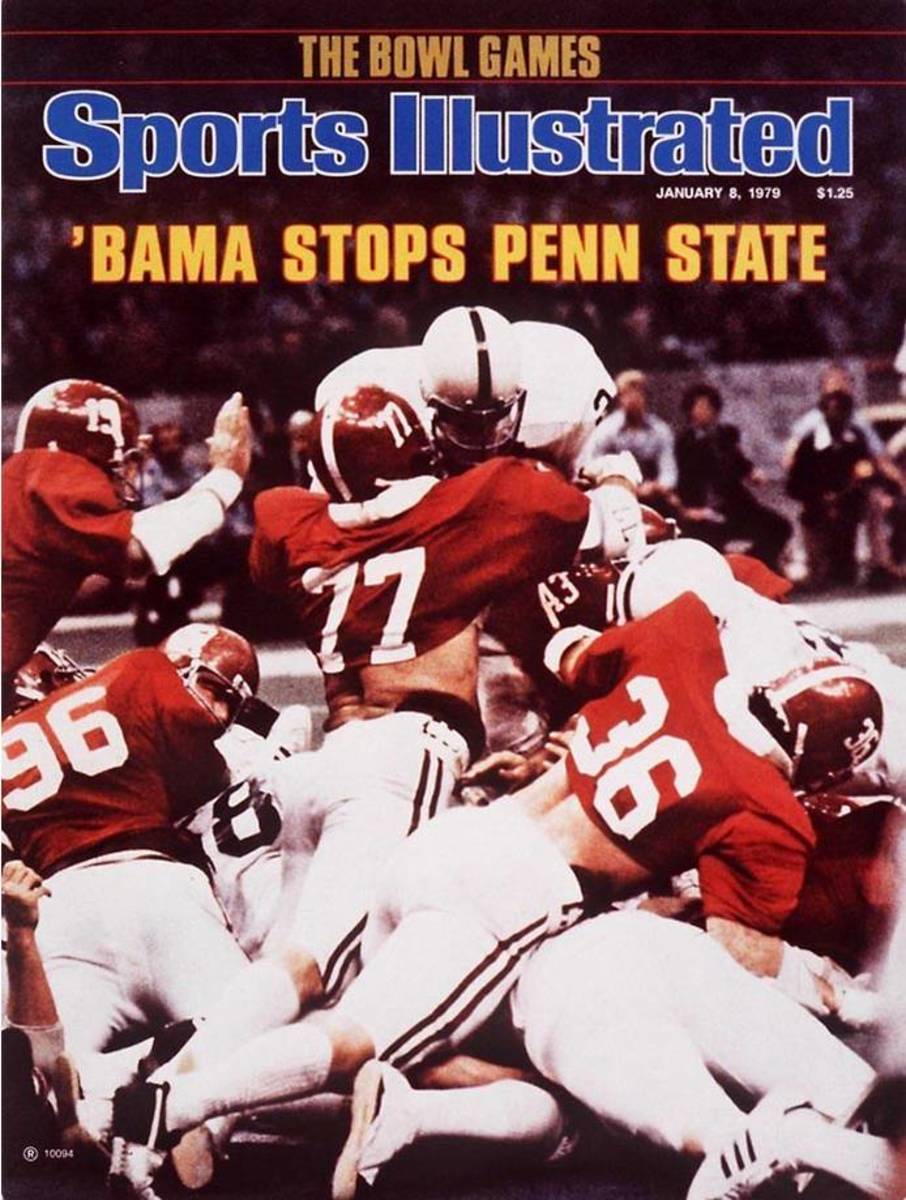
January 1, 1979: The Sugar Bowl is played at the Louisiana Superdome in New Orleans. It will decide the National Championship, as Number 1 Pennsylvania State University, then an independent, play Number 2 University of Alabama, Champions of the Southeastern Conference.
It is the 1st college football game I can remember watching on television. ABC showed a picture of Alabama coach Paul "Bear" Bryant. Then, they showed the Penn State coach, Joe Paterno. At the time, I had no idea that Bryant had once played end, both ways, for 'Bama, and that Paterno had played quarterback and defensive back for Brown University, an Ivy League school.
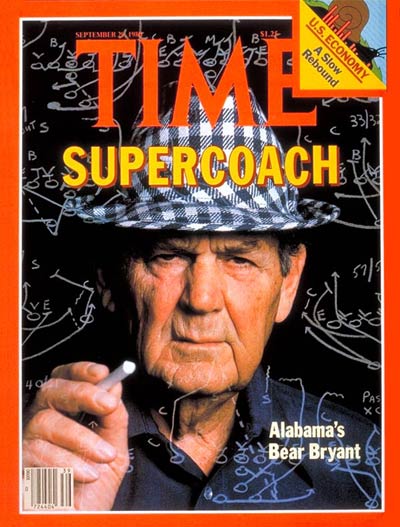
But, with ABC's college football anchor Keith Jackson describing Bryant and his achievements, and his craggy, weather-beaten image, I got the impression that his was what a football coach should look like. One look at Paterno, however, with his dark blue jacket, his jet-black hair, his sunglasses (even indoors at the Superdome), his big nose, his gritted teeth, and his hunched-over appearance, I thought even then, at the age of 9, that he looked like a rat. The rest of his life only increased that perception to me.

Alabama, as the SEC Champions in the Sugar Bowl, had the first choice of uniforms, and wore their "Crimson Tide" jerseys with their crimson red helmets with their uniform numbers on the side, and looked great coming onto the field. Penn State wore all white, including plain white helmets with a navy blue stripe down the middle, no logo at all. I didn't know yet that there was such a thing as high school football, but, in hindsight, Penn State looked like a high school team. They looked so plain. This was the Number 1 team in the country? I was sure Alabama were going to clobber them.

The Superdome
It didn't work out that way: The game was scoreless until late in the 1st half, when Jeff Rutledge threw a 30-yard touchdown pass to Bruce Bolton, putting the Tide up, 7-0. In the 3rd quarter, Penn State's defense stopped a 'Bama drive, and Alan McElroy missed a field goal to keep it a one-score game. This led to Chuck Fusina throwing a 17-yard touchdown pass to Scott Fitzkee to tie the game, 7-7.
Lou Ikner fielded a Penn State punt, and took it 62 yards, giving 'Bama a 1st-and-goal on the 8. After 2 stops on runs, Bryant and his offensive coordinator, Mal Moore, guessed that Paterno would now be expecting a pass. So the Bear called an option left, and Rutledge took it, and fooled the entire Nittany Lion defense, except for one defender. Seeing that defender take the bait, Rutledge pitched to Major Oglivie, and he scored the go-ahead touchdown. It was 14-7 Tide.
Early in the 4th quarter, on its own 22-yard line, Rutledge tried another pitch to Oglivie. This was a mistake, as Oglivie wasn't expecting it, and Penn State recovered a fumble. The Lions marched down the field, until they had 1st & goal on the 'Bama 8-yard line.
On 1st down, a run gained 2 yards. 2nd & goal on the 6: Fusina threw a pass to Fitzkee, who looked like he was going to score, until 'Bama cornerback Don McNeal came out of nowhere to knock Fitzkee out of bounds. 3rd & goal on the 1: Matt Suhey ran straight ahead, and tried a jump for the touchdown, but was hit by Curtis McGriff and Rich Wingo.
4th & goal. About 6 minutes left in the game. Fusina asked the referee how far the ball was from the goal line. Alabama defensive tackle Marty Lyons overheard, and said, "About a foot. You better pass." It was complete confidence in his teammates on this goal-line stand.
Paterno called a running play. Fusina gave the ball to Mike Guman. Barry Krauss hit him. So did Murray Legg. No gain. Penn State turned the ball over on downs. It remains the most famous goal-line stand in the history of college football, and it's hard to think of a more consequential one in the NFL.
Penn State held Alabama, and the punt snap was botched, resulting in Woody Umphrey shanking it. Penn State had the ball on the Alabama 30. Except the Nittany Lions were caught with 12 men on the field, and that gave Alabama an automatic 1st down. Paterno was not only losing the game, because he was being outcoached by Bryant, he was losing control.
The Tide were able to run the clock down, and the Lions had a little over a minute left when they got the ball back. They couldn't convert, and Alabama won, 14-7. The Crimson Tide were National Champions.
Bryant would lead Alabama to one more National Championship the next year, and become major college football's all-time winningest coach. He was once asked when he would retire, and he said, "Quit coaching? I'd croak in a week." He was too close to being right: He retired after the 1982 season, and died a month later.
Eventually, he was surpassed by Bobby Bowden of Florida State. Paterno, who had already had a few close calls for the National Championship, finally won one in 1982, and won another in 1986, and surpassed Bowden, and remains the winningest coach in the NCAA's Football Bowl Subdivision (formerly known as Division I-A). In 2011, dying of cancer, his regime collapsed in the most disgusting scandal in the history of college sports.
Chuck Fusina and Scott Fitzkee won 2 professional football championships -- not in the NFL, but in the USFL, with the 1984 Philadelphia Stars and the 1985 Baltimore Stars, under head coach Jim Mora. At that time, you could talk to Mora about Playoffs. But in the NFL, Fusina and Fitzkee were never more than backups.
Jeff Rutledge was also a career backup, "winning" 2 Super Bowl rings as the 3rd-string quarterback on the New York Giants. He became a quarterbacks coach, including with the Arizona Cardinals. Curtis McGriff was his teammate on the Giants, but was released before their 1st Super Bowl win.
Matt Suhey was the secondary running back on the Chicago Bears, behind Walter Payton, and helped them win Super Bowl XX. Mike Guman backed up Eric Dickerson on the Los Angeles Rams.
Marty Lyons became a star with the New York Jets' "New York Sack Exchange." Don McNeal starred with the Miami Dolphins, helping them reach 2 Super Bowls -- reaching 1 of them by beating Lyons' Jets in an AFC Championship Game. Rich Wingo played for the Green Bay Packers. Barry Krauss had a long NFL career, mostly with the Colts, and was with them when they moved from Baltimore to Indianapolis. Major Oglivie and Murray Legg never played pro ball, and found success in related businesses, Oglivie in concrete and Legg in construction.
*
January 1, 1979 was a Monday. The other traditional New Year's Day bowl games were as follows:
* Number 3 University of Southern California beat Number 5 Michigan, 17-10 in the Rose Bowl, in the stadium of the same name, in the Los Angeles suburb of Pasadena, California. USC running back Charles White, who would win the Heisman Trophy the next year, jumped over the Michigan line for the winning touchdown. The instant replay showed that he had fumbled the ball before crossing the plane of the goal line. No replay appeal in those days, and USC won.
* Number 4 Oklahoma beat Number 6 Nebraska, 31-24, in the Orange Bowl, in the stadium of the same name, in Miami. Nebraska had beaten arch-rival Oklahoma for the Big Eight Conference title, but then lost to Missouri the next week. So a rematch was set up in the Orange Bowl, and Oklahoma won it.
* And Number 10 Notre Dame beat Number 9 University of Houston, 35-34, in the Cotton Bowl, at the stadium of the same name in Dallas.
Baseball was out of season. The NFL was between its Conference Championships and Super Bowl XIII, which the Pittsburgh Steelers would win over the Dallas Cowboys, 35-31.
There was 1 game in the NHL: The Los Angeles Kings beat the Colorado Rockies, 5-3 at The Forum outside Los Angeles in Inglewood, California.
And there was 1 game in the World Hockey Association. A national side from Czechoslovakia was permitted to compete, and they played the Winnipeg Jets to a 3-3 tie at the Winnipeg Arena.


No comments:
Post a Comment