Showing posts with label pearl harbor. Show all posts

Wednesday, December 7, 2022

December 7, 1941: The Japanese Bomb Pearl Harbor

December 7, 1941: As President Franklin D. Roosevelt said the next day, asking Congress for a Declaration of War against the Empire of Japan, and getting it, it is "a date which will live in infamy." Japanese planes attack the U.S. Naval base at Pearl Harbor in Honolulu, Hawaii.

American casualties and losses: 2 battleships totally lost, 2 battleships sunk and recovered, 3 battleships damaged, 1 battleship grounded, 2 other ships sunk, 3 cruisers damaged, 3 destroyers damaged, 3 other ships damaged, 188 aircraft destroyed, 159 aircraft damaged, 2,403 people killed, 1,178 wounded.

To put that in perspective: In 1941, the U.S. had about 130 million people, and we lost 2,400 in Honolulu that day. In 2001, we had about 300 million, and lost 3,000 on 9/11. Proportionately, we lost about twice as many people at Pearl Harbor as we did at the World Trade Center and the Pentagon combined 60 years later.

The 1970 film Tora! Tora! Tora! -- named for the code given that the attack was on -- is usually still considered the best film about the attack, more so than From Here to Eternity (1953, in which the attack is secondary to the story), The Final Countdown (1980, ditto), and Pearl Harbor (2001, in which the acting has been heavily criticized). Playing the Japanese commander, Admiral Isoroku Yamamoto, Japanese actor Sō Yamamura said, "I fear that all we have done is to awaken a sleeping giant, and fill him with a terrible resolve." Yamamoto may have believed this, but there is no record of him actually saying it.

But it was true: For Japan, the attack on Pearl Harbor was a "Pyrrhic victory." The phrase originates from a quote from Pyrrhus of Epirus, whose triumph against the Romans in the Battle of Asculum, in what is now Southern Italy, in 279 BC destroyed much of his forces, forcing the end of his campaign. According to legend, he said, "If we are victorious in one more battle with the Romans, we shall be utterly ruined." The more common translation is, "Another such victory, and I am undone."

About 18,000 people were stationed at Pearl Harbor at the time. In 2013, 2,000 to 2,500 survivors were thought to be still alive, according to Eileen Martinez, chief of interpretation for the USS Arizona Memorial. But I can find no definitive number of how many people who were there who are still alive, only that there are believed to be 3 still alive who served on the Arizona.

UPDATE: An obituary for Lou Conter, the 102-year-old last survivor of the Arizona, who died on April 1, 2024, said that there were only 21 overall survivors left. A CNN report on December 6, 2024 said that 16 were left. A report the next day by Voice of America confirmed that total, and said that only 2 of them made it to a memorial service at the site, 83 years after the attack. One was 104 years old; the other, 102.

A CNN story about the memorial ceremony held at Pearl Harbor on December 7, 2025 said that there were only 12 survivors left, and, for the 1st time, 84 years after the attack, none was able to attend.

*

December 7, 1941 was a Sunday, and 3 games were played in the National Football League. The most notable was at the Polo Grounds in New York, between 2 teams that were named for established baseball teams: The New York Giants and the Brooklyn Dodgers.

The Giants had won the NFL's Eastern Division title, as they had previously done in 1933, 1934, 1935, 1938 and 1939, winning the NFL Championship Game in 1934 and 1938 -- Super Bowl -XXXIII and Super Bowl -XXIX, if you prefer. But before they could face the Chicago Bears in the 1941 edition (having beaten them in 1934 and lost to them in 1933), they had to face the football Dodgers, who, like their baseball namesakes, played home games at Ebbets Field.

It was Tuffy Leemans Day at the Polo Grounds. Alphonse Emil Leemans (1912-1979) was a native of Superior, Wisconsin, and had been an All-American back (offensive and defensive) at George Washington University in Washington, D.C. The Giants would later retire his Number 4, and he was elected to the Pro Football Hall of Fame.
The Dodgers didn't care. They were going for a season sweep of the Giants, and they got it, winning 21-7. The Giants may have been the official Division Champions, but the Dodgers were the unofficial City Champions.
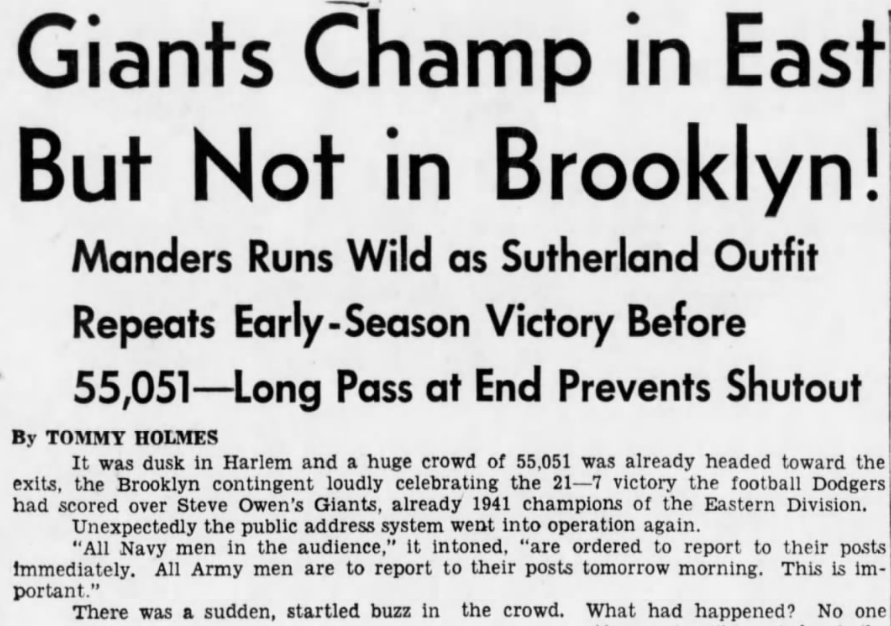
The Brooklyn Eagle, December 8, 1941

The attack started at 7:48 AM Hawaii time, which was 1:48 PM East Coast time. During the 2nd half, word got to the press box, and announcements began to come over the public address system. In those days, it was rare for someone to get paged at a sporting event. Usually, it was a doctor, who had to go and attend to a medical emergency.

This time, with the draft already in place, and enlistments already well underway as well, military officers attending the game were paged, and told to report to their various bases in and around New York City.

At Comiskey Park in Chicago, home to the Great Lakes Naval Training Center on Lake Michigan, another crosstown battle was held. The Bears beat the host Cardinals 34-24. And at Griffith Stadium in Washington, in the capital so the number of government officials and military officers present was considerably larger than in New York and Chicago, the host Redskins beat the Philadelphia Eagles 20-14.

When the game in New York ended, Dodger fans could not openly celebrate, and Giant fans didn't care, either, because it was then announced to the crowd that Pearl Harbor had been attacked.

The NFL Championship Game was played as scheduled, at Wrigley Field in Chicago on December 21, and, despite a 9-9 deadlock in the 3rd quarter, the Bears went on to beat the Giants 37-9.

This was during Major League Baseball's offseason, so none of their games were played. This was 5 years before the founding of the NBA, so none of their games were played. There were 3 National Hockey League games played on the day that Pearl Harbor was attacked:

* At the old Madison Square Garden, the host New York Rangers beat the defending Stanley Cup Champions, the Boston Bruins, 5-4. Alex Shibicky scored 2 goals.

* At the Olympia Stadium, the host Detroit Red Wings beat the Montreal Canadiens, 3-2.

* And at the Chicago Stadium, the host Chicago Blackhawks beat the Brooklyn Americans, 5-4. Only in this, what turned out to be their last season, were the former New York Americans, or "Amerks," using the Brooklyn name, even though they still played all their home games at The Garden. A plan for a new arena in Brooklyn was proposed for after The War, but it never happened, and the franchise suspended at the conclusion of the 1941-42 season, was officially folded in 1946.

* The Toronto Maple Leafs were not scheduled to play that day.

Time magazine named Roosevelt its Man of the Year for the 3rd time, due to his efforts to aid Britain, France and the Soviet Union without getting Congress to declare war on the Axis Powers, until Pearl Harbor made it unavoidable.

Sunday, August 21, 2022

August 21, 1959: Hawaii Is Admitted As the 50th State

August 21, 1959: Hawaii -- or "Hawai'i," as its natives write its name -- is admitted to the Union as the 50th State. It remains the most-recently-added State.

The 1st 48 States are known as the "Contiguous States." But Alaska and Hawaii, the 2 newest States, are separated from them, and neither borders any other State.

Because new States mean new stars added to the American Flag on the following July 4, the addition of a 50th Star on July 4, 1960 produced the American Flag that has flown ever since. On July 5, 2007, it surpassed the 48-Star Flag of July 4, 1912 to 1959 as the longest-lasting American Flag.
Hawaii's State Flag is a combination of the American Stars & Stripes and the British Union Jack. It is a legacy of the British Royal Navy's historical relations with the Kingdom of Hawai'i, and, in particular, the pro-British sentiment of the 1st ruler of a united Hawaiian Islands, King Kamehameha I. This flag was retained after the overthrow of the Hawaiian monarchy in 1893, after U.S. annexation in 1898, and after Statehood in 1959. The original State Capitol building, replaced by the current one in 1969, was the Royal Palace, and is the only royal palace on what is now American soil.

Hawaii is a chain of islands in the Pacific Ocean. There are 8 main islands. From west to east, they are: Ni'ihau, The Forbidden Isle (population just 84); Kaua'i, The Garden Isle; O'ahu, The Gathering Place; Moloka'i, The Friendly Isle; Lānaʻi, The Pineapple Isle; Kaho'olawe, The Target Isle (no permanent residents); Maui, The Valley Isle; and Hawai'i, The Big Island. Ka Lae, on the Big Island, is the southernmost point in the United States.

Hawaii is known for each beach resorts, its flowers, its volcanoes, and its U.S. Navy base at Pearl Harbor, whose attack by Japanese airplanes on December 7, 1941 brought America into World War II.

Hawaii has the lowest percentage of white residents of any State, just 21 percent; and 57 percent as Asian and/or "Pacific Islander." Because of this multicultural background Hawaii tends to be liberal politically. Since its 1st Presidential election in 1960 -- when a recount turned it from Richard Nixon to John F. Kennedy -- it has only voted for the Republican nominee for President twice: Nixon in 1972, and Ronald Reagan in 1984, the 2 elections where 49 of the 50 States were won.

Hawaii has about 1.4 million people, with O'ahu having the vast majority of them, just over 1 million people. It is home to Honolulu, the State's capital and, at 350,000, its largest city. The State's size, and its distance from the American mainland -- 2,556 air miles from Honolulu to Los Angeles, almost as much as from the Pacific Coast to the Atlantic Coast -- and its time zones, 3 hours behind Pacific Time and 6 hours behind Eastern Time, make major league sports there almost impossible.

The Hawaii Islanders played in the Class AAA Pacific Coast League from 1961 to 1987. A team known simply as "The Hawaiians" played in the World Football League in 1974 and '75. The State has hosted college football bowl games and early-season college basketball tournaments. The University of Hawaii has had a prominent football program.

It is unlikely that there will be a 51st State anytime soon. Potential candidates tend to include the District of Columbia and Puerto Rico, but the former has Republicans in Congress standing in its way, since they don't want a majority-black State electing 1 liberal to the U.S. House of Representatives and 2 to the Senate; and the latter has voted to remain a "commonwealth," instead of for Statehood or independence, every time the subject has come up.

*

August 21, 1959 was a Friday. Jim McMahon, the only quarterback ever to lead the Chicago Bears to victory in a Super Bowl, was born.

These baseball games were played:

* The New York Yankees beat the Kansas City Athletics, 9-7 at Kansas City Municipal Stadium. Duke Maas was the winning pitcher. Héctor López hit a home run. Mickey Mantle went 1-for-3 with 2 walks. Yogi Berra went 1-for-4 with a walk and 2 RBIs. For the A's, future major league manager Dick Williams hit a home run, and Roger Maris drew a walk as a pinch-hitter. After the season, the Yankees traded for Maris.

* The San Francisco Giants swept a doubleheader from the Philadelphia Phillies, 6-0 and 10-6 at Connie Mack Stadium in Philadelphia. In the opener, Johnny Antonelli allowed 8 hits, but kept the shutout to beat Robin Roberts, and even hit a home run in his own cause. Over the 2 games, Willie Mays went 1-for-10, and Willie McCovey went 2-for-9 with 2 RBIs.

* The Los Angeles Dodgers beat the Pittsburgh Pirates, 6-5 at Forbes Field in Pittsburgh. Roberto Clemente went 1-for-3.

* The Cleveland Indians beat the Baltimore Orioles, 5-0 at Cleveland Municipal Stadium. Jack Harshman pitched a 3-hit shutout.

* The Cincinnati Reds beat the St. Louis Cardinals, 2-1 at Crosley Field in Cincinnati. Frank Robinson went 1-for-3 with a walk. Stan Musial appeared as a pinch-hitter, and drew a walk.

* The Detroit Tigers beat the Boston Red Sox, 2-0 at Briggs Stadium in Detroit. (It was renamed Tiger Stadium in 1961.) Paul Foytack pitched a 4-hit shutout. Al Kaline hit a home run. Ted Williams appeared only as a pinch-hitter, and struck out.

* The Chicago White Sox beat the Washington Senators, 5-4 at Comiskey Park in Chicago.

* And the Chicago Cubs and the Milwaukee Braves were rained out at Milwaukee County Stadium. The game was made up as part of a doubleheader the next day. The Braves swept, 7-0 and 3-2. Carl Willey pitched a 6-hit shutout in the 1st game. In the 2nd game, with Stan Lopata batting in the bottom of the 9th, Bill Henry threw a wild pitch, allowing Bobby Ávila to score the winning run.

Over the 2 games, Hank Aaron went 0-for-8 with a walk, Eddie Mathews went 4-for-8 with a walk and 2 RBIs, and Ernie Banks went 0-for-8.

Tuesday, April 19, 2022

April 19, 1989: The USS Iowa Explosion

April 19, 1989: An explosion onboard the USS Iowa kills 47 crewmen, during a fleet exercise in the Caribbean Sea, off the coast of the British Overseas Territory of Anguilla. This hastened the ship's retirement, and that of the other remaining World War II-Korean War era battleships.

The NIS (Naval Investigative Service), the precursor to the NCIS (Naval Criminal Investigative Service), determined that it was caused by a sailor's suicide attempt.

Battleships BB-65, USS Illinois, and BB-66, USS Kentucky, were still under construction when World War II ended, were never completed, and were ultimately scrapped, never joining the Iowa-class battleships that actually did sail. Those 4 have all become "museum ships":

* BB-61, USS Iowa, "The Grey Ghost." Decommissioned October 26, 1990. It is berthed at the Pacific Battleship Center, Port of Los Angeles.

* BB-62, USS New Jersey, "The Big J" or "The Black Dragon," it saw more battles than the other 3 combined. Decommissioned February 8, 1991. It is berthed at the Home Port Alliance in Camden, New Jersey, across the Delaware River from Philadelphia.

* BB-63, USS Missouri, "The Mighty Mo," the ship on which the Empire of Japan formally surrendered to the Allies. Decommissioned March 31, 1992, making it America's last battleship. It is berthed at Pearl Harbor in Honolulu, Hawaii. The place where, for America, World War II began seems an appropriate place for the ship where it formally ended.

* BB-64, USS Wisconsin, "The Big Wisky." Decommissioned September 30, 1991. It is berthed at Nauticus, a museum at the Norfolk Naval Base in Norfolk, Virginia.

*

April 19, 1989 was a Wednesday. Actor Simu Liu was born. This was also the day the "Central Park Jogger" case began. I have a separate entry for that event.

These baseball games were played:

* The New York Yankees beat the Toronto Blue Jays, 4-2 at Exhibition Stadium in Toronto. John Candelaria outpitched future Yankee Jimmy Key. Steve Sax, Bob Brower and Álvaro Espinoza each had 2 hits for the Yankees. Don Mattingly and Rickey Henderson each went 1-for-5.

* The New York Mets beat the Philadelphia Phillies, 4-2 at Shea Stadium. Lee Mazzilli hit a 3-run home run in the bottom of the 8th inning, to make Randy Myers a winning pitcher in relief of David Cone. Mike Schmidt, entering his final season, went 1-for-3 with a walk.

* The Montreal Expos beat the Chicago Cubs, 3-2 at the Olympic Stadium in Montreal.

* The Baltimore Orioles beat the Kansas City Royals, 6-5 at Memorial Stadium in Baltimore. Cal Ripken went 1-for-4. George Brett and Bo Jackson hit home runs for the Royals.

* The Atlanta Braves beat the Houston Astros, 4-3 at Atlanta-Fulton County Stadium.

* The Boston Red Sox beat the Cleveland Indians, 8-4 at Cleveland Municipal Stadium.

* The California Angels beat the Chicago White Sox, 7-2 at Comiskey Park in Chicago.

* The Detroit Tigers beat the Minnesota Twins, 3-2 at the Metrodome in Minneapolis.

* The Pittsburgh Pirates beat the St. Louis Cardinals, 7-5 at Busch Memorial Stadium in St. Louis. Barry Bonds went 2-for-5.

* The Texas Rangers beat the Milwaukee Brewers, 5-1 at Arlington Stadium in the Dallas suburb of Arlington, Texas. Robin Yount went 0-for-3 with a walk. Paul Molitor went 2-for-4.

* The Los Angeles Dodgers beat the Cincinnati Reds, 3-0 at Dodger Stadium in Los Angeles. How many Dodgers does it take to pitch a 5-hit shutout? On this night, 4: Mike Morgan, 4 over 5 2/3rds innings; Tim Crews, 1 before getting the last out in the 6th; Ray Searage, a perfect 7th; and Jay Howell, a perfect 8th and 9th.

* The San Diego Padres beat the San Francisco Giants, 4-3 at Candlestick Park in San Francisco. Tony Gwynn went 0-for-3 with a walk.

* And the Oakland Athletics beat the Seattle Mariners, 7-5 at the Kingdome in Seattle. Ken Griffey Jr. went 2-for-4.

Football was out of season. There were 4 games played in the NBA:

* The Phoenix Suns beat the Miami Heat, 117-91 at the Miami Arena.

* The Detroit Pistons beat the Indiana Pacers, 115-105 at The Palace in the Detroit suburb of Auburn Hills, Michigan.

* The Atlanta Hawks beat the Milwaukee Bucks, 100-92 at the Bradley Center in Milwaukee.

* And the Houston Rockets beat the San Antonio Spurs, 99-84 at the HemisFair Arena in San Antonio.

There were 2 games in the Stanley Cup Playoffs, both in Game 2 of the Prince of Wales Conference Finals. The Montreal Canadiens beat the Boston Bruins, 3-2 at the Montreal Forum, in Game 2 of their series. Bobby Smith scored the winner, at 12:24 of the 1st overtime. And the Philadelphia Flyers beat the Pittsburgh Penguins, 4-2 at the Civic Arena in Pittsburgh.

Monday, April 18, 2022

April 18, 1943: The Assassination of Isoroku Yamamoto

April 18, 1943: Japanese Admiral Isoroku Yamamoto is assassinated, as U.S. Army Air Forces planes shoot his plane down near the Solomon Islands. He was 59 years old.

Born on April 4, 1884 in Nagaoka, Niigata Prefecture (Japan calls its administrative divisions "prefectures" instead of "states"), Yamamoto had samurai training, and graduated from the Imperial Japanese Naval Academy in Hiroshima. (It was not destroyed in the atomic bomb attack, but it was closed when the American occupation force abolished the Imperial Japanese Navy. Japan's current Naval Academy, Etajima Base, was built on the site, and opened in 1956.)

He served in the Russo-Japanese War, including at Japan's biggest military victory up to that point, the Battle of Tsushima, losing the index and middle finger on his left hand. He taught at the Naval Staff College, and was a naval attaché to America, learning to speak fluent English.

He received his 1st command in 1928, and participated in the London Naval Conferences of 1930 (as a Real Admiral) and 1935 (as a Vice Admiral). He was a promoter of naval aviation, but opposed Japan's invasions of Manchuria in 1931 and China as a whole in 1937, and the Axis pact with Nazi Germany and Italy in 1940.

Due to his experience there after World War I, he opposed going to war with America. Despite this, and the enmity between him and Prime Minister Hideki Tojo, he was promoted to full Admiral, and placed in command of the Combined Fleet. (On October 18, 1941, Tojo was replaced as Prime Minister by Fumimaro Konoe, but was still in charge of Japanese military forces, answerable only to Emperor Hirohito and Konoe.)

On November 5, 1941, Yamamoto said, in his "Top Secret Operation Order no. 1," issued to the Combined Fleet, the Empire of Japan must drive out Britain and America from Greater East Asia, and hasten the settlement of China, whereas, in the event that Britain and America were driven out from the Philippines and Dutch East Indies, an independent, self-supporting economic entity will be firmly established.

Two days later, he set the date for the intended surprise attack on the U.S. naval base at Pearl Harbor, Hawaii. He chose December 7, for one simple reason: It was a Sunday, the day that American military personnel would be the least alert to an attack.

The 1970 film Tora! Tora! Tora! -- named for the code given that the attack was on -- is usually still considered the best film about the attack, more so than From Here to Eternity (1953, in which the attack is secondary to the story), The Final Countdown (1980, ditto), and Pearl Harbor (2001, in which the acting has been heavily criticized). Playing Yamamoto, Japanese actor Sō Yamamura said, "I fear that all we have done is to awaken a sleeping giant, and fill him with a terrible resolve." Yamamoto may have believed this, but there is no record of him actually saying it.

The U.S. defeated Japan at the Battle of Midway in June 1942, and again at Guadalcanal in early 1943. (By this point, Tojo was again Prime Minister.) After this, Yamamoto decided to make an inspection tour throughout the South Pacific. On April 14, 1943, the U.S. naval intelligence effort, codenamed "Magic," intercepted and decrypted a message containing specifics of Yamamoto's tour, including arrival and departure times and locations, as well as the number and types of aircraft that would transport and accompany him on the journey. Yamamoto, the itinerary revealed, would be flying from Rabaul to Balalae Airfield, on an island near Bougainville in the Solomon Islands, on the morning of April 18.

It's not clear whether President Franklin D. Roosevelt personally ordered Secretary of the Navy Frank Knox to have Yamamoto killed. What is known is that Knox gave the option to Admiral Chester Nimitz, who authorized the decision. A squadron of U.S. Army Air Forces Lockheed P-38 Lightning aircraft were assigned, informed that they were intercepting an "important high officer," with no specific name given.

Yamamoto's plane, a Mitsubishi G4M bomber designated T1-323, had an escort of another G4M (as a decoy) and 6 Mitsubishi A6M Zeroes. They were no match for 16 P-38s. 1st Lieutenant Rex T. Barber is credited with firing the shot that brought down T1-323, which crashed into the jungle on the island of Bougainville. Yamamoto's body was found by a Japanese search party the next day. His staff cremated him, he was given a full state funeral, and his ashes were divided between the public Tama Cemetery in Tokyo and his hometown of Nagaoka.

Like the bombing of Pearl Harbor, the assassination happened on a Sunday. And it happened one year to the day after Colonel Jimmy Doolittle led the raid to avenge the Pearl Harbor bombing, the one that would be depicted in the 1944 film Thirty Seconds Over Tokyo.

Barber remained in the U.S. Air Force until 1961, also serving in the Korean War, rose to the rank of Colonel, and received The Navy Cross, the Silver Star, the Air Medal and the Purple Heart. He lived until 2001.
A 2002 episode of the NBC drama The West Wing was titled "We Killed Yamamoto." It included this exchange, written by series creator Aaron Sorkin, based on the fact that the Defense Minister, and brother of the monarch, of an alleged ally of America's, had plotted that universe's thankfully-prevented version of the 9/11 attacks, and debated whether the U.S. government could, or should, have him killed:

Admiral Percy Fitzwallace, Chairman of the Joint Chiefs of Staff (played by John Amos): Can you tell when it's peacetime and wartime anymore? (In other words, with the threat of terrorism being as bad as it is right now, can you tell the difference?)

Leo McGarry, White House Chief of Staff (John Spencer): No.

Fitz: I don't know who the world's leading expert on warfare is, but any list of the top has got to include me, and I can't tell when it's peacetime and wartime anymore.

Leo: Look, international law has always recognized certain protected persons who you couldn't attack. It's been this way since the Romans.

Fitz: In peacetime.

Leo: Yes.

Fitz: The Battle of Agincourt (October 25, 1415, in northern France, in the Hundred Years War): This was the French fighting against the British archers. This was like a polo match. The battles were observed by heralds, and they picked the winners. And if a soldier laid down his arms, he was treated humanely.

Leo: Yeah.

Fitz: And the "international laws" that you're talking about, this is where a lot of them were written, at a time, in a place, where a person could tell between peacetime and wartime.

Fitz then invoked William Pitt the Younger, who was Prime Minister of Britain at the height of the Napoleonic Wars, and did die young, at 46 in 1806, from a bleeding ulcer. His father, William Pitt the Elder, previously served as Prime Minister, but not during a war between Britain and France.

Fitz: The idea of targeting one person was ridiculous. It wouldn't have occurred to the French to try to kill William Pitt. That all changed after Pearl Harbor.

Leo: I don't like where this conversation's going.

Fitz: Leo...

Leo: In the Situation Room, Fitz?

Fitz: We killed Yamamoto! We shot down his plane!

Leo: We declared war!

Fitz: And if Dietrich Bonhoeffer had been successful...

Leo: And the plot to kill Hitler was an internal rebellion. (And Bonhoeffer, though accused and executed after the fact, had nothing to do with it. Sorkin had him confused with Claus von Stauffenberg.)

Fitz: ...there would've been statues built of an assassin. We'd have to explain that to our kids!

Leo: I'm going to get back to the office.

Fitz: We measure the success of a mission by two things: Was it successful? And, How few civilians did we hurt? They measure success by how many. Pregnant women are delivering bombs! You're talking to me about international laws/ The laws of nature don't even apply here! I've been a soldier for 38 years, and I've found an enemy I can kill. He can't cancel Shareef's trip, Leo. You've got to tell him he can't cancel it!

But since war had been declared by both sides, and Yamamoto was a military officer who had ordered the biggest attack on an American military installation since Fort Sumter, he was a legitimate target. Perhaps among the less evil men in the Japanese command, and by some measures an honorable man. But a legitimate target nonetheless.

*

April 18, 1943 was a Sunday. Football was out of season. The NBA hadn't been founded yet. Baseball season didn't start for another 2 days. And the NHL season ended 10 days earlier, when the Detroit Red Wings beat the Boston Bruins to win the Stanley Cup. So there were no scores on this historic day.

December 31, 1999 & January 1, 2000: The Millennium

December 31, 1999:  The Millennium arrives. The people of planet Earth survived. At a terrible cost. But we hadn't destroyed ourselves. ...