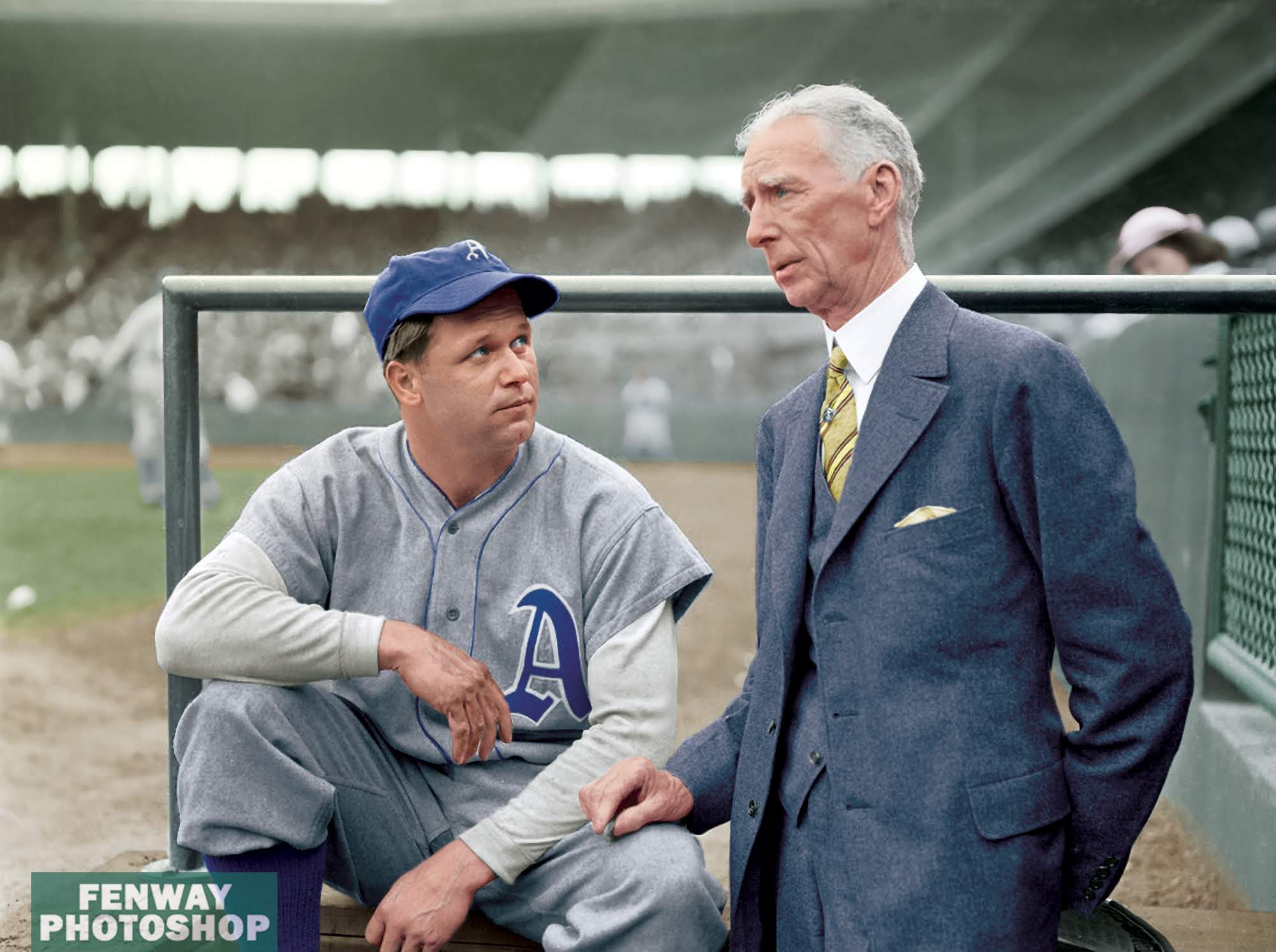
Jimmie Foxx (left) and Connie Mack
September 28, 1932: Connie Mack begins the breakup his of his Philadelphia Athletics. The 1st time he'd done so, in 1914-15, it was because he couldn't keep up with the salaries being offered by the Federal League teams. This time, it was personal.
In 1925, the A's went 88-64, and were only 8 1/2 games behind the 1st-place Washington Senators. But the rise of the "Murderers' Row" Yankees delayed Philadelphia's return to greatness. In 1929, they began a run of 3 seasons in which they won 313 games, and game within a Game 7 loss in 1931 of winning 3 straight World Series.
But Mack lost all of his non-baseball holdings in the stock market Crash of 1929. He couldn't fund the A's with any other income. So, after the 1932 season, despite a strong 94-60 record (but 13 games behind the Pennant-winning Yankees), he began to sell of his 2nd generation of stars.
On September 28, 1932, he sent left fielder Al Simmons, 3rd baseman Jimmy Dykes, and center fielder Mule Haas are all sold to the Chicago White Sox, for $100,000. Simmons would be elected to the Baseball Hall of Fame, and Dykes and Haas would have been perennial All-Stars had the All-Star Game been founded before 1933.
But the big day was...
December 12, 1933: When Mack made 3 separate moves:
* Pitchers Lefty Grove and Rube Walberg, and 2nd baseman Max Bishop, are traded to the Boston Red Sox for Bob Kline and Rabbit Warstler and $125,000. Along with Carl Hubbell, Grove was 1 of the 2 best lefthanded pitchers in the game, and would go to the Hall of Fame. Walberg was the 3rd starter on the A's, behind Grove and George Earnshaw, but would have been the ace on many teams.
Key to this deal was the fact that Tom Yawkey had recently turned 30 and come into his inheritance, and had bought the Red Sox, and could afford to spend whatever he wanted to build a championship team. He did try, but the Yankees' dynasty that was restarted in 1936 thwarted his early efforts.
Grove's 199 wins during the 1930s made him the winningest pitcher of the decade.
* Catcher Mickey Cochrane was traded to the Detroit Tigers for Johnny Pasek and $100,000. The Tigers subsequently named Cochrane player-manager, and won the next 2 American League Pennants.
* Finally, before the ink was dry on the previous 2 trades, Mack traded Pasek and Earnshaw to the White Sox for Charlie Berry and $100,000. So, in 1 day, Mack sold off his 3 best pitchers.
On December 10, 1935, 1st baseman Jimmie Foxx and pitcher Johnny Marcum were traded to the Red Sox for Gordon Rhodes, George Savino and $150,000. Foxx was the best righthanded slugger in the game, and would go to the Hall of Fame. Marcum was the Mackmen's best pitcher following the '33 fire sale, and Mack dumped him, anyway.
The A's went from 94-60 in 1932 to 79-72 in 1933, to 68-82 in 1934, to 58-91 in 1935, and to 53-100 in 1936. To make matters worse, Tom Shibe died in 1936, and Jack Shibe the next year. The deaths of these sons of Ben Shibe, with whom Mack founded the A's in 1901, pretty much left Mack, 74 years old at the time, in full control of the A's, and his control of his mental faculties began to diminish.
The A's never recovered. In 1950, Mack's sons, who seemed to agree on nothing else, ganged up in the senile 87-year-old man, and finally removed him from control, if not ownership, and the manager's job after his 50th season in charge. The Mack family ended up selling the team in 1954, to a buyer who moved them to Kansas City.
They failed there as well, and Charlie Finley bought them in 1960, moving them to Oakland in 1968. After 5 straight AL Western Division titles, 1971-75, including 3 straight World Series wins, 1972-74, he broke them up, and the team crashed. New owner Walter Haas rebuilt them in the early 1980s, but the pitching collapsed, preventing a new dynasty. The A's rebuilt again, and won 3 straight Pennants, 1988-90, but after another Division title in 1992, were broken up again.
The pattern held: By 2000, the "Moneyball" regime built a team that reached the Playoffs 5 times in 7 years, but won no Pennants. They sold off, rebuilt, and made 3 straight Playoffs, 2012-14. They couldn't afford to keep it going, sold off, rebuilt, and made 3 straight Playoffs, 2018-20. They couldn't afford to keep it going, and sold off. In 2022, the A's lost 102 games, their most since the Finley fire sale bottomed out at 108 in 1979.
Rumors of the A's moving again have been renewed, since they haven't been able to get a deal to replace the Oakland Coliseum. If they do move, how long will it be before they win again? And, if so, how long before they have a 9th fire sale?
One thing is for sure: The A's are not moving back to Philadelphia, where the Phillies, having won the 2022 NL Pennant, are overwhelmingly popular. The Delaware Valley is certainly big enough to support one winning Major League Baseball team, but not two MLB teams, regardless of performance. But, wherever they go, or if they stay, at some point, the A's will go back to their Philadelphia roots, by breaking it all down and starting all over again.
In 1949, Ogden Nash, my grandmother's favorite poet, wrote "Line-Up for Yesterday" for Sport magazine, an alphabetical list of star players. For the letter Q, Nash had to cheat a little, and wrote:
Q is
for Don Quixote
Cornelius Mack;
Neither Yankees nor years
Can halt his attack.
He also had to cheat a little for the letter X:
X is
the first
of two x's in Foxx
Who was right behind Ruth
with his powerful soxx.
But even that poem is now so far back in history that it hasn't raised their profiles. The Athletics' moves have left their Philadelphia era virtually forgotten, even though Foxx hit 534 home runs, Grove and Eddie Plank each won at least 300 games, and Eddie Collins collected over 3,000 hits and Al Simmons nearly did. Foxx hit 415 home runs during the 1930s, making him the decade's leader. And, unlike their Bay Area neighbors, the San Francisco Giants, the Oakland version of the A's doesn't really pay tribute to that era.
They have notations for Philadelphia's 1910, 1911, 1913, 1929 and 1930 World Series wins at the Oakland Coliseum, but, unlike the Giants with the top players from their New York era, they have not retired any uniform numbers from their time in Philly: The 2 of Mickey Cochrane, the 3 of Jimmie Foxx, the 7 of Al Simmons and the 10 of Lefty Grove remain in circulation. Earlier players like Plank and Collins did not have numbers that could be retired, though Collins later wore 32 as a coach. And, of course, wearing suits instead of uniforms, Connie Mack also never had a number to retire.
And it took until 2018 for them to establish a team Hall of Fame, and 2021 for them to honor any figures from the Philadelphia era: Mack, Plank, Collins, Cochrane, Foxx, Simmons, Grove, George "Rube" Waddell, Charles "Chief" Bender, Frank "Home Run" Baker, Bob Johnson and Eddie Joost.
*
December 12, 1933 was a Tuesday. Baseball was out of season. The NBA hadn't been founded yet. The NFL was going to play its 1st official Championship Game the following Sunday, and the Chicago Bears won it, 23-21 over the New York Giants.
There were 4 games played in the NHL that night:
* The Toronto Maple Leafs beat the Boston Bruins, 4-1 at the Boston Garden. This was the game in which Eddie Shore hit Ace Bailey over the head with his stick, ending his career. I have a separate entry for that event.
* The New York Americans beat the New York Rangers, 3-0 at the old Madison Square Garden, which was still fairly new at the time. The company that ran the Garden owned the Rangers, and the Amerks were tenants, so any win the tenants had over the landlords was considered big.
* The Detroit Red Wings beat the Chicago Black Hawks, 4-1 at the Olympia Stadium in Detroit.
* And the Montreal Canadiens and the Ottawa Senators played to a 1-1 tie at the Ottawa Auditorium.


