Showing posts with label north jersey. Show all posts

Thursday, December 22, 2022

December 22, 1937: The Lincoln Tunnel Opens

December 22, 1937: The Lincoln Tunnel opens, connecting Midtown Manhattan in New York City with Weehawken, Hudson County, New Jersey. Its approachway, now New Jersey Route 495, flowed into New Jersey Route 3, and eventually connected with the New Jersey Turnpike and, still later, the Meadowlands Sports Complex.

George Washington got a bridge in New York City, Abraham Lincoln got a tunnel.

The original tube is now the center tube. What is now the north tube opened on February 1, 1945. What is now the south tube opened on May 25, 1957.

Each tube, roughly at its midpoint, has a marker noting the State Line between the States of New York and New Jersey, known as "The Stripe." The Holland Tunnel, which opened in 1927, also has this.
On top of the New Jersey entrance, abutting the curled highway nicknamed "The Helix," is Weehawken Stadium, home of the baseball and football teams of Weehawken High School. Yes, sports are played on top of the Lincoln Tunnel.

*

December 22, 1937 was a Wednesday. There were no games that day: Baseball was out of season; the NBA hadn't been founded yet; it was a Wednesday, so there were no football games; and the NHL had no games scheduled.

Wednesday, November 30, 2022

November 30, 1951: The New Jersey Turnpike Opens

November 30, 1951: The New Jersey Turnpike opens, mostly. For the moment, it runs from Exit 1 in Penns Grove, near the newly-opened Delaware Memorial Bridge, to Exit 11 in Woodbridge, an interchange with U.S. Route 1, U.S. Route 9, State Route 440, and, by 1956, the Garden State Parkway. (On that road, that interchange will be Exit 129.)

Like the later Garden State Parkway, the Turnpike was the brainchild of Governor Alfred E. Driscoll. He set a November 30, 1951 deadline, and there were delays that suggested they wouldn't make it. They did.

The Turnpike was extended to its full 117-mile length the next year, connecting with New York City via the Lincoln Tunnel (Exit 16) and the George Washington Bridge (Exit 18). One notable problem was the Pulaski Skyway, which has carried Routes 1 and 9 from Newark to Jersey City since 1932. If they built the Turnpike under the Skyway, there might not be enough room for trucks to fit. If they built the Turnpike over the Skyway, there would be room, but construction would take a lot more time and money. They decided to build under, and no truck has ever gotten stuck under it. Just in case, a few years ago, a big construction project was undertaken, and it lowered the roadway.

In 1956, the Newark Bay Extension opened at Exit 14, near Newark International Airport. This includes the Newark Bay Bridge, and 3 new exits in Jersey City: Exit 14A for Bayonne, Exit 14B for downtown, and Exit 14C for the Holland Tunnel into New York.

That same year, an extension was built from Exit 6 to the new Delaware River-Turnpike Toll Bridge, connecting the New Jersey Turnpike with the Pennsylvania Turnpike. It is named the Pearl Harbor Memorial Turnpike Extension. From here on north, the New Jersey Turnpike is bannered as part of Interstate 95.

In 1970, the Western Spur was opened, designed to aid travelers going around New York City to New England (taking the Tappan Zee, now Mario Cuomo, Bridge to the New England Thruway). It was also meant to access the planned Meadowlands Sports Complex in East Rutherford. The new exits were labeled 15W, 16W and 18W; while the former Exits 15, 16 and 18 were relabeled 15E, 16E and 18E. In 2005, the newest exit opened: Exit 15X, for the Secaucus Junction Rail Station.

The Turnpike has become not just a great method for getting people from one point in New Jersey to another, or from New York to points south and west (or vice versa) without having to go through Philadelphia, but it's become a cultural icon. Chuck Berry, The Mamas & the Papas, Paul Simon and Bruce Springsteen have all written songs mentioning it. And the opening montage of The Sopranos showed James Gandolfini as Tony Soprano, driving out of the Lincoln Tunnel and down the Turnpike.

Of course, for a lot of people not from New Jersey, the Turnpike is all they see of the State: Things like the Meadowlands' stadiums and swamps, the Skyway, the Airport, the big oil refinery in Linden, and vast swaths of not much of anything taking up the space south of Trenton. These people never see the nice parts of New Jersey, and never understand why it's called "The Garden State."

The Turnpike's exit numbers are sequential, not by milepost as the Parkway's will be. As a result, when new exits need to be built, they require letters. Between Exit 7 in Bordentown Township and Exit 8 in East Windsor is Exit 7A in Robbinsville; and between Exit 8 and Exit 9 in East Brunswick is Exit 8A in Monroe.

If the exits were by mileposts, they would be, as follows: 

* Exit 1, Penns Grove, Salem County, connecting with Interstate 295, U.S. Routes 40 and 130, New Jersey Route 49 and the Delaware Memorial Bridge: Exit 0, or Exit 1.

* Exit 2, Woolwich, Gloucester County, U.S. Route 322 and the Commodore Barry Bridge: Exit 13.

* Exit 3, Runnemede, Camden County, N.J. Route 168 and, by extension, the Atlantic City Expressway and the Walt Whitman Bridge to Philadelphia: Exit 26. Oddly, despite the access to the Expressway, this exit, unlike Exits 7A and 11, is not labeled "Shore Points."

* Exit 4, Mount Laurel, Burlington County, N.J. Route 73 and, by extension, the Ben Franklin Bridge to Philadelphia: Exit 34.

* Exit 5, Westampton, Burlington County, County Route 541: Exit 44.

* Exit 6, Mansfield, Burlington County, Interstate 95 and, by extension, Interstate 276 and the Pennsylvania Turnpike: Exit 51.

* Exit 7, Bordentown Township (surrounding Bordentown City), Burlington County, U.S. Route 206: Exit 53.

* Exit 7A, Robbinsville, Mercer County, Interstate 195: Exit 60. This exit can be used for both the State capital of Trenton and the Six Flags Great Adventure theme park. For drivers going north on the Turnpike, this exit is labeled "Shore Points," due to the access to I-195.

* Exit 8, East Windsor, Mercer County, N.J. Routes 33 and 133: Exit 67.

* Exit 8A, Monroe, Middlesex County, N.J. Route 32 for access to U.S. Route 130 and County Route 535: Exit 74. For me, growing up in East Brunswick in the 1970s and '80s, this was the exit we used for southbound points like Philadelphia, Washington and Virginia.

* Exit 9, East Brunswick, Middlesex County, N.J. Route 18 for access to U.S. Route 1: Exit 83. This was the exit we used for North Jersey and New York City. East Brunswick's main bus terminal was here, and, from 1991 to 2020, I lived 1 mile away, for relatively easy access to The City.

* Exit 10, Edison, Middlesex County, Interstate 287 and N.J. Route 440, and, by extension, the Outerbridge Crossing into Staten Island, New York City: Exit 88.

* Exit 11, Woodbridge, Middlesex County, the Garden State Parkway, U.S. Routes 1 and 9: Exit 91. For drivers going south on the Turnpike, this exit is labeled "Shore Points," due to the Parkway access.

* Exit 12, Carteret, Middlesex County, County Route 602: Exit 96.

* Exit 13, Elizabeth, Union County, Interstate 278 and the Goethals Bridge into Staten Island: Exit 99.

* Exit 13A, Elizabeth, Union County, N.J. Route 81 and, by extension, Newark Liberty International Airport and Elizabeth Seaport: Exit 101. It also provides access to the Jersey Gardens Mall and that big IKEA store visible from the road.

* Exit 14, Newark, Essex County, Interstate 78, U.S. Routes 1, 9 and 22, with access to the Airport and the Newark Bay Extension: Exit 104.

* Exit 15E, Newark, Essex County, U.S. Routes 1 and 9, and thus the Pulaski Skyway toward Jersey City: Exit 107.

* Exit 15W, Kearny, Hudson County, Interstate 280: Exit 108. Theoretically, any of Exits 14, 15E or 15W can be used for downtown Newark and the Prudential Center arena. For Red Bull Arena, Exit 15W is the most convenient.

* Exit 15X, Secaucus, Hudson County, the Secaucus Junction Rail Station: Exit 110.

* Exit 16E, Secaucus, Hudson County, N.J. Routes 3 and 495, accessing the Lincoln Tunnel into Manhattan: Exit 112.

* Exit 16W, East Rutherford, Bergen County, N.J. Route 3 and the Meadowlands Sports Complex: Exit 112.

* Exit 18E and Exit 18W, Carlstadt, Bergen County, Interstates 80 and 95, U.S. Routes 1, 9 and 46: Exit 114.

*

November 30, 1951 was a Friday. Baseball was out of season. There were 3 college football games played that night:

* The University of Richmond beat George Washington University, 20-19 at Griffith Stadium in Washington.

* The University of Miami beat Nebraska, 19-7 at Burdine Stadium (later renamed the Orange Bowl) in Miami. This would happen a few more times in the decades to come.

* And the University of Houston beat North Texas State University (now the University of North Texas), 20-14 at Eagle Field in Denton, Texas.

There was only 1 game played in the NHL that night, at the Montreal Forum, and the Montreal Canadiens and the Toronto Maple Leafs played to a 0-0 tie. There were 3 games played in the NBA that night:

* In a rematch and a reverse of the previous season's NBA Finals, the New York Knicks beat the Rochester Royals, 79-74 at the old Madison Square Garden.

* The Philadelphia Warriors beat the Syracuse Nationals, 81-78 at the Philadelphia Arena. When the Warriors moved to San Francisco in 1962, the Nationals replaced them a year later, as the Philadelphia 76ers.

* And the Washington Capitols beat the Boston Celtics, 85-81 at the Boston Garden. Ironically, the Celtics had just hired a former Capitols coach, who quit because he didn't have the team owner's backing to acquire what he thought were the necessary players. With Walter Brown, owner of the Garden, the Celtics and the Bruins, and making more money on the Ice Capades than on the rest of it combined, paid for the players his new coach wanted.

That new coach was a native of Brooklyn, but went to George Washington University, and seemed at first to be a natural to coach the Caps. And, for the rest of his life, despite being involved with the Celtics in one capacity or another, he kept his home in Washington. He was Arnold Jacob "Red" Auerbach.

Sunday, November 13, 2022

November 13, 1927: The Holland Tunnel Opens

November 13, 1927: The Holland Tunnel opens to traffic. It connects Canal Street in Lower Manhattan, New York City, with 12th Street in Jersey City, Hudson County, New Jersey.

It was the 1st road crossing of the Hudson River between The City and New Jersey. Previously, there had only been ferry boats and, with the addition of the Hudson Tubes (now the PATH system) in 1908 and the construction of New York's Pennsylvania Station in 1913, railroads.

The Outerbridge Crossing and the original version of the Goethals Bridge opened the next year, and the Bayonne Bridge opened in 1931, all connecting New Jersey with Staten Island. Manhattan would again be connected to New Jersey by the George Washington Bridge in 1931 and the Lincoln Tunnel in 1937.

The name of the Holland Tunnel has nothing to do with the Netherlands' 1614 founding of the colony of New Netherland, which would include present-day New York State and northern New Jersey. Rather, it was named for its chief engineer, Clifford Milburn Holland.

On April 1, 1922 -- having already supervised the construction of the 14th Street, 60th Street, Clark Street and Montague Street Tunnels for New York's Subway system -- he drove a ceremonial pick into the ground at Canal and West Streets, on the Manhattan side of the Hudson.
But the stress of the project of building what was then the longest vehicular tunnel in the Western Hemisphere, and the 5th-longest in the world, wrecked his health. He went to a sanatorium in Battle Creek, Michigan, hoping to recover. He did not: On October 27, 1924, 20 years to the day after the Subway opened, and one day before the final charge of dynamite connected the tunneling, by air if not yet by road, Cliff Holland died of a heart attack. He was only 41 years old.

As a commuter from New Jersey to New York City, one of my pet peeves is a bus driver hearing his radio dispatcher tell him that there's a lot of traffic at the Lincoln Tunnel, so he decides to detour off the New Jersey Turnpike, onto the Newark Bay Bridge, and take the Holland Tunnel.

This never works. Every time it's been tried with me on the bus, and it must be half a dozen times by now, the traffic at the Holland Tunnel is every bit as bad. And then, once you get out onto Canal Street, you still have to go 50 blocks up the West Side Highway to get to the Port Authority Bus Terminal. It always takes at least 15 minutes longer than if you'd just stuck with the Lincoln Tunnel. It's just not worth it.

*

November 13, 1927 was a Sunday. It was the off-season for baseball. The NHL season hadn't started yet. The NBA hadn't been founded yet. But these NFL games were played that day:

* Yes, there was then an NFL team named the New York Yankees. On this day, they beat the Chicago Cardinals, 20-6 at Yankee Stadium.

* The Providence Steam Roller beat the Duluth Eskimos, 13-7 at the Cycledrome in Providence.

* The Cleveland Bulldogs beat the Frankford Yellow Jackets, the NFL's Philadelphia team at the time, 37-0 at Luna Park in Cleveland.

* The Chicago Bears beat the Pottsville Maroons, 30-12 at Wrigley Field in Chicago.

* The Green Bay Packers beat the Dayton Triangles, 6-0 at City Stadium in Green Bay, Wisconsin.

* The New York Giants had the week off. They went 11-1-1 that season, the only blemishes on their record  both coming at the hands of the Cleveland Bulldogs: An October 2 tie, 0-0 at Luna Park; and an October 16 loss, 6-0 at the Polo Grounds. But the Giants closed the season by defeating the Yankees, 14-0 on December 4 at the Polo Grounds, and 13-0 on December 11 at Yankee Stadium. This enabled the Giants to edge the 7-2-1 Packers for their 1st NFL Championship, in their 3rd season of play.

Tuesday, October 25, 2022

October 25, 2007: The Prudential Center Opens

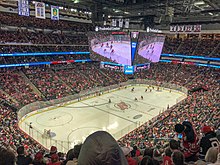
October 25, 2007: The Prudential Center opens, at 165 Mulberry Street in Newark, with a concert by Jon Bon Jovi.

Eventually, the address would be changed to 25 Lafayette Street. It is bounded by Edison Place on the north, Mulberry Street on the east, Lafayette Street on the south, and Broad Street on the west, although there is a row of buildings between Broad Street and the arena.

It replaces the Meadowlands Arena, in East Rutherford, known from 1981 to 1996 as the Brendan Byrne Arena; then until 2007 as the Continental Airlines Arena; and thereafter as the Izod Center. That arena had opened on July 2, 1981, with a concert by Bruce Springsteen & the E Street Band. So it was somewhat appropriate that the replacement was opened with a concert by a later New Jersey rock and roll legend.

It has been home to the NHL's New Jersey Devils and Seton Hall University's basketball team since it opened. It was also a temporary home to the NBA's New Jersey Nets from 2010 to 2012, and the WNBA's New York Liberty in 2011 and 2012.
Its location, in the downtown of New Jersey's largest city, 3 blocks from Newark's version of Pennsylvania Station, makes it considerably more convenient an arena than the Meadowlands, which, until New Jersey Transit built the Meadowlands Rail Spur in 2009, was only accessible by 1 of 2 ways: Driving, or a bus that had to be picked up at the Port Authority Bus Terminal in Midtown Manhattan. Since 2007, a person wanting to see a Devils game can take the train, on NJT's Northeast Corridor or North Jersey Coast Lines; or a bus, the Number 67.

The Devils won 3 Stanley Cups, reached 1 other Stanley Cup Finals, and won 7 Division titles at the Meadowlands. Since moving into "The Rock," nicknamed for Prudential Insurance's use of the Rock of Gibraltar as a symbol, they have won 2 Division titles, and reached the Stanley Cup Finals in 2012 -- but have missed the Stanley Cup Playoffs in 9 of the last 10 years. And the building has replaced the Meadowlands Arena as New Jersey's leading rock concert venue.

*

October 25, 2007 was a Thursday. The Devils opened the season on the road, because it wasn't clear that the arena would be ready when the 2007-08 NHL season opened -- and, as it turned out, it wasn't. They played the 1st game there 2 days later, losing 4-1 to the Ottawa Senators. Chris Neil scored the 1st goal, while Brian Gionta scored the 1st Devils goal. On Halloween, 4 days later, they got their 1st win in the new building, 6-1 over the Tampa Bay Lightning.

These 9 NHL games were played on October 25:

* The Devils lost to their arch-rivals, the New York Rangers, 2-0 at Madison Square Garden. Nigel Dawes scored both goals.

* The Boston Bruins beat the Chicago Blackhawks, 3-1 at the building now named the TD Garden in Boston.

* The Tampa Bay Lightning beat the Philadelphia Flyers, 5-2 at the St. Pete Times Forum in Tampa. (It's now named the Benchmark International Arena.)

* The Toronto Maple Leafs beat the Pittsburgh Penguins, 5-2 at the Civic Arena in Pittsburgh. (It was then named the Mellon Arena, before reverting to its original name.)

* The Columbus Blue Jackets beat the St. Louis Blues, 3-0 at Nationwide Arena in Columbus.

* The Nashville Predators beat the Atlanta Thrashers, 3-0 at the Sommet Center in Nashville. (It's now named the Bridgestone Arena.)

* The Edmonton Oilers beat the Minnesota Wild, 5-4 in a shootout, at the Northlands Coliseum in Edmonton.

* The Phoenix Coyotes beat the Anaheim Ducks, 1-0 at the Honda Center in the Los Angeles suburb of Anaheim, California.

* And the Los Angeles Kings beat the Dallas Stars, 2-1 at the Staples Center in Los Angeles. (It's now named the Crypton.com Arena.)

The 2007-08 NBA season opened 5 days after the Prudential Center did. There was one other sporting event of note on October 25: Game 2 of the World Series. The Boston Red Sox beat the Colorado Rockies, 2-1 at Fenway Park in Boston. The Rockies got to Curt Schilling for a run in the 1st inning, but the Sox tied the game in the 4th, and that ended the only lead Colorado had in the entire Series, which Boston swept.

Monday, October 24, 2022

October 24, 1931: The George Washington Bridge Opens

October 24, 1931: The George Washington Bridge opens, connecting Upper Manhattan at 179th Street with Fort Lee, Bergen County New Jersey, over the Hudson River. Until the opening of the Golden Gate Bridge in San Francisco 6 years later, it is the longest suspension bridge in the world.

It was named for Washington because it was at roughly that spot where he evacuated the retreating Continental Army across the Hudson, to escape the British Army. Fort Lee was named for Charles Lee, one of Washington's Generals, a bad one. He wanted to use Washington's setbacks to get himself named General-in-Chief. Washington's Christmas victory at Trenton would end that ambition. Lee died in 1782, before the war ended.

The original idea for a replacement for the ferry for cars at 42nd Street was a bridge at 57th Street, but it was deemed too costly. Swiss engineer Othmar Ammann saw the growth of the automobile industry, and realized that it would be better to, essentially, have the bridge bypass the heart of the City, connecting New England with the rest of the the country, especially the Northeast. This presaged the idea of highway "beltways" around major cities.

But a Midtown connector with New Jersey was still necessary, and construction soon began. The Tunnel that opened in 1937 was named for Abraham Lincoln because, along with Washington who had the Bridge named after him, Lincoln was 1 of the 2 most important Presidents.

The Lower Level opened in 1962. Building that, and the 2 additional tubes of the Lincoln Tunnel, was cheaper than building an additional crossing of the Hudson somewhere between 42nd and 179th.

The Bridge led to the great suburban growth of Bergen County, which eventually replaced Essex County as the most populous in New Jersey in the 1980s. In 1946, the upper deck was widened from 6 to 8 lanes. In 1962, a 6-lane lower level opened.

Today, it carries U.S. Routes 1 and 9, and Interstate 95. The State Line in the middle of the Hudson also marks the terminus of U.S. Route 46. Interstate 80 is not included in the Bridge, terminating at I-95, in Teaneck, 5 miles west of the Bridge.

Through I-95, the Bridge is connected with in one direction with the New Jersey Turnpike, and in the other direction with the Cross Bronx Expressway, the New England Thruway and the Connecticut Turnpike. Through the Cross Bronx, it is linked with Interstate 87, and thus the New York State Thruway, accessing Upstate and Canada. Through I-95's link with I-80, it is linked with the Great Lakes, the Rocky Mountains and the West Coast.

The Bridge is a major entrance and exit in New York City for fans going to Yankee games. Many was the time that Yankee broadcaster Phil Rizzuto wanted to leave a game early, saying, "I gotta get over that bridge!"

Of course, these days, it's best known for the scandal that sank the 2016 Presidential campaign of Chris Christie, and led to him being the most unpopular Governor in New Jersey's history, despite winning 60 percent of the vote in his re-election bid.

Othmar Ammann lived until 1965.

*

October 24, 1931 was a Saturday. The baseball season was over. The NHL season was 3 weeks away. There was no NBA yet. And the NFL played the next day. But there were college football games played that day:

* Notre Dame won a battle of unbeatens with the University of Pittsburgh, 25-12 at Notre Dame Stadium in South Bend, Indiana.

* Army and Yale played to a 6-6 tie at the Yale Bowl in New Haven, Connecticut.

* Harvard beat Texas, 35-7 at Harvard Stadium in Boston.

* Northwestern pulled the upset over Ohio State, 10-0 at Ohio Stadium in Columbus.

* Michigan beat Illinois, 35-0 at Memorial Stadium in Champaign, Illinois.

* Alabama beat Sewanee University of Sewanee, Tennessee, 33-0 at Legion Field in Birmingham.

* USC beat the University of California, 6-0 at Memorial Stadium in Berkeley, California.

* In New Jersey, Princeton lost to Navy, 15-0 at Palmer Stadium.

* Rutgers lost to Holy Cross, 27-0 at Fitton Field in Worcester, Massachusetts.

* In New York City, New York University beat Colgate, 13-0 at Yankee Stadium.

* City College of New York lost to Drexel, 37-0 at Drexel Field in Philadelphia. (CCNY was never a football power.)

* Fordham beat Drake 46-0 at the Polo Grounds. They blew an undefeated season in their final game, losing to Bucknell 14-13 at the Polo Grounds on November 21.

* And Columbia beat Williams College of Massachusetts, 19-0 at Baker Field. They would also lose only once all season, the next week, away to Cornell.

Also, Arsenal beat Leicester City, 2-1 at Filbert Street in Leicester. 

Sunday, October 23, 2022

October 23, 1967: The Nets Debut


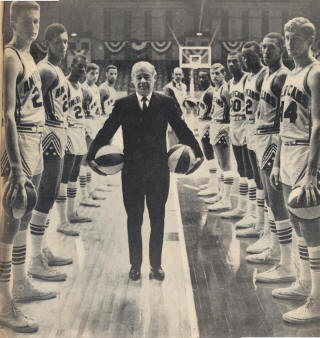
Former NBA star Max Zaslofsky, head coach,
and the original 1967-68 New Jersey Americans.

October 23, 1967: The franchise known today as the Brooklyn Nets plays its 1st game. As the New Jersey Americans, they host the Pittsburgh Pipers at the Teaneck Armory. The Pipers, led by future Hall-of-Famer Connie Hawkins, win, 110-107, and will go on to win the 1st American Basketball Association title.

It is the 1st game for a major league team (or even one pretending to be major league) in New Jersey since the 1915 Newark Peppers of baseball's Federal League, and the 1st one ever for a team using "New Jersey" as their locality instead of a city name.

Connie Hawkins, banned from the NBA after a gambling scandal despite no one ever proving he did anything illegal, would be the ABA's Most Valuable Player that season, and he showed NBA fans what they were missing, scoring 32 points for the Pipers. Charles Williams added 32. For the Americans, Dan Anderson led all scorers with 41, and former Duke star Art Heyman, also banned by the NBA for ridiculous reasons, scored 25.

The Americans finished the 1967-68 season at 36-42, 5th and last in the ABA's Eastern Division, and missing the Playoffs. They moved to Long Island after just 1 season, becoming the New York Nets; back to New Jersey, to the Rutgers Athletic Center in Piscataway, in 1977, becoming the New Jersey Nets; to the Brendan Byrne Arena at the Meadowlands Sports Complex in East Rutherford in 1981; to the Prudential Center in Newark in 2010; and to the Barclays Center in 2012, becoming the Brooklyn Nets.

They won the ABA Championship in 1974 and 1976 -- making them still the most recent pro basketball team in the New York Tri-State Area to win a league title. But the move to the NBA meant paying an expansion fee to the NBA and a territorial indemnification fee to the Knicks. This forced them to sell off their best player, Julius "Dr. J" Erving, and they immediately went from the best of the 6 teams that closed the ABA to the worst of the 22 teams in the NBA.

From their arrival in 1976 until 2001, their 1st 25 NBA seasons, they won exactly 1 Playoff series, against the Philadelphia 76ers in 1984. In 2001, they traded for Jason Kidd, and won the Eastern Conference Title in 2002 and 2003, losing the NBA Finals both times. They won Atlantic Division titles in 2004 and 2006.

But the long process of moving to Brooklyn essentially left them a lame duck, and crowds dried up. As the Brooklyn Nets, they have remained terrible, a joke franchise despite their early-2000s success. Only the colossal ineptitude of Knick management has saved them from the glare of the spotlight.

Built in 1936, the Teaneck Armory still stands, at 1799 Teaneck Road. John F. Kennedy has a campaign rally there on November 6, 1960, 2 days before the Presidential election -- and also had one at the Nets' next arena, the Long Island Arena in Commack, later that day. It was also used as a filming location for the movies Sweet and Lowdown, You've Got Mail, Bogus and StonewallIt now hosts youth soccer, under the name of the Soccer Coliseum.
Despite winning the 1st ABA title, the Pipers fared even less well. A Minneapolis attorney bought them, and moved them, making them the Minnesota Pipers. They went back to Pittsburgh for 1968-69, but the momentum was lost. They became the Pittsburgh Condors in 1970, and folded in 1972.

From their time as the New York Nets, the team has retired the numbers 23 of John Williamson, the 25 of Bill Melchionni, and the 32 of Julius Erving -- but not, as once widely believed, the 4 of Wendell Ladner.

From their time as the New Jersey Nets, the team has retired the numbers 3 of Dražen Petrović, the 5 of Jason Kidd, the 15 of Vince Carter, and the 52 of Buck Williams. (UPDATE: Through the 2025-26 season, no numbers of the Brooklyn Nets have been retired.)

And Bill Raftery and Mike Fratello have received the Curt Gowdy Media Award, the Basketball Hall of Fame's award for broadcasters.

*

October 23, 1967 was a Monday. The baseball season had ended 11 days earlier, with the St. Louis Cardinals beating the Boston Red Sox in the World Series. It was football season, but the NFL hadn't yet adopted Monday Night Football. The AFL was playing then, but they didn't play on Monday nights, either.

There were no games played in the NHL or the NBA that night, but there was 1 other played in the ABA: The Dallas Chaparrals beat the Houston Mavericks, 100-83 at the Sam Houston Coliseum in Houston. The Mavericks have no connection to the current Dallas Mavericks, or the Houston Rockets, for that matter: They became the Carolina Cougars in 1969, and the Spirits of St. Louis in 1974, and were not among the ABA teams absorbed into the NBA in 1976. The Chaparrals were, having become the San Antonio Spurs in 1973. 

October 23, 1935: Dutch Schultz Is Rubbed Out

October 23, 1935: Mobster Dutch Schultz is rubbed out, along with 2 bodyguards and his accountant, at the Palace Chophouse at 12 E. Park Street in Newark. He was 34 years old.
(The address no longer exists, as the 60 Park Place Building has wiped it out. A restaurant called Dutch's Lounge has opened at 24 E. Park.)
Schultz had asked the Mafia Commission for permission to kill the U.S. Attorney investigating him in New York, Thomas Dewey. They refused, because it would have meant the U.S. government declaring all-out war on them, a war the Mob knew it couldn't win. They thought he might try it anyway, and rival Charles "Lucky" Luciano sent 2 hitmen from Murder, Incorporated to do it. He was shot at 10:15 that night, and died at 2:20 the next morning.
Born on August 6, 1901 as Arthur Simon Flegenheimer, Dutch Schultz started as a bouncer at a Bronx speakeasy, whose owner, Joey Noe, took a liking to him for his ruthlessness in throwing guys out. He joined Noe's bootlegging operation, and took over when Noe was rubbed out in 1928, as part of the Castellamarese War. Schultz may have ordered the 1928 killing of Arnold Rothstein, the gambler who fixed the 1919 World Series; and the 1930 attempted rubout of Legs Diamond, who recovered, only to be killed by another gang the following year.
When Prohibition ended in 1933, Schultz moved into a numbers racket (an illegal lottery) and extortion. But Dewey, remembering how Al Capone was brought to justice, indicted Schultz for tax evasion. So Schultz made his request, and it ended up backfiring.
He didn't die immediately, and was still conscious when he was loaded into an ambulance that would take him to Newark City Hospital (now University Hospital). He had $3,000 in cash (about $64,000 in 2022 money) on him, and gave it to an intern in the ambulance, because, "It's not going to do me any good where I'm going." When it looked like Schultz might live, the intern got scared that Schultz might want the cash back, and gave it to the police.
Schultz lived for 29 hours, and remained lucid long enough for the police to question him, and ask him if he knew who shot him, or if he knew who sent them. Keeping the Mob's code of silence, he wouldn't say.
With a tombstone bearing his real name, he is buried in Gate of Heaven Cemetery in Hawthorne, New York -- the same cemetery as Babe Ruth, Billy Martin, Ralph Branca, Giants owners Tim and Wellington Mara, Heywood Broun, Dorothy Kilgallen, Conde Nast; steel magnate Charles M. Schwab (no relation to the investment guru Charles R.), Fred Allen, James Cagney, Sal Mineo and 1920s Mayor Jimmy Walker.
One of the gunmen, Charles Workman, served 23 years in prison. The other, Emmanuel Weiss, was arrested for a different murder, and executed in 1944. Albert Anastasia, the Commission head, "the boss of all bosses," remained in power until getting whacked himself in 1957.
Lucky Luciano and his business partner Meyer Lansky allowed their friend Abner "Longy" Zwillman, a former bootlegger and the king of Newark's "numbers racket," to take over Schultz's New Jersey operations. He became the most powerful gangster between the Hudson and Delaware Rivers, until his tax problems piled up, and he was found dead in his West Orange home in 1959, shortly before he was to testify before a Senate Committee in Washington. It's been alleged that Vito Genovese, head of the New York crime family that still bears his name, ordered it, with Lansky's blessing.
Luciano was convicted in 1936, a case prosecuted by Dewey, but the charges had nothing to do with the Schultz murder, for which he was never charged. He was sentenced to 30 to 50 years in prison. During World War II, he accepted a deal with the federal government, negotiated by Lansky: Through his operations, he had naval knowledge that could help win The War. In 1946, his sentence was commuted, on the condition that he accept deportation back to Italy. He accepted, and died in Naples in 1962. Lansky lived on until 1983, his power and fortune having waned, but he was never imprisoned. Nor was he assassinated, like the Hyman Roth, the character based on on him for the film The Godfather Part II.
Schultz has been played by Lawrence Dobkin on 3 episodes of the TV series The Untouchables in 1959, Vic Morrow in Portrait of a Mobster in 1961, Vincent Gardenia in Mad Dog Coll the same year, James Remar in The Cotton Club in 1984, Dustin Hoffman in Billy Bathgate in 1991, and Tim Roth in Hoodlum in 1997.
In 1998, Michael Walsh published As Time Goes By, an authorized combination prequel and sequel to the film Casablanca. It imagines Humphrey Bogart's character as a young man named Yitzik Baline, working for Solly Horowitz, a mobster based on Schultz. When Horowitz is rubbed out on October 23, 1935, "Rick" Baline, by then running Horowitz' speakeasy, has to flee the country, and changes his name to Richard Blaine.
*

October 23, 1935 was a Wednesday. Puerto Rican golfer Juan Antonio "Chi-ChiRodríguez was born.

The baseball season was over, the hockey season didn't start for another 2 weeks, there was no NBA, and it was a Wednesday, so there were no football games. So there were no scores on this historic day.

Monday, October 10, 2022

October 10, 1976: Giants Stadium Opens

October 10, 1976: Giants Stadium opens at the Meadowlands Sports Complex in East Rutherford, Bergen County, New Jersey. The New York Giants football team doesn't own it -- the State of New Jersey does, and operates it through the New Jersey Sports & Exposition Authority. But, for the 1st time in their 52-season history, the Giants have a home field where they get priority for scheduling.

What they don't get is exclusive use. The New York Jets will move in for the 1984 season. The football team at Rutgers University will also use it for home games too big for their 23,000-seat on-campus stadium from 1976 to 1992, for their entire 1993 season when their stadium is rebuilt, and occasionally from 1994 onward.

Other college football games will be played there, including the short-lived Kickoff Classic and the even-shorter-lived Garden State Bowl. A few high school State Championship games will be played there. Lots of soccer games, including the New York Cosmos (1977-84), the New York/New Jersey MetroStars/Red Bulls (1996-2009), and games of the 1994 World Cup. Lots of concerts. And a 1995 Mass by Pope John Paul II.

What the Giants also don't get is a successful debut. In front of a sellout crowd of 76,042, they are beaten 24-14 by the Dallas Cowboys. However, for the most part, the stadium will be good to the Giants, and they win 7 NFC Eastern Division titles, 4 NFC Championships and 3 Super Bowls while playing there, until they and the Jets move into the new MetLife Stadium next-door in 2010.

For those of us growing up in New Jersey at the time, Giants Stadium was huge. Not just big in physical size, but in terms of how it raised our profile. We were "major league," and could stand alongside New York City and Philadelphia with pride.

Not everybody liked the place. In 1997, Tim Green, a former defensive end for the Atlanta Falcons, and an analyst for Fox Sports, published The Dark Side of the Game: My Life in the NFL. In it, he discussed his opinions on various NFL stadiums. Here is the entirety of his entry on Giants Stadium: "Football in a can. Curse the Giants for ever leaving Yankee Stadium."

He had a point: The place was impressively big, and functioned well, but it was no architectural marvel, the artificial turf was hard, the real grass that replaced it was choppy, the concourses were concrete and poorly lit, and the food wasn't very good. Unless you were from New Jersey and felt the symbolism of what the place meant for your home State, Giants Stadium was not special.

And that wind. Known as "The Hawk," it often left the place terribly cold. When the stadium was replaced in 2010, with what became known as MetLife Stadium, the State spent $1.6 billion on it, and couldn't get rid of the old stadium's biggest problem: The wind was every bit as bad.

*

October 10, 1976 was a Sunday. These were the other NFL games played that day:

* The New York Jets beat the Buffalo Bills, 17-14 in front of 59,110 at Shea Stadium. Maybe having the Giants and the Jets both playing at home on the same day wasn't a good idea. At any rate, the Jets' 1st touchdown was scored by Ed Marinaro, who in 1971 played for Cornell University, and finished 2nd to Auburn quarterback Pat Sullivan for the Heisman Trophy, the closest any Ivy League player has since 1937. Marinaro later played a police officer on the NBC drama Hill Street Blues, as did former UCLA basketball player Michael Warren.

Joe Namath did not win the Heisman Trophy as the quarterback at the University of Alabama. Nor did Richard Todd. On this day, Namath was 3-for-11 for 21 yards and a touchdown, but also threw an interception. Todd was 4-for-11 for 58 yards. O.J. Simpson did win the Heisman, for Southern California in 1968, and rushed for 53 yards for the Bills.

* The Baltimore Colts beat the Miami Dolphins, 28-14 at Memorial Stadium in Baltimore.

* The Kansas City Chiefs beat the Washington Redskins, 33-30 at Robert F. Kennedy Stadium in Washington.

* The Cleveland Browns beat their arch-rivals, the defending Super Bowl Champion Pittsburgh Steelers, 18-16 at Cleveland Municipal Stadium.

* The Cincinnati Bengals beat the Tampa Bay Buccaneers, 21-0 at Riverfront Stadium in Cincinnati. The Bucs were an expansion team, and would lose their 1st 26 games, not winning until December 11, 1977.

* The Detroit Lions beat the New England Patriots, 30-10 at the Silverdome in the Detroit suburb of Pontiac, Michigan.

* The Green Bay Packers beat the Seattle Seahawks, 27-20 at Milwaukee County Stadium.

* The Minnesota Vikings beat the Chicago Bears, 20-19 at Metropolitan Stadium in the Minneapolis suburb of Bloomington, Minnesota.

* The St. Louis Cardinals beat the Philadelphia Eagles, 33-14 at Busch Memorial Stadium in St. Louis.

* The New Orleans Saints beat their arch-rivals, the Atlanta Falcons, 30-0 at the Superdome in New Orleans.

* The Houston Oilers beat the Denver Broncos, 17-3 at the Astrodome in Houston.

* The Oakland Raiders beat the San Diego Chargers, 27-17 at San Diego Stadium.

* And the next day, on ABC Monday Night Football, the San Francisco 49ers beat their arch-rivals, the Los Angeles Rams, 16-0 at the Los Angeles Memorial Coliseum.

Baseball's Playoffs were underway. In Game 2 of the American League Championship Series, the Kansas City Royals beat the New York Yankees, 7-3 at Royals Stadium in Kansas City. (It was renamed Kauffman Stadium in 1993.) But the Yankees would win the series in Game 5, on a walkoff home run by Chris Chambliss.

In Game 2 of the National League Championship Series, the Cincinnati Reds beat the Philadelphia Phillies, 6-2 at Veterans Stadium in Philadelphia. The Reds would complete the sweep 2 days later, and beat the Yankees in the World Series.

The NBA season, the 1st after absorbing 4 teams from the ABA, began 11 days later. But the NHL season was underway, and 4 games were played:

* The Buffalo Sabres beat the Montreal Canadiens, 3-1 at the Buffalo Memorial Auditorium.

* The Boston Bruins beat the Cleveland Barons, 4-3 at the Boston Garden, In 1978, the Barons were merged with the Minnesota Twins, making them, for all intents and purposes, the last team in North America's "big four" major league sports to go out of business.

* The Philadelphia Flyers beat the Los Angeles Kings, 1-0 at The Spectrum in Philadelphia.

* And the Chicago Black Hawks beat the Vancouver Canucks, 5-1 at the Chicago Stadium.

And 3 games were played in the World Hockey Association:

* The Quebec Nordiques beat the Birmingham Bulls 4-3 in overtime at Le Colisee de Quebec.

* The Minnesota Fighting Saints beat the Indianapolis Racers, 4-1 at the St. Paul Civic Center.

* And the Winnipeg Jets beat the New England Whalers, 5-2 at the Winnipeg Arena.

And hockey star Shane Doan was born on this day.

Wednesday, October 5, 2022

October 5, 1982: The New Jersey Devils Debut

October 5, 1982: The New Jersey Devils play their 1st regular-season game, a 3-3 tie against the Pittsburgh Penguins at the Brendan Byrne Arena in East Rutherford, Bergen County, New Jersey. As a favor to his friend, team owner John McMullen, John Amirante, usually the National Anthem singer for the New York Rangers, sings the Anthem for this game.

The franchise had begun play in 1974, as the Kansas City Scouts. After 2 terrible seasons, they were sold to a group that moved them to Denver, Colorado, and renamed them the Colorado Rockies, a name that would later be given to Denver's Major League Baseball team.

The Rockies made the Playoffs in 1978, but only in that season. By 1982, they were losing money fast. McMullen, a native of Montclair in Essex County, a graduate of the U.S. Naval Academy who rose to the rank of Commander (the Academy went on to name their hockey rink for him), and a marine engineer in civilian life, bought the Rockies on May 27, 1982, and announced he would move them into the newly-constructed Meadowlands Arena, named for the recently-retired Governor who got it built.
Dr. John McMullen with the Stanley Cup

McMullen, who was then also the owner of MLB's Houston Astros, also had to compensate the Rangers, the defending Stanley Cup Champion New York Islanders, and the Philadelphia Flyers for territorial indemnification. Doing this for the New York Knicks and the Philadelphia 76ers had almost sunk the owners of the ABA's New York, soon to be New Jersey, Nets when they joined the NBA in 1976, and they were still terrible when they moved into the Meadowlands in 1981. But McMullen could afford the $20 million or so that it took to buy the team, move it, and pay off the regional rivals.

The 1st goal in team history was scored just 2 minutes and 21 seconds into the game, by team Captain Don Lever, a former Vancouver Canucks star, assisted by Steve Tambellini and Bob MacMillan. At 5:23, Hector Marini made it 2-0, assisted by Aaron Broten and Brent Ashton. At 6:31, Rick Kehoe brought the Pens within 2-1.
Don Lever

At 16:18 of the 2nd period, the Penguins went on a power play, and Pat Boutette fired past former New York Islanders backup goaltender Glenn "Chico" Resch to tie the game. Just 13 seconds into the 3rd period, Kehoe scored on another power play. But 5:03 in, the magically-named Merlin Malinowski tallied for New Jersey, assisted by Bob Lorimer and Marini. With no overtime in the regular season in those days, the game ended tied.

Three days later, also at home, the Devils played their 2nd game, and got their 1st win, against, appropriately enough, the Rangers. As of October 18, they were 3-1-3. Then they started playing like an expansion team, and went on a streak of 7 losses, followed by 3 ties, followed by 7 more losses and a tie, an 18-game winless streak, before finally winning again on November 27.

They finished with a record of 17 wins, 49 losses and 14 ties, for 48 points, finishing 5th in what was then named the Lester Patrick Division, ahead of only the Penguins. Of the 21 teams then in the NHL, they ranked 19th, ahead of only the Penguins and the Hartford Whalers.

Although Resch was a terrible goalie, he would become a beloved broadcaster for the team. Broten was the last remaining Original Devil, playing with them until 1990. His brothers Neal and Paul would also play for the Devils, and Neal, a member of the U.S. team that won the 1980 Olympic Gold Medal, would score the goal that secured the team's 1st Stanley Cup.

It would take until 1988 for the Devils to make the Playoffs, reaching Game 7 of the Conference Finals before falling. They did so again in 1994. They won the Stanley Cup in 1995, 2000 and 2003, losing in the Finals in 2001 and 2012. However, despite moving out of the Meadowlands and into their own building, the Prudential Center in downtown Newark in 2007, they have made the Playoffs only once since those 2012 Finals, and still look like they're going in circles.

UPDATE: The Devils have retired 5 uniform numbers. They retired 3 for defenseman Ken Daneyko, 4 for defenseman Scott Stevens, 27 for defenseman Scott Niedermayer, and 30 for goaltender Martin Brodeur. All 4 of those were key on the 1st Stanley Cup win in 1995. They were also key on the 2000 and 2003 Stanley Cup wins, as was the team's all-time leading scorer, left wing Patrik Eliáš, for whom Number 26 was retired.

In addition, the Devils have a Ring of Honor. It includes founding owner John McMullen, 1995 Cup-winning head coach Jacques Lemaire, and the other player who was on all 3 Cup wins, left wing Sergei Brylin, whose Number 18 remains in circulation.

*

October 5, 1982 was a Tuesday. There were 2 other NHL games played that day. In a rematch of the previous season's Stanley Cup Finals, the New York Islanders lost to the Vancouver Canucks, 2-1 at the Pacific Coliseum in Vancouver. But the Isles would go on to win their 4th straight Stanley Cup that season, anyway.

And in "The Battle of Alberta," the Edmonton Oilers beat the Calgary Flames, 7-5 at the Northlands Coliseum in Edmonton. Wayne Gretzky was coming off the most spectacular offensive season any hockey player has ever had, and went on to lead the Oilers to their 1st Stanley Cup Final, where they lost to the Islanders. The next season, the Oilers beat the Isles in the Finals to win their 1st Cup.

It was a Tuesday, so while it was during the NFL season, there were no games played that day. And the NBA wouldn't start its season until later in the month. Major League Baseball had just started its Playoffs. In Game 1 of the American League Championship Series, at Anaheim Stadium (now Angel Stadium) in the Los Angeles suburb of Anaheim, California, the California Angels beat the Milwaukee Brewers, 8-3. Tommy John outpitched Mike Caldwell. Fred Lynn hit a home run for the Halos, and Gorman Thomas hit one for the Brew Crew.

The Angels would also win Game 2 in Anaheim. But the Brewers won the next 3 in Milwaukee, winning their 1st Pennant, and becoming the 1st team ever to come back from a 2-0 deficit in either League's Championship Series. Despite having such veteran stars as John, Lynn, Reggie Jackson, Rod Carew, Don Sutton, Bobby Grich and Don Baylor, the Angels choked. 

Tuesday, September 27, 2022

September 27, 1925: The New York Football Giants Debut

September 27, 1925: The New York Giants football team, named for the already-legendary baseball team, plays its 1st game. Founded by professional bookmaker Tim Mara, they travel to Dreamland Park, and play the Newark Red Jackets. The Giants win, 3-0.

Although the Giants were members of the National Football League, the Red Jackets were not. Nor were the Giants' next opponents, All-New Britain. The Giants traveled to New Britain, outside the Connecticut capital of Hartford, and beat them 26-0.

Then the Giants began playing NFL teams. On October 11, they went to the Cycledrome in Providence, Rhode Island, and lost to the Providence Steam Roller, 14-0. (That's how their name was written: Two words, no S on the end.) On back-to-back days, October 17 at Frankford Stadium in Northeast Philadelphia, and October 18 in their 1st true home game at the Polo Grounds, the Giants played the Philadelphia NFL team of that era, the Frankford Yellow Jackets, losing both games, 5-3 and 14-0, respectively.

Then they won their next 8 games, 7 of them at the Polo Grounds. They beat the Cleveland Bulldogs 19-0, the Buffalo Bisons 7-0, the Columbus Tigers 19-0, the Rochester Jeffersons 13-0, the Steam Roller 13-12, the Kansas City Cowboys 9-3, the Staten Island Stapletons 7-0, and the Dayton Triangles 23-0.

The Stapletons, or "Stapes" for short, were founded in 1915, and played in the Stapleton neighborhood of Staten Island. Their November 26, 1925 game against the Giants was the 1st Thanksgiving Day game involving an NFL team. It was played at the Stapes' home, Thompson Stadium, which stood from 1924 to 1933. The Stapes did not join the NFL until the 1929 season, and the Great Depression knocked them out in 1932. Berta A. Dreyfus Intermediate School is now on the site of Thompson Stadium, at 101 Warren Street.

Despite a strong 10-3 start, the Giants were not doing well at the box office. To the rescue came the Chicago Bears, who had recently signed the biggest name in college football, two-way back Harold "Red" Grange. A crowd of 75,000 crammed into the Polo Grounds, and Grange led the Bears to a 19-7 victory. The gate receipts saved the NFL's New York franchise -- and since no league can survive for long without a New York franchise, that game may even have saved the NFL. But Grange was injured in the game. A week later, at Wrigley Field, with Grange unavailable, the Giants won the return match, 9-0, finishing 11-4.

Bob Folwell, the Giants' 1st head coach, formerly the head man at the University of Pennsylvania and the U.S. Naval Academy, was fired after that 1st season. For 1926, he was replaced by Joseph "Doc" Alexander. He lasted only 1 season as well, before Earl Potteiger was given the reins for 1927. That season, he led the Giants to the NFL Championship, by finishing 1st in the single-division league.

They won the NFL Championship Game in 1934, 1938 and 1956; and lost it in 1933, 1935, 1939, 1941, 1944, 1946, 1958, 1959, 1961, 1962 and 1963. It took a while after the start of the Super Bowl era, but they won the Super Bowls in the seasons for calendar years 1986, 1990, 2007 and 2011, losing in 2000. Their 8 NFL Championships are 3rd only to the 13 of the Green Bay Packers and the 9 of the Bears.

Tim Mara died in 1959. He left the team to his sons Jack and Wellington. In 1991, Wellington bought his brother out. He died in 2005, and he and Tim were the 1st father-son pair in the Pro Football Hall of Fame. He left the team to his son John. Jack's children include son Tim Mara II, who married Kathleen Rooney, granddaughter of Pittsburgh Steelers founding owner Art Rooney. Their daughters are actresses Kate Mara and Rooney Mara, so they are great-granddaughters of the founding owners of 2 NFL teams. Kate has sung the National Anthem at home games for both teams.

And the site of that first game for "the New York Football Giants"? Dreamland was an amusement park, similar to the one of the same name that had stood at Coney Island in Brooklyn. It was demolished in 1938.

In 1941, a housing project, the Seth Boyden Terrace, a.k.a. the Seth Boyden Houses, was built on the site, at 737 Frelinghuysen Avenue, a.k.a. New Jersey Route 27. The occupants have been moved elsewhere, and the project was demolished in 2022. Lionsgate Newark Studios is now planned for the site, alongside a housing facility for the elderly.
No photograph of the football field on the site
seems to survive, although there are some
of the inside of the roller rink.
This is the new Seth Boyden Elderly House.

UPDATE: The New York Giants have a Ring of Honor. The inductees include:

* From their 1927 NFL Champions: Owners Tim and Jack Mara (brothers), and offensive tackle and head coach Steve Owen.

* From their 1934 NFL Champions: The Mara brothers, Owen (now only head coach), center and linebacker Mel Hein, and halfback Ken Strong. From their 1938 NFL Champions, the preceding, and fullback Alphonse "Tuffy" Leemans. Leemans' Number 4, Hein's Number 7 and Strong's Number 50 have been retired. End Ray Flaherty, not in the Ring of Honor but in the Hall of Fame, was on the 1934 team, and his Number 1 was retired, but has been re-activated with his family's permission for Malik Nabers.

* The Giants have honored 2 of their players who went on to be killed in action in World War II: End Jack Lummus and tackle Al Blozis. Both of them had been honored with plaques on the wall of the clubhouse at the Polo Grounds. Blozis' Number 32 has been retired, but Lummus' Number 29 has not.

* From their 1956 NFL Champions: The Mara brothers, Tim's son Wellington (now an executive), head coach Jim Lee Howell, quarterback Charlie Conerly; running backs Frank Gifford, Kyle Rote and Alex Webster; offensive tackle Roosevelt "Rosey" Brown, defensive end Andy Robustelli, linebacker Sam Huff, safeties Emlen Tunnell and Jim Patton, and trainer John Johnson. Gifford's Number 16 and Conerly's Number 42 have been retired.

Despite their contributions to this era of Giants football, neither offensive coodrinator Vince Lombardi, who became Green Bay Packers coach in 1959, nor defensive coordinator and former cornerback Tom Landry, who became Dallas Cowboys coach in 1960, have been honored by the Giants.

* From their teams that lost the NFL Championship Game in 1958, '59, '61, '62 and '63, but not the one that won it in 1956: quarterback Y.A. Tittle, running back Joe Morrison, and cornerback Dick Lynch. Tittle's Number 14 and Morrison's Number 40 have been retired.

* From the 1960s: Kicker Pete Gogolak.

* From the 1970s: Linebacker Brad Van Pelt and punter Dave Jennings.

* From their Super Bowl XXI winners in 1987: Owner Wellington Mara, general manager George Young, head coach Bill Parcells, trainers John Johnson and Ronnie Barnes, quarterback Phil Simms, running backs Ottis Anderson and Joe Morris, tight end Mark Bavaro; defensive ends George Martin and Leonard Marshall; and linebackers Lawrence Taylor, Harry Carson and Carl Banks. Simms' Number 11 and Taylor's Number 56 have been retired.

* From their Super Bowl XXV winners in 1991: Mara, Young, Parcells, Johnson, Barnes, Simms, Anderson, Bavaro, Marshall, Taylor, Banks, and running back Rodney Hampton.

* From their 2000 NFC Champions that lost Super Bowl XXXV: Co-owners Wellington Mara and Bob Tisch, general manager Ernie Accorsi, trainers John Johnson and Ronnie Barnes; running back Tiki Barber, receiver Amani Toomer, defensive end Michael Strahan, and linebacker Jessie Armstead. Head coach Jim Fassel and quarterback Kerry Collins have not been inducted.

* From their Super Bowl XLII winners in 2008: Accorsi, Johnson, Barnes, Toomer, Strahan; head coach Tom Coughlin, quarterback Eli Manning, guard Chris Snee, and defensive ends Osi Umenyiora and Justin Tuck. Manning's Number 10 and Strahan's Number 92 have been retired.

* From their Super Bowl XLVI winners in 2012: Coughlin, Barnes, Manning, Snee, Umenyiora and Tuck. General manager Jerry Reese has not yet been inducted. Nor have any players from since that game.

*

September 27, 1925, as you might guess, was a Sunday. There were other NFL games played that day:

* The aforementioned Chicago Bears lost to the team that would become their arch-rivals, the Green Bay Packers, 14-10 at Green Bay City Stadium.

* The team that was then the Bears' arch-rivals, the Chicago Cardinals, lost to the Hammond Pros of nearby northwestern Indiana, 10-6 at Comiskey Park. But the Cardinals finished 11-2-1, and were controversially awarded the NFL Championship.

* The Canton Bulldogs beat the Rochester Jeffersons, 14-7 at League Field in Canton, Ohio.

* The Detroit Panthers beat the Columbus Tigers, 7-0 at Navin Field, later renamed Briggs Stadium and Tiger Stadium. But the Panthers folded after the 1926 season,a nd have no connection to the Detroit Lions.

* The Rock Island Independents and the Dayton Triangles played to a 0-0 tie, at Douglas Park in Rock Island, Illinois, one of the "Quad Cities" on either side of the Mississippi River in Illinois and Iowa.

* The Frankford Yellow Jackets did not play that day. Until 1933, professional sports on Sundays was illegal in the Commonwealth of Pennsylvania. Hence, the October 17/18 back-to-back days solution: The Jackets played in Frankford on Saturday and in Harlem on Sunday. The day before the Giants' debut, the Jackets beat the Buffalo Bisons, 27-7 at Frankford Stadium.

* The Pottsville Maroons beat the Bisons, 28-0 at Minersville Park in Pottsville, Pennsylvania. They finished 10-2, and contended that the Cardinals had unfairly been chosen NFL Champions, and that they should have been awarded the title.

* The Akron Pros beat the Cleveland Bulldogs, 7-0 at League Park in Akron. Yes, Cleveland, Akron and Canton all had teams; and Cleveland and Canton both had teams called the Bulldogs. The NFL wasn't exactly logical in its early years.

* And the Kansas City Cowboys beat the Duluth Kelleys, 3-0 at Athletic Park in Duluth, Minnesota.

There were Major League Baseball games played that day:

* There was a doubleheader at Yankee Stadium. The New York Yankees lost the 1st game to the Detroit Tigers, 10-5. Babe Ruth and Bob Meusel hit home runs, but Sad Sam Jones didn't get out of the 4th inning. Ty Cobb was then player-manager for the Tigers, but did not play in this game.

The 2nd game was tied 1-1 after 5 innings, when it was called due to darkness. Cobb didn't play in this game, either, and Ruth didn't get a hit.

* The Brooklyn Robins beat the New York Giants, 5-4 at Ebbets Field. The Robins were then named for their manager, Wilbert Robinson. After he was fired in 1931, they went back to the name they had before: The Brooklyn Dodgers.

* The Washington Senators beat the St. Louis Browns, 8-0 at Griffith Stadium in Washington. Curly Ogden pitched a 3-hit shutout. 

* The Pittsburgh Pirates were leading the Cincinnati Reds, 4-3 at Crosley Field, when the game was called due to rain after 5 innings.

* The Chicago Cubs beat the Philadelphia Phillies, 3-1 at Cubs Park in Chicago. Chewing gum magnate William Wrigley Jr. had recently bought full control of the Cubs, and their ballpark would be renamed Wrigley Field before the next season.

* A doubleheader was split at Sportsman's Park in St. Louis. The St. Louis Cardinals beat the Boston Braves, 6-5 in 10 innings in the 1st game. In the 2nd game, the Braves led 7-6 after 7 innings, before the game was called due to darkness.

* Not scheduled to play: The Boston Red Sox, the Cleveland Indians, the Boston Braves and the Cincinnati Reds.

Thursday, September 15, 2022

September 15, 1958: The Newark Bay Rail Disaster

September 15, 1958: A commuter train derails off a bridge, and plunges into Newark Bay, killing 48 people, and injuring 48 more. Among the dead was a former Yankee star.

George Henry Stirnweiss was born on October 26, 1918 in Manhattan, and grew up in The Bronx. He remains the closest thing to a Yankee Legend who grew up in the Bronx Bombers' home Borough. Lou Gehrig grew up in Manhattan; Willie Keeler, Waite Hoyt and Willie Randolph in Brooklyn; and Phil Rizzuto and Whitey Ford in Queens. 

His father had been a respected taxi driver, but got caught up in criminal activity, disgracing the family while George was a baseball, football and basketball star at Fordham Preparatory School. This may have been why, when he received scholarship offers, he didn't stay in The Bronx and go to Fordham University, but went south, to the University of North Carolina at Chapel Hill.

At Chapel Hill, he won the school's highest athletic honor, the Patterson Medal, which is awarded based on "athletic ability, sportsmanship, morale, leadership and general conduct." In 1940, the NFL's Chicago Cardinals drafted him. But, as with later University of Mississippi quarterback Jake Gibbs, the Yankees made him an offer, and he abandoned football for baseball.

It's not clear when, or why, George Stirnweiss first got the nickname "Snuffy." Maybe, playing in the South, either at UNC or for the Norfolk Tars, a Yankee farm team, he picked up the habit of chewing tobacco or using its nasal cousin, snuff. He certainly didn't resemble the rural comic strip character Snuffy Smith.

In 1943, defending American League Most Valuable Player Joe Gordon was called up into World War II. Snuffy was not. That led the Yankees to bring him to the major league roster as the starting 2nd baseman, giving him uniform Number 1. The Yankees won the World Series, although Snuffy was not a major contributor that season. But in 1944, he batted .319 and fielded brilliantly, finishing 4th in the MVP voting. In 1945, he batted .309, and that was enough to win the batting title and finish 3rd in the MVP voting.
With The War ending, there was a question of whether Snuffy had bulked up his stats on weakened pitching. Gordon returned as the starting 2nd baseman in 1946, and it looked like Snuffy's day in the Sun was over. But after that season, the Yankees traded Gordon to the Cleveland Indians for pitcher Allie Reynolds. This was a brilliant trade for both teams: Gordon helped the Indians win the World Series in 1948, while the Yankees essentially got 2 players: Reynolds, their pitching ace through 1954, and the "return" of Stirnweiss.

He helped the Yankees win the World Series again in 1947, getting 7 hits and drawing 8 walks in the 7 games. But by the time of their 1949 title, he had been replaced as starting 2nd baseman by Jerry Coleman. He was traded to the St. Louis Browns in 1950 and the Indians in 1951, and retired after the 1952 season.

Snuffy managed in the minor leagues, with the Philadelphia Phillies' Class AA team, the Schenectady Blue Jays; then for the Yankees' team in the same league, the Binghamton Triplets. But he didn't like managing, and it didn't pay well, and he had a wife and 6 children to support. He worked for a bank, but had a heart attack in 1957, and never returned to work for them.

Instead, he went to work for Caldwell & Company, a manufacturer of light fixtures, in Manhattan. Every morning, he would go to the Central Railroad of New Jersey station near his home in Red Bank, Monmouth County, and take the train up the Raritan Bayshore, past Newark Airport, and over Newark Bay, to the Communipaw Terminal in Jersey City, where he would take a ferry across the Hudson River into The City.

On September 15, 1958, he got on CRRNJ train #3314 in Red Bank, but the train never made it to Communipaw. The Newark Bay lift bridge was left open, and at 10:01 AM, the train went straight through signals, and 2 of the cars fell into the Bay. George H. "Snuffy" Stirnweiss was 1 of 48 people killed. He was just short of turning 40.
The locomotive crew were among those killed, so there was no one to interview about the cause of the crash. The investigation turned up nothing. No one was charged.

Increased car sales, the building of the New Jersey Turnpike (particularly the Newark Bay Extension in 1956) and the Garden State Parkway, and a 2nd and 3rd tube for the Lincoln Tunnel meant that the Jersey Central had already begun to decline, and it pretty much abandoned the bridge by 1967. Conrail took over the railroad's operations in 1976, stopped passenger service in 1978, and demolished the bridge in 1980.

The spot where Snuffy Stirnweiss and the others fell to their deaths is a few feet from the Jersey Gardens Mall in Elizabeth, Union County. He was buried in Mount Olivet Cemetery, across the Navesink River from Red Bank, in Middletown. Legendary football coach Vince Lombardi is also buried there, because Red Bank was his wife Marie's hometown.

*

September 15, 1958 was a Monday. It was before the NBA and the NHL started their seasons. The NFL season wouldn't start for another 2 weeks, and there was no Monday Night Football in those days, anyway. And, as Monday is often a travel day in Major League Baseball, only 2 of a possible 8 games were played:

* The Philadelphia Phillies beat the St. Louis Cardinals, 6-2 at Connie Mack Stadium in Philadelphia. Robin Roberts outpitched Wilmer "Vinegar Bend" Mizell. Jim Hegan got 3 hits for the Phils; Richie Ashburn, Bob Bowman and Ted Kazanski 2 each. (That's Ted Kazanski, not Ted Kaczynski, the future Unabomber.) The only home run of the game was hit by the Cards' Irv Noren, a former Yankee, playing left field in place of Stan Musial, who did not get into the game.

* And the Milwaukee Braves beat the Los Angeles Dodgers, 8-3 at Milwaukee County Stadium. Joe Adcock hit a home run. Hank Aaron did not, but did go 2-for-3 with an RBI. John Roseboro hit a home run in defeat for the Dodgers, in their 1st season in L.A. Gil Hodges 2-for-4, but Duke Snider did not play.

The Braves, defending World Champions, would win the Pennant again, but the Yankees -- who did not add a black armband to their left sleeves in memory of Stirnweiss -- would avenge their loss to the Braves in the 1958 World Series.

Monday, September 12, 2022

September 12, 1940: The Hercules Munitions Plant Explosion

September 12, 1940: The Hercules Munitions Plant in Roxbury, Morris County, New Jersey explodes, killing 51 people. The site is 44 miles west of Times Square.

Hercules Powder Company was a chemical and munitions manufacturing company, based in Wilmington, Delaware, incorporated in 1912 following the court-ordered breakup of the DuPont explosives monopoly.

News reports at the time estimated at least 15 buildings were destroyed, along with 25 tons of explosives. Beyond the 51 deaths, perhaps 200 hundred were injured. The site may have been jinxed: It exploded twice in 1934, and would again in 1989.

Hercules Powder Company became Hercules, Inc. in 1966, operating under this name until 2008, when it was merged into Ashland Inc.

*

September 12, 1940 was a Thursday. These baseball games were played:

* The New York Yankees lost to the Detroit Tigers, 6-3 at Briggs Stadium (later renamed Tiger Stadium) in Detroit. This turned out to be a key win for the Tigers, as they ended up beating the Cleveland Indians for the American League Pennant by 1 game, with the Yankees 2 games back. Lynwood "Schoolboy" Rowe outpitched Atley Donald. Hank Greenberg hit a home run. Joe DiMaggio went 2-for-5 with 2 RBIs.

* The New York Giants lost to the Cincinnati Reds, 9-4 at the Polo Grounds. Mel Ott hit a home run. The Reds went on to beat the Tigers in the World Series.

* The Brooklyn Dodgers swept the Pittsburgh Pirates, 7-0 and 7-4 at Ebbets Field. Hugh Casey, who would become better known as a reliever, pitched a 3-hit shutout in the opener. Gus Mancuso went 4-for-4 with 2 RBIs. Dolph Camilli hit a home run in the nightcap.

* The Boston Bees swept a doubleheader from the St. Louis Cardinals, 17-7 and 6-1 at National League Park, a.k.a. The Bee Hive, in Boston. This was the last of 5 seasons of a "rebrand" following a horrible 1935 season for the Boston franchise of the National League. In 1941, they switched back to calling themselves the Boston Braves, and their ballpark Braves Field.

* The Chicago Cubs beat the Philadelphia Phillies, 5-1 at Shibe Park in Philadelphia.

* The Cleveland Indians beat the Boston Red Sox, 8-1 at Cleveland Municipal Stadium. Mel Harder went the distance for the win. Ted Williams went 0-for-3, but drove in the Sox' only run with a sacrifice fly.

The Chicago White Sox swept the Philadelphia Athletics, 1-0 and 4-3 at Comiskey Park in Chicago. Bill Dietrich pitched a 4-hit shutout in the 1st game.

* And the Washington Senators beat the St. Louis Browns, 7-2 at Sportsman's Park in St. Louis.


Thursday, July 28, 2022

July 28, 1954: "On the Waterfront" Premieres

Eva Marie Saint (left) and Marlon Brando

July 28, 1954: On the Waterfront premieres, directed by Elia Kazan. It is regarded as one of the greatest movies ever made.

The film is widely considered to be Kazan's answer to those who criticized him for identifying 8 Communists in the film industry before the House Committee on Un-American Activities (HUAC) in 1952. Budd Schulberg, who had previously written about boxers (and would again), wrote the script, after Kazan's friend, playwright Arthur Miller, backed out. Leonard Bernstein composed the musical score.

Terry Malloy (Marlon Brando) was a former boxer, who never made it, because his brother Charley (Rod Steiger), desperate for cash, made a deal with a corrupt union leader, Johnny Friendly (Lee J. Cobb), who strong-armed Terry into throwing a fight. In a famous scene in the back of a taxicab, Terry tells Charley, "You don't understand! I coulda had class! I coulda been a contender! I coulda been somebody! Instead of a bum, which is what I am. Let's face it."

(When people do impressions of Brando, they have multiple choices. It's often this scene. But they also do Stanley Kowalski yelling, "Stella!" from A Streetcar Named Desire; Colonel Kurtz's last words, "The horror... " from Apocalypse Now; and and various quotes from Don Vito Corleone in The Godfather.)

In saying this, Terry, now a poor longshoreman on the docks of Hoboken, New Jersey, across the Hudson River from Manhattan, tells Charley that he's going to testify against Friendly before the Waterfront Crime Commission. This is in revenge for Friendly having coerced him into luring Joey Doyle, a fellow dockworker, onto a rooftop, where Friendly's thugs pushed him to his death for testifying.

Terry had been dating Joey's sister Edie (Eva Marie Saint, in her 1st film role). She talks a local priest, Father Barry (Karl Malden), into rallying the dockworkers against Friendly. But they are more afraid of Friendly than than they are of God, and refuse. That fear grows the next day, when another boxer-turned-dockworker "owned" by Friendly, Timothy "Kayo" Dugan, testifies behind closed doors, in an attempt to keep his identity hidden, but it gets out, and he is killed.

Terry is subpoenaed, and Friendly sends Charley to tell him not to testify, leading to the conversation in the cab. Having failed in his mission, Charley is killed by Friendly, and left on a hook for Terry to see, as one final warning not to testify, meaning, if he does, he will be the next to go.

My mother told me her parents took her to see this movie, because they wanted to see it and they couldn't get a babysitter. She was 7 years old, and she said the sight of Charley on the hook traumatized her. I was 17 when I first saw it, and I can understand why.

The murder has the opposite effect on Terry: He is more determined than ever, and he does testify. The next day, He appears at the dock for the daily ritual where workers are chosen from the assembled longshoremen. Everyone is called to work except Terry, who taunts Friendly outside the nearby shack, shouting that he is proud of testifying. They get into a shouting match, and start fighting. Terry is winning until Friendly's thugs beat the hell out of him, leaving him all but dead.

Finally, the other dockworkers get it: They tell Friendly that they're on strike until Terry goes back to work. In his condition, he can't. Father Barry tells him that he lost the battle, but has a chance to win the war if he can walk into the warehouse. Father Barry and Edie get him on his feet, and he stumbles up the gangway to stand before the warehouse, where the boss nods to Terry, letting him in, and tells them to get to work. The men follow Terry inside, ignoring Friendly. Friendly threatens them all, but it's over: Even his thugs are no longer afraid of him, so his power is gone, and he is completely ignored.

Tony Galento, Tami Mauriello and Abe Simon, all of whom had fought Joe Louis for the Heavyweight Championship of the World, played dockworkers in this film. Fred Gwynne, later to star on The Munsters, played dockworker Mladen "Slim" Sekulovich. Mladen Sekulovich was Karl Malden's real name.

(Malden would also play the warden in The Birdman of Alcatraz, and "Sekulovich" was one of the names he rattled off in solitary confinement along with Burt Lancaster's Robert Stroud, the titular birdkeeper.)

The film was nominated for 12 Academy Awards. It won 8, including Best Picture, Best Actor for Brando, Best Supporting Actress for Saint, and Best Director for Kazan. Saint did not attend the award ceremony: She was pregnant, and her son Darrell Hayden was born 2 days later. Eva and director Jeffrey Hayden had one of the longest marriages in Hollywood history, marrying in 1951, and were still married when he died in 2016. In addition to Darrell, they later had a daughter, Laurette.

In 1999, Malden played a priest on an episode of The West Wing. Onto their Oval Office set, he brought the same Bible he'd used in On the Waterfront.

Cobb died in 1976, Bernstein in 1990, Steiger in 2002, Kazan in 2003, Brando in 2004, Malden and Schulberg in 2009. As of July 28, 2022, Saint is still alive, the last surviving actor from the film.

*

July 28, 1954 was a Wednesday. Hugo Chávez, dictatorial President of Venezuela from 1999 until his death in 2013, was born on this day.

And these baseball games were played:

* The New York Yankees beat the Chicago White Sox, 7-5 at Comiskey Park in Chicago. Mickey Mantle went 3-for-5 with a home run and 3 RBIs. Yogi Berra went 4-for-5 with an RBI. Still, Eddie Lopat only lasted 1 inning, and the Yankees trailed 5-1 after 7 innings, before coming from behind, scoring 3 runs in the 8th and 3 more in the 9th. Bob Grim was the winning pitcher in relief.

* The New York Giants beat the St. Louis Cardinals, 10-0 at the Polo Grounds. Johnny Antonelli allowed 10 hits, but only 1 walk, and kept the shutout. Dusty Rhodes hit 3 home runs. Willie Mays added 1.

* The Brooklyn Dodgers beat the Chicago Cubs, 3-1 at Ebbets Field. Roy Campanella hit a home run. Jackie Robinson went 0-for-3, but drove in a run with a bases-loaded walk. The only Cub run came on a home run by Ralph Kiner. Rookie Ernie Banks went 0-for-4.

* The Philadelphia Phillies beat the Cincinnati Redlegs, 3-2 at Connie Mack Stadium. (That ballpark had been Shibe Park until the year before. The Reds called themselves the Redlegs from 1953 to 1958, because of the Red Scare.)

* The Baltimore Orioles beat the Washington Senators, 2-1 at Memorial Stadium in Baltimore.

* The Milwaukee Braves beat the Pittsburgh Pirates, 6-4 at Forbes Field in Pittsburgh. Rookie Hank Aaron went 3-for-5 with 3 RBIs, although he did not hit a home run.

* The Cleveland Indians beat the Boston Red Sox, 2-1 at Cleveland Municipal Stadium. Early Wynn was the winning pithcer. Ted Williams went 2-for-4 with an RBI.

* The Detroit Tigers beat the Philadelphia Athletics, 10-2 at Briggs Stadium (renamed Tiger Stadium in 1961) in Detroit. Bud Souchock hit 2 home runs, and Al Kaline went 1-for-4.

December 31, 1999 & January 1, 2000: The Millennium

December 31, 1999:  The Millennium arrives. The people of planet Earth survived. At a terrible cost. But we hadn't destroyed ourselves. ...