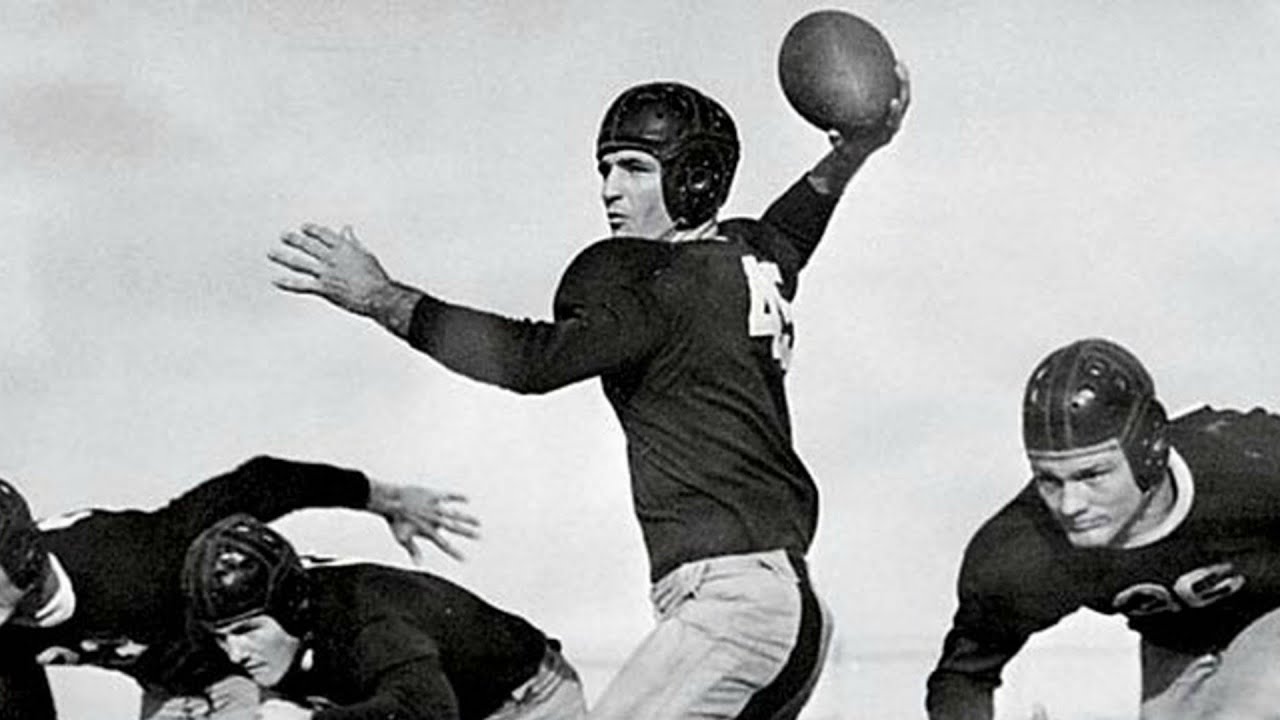
Showing posts with label sammy baugh. Show all posts

Monday, December 26, 2022

December 26, 1943: Nagurski's Return Leads Bears to Title

Bronko Nagurski

December 26, 1943: The NFL Championship Game is played at Wrigley Field in Chicago. It features the 2 best teams in the League, based not just on recent history, but also on the fact that these are the 2 teams least affected by the manpower drain of World War II.

Sammy Baugh had debuted in the NFL in 1937, as the quarterback for the Washington Redskins, coached by Ray Flaherty. That year, they beat George Halas' Chicago Bears in the Championship Game. They faced each other again in the Championship Game in 1940, when the Bears won the biggest blowout in NFL history, 73-0; and in 1942, when the Redskins ruined an undefeated season for the Bears.

In 1943, Baugh did something never done before, nor since: He led the NFL in passing yards, interceptions by a defensive player, and punting yards. To put this into a more modern perspective: Imagine that, in the 2000s, Tom Brady, Ed Reed and Sean Landeta were one man doing what all three of those men did. That was "Slingin' Sammy": The 1st great quarterback, a great defensive back, and the best punter ever.

But the Bears had the era's other great quarterback, Sid Luckman. And an offense and a defense so mighty that they were nicknamed "The Monsters of the Midway." In addition to facing the Redskins in the title game in 1937, 1940 and 1942, they had also beaten the New York Giants in the title game in 1941.

What the Bears did not have was Halas, who was team founder, owner, general manager and, usually, head coach. But, having served in the U.S. Navy during World War I, he was called back to serve in World War II, overseeing the recreational needs of the Seventh Fleet, and eventually being discharged with the rank of Captain.

In his stead, his assistant coaches, Heartley "Hunk" Anderson and Luke Johnsos served as co-head coaches. Anderson had been a guard at Notre Dame on Knute Rockne's National Championship teams of 1919 and 1920, and had played for the Bears from 1922 to 1925. Johnson was a Chicago native who played end at Northwestern University, and helped the Bears win the NFL Championship in 1932 and 1933.

But the draft -- the U.S. Army's, not the NFL's -- had hit the Bears, too. While a deal was worked out to keep some players stateside, as long as they kept their jobs in defense plants, they lost other key players. They kept their great center and defensive tackle Clyde "Bulldog" Turner, but lost back Bill Osmanski. They needed help.

From 1930 to 1937, the Bears had Bronislau "Bronko" Nagurski. At 6-foot-2 and 230 pounds, he wouldn't be considered all that big today. But in the 1930s, he was considered huge, and was the prototype for the big bruising fullback, the progenitor of Marion Motley, Jim Brown, Larry Csonka, John Riggins, Jerome Bettis, etc.

The University of Minnesota didn't win anything while he was there, but, in the same backfield as Red Grange, he helped the Bears win the Championship in 1932 and 1933.

"Who would you pick to win a football game?" asked the great sportswriter Grantland Rice. "11 Jim Thorpes? 11 Glenn Davises? 11 Red Granges? Or 11 Bronko Nagurskis? The 11 Nagurskis would be a mop-up. It would be something close to murder and massacre. For the Bronk could star at any position on the field, with 216 pounds of authority to back him up."

Try 230, Mr. Rice. Otherwise, you're right. One year, Nagurski hurt his back, and, instead of sitting out and healing, accepted a switch to offensive tackle, and was great at it. He played defensive tackle. Oh yeah, he could also pass, pretty well by the standards of the time. Imagine Bettis throwing an option pass, and having it result in a touchdown: Nagurski did it. In an interview late in life, he said he'd probably be a linebacker, admitting he wouldn't be carrying the ball 30 times a game. I have no doubt that, with his speed, he would have excelled.

He was a professional wrestler in the off-season, because, at the time, it made him more money. He was the Heavyweight Champion of the World. And while pro wrestling was always a bit theatrical, it was not like today's WWE. He would have made mincemeat out of Hulk Hogan in the 1980s, Stone Cold Steve Austin in the 1990s, Dwayne "The Rock" Johnson (also a college football star) in the 2000s and John Cena today. And he would never have done Vince McMahon's bidding.

After the 1937 season, Nagurski quit football over a salary dispute with Halas. He kept wrestling, even though he had a bad back, and, once World War II came, it didn't make him as much money. In 1943, due to the manpower shortage, Halas sent a telegram to Anderson and Johnsos, telling them to offer Nagurski, now 35 and 6 years past his last down of football, $5,000 to come back. He took it.

In 1943, the Bears went 8-1-1. The season began with a 21-21 tie away to their arch-rivals, the Green Bay Packers. But they still had a shot at an undefeated season until their next-to-last game, when the Redskins beat them in Washington, 21-7.

The Redskins, by now coached by Dutch Bergman, had a bit more trouble. They started out 6-0-1, the only blot on their record a 14-14 tie with the Steagles in Philadelphia. Yes, the "Steagles": Because of the manpower drain, the 2 Pennsylvania teams, the Philadelphia Eagles and the Pittsburgh Steelers, joined forces for one season, playing 4 games at the Eagles' Shibe Park and 2 at the Steelers' Forbes Field.

But after beating the Bears, the Redskins dropped their last 3 games, 27-14 to the Steagles at Griffith Stadium, 14-10 to the Giants at the Polo Grounds, and then 31-7 to the Giants at home. This forged a tie with the Giants for the Eastern Division title. Under today's rules, the Giants would have won the Division, due to the head-to-head win. Under the rules of 1943, a Playoff game was needed, so the Giants and Redskins ended up playing 3 weeks in a row. Despite the Giants having home-field advantage, the Redskins won, 20-0.

So the NFL Championship Game was set for a week later than intended, on the day after Christmas. Since the game alternated between the Division titlists' homes, and it was the Western winner's turn to host, the game would be at Wrigley Field. Because of the weather, this became the 1st NFL game to earn the nickname "The Ice Bowl." After the 1967 NFL Championship Game, that name was retired, and nobody ever again used the name for the 1943 title decider.
Wrigley Field in its football configuration

There was no scoring in the 1st quarter. In the 2nd, Andy Farkas ran the ball in from 1 yard out to give the Redskins a 7-0 lead. That may have woken the Bears up: Later in the quarter, Luckman threw a 31-yard touchdown pass to Harry Clarke, and Nagurski ran the ball in from 3 yards, and it was 14-7 Chicago at the half.

The Bears dominated in the 2nd half as well. Luckman threw 2 touchdown passes to Dante Magnani in the 3rd quarter, 36 and 66 yards. On the 2nd of these, Bob Snyder missed the extra point, so it was 27-7 Bears. Baugh threw a 17-yard touchdown pass to Farkas, to give the 'Skins some hope as the quarter ran out, 27-14.

That hope ended quickly. Luckman threw touchdown passes to Jim Benton for 26 yards and Clarke for 10. Baugh threw one to Joe Aguirre for 25 yards, but it was small consolation. The Bears won, 41-21, and had their 3rd title in 4 seasons.

Nagurski retired again, returning to his farm in Minnesota in the Summer, and the pro wrestling circuit the rest of the year, until 1960. The University of Minnesota retired its Number 72 for him, and named its football facility the Gibson-Nagurski Football Complex. The Chicago Bears retired Number 3 for him. He was a charter inductee into the Pro Football Hall of Fame in 1963.

He was named to the NFL's 50th Anniversary Team in 1969, and its 75th Anniversary Team in 1994. Despite being named as a finalist, he was not named to the 100th Anniversary Team in 2019. The Sporting News ranked him 35th on their 100 Greatest Football Players in 1999. and the NFL Network's 100 Greatest Players in 2010, 73 years after he was a regular player, actually boosted him to 19th. In 2008, ESPN named ranked him 17th on their list of the Top 25 College Football Players of All Time. He died in 1990.

The 1944 season saw the continued decimation of the NFL. But by the start of the 1945 season, The War was over, and the players began to be discharged, and switch back from the battlefield to the football field. The Redskins reached the Championship Game again, losing to the Cleveland Rams, who then moved to Los Angeles for 1946. In that season, the Bears won another title, beating the Giants in the Championship Game. So it was 4 titles in 7 seasons.

The Bears would not reach another NFL Championship Game, under any name, until 1956; the Redskins, the 1972 season. The Bears would not win another title until the season of 1963; the Redskins, that of 1982.

*

December 26, 1943 was a Sunday. Baseball was out of season. The NBA hadn't been founded yet. There were 2 NHL games played on this day. The New York Rangers beat the Chicago Black Hawks, 7-6 at the old Madison Square Garden. For the Rangers, Bryan Hextall Sr. had 2 goals and 2 assists. For the Hawks. Bill Mosienko had 3 goals and an assist, while former Ranger Clint Smith had a goal and 3 assists.

And the Boston Bruins and the Detroit Red Wings played to a tie, 4-4 at the Olympia Stadium in Detroit.

The Montreal Canadiens and the Toronto Blue Jays were not scheduled. This strikes me as odd, since Canada was part of the British Empire, and December 26, the day after Christmas, is Boxing Day, a big day for the British, including major soccer games. But Canada's NHL teams didn't play on the day.

Friday, December 16, 2022

December 16, 1945: The Cleveland Rams' Championship Farewell

Number 24 is Jim Gillette, who scored the winning touchdown.

December 16, 1945: The NFL Championship Game is played. The winning team... moves to another city.

You know how, when the Cleveland Browns announced during the 1995 season that they were moving, their fans had such a fit, and talked about how loyal they were? Well, at the time, they were averaging 66,772 fans per home game, which, given the capacity of Cleveland Municipal Stadium, was an average of about 14,000 empty seats.

The Cleveland Rams would have gladly taken that. Founded in 1936, they had hoped to use Municipal Stadium for their home games, but ticket demand was usually so low, instead, they played at 22,000-seat League Park, or the even smaller Shaw Stadium, a high school facility.

In 1945, Adam Walsh was named head coach. He was the center on Notre Dame's 1924 National Championship team, leading the line known as the Seven Mules, so named because they blocked for the backfield known as the Four Horsemen. He saw to it that they drafted UCLA quarterback Bob Waterfield.
Bob Waterfield. Teammate Fred Gehrke,
a graphic artist, invented the modern helmet logo
by painting rams' horns on the helmets in 1948.

And they went 9-1, their best season yet. They played all their home games at League Park, and averaged just 19,402 fans. Granted, a lot of would-be fans were still overseas, as the end of World War II did not mean that every serviceman went home at once. Still, their away games did better: A crowd of 46,219 saw them beat the New York Giants at the Polo Grounds, 40,017 saw them beat the Detroit Lions at Briggs Stadium (later renamed Tiger Stadium), and 38,149 saw their only loss, to the Philadelphia Eagles at Shibe Park.

Since it was the Western Division Champion's turn to host the NFL Championship Game, Rams owner Dan Reeves -- no relation to the later coach of the same name -- booked Municipal Stadium for it, hoping for a big crowd. Certainly, he got the right opponent: The Eastern Division Champions were the Washington Redskins, with superstar quarterback Sammy Baugh, in their 5th Championship Game in the last 9 seasons. (They'd won in 1937 and 1942, and lost in 1940 and 1943.)

But the weather did not cooperate: At kickoff time, it was 8 degrees below zero, the coldest NFL Championship Game ever to that point. (That temperature has only been exceeded once, and that once with an asterisk: The 1967 NFL Championship Game, "The Ice Bowl," was not the World Championship Game.)

As a result, in the football-mad State of Ohio, where Ohio State had played to 4 crowds of 69,000 or more that season, only 32,178 fans paid their way into the big stadium on the shore of Lake Erie. In contrast, playing in Griffith Stadium, which barely seated 35,000 with added seating for football, the Redskins drew more than 32,178 fans in 9 of their 10 regular-season games, home and away.

From 1933 to 1973, the goalposts were on the goal line, not the end line. In the 1st quarter of this game, Baugh faded back from his own 5-yard line, into the end zone, and made a bad throw, which hit the goal post. Under the rule of the time, this was a safety for the Rams, who now led, 2-0. It would matter. 
Sammy Baugh

Each team scored a touchdown in the 2nd quarter. Baugh left the game due to bruised ribs, and Frank Filchock came into replace him. The backup to Slingin' Sammy was called Flingin' Frank, and he threw a 38-yard touchdown pass to Steve "Jack Rabbit" Bagarus. Waterfield threw a 37-yard touchdown pass to Jim Benton, and it was 9-7 Cleveland at the half.

In the 3rd quarter, Waterfield threw a 44-yard touchdown pass to Jim Gillette. However, Waterfield, also the Rams' placekicker, missed the extra point, and it was 15-7. Early in the 4th quarter, Filchock threw an 8-yard touchdown pass to Bob Seymour. Joe Aguirre kicked the extra point, and it was 15-14 in the Rams' favor.
Joe Aguirre

But Aguirre, nicknamed "Hot-Toe," blew 2 chances to win the title, missing 2 field goals in the 4th quarter. The 15-14 score held, and the difference wasn't just Aguirre's toe going cold, it was Baugh's end-zone goof.

Redskins owner George Preston Marshall, who had been the driving force behind several notable rule changes, led the NFL to change the rule for the 1946 season: A forward pass that strikes the goal post would now be ruled an incomplete pass. That rule held until the posts were moved back to the end line for the 1974 season, making such a play impossible: It would have required crossing the end line, which has always been a safety.

Reeves lost $64,000 owning the Rams in the 1945 season. And, with the war over, a new league was being formed, the All-America Football Conference. And they would have a Cleveland team, soon to be named the Browns. Reeves knew that it would be folly to stay in Cleveland.

So he went to the previously untapped market of Los Angeles, and moved the Rams there. Since football is only played once a week, teams taking trains to the West Coast and back was the same kind of problem it would have been for baseball teams before jet travel made it easier. Over a decade before baseball's Brooklyn Dodgers moved there, the Los Angeles Rams became the toast of the town, reaching 4 NFL Championship Games between 1949 and 1955, winning in 1951.

Ironically, Joe Aguirre also went west in 1946, kicking for the AAFC's Los Angeles Dons. They did well at the box office, but couldn't outdraw the Rams, and folded with the league. Aguirre went to the Canadian Football League, and was its leading scorer in 1950 and 1954. But he never won a title in any league.

The Redskins got old in a hurry. And Marshall's policy of refusing to sign black players held the team back in the 1950s. Marshall's eventually fatal illness and incapacity held the team back in the 1960s. It would be 27 years before the team reached another championship game, under any name.

*

December 16, 1945 was a Sunday. Baseball was out of season. The NBA hadn't been founded yet. There were 2 games played in the NHL. The Boston Bruins beat the New York Rangers, 8-7 at the Boston Garden. And the Montreal Canadiens and the Chicago Black Hawks played to a tie, 4-4 at Chicago Stadium.

Monday, December 12, 2022

December 12, 1937: A Rookie Quarterback Wins the NFL Championship

December 12, 1937: The National Football League has been holding Championship Games, under the name "NFL Championship Game" from seasons 1933 to 1965, and the name "Super Bowl" from seasons 1966 onward. Only twice has it been won by a team with a rookie starting quarterback.

Sammy Baugh nearly led Texas Christian University to the National Championship in 1935. In 1937, in their 1st season in the nation's capital after 5 ill-attended seasons in Boston, the Washington Redskins drafted him.

With team owner George Preston Marshall presenting the professional team in the same manner as a college team, complete with a marching band and a fight song, "Hail to the Redskins," and coach Ray Flaherty and Baugh leading the most-passing offense the NFL had ever seen, the Redskins did very well at the box office, and equally well on the field. They split their 1st 4 games, then won 6 of their last 7 to finish 8-3, winning the NFL Eastern Division.

The season before, in Boston, they had won the Division, but lost the NFL Championship Game to the Green Bay Packers. This time, they were playing the Chicago Bears, who had gone 9-1-1. They didn't have a notable passer, but they did have Bronko Nagurski, the man who became the model for all big, bruising fullbacks to follow. Since it was the Western Division Champions' turn to host the title game, it would be at Wrigley Field in Chicago.

The game kicked off at 1:15 PM Central Time (2:15 Eastern). Cliff Battles put the Redskins on the board first with a 7-yard touchdown run. The Bears' Jack Manders, also their main placekicker, ran it in from 10 yards, and caught a 37-yard touchdown pass from Bernard Masterson. At halftime, it was Chicago 14, Washington 7.

Baugh took to the air in the 2nd half, throwing a 55-yard touchdown pass to former Notre Dame end Wayne Millner to tie the game. But before the 3rd quarter ran out, the Bears retook the lead on a short pass from Masterson to Edgar "Eggs" Manske.

The Redskins owned the 4th quarter. Baugh threw a 78-yard touchdown pass to Millner and a 35-yard touchdown pass to Ed "Chug" Justice (no relation to later Washington running back Charlie "Choo Choo" Justice). Washington won, 28-21.

Baugh would lead the Redskins back to the NFL Championship Game in 1940. By that point, however, the Bears had retooled, drafting quarterback Sid Luckman, running the T formation on offense, and and boosting their defense. The Bears won by a reality-shaking 73-0. They won again in 1941, beating the New York Giants. In 1942, Baugh and the Redskins beat Luckman and the Bears.

In 1943, Baugh had the greatest season any individual player has ever had, leading the NFL in passing yards, punting yards, and interceptions by a defensive player. And he got the Redskins back into the Championship Game. But the Bears won. The Redskins got back into the Championship Game in 1945, losing to the Cleveland Rams. Their quarterback was Bob Waterfield, and he became the 2nd rookie quarterback to win an NFL Championship. There has never been a 3rd.

After that, the Redskins got old, and Baugh was soon the last remaining player from the 1937 and '42 title teams, retiring in 1952. The Redskins didn't reach the Playoffs at all -- not even the 2nd-place Bert Bell Benefit Bowl of the 1960s -- between 1945 and 1972. But they won the NFC Championship in 1972, and won 4 in a span of 10 years from 1982 to 1991, going 3-1 in Super Bowls.

Baugh lived to see them all: When he died in 2008, he was the last surviving charter inductee of the Pro Football Hall of Fame in 1963. Until recently, the Washington Football Team had a policy of not officially retiring numbers, only "unofficially retiring" them, with the exception of Baugh's Number 33.

From 1992 to 2021, under any name, the team now known as the Washington Commanders has made the Playoffs only 6 times, winning only 2 Playoff games.

The Commanders have a Ring of Honor, based on the Washington Wall of Stars that had been erected at Robert F. Kennedy Memorial Stadium. From the 1937 NFL Champions, it includes quaterback Sammy Baugh, running back Cliff Battles, and end Wayne Millner. The Washington DC Sports Hall of Fame has elected each of them, and also head coach Ray Flaherty.

Millner enlisted in the U.S. Navy after America entered World War II, so he was not there for the Redskins' return to the Championship in 1942, though Baugh was still quarterback, and Flaherty was still head coach. With The War over, Millner returned, and, with Baugh throwing to him and Dudley DeGroot as Washington coach, played in the 1945 NFL Championship Game, which, as I said, they lost to the Rams. No additional player from the 1945 team has been elected to either the Commanders Ring of Fame or the DC Sports Hall of Fame.

George Preston Marshall, the owner who brought the team to Washington, was elected to both, but was removed from both in 2020, over his racism. The monument to him that had been erected outside RFK Stadium was also removed, and put into storage.

It speaks to Marshall's mismanagement of the team from 1946 until the stroke that incapacitated him in 1963, leading to his death in 1969, that there were only 5 players from the 1950s elected to the Ring of Fame: Quarterback Eddie LeBaron; running backs "Bullet" Bill Dudley, Charlie "Choo-Choo" Justice and Dick James: and defensive end Gene Brito. From the 1960s, but not the 1972 NFC Championship, there have been 4: James, guard Vince Promuto, flanker Bobby Mitchell, and linebacker Sam Huff.

All of those men were also elected to the DC Sports Hall of Fame. So was Jim Gibbons, who broadcast for the team from 1943 to 1967. In 1999, The Sporting News released their list of the 100 Greatest Football Players. In 2010, the NFL Network released their list of the 100 Greatest Players. Baugh ranked 11th in the former, and 14th in the latter, despite it being 47 and 58 years, respectively, since he had played his last game.

*

December 12, 1937 was a Sunday. Singer Connie Francis was born on this day.

This was the 2nd and last season of one of several leagues with the name of the American Football League, and the Los Angeles Bulldogs beat the Cincinnati Bengals, 14-3 at Nippert Stadium in Cincinnati. The Bulldogs won the AFL Championship, then folded with the league. The team that debuted in the 1960s AFL in 1968 named themselves the Cincinnati Bengals after this team.

Baseball was out of season. The NBA hadn't been founded yet. There were 3 games played in the NHL:

* The New York Rangers beat the Detroit Red Wings, 5-2 at the Olympia Stadium in Detroit.

* The New York Americans and the Montreal Canadiens played to a tie, 4-4 at the old Madison Square Garden.

* The Chicago Black Hawks beat the Montreal Maroons, 3-2 at the Chicago Stadium. Paul Thompson scored the winning goal with 39 seconds left in overtime. The teams were going in opposite directions: The Hawks won the Stanley Cup in 1937-38, while the Maroons went out of business.

* And the Boston Bruins were not scheduled.

Wednesday, November 30, 2022

November 30, 1935: The Game That Made Texas Football

November 30, 1935: If, as they say, football is a religion in the State of Texas, then this was their moment of evangelism, when they spread their gospel throughout the land.

Dallas is the largest city in North Texas. Fort Worth is the 2nd-largest. Dallas is home to Southern Methodist University. Fort Worth is home to Texas Christian University, affiliated with a different Protestant sect, the Disciples of Christ. SMU's Ownby Stadium and TCU's Amon G. Carter Stadium are just 40 miles apart, making their schools among the closest major rivals in college football. (For comparison's sake, in the State's biggest football rivalry, Texas and Texas A&M are 104 miles apart.)

Ownby Stadium was named for its benefactor, Jordan C. Ownby. Amon G. Carter was the publisher of the city's largest newspaper, the Fort Worth Star-Telegram, a.k.a. the Startle-gram. Left his fortune, his daughter Ruth Carter Stevenson spent much of it to found Fort Worth's Amon Carter Museum Museum of American Art, the most popular museum dedicated to art about the American West.

As with any other pair of big cities that are relatively close -- such as Minneapolis and St. Paul, Tampa and St. Petersburg, San Francisco and Oakland, etc. -- Dallas and Fort Worth don't like each other, despite all that they have in common. Fort Worthers think Dallasites are stuck-up, what with their nouveau riche money in oil, banking and insurance. Dallasites point to the fact that Fort Worth is known for its stockyards, and think of Fort Worthers as their country cousins, bumpkins.

From 1916 to 1921, interrupted by serving in World War I, Leo Robert Meyer, nicknamed Dutch because he was of German descent and people tended not to be able to tell the difference between "Dutch," from the Netherlands, and "Deutsch," the Germans' name for themselves, played end for TCU.

In 1923, he was named an assistant coach for them. In 1934, he was named head coach, and would remain so until 1952. He also coached baseball there, on and off, from 1926 to 1957; and basketball from 1934 to 1937. He was also their athletic director from 1950 to 1963, and lived until 1982, age 84.

In 1981, TCU graduate Dan Jenkins, the college football expert for Sports Illustrated, wrote an article for their College Preview Issue about growing up in Fort Worth as a TCU fan. He was just about to turn 7 when this game was played, but seemed to remember it well. He also claimed to remember Dutch Meyer once telling his players, "Football is a game played by men! Not by a bunch of damn sissies and city slickers from Dallas!"

And how did the "men" play for the Horned Frogs of TCU in 1935? Pretty well: They came into the game 10-0, their defeated opponents including Texas, Texas A&M and Arkansas. They were led by a quarterback named Sammy Baugh. Slingin' Sammy was the greatest passer Texas had ever seen -- maybe the greatest anybody had ever seen to that point.

And how did the "bunch of damn sissies and city slickers from Dallas" play for the Mustangs of SMU that year? About equally well: They came into the game 10-0, their defeated opponents including Texas, Arkansas, and UCLA at the Los Angeles Memorial Coliseum. They had a game at Texas A&M yet to come. Their best player was halfback Bob Wilson.

They were coached by William Madison "Matty" Bell, who had also played end, although not at the school he was coaching now, but at Centre College in Kentucky. He had been TCU's head coach from 1923 to 1928, with Meyer on his staff. So perhaps Meyer was taking this personally.

So the rivals came into the game undefeated, with the championship of the Southwest Conference on the line. It could have even been for the National Championship, because the Rose Bowl was talking about inviting the winner. Four weeks earlier, Notre Dame had beaten Ohio State in a game that was called "The Game of the Century" by some people. But in Texas, this game was called "The Game of the Century." NBC decided to broadcast it live on radio to the entire country. A crowd of 36,000 packed into Carter Stadium to watch it in person.
Amon G. Carter Stadium. Built in 1930
and expanded a few times since, TCU still play there.

The only scoring in the 1st quarter was an SMU touchdown. The Mustangs scored again early in the 2nd quarter. But Baugh led the Frogs on a touchdown drive, and the half ended 14-7 SMU. It remained that way through the 3rd quarter, but Baugh led a touchdown drive early in the 4th quarter, and the game was tied.

With 9 minutes left to play, and a 4th down and long to go, Bob Finley faked a punt and threw to Wilson, who took the ball in for a touchdown. The extra point was missed, so SMU's lead was 20-14, giving TCU fans hope of winning, 21-20.

With the clock winding down, Baugh took the Horned Frogs down the field, and got to the SMU 35-yard line. But on the final play, he threw into the end zone, and his receiver was too well-covered, and SMU's 20-14 lead held. SMU's band played "California, Here I Come."

Grantland Rice, the nation's leading syndicated sports columnist, covered the game, called it "one of the greatest football games ever played." It is credited with elevating the Southwest Conference to the college football equivalent of "major league" status. In 2017, The Dallas Morning News ranked it the greatest game ever played between the 2 rivals. However, having taken place in the age of radio, it tends to get passed over in "Game of the Century" discussions in Texas, in favor of the nationally-televised 1969 game between Texas and Arkansas.

SMU still had to play Texas A&M, but beat them, after which they were, indeed, invited to the Rose Bowl. But they lost it to Stanford. TCU went to San Francisco to play their last scheduled regular-season game, beating Santa Clara University. They were invited to the Sugar Bowl in New Orleans, and beat Louisiana State.

TCU, in spite of their loss to SMU, were named National Champions by the Williamson System. SMU, in spite of their loss to Stanford, were named National Champions by the Dickinson System, the Houlgate System, and, retroactively, by the Berryman System and the Sagarin Ratings. The University of Minnesota were selected as National Champions by United Press (UP, forerunners of United Press International or UPI), the Billingsley Report, the Boand System, the Helms Athletic Foundation, the Litkenhous System, the Poling System, and retroactively by the College Football Researchers Association and the National Championship Foundation.

This system didn't work too well. For the 1936 season, the Associated Press (AP) began polling the sportswriters who covered college football. Usually, they got it right. UP/UPI, which polled the nation's head coaches, usually named a National Champion, and it usually matched the AP's selection. On the occasions when it didn't, their selection was usually justifiable, if not the better choice. Still, this system proved unsatisfying. The Bowl Championship Series made things better, and the current College Football National Playoff system better still, but there have been flaws in every system yet tried.

Baugh went on to a great career with the NFL's Washington Redskins, and was a charter inductee into the College and Pro Football Halls of Fame. TCU won a legitimate National Championship in 1938, with another great quarterback, Heisman Trophy winner Davey O'Brien. But for the rest of the 20th Century, they tended to struggle, before a revival in the early 21st Century.

None of SMU's players did much in the pros, but they had a better record over the next few decades than TCU. In 1982, they nearly won the National Championship with their "Pony Express" backfield of Eric Dickerson and Craig James. But their cheating on top of cheating led them to become the 1st, and still the only, college football program ever to receive the NCAA's "death penalty," in 1986. They started play again in 1989, and they've been what college basketball fans call a "mid-major" school ever since. But then, so have TCU.

Carter Stadium still stands, with significant modernization. Ownby Stadium was demolished in 1998, and Gerald J. Ford Stadium was built on the site. Again, the new stadium was named for its funder. He was not related to Gerald R. Ford, the 38th President of the United States -- although that Gerald Ford was an All-American football player in 1935, a center at the University of Michigan.

*

November 30, 1935 was a Saturday. Comedian and director Woody Allen was born on this day.

These other notable college football games were played that day:

* Army beat Navy, 28-6 at Franklin Field in Philadelphia.

* Georgia Tech beat Georgia, 19-7 at Grant Field in Atlanta.

* Mississippi beat Mississippi State, 14-6 at Hemingway Stadium (now Vaught-Hemingway Stadium) in Oxford, Mississippi.

* Louisiana State beat Tulane, 41-0 at Tulane Stadium.

* Washington University beat crosstown rivals Saint Louis University, 26-0 at Walsh Memorial Stadium.

* Columbia beat Dartmouth, 13-7 at Baker Field in Manhattan.

* And Princeton beat Yale, 38-7 at the Yale Bowl in New Haven, Connecticut.

Actually, most of the big rivalries that weekend were played 2 days earlier, on Thanksgiving Day: Fordham beat New York University 21-0 in front of 72,000 at Yankee Stadium, Pittsburgh and next-door neighbors Carnegie Tech (now Carnegie-Mellon) played to a 0-0 tie, Kentucky beat Tennessee, Missouri and Kansas played to a 0-0 tie, Oklahoma beat Oklahoma State, and Utah and Utah State played to a 14-14 tie.

And, most important from the Lone Star State's perspective, for if football is a religion there, then this is its holy war: Texas A&M beat Texas, 20-6 at Kyle Field in College Station.

Baseball was out of season. The NBA hadn't been founded yet. There were 3 NHL games played that day:

* The New York Americans beat the Boston Bruins, 2-1 at the old (but then still relatively new) Madison Square Garden.

* The Montreal Maroons beat the Detroit Red Wings, 3-2 at the Montreal Forum.

* And the Toronto Maple Leafs beat their arch-rivals, the Montreal Canadiens, 8-3 at Maple Leaf Gardens in Toronto.

And in English soccer, North London team Arsenal went to Yorkshire, and played Huddersfield Town to a draw, 0-0 at Leeds Road in Huddersfield.

Wednesday, September 7, 2022

September 7, 1963: The Pro Football Hall of Fame Opens

The Hall of Fame, with Benson Stadium in the background

September 7, 1963: The Pro Football Hall of Fame opens in Canton, Ohio, about 55 miles south of Cleveland. The location was chosen because the National Football League was founded in the city in 1920.

The opening includes an induction ceremony, with 17 charter members of the Hall:

* George "Papa Bear" Halas, founder, owner, coach, end, Chicago Bears -- yes, he played.
* Joseph F. Carr, founder, Columbus Panhandles; NFL President, 1921-39.
* Earl "Curly" Lambeau, founder, owner, coach, running back, Green Bay Packers.
* Tim Mara, founder, owner, New York Giants.
* Bert Bell, founder, owner, Philadelphia Eagles; Commissioner, 1946-59.
* George Preston Marshall, founder, owner, Washington Redskins.
* Jim Thorpe, running back, Canton Bulldogs; figurehead league President, 1920.
* Wilbur "Pete" or "Fats" Henry, tackle, Canton Bulldogs.
* Harold "Red" Grange, "the Galloping Ghost," running back, Chicago Bears.
* Bronislau "Bronko" Nagurski, running back, Chicago Bears.
* Ernie Nevers, running back, Chicago Cardinals.
* Earl "Dutch" Clark, quarterback, Detroit Lions.
* Cal Hubbard, tackle, Green Bay Packers -- also in Baseball Hall as umpire.
* Don Hutson, receiver, Green Bay Packers.
* John "Johnny Blood" McNally, running back, Green Bay Packers.
* Mel Hein, center, New York Giants.
* "Slingin'" Sammy Baugh, quarterback, Washington Redskins.

Carr had died in 1939, Henry in 1952, Thorpe in 1953, Bell and Mara in 1959. The rest were alive and on hand for the ceremony. Lambeau died in 1965, Marshall in 1969, Hubbard in 1977, Clark in 1978, Halas in 1983, McNally in 1985, Nagurski in 1990, Grange in 1991, Hein in 1992, Hutson in 1997, and Baugh was the last survivor, living until 2008.

Halas, McNally and Grange would be interviewed in 1976 for an NFL Films production about the early days of the game, titled Old Leather.

Hubbard was also elected to the Baseball Hall of Fame, as an umpire. He is the only member of both of those Halls of Fame.

Mara and Hein -- and, while they only briefly played for Big Blue, Thorpe, Henry and Hubbard -- were the first New York Giants in the Hall of Fame. The first New York Jet? Coach Weeb Ewbank, elected 1978. The first Jet player, as you might guess, was Joe Namath, in 1985.

Another Giant, 1950s safety Emlen Tunnell, once the NFL's all-time leader in interceptions, was elected in 1967, making him the 1st black player elected.

It's "The Pro Football Hall of Fame," not "The National Football League Hall of Fame." Yet there is one player in it who never played in the NFL: Billy Shaw, who played 9 seasons as a guard for the Buffalo Bills, all in the American Football League of the 1960s before the merger with the NFL.

Some players in the Hall had significant performances in the AFL, the All-America Football Conference of the late 1940s, the United States Football League of the early 1980s, and the Canadian Football League. However, no player who only played in the CFL has been elected to Canton. (As with "Cooperstown" for baseball, the Hall's location, "Canton," has become a byword for the Hall itself.)

Each member of the Hall is given a yellow jacket with the Hall of Fame logo on it, similar to the green jacket worn by the winners of the Masters golf tournament; and a bronze bust of himself, a copy of which goes into the Hall of Fame Gallery. Because of the criminal charges against him, O.J. Simpson is the one member whose bust cannot be displayed, for fear of vandalism.

The address of the Hall of Fame is 2121 George Halas Drive NW. Adjacent is Tom Benson Hall of Fame Stadium, site of the annual season-opening exhibition Hall of Fame Game. Formerly Fawcett Stadium, it was renamed for the late New Orleans Saints owner, who funded its renovation.

*

September 7, 1963 was a Saturday. The college football season started the next week. So did the NFL season. The AFL played 2 games on this day. The Oakland Raiders beat the Houston Oilers, 24-13 at Jeppesen Stadium in Houston. And the Kansas City Chiefs, in their 1st game under that name after being the AFL's flagship franchise, the Dallas Texans, beat the Denver Broncos 59-7 at Bears Stadium (later renamed Mile High Stadium) in Denver.

These baseball games were played:

* The New York Yankees beat the Detroit Tigers, 11-6 at Yankee Stadium. The Yankees scored 8 runs in the 5th inning. Mickey Mantle went 2-for-4. Roger Maris went 3-for-5 with a home run and 4 RBIs. Al Kaline did not play for the Tigers in this game.

* The New York Mets lost to the Cincinnati Reds, 4-2 at Crosley Field in Cincinnati. Frank Robinson did not play in this game for the Reds. Rookie Pete Rose went 0-for-4.

* The Milwaukee Braves beat the Philadelphia Phillies, 6-4 at Connie Mack Stadium in Philadelphia. Shortstop Bobby Wine went 3-for-4, raising his batting average to .212, but his error in the top of the 10th inning doomed the Phils. Hank Aaron and Joe Torre hit home runs for the Braves.

* The Boston Red Sox beat the Baltimore Orioles, 4-1 at Memorial Stadium in Baltimore. Carl Yastrzemski went 1-for-4. Brooks Robinson went 2-for-4.

* The Cleveland Indians beat the Washington Senators, 9-2 at District of Columbia Stadium (later Robert F. Kennedy Stadium) in Washington.

* The St. Louis Cardinals beat the Pittsburgh Pirates, 6-5 at Forbes Field in Pittsburgh. The Cards scored 2 runs in the 8th and 1 in the 9th, on an RBI single by Curt Flood, to come from behind to win this game. The runner he drove in was Bob Gibson, pinch-running for Stan Musial, in his final month as an active player. He had drawn a walk as a pinch-hitter. Roberto Clemente also appeared only as a pinch-hitter, and did not reach base.

* The Minnesota Twins beat the Chicago White Sox, 4-2 at Comiskey Park in Chicago. Rich Rollins singled home the winning runs in the top of the 12th inning. Harmon Killebrew went 0-for-4.

* The Houston Colt .45s beat the Chicago Cubs, 2-1 at Colt Stadium in Houston. Richard "Turk" Farrell, with 1 run on 4 hits, 1 walk, and 10 strikeouts, outpitched Dick Ellsworth, with 2 runs on 5 hits, 3 walks and 11 strikeouts. Ernie Banks only appeared as a defensive replacement, and did not come to bat. The Colts became the Houston Astros in 1965.

* The Kansas City Athletics beat the Los Angeles Angels, 5-2 at Dodger Stadium in Los Angeles, where the Angels were groundsharing while their Anaheim stadium was being built.

* And speaking of the Dodgers, they were beaten by their arch-rivals, the San Francisco Giants, 5-3 at Candlestick Park in San Francisco. Juan Marichal outpitched Don Drysdale. Willie Mays, Willie McCovey and Orlando Cepeda all hit home runs. The Dodgers went on to win the World Series, anyway.

And in English soccer, Arsenal beat Manchester-area team Bolton Wanderers, 4-3 at the Arsenal Stadium, a.k.a. Highbury, in North London.

Saturday, January 1, 2022

January 1, 1937: The 1st Cotton Bowl

Slingin' Sammy Baugh

January 1, 1937: The 1st Cotton Bowl -- or, as it's officially known, the Cotton Bowl Classic -- is played at Fair Park Stadium on the Texas State Fair Grounds in Dallas. Texas Christian University (TCU) defeat Marquette University, 10-6.

This was the last collegiate game for Sammy Baugh, the greatest quarterback that football had yet seen, who threw a 55-yard pass for the Horned Frogs' only touchdown.

Before the Cotton Bowl, Fair Park had hosted the Dixie Classic 3 times: In 1922, 1925 and 1934. That game never caught on, but the dream of a New Year's Day bowl game in Dallas, like the Rose Bowl in Pasadena, California, wouldn't go away. And on New Year's Day 1935, the sunny cities of Miami and New Orleans began hosting the Orange Bowl and the Sugar Bowl, respectively.

So oil executive J. Curtis Sanford financed the game out of his own pocket. The Fair Grounds stadium was subsequently expanded to 37,000 seats, and renamed the Cotton Bowl, after the South's most famous agricultural product.

TCU had won its 1st title in the Texas Intercollegiate Athletic Association in 1920, and won SWC titles in 1929, 1932, 1938, 1944, 1951, 1955, 1958 and 1959, before going into a decline. They won one last SWC title in 1994, before the league split up in 1996. They won titles in the Western Athletic Conference in 1999 and 2000; in Conference USA in 2002; in the Mountain West Conference in 2005, 2009, 2010 and 2011; and in the Big 12 Conference in 2014.

The inaugural Cotton Bowl would be the only bowl appearance for Marquette, a Catholic school in Milwaukee. They dropped their program in 1960, and have never reinstated it. Known as the Golden Avalanche until then, they became the Warriors, before the appeal to drop Native American mascots took hold there in 1994. They have been the Golden Eagles ever since, and basketball has been their most successful sport, winning the National Championship in 1977 after reaching the Final in 1974.

Southern Methodist University (SMU), based in Dallas, used the Cotton Bowl stadium as their home field. The success of star running back Doak Walker, who led them to victory in the 1948 and 1949 Cotton Bowls, led to the stadium receiving an upper deck, and the nickname "The House That Doak Built." Walker won the Heisman Trophy in 1948, and finished 2nd in the voting in 1949.
The Cotton Bowl stadium

In 2010, the Cotton Bowl Classic was moved to the Dallas Cowboys' new AT&T Stadium in suburban Arlington, about halfway between the downtowns of Dallas and Fort Worth. It was never held at the Cowboys' previous home, Texas Stadium in suburban Irving, although SMU did play their home games there from 1979 to 1986. Today, the Cotton Bowl stadium's main purpose is soccer games and the annual Texas vs. Oklahoma game on the 2nd Saturday in October, the week of the State Fair.
The game, officially "The Cotton Bowl Classic," would have an affiliation with the Southwest Conference. Every year from its start in 1937 until 1995, the last year of the SWC, a team from that league would be in it, usually the league Champion. The breakup of the SWC ended the official relationship, but it still featured a former SWC team in 1998, 1999, 2000, 2002, 2003, 2005, 2006, 2008, 2009, 2011, 2012, 2013 and 2015.

The Cotton Bowl has hosted teams that won the National Championships for the calendar years of 1950, Tennessee; 1959, Syracuse; 1963 and 1969, Texas; 1964, Arkansas; 1977, Notre Dame; 2015, Alabama; and 2018, Clemson.

*

January 1, 1937 was a Friday. Also on this day, the Rose Bowl was played in the stadium of the same name, outside Los Angeles in Pasadena, California. The University of Pittsburgh beat the University of Washington, 21-0.

In the Orange Bowl, at Miami Field in Miami, Duquesne beat Mississippi State, 13-12.

In the Sugar Bowl, at Tulane Stadium in New Orleans, Santa Clara University beat Louisiana State University (LSU), 21-14.

And in the Sun Bowl, at Jones Stadium in El Paso, Texas, Hardin-Simmons University beat Texas Mines, 34-6. Texas College of Mines was renamed Texas Western University in 1948, and the University of Texas at El Paso (UTEP) in 1966.

One game was played in the NHL: The Chicago Black Hawks beat the Detroit Red Wings, 4-2 at the Chicago Stadium.

December 31, 1999 & January 1, 2000: The Millennium

December 31, 1999:  The Millennium arrives. The people of planet Earth survived. At a terrible cost. But we hadn't destroyed ourselves. ...