November 7, 1933: The Pennsylvania legislature votes to repeal the law banning the playing of professional sports on Sunday. Governor Gifford Pinchot signs the bill into law.
Pinchot was a Republican. He was elected in 1922, but the State Constitution then forbid Governors from serving consecutive terms, so he couldn't run again in 1926. He ran again in 1930, and won, but couldn't run again in 1934. A new Constitution, in 1968, made Governors eligible for 2 consecutive terms, but not 3. It's possible that Pinchot would have lost in the Democratic landslide of 1934, anyway.
For centuries, Christians followed the Commandment of "Remember the Sabbath Day, and keep it holy," defining it as 12:00 AM to 11:59 PM on Sunday, and not doing any work on the day. Of course, there would always be people who tried to get around this. But when professional sports became viable, some people of faith fought to get laws passed banning it on Sundays. They also tried to get laws passed banning other things on Sundays, like shopping. They called themselves "Sabbatarians."
Baseball was the first sport in America to really go professional. And when the National League was founded in 1876, the team owners chose not to challenge the laws: They refused to schedule games on Sundays. But this meant that that, since most people worked a six-day week, and permanent lights at a ballpark were not yet practical, thus making night games any day of the week possible, there would be no day on which the average working man could go to a baseball game.
In 1882, the American Association was founded, and they chose to play on Sunday -- where it was legal. Some teams got around this by playing games outside the city limits, or in neighboring States. A Boston team might play in neighboring Providence, Rhode Island; a Pittsburgh team might play in Wheeling, West Virginia: and a Detroit team might play in Toledo, Ohio.
The AA folded in 1891, but the American League, founded in 1901, adopted this "play on Sunday where and when you can" philosophy. The 1903 National Agreement between the NL and the AL allowed the NL to play on Sunday, where and when legal.
By that point, Saturday had become a non-mandatory workday for many people, allowing big crowds on the day; and professional football had become viable. The National Football League was founded in 1920, and began playing on Sunday because they didn't want to compete with college football, which played on Saturday.
It took until 1929 for Massachusetts to legalize Sunday sports. Right on time: The Great Depression came, and the Boston Red Sox, the Boston Braves, and anyone thinking of funding an NFL team in Boston needed those big crowds badly. (Of course, the big crowds still didn't come for George Preston Marshall's Boston Redskins, so he moved them to Washington in 1937.) Even so, for the 1929 season, the Red Sox made a deal with the Braves to play Sunday home games at Braves Field, because Fenway Park was "too close to a church." People really thought about such ridiculous things at the time.
In 1931, the NFL's Philadelphia team, the Frankford Yellow Jackets, folded. Their Frankford Stadium in Northeast Philadelphia had burned down, and they had trouble securing a new home field, since they couldn't play on Sunday, and most football stadiums of any size in the city had a college team playing there on Saturday afternoons.
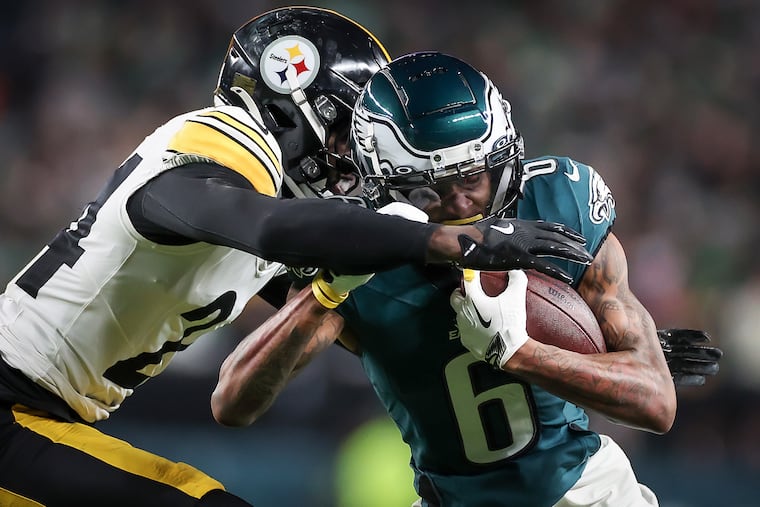
In 1933, the rights to a Philly NFL team were bought by Bert Bell (later to be the Commissioner of the NFL) and Lud Wray, and they founded the Philadelphia Eagles. The same year, Art Rooney founded a football team named the Pittsburgh Pirates, which he would rename the Pittsburgh Steelers in 1940. Together, Bell and Rooney lobbied the Pennsylvania legislature to make Sunday sports legal, and they succeeded, making the long-term success of their teams possible.
The Pirates/Steelers debuted on September 20, at home at Forbes Field, and lost to the New York Giants, 23-2. The Eagles debuted on October 15, also against the Giants, and they were nearly strangled in their crib, losing 56-0 at the Polo Grounds. Three days later, playing their 1st home game, at Baker Bowl, home of the Phillies in North Philadelphia, they lost 25-0 to the Portsmouth Spartans, the team that would become the Detroit Lions the next season.
Angelo Cataldi of Philadelphia sports-talk radio station WIP says of the city, "This place is wired for football." That's a little misleading: Philadelphia is a basketball city, but Pennsylvania is a football State. As political consultant James Carville, a graduate of Louisiana State University, said after getting Bob Casey Sr. elected Governor in 1986, "Pennsylvania is Philadelphia and Pittsburgh, with Alabama in between." He wasn't kidding: In neighboring New Jersey, we call the rural portions of the State "Pennsyltucky." The State is absolutely nuts about football.
In hindsight, legalizing Sunday sports was inevitable. Now, it is impossible to imagine an Autumn Sunday without a big percentage of the State's people in Eagles green and white, and another in Steelers black and gold.
*
November 7, 1933 was a Tuesday. Baseball season was over. Football was in midweek. The NBA hadn't been founded yet. And the NHL season started 2 days later. So there were no scores on this historic day, despite it being a day that made some scores possible.


