Showing posts with label bill veeck. Show all posts

Tuesday, October 11, 2022

October 11, 1948: The Cleveland Indians Win the World Series

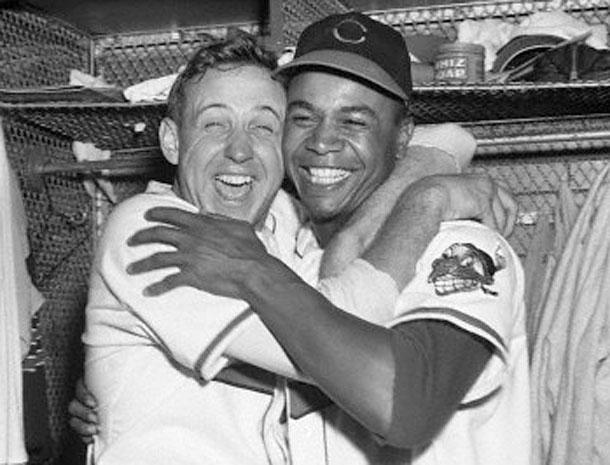
Steve Gromek (left) and Larry Doby

October 11, 1948: The Cleveland Indians defeat the Boston Braves behind "rookie" 30-year-old knuckleballer Gene Bearden, 4-3 at Braves Field, and take Game 6 and win the World Series. It is their 2nd title, the 1st coming in 1920.
Braves Field

Team owner Bill Veeck had built this team. Larry Doby and Satchel Paige thus become the 1st black players to play on a World Series winner. Doby became the 1st black player to hit a home run in a World Series game. And Lou Boudreau, age 31, both shortstop and manager, becomes the last player-manager to win a World Series, or even a Pennant. Bob Feller would join Veeck, Doby, Paige and Boudreau in the Baseball Hall of Fame, although he ended up as the losing pitcher in both games the Indians lost in the Series: Game 1, to Johnny Sain; and Game 5, to another Hall-of-Famer, Warren Spahn.
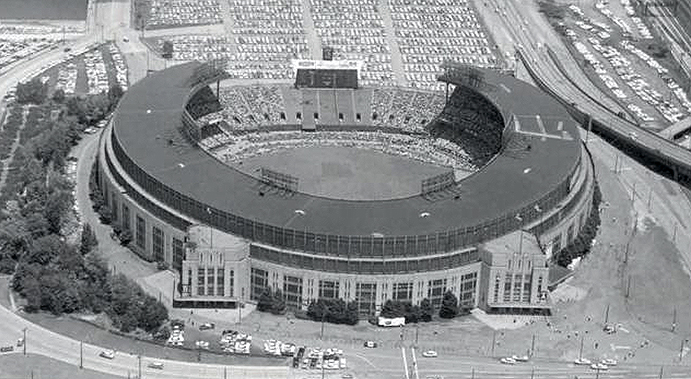
Cleveland Municipal Stadium

A photograph of Doby being hugged by a white teammate, pitcher Steve Gromek, circulated, and was considered another step forward in black and white players working together.

The team has never won another World Series. They have had some close calls, some of them truly agonizing. And they're not even called the Indians anymore: In 2021, after years of complaints about their Native American name and its racist implications, they announced that, for the following season and thereafter, they would be named the Cleveland Guardians.

But at least they're still in Cleveland, despite a number of fears of having to move in the 1960s, '70s and '80s. In contrast, despite all their success in the 19th Century and winning Pennants in 1914 and 1948, that 1948 World Series Game 6 was the last late-season meaningful game the Boston franchise of the National League would ever play. The Braves would be in Milwaukee by the next time they reached the Series, in 1957.

The Indians' Eddie Robinson was the last surviving player from the 1948 World Series, living until 2021, age 100, 73 years later. Clint Conatser was the last survivor of the '48 Braves, living until 2019, at 98.

UPDATE: The Guardians have a team Hall of Fame. From the 1948 World Champion Indians, they have honored Lou Boudreau, Bob Feller, Satchel Paige, Bob Lemon, Early Wynn, Mike Garcia, Joe Gordon, Larry Doby, Al Rosen, Ken Keltner, Jim Hegan, team owner Bill Veeck, scout Cy Slapnicka, and broadcasters Jack Graney and Jimmy Dudley. Feller and Hegan have also been elected to the Greater Cleveland Sports Hall of Fame.

*

October 11, 1948 was a Monday. This was also the day Thomas Merton publishes his memoir The Seven Storey Mountain. I have a separate entry for that event.

The baseball season had ended that day. Football was in midweek. And it was too soon for the NBA and NHL seasons. So there were no other scores on this historic day.

October 11, 1946: The Reynolds-Gordon Trade

Allie Reynolds

October 11, 1946: A trade is made in baseball, and it is a rarity: One that works out very well for both teams.

The New York Yankees trade 2nd baseman Joe Gordon to the Cleveland Indians for pitcher Allie Reynolds. Gordon, the 1942 American League Most Valuable Player, was nicknamed "Flash," not because of his flashy defense, but because he reminded people of science-fiction film hero Flash Gordon, played by Buster Crabbe, who also played another sci-fi hero, Buck Rogers.

Joe Gordon secured his (posthumously-elected) Hall of Fame status by helping the Indians win the 1948 World Series, on October 11, 2 years to the day after the trade. This was his 5th title, having won 4 with the Yankees. But the Yankees had gotten George "Snuffy" Stirnweiss in a separate trade, and then had Jerry Coleman, Billy Martin and Bobby Richardson at the keystone sack for the next 15 years.
Joe Gordon

The Indians needed a veteran infield presence like Gordon, and their owner, Bill Veeck, was willing to trade any pitcher except the future Hall-of-Famer Bob Feller. Yankee general manager Larry MacPhail asked his best player, Joe DiMaggio, which one he should take. The Yankee Clipper said, "Take Reynolds. I'm a fastball hitter, but he can buzz his hard one by me any time he has a mind to." In other words, "He's really good, so even if he does nothing for us, at least he won't be doing anything to us."

That fastball, and his Cherokee heritage, got Reynolds a nickname that applied to Native Americans and a famous train of the time: The "Superchief." Still, he was only 51-47, with a 3.31 ERA, for his career when the Yankees acquired him. There was no indication that he would become a great pitcher.

But he did. In a rotation that already included Vic Raschi, the "Springfield Rifle," the Yankees won the 1947 World Series. In 1948, the Yankees obtained Eddie Lopat, a lefthander specializing in off-speed pitches, known as "the Junkman."

And with new manager Charles "Casey" Stengel coming in for the 1949 season, and pitching the speedy righthander Reynolds followed by the junkballing lefty Lopat, followed by the speeding righthander Raschi, the Yankees had a very tough combination that won the next 5 World Series: 1949, '50, '51, '52 and '53 -- each time with a different 4th starter. So this trade helped the Yankees get 6 titles.

Reynolds only won 20 games once, in 1952, but that was partly because Stengel also frequently used him as a reliever. Had he come along 30 years later, he might have been a big blazing righthanded closer in the mold of Goose Gossage, Rob Dibble or Rod Beck. He hurt his back in 1954, but still managed to go 13-4 at age 37. He then retired: Having invested in oil wells in Oklahoma, he could afford to play for the love of the game, and then walk away.

The Yankees honored him with a Plaque for Monument Park in Yankee Stadium in 1989, although they have never retired his Number 22. He died in 1994.

*

October 11, 1946 was a Friday. There was baseball action on this day, Game 5 of the World Series at Fenway Park in Boston. The Boston Red Sox beat the St. Louis Cardinals, 6-3. Ted Williams singled in a run in the bottom of the 1st inning, and Cardinal manager Eddie Dyer panicked, taking out starter Howie Pollet. While Al Brazle got out of the jam, he gave up a home run to Leon Culberson in the 6th inning, and fell apart in the 7th. In contrast, Joe Dobson went the distance for the Sox, holding Stan Musial to a 1-for-3 day.

The Sox thus took a 3-games-to-2 lead in the Series. All they had to do was win 1 of 2 games at Sportsman's Park in St. Louis. They just had to win 1 more World Series game, and they would have their 1st World Championship since 1918. It took them another 58 years to get that title.

There was also a game played in the All-America Football Conference: The football version of the Brooklyn Dodgers and the Chicago Rockets played to a tie, 21-21 at Ebbets Field.

And there were 7 college football games:

* Number 8 Georgia beat Number 19 Kentucky, 28-13 at Sanford Stadium in Athens, Georgia.

* Georgetown beat Fordham, 8-7 at Griffith Stadium in Washington. Georgetown dropped their football program after the 1950 season, re-established it at NCAA Division III in 1973, and moved up to Division I-AA/Football Championship Subdivision in 1993. Fordham dropped their program after 1954, restored it to Division III in 1973, and to I-AA/FCS in 1989.

* South Carolina beat Furman University, 14-7 at Furman's Sirrine Stadium in Greenville, South Carolina.

* George Washington University beat Rollins College, 13-0 at Orlando Stadium (now Camping World Stadium). Orlando-based Rollins dropped their football program after the 1949 season, and D.C.-based GWU dropped theirs after 1946.

* The University of Miami beat Texas Christian University, 20-12 at Burdine Stadium (later renamed the Orange Bowl) in Miami.

* Wichita State University beat Drake University, 12-6 at Drake Stadium in Des Moines, Iowa. Drake downgraded their program to Division I-AA/FCS in 1971, and Wichita State dropped theirs after 1985.

* And Southern Methodist University beat Oklahoma A&M, 15-6 at the Cotton Bowl in Dallas. A&M became Oklahoma State in 1958.

Tuesday, September 27, 2022

September 27, 1953: The End of the St. Louis Browns

September 27, 1953: The Chicago White Sox beat the St. Louis Browns, 2-1 at the original Busch Stadium, known as Sportsman's Park until this season, in St. Louis. Minnie Miñoso doubled home the winning run in the top of the 11th inning. Attendance: Only 3,174. It was the last game the Browns ever played: The next season, they were sold, and moved to become the Baltimore Orioles.

Although they were the landlords at Sportsman’s Park, and the Cardinals were their tenants, the Cards were always more successful. Even in the one and only season in which the Browns won an American League Pennant, 1944 – the year they desegregated the stands at the ballpark, including for Cardinals’ games, over that team’s objections – the Cards beat them in the World Series.
Bill Veeck, who formerly owned the Cleveland Indians and the minor-league version of the Milwaukee Braves, bought the Browns in 1951, and, knowing that Cardinals owner Fred Saigh was in financial difficulty, thought he could force the Cards to move, and have the St. Louis market all to himself. It was necessary: St. Louis was big enough to support one major league baseball team, but not two.

It almost worked: Saigh, was imprisoned for tax evasion, and, according to Major League Baseball's rules, this meant that he had to sell the team. He came very close to selling the Cards to a group that was going to move them to Milwaukee for 1953.

But August Anheuser Busch Jr. stepped in. The grandson of Adolphus Busch and the great-grandson of Eberhard Anheuser, founders of the St. Louis-based brewing company that bears their names, wasn't a baseball fan at first. But he liked being a bigshot, which sports team owners are. And he wanted to sell lots and lots of beer, under the brand he'd been selling it under, Budweiser, named for the Budweis region of Austria, from which his grandfather Adolphus had come.

Someone told him that the Cardinals were for sale, and that their radio network, which reached all over the Midwest and into the South, could be used to sell Budweiser. That was all Gussie needed to hear: He bought the Cardinals from Saigh, and then bought Sportsman's Park, from Veeck, ending the odd status of the legendary loser Browns being the landlords, and the far more successful Cardinals (who had won 13 Pennants and 5 World Series, including beating the Browns in '44), being the tenants.

From that day onward, the Browns were doomed, because Gussie was rich as hell, and, like Tom Yawkey of the Boston Red Sox, and later George Steinbrenner of the New York Yankees and Earvin "Magic" Johnson of the Los Angeles Dodgers, he wasn't afraid to spend big if he thought it would get him big results.

Veeck knew the game was up. He applied to the AL to move the Browns to Baltimore for 1954. But the other AL team owners hated his guts, and they voted to let the move happen, but only on the condition that Veeck sell the team to a Baltimore-based group. Ironically, it was a brewery that bought them: Gunther Brewing Company, led by Jerry Hoffberger. (In the 1950s, Baltimore was every bit a brewing town as St. Louis and Milwaukee.)

The Browns weren't just unable to win Pennants, they were always broke, so they were usually terrible. Just as the Washington Senators were "First in war, first in peace, and last in the American League," St. Louis, because of its influence in the American leather and brewing industries, were said to be "First in shoes, first in booze, and last in the American League." They did have a sharp logo, showing St. Louis' namesake, Louis IX, the "Crusader King" of France.

In contrast, in their 1st 30 seasons in Baltimore, the franchise won 6 Pennants – although they haven’t won one in the 40 years since.

The end of the Browns had one other consequence, although it wasn't realized for a full year. Yankee catcher Lawrence "Yogi" Berra was from St. Louis, and when the Yankees made roadtrips to play the Browns, he would bring teammates over for Sunday dinner. The Yankees won the Pennant in 1947, just missed it in 1948, then won again in 1949, '50, '51, '52 and '53.

But with the Browns having moved, there was no trip to St. Louis -- like St. Louis, Baltimore had a large Italian community, and still does, but the Berras didn't live there -- and the Yankees didn't win the Pennant in 1954: They won 103 games, the most the franchise would win between 1942 and 1963, but finished 8 games behind the Cleveland Indians.

Pitcher Whitey Ford later said, "You know, we didn't win the Pennant in 1954, even though we had one of our best teams. And after the season, when we were fishing around for a reason why we didn't win, some of us would say it was because we didn't get to eat at the Berras' house."

After the 1954 season, the Browns-turned-Orioles and the Yankees, made the biggest trade by number of players in baseball history: 17. One of the players the Yankees got was Don Larsen, who pitched a perfect game for them in the 1956 World Series. He retired in 1967, as the last active former St. Louis Brown.

UPDATE: Billy Hunter, another player the Yankees acquired in that 17-man trade, became the last living former St. Louis Brown, living until July 3, 2025. He was their only All-Star in their final season, and played shortstop in that last game, as well as for the Orioles in their 1st game.

Browns players George Sisler, Bobby Wallace, Rogers Hornsby (more for what he did with the Cardinals), Don Gutteridge, Ned Garver, Roy Sievers and Satchel Paige have been elected to the St. Louis Sports Hall of Fame. So has team owner Bill Veeck and general manager Bill DeWitt Sr., whose son Bill Jr. had been the team batboy, and who lent his "Number 1/8th" uniform to Eddie Gaedel, the little person that Veeck sent up to pinch-hit in 1951.

Sievers, Gutteridge and Satchel Paige (more for what he did with the Negro Leagues' Kansas City Monarchs) have been elected to the Missouri Sports Hall of Fame.

*

September 27, 1953 was a Sunday. Italian soccer star Claudio Gentile was born on this day.

These other major league baseball games were played:

* The New York Yankees lost to the Boston Red Sox, 2-1 at Yankee Stadium. Bill Henry outpitched Whitey Ford, allowing only 2 hits, a double by Billy Martin and an RBI triple by Yogi Berra. Mickey Mantle went 0-for-3 with a walk. Ted Williams went 1-for-3 before leaving for a defensive replacement. It didn't matter: The Yankees had won the American League Pennant, with the Cleveland Indians the closest team, 8 1/2 games behind.

* The Brooklyn Dodgers beat the Philadelphia Phillies, 8-2 at Connie Mack Stadium in Philadelphia. Russ Meyer started, but only lasted 3 innings against his former team, thus not qualifying as the winning pitcher, who turned out to be Billy Loes. Robin Roberts fell to 23-16 on the season for the Phils. Jackie Robinson went 0-for-4, but drew a walk, and had an RBI on a sacrifice fly.

The Dodgers won 105 games, taking the National League Pennant by 13 games over the Milwaukee Braves, and might have had their most powerful lineup in franchise history. But they didn't yet have Don Newcombe back from the Korean War, while the Yankees had Whitey Ford back from it, and that helped make the difference, as the Yankees won the World Series in 6 games.

* The New York Giants lost to the Pittsburgh Pirates, 6-4 at Forbes Field in Pittsburgh. In the kind of odd move that sometimes happens in season finales, Alvin Dark, the Giants' Captain and usual shortstop, was the starting pitcher, going just 1 inning and allowing 2 runs, before giving way to Rubén Gómez, who went 7 innings. But it would be Al Corwin who gave up a game-winning homer in the bottom of the 9th, to Preston Ward. Cal Hogue went the distance for the Pirates.

Willie Mays was still in the U.S. Army, despite the Korean War being over. He would return during the next season's Spring Training, and would remain on the Giants' roster until May 11, 1972.

* The Philadelphia Athletics beat the Washington Senators, 9-2 at Griffith Stadium in Washington. A year later, the A's would leave Philly. Six years after that, the Senators would also move, replaced by a new team. That team would also move, after 11 years.

* The Detroit Tigers beat the Cleveland Indians, 7-3 at Cleveland Municipal Stadium. Al Aber outpitched Bob Feller. Ray Boone, father of Bob, and grandfather of Bret and Aaron, hit a home run for the Tigers. Rookie Al Kaline went 0-for-3 with a walk.

* The Milwaukee Braves beat the Cincinnati Redlegs, 8-2 at Crosley Field in Cincinnati. This was the 1st of 6 seasons in which the Reds caved in to anti-Communist pressure, and dropped the "Reds" name, before realizing it was stupid, and reclaiming their name.

* And the Chicago Cubs beat their arch-rivals, the St. Louis Cardinals, 3-2 at Wrigley Field in Chicago. At least the Cardinals would still be in St. Louis the next season. Stan Musial went 2-for-5. For the Cubs, Ralph Kiner went 0-for-4, and rookie Ernie Banks went 0-for-3.

And it was the opening Sunday of the NFL season. These games were played:

* The New York Giants lost to the Los Angeles Rams, 21-7 at the Los Angeles Memorial Coliseum.

* The Baltimore Colts beat the Chicago Bears, 13-9 at Municipal Stadium in Baltimore. That facility was being converted into Memorial Stadium for the 1954 baseball season. It had been a 70,000-seat football stadium, a horseshoe with the open end at the south, and the baseball diamond in the northwest corner, into a 50,000-seat multipurpose stadium, a horseshoe with the open end at the north, and the diamond in the south end.

* The Detroit Lions beat the Pittsburgh Steelers, 38-21 at Briggs Stadium (later Tiger Stadium) in Detroit.

* The Washington Redskins beat the Chicago Cardinals, 24-13 at Comiskey Park in Chicago.

* The Cleveland Browns beat the Green Bay Packers, 27-0 at Milwaukee County Stadium.

* And the San Francisco 49ers beat the Philadelphia Eagles, 31-21 at Kezar Stadium in San Francisco. 

Friday, September 23, 2022

September 22, 1959: The Go-Go White Sox Win the Pennant

September 22, 1959: The Chicago White Sox beat the Cleveland Indians, 4-2 at Cleveland Municipal Stadium, and clinch the American League Pennant, putting the Indians 4 1/2 games back with 4 games to play. For the White Sox, it is the 1st Pennant in 40 years.

The White Sox had won the World Series in 1917, and lost it in 1919. Late in the 1920 season, it was revealed that 7 members of the White Sox had "thrown" the 1919 World Series for a payoff from gamblers, and an 8th knew about the "fix" but hadn't told anyone. All 8 of them were banned for life, and it wrecked the franchise.

Despite such talents as hard-hitting shortstop Luke Appling and pitcher Ted Lyons, the South Siders didn't even get into another Pennant race until 1957. Finally, in 1959, with the New York Yankees -- who had won 9 of the last 10 Pennants -- having a rare bad year, the title was open for someone else.

The Indians looked good for it, with their right fielder, Rocky Colavito, having a fantastic season. But the White Sox had a former Indian, 39-year-old Early Wynn, as their ace, winning 24 games, with Billy Pierce and Dick Donovan giving them a good rotation. 

And with Comiskey Park not having close fences for a slugger -- although they did pick up former Cincinnati Reds 1st baseman Ted Kluszewski for the stretch drive -- they had a scrappy, running style that reminded people of the 1930s St. Louis Cardinals' "Gashouse Gang."

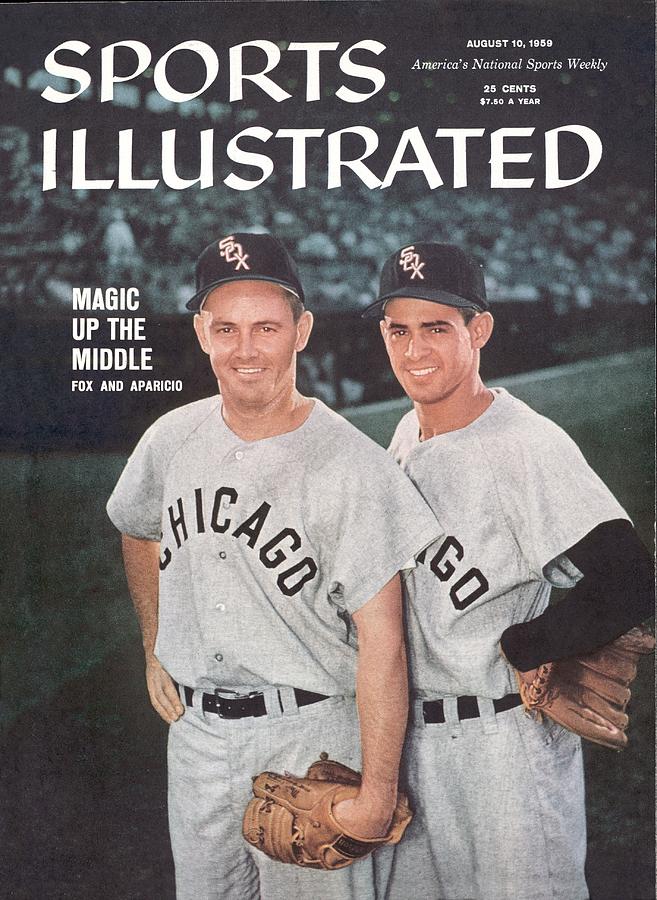
Shortstop Luis Aparicio and 2nd baseman Nellie Fox didn't just form the AL's best double-play combination, known as the Keystone Twins. They formed the nucleus of a team that made fans yell, "Go! Go! Go!" when they were on the bases. They became known as "The Go-Go White Sox," including an outfield of Al Smith, Jim Landis and Jim Rivera.

It led to Al Trace, a songwriter who had played in the White Sox' farm system, and Walter "Li'l Wally" Jagiello, to write a song for the team, recorded by Tom Fouts, a.k.a. Captain Stubby, leader of the band Captain Stubby and the Bucaneers. It remains the team's fight song to this day:

White Sox! White Sox! Go-Go White Sox!
Let’s go, Go-Go White Sox!
We’re with you all the way!
You’re always in there fighting,
and you do your best.
We’re glad to have you out here
in the Middle West.
We’re gonna root-root-root-root White Sox.
and cheer you on to victory.
When we’re in the stands,
we’ll make those rafters ring;
All through the season,
you will hear us sing.
Let’s go, Go-Go White Sox,
Chicago’s proud of you!

The last Pennant not won by the Yankees was in 1954, won by the Indians. Their manager was Al López. Bill Veeck had once owned the Indians (before that, building their 1948 World Champions), and now owned the White Sox, and hired López away. He led them to a record of 94-60.

They clinched in Cleveland, with 3 games to spare. Aparicio and Billy Goodman had RBI doubles in the 3rd inning, and Smith and Rivera hit back-to-back home runs in the 6th, to give the Pale Hose a 4-2 win over the Tribe. Wynn was the winning pitcher, rookie Jim Perry the losing pitcher. The last out was Vic Power grounding into a double play, Aparicio stepping on 2nd to force Jimmy Piersall out, and throwing Power out at 1st base. Thus ended a 40-year Pennant drought: Like the ancient Israelites, they had spent 40 years in the wilderness. 

Mayor Richard J. Daley lived at 3536 South Lowe Avenue, 9 blocks from Comiskey Park, and was a lifelong White Sox fan. He announced that, as soon as he got word that the Sox had clinched, he would order the City's air-raid sirens to go off. It is still widely remembered today.

Two oddities about this White Sox team: Because he was serving in the U.S. Marine Corps during World War II, Jack Brickhouse, long the voice of both Chicago teams but better known for his work with the National League's Cubs, missed the Cubs' 1945 Pennant. As a result, the only Pennant team he broadcast for in a long career was the '59 White Sox.

And Cuban left fielder Orestes "Minnie" Miñoso, who had starred for the ChiSox from 1951 to 1957, and would again in 1960 and 1961, was with the Indians at the time, so one of the most popular players in White Sox history missed out on this Pennant.

Fox was named the AL's Most Valuable Player, and Wynn received the Cy Young Award. The White Sox won Game 1 of the World Series against the Los Angeles Dodgers, and were leading Game 2, but the Dodgers struck back, winning the next 3 games. The White Sox won Game 5, but the Dodgers won Game 6 to take the title. The 1917 World Series was still the last one won by either Chicago team. 

Over the years, the White Sox had some close calls. They missed the Pennant by 1 game in 1964, and 3 games in 1967. They missed the AL Western Division title by 5 1/2 games in 1972, and led the Division as late as August 8 in 1977, before drifting to 12 games back. They won the Division in 1983, but lost the AL Championship Series to the Baltimore Orioles. In 1990, the last season at the old Comiskey Park, they stayed close to the Oakland Athletics most of the season, before 9 back.

In 1993, they won the AL West, but lost the ALCS to the Toronto Blue Jays. In 1994, they led the newly-created AL Central Division when the Strike hit. In 2000, they won the Division, but lost the AL Division Series to the Seattle Mariners.

And so their drought after 1959 turned out to be longer than the one they had from 1919 to 1959. What's more, the crosstown Cubs, who hadn't won a Pennant since 1945 and the World Series since 1908, and the Boston Red Sox, who hadn't won the World Series since 1918 -- one year more recently than the White Sox -- were celebrated for their seemingly "cursed" close calls. The White Sox? They didn't have a litany of bizarre incidents down the years that could seemingly be ascribed to a curse. They just... lost.

And with the Cubs having gotten the WGN Superstation to broadcast their games, and the White Sox not, and the Cubs and the Red Sox both having literati write lots of books about their woe-is-us status, it was as if the baseball world didn't care that the White Sox hadn't won the World Series for longer than the Red Sox. Even when the Red Sox finally won it in 2004, the attention that was on them didn't shift to the White Sox. If anything, the Cubs got even more.

Finally, the White Sox won the Pennant again in 2005, and swept the Houston Astros in the World Series, 4 straight. It was Chicago's 1st title in 88 years. Still, the Cubs had better attendance over the next few years. And when the Cubs finally won it all again in 2016, it was celebrated as a great moment for Chicago and environs, and White Sox fans were all, "Uh, hello? We did it first!"

*

September 22, 1959 was a Tuesday. These other baseball games were played that day:

* The New York Yankees beat the Washington Senators, 8-4 at Griffith Stadium in Washington. Despite having by far the best season of anyone on the Yankees, Mickey Mantle struck out in his 1st at-bat in this game, and then left due to injury, and played in only 1 of the season's last 4 games.

* The Boston Red Sox beat the Baltimore Orioles, 4-3 at Fenway Park in Boston. Ted Williams did not play. Brooks Robinson went 1-for-4.

* The Philadelphia Phillies swept a doubleheader from the Cincinnati Reds, 3-1 and 3-2 at Connie Mack Stadium (formerly Shibe Park) in Philadelphia. Frank Robinson did not play for the Reds in either game.

* The Milwaukee Braves beat the Pittsburgh Pirates, 5-3 at Forbes Field in Pittsburgh. Hank Aaron went 0-for-3, but had an RBI on a sacrifice fly. Roberto Clemente went 0-for-4.

* The Detroit Tigers beat the Kansas City Athletics, 6-4 at Briggs Stadium in Detroit. (That ballpark was renamed Tiger Stadium in 1961.) Al Kaline went 1-for-2 with a walk. For the A's, Roger Maris went 2-for-5. In the off-season, the Yankees traded for Maris.

* The Chicago Cubs beat the San Francisco Giants, 5-4 at Wrigley Field in Chicago. Unlike the White Sox, the North Siders had a losing season, but Ernie Banks was still named the National League's MVP. In this game, he went 2-for-4 with an RBI. Willie Mays went 1-for-4 with a walk. The Cubs led 3-2 after 7 innings, but the Giants scored 2 runs in the 8th. The Cubs won it in the bottom of the 9th, on a 2-run home run by George Altman.

* And the St. Louis Cardinals beat the Los Angeles Dodgers, 11-10 at the 1st Busch Stadium (formerly known as the last Sportsman's Park) in St. Louis. Neither the Dodgers' Sandy Koufax nor the Cardainals' Larry Jackson got out of the 1st inning. Stan Musial went 1-for-3 with a walk.

Monday, September 12, 2022

September 12, 1976: A Hit for Minnie Miñoso -- at Age 53

September 12, 1976: The Chicago White Sox sweep a doubleheader from the California Angels at Comiskey Park, 2-1 and 5-1.

In the 10th inning of the opener, Sid Monge walked future Yankee Jim Spencer, and gave up a game-winning double to Brian Downing, making a winning pitcher out of future Yankee Rich "Goose" Gossage.

Minnie Miñoso, age 53, batted 9th as the designated hitter, and went 1-for-3, singling off Monge in the 2nd inning. He got the 2nd game off. A longtime player for the White Sox, he was coaching for them, and team owner Bill Veeck, seeing yet another opportunity to perk up publicity for his team, activated him. At the time, Miñoso was believed to be the oldest player ever to get a hit in a major league game.

This is because Charlie O'Leary, another coach briefly reactivated for a late-season game, in his case in 1934, was believed to have been born in 1882, so Miñoso got credit for breaking his record. Later, it was discovered that O'Leary was born in 1875, so he was just short of turning 59. So, while Miñoso's achievement was remarkable, it was not unprecedented.

In 1980, Veeck sent him up to bat again, making him a 5-decade player (1940s to 1980s), but he did not get a hit. So O'Leary remains the oldest player to come to bat, the oldest to get a hit, and the oldest to score a run.

Mexican lefthander Francisco Barrios went the distance for the win in the 2nd game. But his career would end tragically: In 1981, while still an active player, he injured his elbow, then, during the strike that season, he was arrested for cocaine possession in a Chicago bar owned by Chicago Bears player Doug Buffone.
He entered a rehab program, but the White Sox released him before the season ended. He signed with a team in the Mexican Pacific League, and pitched for them in 1982. The Milwaukee Brewers were interested in him. But he died of a heart attack, probably brought on by cocaine use. He was 28 years old.

*

September 12, 1976 was a Sunday. These other Major League Baseball games were played:

* A doubleheader was split at Yankee Stadium. The Detroit Tigers won the opener, 6-0. Mark Fidrych, the season's rookie sensation, allowed 9 hits, but kept the shutout, outpitching another player known for unusual activities, Dock Ellis. Ben Oglivie hit a home run. The New York Yankees won the nightcap, 3-1. Ed Figueroa outpitched Ed Glynn. In the 1st inning, Mickey Rivers reached on an error, was doubled home by Elliott Maddox, and he was singled home by Lou Piniella.

* The New York Mets lost to the St. Louis Cardinals, 6-5 at Busch Memorial Stadium in St. Louis. Ted Simmons doubled Garry Templeton and future Met Keith Hernandez home in the bottom of the 8th inning to win the game. Hernandez and Héctor Cruz had homered for the Cards.

* The Boston Red Sox beat the Cleveland Indians, 11-3 at Fenway Park in Boston. Luis Tiant went the distance for the win, allowing just 6 hits, but 2 of them were home runs by George Hendrick. Carlton Fisk and Jim Rice homered for the Sox. Carl Yastrzemski went 2-for-3 with 2 RBIs. Indians manager Frank Robinson did not put himself into the game, and made his last appearance as a player 6 days later.

* The Philadelphia Phillies beat the Chicago Cubs, 8-0 at Veterans Stadium in Philadelphia. Larry Christenson allowed 6 hits over 7 innings, and Tug McGraw finished the 6-hit shutout. Mike Schmidt went 1-for-4 with a walk and an RBI.

* The Pittsburgh Pirates beat the Montreal Expos, 6-1 at Three Rivers Stadium in Pittsburgh. Willie Stargell did not play. Richie Zisk went 3-for-3 with a walk and an RBI.

* The Baltimore Orioles beat the Milwaukee Brewers, 3-1 at Milwaukee County Stadium. Jim Palmer outpitched Jerry Augustine. Reggie Jackson, in his only season as an Oriole, went 2-for-3 with a solo home run and a walk. Brooks Robinson did not play. Robin Yount went 0-for-4. 2nd baseman Tim Johnson got 3 of the Brew Carew's 6 hits. Hank Aaron, in his last month as an active player, did not play.

* The Kansas City Royals beat the Minnesota Twins, 16-6 at Metropolitan Stadium in the Minneapolis suburb of Bloomington, Minnesota. The Royals scored 9 runs in the top of the 6th. Frank White went 1-for-4 with 4 RBIs, on a triple and a sacrifice fly. Hal McRae and Bob Stinson each had 3 hits. George Brett went 2-for-5. Rod Carew went 1-for-4.

* The Oakland Athletics beat the Texas Rangers, 9-6 at Arlington Stadium in the Dallas suburb of Arlington, Texas.

* A doubleheader was split at Dodger Stadium in Los Angeles. The Atlanta Braves won the 1st game, 3-2. In the top of the 10th inning, Dave May reached on an error by Bill Russell, allowing Rod Gilbreath to score the winning run. This allowed Adrian Devine to become the winning pitcher, in relief of Phil Niekro. The Los Angeles Dodgers won the 2nd game, 2-0. Don Sutton pitched a 4-hit shutout.

* And a doubleheader was split at Candlestick Park in San Francisco. The San Francisco Giants won the 1st game, 3-1. Johnny Bench went 0-for-4, and got the 2nd game off. The Cincinnati Reds won the 2nd game, 9-8. Dave Concepción hit a sacrifice fly, scoring Joel Youngblood with the winning run in the top of the 11th. Over the 2 games, Pete Rose went 4-for-10 with 3 RBIs.

And the NFL season opened, with these games:

* The New York Giants lost to the Washington Redskins, 19-17 at Robert F. Kennedy Stadium in Washington.

* The New York Jets lost to the Cleveland Browns, 38-17 at Cleveland Municipal Stadium.

* The Baltimore Colts beat the New England Patriots, 27-13 at Schaefer Stadium (later Sullivan Stadium and Foxboro Stadium) in the Boston suburb of Foxborough, Massachusetts.

* The Dallas Cowboys beat the Philadelphia Eagles, 27-7 at Texas Stadium in the Dallas suburb of Irving, Texas. This was Dick Vermeil's 1st game as Eagles head coach. The Cowboys had dominated the NFC Eastern Division, and would continue to. Vermeil would focus on Dallas, starting each practice with the words, "What's it going to take to beat the Dallas Cowboys?" It would take until 1979 for him to find an answer. The Eagles beat the Cowboys in the 1980 NFC Championship Game.

* The Los Angeles Rams beat the Atlanta Falcons, 30-14 at Atlanta-Fulton County Stadium.

* The Minnesota Vikings beat the New Orleans Saints, 40-9 at the Superdome in New Orleans.

* The Cincinnati Bengals beat the Denver Broncos, 17-7 at Riverfront Stadium in Cincinnati.

* The Chicago Bears beat the Detroit Lions, 10-3 at Soldier Field in Chicago.

* The San Francisco 49ers beat the Green Bay Packers, 26-14 at Lambeau Field in Green Bay, Wisconsin.

* The San Diego Chargers beat the Kansas City Chiefs, 30-16 at Arrowhead Stadium in Kansas City.

* The expansion Tampa Bay Buccaneers made their regular-season debut, losing to the Houston Oilers, 20-0 at the Astrodome in Houston.

* The Oakland Raiders beat the Pittsburgh Steelers, 31-28 at the Oakland Coliseum. The Raiders would beat the 2-time defending Champion Steelers again in the AFC Championship Game.

* The expansion Seattle Seahawks also made their regular-season debut, losing to the football version of the St. Louis Cardinals, 30-24 at the Kingdome in Seattle.

* And the next night, on ABC Monday Night Football, the Miami Dolphins beat the Buffalo Bills, 30-21 at Rich Stadium (later Ralph Wilson Stadium) in the Buffalo suburb of Orchard Park, New York.

Wednesday, August 24, 2022

August 24, 1951: Grandstand Managers Night

August 24, 1951: The St. Louis Browns beat the Philadelphia Athletics, 5-3 at Sportsman's Park in St. Louis. Team manager Zack Taylor cannot claim credit for the win, though: It was Grandstand Managers Night.
Born in Florida in 1898, James Wren Taylor, nicknamed after the 12th President of the United States, Zachary Taylor, was a catcher in the major leagues from 1920 to 1935. As a rookie, he reached the World Series with the Brooklyn Robins, as the Dodgers were known while Wilbert Robinson was their manager. He reached the World Series again with the Chicago Cubs in 1929 and 1932. He was considered a good defensive catcher, but for most of his career was a backup.
He managed in the minor leagues from 1936 to 1940, became a coach for the Browns in 1941, and was on manager Luke Sewell's staff when the Browns won their only American League Pennant in 1944. Sewell resigned in 1946, and Taylor finished the season as manager. In 1947, he joined the coaching staff of the Pittsburgh Pirates. The next season, Browns GM Bill DeWitt brought him back as manager.
In 1951, former Cleveland Indians owner Bill Veeck bought the Browns, and used his promotional skill to try to make the team, landlords of the more successful St. Louis Cardinals of the National League, the more popular team in town. On August 19, he signed Eddie Gaedel, a 3-foot-7-inch midget, to a contract and let him bat, drawing a walk, and then having him removed from the game. Taylor appeared to have no problem with this.
But, 5 days later, Veeck held Grandstand Managers Night. Veeck had hired Max Patkin, the traveling ballpark comedian already known as "The Clown Prince of Baseball," to be his 1st base coach for this game. He had 1,115 placards printed up, with "YES" on one side and "NO" on the other. At certain points in the game, a man would hold up signs, asking key questions, such as, "SHOULD WE WALK HIM?" (Issue an intentional walk.) "SHOULD WE YANK HIM?" (Replace the pitcher.) "INFIELD IN?" (In an attempt to get a double play.) And so on.
Art Ehlers, general manager of the Athletics, said the idea was "farcical." But the Browns beat the A's. In his autobiography, Veeck -- As in Wreck, Veeck wrote, "Never has a game been called better." When the A's scored 3 runs in the top of the 1st inning, the fans were asked, "INFIELD IN?" A majority of the placards said, "YES," and it worked: They got a double play.
In the bottom of the 1st inning, the Browns tied the game, 3-3, the fans were asked, "STEAL?" They said, "YES." But this was a little too obvious, and 1st baseman Hank Arft was thrown out stealing 2nd base with two outs. Unfortunately, the Athletics apparently saw the move coming, and Arft was thrown out easily to end the inning.
But it was the only mistake the fans made. At the start of the 2nd inning, with starting pitcher Ned Garver having allowed 3 runs in the 1st, the fans were asked, "SHOULD WE YANK HIM?" A majority of the placards said, "NO," so Garver was left in, and it worked: He pitched shutout ball the rest of the way.
Grandstand Managers Night was 1 of only 52 games the Browns won all season. Zack Taylor was fired after the season. Two seasons later, with Gussie Busch and his seemingly unlimited beer money now funding the Cardinals, Veeck realized that it was his team, not the other one, that would have to go. He sold the Browns, who were moved to become the Baltimore Orioles.
Zack Taylor
With the stigma of having been outmanaged by his own fans, Taylor never managed again, at any level. But he served as a scout, first for the Chicago White Sox, then for the Milwaukee and Atlanta Braves, a post he still held when he died in 1974.
*
August 24, 1951 was a Friday. Science fiction author Orson Scott Card was born. And these other baseball games were played:

* The New York Yankees beat the Cleveland Indians, 2-0 at Cleveland Municipal Stadium. Gene Woodling provided all the scoring with a 2-run home run in the top of the 7th inning, making Joe Ostrowski a winning pitcher in relief of Stubby Overmire, beating Early Wynn. Joe DiMaggio, in his last season, went 1-for-5. Mickey Mantle, in his 1st season, went 1-for-4 with a walk.

* The New York Giants beat the St. Louis Cardinals, 6-5 at the Polo Grounds. Whitey Lockman tied the game in the bottom of the 9th by singling home Monte Irvin. Davey Williams grounded to short, and Bobby Thomson scored the winning run on a fielder's choice. Lockman and Alvin Dark hit home runs. Rookie Willie Mays went 3-for-5 with an RBI. Stan Musial went 0-for-5.

* The Brooklyn Dodgers beat the Chicago Cubs, 1-0 at Ebbets Field. The only run of the game came on a double by Jackie Robinson in the bottom of the 1st inning, scoring Pee Wee Reese. Ralph Branca had perhaps his greatest game, pitching a 3-hit shutout, no walks, 10 strikeouts, to outpitch Paul Minner. No one knew it, but Branca was 40 days away from his worst moment in the major leagues.

* The Boston Braves swept a doubleheader from the Cincinnati Reds, 5-1 and 2-1 at Braves Field in Boston. Warren Spahn and Chet Nichols were the winning pitchers.

* The Pittsburgh Pirates beat the Philadelphia Phillies, 5-1 at Shibe Park in Philadelphia.

* The Washington Senators beat the Detroit Tigers, 10-7 at Briggs Stadium (later Tiger Stadium) in Detroit.

* And the Chicago White Sox beat the Boston Red Sox, 3-2 at Comiskey Park in Chicago. Ted Williams went 0-for-3 with a walk.

Friday, August 19, 2022

August 19, 1951: The Eddie Gaedel Game

August 19, 1951: Eddie Gaedel makes his major league debut. He reaches base in his 1st plate appearance. He never makes a 2nd.

Born on February 9, 1914 in Chicago, William Louis Veeck Jr. was the son of a Chicago Cubs executive, and, in 1937, was responsible for putting the ivy on the brick outfield wall at Wrigley Field, and supervised the building of the hand-operated scoreboard atop the bleachers. He later bought the minor-league version of the Milwaukee Brewers, who won 3 American Association Pennants. After serving in World War II, he bought the Cleveland Indians, and built the team that won the 1948 World Series.

He got divorced the next year, and, needing cash, he sold the Indians. In 1951, he bought the St. Louis Browns, the most embarrassing team in the American League. Although they owned Sportsman's Park, leasing it to the National League's St. Louis Cardinals, they were pathetic, and had hardly any attendance at all. Veeck thought he could save the Browns, and drive the Cardinals, despite their 4 Pennants and 2 other near-misses in the 1940s, out of town.

Veeck held all kinds of promotions, including races between players and track stars, cow-milking contests, things like that. He once said, "There is nothing in the world more beautiful than a baseball stadium full of people having fun." But, despite a seating capacity of just 30,804, Sportsman's Park wouldn't fill, even for these promotions, leading Veeck to say, "You can draw more people with a losing team plus bread and circuses than with a losing team and a long, still silence."
In 1951, the American League celebrated its 50th Anniversary. All 8 teams wore anniversary sleeve patches. Veeck decided to celebrate the anniversary on August 19, with a large cake, which had wheeled onto the field between games of a Sunday doubleheader, against the Detroit Tigers. The Tigers won the 1st game, 5-2.

Out of the cake popped Eddie Gaedel, a 3-foot-7-inch, 65-pound dwarf. The term "dwarf" comes from German folklore, and referred to supernatural beings with a human appearance. Scientifically speaking, a "dwarf," or a "person with dwarfism," is defined as an adult with a height of less than 4 feet, 10 inches. The average adult height among people with dwarfism is about 4 feet even.

The term "midget" comes from "midge," a tiny biting insect, and has historically been used for any person considered short; but, unlike "dwarf," it does not have a scientific definition. Various other small things have had the tag applied: Small cars are used in "midget racing," a kids' hockey team is sometimes called "midget hockey," and so on." But people with dwarfism consider "midget" to be a slur, and it is not used as often anymore. On TV nostalgia networks' rebroadcasts of old shows, when the word "midget" was originally used, it is sometimes bleeped out.

While Eddie Gaedel was, medically speaking, a dwarf, he has gone down in history as "the midget who played baseball." Born on June 8, 1925, and also a Chicagoan, he had worked as a riveter during World War II, as he was small enough to climb into spaces fully-grown men couldn't. After the war, he became a professional entertainer, and was the model for the "Mercury Man" logo of Mercury Records.

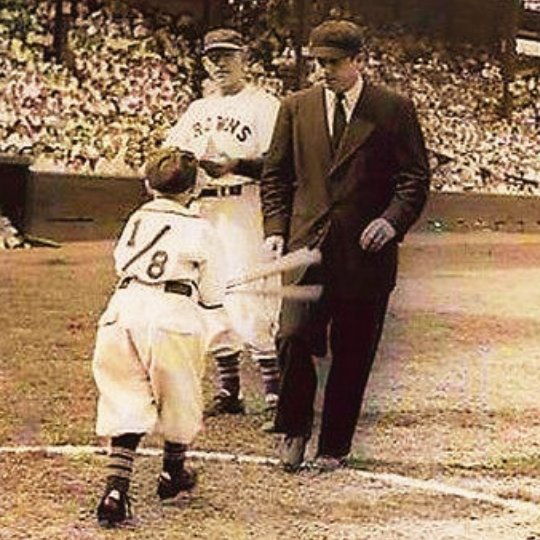
Gaedel popped out of the cake wearing a Browns uniform with the Number 1/8 (one-eighth) on it. The uniform belonged to Bill DeWitt Jr., the Browns' batboy, and the son of Bill DeWitt Sr., the Browns' general manager. The fans got a kick out of it.
Bill DeWitt Jr. wearing the unusual number


But that wasn't the end of it. In the bottom of the 1st inning, Gaedel walked to the plate, to pinch-hit for the alleged leadoff hitter, right fielder Frank Saucier. He was announced by the public-address announcer. The fans went wild -- although there were just 18,369 of them, so the stunt didn't get a big crowd.

The home plate umpire, Ed Hurley, wasn't having it. He called time-out, and looked over to Browns manager Zack Taylor. But Taylor was ready: He walked out, and took a rolled-up piece of paper from his pocket. It was Gaedel's contract, signed not only by him and by Veeck, but by the President of the American League, Will Harridge. Clearly, Harridge signed it with no idea that the player involved was 3-foot-7. The subject of signing a midget to a contract had never come up before. So the contract was real and official. Hurley had no choice: He had to allow the at-bat.
Note the height of the ball in the mitt, compared to Gaedel's.
Note also Gaedel's crouching stance.

With his height, and a crouching batting stance, Gaedel had the smallest strike zone in baseball history, not much larger than the ball itself. The idea was that the pitcher, Bob Cain, wouldn't come close to a strike, and that Gaedel would walk on 4 straight pitches.

Veeck told Gaedel that there was a sniper on the roof of Sportsman's Park, ready to shoot him if he swung at any pitch. Veeck never said whether there actually was a sniper. If there really was one, he never came forward and admitted it. And whether Gaedel took this threat seriously, only he knew.

What everyone else knew is that catcher Bob Swift got onto his knees, and told Cain, "Keep it low." Cain threw 4 pitches. The 1st 2 were serious attempts at strikes, and did get over the plate, but were too high. Realizing it was hopeless, Cain threw the last 2 at half-speed, still getting them over the plate, but at about the level of Gaedel's head.

After ball 4, Hurley told Gaedel, "Take your base," and Gaedel trotted to 1st base. Jim Delsing then ran out to pinch-run for him. Like a real major-league ballplayer, which he now was, Gaedel slapped Delsing on the rear and, and trotted off the field -- to a standing ovation.

Delsing remained in the game, played center field as former Yankee Cliff Mapes moved from center to right, and went 1-for-3. It was no use: The Tigers got a fine pitching performance from Cain, a home run from Jerry Priddy, and 3 hits each from George Kell and Pat Mullin, and completed the sweep, 6-2.

The next day, AL President Harridge publicly said that Veeck was making a mockery of the game, and voided Gaedel's contract. In response, Veeck, who always hated the New York Yankees, told the Chicago press that he was going to request an official ruling on whether Phil Rizzuto, the Yankees' shortstop and the previous season's AL Most Valuable Player, was "a short ballplayer or a tall dwarf." 

Rizzuto was listed at 5-foot-6, and that may have been generous by an inch. Nevertheless, he was also the best shortstop in baseball at that point, and had batted .324 the season before, getting 200 hits. And, while his 92 walks that season were a career high, that was hardly an extraordinary total, probably was not much aided by his lack of height. Rizzuto's reaction to Veeck's request is unrecorded, but it would probably have been something like, "Veeck, you huckleberry. Holy cow."

Nevertheless, Gaedel got paid for his appearance: $100, his standard fee at the time. (In 2022 money, it works out to about $1,134.) Some time later, he was a guest on the radio show of Chicago-based talk show host Louis "Studs" Terkel. He complained that "Mr. Veeck" wouldn't let him swing the bat, and that he wanted to do that, just once. Terkel, then 39 years old and not looking much like a man who had ever been any kind of athlete, consoled him by saying, "You are exactly what I wish I was: An ex-big-league ballplayer!"

(Terkel would later play Chicago sportswriter Hugh Fullerton in Eight Men Out, the film about the 1919 Black Sox Scandal, and be interviewed by Ken Burns, including on the subject of Gaedel, for his miniseries Baseball.)

Veeck had hoped to run the financially troubled Cardinals out of St. Louis. But, early in 1953, they were bought by Anheuser-Busch chairman Gussie Busch. With Busch's beer fortune behind them, Veeck knew the Browns could not afford to compete for St. Louis' baseball fans.

He didn't particularly care about St. Louis: He just wanted to eliminate the competition and be Number 1 in whatever city he was in, as he had been in Milwaukee and Cleveland. With that option no longer available in St. Louis, he tried to get the Browns moved to Baltimore. The other AL owners, seeing a chance to get rid of him, voted to approve the move, on the condition that Veeck sell the team. He did. But in 1959, he bought the Chicago White Sox.

On May 26, 1959, as Harvey Haddix of the Pittsburgh Pirates, was pitching his perfect-but-then-not game, 90 miles to the north in Milwaukee, Eddie Gaedel worked for Bill Veeck again. A helicopter carrying Gaedel and 3 other dwarfs dressed in spacesuits landed on the infield at Comiskey Park. They came bearing gifts: Ray guns. They gave these to White Sox stars Luis Aparicio and Nellie Fox. In a parody of the alien visitors' line, "Take me to your leader," Gaedel told them, "I don't want to be taken to your leader. I've already met him." The White Sox won the Pennant that season.

On June 18, 1961, Gaedel was found dead in his bed by his mother, with bruises all over his body. He was just 36 years old. His killer has never been identified.

By this point, Veeck had sold the White Sox, to pay for his medical expenses, as he had been told he was dying. This turned out to be a misdiagnosis, as he recovered, and he later owned the White Sox again, from 1975 to 1980. He lived until 1986.

But as a result of his 1961 illness, he was unable to attend Eddie Gaedel's funeral. Indeed, only one person with any connection with baseball did: Bob Cain, the pitcher who faced him. They had never even formally met.

Catcher Bob Swift died in 1966. Umpire Ed Hurley lived until 1969. Will Harridge served as AL President from 1931 to 1959, and died in 1971. Browns manager Zack Taylor lived until 1974. Bob Cain lived until 1997. Pinch-runner Jim Delsing lived until 2006. As of August 19, 2022, Frank Saucier, for whom Gaedel pinch-hit, is still alive, 1 of 3 surviving former St. Louis Browns, along with Ed Mickelson and Billy Hunter. (UPDATE: All 3 of those men died in 2025, Hunter turning out to be the last survivor of them.)

Bill DeWitt Jr. donated his uniform, Gaedel's uniform, to the Baseball Hall of Fame in Cooperstown, New York. He later became the principal owner of the St. Louis Cardinals, and got the uniform back, where it is on display at the St. Louis Cardinals Hall of Fame and Museum, across Clark Avenue from the current Busch Stadium, which also features artifacts from the Browns and St. Louis-area natives who played for other teams, such as Yogi Berra. 

Officially, the shortest players in MLB history have been Edmund "Stubby" Magner, who played 13 games for the New York Highlanders (forerunners of the Yankees) in 1911; and Pompeyo "Yo-Yo" Davalillo, who played 19 games for the Washington Senators in 1953. Both were listed at 5-foot-3.

In 1978, in his 2nd go-round as White Sox owner, Veeck promoted Harry Chappas to the majors, telling the media that he was, after Gaedel, the shortest player in MLB history, at 5-foot-3. This was a lie, but, fittingly, a small one: He was really 5-foot-5, the same height as the man then considered the shortest in the majors, Freddie Patek of the Kansas City Royals. Magner, Davalillo, Chappas and Patek were all, by a quirk of fate, shortstops.

Jon Rauch appeared in the major leagues from 2002 to 2013, including for the Montreal Expos when they moved to become the Washington Nationals in 2004-05, and for the Minnesota Twins in 2009 and 2010, enabling him to appear in postseason play. Sean Hjelle made his big-league debut with the San Francisco Giants in 2022. Both are 6-foot-11, and thus the tallest players in MLB history. Loek van Mil, a 7-foot-1 native of the Netherlands, appeared in professional baseball from 2006 to 2018, but only got as high, if you'll pardon the choice of words, as Class AAA. All 3 of these men are relief pitchers.

*

August 19, 1951 was a Sunday. John Deacon, the bass guitarist for Queen, was born.

And these other games were played that day:

* The New York Yankees had their worst game of the season, losing to the Philadelphia Athletics, 15-1 at Yankee Stadium. Starting pitcher Bob Wiesler didn't get out of the 3rd inning, former St. Louis Browns ace Jack Kramer (no relation to the great tennis player of that era, of the same name) couldn't stop the bleeding, and Frank "Spec" Shea really took one for the team, allowing 11 runs in 3 innings. But of the A's' 15 runs, only 9 were earned, as the Yankees made 3 errors.

Dave Philley -- who, true to his name, ended up playing for both the A's and the Philadelphia Phillies -- went 5-for-5 with a walk and 2 RBIs. Joe Astroth hit a home run. Morrie Martin went the distance for the win. Joe DiMaggio, in his last few weeks as an active player, went 0-for-3 with a walk. Rookie Mickey Mantle had been sent down to the minor leagues, but would soon be called back up.

* The New York Giants beat the Philadelphia Phillies, 5-4 at Shibe Park in Philadelphia. The Phils led 4-0 after 6 innings, but the Giants came back. Rookie Willie Mays went 1-for-5, and a home run was hit by Bobby Thomson. It was his 23rd of the season. He would finish with a career-high 32. The last one may have been the shortest in physical distance, but it has traveled the longest in memory.

* The Brooklyn Dodgers lost to the Boston Braves, 13-4 at Braves Field in Boston. Ralph Branca got chased in the 6th inning. Roy Campanella hit a home run off Warren Spahn. Jackie Robinson went 0-for-4.

* The Boston Red Sox beat the Washington Senators, 8-3 at Griffith Stadium in Washington. Ted Williams hit a home run.

* The Pittsburgh Pirates swept a doubleheader from the Chicago Cubs, 4-2 and 5-4 at Forbes Field in Pittsburgh.

* The St. Louis Cardinals swept a doubleheader from the Cincinnati Reds, 5-4 and 5-1 at Crosley Field in Cincinnati. Over the 2 games, Stan Musial went 4-for-7 with 2 walks and an RBI.

* And a doubleheader was split at Comiskey Park in Chicago. The Cleveland Indians won the opener, 4-0. Early Wynn pitched a 7-hit shutout. The Chicago White Sox won the nightcap, 7-6. The ChiSox scored 5 runs in the bottom of the 7th. The Tribe scored 5 in the top of the 8th, but couldn't complete the comeback.
Thursday, August 4, 2022

August 4, 1977: The Modern Height of Chicago Baseball

August 4, 1977: This is the modern height of Chicago baseball. Both of Chicago's baseball teams are in 1st place in their respective Divisions. That had never happened this late in the season before (including in the years of single-division leagues), and it has only happened once since (in 2008).

On this day, the Chicago White Sox beat the Texas Rangers, 5-4 at Comiskey Park, on the South Side. Steve Stone outpitched Bert Blyleven. Oscar Gamble went 3-for-3. As a result of this game, the White Sox led the American League Western Division by 3 1/2 games over the Minnesota Twins, 4 1/2 over the Kansas City Royals, and 5 1/2 over the Rangers.
Oscar Gamble

White Sox owner Bill Veeck was going for it: Having saved the team from bankruptcy and from being moved to Seattle in the 1975-76 off-season, and staged several kooky promotions like he had in his previous ownership of the South Siders, 1959 to 1961, he obtained a few "rent-a-players," in an attempt to win the Pennant this season, knowing that, as perhaps the least wealthy team owner in Major League Baseball, he wouldn't be able to re-sign them as free agents for the next season. He often remarked, "It's not the high price of talent that bothers me, it's the high prices of mediocrity."

Tying in with Chicago's image as a high-crime city, particularly one gripped by organized crime, the '77 White Sox became known as "The South Size Hit Men." Designated hitter Gamble hit 31 home runs and had 83 RBIs, right fielder Richie Zisk hit 30 home runs and had 101 RBIs, 2nd baseman Jorge Orta had 84 RBIs, 1st baseman Jim Spencer had 18 homers and 69 RBIs, 3rd baseman Eric Soderholm had 25 home runs and 67 RBIs, center fielder Chet Lemon had 67 RBIs, designated hitter Lamar Johnson had 65 RBIs, and left fielder and former National League batting champion Ralph Garr batted .388 and had 54 RBIs.

This was no old-style "Go-Go White Sox": Garr, whose speed had earned him the nickname "The Roadrunner," led the team with 12 stolen bases. There were a lot of fireworks shot off from Comiskey's center field "exploding scoreboard," and organist Nancy Faust gleefully playing Steam's 1969 Number 1 hit "Na Na Hey Hey Kiss Him Goodbye" every time the "Hit Men" led an opposing manager to relieve his pitcher.

Playing their home games at Wrigley Field on the North Side, the Chicago Cubs were not scheduled for the day. They were in an even tighter race for the lead in the National League Eastern Division, but, for the moment, they had it, by 1 game over the Philadelphia Phillies, 2 1/2 over the Pittsburgh Pirates, and 4 over the St. Louis Cardinals.

They weren't loaded with big hitters. Right fielder Bobby Murcer, the former Yankee star, hit 27 home runs, but he was their only player with more than 12. He had 89 RBIs, and was the only one with more than 69. But 3rd baseman Steve Ontiveros batted .299, center fielder Jerry Morales batted .290, 1st baseman Bill Buckner batted .284, and 2nd baseman Manny Trillo batted .280.

But while the Cubs have been known for power hitting, they only times they have ever seriously contended was when they had very good pitching. Rick Reuschel finished the season 20-10, making him the Cubs' only 20-game winner between Ferguson Jenkins in 1972 and Greg Maddux in 1992. (Rick Sutcliffe went 20-6 in 1984, but 15-1 after being traded to the Cubs in midseason.) And Bruce Sutter had one of the best seasons any reliever had ever had, going 7-3 with 31 saves and a 1.34 ERA.
Rick Reuschel

Between the Cubs and their ivy-covered walls, their hand-operated scoreboard, and their "Bleacher Bums" by daylight, and the White Sox and their promotions, their exploding scoreboard, and their "South Side Hit Men" by night, Chicago was the place to be for a baseball fan from early April to early August.

But, in the end, neither team had enough pitching, and things began to fall apart after this. On Sunday, August 7, at Wrigley, the Cubs beat the San Diego Padres, 9-4. José Cardenal and Steve Swisher hit home runs, and Steve Renko was the winning pitcher. But it was the 2nd game of a doubleheader, and they had lost the 1st game, 8-6. The Phillies beat the Dodgers, 3-1 at Veterans Stadium, and passed the Cubs for 1st place in the NL East. The Phils led the Division the rest of the way, and the Cubs had another late-season fade, finishing at exactly .500, 81-81, a whopping 20 games behind the Phillies, in 4th place.

Also on August 7, the White Sox lost, 3-2 to the Royals at Royals Stadium. Gamble hit a home run, but John Wathan's single won it in the bottom of the 9th, completing a 3-game sweep for the defending AL West Champions.

On August 12, a loss to the Rangers knocked the Pale Hose out of 1st place. They were tied for 1st as late as August 19, but they went into a tailspin as the Royals surged. The White Sox finished 90-72, their highest win total between 1965 and 1983; but were 12 games behind the Royals, in 3rd place.

Sure enough, Veeck let his players drift away to other teams. Zisk signed with the Rangers. Gamble signed with the Padres. In mid-1978, Spencer was traded to the Yankees. Soderholm and Garr stayed until mid-1979, when they was traded to the Rangers and the Angels, respectively. Orta remained through the 1979 season, before going to Cleveland. Lemon and Johnson each lasted all the way until the end of the 1981 season.

After 3 seasons, in 1980, he sold the team to Jerry Reinsdorf and Eddie Einhorn. Veeck died in 1986. In 1988, "The Reinhorn Twins" threatened to move to the White Sox to the Tampa Bay region if they didn't get a replacement for Comiskey Park. They got it, and it opened in 1991. Finally, in 2005, the White Sox won their 1st Pennant since 1959, and their 1st World Series since 1917.

The Cubs would have shocking Playoff losses in 1984 and 2003, and ordinary Playoff losses in 1989, 1998, 2007, 2008 and 2015. Finally, in 2016, the Cubs won their 1st Pennant since 1945, and their 1st World Series since 1908.

The 2008 and 2020 seasons remain the only ones in which both the Cubs and the White Sox made the Playoffs. Neither won a round, either time.

*

August 4, 1977 was a Thursday. In addition to the White Sox' win over the Rangers, 5 MLB games were played that day:

* The Philadelphia Phillies beat the San Diego Padres, 2-1 at Veterans Stadium in Philadelphia. Bake McBride singled Jerry Martin home with the winning run in the bottom of the 10th inning. Mike Schmidt went 0-for-3. Dave Winfield went 0-for-4.

* The Atlanta Braves beat the Montreal Expos, 5-2 at Atlanta-Fulton County Stadium.

* The Detroit Tigers beat the Minnesota Twins, 4-2 at Metropolitan Stadium in the Minneapolis suburb of Bloomington, Minnesota. Rod Carew went 1-for-5.

* The Kansas City Royals beat the Toronto Blue Jays, 8-0 at Royals Stadium (now Kauffman Stadium) in Kansas City. Larry Gura allowed 9 hits, but no walks, and kept the shutout. George Brett went 4-for-5 with an RBI, but the only home run was hit by the shortest player in baseball at the time, shortstop Freddie Patek.

* And the Boston Red Sox beat the Oakland Athletics, 3-1 at the Oakland Coliseum. Fergie Jenkins outpitched Vida Blue. Carl Yastrzemski did not play.

December 31, 1999 & January 1, 2000: The Millennium

December 31, 1999:  The Millennium arrives. The people of planet Earth survived. At a terrible cost. But we hadn't destroyed ourselves. ...