
August 19, 1951: Eddie Gaedel makes his major league debut. He reaches base in his 1st plate appearance. He never makes a 2nd.
Born on February 9, 1914 in Chicago, William Louis Veeck Jr. was the son of a Chicago Cubs executive, and, in 1937, was responsible for putting the ivy on the brick outfield wall at Wrigley Field, and supervised the building of the hand-operated scoreboard atop the bleachers. He later bought the minor-league version of the Milwaukee Brewers, who won 3 American Association Pennants. After serving in World War II, he bought the Cleveland Indians, and built the team that won the 1948 World Series.
He got divorced the next year, and, needing cash, he sold the Indians. In 1951, he bought the St. Louis Browns, the most embarrassing team in the American League. Although they owned Sportsman's Park, leasing it to the National League's St. Louis Cardinals, they were pathetic, and had hardly any attendance at all. Veeck thought he could save the Browns, and drive the Cardinals, despite their 4 Pennants and 2 other near-misses in the 1940s, out of town.
Veeck held all kinds of promotions, including races between players and track stars, cow-milking contests, things like that. He once said, "There is nothing in the world more beautiful than a baseball stadium full of people having fun." But, despite a seating capacity of just 30,804, Sportsman's Park wouldn't fill, even for these promotions, leading Veeck to say, "You can draw more people with a losing team plus bread and circuses than with a losing team and a long, still silence."

In 1951, the American League celebrated its 50th Anniversary. All 8 teams wore anniversary sleeve patches. Veeck decided to celebrate the anniversary on August 19, with a large cake, which had wheeled onto the field between games of a Sunday doubleheader, against the Detroit Tigers. The Tigers won the 1st game, 5-2.
Out of the cake popped Eddie Gaedel, a 3-foot-7-inch, 65-pound dwarf. The term "dwarf" comes from German folklore, and referred to supernatural beings with a human appearance. Scientifically speaking, a "dwarf," or a "person with dwarfism," is defined as an adult with a height of less than 4 feet, 10 inches. The average adult height among people with dwarfism is about 4 feet even.
The term "midget" comes from "midge," a tiny biting insect, and has historically been used for any person considered short; but, unlike "dwarf," it does not have a scientific definition. Various other small things have had the tag applied: Small cars are used in "midget racing," a kids' hockey team is sometimes called "midget hockey," and so on." But people with dwarfism consider "midget" to be a slur, and it is not used as often anymore. On TV nostalgia networks' rebroadcasts of old shows, when the word "midget" was originally used, it is sometimes bleeped out.
While Eddie Gaedel was, medically speaking, a dwarf, he has gone down in history as "the midget who played baseball." Born on June 8, 1925, and also a Chicagoan, he had worked as a riveter during World War II, as he was small enough to climb into spaces fully-grown men couldn't. After the war, he became a professional entertainer, and was the model for the "Mercury Man" logo of Mercury Records.
Gaedel popped out of the cake wearing a Browns uniform with the Number 1/8 (one-eighth) on it. The uniform belonged to Bill DeWitt Jr., the Browns' batboy, and the son of Bill DeWitt Sr., the Browns' general manager. The fans got a kick out of it.
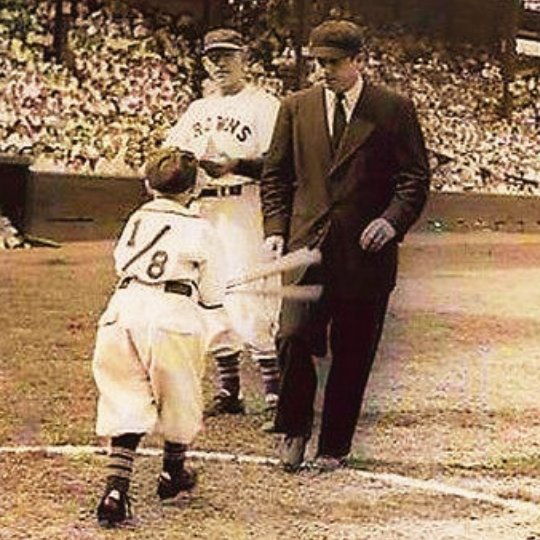
Bill DeWitt Jr. wearing the unusual number
But that wasn't the end of it. In the bottom of the 1st inning, Gaedel walked to the plate, to pinch-hit for the alleged leadoff hitter, right fielder Frank Saucier. He was announced by the public-address announcer. The fans went wild -- although there were just 18,369 of them, so the stunt didn't get a big crowd.
The home plate umpire, Ed Hurley, wasn't having it. He called time-out, and looked over to Browns manager Zack Taylor. But Taylor was ready: He walked out, and took a rolled-up piece of paper from his pocket. It was Gaedel's contract, signed not only by him and by Veeck, but by the President of the American League, Will Harridge. Clearly, Harridge signed it with no idea that the player involved was 3-foot-7. The subject of signing a midget to a contract had never come up before. So the contract was real and official. Hurley had no choice: He had to allow the at-bat.

Note the height of the ball in the mitt, compared to Gaedel's.
Note also Gaedel's crouching stance.
With his height, and a crouching batting stance, Gaedel had the smallest strike zone in baseball history, not much larger than the ball itself. The idea was that the pitcher, Bob Cain, wouldn't come close to a strike, and that Gaedel would walk on 4 straight pitches.
Veeck told Gaedel that there was a sniper on the roof of Sportsman's Park, ready to shoot him if he swung at any pitch. Veeck never said whether there actually was a sniper. If there really was one, he never came forward and admitted it. And whether Gaedel took this threat seriously, only he knew.
What everyone else knew is that catcher Bob Swift got onto his knees, and told Cain, "Keep it low." Cain threw 4 pitches. The 1st 2 were serious attempts at strikes, and did get over the plate, but were too high. Realizing it was hopeless, Cain threw the last 2 at half-speed, still getting them over the plate, but at about the level of Gaedel's head.
After ball 4, Hurley told Gaedel, "Take your base," and Gaedel trotted to 1st base. Jim Delsing then ran out to pinch-run for him. Like a real major-league ballplayer, which he now was, Gaedel slapped Delsing on the rear and, and trotted off the field -- to a standing ovation.
Delsing remained in the game, played center field as former Yankee Cliff Mapes moved from center to right, and went 1-for-3. It was no use: The Tigers got a fine pitching performance from Cain, a home run from Jerry Priddy, and 3 hits each from George Kell and Pat Mullin, and completed the sweep, 6-2.
The next day, AL President Harridge publicly said that Veeck was making a mockery of the game, and voided Gaedel's contract. In response, Veeck, who always hated the New York Yankees, told the Chicago press that he was going to request an official ruling on whether Phil Rizzuto, the Yankees' shortstop and the previous season's AL Most Valuable Player, was "a short ballplayer or a tall dwarf."
Rizzuto was listed at 5-foot-6, and that may have been generous by an inch. Nevertheless, he was also the best shortstop in baseball at that point, and had batted .324 the season before, getting 200 hits. And, while his 92 walks that season were a career high, that was hardly an extraordinary total, probably was not much aided by his lack of height. Rizzuto's reaction to Veeck's request is unrecorded, but it would probably have been something like, "Veeck, you huckleberry. Holy cow."
Nevertheless, Gaedel got paid for his appearance: $100, his standard fee at the time. (In 2022 money, it works out to about $1,134.) Some time later, he was a guest on the radio show of Chicago-based talk show host Louis "Studs" Terkel. He complained that "Mr. Veeck" wouldn't let him swing the bat, and that he wanted to do that, just once. Terkel, then 39 years old and not looking much like a man who had ever been any kind of athlete, consoled him by saying, "You are exactly what I wish I was: An ex-big-league ballplayer!"
(Terkel would later play Chicago sportswriter Hugh Fullerton in Eight Men Out, the film about the 1919 Black Sox Scandal, and be interviewed by Ken Burns, including on the subject of Gaedel, for his miniseries Baseball.)
Veeck had hoped to run the financially troubled Cardinals out of St. Louis. But, early in 1953, they were bought by Anheuser-Busch chairman Gussie Busch. With Busch's beer fortune behind them, Veeck knew the Browns could not afford to compete for St. Louis' baseball fans.
He didn't particularly care about St. Louis: He just wanted to eliminate the competition and be Number 1 in whatever city he was in, as he had been in Milwaukee and Cleveland. With that option no longer available in St. Louis, he tried to get the Browns moved to Baltimore. The other AL owners, seeing a chance to get rid of him, voted to approve the move, on the condition that Veeck sell the team. He did. But in 1959, he bought the Chicago White Sox.
On May 26, 1959, as Harvey Haddix of the Pittsburgh Pirates, was pitching his perfect-but-then-not game, 90 miles to the north in Milwaukee, Eddie Gaedel worked for Bill Veeck again. A helicopter carrying Gaedel and 3 other dwarfs dressed in spacesuits landed on the infield at Comiskey Park. They came bearing gifts: Ray guns. They gave these to White Sox stars Luis Aparicio and Nellie Fox. In a parody of the alien visitors' line, "Take me to your leader," Gaedel told them, "I don't want to be taken to your leader. I've already met him." The White Sox won the Pennant that season.
On June 18, 1961, Gaedel was found dead in his bed by his mother, with bruises all over his body. He was just 36 years old. His killer has never been identified.
By this point, Veeck had sold the White Sox, to pay for his medical expenses, as he had been told he was dying. This turned out to be a misdiagnosis, as he recovered, and he later owned the White Sox again, from 1975 to 1980. He lived until 1986.
But as a result of his 1961 illness, he was unable to attend Eddie Gaedel's funeral. Indeed, only one person with any connection with baseball did: Bob Cain, the pitcher who faced him. They had never even formally met.
Catcher Bob Swift died in 1966. Umpire Ed Hurley lived until 1969. Will Harridge served as AL President from 1931 to 1959, and died in 1971. Browns manager Zack Taylor lived until 1974. Bob Cain lived until 1997. Pinch-runner Jim Delsing lived until 2006. As of August 19, 2022, Frank Saucier, for whom Gaedel pinch-hit, is still alive, 1 of 3 surviving former St. Louis Browns, along with Ed Mickelson and Billy Hunter. (UPDATE: All 3 of those men died in 2025, Hunter turning out to be the last survivor of them.)
Bill DeWitt Jr. donated his uniform, Gaedel's uniform, to the Baseball Hall of Fame in Cooperstown, New York. He later became the principal owner of the St. Louis Cardinals, and got the uniform back, where it is on display at the St. Louis Cardinals Hall of Fame and Museum, across Clark Avenue from the current Busch Stadium, which also features artifacts from the Browns and St. Louis-area natives who played for other teams, such as Yogi Berra.
Officially, the shortest players in MLB history have been Edmund "Stubby" Magner, who played 13 games for the New York Highlanders (forerunners of the Yankees) in 1911; and Pompeyo "Yo-Yo" Davalillo, who played 19 games for the Washington Senators in 1953. Both were listed at 5-foot-3.
In 1978, in his 2nd go-round as White Sox owner, Veeck promoted Harry Chappas to the majors, telling the media that he was, after Gaedel, the shortest player in MLB history, at 5-foot-3. This was a lie, but, fittingly, a small one: He was really 5-foot-5, the same height as the man then considered the shortest in the majors, Freddie Patek of the Kansas City Royals. Magner, Davalillo, Chappas and Patek were all, by a quirk of fate, shortstops.
Jon Rauch appeared in the major leagues from 2002 to 2013, including for the Montreal Expos when they moved to become the Washington Nationals in 2004-05, and for the Minnesota Twins in 2009 and 2010, enabling him to appear in postseason play. Sean Hjelle made his big-league debut with the San Francisco Giants in 2022. Both are 6-foot-11, and thus the tallest players in MLB history. Loek van Mil, a 7-foot-1 native of the Netherlands, appeared in professional baseball from 2006 to 2018, but only got as high, if you'll pardon the choice of words, as Class AAA. All 3 of these men are relief pitchers.
*
August 19, 1951 was a Sunday. John Deacon, the bass guitarist for Queen, was born.
And these other games were played that day:
* The New York Yankees had their worst game of the season, losing to the Philadelphia Athletics, 15-1 at Yankee Stadium. Starting pitcher Bob Wiesler didn't get out of the 3rd inning, former St. Louis Browns ace Jack Kramer (no relation to the great tennis player of that era, of the same name) couldn't stop the bleeding, and Frank "Spec" Shea really took one for the team, allowing 11 runs in 3 innings. But of the A's' 15 runs, only 9 were earned, as the Yankees made 3 errors.
Dave Philley -- who, true to his name, ended up playing for both the A's and the Philadelphia Phillies -- went 5-for-5 with a walk and 2 RBIs. Joe Astroth hit a home run. Morrie Martin went the distance for the win. Joe DiMaggio, in his last few weeks as an active player, went 0-for-3 with a walk. Rookie Mickey Mantle had been sent down to the minor leagues, but would soon be called back up.
* The New York Giants beat the Philadelphia Phillies, 5-4 at Shibe Park in Philadelphia. The Phils led 4-0 after 6 innings, but the Giants came back. Rookie Willie Mays went 1-for-5, and a home run was hit by Bobby Thomson. It was his 23rd of the season. He would finish with a career-high 32. The last one may have been the shortest in physical distance, but it has traveled the longest in memory.
* The Brooklyn Dodgers lost to the Boston Braves, 13-4 at Braves Field in Boston. Ralph Branca got chased in the 6th inning. Roy Campanella hit a home run off Warren Spahn. Jackie Robinson went 0-for-4.
* The Boston Red Sox beat the Washington Senators, 8-3 at Griffith Stadium in Washington. Ted Williams hit a home run.
* The Pittsburgh Pirates swept a doubleheader from the Chicago Cubs, 4-2 and 5-4 at Forbes Field in Pittsburgh.
* The St. Louis Cardinals swept a doubleheader from the Cincinnati Reds, 5-4 and 5-1 at Crosley Field in Cincinnati. Over the 2 games, Stan Musial went 4-for-7 with 2 walks and an RBI.
* And a doubleheader was split at Comiskey Park in Chicago. The Cleveland Indians won the opener, 4-0. Early Wynn pitched a 7-hit shutout. The Chicago White Sox won the nightcap, 7-6. The ChiSox scored 5 runs in the bottom of the 7th. The Tribe scored 5 in the top of the 8th, but couldn't complete the comeback.


No comments:
Post a Comment