Showing posts with label american league. Show all posts

Thursday, December 22, 2022

December 22, 1915: The Federal League Peace Treaty

December 22, 1915: An agreement is made between the owners of the teams in baseball's Federal League and those of the established major leagues, the American League and the National League. The FL's team owners needed it because they had run out of money. The AL's and NL's team owners needed it because they didn't want to pay higher salaries to keep players from defecting.

First, the FL folds. Then, Charles Weeghman, owner of the FL's Chicago Whales, was allowed to buy the NL's Chicago Cubs. And Phil Ball, owner of the FL's St. Louis Terriers, was allowed to buy the AL's St. Louis Browns.

Weeghman brought his Whales players to the Cubs, and moved the Cubs into his ballpark on the North Side, Weeghman Park. But, in spite of the Cubs winning the 1918 NL Pennant, Weeghman lost everything in World War I, and sold the team, with chewing gum magnate William Wrigley Jr. eventually emerging as sole owner. In 1926, he renamed the team's home Wrigley Field. It is the most significant remaining relic of the Federal League.

Ball also bought his players to the Browns, with less success, mainly because he couldn't get along with established general manager Branch Rickey. Rickey went over to the NL's St. Louis Cardinals, and the rest is history.

The Kansas City Packers franchise had been declared bankrupt and taken over by the league office after the close of the regular season, and the Baltimore Terrapins' owners, including former Baltimore Orioles and Brooklyn Superbas (Dodgers) manager Ned Hanlon, rejected the offer made to them. They had sought to buy and move an existing franchise to their city, but were rebuffed, and sued.

And so, his was the "Federal Baseball Club" that was the plaintiff in this case. He argued that baseball was a monopoly, restricting competition, and thus subject to the Sherman Antitrust Act. It took until 1922 for the U.S. Supreme Court to rule otherwise, granting baseball what has come to be known as its "special exemption" from the Sherman Antitrust Act.

The FL's 1914 Pennant was won by the Indianapolis Hoosiers. But they lost money, and were sold to a group that moved them to Newark, setting up shop in a ballpark across the Passaic River, in Harrison, New Jersey. The Newark Peppers did not repeat, as the Chicago Whales won the 1915 Pennant.

With the folding of the FL, that left Baltimore, Buffalo, Indianapolis, Newark and Kansas City as cities that had had FL teams, but not an AL team or an NL team. Baltimore would return to the majors with a new Orioles in 1954, Kansas City with the A's moving there in 1955. (They moved again in 1967, and were replaced by the Royals in 1969.)

Newark and other New Jersey cities have had minor-league teams since, but, with the exception of 14 games played in Jersey City by the Brooklyn Dodgers in 1956 and 1957, New Jersey has never again hosted a game in Major League Baseball. It has hosted games in the NFL, the NBA, the NHL, and professional soccer. The New York Red Bulls of Major League Soccer play at Red Bull Arena, almost right across the street from where the Peppers played.

Indianapolis has since had an NFL team, an NBA team, and a team in the World Hockey Association, but never in MLB. Buffalo has since had an NFL team, an NBA team, and an NHL team. But it has only returned to MLB for 49 games, played at Sahlen Field by the Toronto Blue Jays during the 2020 and 2021 seasons, due to COVID restrictions.

*

December 22, 1915 was a Thursday. Baseball and football were out of season. Professional basketball barely existed. There were 2 games played in the National Hockey Association, predecessor to the NHL. The Montreal Wanderers beat the Montreal Canadiens, 3-2 at the Montreal Arena. (Both teams played home games there, but, officially, this was a Canadiens' home game.) And the Ottawa Senators beat the Toronto Blue shirts, 7-1 at the Ottawa Arena.

Sunday, November 27, 2022

November 27, 1947: The MVP "Robbery" of Ted Williams

Ted Williams (left) and Joe DiMaggio

November 27, 1947: Despite it being Thanksgiving Day, the vote for the American League’s Most Valuable Player is announced. Joe DiMaggio of the New York Yankees wins for the 3rd time, despite the fact that Ted Williams of the Boston Red Sox won the Triple Crown. Why?

The official reason is that one sportswriter, who didn't like Ted, and whose name has never been revealed, left him off his ballot completely. Had he given Ted even a 10th-place vote, he would have won.

There were previous MVP controversies involving Ted. In 1941, with his 56-game hitting streak, Joe put the Yankees on his back, and carried them to glory. On Game 3 of the streak, on May 17, the Yankees were 7 1/2 games out of 1st place in the American League. The day the streak ended, exactly 2 months later, they were in 1st place by 7 games, a 14 1/2-game swing.

Don't tell me Ted was the most valuable player, capitalized or otherwise, in the AL that season. His .406 batting average didn't help his team come anywhere near a Pennant. The latest in the season that the Boston Red Sox were in 1st place was April 22. After June 25, they were never within 3 games of 1st place. From July 13 onward, they were never within 10. From August 9 onward, they were never within 14. On September 4, they bottomed out at 20 1/2 back. And when the regular season ended on September 28, they were 84-70, not a bad record, and in 2nd place, not a bad finish -- but 17 games behind the Yankees.

Ted batted .406, with an on-base percentage of .553, a slugging percentage of .735, a 235 OPS+, and hit 37 home runs, all of which led both major leagues. He had 120 RBIs. In comparison, Joe's "slash line" for the season was .357/.440/.643, his OPS+ was 185, and he hit 30 homers, but led both Leagues with 125 RBIs.

But with the streak, DiMaggio put the Yankees on his back, and carried them to glory. On Game 3 of the streak, on May 17, the Yankees were 7 1/2 games out of 1st place in the American League. When it was stopped in Game 57, exactly 2 months later, they were in 1st place by 7 games, a 14 1/2-game swing.

The Yankees went 41-13, with a game tied when called due to darkness and another tied when called due to rain, over those 56 games, including winning streaks of 14 and 8. Of those 56, 4 went to extra innings, but Joe got his 1st hit within the 1st 9 each time; and 4 were shortened due to rain, making it even more impressive that Joe got at least 1 hit in each.

For those of you who believe in "WAR," Wins Above Replacement: Ted's was 10.4, Joe's was 9.3. More evidence that WAR is misleading, and should be ignored.

In 1942. Ted batted .356, hit 36 home runs, and had 137 RBIs. Each of these led the League, giving him the Triple Crown. But the Sox finished 2nd to the Yankees, a not-very-close 9 games back, and the MVP went to Joe Gordon, who did bat .302 with 103 RBIs, though only 18 home runs, and played 2nd base superbly. How do you deny a Triple Crown winner the MVP? Again: Most Valuable Player, not Most Outstanding Player.

In 1946, the Red Sox ran away with the Pennant. This time, there was no denying Ted: He batted .342, hit 38 home runs, and had 123 RBIs (oddly, none of these led the AL), and he was an easy choice for MVP.

Then came the World Series. The opposition was the St. Louis Cardinals. Led by the NL's answer to Ted, Stan Musial, the Cards were in their 4th World Series in 6 years, having won in 1942 and 1944, and lost in 1943. But Ted was nursing an elbow injury, and only batted .200, 5-for-25. Stan didn't hit well, either, and neither would end up the big story of the Series. The Cards won in 7 games.

Ted won the Triple Crown again in 1947, as he batted. .343, hit 32 home runs and had 114 RBIs. But, again, the Sox didn't win the Pennant, finishing 3rd, 14 games behind the Yankees (and 2 behind the Tigers). Joe batted .315, hit 20 homers, had 97 RBIs, and led his team to the Pennant, and then to the World Series.

The National League's MVP went to Bob Elliott, the 3rd baseman for the Boston Braves. He batted .317, hit 22 homers, and had 113 RBIs. The Braves finished 3rd, 8 games behind the Pennant-winning Brooklyn Dodgers. Ewell Blackwell of the Cincinnati Reds finished 2nd in the voting, going 22-8, including a 16-game winning streak, the 9th game of which was a no-hitter; and led the major leagues with 193 strikeouts.

Johnny Mize of the New York Giants finished 3rd, batted .302, led the majors with 138 RBIs, and shared the major league lead in home runs with Ralph Kiner of the Pittsburgh Pirates, who finished 6th, with 51. Finishing 4th and 5th were members of the Pennant-winning Dodgers: Catcher Bruce Edwards, and 1st baseman Jackie Robinson, the 1st black player in modern baseball, who received the 1st-ever Rookie of the Year award.

Personally, I think Jackie should have gotten it: He was the biggest reason the Dodgers won. Only twice has a player ever gotten the MVP and the ROY in the same season: Fred Lynn of the 1975 Boston Red Sox, and Ichiro Suzuki of the 2001 Seattle Mariners. Ichiro, who had starred in Japan, and Jackie, who had played in the Negro Leagues and had starred in football at UCLA, were both 28, and only "rookies" by the letter of the law.

In 1949, the Sox and Yanks battled for the Pennant all the way to the final weekend. The Sox led the Yanks by 1 game with 2 to go, against each other, at Yankee Stadium. All the Sox had to do was win 1 of the 2. The Yankees won them both, 5-4 and 5-3. Ted went 1-for-3 with a walk in the Saturday game, and 0-for-2 with 2 walks in the Sunday game.

In spite of the Sox not winning the 1949 Pennant, the Yanks didn't have any single player who stood out above the others -- DiMaggio being hurt much of the year, keeping his power stats down -- so Ted got his 2nd MVP. But he had also begun to get a reputation as coming up small in big games. This ignores the fact that, in those 3 end-of-season games in '48 and '49, he did reach base 5 times. But, in those days, you rarely heard the cliché, "A walk is as good as a hit."

Ted hit 43 home runs and had 159 RBIs. His .343 slightly trailed George Kell of the Tigers for the batting title, costing him a record 3rd Triple Crown by the slimmest of margins. But he got 13 of a possible 16 1st-place votes, and won the MVP.

Among the Yankees, Phil Rizzuto finished 2nd, reliever Joe Page 3rd, and Tommy Henrich 6th. But the Scooter just didn't have big stats, and as for Page, nobody was willing to give the MVP to a relief pitcher to that point. The next year, Jim Konstanty of the Philadelphia Phillies became the 1st, in the NL. No AL reliever would get the award until Rollie Fingers of the Milwaukee Brewers in 1981.

So Ted didn't help his team win the Pennant. Yogi Berra finished 15th in the voting, but, giving the Yankees their 1st good year from a catcher since 1943, he was probably the best choice.

In 1978, Jim Rice got the MVP in a year when Ron Guidry may have been more valuable to the Yankees than any player has ever been to a single team for a single season. So Red Sox fans who say Ted was robbed of one or more MVPs can put a red sock in it.

*

November 27, 1947, like all Thanksgiving Days, was a Thursday. The Chicago Bears beat the Detroit Lions, 34-14 at Briggs Stadium (later Tiger Stadium) in Detroit. In the All-America Football Conference, the Cleveland Browns beat the Los Angeles Dons, 27-17; and the San Francisco 49ers beat the Brooklyn Dodgers, 21-7 at Ebbets Field. Yes, from 1930 to 1948, there were 2 different professional football teams named the Brooklyn Dodgers.

There were 14 college football games played, including some major rivalries:

* Rivalry: Number 7 Texas beat Texas A&M, 32-13 at Kyle Field in College Station.

* Number 8 University of Pennsylvania beat Cornell, 21-0 at Franklin Field in Philadelphia.

* Rivalry: Number 14 William & Mary beat Richmond, 35-0 at City Stadium in Richmond, Virginia.

* Rutgers beat Brown, 27-20 at Brown Stadium in Providence, Rhode Island.

* George Washington University beat the U.S. Merchant Marine Academy, 40-0 at Griffith Stadium in Washington.

* Rivalry: Virginia Military Institute (VMI) beat Virginia Tech, 28-14 at Victory Stadium in Roanoke. It would be several more years before VMI became a "small college team," and the University of Virginia replaced them as Tech's main rival.

* South Carolina beat Wake Forest, 6-0 at American Legion Memorial Stadium in Charlotte, North Carolina.

* Davidson University beat Furman University, 20-6 at Sirrine Stadium in Greenville, South Carolina.

* North Texas beat Chattanooga, 14-7 at Chamberlain Field in Chattanooga, Tennessee.

* Saint Louis University beat Duquesne, 14-13 at Walsh Stadium in St. Louis.

* The Municipal University of Wichita (now Wichita State University) beat Colorado College (not to be confused with the University of Colorado or Colorado State), 62-6 at Veterans Field in Wichita, Kansaas.

* Arkansas beat the University of Tulsa, 27-13 at Skelly Stadium (now Skelly Field at H.A. Chapman Stadium) in Tulsa, Oklahoma.

* Rivalry: The University of Denver beat the University of Colorado, 26-20 at DU Stadium at Denver.

* Rivalry: Utah beat Utah State, 40-14 at Ute Stadium (later Robert Rice Stadium) in Salt Lake City.

These days, the NBA does not play on Thanksgiving. In the 1947-48 season, still using the name of the Basketball Association of America, they did, playing 2 games. The New York Knicks beat the Philadelphia Warriors, 81-59 at the Philadelphia Arena. And the Baltimore Bullets beat the Providence Steam Roller, 76-61 at the Rhode Island Auditorium in Providence.

The NHL also does not play on Thanksgiving in the modern era. But, on this day, they also played 2 games. The Montreal Canadiens beat the Toronto Maple Leafs, 2-0 at the Montreal Forum. And the Detroit Red Wings beat the Boston Bruins, 4-1 at the Olympia Stadium in Detroit. Boston has a tradition of high school football on Thanksgiving Day, which is probably why the Bruins did not play at home. The New York Rangers and the Chicago Black Hawks did not play.

Tuesday, November 8, 2022

November 8, 1954: The Death of the Philadelphia Athletics

Connie Mack and Bobby Shantz, who turned out to be
the last living former player for the Philadelphia Athletics

November 8, 1954: The American League owners approve the shift of the Philadelphia Athletics franchise to Kansas City. Roy and Earle Mack, sons of the now-senile 88-year-old Connie Mack, sell the A's to Arnold Johnson, a Chicago-based trucking magnate.

Johnson's bid is $3‚375‚000 for the team and stadium‚ Shibe Park, recently renamed Connie Mack Stadium. He says he will sell the stadium to the Phillies for $1‚675‚000, although Phils owner Bob Carpenter, a very wealthy man as a member of both the Carpenter and the duPont families, says, "I need Shibe Park like I need a hole in the head."

One of the offers for the team is from a wealthy Texas group that proposes to move the A's to Los Angeles. This would have meant that the expansion team of 1961 that we currently know as the Los Angeles Angels would have been established elsewhere. However, given that the A's were in the American League, Walter O'Malley still might have moved the National League's Brooklyn Dodgers there.

But the A's did not go to L.A. Kansas City, long a hotbed of minor league and Negro League baseball, gets major league status for the 1st time since the Kansas City Packers of the Federal League in 1915 – or, if you don’t count that, since the Kansas City Cowboys of the old American Association in 1889.

The A's had won AL Pennants in 1902, 1905, 1910, 1911, 1913, 1914, 1929, 1930 and 1931. They had won the World Series in 1910, 1911, 1913, 1929 and 1930. Connie Mack had built 2 dynasties, then broke them up because he needed money.

Unlike in Boston, where the Red Sox stayed and the Braves left, and St. Louis, where the Cardinals stayed and the Browns left, in Philadelphia, the more historically successful team was the one that moved. But while the A's had 9 Pennants to the Phillies' 2, and 5 titles to the Phils' none, the Phils had money, and the A's didn't. And, since both teams couldn't survive in the city, the one without the money went.

Would Philadelphia have been better off if it had been the A's that stayed and the Phils that moved? Imagine, instead, that the Carpenters had bought the A's from the Macks in 1943, instead of buying the Phils from William D. Cox at that time. Here is what the teams won from 1931 to 1970:

Phillies: 1950 Pennant, plus that agonizing near-miss of 1964
A's: Nothing

Doesn't sound good for either team, but at least the Phils won something, right? Hold on, here's 1971 to 2006:

A's: 1971 AL West, 1972 World Series, 1973 World Series, 1974 World Series, 1975 AL West, 1981 AL West, 1988 Pennant, 1989 World Series, 1990 Pennant, 1992 AL West, 2000 AL West, 2001 AL Wild Card, 2002 AL West, 2003 AL West, 2006 AL West

Phils: 1976 NL East, 1977 NL East, 1978 NL East, 1980 World Series, 1981 NL East (1st half), 1983 Pennant, 1993 Pennant

Better for both, but now, it favors the A's. Now, check it out from 2007 onward:

Phils: 2007 NL East, 2008 World Series, 2009 Pennant, 2010 NL East, 2011 NL East, 2022 Pennant

A's: 2012 AL West, 2013 AL West, 2014 AL Wild Card, 2018 AL Wild Card, 2019 AL Wild Card, 2020 AL Wild Card

So, now, the A's have the edge. Here it is, overall, 1901 to 2014:

A's: 30 postseason appearances, 15 Pennants, 9 World Championships
Phillies: 15 postseason appearances, 8 Pennants, 2 World Championships

Definitely, the A's were the ones that should have stayed. At least then, they'd have been in a better stadium than either the Oakland Coliseum or Veterans Stadium by 2004.

Vic Power played until 1965, making him the last active Philadelphia Athletic.

UPDATE: On September 26, 2025, Bobby Shantz celebrated his 100th birthday. By that point, he was the last living Philadelphia Athletic, and the last living man who had played for Connie Mack.

*

November 8, 1954 was a Monday. Baseball season was over. Football was in midweek: There would be no Monday Night Football for another 16 years. And the NBA and NHL seasons were underway, but no games were scheduled in either. So there were no scores on this historic day.

Thursday, October 20, 2022

October 20, 2004: The Boston Red Sox Slay the Pinstriped Dragon

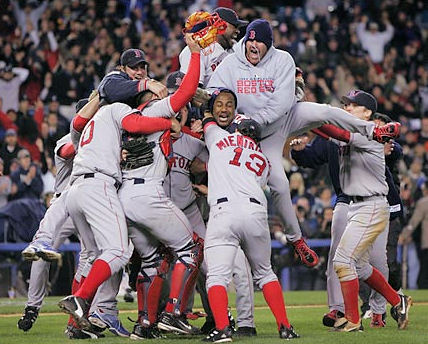
October 20, 2004: The Red Sox ruin the anniversary of Mickey Mantle's birth. Unlike the 2003-18 Red Sox, Mickey didn't need no steroids to win baseball games. The chemicals he ingested were, most definitely, not performance-enhancing.

Having dropped 3 straight to the Sox to force a Game 7 at Yankee Stadium, the Yankees had nothing left, at least not emotionally. The Red Sox led 6-0 after 2 innings. It was 8-1 after 4. The final was 10-3.

Having let Andy Pettitte and David Wells get away, the Yankees had no lefthanded starting pitchers to counter the Boston lefthanders: David Ortiz (who hit a home run in the 1st inning), Johnny Damon (who hit one in the 2nd and another in the 4th), Trot Nixon (limited to a single in 5 at-bats), and the switch-hitting Mark Bellhorn (who homered lefthanded in the 8th) and Bill Mueller (who hit 2 singles).

Instead, manager Joe Torre had a choice of Kevin Brown, a great pitcher not that long ago but now unreliable; and Javier Vázquez, who, as his later career would confirm, seemed to pitch well for everybody but the Yankees. Torre removed Brown after loading the bases in the 2nd, already down 2-0 because of the steroid-aided homer of Ortiz. He brought in Vázquez, who gave up the 1st of Damon's homers, a grand slam.

This was not the kind of loss that crushes you because you apparently had it won at the end, and blew it. We got beat early. From the 1st inning onward, we knew the Red Sox were going to win the game. We knew it, and their fans knew it. There was nothing that could be done. And we had to stick it out, all 9 innings, and hear those Red Sox fans give us the business in our house for, as it turned out, 3 hours and 31 minutes. Never mind what the clock said: This was the longest game in Yankee history.

To paraphrase the movie Goodfellas: It was revenge for Bucky Dent, and a lot of other things. And there was nothing that we could do about it. The Red Sox were beloved in the national media, and the Yankees weren't. And we had to sit still and take it. It was among the New Englanders. It was real chowderhead shit.

It was 12:01 AM, October 21, when Ruben Sierra grounded to 2nd for the final out. So not only had the Sox ended the Curse of the Bambino, they had ruined the birthdays of both Mickey Mantle and Whitey Ford.

Finally, after losing the Pennant to the Yankees on the final day in 1949, blowing the Division title to the Yankees in 1977 and 1978, losing the ALCS to the Yankees in 1999, and the shock of 2003, the Red Sox and their fans had their revenge over the Yankees. They had slain the big Pinstriped Dragon. 
But, as Dan Shaughnessy of The Boston Globe, who knows more about the Red Sox than anyone, pointed out, it wasn't over: "The Curse of the Bambino is not that the Red Sox can't beat the Yankees. The Curse of the Bambino is that the Red Sox can't win the World Series." They lost the 1946, 1967, 1975 and 1986 World Series; the 1948 AL Playoff game; fell a little short of the AL Eastern Division title in 1972, 1974, 1979 and 1991; and lost the ALCS in 1988 and 1990. And some of those losses were crushing. But none of those defeats had anything to do with the Yankees, although the 1986 World Series loss, the most crushing of them all, was to a New York team.

Shaughnessy's Globe teammate, columnist Bob Ryan, was asked if only the Pennant, even with a win over the Yankees, would have been enough. He was emphatic: "Let's get this out of the way, right now: Would it have been enough for the Red Sox to beat the Yankees, without winning the World Series? The answer is, 'No!'"

It would take 7 more days for the Sox to truly break the Curse, beating the St. Louis Cardinals in the World Series. The Cards had beaten them in the Series in 1946 and '67. The Sox have since beaten them again, in 2013.

On July 30, 2009, it was revealed that David Ortiz and Manny Ramirez, the 2 biggest reasons the Red Sox won the World Series in 2004 and again in 2007, had failed steroid tests. They hadn't earned a fucking thing. They'd cheated. Ortiz was still there when they won it all again in 2013. Those 3 titles are fake, and they goddamned well know it. 1918 * Forever.

The baseball media, of course, will never give the Yankees the same benefit of the doubt that they give the Red Sox. Well, to hell with them. The world knows the truth, whether they accept it or not. They would say the Yankees "cheated" to win their titles. Really? The evidence against the 1996-2003 Yankees is incredibly flimsy. The evidence against the 2003-2013 Red Sox is overwhelming. The evidence against the 2018 Red Sox, while separate, is also pretty strong.

*

October 20, 2004 was a Wednesday. It was midweek, so no football games. The NBA season hadn't started yet. And the NHL team owners had locked the players out. But there was one other score in North American sports that day:

Lost in the excitement of the Red Sox' revenge over the Yankees, Jim Edmonds hit a home run in the bottom of the 12th inning, to give the Cardinals a 6-4 win over the Houston Astros at Busch Memorial Stadium, and send the NLCS to a decisive Game 7. The Cards won the next day. But the Red Sox swept them in the World Series, and finished the job.

Also, there was UEFA Champions League Group Stage action:

* Arsenal FC of North London played Panathinaikos to a 2-2 draw at Stadio Apostolos Nikolaidis in Athens, Greece.

* Chelsea FC beat CSKA Moscow, 2-0 at Stamford Bridge in West London.

* Paris Saint-Germain beat FC Porto of Porto, Portugal, 2-0 at the Parc des Princes in Paris.

* AC Milan beat FC Barcelona, 1-0 at the San Siro in Milan.

* Internazionale Milano beat Valencia, 5-1 at Estadio de Mestalla in Valencia, Spain.

* Shakhtar Donetesk beat Celtic of Glasgow, Scotland, 3-0 at RSC Olimpiyskiy in Donetsk, Ukraine.

* Werder Bremen of Germany beat Anderlecht, 2-1 at Constant Vanden Stock Stadium in Brussels, Belgium.

* And PSV Eindhoven of the Netherlands beat Rosenborg, 2-1 at Lerkendal Stadion in Trondheim, Norway.

Wednesday, October 12, 2022

October 12, 1972: A Painful Pennant for Oakland

Reggie is not celebrating.

October 12, 1972: The Oakland Athletics defeat the Detroit Tigers, 2-1 at Tiger Stadium in Detroit, and take the American League Pennant. It is the 1st Pennant for the "A's" since they were in Philadelphia in 1931, 41 years and 2 moves earlier.

John "Blue Moon" Odom was the winning pitcher, outpitching Woodie Fryman. Odom pitched the 1st 5 innings, and Vida Blue, the superstar pitcher of the previous season, pitched the last 4 for a very clutch save.

The Tigers had scored on a Bill Freehan groundout in the bottom of the 1st inning. In the top of the 2nd, A's manager Dick Williams ordered a double steal. Mike Epstein was on 1st base, and he stole 2nd. Seeing Reggie Jackson on 3rd base, breaking for home, Tiger shortstop Dick McAuliffe cut Freehan's throw off, and threw back to him. Reggie was safe, but tore his hamstring, and was out of the game.

The winning run scored in the top of the 4th inning. George Hendrick led off by grounding to McAuliffe, but he made a bad throw to 1st base. Sal Bando bunted him over to 2nd base. Epstein struck out, but Gene Tenace singled Hendrick home. Odom and Blue made the lead hold up.

After the game, in spite of the joy of the Pennant, Odom and Blue give new meaning to the team's nickname, "the Swingin' A's." Blue asked Odom, "How come you starters can't finish what you begin?" He answers his own question by grabbing his throat, the universal "choke" sign. Odom took exception to this, and started a brawl. It was quickly broken up.

Reggie was unable to play in the World Series, and when introduced before the games, came out of the dugout on crutches. He would make up for that many times, as he is the only man to win World Series MVPs with two different teams: The A's in 1973, and the New York Yankees in 1977.

*

October 12, 1972 was a Friday. This was also the day of the race riot about the aircraft carrier USS Kitty Hawk. I have a separate entry for that event.

The National League Pennant had been decided the day before, when the Cincinnati Reds won Game 5 of the NL Championship Series over the Pittsburgh Pirates. The A's went on to beat the Reds in the World Series, in 7 games.

In the World Hockey Association, the New England Whalers made their debut. They defeated the Philadelphia Blazers 2-0 at the Boston Garden. They would win the 1st WHA title in 1973. Tired of being mistreated by their landlords, the NHL's Bruins, they would move to Hartford in 1975.

In 1979, following the WHA's collapse, they were allowed into the NHL, and changed their name to the Hartford Whalers. In 1997, they moved to become the Carolina Hurricanes, winning the Stanley Cup in 2006. (UPDATE: And again in 2026.)

Also on this day, the Winnipeg Jets, the team that came to define the WHA in so many ways, debuted. So did the obligatory New York Tri-State Area franchise in the league, the New York Raiders. Christian Bordeleau scored 4 goals, including the club's 1st, and the Jets won, 6-4. Only 6,273 fans come out, mainly because the legal maneuvering that would allow Bobby Hull to play for the Jets had not yet been settled, and he wasn't available.

The Raiders wanted the new Nassau Coliseum, but got pushed around by the expansion Islanders. The Garden was willing to take them in, but they were low priority. Marvin Milkes, the Seattle Pilots general manager made infamous by Jim Bouton's book Ball Four, was their GM -- that should tell you what kind of organization they were. Their main radio announcer was a young John Sterling.

By midseason, their ownership had bailed, the league took them over, they spent the 1973-74 season in the Philadelphia suburb of Cherry Hill as the Jersey Knights -- the only South Jersey team ever to be remotely considered "major league," and folded.

The Jets would be considerably luckier, settling the situation with Hull (the Golden Jet, for whom the team was named), reaching the 1st WHA Finals (where they lost to the Whalers), and winning the title in 1976, '78 and '79.

Taken into the NHL, and stripped of their big stars (Hull played out the string in Hartford, while Anders Hedberg and Ulf Nilsson were sold to the Rangers), they collapsed immediately, set an NHL record for longest winless streak, and became known as Lose-ipeg. They would recover somewhat, but never got close to a Stanley Cup, and became the Phoenix Coyotes in 1996 and the Arizona Coyotes in 2014. The Atlanta Thrashers became the new Winnipeg Jets in 2011.

One more WHA game was played that day: The Houston Aeros beat the Chicago Cougars, 3-2 at the Sam Houston Coliseum.

There were 3 games in the NHL:

* The New York Islanders beat the Los Angeles Kings, 3-2 at the Nassau Coliseum. This was only the 2nd game, and 1st win, in regular-season play for the expansion Isles.

* The Montreal Canadiens beat the Atlanta Flames, 3-0 at the Montreal Forum. This was the 4th regular-season game for the expansion Flames, who had only won 1 to this point, their debut, against the Islanders.

 And the Philadelphia Flyers beat the Vancouver Canucks, 7-3 at The Spectrum in Philadelphia.

The NBA season had just started, but had no games on this day. There were 3 in the American Basketball Association:

* The Carolina Cougars beat the Virginia Squires, 123-115 at the Richmond Coliseum in Richmond, Virginia.

* The Indiana Pacers beat the Memphis Tams, 109-105 at the Mid-South Coliseum in Memphis. George Thompson scored 34 points in defeat.

* And the Utah Stars beat the Denver Rockets, 115-104 at the Salt Palace in Salt Lake City, Utah.

Monday, October 10, 2022

October 10, 1980: A Royal Revenge for Kansas City

October 10, 1980: After 3 failed attempts, the 4th time is the charm for the Kansas City Royals. George Brett's mammoth home run off Goose Gossage gives the Royals a 4-2 win and a sweep of the American League Championship Series, for the 1st major league Pennant for a Kansas City team – the 1st Pennant won by any KC team since the Blues won the American Association Pennant in 1953.
The Yankees had beaten the Royals in the ALCS 3 straight times. In 1976, it went the distance, 5 games. In Game 5, the Royals' best player, 3rd baseman George Brett, hit a game-tying home run in the 8th inning, but Chris Chambliss hit a home run to win it in the bottom of the 9th.
In 1977, it went the distance again. The Royals led in games, 1-0 and 2-1, but the Yankees came back. The Royals led Game 5 3-1 after 7 innings, but the Yankees won it, 5-3. In the Royals' dugout, diminutive shortstop Freddie Patek was seen crying, because his mentor, Cookie Rojas, was retiring without having played in a World Series. (Rojas had also been a member of the ill-fated 1964 Philadelphia Phillies.)
In 1978, the Royals thought they finally figured it out: They needed a lefthanded reliever, and they signed Al Hrabosky, "The Mad Hungarian." In Game 1 of the ALCS, Hrabosky faced the Yankees' "Mr. October," and Reggie took him deep. In Game 3, Brett hit 3 home runs, but Thurman Munson hit a home run in the 8th inning to turn a 4-3 Royal lead into a 5-4 Yankee win, and the Yankees clinched in Game 4.
The Yankees lost the World Series in 1976, but won it in 1977 and 1978. In 1979, Munson was killed in a plane crash. They seemed to have recovered in 1980, winning a tough AL East race over the Baltimore Orioles, while the Royals, with Whitey Herzog replaced as manager by former Oriole coach Jim Frey, outlasted a revived Oakland Athletics. For the 4th time, all in 5 years, it would be Yankees vs. Royals for the Pennant. But, without Munson, things would be different.
The Royals couldn't touch Yankee ace Ron Guidry in Game 2 in 1977 or Game 4 in 1978. This time, in Game 1, they reached him for 4 runs in the 1st 4 innings, and won, 7-2. They led Game 2, 3-2 in the top of the 8th, when Bob Watson launched a drive that threatened to score Willie Randolph all the way from 1st base. Yankee 3rd base coach Mike Ferraro waved Randolph home, but he was thrown out at the plate, and the Royals' 3-2 lead held.
The Yankees had made so many comebacks over the years that the 1st-ever comeback from two games to none down in a League Championship Series seemed possible, especially since the rest of the series, however long it lasted, would be at Yankee Stadium. Sure enough, in the bottom of the 6th in Game 3, the Yankees took a 2-1 lead.
But with 2 out in the top of the 7th, Willie Wilson doubled. Manager Dick Howser took starter Tommy John out, and brought in closer Rich "Goose" Gossage. He gave up a single to U L Washington -- the Royals' shortstop separated his initials, but did not use periods -- and then Brett, who had batted .390, coming closer to .400 than anyone since Ted Williams did it 39 years earlier, crushed a drive into the upper deck.
Legend has it that this Brett homer left the Yanks totally lifeless the rest of the way. It's not true: They loaded the bases with nobody out in the bottom of the 8th. But submarine-throwing Dan Quisenberry, the reliever that Kansas City had been looking for since 1976, got a double play and a groundout to end the threat, and then a 1-2-3 9th inning. For the 1st time since 1953 -- when the Kansas City Blues were a Yankee farm team -- Kansas City had won a Pennant.
It is one of the most humiliating series in Yankee history. After the World Series, which the Royals lost to the Philadelphia Phillies, Yankee owner George Steinbrenner told Howser to fire Ferraro. He refused. So Steinbrenner fired Ferraro himself. Howser resigned.
In 1985, Howser won the World Series -- as the manager of the Royals. He then developed cancer, managed his last game as the winning manager for the American League in the 1986 All-Star Game, and died in 1987. Howser's successor as Royals manager? Mike Ferraro, although that, and his brief 1983 tenure with the Cleveland Indians, would be his only times managing a major league team. But Steinbrenner did forgive him, and brought him back as a Yankee coach.
Frey would end another team's drought: In 1984, he managed the Chicago Cubs to the National League Eastern Division title, their 1st postseason appearance in 39 years.
Brett would collect over 3,000 hits, and, through the 2022 season, his 317 home runs remains the most in Royals history. It sure seemed like he hit a lot of them to the short porch in right field at Yankee Stadium, including another blast off Gossage in the "Pine Tar Game" in 1983. Until David Ortiz of the Boston Red Sox and his steroids came along, he was probably the biggest "Yankee Killer" of them all.
With him, the Royals made the Playoffs 6 times in 10 years from 1976 to 1985, culminating in a World Championship. Without him, the franchise didn't make the Playoffs until their back-to-back Pennants of 2014-15. 
*
October 10, 1980 was a Friday. On the same day, Game 3 of the National League Championship Series was held at the Astrodome. The Phillies and the Astros are tied at 1 game apiece. Before the game, Phillies broadcaster Harry Kalas, whose previous team had been the Astros (his 1st MLB broadcast was the Astrodome's debut in 1965), tells his broadcast partners, Richie Ashburn and the recently-retired Tim McCarver, that this Game 3 is the key game of the series. "I don't agree," says Ashburn. "I think whoever wins the 5th game is going to win the series." Of course, that makes sense, since Game 5, if necessary, will decide it.
Joe Niekro pitched 10 shutout innings for the Astros, and Dave Smith pitched a scoreless 11th, while the Phils got 10 scoreless from Larry Christenson, Dickie Noles and Tug McGraw. But Joe Morgan led off the bottom of the 11th with a triple off Tug, and Denny Walling's sacrifice fly brought him home with the winning run. Astros 1, Phillies 0. The Astros are now 1 win away from their 1st Pennant.
They didn't get it. The Phils won Games 4 and 5, proving that Whitey Ashburn was right, and Harry the K was wrong: Game 3 was not the key to the series. It would be another 25 years before the Astros finally got their 1st Pennant.
Football was in midweek. The NBA season opened, with these 9 games:
* The New Jersey Nets lost to the Indiana Pacers, 110-91 at the Rutgers Athletic Center in Piscataway, New Jersey. (It's now the Jersey Mike's Arena.)
* The Boston Celtics beat the Cleveland Cavaliers, 130-103 at the Boston Garden.
* The Milwaukee Bucks beat the Philadelphia 76ers, 106-103 at The Spectrum in Philadelphia.
* The Washington Bullets beat the Detroit Pistons, 95-85 at the Silverdome in the Detroit suburb of Pontiac, Michigan.
* The San Antonio Spurs beat the Denver Nuggets, 113-112 at the McNichols Arena in Denver.
* The Utah Jazz beat the Portland Trail Blazers, 96-86 at the Salt Palace in Salt Lake City, Utah. Adrian Dantley led all scorers on the night with 36 points.
* The Phoenix Suns beat the Golden State Warriors, 121-101 at the Arizona Veterans Memorial Coliseum in Phoenix.
* The San Diego Clippers beat the Houston Rockets, 120-104 at the San Diego Sports Arena. (now the Pechanga Arena).
* And the Los Angeles Lakers beat the Seattle SuperSonics, 99-98 at the Seattle Center Coliseum.
The NHL season had started the night before, and there were 3 games on this day:
* The Washington Capitals beat the Winnipeg Jets, 4-1 at the Capital Centre in the Washington suburb of Landover, Maryland.
* The Quebec Nordiques beat the Edmonton Oilers, 7-4 at the Northlands Coliseum in Edmonton. The Oilers retired a number for the 1st time, the Number 3 of Al Hamilton, before this game, their season opener.
* And the Vancouver Canucks beat the Detroit Red Wings, 4-3 at the Pacific Coliseum in Denver.

Sunday, October 9, 2022

October 9, 1910: The Controversial End to the "Chalmers Race"

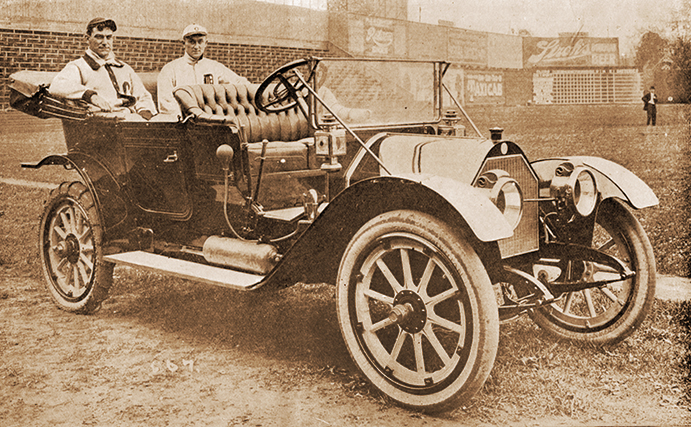
Nap Lajoie (left) and Ty Cobb, in the back seat
of the model of car to be awarded, a 1911 Chalmers 30.

October 9, 1910: The battle for the American League batting title is decided on the final day of the regular season‚ when Ty Cobb of the Detroit Tigers edges Nap Lajoie of the Cleveland… Naps. (Seriously, the team was named after their star 2nd baseman and manager. They would be renamed the Indians in 1915.) Cobb's final average is .385, Lajoie's is .384. Or, more precisely, Cobb's was .385069, and Lajoie's was .384095.

Cobb‚ rather than risk his average‚ sits out the last 2 games‚ the Tigers beating the Chicago White Sox in today's finale‚ 2-1 at the new Comiskey Park in Chicago.

Meanwhile, in a doubleheader with the St. Louis Browns‚ at Sportsman's Park in St. Louis, Lajoie goes 8-for-8, accepting 6 gift hits on bunt singles, on which Browns rookie 3rd baseman Red Corriden is apparently purposely stationed at the edge of the outfield grass.

The prejudiced St. Louis scorer also credits the popular Nap with a "hit" on shortstop Bobby Wallace's wild throw to 1st. In Lajoie's last at-bat‚ he is safe at 1st on an error call‚ but is credited with a sacrifice bunt since a man was on, and thus is not charged with an at-bat.

The St. Louis Post is just one of the papers to be openly critical of the move against Cobb, then the best, but also the most unpopular, player in baseball: "All St. Louis is up in arms over the deplorable spectacle‚ conceived in stupidity and executed in jealousy." The Browns win the opener‚ 5-4‚ and Cleveland takes the nightcap‚ 3-0, with both managers‚ Jack O'Connor and Jim Maguire, catching in the otherwise meaningless game. O'Connor is behind the plate for just an inning‚ but Maguire goes all the way.

AL President Byron Bancroft "Ban" Johnson investigates, and clears everyone concerned‚ enabling Cobb to win the 3rd of 9 straight batting crowns. 
Ty didn't exactly cover himself with glory by sitting it out -- after all, 31 years later, Ted Williams insisted on playing both games of a last-day doubleheader that he went into at .39955, and went 6-for-8 on the day to finish at .406 -- but neither he nor Nap did anything illegal.

The embarrassed Chalmers Auto Company, which had promised a brand-new car to the winner of the batting title, awards cars to both Ty and Nap. Cobb didn't care that Lajoie also got one, as he admired Lajoie: He went on record as saying he badly wanted the car, for the sake of the award, as a measure of respect.

In 1978, baseball historian Pete Palmer uncovered an mistake, which had credited a 2-for-3 game to Cobb twice, that‚ if corrected‚ would have given the batting title, and the "Chalmers Race," to Lajoie, .384 to .383. But the Commissioner's office voted unanimously to leave the stats changed, but not the title. In 1989, The Sporting News looked at the records again, and confirmed Palmer's analysis that one of Cobb's games had been counted twice. In 1991, among other rulings -- including giving Roger Maris full possession of the single-season home run record, and redefining a "no-hitter," the Commissioner's office ruled Cobb's revised totals to be correct.

This reduced Cobb's career hit total from 4,191 to 4,189 (thus meaning that Pete Rose broke the record 3 days before we thought he did, although it was still celebrated when he reached 4,192, due to the number 4,191 being so ingrained in the public memory), and his lifetime batting average from .367 to .366 (although that's still easily a record). Cobb's 1,948 hits in the 1910s led the decade. Lajoie finished with 3,243 hits, and his lifetime average was .339.

In case you're wondering, in that 1910 season, Cobb had a better on-base percentage than Lajoie, .456 to .445; the higher slugging percentage, .551 to .514; the higher OPS, 1.008 to .960; and the higher OPS+, 206 to 199.

Neither Detroit nor Cleveland seriously challenged the Philadelphia Athletics for the Pennant. The A's finished 14 1/2 games ahead of the 2nd-place New York Highlanders (1 of only 3 times the team that became the Yankees in 1913 finished as high as 2nd before their 1st Pennant in 1921), 18 ahead of the 3rd-place Tigers, and 32 ahead of the 5th-place Naps.

So the Tigers were 14 games ahead of the Naps, meaning that, both stats-wise and standings-wise, Cobb unquestionably had a better season than Lajoie. Lajoie lived until 1959, age 84; Cobb, until 1961, at 74.

The NL Pennant race had no drama in 1910, either, as the Chicago Cubs won their 4th flag in the last 5 years, beating the Giants by 13 games. The Brooklyn Superbas, forerunners of the Dodgers, finished 6th, a whopping 40 games back. So it was A's vs. Cubs in the World Series, and the A's won it in 5 games.

*

October 9, 1910 was a Sunday. Professional football was still minor-league at this point. Professional hockey, and basketball in any form, were still in their infancy. There were 2 other games were played that day in what would eventually be called Major League Baseball. The Cincinnati Reds beat the Pittsburgh Pirates, 7-1 at the Palace of the Fans in Cincinnati. And the Chicago Cubs beat the St. Louis Cardinals, 4-3 at West Side Park in Chicago.

Thursday, October 6, 2022

October 6, 1978: Thurman Munson, the Damaged Man

October 6, 1978: Game 3 of the ALCS at Yankee Stadium. The winner will take a 2-1 lead in the series. George Brett of the Kansas City Royals hits 3 home runs off Jim "Catfish" Hunter of the New York Yankees, including when leading off the game.

Reggie Jackson, "Mr. October," as he had off Al Hrabosky, "the Mad Hungarian," to clinch Game 1 of the series, hit a home run in the 2nd inning. But Brett homered again in the 3rd, to make it 2-1 Royals. With 1 out in the bottom of the 4th, Thurman Munson doubled. Reggie singled him home to tie it. Lou Piniella grounded to short, and Freddie Patek threw it away, allowing Reggie to score and Piniella to make it to 3rd. It was 3-2 Yankees.

Graig Nettles then flew to left. Clint Hurdle caught it, Piniella tagged up to try to score, and Hurdle made a perfect throw to nail him at the plate. Ron Luciano, the most demonstrative umpire of all time, pumped his fist to call Piniella "Out! Out! Out!" The inning was over.

"Sweet Lou" had a fit, with what a pro-Yankee writer called a "Wild Man of Borneo" act. I was 8 years old at the time, and already a huge Yankee fan, and I was sure the Yankees were robbed. Seeing the play again many years later, I saw that Lou was out by a mile.

And then Brett led off the top of the 5th with his 3rd home run of the game. Catfish, who had overcome a shoulder injury to be vital for the Yankees down the stretch, pitched 6 innings. Other than Brett's homers, he had allowed no runs on 4 hits, so it wasn't like he was pitching badly. He just got beat 3 times.

Reggie had hit 3 in Game 6 of the previous year's World Series, and Babe Ruth had hit 3 homers in a World Series game twice. This was only the 4th time anybody had hit 3 in any postseason game, and nobody had ever done 4. (Through the 2021 season, that's still true.) Yankee fans were worried that this would be it.

Reggie drove Roy White home with a sacrifice fly in the bottom of the 6th, to retake the lead, 4-3. Manager Bob Lemon, himself a Hall of Fame pitcher, brought Rich "Goose" Gossage in to relieve Catfish in the 7th. In the top of the 8th, he gave up a double to Amos Otis, gave up an RBI single to Darrell Porter, struck Pete LaCock out, gave up a single to Hurdle, and gave up an RBI groundout to Al Cowens, before getting Patek to ground out to end it, but it was 5-4 Royals.

With 1 out in the bottom of the 8th, White singled. Munson stepped up against Royals reliever Doug Bird. Munson was, and remains, the only Yankee to win the American League's Rookie of the Year award and its Most Valuable Player award, in 1970 and 1976 respectively. He was named the Yankees' Captain in 1976. From 1975 to 1977, he had 3 straights seasons of at least a .300 batting average and 100 runs batted in. But he had battled injuries, to his shoulders and his knees. Statistically, 1978 was a down year for him.

(Babe Ruth, Lou Gehrig and Joe DiMaggio all debuted before the Rookie of the Year award did, in 1947. Mickey Mantle did not have an exceptional rookie season. Derek Jeter won the Rookie of the Year in 1996, but was cheated out of at least 2 and possibly 3 MVP awards.) (UPDATE: Aaron Judge was named ROY in 2017 and MVP in 2022, '24 and '25.) 

Munson crushed a pitch, 470 feet to left-center field. Appropriately, it went into Monument Park. On ABC, broadcasting along with Keith Jackson and the still-active pitcher Tom Seaver, Howard Cosell, who admired Munson, laughed: "Ho-ho! The damaged man!" The Goose finished it off in the 9th, and the Yankees won, 6-5.

This is what I love most about Munson: At the moment when the Yankees most needed him to hit a home run, the banged-up Captain hit the longest home run of his career.

At this point, the only players honored in Monument Park were the big 4: Ruth, Gehrig, DiMaggio and Mantle – along with owner Jacob Ruppert, general manager Ed Barrow, managers Miller Huggins, Joe McCarthy and Casey Stengel, and the plaque honoring the Mass delivered by Pope Paul VI.

The next Plaque to be dedicated would be the one for the Mass delivered by Pope John Paul II, but the next one for a Yankee would be, sadly, for Munson himself.

Since Brett, 3 homers in an LCS game has been done in the American League by Adam Kennedy, of the team then known as the Anaheim Angels, against the Minnesota Twins, in Game 5 in 2002; and in the National League by Kiké Hernández, of the Los Angeles Dodgers, against the Chicago Cubs, in Game 5 in 2017.

*

October 6, 1978 was a Friday. Football was in midweek. It was a little early for the NBA, NHL and World Hockey Association seasons to start. So the only other score on this historic day was in Game 3 of the National League Championship Series.

The Philadelphia Phillies beat the Los Angeles Dodgers, 9-4 at Dodger Stadium in Los Angeles. Steve Carlton not only outpitched Don Sutton -- a fellow member of the Hall of Fame and the 300 Win and 3,000 Strikeout Clubs -- but hit a home run in his own cause. Greg Luzinski also homered for the Phils, Steve Garvey for the Dodgers. But this would be the only game the Phils would win in this series, as the Dodgers clinched the next day. The Yankees beat the Dodgers in the World Series.

Also on this day, on CBS, the Wonder Woman TV series airs the episode "The Deadly Sting." Agent Diana Prince (Lynda Carter) investigates the manipulation of college football players into throwing their games. Footage of Notre Dame games against Texas and USC was used. Among the guest stars are former Los Angeles Rams stars Roman Gabriel and Deacon Jones, former TV Tarzan Ron Ely, and, as a player before he became a Coach, Craig T. Nelson.

Tuesday, October 4, 2022

October 4, 1964: Baseball's Greatest Season Concludes

October 4, 1964: Perhaps the greatest season in Major League Baseball history comes to a close. Why did I choose this one as the greatest? It was well after the re-integration of the game. There were still several of the classic old ballparks left, but, as yet, no domes, and no artificial turf. There were as many all-time legends of the game active as we are ever likely to have -- on the field, and in the broadcast booth. And both Leagues' Pennant races came down to 3 teams on the last weekend.
I submit this knowing that I was not born yet, and also knowing that my team did not win the World Series that season, although it came very close.
In the American League, the New York Yankees finished 1 game ahead of the Chicago White Sox, and 2 ahead of the Baltimore Orioles. The Yankees won their 29th Pennant, all in the last 44 seasons. As it turns out, it is the last in their Dynasty.
The Yankees had clinched the day before, so it did not matter that, on this last day, they had lost to the Cleveland Indians, 2-1 at Yankee Stadium. No usual Yankee starter was in the starting lineup, although as the game went on, most appeared as pinch-hitters, but Mickey Mantle and Roger Maris got the whole day off.
The starting pitchers were Jim Bouton for New York and Luis Tiant for Cleveland, and neither got into the 7th inning. Both of them would go on to be viewed by the baseball establishment as weird, though for different reasons.
Tommy John pitched 2 innings in relief of Tiant, who had hit a home run in his own cause. Stan Williams allowed the winning run in the top of the 13th inning, on a groundout by Leon Wagner. Sam McDowell, usually a starter, pitched the 12th and the 13th, and was the winning pitcher.
This was also the last game as a Yankee broadcaster for Mel Allen, who was fired after 26 years. No reason was given. Rumors abounded: He was an alcoholic, he was a prescription drug addict, he'd had a nervous breakdown, he was gay. Most likely, none of these were true.
Apparently, though, in this era when sponsors still had an iron grip on broadcasting, the real reason was that Ballantine beer, the Yankees' sponsor and beneficiary of Mel's calling home runs "Ballantine blasts," saw their sales dropping, and they blamed Mel, the greatest salesman they ever had.
The National League race remained undecided going into this last day, thanks to the Philadelphia Phillies' nosedive, and the surges of the Cincinnati Reds and the St. Louis Cardinals.

The Phillies bombed the Reds, 10-0 
at Crosley Field in Cincinnati. Jim Bunning went the distance to finish 19-8, and NL Rookie of the Year Richie Allen -- later to insist on being called Dick Allen -- went 3-for-5 with 2 home runs and 4 RBIs. For the Reds, Frank Robinson went 2-for-4, and Pete Rose went 1-for-4.
In those pre-Internet, pre-satellite TV days, the 2 teams then joined forces, and sat in the visitors' clubhouse at Crosley, listening to a radio (which was appropriate, since longtime Reds owner Powel Crosley made his fortune selling radios), hoping that the Cardinals would lose to the New York Mets at Busch Stadium in St. Louis (the 1st of 3 ballparks to have now had that name, it was named Sportsman's Park from 1909 to 1952), which would keep both teams alive, and force a 3-way tie for the Pennant.
Since the possibility had already arisen in 1956, when the Reds, the Brooklyn Dodgers and the Milwaukee Braves had a close race -- the Dodgers ended up beating the Braves by 1 game and the Reds by 2 -- a plan for such an eventuality was already in place.

It wasn't a head-to-head tiebreaker. If it had been, the Cards would have had the edge over the Phils (13-5), the Reds would have had the edge over the Phils (10-8), and the Reds and Phils would have split (9-9). Overall, the Cards would've been 21-15, the Reds 19-17, and the Phils 14-22.

NL President Warren Giles -- who would have to remain neutral, despite having once been the Reds' general manager -- would have drawn lots. The team whose name was written down on the 1st slip of paper he pulled out of a hat or box would be designated "No. 1," followed by "No. 2" and "No. 3." The schedule would have been as follows: No. 1 would have hosted No. 2, then No. 2 would have hosted No. 3, and No. 3 would have hosted No. 1. In other words, all 3 teams would have played each of the other 2 teams, and all 3 teams would have had 1 home game.

If 1 team ended up 2-0, with another 1-1 and another 0-2, the 2-0 team should have been declared the Pennant winner. Instead, the 0-2 team would have been eliminated, and Giles would have drawn another lot to determine home field for a 1-game Playoff. But if all 3 finished 1-1, they would do it all over again.

That's what would have happened over the coming days if the Mets had beaten the Cardinals on October 4, 1964.

Here's what actually did happen: The Mets took a 3-2 lead into the 5th inning‚ but the Cards scored 3 runs to regain the lead. The Mets scored once more, but the Cardinals completed their scoring with 3 in the 8th, to win 11-5. Cardinal manager Johnny Keane took no chances: When Curt Simmons was knocked out of the box, he put his best starter, Bob Gibson, into the game, and Gibson was the winning pitcher.
For St. Louis‚ it was their 1st Pennant since 1946, 18 years. For Cincinnati, it was a crushing defeat, as, even though they had won the Pennant just 3 years earlier, they wanted to win this one for their manager, Fred Hutchinson, who was dying of cancer.

For Philadelphia, which hadn't won a Pennant in 14 years, it was even more devastating: The Phils had led by 6 1/2 games with 12 to play, but went on a 10-game losing streak to blow it. The Phillie Phlop would define the franchise for a generation, and even fans who lived long enough to see the titles of 1980 and 2008 remained scarred by it.
To rub it in further, Simmons had been a star on the previous Phils Pennant team, the 1950 "Whiz Kids," but had to miss that year's World Series because his U.S. Army Reserve unit was called to serve in the Korean War just as the regular season was winding down. Now, Simmons had a Pennant, at the Phils' expense. To make it even weirder for the Phillies, the Reds' interim manager, filling in for Hutchinson, was the man whose home run against the Dodgers in the 10th inning of the last game clinched their 1950 Pennant: Dick Sisler, son of Hall-of-Famer George Sisler.
In the end, it was the closest race in NL history: 3 teams within 1 game, 4 within 3, 5 within 5. The Cards won over the Reds and the Phils by 1 game each, the Jints by 3, the Braves by 5, the Dodgers and the Pittsburgh Pirates by 13, the Chicago Cubs by 17, the Houston Colt .45s by 27, and the Mets by 40.
In 1964, the Phillies won 92 games, and lost the Pennant, and were regarded as a failure. In 1980, the Phillies won 91 games, 1 fewer in than in 1964, but it was enough to win the NL East, and they went on to win the Pennant and the franchise's 1st World Series, and they're regarded as the greatest Phillies team ever.
Or, to put it another way: The 1967 Red Sox also won 92 games, but it was enough to win the Pennant by 1 game on the final day, and they're an iconic baseball team for good reasons. The '64 Phils remain iconic for bad reasons.
*

October 4, 1964 was a Sunday. These other baseball games were played that day:

* The Boston Red Sox beat the Washington Senators, 14-8 at Fenway Park in Boston. Carl Yastrzemski went 1-for-4 with a walk. For the Senators, the team that started in 1961 and became the Texas Rangers in 1972, Roy Sievers hit his 318th career home run. As it turned out, it was the last for the slugger, who had starred for the "Old Senators," who became the Minnesota Twins in 1961.

* The Chicago White Sox beat the Kansas City Athletics, 6-0 at Comiskey Park in Chicago. Bruce Howard pitched a 2-hit shutout.

* The Milwaukee Braves beat the Pittsburgh Pirates, 6-0 at Milwaukee County Stadium. Bill Southworth, whose father Billy had managed the Boston version of the Braves to the 1948 NL Pennant, hit his one and only major league home run, in what turned out to be his 3rd and last major league game. Joe Torre went 1-for-4 with 2 RBIs. Neither Hank Aaron, nor Roberto Clemente, nor Willie Stargell played.

Bob Sadowski pitched 8 innings of 2-hit ball, and Warren Spahn pitched the 9th for the save, to finish the shutout. It may have been because the Braves were already trying to move to Atlanta for the 1965 season, and the team wanted Spahn, who started the 1st game at County Stadium in 1953, to pitch the last game. It also explains why Eddie Mathews, whose 1st full season was 1953, and didn't start the game, was put at 3rd base for the 9th inning.

As it turned out, an injunction forced the Braves to stay in Milwaukee for a lame-duck season, and they moved to Atlanta for 1966. Then the Brewers came in 1970, and County Stadium remained open until 2000.

* The Los Angeles Angels beat the Minnesota Twins, 3-0 at Metropolitan Stadium in the Minneapolis suburb of Bloomington, Minnesota. The game was called due to rain after 6 innings. Harmon Killebrew went 1-for-3.

* The Los Angeles Dodgers beat the Houston Colt .45s, 11-1 at Dodger Stadium in Los Angeles. This was the last game the Houston franchise played under that name. In 1965, with the Astrodome opening, they became the Houston Astros.

* The Chicago Cubs beat the San Francisco Giants, 9-2 at Candlestick Park in San Francisco. Jimmy Stewart hit a home run for the Cubs. No, not the It's a Wonderful Life actor, who once played a real-life baseball player in The Stratton Story. Ernie Banks went 2-for-3 with 2 RBIs. Willie Mays hit a home run, but Gaylord Perry got knocked out of the box in the 3rd inning.

* And the Baltimore Orioles and the Detroit Tigers completed their respective schedules against each other the day before.

Since it was Sunday, there was also professional football. In the NFL:

* The New York Giants lost to the Detroit Lions, 26-3 at Tiger Stadium in Detroit. As the Yankees would the next season, the Giants' best players seemed to get old, or get hurt, or both, all at once. They had won their Division in each of the last 3 seasons, and in 6 of the last 8, but finished this season 2-10-2.

* The Philadelphia Eagles beat the Pittsburgh Steelers, 21-7 at Franklin Field in Philadelphia.

* The Baltimore Colts beat the Los Angeles Rams, 34-20 at Memorial Stadium in Baltimore.

* The football version of the St. Louis Cardinals beat the Washington Redskins, 23-17 at District of Columbia Stadium in Washington. (It was renamed Robert F. Kennedy Memorial Stadium in 1969.)

* The Cleveland Browns beat the Dallas Cowboys, 27-6 at Cleveland Municipal Stadium.

* The Minnesota Vikings beat their arch-rivals, the Green Bay Packers, 24-23 at Green Bay City Stadium. (It was renamed Lambeau Field the next year.)

* And the San Francisco 49ers beat the Chicago Bears, 31-21 at Kezar Stadium in San Francisco.

And in the American Football League:

* The New York Jets and the San Diego Chargers played to a tie, 17-17 at Shea Stadium.

* The Kansas City Chiefs beat the Houston Oilers, 28-7 at Kansas City Municipal Stadium.

* The Boston Patriots beat the Denver Broncos, 39-10 at Bears Stadium in Denver. (It was renamed Mile High Stadium in 1968.)

* And the day before, the Buffalo Bills beat the Oakland Raiders, 4-0 at War Memorial Stadium in Buffalo.

October 4, 1948: The Gene Bearden Game


Gene Bearden

October 4, 1948: A Playoff for the American League Pennant is played at Fenway Park in Boston. The Boston Red Sox and the Cleveland Indians had both finished 1 game ahead of the New York Yankees in the AL race.

The Red Sox were managed by Joe McCarthy. Although he'd never played in the major leagues, he had led the Chicago Cubs to the 1929 National League Pennant. Fired after not repeating in 1930, the Yankees immediately hired him. He won the 1932 World Series, then missed 3 straight years, then won the American League Pennant in 7 of the next 8: 1936, '37, '38, '39, '41, '42 and '43, winning the World Series on each of those occasions but '42. Those 7 World Series wins remain a record, matched by Casey Stengel, but never surpassed.

He left the Yankees in the middle of the 1946 season, because he did not like the new owners, Dan Topping, Del Webb and Larry MacPhail. When Joe Cronin retired as Red Sox manager, team owner Tom Yawkey hired McCarthy, who seemed to still be the best manager in baseball.

The Indians were managed by Lou Boudreau. A former pro basketball player (in the Midwest-based National Basketball League, before there was an NBA), he had been their regular shortstop since 1940. After the 1941 season, they needed a new manager. Having been Captain of the basketball team at Bradley University in Peoria, Illinois, he suggested himself.

But he was only 24 years old. Aside from Roger Peckinpaugh, who had been interim manager for the last 15 games of the 1914 Yankees' season at age 23, he would, by far, be the youngest manager in baseball history. (Ironically, he would be replacing Peckinpaugh, now 50, in Cleveland.)

He was named manager by team owner Alva Bradley. It didn't matter much during World War II. But when the veterans came back in 1946, one of them was Bill Veeck, who bought the team from Bradley. Veeck had been an executive with the Chicago Cubs, and had built the minor-league version of the Milwaukee Brewers into a Pennant winner. He believed Boudreau was the best shortstop in baseball, but didn't care for him as a manager. Boudreau fought to keep his job, and won. At 31, he had gotten the Indians closer to a Pennant than they'd ever been, except for their 1920 World Series win.

McCarthy picked Denny Galehouse as his starting pitcher. It's true that he was 36 years old, and left the game with an 8-8 record, an ERA of an even 4.00, and a WHIP of 1.445, and only pitched 2 more games in the major leagues.

But his ERA+ for the 1948 season was 110. For those of you unfamiliar with the stat, ERA-plus is earned run average in relation to the rest of the league. Meaning that an ERA+ of 100 means that a pitcher is exactly at the league average when it comes to preventing earned runs. An ERA+ of 110 meant that Galehouse was 10 percent better at preventing earned runs than the average American League pitcher in 1948, even after the game in question.
Denny Galehouse

In other words, Galehouse was not a bad pitcher. He was 109-118 lifetime, but most of that was for weak Indians and St. Louis Browns teams. And while he was only 9-10 for the Browns in 1944, his ERA of 3.12, and his ERA+ of 117, helped them win the Pennant that year, the only one they ever won.

Furthermore, Galehouse had pitched for the Indians, so he knew the tendencies of some of their players. Sometimes, a mental edge can make all the difference.

This time, it didn't. He got the 1st 2 outs in the top of the 1st inning. But Boudreau was the next hitter, and he hit a home run. 1-0 Cleveland.

Boudreau picked Gene Bearden as his starting pitcher. If anything, Boudreau gambled more than McCarthy did. Yes, Bearden was already 19-7 that season, and, at age 28, was in his prime. But he was a rookie, having faced just 4 batters in the major leagues prior to May 8 of that season. And he was a lefthander, pitching in Fenway. And he was a knuckleballer, adding the threat of passed balls, even for a very good-fielding catcher like Jim Hegan.

And, arm-easier knuckler or no, he was pitching on just 1 day's rest, having pitched a complete game victory just 2 days earlier. In fact, from September 6 to October 4, less than 1 full month, he pitched 71 innings. This included, counting the Playoff, 4 complete games in 10 days. Even by the standards of the Fighting Forties, that was insane.

He allowed a tying run. The score remained 1-1 through the end of the 3rd inning. In the top of the 4th, Boudreau and former Yankee 2nd baseman Joe Gordon singled, and 3rd baseman Ken Keltner hit a home run, making the score 4-1, and chasing Galehouse. McCarthy brought in Ellis Kinder, who allowed another run. Boudreau hit another homer in the 5th, to make it 6-1.

The Red Sox closed to within 6-3 on a 6th-inning home run by Bobby Doerr, but a dropped fly ball by the great Ted Williams in left field led to an 8-3 Indians lead. That was the final score, as Bearden went the distance.

The Boston Braves, playing just 1 mile to the west at Braves Field, had won the National League Pennant. This was the closest baseball ever got to an All-Boston World Series. Instead, the Indians stayed in Boston to play Games 1 and 2 of the World Series, and came back to clinch at Braves Field in Game 6.

Despite Pennants in 1954, 1995, 1997 and 2016, the Indians have never won another World Series. Their drought of 74 years is not only the current longest in Major League Baseball, it is now longer than the Red Sox' drought was when they blew the Series in 1986, and longer than the Cubs' drought was when they blew the National League Championship Series in 1984.

Which makes the Indians' heroes of 1948 all the larger: Bearden, Gordon, Keltner, and Hall-of-Famers Boudreau, Bob Feller, Larry Doby and Satchel Paige, the latter 2 having starred in the Negro Leagues.

Earlier in the year, on August 12, the Indians got hits from 14 different players, a record that still stands, as they beat the St. Louis Browns, 26-3 at Sportsman’s Park in St. Louis.

Hits: Gene Bearden (the starting pitcher!) and Hal Peck, 4; Lou Boudreau, Joe Gordon, Dale Mitchell and Jim Hegan, 3; Eddie Robinson, 2; Larry Doby, Wally Judnich, Thurman Tucker, Ken Keltner, Allie Clark, Joe Tipton and Bob Kennedy, 1. This included home runs by Bearden, Doby, Hegan and Judnich. RBIs: Bearden and Boudreau, 4; Peck, 3; Doby, Mitchell, Robinson and Keltner, 2; Gordon, Hegan, Judnich, Clark and Tipton, 1. Bob Feller closed the game out, but did not come to bat. 

The Red Sox recovered from their Playoff defeat, and took the Yankees down to the wire in 1949. Again, McCarthy made a fateful pitching change: With the last game of the regular season deciding the Pennant, the Yankees led 1-0 in the bottom of the 8th, and McCarthy took Kinder out for a pinch-hitter. It didn't work, and the bullpen was awful, and the Yankees won the game 5-3. Ever since, he has been ripped for both decisions: Starting Galehouse in '48, and relieving Kinder in '49.

He managed the 1950 season, fell short, and retired. Ironically, his successor as Red Sox manager was Lou Boudreau: Veeck had sold the Indians after the 1949 season, and new owner Ellis Ryan had fired Boudreau. 

The way Red Sox fans talked about McCarthy, you'd never know he had won 9 Pennants. Until his death in 1978, they never forgave him. Did they give him a bum rap? Maybe: After all, as I said, Galehouse was a decent pitcher, and Bearden was a big gamble for Boudreau.

In addition, Fenway Park's left-field wall, recently nicknamed The Green Monster, was listed as being 315 feet from home plate. Most people thought it was closer. It was eventually relabeled 310. Then as now, it was a tempting target for righthanded hitters. 

And Mel Parnell, usually cited as the best other option for Boston in this game, was a lefthanded pitcher. Add the fact that he would have been pitching on 3 days' rest, and he wasn't that much better a choice to start the Playoff than Denny Galehouse.

What were McCarthy's other options? The day before, Joe Dobson had pitched 4 innings, Earl Johnson 2, and Dave "Boo" Ferriss 3. They would have been too tired to pitch. The day before, Jack Kramer, Galehouse's '44 Browns teammate (and no relation to the tennis star of the same name, who was then at the peak of his game), had gone the distance, so he wasn't ready for this game.

The day before that was a day off. The day before that, Parnell had gone into the 7th inning, and, as I said, would have been on 3 days' rest. The day before that, Kinder had pitched a complete-game victory, had won his last 5 decisions, and hadn't been the losing pitcher since August 4 -- 2 months.

Except McCarthy did bring Kinder into this game, to pitch in relief of Galehouse, allowing 4 runs, 3 of them earned, on 4 hits and 2 walks. Stretch that over 9 innings, and it becomes 6 runs, 6 hits and 3 walks. He was not appreciably more effective than Galehouse. Would he have been, had he started the game? We can't know for sure. What we do know is that, counting only the runs scored while he was the Sox pitcher, it was Indians 4, Red Sox 2. That's closer than Indians 8, Red Sox 3, but it's still a loss.

Bearden then pitched in 2 games of the World Series, throwing 10 2/3rds innings without allowing a run. He was never so effective again, going just 25-31 in a career that ended only 5 seasons later. But he came through for his manager on this day.
Lou Boudreau

Not only did Boudreau's roll of the dice come up seven, but he was the game's hitting star, too. He went 4-for-4, hitting a solo home run off Galehouse in the 1st inning, and another off Kinder in the 5th. He also fielded 8 chances without an error: 3 putouts, 5 assists. He was named the AL's Most Valuable Player for the season.

At 31, the former "boy manager" had led his team to a Pennant. He remains the last player-manager to do so. And, in so doing, he outmanaged Joe McCarthy, the man then considered the best manager in baseball. Boudreau ended up in the Hall of Fame, although that was more for his playing than his managing. He collected 1,578 hits in the 1940s, more than any other player. Keep in mind that he did not serve in World War II, and kept playing through it; while Stan Musial missed 1 season, Joe DiMaggio and Ted Williams each missed 3, and Hank Greenberg missed nearly 4.

Boudreau managed the Red Sox from 1952 to 1954, the Kansas City Athletics from 1955 to 1957, and the Chicago Cubs for most of 1960. He had broadcast for the Cubs in 1958 and '59, and did so again from 1961 to 1987. He died in 2001. His daughter Sharyn married Detroit Tigers pitcher Denny McLain.

Bearden returned to his native Arkansas, managed a radio station, owned a restaurant and an auto dealership, and coached youth baseball. He died in 2004, at 83. Eddie Robinson, who pinch-hit, and then took over at 1st base, for Allie Clark, turned out to be the last survivor of this game, living until 2021, 100 years old.

*

October 4, 1948 was a Monday. Actress Meg Bennett was born.

There were no other baseball games that day. It was too early for the NBA and NHL seasons. Football was underway, but there would be no Monday Night Football until 1970. So there were no other scores on this historic day.

December 31, 1999 & January 1, 2000: The Millennium

December 31, 1999:  The Millennium arrives. The people of planet Earth survived. At a terrible cost. But we hadn't destroyed ourselves. ...