Showing posts with label green bay. Show all posts

Saturday, December 31, 2022

December 31, 1961: Those Who Stayed Were Champions

December 31, 1961: The NFL Championship Game is played at the 2nd City Stadium in Green Bay, Wisconsin. In 1965, it will be renamed Lambeau Field.

In spite of the previous success of the Green Bay Packers, this is the 1st time the game is played in Green Bay. The previous City Stadium had never hosted it. The Packers had finished 1st in the NFL in 1929, 1930 and 1931; and 2nd behind a team that would have been in the Eastern Division in 1927. But there was no NFL Championship Game for them to host, or for which to be the visiting team, until 1933.

Once that was established, the way the old system worked out, the Championship Game was hosted by the Eastern Division winners in even-numbered years, and the Western Division winners in odd-numbered years. The Packers won the West in 1936, 1938, 1944 and 1960, and played the Championship Game on the road. Their only previous time hosting was in 1939, and with a seating capacity of just 25,000, City Stadium was considered too small, so they moved it to Wisconsin State Fair Park in the Milwaukee suburb of West Allis. They won, beating the New York Giants, 27-0.

In 1956, the NFL gave the Packers an ultimatum: Build a bigger stadium, or move. They built what became Lambeau Field in 1957, and seating capacity was 32,500. By 1961, it was 38,669. (By the time of the 1967 title game, the Ice Bowl, it was 50,861. It reached 56,263 in 1970, 60,890 in 1990, 72,515 in 2003, and 81,441 by 2013.) Now, all they had to do was qualify for the title game, by winning the Western Division.

The 1961 season was also the one in which the teams involved adopted their familiar helmet logos: The Packers, football-shaped "G" monogram, for Green Bay (they've never used a "GB," although Lombardi had practice caps made with such a logo); the Giants, the lower-case "ny," for "New York."

The Giants won the NFL Championship in 1956, with head coach Jim Lee Howell. What we would now call his offensive coordinator was Vince Lombardi, and his defensive coordinator was Tom Landry. Lombardi left to become the head coach of the Packers in 1959. Landry left to become the head coach of the expansion Dallas Cowboys in 1960. It would take them a few years to get their act together.

Meanwhile, the Giants again reached the Championship Game in 1958 and 1959, losing to the Baltimore Colts both times. In 1961, Allie Sherman replaced Howell as Giants head coach, and Y.A. Tittle replaced Charley Conerly as quarterback. But running back Frank Gifford came out of retirement, and Sam Huff still led the best defense in the NFL.

The Giants lost their opener, home to the St. Louis Cardinals, then won 5 straight -- the 1st 4 on the road, as the New York Yankees kept using Yankee Stadium all the way to the World Series -- then lost at home to the Dallas Cowboys, won 4 straight, lost to the Packers in Green Bay, beat the defending Champion Philadelphia Eagles away, and finished with a home tie with the Cleveland Browns. At 10-3-1, they won the Eastern Division.

Back to Lombardi: When he arrived, the Packers were coming off a 1-10-1 season. He told his players, "We may not win, but we won't be losing with the same people." With that in mind, he cut the man then regarded as the team's best player, end Billy Howton, because he didn't think Howton was serious enough.

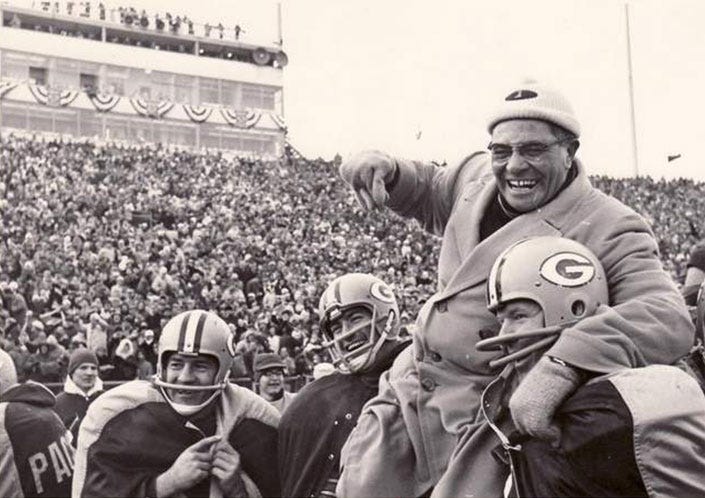
But he kept the actual best player, Paul Hornung: While Hornung was the life of the party off the field, he was completely dedicated on it. And that summed up what Lombardi meant when he gave the Packers their slogan: "Those who stay will be champions."

Sure enough, in just 1 season, having gotten rid of the unserious, and having promoted the dedicated, he took the Packers to to 7-5. In 1960, they went 8-4, and won the Western Division, but lost the NFL Championship Game to the Philadelphia Eagles. It would be the only postseason game Lombardi ever lost.

In 1961, they lost their opener to the Detroit Lions in Milwaukee, then won 6 straight, lost to away to the Baltimore Colts, won their next 4, lost away to the San Francisco 49ers, and closed with a win away to the Los Angeles Rams, finishing 11-3.

With Bart Starr quarterbacking an offense with Hornung and Jim Taylor running, Boyd Dowler receiving, and one of the great offensive lines of all time, including Hall-of-Famers Jim Ringo at center, Jerry Kramer at guard and Forrest Gregg at tackle -- Lombardi called Gregg "the finest player I ever coached," and he later coached the Cincinnati Bengals into their 1st Super Bowl -- the Pack dropped 49 points on the Browns, 45 on the Colts, and 35 on the Rams.

The defense was fearsome, with end Willie Davis, tackle Henry Jordan, linebacker Ray Nitschke, cornerback Herb Adderley, and safeties Willie Wood, and former Giant Emlen Tunnell all going to the Hall of Fame. They shut out the Chicago Bears, held the Colts and the Minnesota Vikings to just 7 points each, held the Lions to 9 in their rematch, and held the 49ers in their earlier win and the Vikings in their other game to 10.

This was the 1st title game played in Green Bay, which would become famous for its cold weather, especially after the 1967 NFL Championship Game, which became known as the Ice Bowl. Green Bay wasn't the furthest-north city in the NFL anymore -- the expansion Vikings now were -- but they were further north than 2 of the Canadian Football League's 9 teams, the Toronto Argonauts and the Hamilton Tiger-Cats.

For the 3rd time, the Giants faced a frozen field for an NFL Championship Game. For the 3rd time, they decided to try sneakers rather than cleats, to get better traction. (This would eventually be outlawed.) In 1934 and 1956, both times against the Bears, it worked. This time, it didn't.

The game kicked off at 1:00 PM Central Time (2:00 Eastern). The 1st quarter ended with the game scoreless, and that would be the highlight of the day for the Giants. It was all Packers: Hornung scored on a 6-yard run, Starr threw a 13-yard pass to Dowler, Starr threw a 14-yard pass to Ron Kramer, and Hornung kicked a 17-yard field goal -- all in the 2nd quarter. Green Bay led, 24-0.

In the 3rd quarter, Hornung kicked a 22-yard field goal, and Starr threw a 13-yard touchdown pass to Kramer. Hornung added a 19-yard field goal. Meanwhile, the Packer defense completely shut Big Blue down. Packers 37, Giants 0. It was only the 5th shutout in an NFL Championship Game -- and, after 4 more NFL Championship Games and 56 Super Bowls, it remains the last. (The 1939 game was also a Packer shutout of the Giants, 27-0.

The Packers beat the Giants again in the 1962 NFL Championship Game, 16-7 at Yankee Stadium. The Giants made one more Championship Game in 1963, losing to the Chicago Bears, then collapsed, not reaching the Playoffs again until 1981.

The Packers fell short in 1963 and 1964, then became the only team ever to win 3 straight NFL Championship Games: 1965, 1966 and 1967. This included the 1st 2 Super Bowls, before Lombardi retired. After coaching the Washington Redskins to a big improvement in 1969, Lombardi developed colon cancer, and died the next year.

Nevertheless, he was right about his Packers: In 7 seasons, 5 times, those who stayed were champions.

UPDATE: The Packers have the largest team Hall of Fame in North American sports. Through the 2025 NFL season, the inductees from the Lombardi Era, 1959 to 1968, are:

* Offense: Quarterbacks Bart Starr and Zeke Bratkowski; running backs Paul Hornung, Jim Taylor, Elijah Pitts, Donny Anderson and Travis Williams; wide receivers Gary Knafelc, Ron Kramer, Max McGee and Boyd Dowler; tight ends Marv Fleming and Carroll Dale; centeres Jim Ringo and Ken Bowman; guards Jerry Kramer, Fred "Fuzzy" Thurston and Gale Gillingham; tackles Forrest Gregg, and Bob Skoronski; and kicker-punter Don Chandler.

* Defense: Ends Willie Davis, Dave Hanner and Lionel Aldridge; tackles Henry Jordan and Ron Kostelnik; linebackers Ray Nitschke, Bill Forester, Dan Currie, Dave Robinson and Lee Roy Caffey; cornerbacks Herb Adderley and Jesse Whittenton; and safeties Willie Wood and Bob Jeter.

* Management: Head coach and general manager Vince Lombardi, assistant coaches Red Cochran and Phil Bengtson; scout Jack Vainisi; longtime executives Fred Leicht, Frederick Trowbridge, Jerry Atkinson, Dominic Olejniczak and Tom Miller; trainer Bud Jorgensen and team physician E.S. Brusky; team historian Lee Remmel; team photographer Vernon Biever; band director Wilner Burke; video director Al Treml; broadcaster Ray Scott; journalist Art Daley; the Hall of Fame's founder, William Brault; and longtime Packer fan Al Schneider.

Lombardi, Starr, Hornung, Taylor, Kramer, Thurston, Davis and Nitschke have also been inducted into the Wisconsin Athletic Hall of Fame.

After Lombardi left, it would be a long time before there was another title. Elected to the Packers Hall of Fame from the 1970s: Linebacker Fred Carr, cornerbacks Ken Ellis and Willie Buchanon, running back John Brockington, and placekicker Chester Marcol.

Elected from the 1980s: Quarterbacks Lynn Dickey and Don Majkowski; running back Gerry Ellis; receivers James Lofton and Sterling Sharpe; tight end Paul Coffman; center Larry McCarren; tackle Greg Koch; defensive end Ezra Johnson; linebackers Mike Douglass, John Anderson, Tim Harris and Johnny Holland; cornerback Mark Lee; safeties Johnny Gray and Mark Murphy (not to be confused with the Mark Murphy who was Packer team president from 2007 to 2025); placekicker Jan Stenerud; and executive Robert Parins.

*

December 31, 1961 was a Sunday. The AFL Championship had been played a week earlier, with the Houston Oilers beating the San Diego Chargers, 10-3 at Balboa Stadium in San Diego. There had been 2 college bowl games the day before the NFL Championship Game, and the 4 major bowls were played the next day, New Year's Day. This included the Sugar Bowl, at Tulane Stadium in New Orleans, in which Number 1-ranked Alabama clinched the National Championship, beating Arkansas, 10-3.

Baseball was out of season. The NBA scheduled no games for the day. The NHL scheduled 2. The New York Rangers lost to the Boston Bruins, 7-4 at the old Madison Square Garden. And the Detroit Red Wings beat the Toronto Maple Leafs, 4-2 at the Olympia Stadium in Detroit. The Montreal Canadiens and the Chicago Black Hawks were not scheduled.

Tuesday, November 29, 2022

November 29, 1931: The Packers' 1st "Threepeat"

Johnny "Blood" McNally

November 29, 1931: The Championship of the National Football League is clinched... at Ebbets Field. The Green Bay Packers beat the football team named the Brooklyn Dodgers, 7-0, to advance to 12-1 on the season.

Coached by Earl "Curly" Lambeau, the Packers' star player was John Victor McNally Jr., from New Richmond, Wisconsin, across the State, close to Minneapolis rather than to Green Bay or Milwaukee. He starred at St. John's University in Minnesota, and then at Lambeau's Alma Mater, Notre Dame.

In 1922, while at St. John's, he and a teammate, Ralph Hanson, were passing a Minneapolis movie theater, showing the movie Blood and Sand, starring Rudolph Valentino as a Spanish bullfighter. McNally turned to the teammate, and, knowing that they could secretly make money playing professional or semipro ball on Sundays, the day after playing for Notre Dame, if they used fake names, and said, "I'll be Blood, and you be Sand." Hanson, as Ralph Sand, never played in the NFL, but John McNally was "Johnny Blood" from then on.

He played in the NFL for the Milwaukee Badgers, the Duluth Eskimos and the Pottsville Maroons, before joining the Packers in 1929, eventually helping them win 4 NFL Championships. In this 1931 season, the two-way halfback scored 2 touchdowns rushing, a then-record 10 receiving, and another on an interception return. He later served as a player-coach with the football version of the Pittsburgh Pirates, before they changed their name to the Steelers; and returned to St. John's to coach. (St. John's is now an NCAA Division III school, and has no connection besides name to the one in New York City.)

The Packers benefited from having their 1st 7 games all at home, probably because most NFL teams then used the biggest stadium in their city, which tended to be not a college football stadium, including one of the many "Memorial Stadiums" built to honor the dead of World War I in the preceding decade, but a baseball park, and most of those parks were occupied in September.

The Packers beat the football version of the Cleveland Indians, 26-0; the Dodgers, 32-6; the team that would become their arch-rivals, the Bears, 7-0; the football version of the New York Giants, 27-7; the Chicago Cardinals, 26-7; the Frankford Yellow Jackets, 15-0; and the Providence Steam Roller (no "S" on the end), 48-20.

The Packers went to Wrigley Field to play the Bears again, and won, 6-2. They hosted the Staten Island Stapletons, and won, 26-0. They were finally beaten by Ernie Nevers and the Cardinals, 21-13 at Wrigley, where they played their home games that season, rather than at Comiskey Park, the usual home of the Cardinals and baseball's Chicago White Sox.

The Packers rebounded, beating the Giants, 14-10 at the Polo Grounds; beating the Steam Roller, 38-7 at the Providence Cycledrome on Thanksgiving; and clinching against the Dodgers at Ebbets Field. The following week, they lost to the Bears, 7-6 at Wrigley Field. But it didn't matter, because the Portsmouth Spartans finished at 11-3, and could not catch the Packers.

The Packers thus won their 3rd straight NFL Championship. It had never happened before. Through the 2021 season, it has happened only once since: The Packers again, in 1965, 1966 and 1967, including Super Bowls I and II.

This remains the last time the NFL Championship has been decided without some form of postseason play.

Lambeau and McNally were both charter inductees into the Pro Football Hall of Fame in 1963. Lambeau died in 1965, and Green Bay's new City Stadium was renamed Lambeau Field in his memory. McNally was one of a few 1920s players interviewed by NFL Films for their 1976 documentary Old Leather, and lived until 1985.

UPDATE: The Green Bay Packers have the largest team Hall of Fame of any team in the "Big Four" North American sports: The NFL, MLB, the NBA and the NHL. From the team's founding era, 1919 to 1928, but not on the 1929, '30 or '31 title teams, they have inducted tackle Howard "Cub" Buck, back Charlie Mathys, and team executive Andrew Turnbull.

From the 1929-30-31 title teams, they have inducted co-founder, owner, general manager, head coach and back Earl "Curly" Lambeau; co-founder George Whitney Calhoun; executives Frank Jonet, Gerald F. Clifford, Fred Leicht, Emil Fischer and Lee Joannes; backs Johnny "Blood" McNally, Verne Lewellen, Arnie Herber, Hank Bruder and Joseph "Red" Dunn; ends Lavern "Lavvie" Dilweg and Milt Gantenbein; tackle Cal Hubbard; guards Mike Michalske and Howard "Whitey" Woodin; centers Francis "Jug" Earp, Bernard "Boob" Darling and Nate Barragar; trainer Carl "Bud" Jorgensen and team doctor W. Webber Kelly; and the team's 1st broadcaster, Russ Winnie.

Lambeau, Buck, Dilweg, Dunn, Goldenberg, Lewellen, McNally and Michalske have also been inducted into the Wisconsin Athletic Hall of Fame.

*

November 29, 1931 was a Sunday. Only 2 other games were played that day. The Giants and the Steam Roller played to a 0-0 tie at the Polo Grounds. This turned out to be the last game the Steam Roller ever played. They had won the NFL Championship in 1928, but the Great Depression did them in.

And the Spartans beat the Bears, 3-0 at Universal Stadium in Portsmouth, Ohio. It still stands, as Spartan Memorial Stadium.

The day before, the Cardinals beat the Indians, 21-0 at Wrigley Field. And, 2 days before that, on Thanksgiving Day, these games were played:

* The Giants lost to the Stapletons, 9-6 at Thompson Stadium on Staten Island.

* The Bears beat the Cardinals, 18-7 at Wrigley Field.

* And, as I said, the Packers beat the Steam Roller, 38-7 at the Cycledrome.

Baseball was out of season. The NBA hadn't been founded yet. There were 2 games played in the NHL. The New York Rangers beat the Chicago Black Hawks, 5-0 at the Chicago Stadium. And the Detroit Falcons beat the Montreal Canadiens, 3-2 at the Olympia Stadium in Detroit. Ebenezer "Ebbie" Goodfellow scored the winning goal, 3:33 into overtime. The next season, the Falcons became the Detroit Red Wings.

Thursday, September 29, 2022

September 29, 1957: A Harlem Farewell, and Hellos In Green Bay and Cleveland


September 29, 1957: The New York Giants baseball team play their last game at the Polo Grounds, their owner Horace Stoneham having already announced that they're moving to San Francisco. Unlike the Brooklyn Dodgers, who played their last home game at Ebbets Field 5 days earlier, they have a farewell ceremony, including Blanche McGraw, widow of longtime manager John, who said that the move would have broken his heart.

Since moving to the site in 1890, including replacing the original stadium that burned down in 1911, the Giants had won 15 National League Pennants, and won the World Series 5 times: In 1905, 1921, 1922, 1933 and 1954.

The Pittsburgh Pirates, unable to even score off the Dodgers on Tuesday night, beat the Giants on Sunday afternoon, 9-1. The crowd is a pathetically small 11,606, and storms the field after the game. At one point, they gather at the center field blockhouse that included both teams' locker rooms, chanting for Mays, "We want Willie!" And, to the tune of "Good Night, Ladies," they sing, "We want Stoneham! We want Stoneham! We want Stoneham, with a rope around his neck!"
Stoneham had already said that the fans had no one to blame but themselves, as they hadn't shown up in sufficient numbers, borne out by the small crowd at the finale: "I feel bad for the kids, but I haven't seen too many of their fathers lately."

As for the Dodgers: Their last game as a Brooklyn team is also on this day, and it is a 2-1 loss to the Philadelphia Phillies at Connie Mack Stadium. Ed Bouchee homers for the Phils, and Seth Morehead outpitches Roger Craig.

The last active Brooklyn Dodger was Bob Aspromonte, who played until 1971. The last active New York Giant was Willie Mays, who played until 1973.

The last pitch by a Brooklyn Dodger is thrown by an erratic (so far) reliever from Brooklyn, Sandy Koufax. The last Brooklyn play is left fielder Bob Kennedy flying to center fielder Richie Ashburn. It is also, though no one foresees the Winter's tragedy, the last game for Roy Campanella, and his last at-bat is also a fly to Ashburn. With both teams well out of the race, only 9,886 attend the Brooklyn Dodgers' semi-official funeral.

*

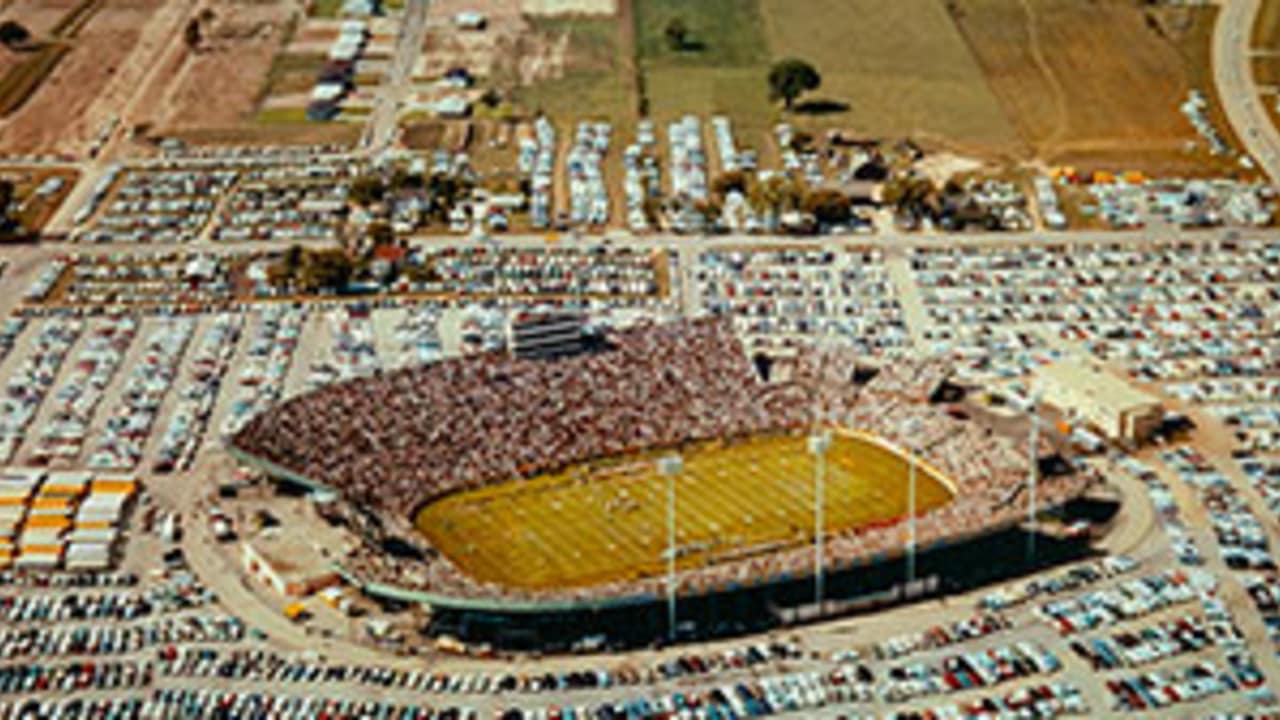
That is not the case at the 1st game at the new City Stadium in Green Bay, Wisconsin, as the Packers move out of the old one, which was too small, and 32,132 see them beat their arch-rivals, the Chicago Bears, 21-17.
Actual color photo from the 1st game

The stadium was renamed Lambeau Field after team founder Earl "Curly" Lambeau died in 1965. By that point, capacity was be 50,861. That's how many people attended the 1967 NFL Championship Game on New Year's Eve, known as the Ice Bowl: Despite a gametime temperature of -15 degrees Fahrenheit, without the wind chill factor, there wasn't an empty seat in the house. The capacity became 55,000 by 1970, 58,000 by 1990, 60,000 by 1995, 70,000 by 2005, and is now 81,411.

Since moving to Lambeau Field in 1957, the Packers have made the Playoffs 27 times, won 14 Division titles, reached the NFL (1957-69) or NFC (1970-2016) Championship Game 13 times, won 8, reached 5 Super Bowls, and won 4 of them: I, II, XXXI and XLV -- meaning they have been World Champions for the seasons of 1961, 1962, 1965, 1966, 1967, 1996 and 2010.

Lambeau Field is the oldest active stadium in the NFL. The Bears' Soldier Field went up in 2002, replacing the same of the same name on the same site that went up in 1924, although the Bears have only played on the site since 1970.

Its debut was also the NFL debut of Jim Brown, who ran for 86 yards, and caught a pass for 6 yards. This helped the Cleveland Browns beat the New York Giants, 6-3 at Cleveland Municipal Stadium.
Brown would go on to become the NFL's all-time leading rusher. In 1999, The Sporting News put him on top of their list of the 100 Greatest Football Players.

*

September 29, 1957 was a Sunday. On this day, Mark L. Attanasio is born in The Bronx, and grows up just across the Hudson River, in Tenafly, Bergen County, New Jersey. Since 2005, he has been the owner of the Milwaukee Brewers. This was also the day of the Kyshtym Disaster, a nuclear plant explosion and leak in Russia. I have a separate entry for that event.

In addition to the Giants' and Dodgers' losses, these baseball games were played:

* The New York Yankees lost to the Boston Red Sox, 3-2 at Fenway Park in Boston. Ted Williams went 2-for-2 with an RBI, before being replaced for defensive purposes by Jimmy Piersall. Jerry Coleman hit a home run. Mickey Mantle did not play.

* The Baltimore Orioles beat the Washington Senators, 7-3 at Griffith Stadium in Washington. The Senators' bullpen collapsed in the top of the 10th inning, with the winning run scoring on an RBI double by Brooks Robinson.

* The Detroit Tigers beat the Kansas City Athletics, 7-4 at Briggs Stadium (later Tiger Stadium) in Detroit. Al Kaline went 2-for-5.

* The Cleveland Indians beat the Chicago White Sox, 5-3 at Comiskey Park in Chicago.

* The Milwaukee Braves beat the Cincinnati Redlegs, 4-3 at Milwaukee County Stadium. (The Reds called themselves the Redlegs from 1953 to 1959, because of the Red Scare.) Hank Aaron went 0-for-3. Frank Robinson went 1-for-4.

* The Chicago Cubs beat their arch-rivals, the St. Louis Cardinals, 8-3 at Busch Stadium (formerly Sportsman's Park) in St. Louis. Ernie Banks went 5-for-5 with an RBI. Stan Musial did not play.

And, in addition to the Lambeau and Jim Brown debuts, these NFL games were played:

* The Baltimore Colts beat the Detroit Lions, 34-14 at Memorial Stadium in Baltimore.

* The Pittsburgh Steelers beat the Washington Redskins, 28-7 at Forbes Field in Pittsburgh.

* The Los Angeles Rams beat the Philadelphia Eagles, 17-13 at the Los Angeles Memorial Coliseum.

* And the Chicago Cardinals beat the San Francisco 49ers, 20-10 at Kezar Stadium in San Francisco.

Wednesday, September 14, 2022

September 14, 1919: The Debut of the Green Bay Packers

Curly Lambeau

September 14, 1919: The football team of the Indian Packing Company of Green Bay, Wisconsin, coached and captained by local hero and former University of Notre Dame quarterback Earl "Curly" Lambeau, a Green Bay native, defeats the Menominee North End Athletic Club, 53-0 at Hagemeister Park.
Thus debuted the team that would come to be known as the Green Bay Packers, the most successful team in the history of professional football, with 13 NFL Championships.

Because they were made up of co-workers, the Packers were a "company team," or what the British would call a "works side." This would also be true of the team that would become their arch-rivals, the Chicago Bears, who began the following season as the Decatur Staleys, representing the A.E. Staley Starch Company of Decatur, Illinois.

The Staleys/Bears, run by George Halas, were a founding team of the NFL in 1920. The Packers were not, but joined in 1921. The Packers won the NFL Championship in the single-division, no-playoff era, 3 straight times: 1929, 1930 and 1931. They won the NFL Championship Game in 1936, 1939, 1944, 1961, 1962, 1965, 1966 and 1967, meaning they won 3 straight NFL Championships for a 2nd time. No other franchise has done this. Vince Lombardi coached them to those last 5 titles. They also lost NFL Championship Games in 1938 and 1960.

Those last 2 titles, 1966 and 1967, were won by defeating the Dallas Cowboys, the former on New Year's Day 1967 at the Cotton Bowl in Dallas, the latter on New Year's Eve 1967, in frigid conditions that got the game nicknamed "The Ice Bowl."

That game was played at their new stadium, built in 1957, which, like its predecessor, was named Green Bay City Stadium. Curly Lambeau, who played for them from 1919 to 1929, coached them from 1920 to 1949, and later coached the Chicago Cardinals and the Washington Redskins, died before the 1965 season. In his memory, the 2nd City Stadium was then renamed Lambeau Field.
Statue of Lambeau outside the stadium

Those last 2 NFL titles sent the Packers to the games that would retroactively be named the 1st 2 Super Bowls, and they won both. After a long down period, they won Super Bowl XXXI in 1997, and lost Super Bowl XXXII in 1998, both under head coach Mike Holmgren. They have usually been at least competitive since. In 2011, they won Super Bowl XLV, under head coach Mike McCarthy.

Because Green Bay is a small city -- population 62,888, according to a sign shown in a 1967 NFL Films documentary, and 107,395 according to the 2020 Census -- the Packers often played regular-season games in Milwaukee, including the 1939 NFL Championship Game at the State Fair stadium in suburban West Allis, now a racetrack known as the Milwaukee Mile; and at Milwaukee County Stadium, home of baseball's Braves and later the Brewers.

They stopped doing this in 1994, as Lambeau Field had been expanded to be bigger than County Stadium, and it had become more costly to move everything from one "home field" to another and back than it did to stage the games in the much bigger city.

Green Bay is the only one of the NFL's early small cities to survive -- R.I.P. Providence, Rhode Island; Hartford, Connecticut; Rochester, New York; Pottsville, Pennsylvania; Canton, Massillon and Dayton, Ohio; Muncie and Hammond, Indiana; Decatur and Rock Island, Illinois; Racine, Wisconsin; and Duluth, Minnesota.

How? Halas, despite his rivalry with Lambeau, stepped in to use his influence to keep the Packers in the League. And the NFL's TV revenue-sharing agreement means that the Packers can compete on an even level with big cities like New York, Chicago and Los Angeles. Without that, most likely, the Packers would have begun "groundsharing" with the Brewers at the Milwaukee domed stadium now named American Family Field.

Since the team now known as the Arizona Cardinals, despite claiming an official connection to a Chicago athletic club that began playing professional football in 1898, hasn't played continuously since then, the Packers are officially the NFL's oldest franchise, older than the NFL itself. And their rivalry with the Bears is the NFL's oldest, and probably its best, helping to give first the NFC Central Division (1970-2001), then the NFC North Division, the nickname "The Black and Blue Division."

Interestingly, while the Packers named their stadium for Lambeau, and dedicated a statue of him outside (along with one of Lombardi), they have never retired his Number 20.

*

September 14, 1919 was a Sunday. Because the Commonwealths of Massachusetts and Pennsylvania still prohibited professional sports on Sunday, it was difficult for pro football leagues to gain traction, prior to the NFL's founding the next season. And some baseball teams were forced to take the day off. But these baseball games were played that day:

* The New York Yankees beat the St. Louis Browns, 8-1 at the Polo Grounds. The newly-acquired Carl Mays went the distance for the win. Wally Pipp hit a home run. George Sisler went 0-for-4 for the Browns.

* The New York Giants lost to the St. Louis Cardinals, 3-1 at Robison Field in St. Louis. Rogers Hornsby went 1-for-4. The Giants got only 4 hits, 2 by Art Fletcher.

* The Detroit Tigers beat the Washington Senators, 9-4 at National Park (later renamed Griffith Stadium) in Washington. Ty Cobb went 2-for-3 with 2 walks, a stolen base, and 2 RBIs. Harry Heilmann went 4-for-5 with 2 RBIs.

* The Cincinnati Reds beat the Boston Braves, 1-0 at Redland Field (later renamed Crosley Field) in Cincinnati. Ray Fisher pitched a 6-hit shutout. Edd Roush, the Hall of Fame center fielder about to lead the Reds to a World Series win over the Chicago White Sox -- and he insisted until his death that the Reds would have won even if the White Sox had played on the level -- went 4-for-4.

* And the Chicago Cubs beat the Philadelphia Phillies, 4-0 at Weeghman Park -- later renamed Cubs Park and Wrigley Field -- in Chicago. Elwood "Speed" Martin allowed the Phils 10 hits, but kept the shutout.

Sunday, June 26, 2022

June 26, 1959: The St. Lawrence Seaway Opens

June 26, 1959: The St. Lawrence Seaway opens, aiding international trade for the United States; Canada, its neighbor and co-owner of the Seaway; and their allies.

It had actually opened on April 25, but June 26 was the dedication ceremony. Attending was each country's head of state: The 68-year-old President Dwight D. Eisenhower and the 33-year-old Queen Elizabeth II of the British Commonwealth, to which Canada still belonged (and still does).

The year before, the Republican nominee for U.S. Senator from Massachusetts, opposing Democratic incumbent John F. Kennedy, was noted Boston attorney Vincent J. Celeste. One of his campaign statements was, "Of course my opponent voted for the St. Lawrence Seaway. It ends at the Merchandise Mart in Chicago, which is owned by old Joe Kennedy." The suggestion was that JFK voted for it not because it was good policy -- and even most Republicans seemed to agree that it was -- but because of family corruption. This didn't work at all -- and not just because, while the Merch Mart is effectively on the Seaway, it is not the Seaway's terminal -- and JFK rose from 51 percent of the vote in his 1952 election to 73 percent.

The Seaway is a system of locks, canals and channels that connects the Great Lakes with the St. Lawrence River, and eventually the Atlantic Ocean. Officially, it runs 370 miles from Port Colborne to Montreal. Unofficially, it accesses such port cities as Duluth, Minnesota; Green Bay and Milwaukee, Wisconsin; Chicago, Illinois; Detroit, Michigan; Toledo and Cleveland, Ohio; Erie, Pennsylvania; Thunder Bay, Sault Ste. Marie, Sarnia, Port Colborne, Hamilton, Toronto and Oshawa, Ontario; Buffalo, Niagara Falls and Ogdensburg, New York; and Montreal, Trois-Rivières, Québec City, Baie-Comeau and Sept-ÃŽles, Quebec, into the Atlantic Ocean.

The locks on the U.S. side are managed by the St. Lawrence Seaway Development Corporation. The ones on the Canadian side are managed by the St. Lawrence Seaway Management Corporation. Over 3,000 ships use the Seaway every year. From Duluth to Sept-ÃŽles, it takes about 8 1/2 days.

*

June 26, 1959 was a Friday. Canadian Comedian Mark McKinney, known for his work on The Kids in the Hall from 1989 to 1995, and on Saturday Night Live from 1995 to 1997, was born on this day. This was also the day that Ingemar Johansson knocked Floyd Patterson out to become the Heavyweight Champion of the World.

And these baseball games were played:

* The New York Yankees beat the Chicago White Sox, 8-4 at Comiskey Park in Chicago. Mickey Mantle went 3-for-4 with a walk. Art Ditmar outpitched Billy Pierce.

* The Cleveland Indians beat the Boston Red Sox, 11-5 at Cleveland Municipal Stadium. Ted Williams went 1-for-3 with a walk.

* The Cincinnati Reds beat the St. Louis Cardinals, 7-6 at Crosley Field in Cincinnati. Johnny Temple doubled Eddie Kasko home with the winning run in the bottom of the 10th inning. Frank Robinson only appeared as a pinch-runner, and never came to bat or took the field. Stan Musial hit 2 home runs.

* The Baltimore Orioles swept a doubleheader from the Detroit Tigers, 12-7 and 4-1 at Briggs Stadium (later Tiger Stadium) in Detroit. Over the 2 games, Al Kaline went 2-for-9 with a home run and 2 RBIs. Brooks Robinson did not play in either game.

* The Milwaukee Braves beat the Chicago Cubs, 11-1 at Milwaukee County Stadium. Warren Spahn went the distance for the win, and helped his own cause with a home run. Hank Aaron went 2-for-4 with an RBI. Ernie Banks went 1-for-4 with an RBI.

* The Washington Senators beat the Kansas City Athletics, 8-4 at Kansas City Municipal Stadium. Harmon Killebrew hit a home run for the Senators. Roger Maris went 0-for-5 for the A's.

* The Los Angeles Dodgers beat the Pittsburgh Pirates, 6-5 at the Los Angeles Memorial Coliseum. Duke Snider, John Roseboro and Charlie Neal hit home runs for the Dodgers. Harry Bright, Don Hoak and Dick Stuart hit home runs for the Pirates. Roberto Clemente did not play.

* And the San Francisco Giants beat the Philadelphia Phillies, 8-0 at Seals Stadium in San Francisco. Mike McCormick pitched a 3-hit shutout. Willie Mays and Jackie Brandt hit home runs for the Giants.

December 31, 1999 & January 1, 2000: The Millennium

December 31, 1999:  The Millennium arrives. The people of planet Earth survived. At a terrible cost. But we hadn't destroyed ourselves. ...