Showing posts with label u.s. army. Show all posts

Wednesday, December 28, 2022

December 29, 1890: The Wounded Knee Massacre

December 29, 1890: The Wounded Knee Massacre takes place near the creek and now town of the same name, in southwestern South Dakota. It is the last major action between the U.S. Army and Native Americans, and possibly the worst.

In 1876, the the Lakota Sioux fought the 7th Cavalry, under the command of Lieutenant Colonel George Armstrong Custer (who'd held the temporary, or brevet, rank of Brigadier General in the American Civil War), at the Battle of the Little Bighorn in Montana, and the Cavalry lost more than 1/3rd of its men, including Custer.

One of the chiefs leading the Lakota troops was Sitting Bull. For 5 more years, he managed to avoid capture by U.S. troops, until finally surrendering. He joined William F. "Buffalo Bill" Cody's Wild West Show, but returned to the Standing Rock Reservation in South Dakota, which had gained Statehood along with North Dakota on November 2, 1889.

In response to the many degradations the Natives faced, the "Ghost Dance" movement began, a nationalist movement similar to the later Black Panther Party and the Reconquista movement of Mexican-Americans.

Faced with a nonwhite people expressing pride in themselves and their traditions, white America's government did what it had done so many times, and would continue to do: It overreacted. In the tradition of "Cut off the head, and the body will die," the rebuilt 7th Cavalry went to arrest Sitting Bull. They arrived on December 15, 1890, and he refused to accept arrest, and was shot and killed. Although Native record-keeping made establishing his exact birthdate impossible, he was believed to be 59 years old.

The Cavalry, under the command of Colonel James W. Forsyth, moved on to Wounded Knee, 275 miles to the southwest. Arriving on December 28, they surrounded the Lakota camp. On the morning of the 29th, they went in to take the Lakota men's guns away. A Ghost Dance ritual was being conducted at the time. A man named Black Coyote refused to give up his rifle, citing the large amount of money he'd paid for it. What happened next is in dispute: Either Black Coyote fired, and a soldier grabbed his rifle, they struggled over it, and it went off.

What is not in dispute is what happened after that first gunshot: The Cavalry opened fire, and those few Lakota who still had their weapons returned what fire they could. More than 250 men, women and children were killed. That was nearly as many men as the 7th Cavalry lost at the Little Bighorn, but those were all trained soldiers. To put that in a modern perspective, it's nearly half again as many people as died in the Oklahoma City Bombing of 1995, and 1/8th as many as were killed on 9/11 -- and since the U.S. had about 1/4th as many people in 1890 as it had in 2001, it's proportionately about half as bad as 9/11.

The Cavalry lost 31 men. Twenty men were awarded the Congressional Medal of Honor. There was no honor in what they did.

At the time, the President of the United States was Benjamin Harrison. His grandfather, William Henry Harrison, had been President for one month in 1841, before dying of pneumonia. In 1811, William Henry Harrison defeated Native tribes at the Battle of Tippecanoe in Indiana. In 1813, his troops killed the Native chief Tecumseh at the Battle of the Thames near what's now Stratford, Ontario, Canada. Now, perhaps unwittingly, he had finished his grandfather's work. Of course, white men's attacks on the Native peoples of North America went all the way back to the Spanish settlement of St. Augustine, Florida in 1565, so it's not like "Old Tip" Harrison started it.

Wounded Knee is far from any major city. It's 104 miles southeast of Mount Rushmore, 350 miles northeast of Denver and over 400 miles northwest of Omaha. In fact, the Little Bighorn Battlefield is about 350 miles to the northwest, so it's closer to that than to Denver, the closest major league city.

*

December 29, 1890 was a Monday. Baseball and football seasons were over. Basketball wouldn't be invented for another year. There was a hockey league at the time, the Canadian Amateur Hockey Association, but no games were scheduled for this day. So, there were no scores on this historic day.

Thursday, December 22, 2022

December 22, 1944: General McAuliffe Says, "Nuts!"

December 22, 1944: Seven days after beginning their last stand on the Western Front, and sensing victory, Nazi Germany sends a surrender demand to the American commander. They got a response they did not expect.

With the Allies having liberated France, and marching toward Germany itself from the West, and the Soviet Union's Red Army marching from the East, the Nazis needed a win, somewhere. On December 15, they attacked in the Ardennes Forest, which stretches over France, Belgium, Luxembourg, and even part of Germany.

They pushed forward, and formed a "bulge" in the American line, leading to the conflict being known as "The Battle of the Bulge." By the 22nd, they had the U.S. Army's 101st Airborne Division, then stationed in Bastogne, Belgium, virtually surrounded.

One of the reasons the attack was launched when it was is that the 101st's commanding officer, Major General Maxwell D. Taylor, was away, attending a staff conference. In temporary command was Brigadier General Anthony C. McAuliffe.

(In the Army, the Marine Corps, and, since its separation from the Army in 1947, the Air Force, A Brigadier General wears one star, a Major General two, a Lieutenant General three, a full General four, and a General of the Army five. In the Navy, the equivalent ranks are, respectively: Commodore, Rear Admiral, Vice Admiral, Admiral, and Admiral of the Fleet. However, the Navy discontinued the rank of Commodore in 1985.)

On December 22, the Nazi commander, General der Panzertruppe Heinrich Diepold Georg Freiherr von Lüttwitz, sent a major under a flag of truce, and delivered this message to McAuliffe:

To the U.S.A. Commander of the encircled town of Bastogne.
The fortune of war is changing. This time the U.S.A. forces in and near Bastogne have been encircled by strong German armored units. More German armored units have crossed the river Ourthe near Ortheuville, have taken Marche and reached St. Hubert by passing through Hompre-Sibret-Tillet. Libramont is in German hands.
There is only one possibility to save the encircled U.S.A. troops from total annihilation: that is the honorable surrender of the encircled town. In order to think it over a term of two hours will be granted beginning with the presentation of this note.
If this proposal should be rejected one German Artillery Corps and six heavy A. A. Battalions are ready to annihilate the U.S.A. troops in and near Bastogne. The order for firing will be given immediately after this two hours term.
All the serious civilian losses caused by this artillery fire would not correspond with the well-known American humanity.
The German Commander. 
According to those present when McAuliffe received the German message, he read it, crumpled it into a ball, threw it in a wastepaper basket, and muttered, "Aw, nuts." The officers in McAuliffe's command post were trying to find suitable language for an official reply when Lieutenant Colonel Harry Kinnard suggested that McAuliffe's first response summed up the situation pretty well, and the others agreed. The official reply was typed and delivered by Colonel Joseph Harper. It read as follows:
To the German Commander.
NUTS!
The American Commander.
The German major appeared confused, and asked Harper what the message meant. Harper said, "In plain English? 'Go to Hell.'"
The choice of "Nuts!" rather than something earthier was typical for McAuliffe. Captain Vincent Vicari, his personal aide at the time, recalled that "General Mac was the only general I ever knew who did not use profane language. 'Nuts' was part of his normal vocabulary."
The artillery fire did not materialize, although several infantry and tank assaults were directed at the positions of the 327th Glider Infantry. In addition, the German Luftwaffe attacked the town, bombing it nightly. The 101st held off the Germans until the 4th Armored Division arrived on December 26 to provide reinforcement.
The Battle of the Bulge was the largest battle ever to involve American troops, with 705,000 men eventually taking on a peak of 449,000 Germans. Losses: 75,000 Americans, 104,000 Germans. Among the Americans serving, and earning a Bronze Star and a Purple Heart, was Warren Spahn, who would survive the war and pitch his way into the Baseball Hall of Fame.
Once the American reinforcements arrived, the Nazis were doomed, both on the Western Front and overall. By January 28, 1945, they were in retreat.
A 1919 West Point graduate, McAuliffe would be awarded a Distinguished Service Cross, a Silver Star and 2 Bronze Stars over the course of his career. After General Taylor returned, McAuliffe was given command of the 103rd Infantry Division, which liberated the Kaufering concentration camp and the Austrian city of Innsbruck. He was named Commander of the Seventh Army in 1953. In 1955, he was promoted to a full General, and appointed Commander-in-Chief of the U.S. Army Europe. He retired in 1956, and lived until 1975.
Harry Kinnard, who recommended the response of "Nuts!", had already received the Distinguished Service Cross for his service in Operation Market Garden earlier in the year. He remained in the Army. During the Vietnam War, he came up with the "airmobile" concept: Using helicopters to send troops into battle and then get them out. He retired as a Lieutenant General, and lived until 2009.
Freiherr von Lüttwitz was captured in the Battle of the Ruhr Pocket on April 16, 1945, and was held as a prisoner of war until July 1, 1947. He was not charges with war crimes, was permitted to retire in peace, and lived until 1969.
*
December 22, 1944 was a Friday. Baseball Hall of Fame pitcher Steve Carlton was born on this day.

Baseball was in the off-season. The NFL Championship Game was played 5 days earlier, with the Green Bay Packers beating the New York Giants, 14-7 at the Polo Grounds in New York. The NBA hadn't been founded yet. And, while the NHL was in-season, no games were scheduled for that day. So there are no scores on this historic day.

Tuesday, December 20, 2022

December 21, 1918: The Death of Hobey Baker

December 21, 1918: Hobey Baker, America's 1st great hockey player, is killed in a plane crash. He was only 26 years old.

Hobart Amory Hare Baker was born on January 15, 1892 outside Philadelphia in Bala Cynwyd, Pennsylvania. His family was rich, and could have gotten him into any college he wanted. Instead of the nearby University of Pennsylvania, he chose Princeton University, helping them win National Championships in football in 1911, and in hockey in 1912 and 1914.

He graduated in 1914, and moved to New York where he went to work for J.P. Morgan Bank and helped the St. Nicholas Hockey Club win the national amateur championship in 1915.

In 1917, he enlisted in the U.S. Army Air Service, a precursor of the U.S. Air Force. By the time the Armistice was signed on November 11, 1918, he held the rank of Captain, and was commander of the 141st Aero Squadron.

On December 21, 1918, 40 days after the Armistice, and the day before he was set to return to America, he was test-piloting a plane in Toul, France, when the engine failed, and crashed nose-first. He was pulled out of the wreckage, but died in the ambulance.

In 1921, Princeton opened the Hobey Baker Memorial Rink. He was the only American among the 1st 9 inductees into the Hockey Hall of Fame in 1945. In 1975, he was elected to the College Football Hall of Fame. In 1980, the Hobey Baker Award was introduced, a hockey version of the Heisman Trophy.

*

December 21, 1918 was a Saturday. Born on this day were Kurt Waldheim, the Austrian diplomat who served as Secretary-General of the United Nations 1972 to 1981, and President of Austria from 1986 to 1992, but was later exposed as having committed war crimes during World War II; and Donald Regan, who served President Ronald Reagan as Secretary of the Treasury during his 1st term and White House Chief of Staff for the 1st half of his 2nd, before his resignation over the Iran-Contra scandal.

Baseball was in the off-season. Football season was also over, except for the Rose Bowl, which was an all-military affair: George Halas led the Great Lake Naval Training Station, north of Chicago, to a 17-0 win over the Mare Island Marines, based outside San Francisco, led by former Washington State quarterback Dick Hanley. Both teams went into the game undefeated. Hanley would coach Marine teams in World War II. Halas, of course, went on to found the team that became the Chicago Bears, and co-found the NFL.

There was no serious professional basketball league. But the NHL season opened on this date, with 1 game: The Ottawa Senators beat the Montreal Canadiens, 5-2 at the Jubilee Arena in Montreal.

Saturday, December 17, 2022

December 17, 1944: The Malmédy Massacre

December 17, 1944: The Malmédy Massacre is carried out, in Malmédy, Wallonia, the French-speaking part of Belgium, during the Battle of the Bulge in World War II.

With the Allies having liberated France, and marching toward Germany itself from the West, and the Soviet Union's Red Army marching from the East, the Nazis needed a win, somewhere. On December 15, they attacked in the Ardennes Forest, which stretches over France, Belgium, Luxembourg, and even part of Germany.

They pushed forward, and formed a "bulge" in the American line, leading to the conflict being known as "The Battle of the Bulge." By the 22nd, they had the U.S. Army's 101st Airborne Division, then stationed in Bastogne, Belgium, virtually surrounded.

What is generally called "The Malmédy Massacre" was actually 2 separate incidents. At 4:30 AM local time on December 17, troops of the 1st SS Panzer Division captured dozens of American soldiers at a small fuel depot in Büllingen, in Belgium, but a German-speaking town, just 4 miles from the German border. The SS executed all of the American soldiers.

Later that day, between 12:00 Noon and 1:00 PM, Kampfgruppe Peiper approached the Baugnez crossroads, 2 miles southeast of the city of Malmédy. A U.S. Army convoy of 30 vehicles, from B Battery of the 285th Field Artillery Observation Battalion, was negotiating the crossroads, and then turning right, towards Ligneuville and St. Vith, in order to join the U.S. 7th Armored Division.

The Germans saw the U.S. convoy first, and the spearhead unit of Kampfgruppe Peiper fired upon and destroyed the first and last vehicles, which immobilized the convoy, and halted the American advance. As their immobilized convoy was outnumbered and outgunned, those soldiers of the 285th surrendered to the SS.

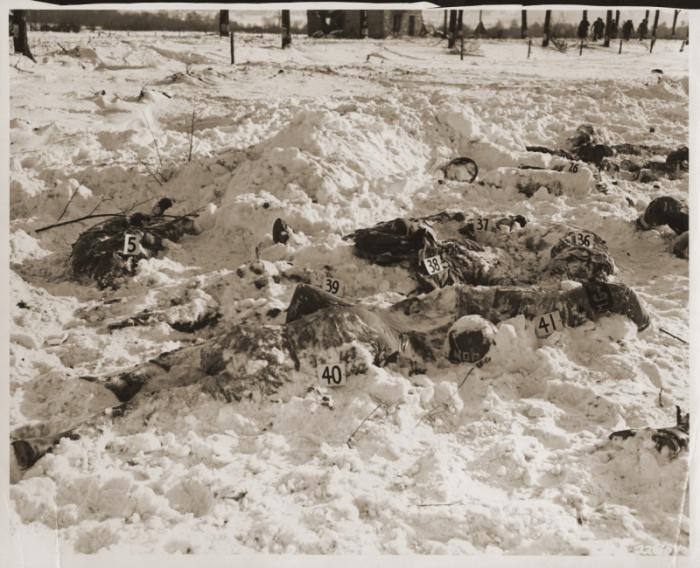
At the Baugnez crossroads, the SS infantry assembled the just-surrendered U.S. prisoners-of-war in a farmer's field, and added them to another group of U.S. POWs, soldiers who had been captured earlier that day. The POWs who survived the massacre at Malmédy said that a group of approximately 120 U.S. POWs stood in the farmer's field, when the SS fired machine guns at them. Panicked by the machine gun fire, some POWs ran and fled the field, but the SS soldiers shot and killed most of the grouped POWs where they stood; and some G.I.s had dropped to the ground and pretended to be dead.

Nonetheless, after the initial machine-gunning of the group of POWs, the SS soldiers walked amongst the POW corpses, searching for wounded survivors to kill with a coup de grâce gunshot to the head. Moreover, some of the POWs who fled the farmer's field had run to and hidden in a café at the Baugnez crossroads. The SS then set the café afire, and killed every U.S. POW who escaped the burning building.

At about 2:30 PM, 43 U.S. POWs who survived the massacre emerged from hiding from the SS, and then sought help and medical aid in nearby Malmédy, which was held by the U.S. Army. They were encountered by a patrol from the 291st Combat Engineer Battalion, and told them of what had happened. 

On December 26, reinforcements arrived, and the tide of the battle was turned. It was the beginning of the end of the Third Reich. Because it took until then for U.S. troops to push the Nazis back, and also because of the heavy snow, many of the bodies were not found for over a month.

In 1949, a U.S. Senate investigation concluded that, in the 36-day Battle of the Bulge, the soldiers of Kampfgruppe Peiper murdered between 538 and 749 U.S. POWs. Other investigations put the figure of the dead as being between 300 and 375 U.S. soldiers and 111 civilians executed.

The German commander, Joachim Peiper, was second-in-command to Heinrich Himmler in the SS. On July 16, 1946, he was convicted of war crimes, and sentenced to death. But the sentence was never carried out, and he was paroled after serving 10 years. In 1972, he moved to France. He was assassinated by an anti-Nazi group calling themselves The Avengers, on Bastille Day, July 14, 1976. He was 61.

On May 30, 2006, hosting The O'Reilly Factor on Fox News, Bill O'Reilly said, "In Malmédy, as you know, U.S. forces captured SS forces who had their hands in the air, and they were unarmed, and they shot them down."

O'Reilly lost his job -- not shortly after this, and not for this, but 11 years later, for his sexual assaults of women. Furthermore, Fox News scrubbed the reference to the Malmédy Massacre from the transcript of the show on their website.

*

December 17, 1944 was a Sunday. The NFL Championship Game was played at the Polo Grounds in Upper Manhattan. The Green Bay Packers, coached by team co-founder Earl "Curly" Lambeau, and led by quarterback Irv Comp and pro football's 1st great receiver, Don Hutson, visited the New York Giants, coached by Steve Owen, and led by former Packer quarterback Arnie Herber.

Four weeks earlier, also at the Polo Grounds, the Giants had beaten the Packers, 24-0. Not this time: The Packers won, 14-7, and won their 6th NFL Championship, all in a span of 16 years. They wouldn't get back to the title game for 16 years, upon the rebuilding led by Vince Lombardi.

The Giants thus fell to to 2-5 in NFL Championship Games, and would be 3-11 before their win in Super Bowl XXI in 1987.

Baseball was out of season. The NBA hadn't been founded yet. There were 2 games played in the NHL. The New York Rangers lost to the Montreal Canadiens, 4-1 at the old Madison Square Garden. And the Chicago Black Hawks beat the Detroit Red Wings, 2-1 at the Chicago Stadium. The Boston Bruins and the Toronto Maple Leafs were not scheduled.

Thursday, December 15, 2022

December 15, 1944: Five-Star Officers

Admiral of the Fleet William D. Leahy

December 15, 1944: William D. Leahy is named the 1st Fleet Admiral, a 5-star Admiral. This makes him the 1st U.S. military officer, in any branch, to wear 5 stars. Regardless of official status, George Washington, Andrew Jackson and Zachary Taylor never wore more than 2 stars; while Ulysses S. Grant and John J. Pershing limited themselves to 4.

The next day, December 16, George C. Marshall was named the 1st 5-star General in U.S. history: "General of the Army." On December 17, Ernest J. King was named a Fleet Admiral. On December 18, Douglas MacArthur was named a General of the Army. On December 19, Chester Nimitz was named an Admiral of the Fleet. On December 20, Dwight D. "Ike" Eisenhower was named a General of the Army. On December 21, 1944, Henry H. "Hap" Arnold was named a General of the Army.

On December 11, 1945, after V-E Day and V-J Day, William F. "Bull" Halsey was named an Admiral of the Fleet. On May 7, 1949, Hap Arnold was made the 1st General of the Air Force. He remains the only one.

On September 22, 1950, during the Korean War, Omar Bradley was named a General of the Army, our last. Despite some calls for it, there was no promotion from 4 stars for William C. Westmoreland (Vietnam War), Colin Powell (Persian Gulf War) or Norman Schwarzkopf (also the Persian Gulf War). There has never been a 5-star General in the U.S. Marine Corps.

After World War II, it was recommended that George C. Marshall be named the 1st Field Marshal in American history. Other countries have that rank, but America doesn't. President Harry S Truman admitted that Marshall deserved it, but thought that calling him "Marshal Marshall" wouldn't be dignified. So we still don’t have the rank.

*

December 15, 1944 was also the day the Battle of the Bulge began in the Ardennes Forest of France, Belgium and Luxembourg. It was Nazi Germany's last stand on the Western Front. On December 22, the Nazis sent an officer to deliver a surrender demand to the U.S. Army's 101st Airborne Division, then stationed in Bastogne, Belgium, and virtually surrounded. General Anthony McAuliffe, in command, sent him away with a one-word reply: "Nuts!"

The Nazis held the upper hand through Christmas, but the day after, the 4th Armored Division arrived with reinforcements, and turned the tide of the battle. Once that happened, the Nazis were doomed, both on the Western Front and overall.

It was also the day that Glenn Miller, the biggest bandleader of the World War II era, disappeared, his plane lost somewhere over the English Channel, as he was preparing for a concert for the troops in Paris. I have a separate entry for that event.

And it was the day the film Hollywood Canteen opened. I have a separate entry for that, too.

December 15, 1944 was a Friday. Baseball was in the off-season. The NFL Championship Game was played 2 days later, with the Green Bay Packers beating the New York Giants, 14-7 at the Polo Grounds in New York. The NBA hadn't been founded yet. And, while the NHL was in-season, no games were scheduled for that day. So there are no scores on this historic day.

Monday, November 14, 2022

November 14, 1965: The Battle of Ia Drang

November 14, 1965: The Battle of Ia Drang is fought, the first major engagement between American and Vietcong troops. Both sides claimed victory. About 1,300 American soldiers were killed.

The battle was part of the Pleiku campaign conducted early in the Vietnam Warin the central highlands of Vietnam, in 1965. It is notable for being the first large scale helicopter air assault, and also the first use of Boeing B-52 Stratofortress strategic bombers in a tactical support role.

General William Westmoreland had been assigned as Commander of Military Assistance Command, Vietnam (MACV) on June 20, 1964. President Lyndon B. Johnson assigned him to the post because Secretary of Defense Robert McNamara had told him Westmoreland was "the best we have, without question."
The Pentagon, and the Johnson Administration as a whole, treated Ia Drang as a victory. Time magazine named Westmoreland its Man of the Year for 1965. In a later article, Time suggested Westmoreland as a candidate for the Republican Presidential nomination in 1968. After all, successful Generals, even without political experience, were often touted as possible Presidents.

Ia Drang set the blueprint for the Vietnam War with the Americans relying on air mobility, artillery fire and close air support, while the People's Army of Viet Nam (PAVN) neutralized that firepower by quickly engaging American forces at very close range.

In other words, as generals so often do, America's generals were "fighting the last war," and the Vietnam War was not going to be like World War II, because the Vietcong were not the Wehrmacht, nor were they the Imperial Japanese Army. And it wasn't going to be like the Korean War, either. This was guerrilla warfare, and America hadn't been involved in that since... well, since their own Revolution of 1775 to 1783. And the Pentagon didn't know how to handle it. And so, the "quagmire" of Vietnam began.

On July 3, 1968, with the Tet Offensive already well past, and U.S. troop levels in Vietnam having risen from 16,000 to 535,000 under Westmoreland's command, LBJ promoted Westmoreland to Chief of Staff of the Army. At first glance, this would seem to be a reward -- for putting the U.S. in position to win the war, and for not running for President.

In hindsight, it seemed more like "kicking him upstairs," removing him from direct command as a punishment for failure. Westmoreland never achieved a "V-V Day," never got that 5th star, never got serious consideration for President from either major party, never joined the pantheon of legendary American Generals such as George Washington, Andrew Jackson, Zachary Taylor, Ulysses S. Grant, John Pershing, Dwight D. Eisenhower and Douglas MacArthur. Norman Schwarzkopf would eventually join that list, but Westmoreland died in 2005, at the age of 91, remembered as a General who failed.

*

November 14, 1965 was a Sunday. These NFL games were played:

* The New York Giants lost to the Cleveland Browns, 34-21 at Cleveland Municipal Stadium.

* The Philadelphia Eagles beat the Washington Redskins, 21-14 at Franklin Field in Philadelphia.

* The San Francisco 49ers beat the Detroit Lions, 27-21 at Tiger Stadium in Detroit.

* The Chicago Bears beat the football version of the St. Louis Cardinals, 34-13 at Wrigley Field in Chicago.

* The Green Bay Packers beat the Los Angeles Rams, 6-3 at Milwaukee County Stadium.

* The Baltimore Colts beat the Minnesota Vikings, 41-21 at Metropolitan Stadium in the Minneapolis suburb of Bloomington, Minnesota.

* And the Dallas Cowboys beat the Pittsburgh Steelers, 24-17 at the Cotton Bowl in Dallas.

In the American Football League:

* The New York Jets beat the Boston Patriots, 30-20 at Fenway Park in Boston.

* The Kansas City Chiefs beat the San Diego Chargers, 31-7 at Kansas City Municipal Stadium.

* The Denver Broncos beat the Houston Oilers, 31-21 at Rice Stadium in Houston.

* And the Buffalo Bills beat the Oakland Raiders, 17-14 at Frank Youell Field in Oakland.

Baseball was out of season. There was 1 game in the NBA: The Los Angeles Lakers beat the Baltimore Bullets, 129-114 at the Los Angeles Memorial Sports Arena.

And the NHL's entire "Original Six" were in action:

* The New York Rangers beat the Chicago Black Hawks, 4-2 at the Chicago Stadium.

* The Boston Bruins beat the Toronto Maple Leafs, 2-0 at the Boston Garden.

* And the Montreal Canadiens and the Detroit Red Wings, played to a tie, 2-2 at the Olympia Stadium in Detroit.

Friday, November 11, 2022

November 11, 1921: The Tomb of the Unknown Soldier

November 11, 1921: The Tomb of the Unknown Soldier is dedicated at Arlington National Cemetery, in Arlington, Virginia, across the Potomac River from Washington, D.C. The Tomb faces east, overlooking the national capital.

It is 3 years to the day after the Armistice that ended World War I. An unidentified soldier from World War I is buried there on the day. Every day since, regardless of weather, a team of U.S. Army Sergeants, in dress uniform, known as "Sentinels," has walked a guard along a black mat in front of the Tomb, one at a time until relieved by another. The Sentinel does the following:

  1. Marches 21 steps south down the 21-yard-long black mat laid across the Tomb.
  2. Turns and faces east, toward the Tomb, for 21 seconds.
  3. Turns and faces north, changes weapon to the outside shoulder, and waits 21 seconds.
  4. Marches 21 steps up the mat.
  5. Turns and faces east for 21 seconds.
  6. Turns and faces south, changes weapon to the outside shoulder, and waits 21 seconds.
  7. Repeats the routine until the soldier is relieved of duty at the Changing of the Guard.

The temporary Tomb was replaced by the permanent design in 1932, with a Memorial Amphitheater around it. People are asked to view with quiet and respect. The Sentinel will remind the audience of this if there is noise.

In 1958, coffins containing unidentified remains of soldiers killed in World War II and the Korean War were added. In 1984, one from the Vietnam War was added. In 1998, a reporter looked at evidence and decided he had identified the Vietnam "Unknown" as Air Force 1st Lt. Michael Blassie. The remains were exhumed, tested, and his identity confirmed. Blassie’s coffin was taken back to his hometown of St. Louis, where he was buried with full honors.

Rather than fill the space at Arlington where Blassie had rested with another "Unknown" from the Vietnam era, the space has been left empty, as an official tribute to those who never made it home, alive or dead.

Each day, on November 11, the President of the United States, or the Vice President if the President is unavailable due to a foreign trip or illness, lays a wreath at the Tomb, with assistance from a member of the Sentinel corps not walking the guard.
President Barack Obama, November 11, 2013

And all active-duty military personnel salute the Tomb, because they don't know the men's ranks: Each of the three remaining "Unknowns" could be a buck private, or a General, although the likelihood of a General having been unaccounted for, in any war, is slim. While they are all definitely men, no one knows their ranks, their races, their religions, their places of origin, or their branches of the service. The idea is that each could be anyone, and could have been anyone -- including veterans or future servicepeople.

*

November 11, 1921 was a Friday. Baseball was out of season. Professional basketball barely existed. The start of the NHL season was over a month away. And no games were played in the NFL. But there were 8 college football games played that day:

* Virginia Tech beat North Carolina State, 7-3 on (mostly) neutral ground at League Park in Norfolk, Virginia.

* Trinity College beat Wake Forest, 17-0 at Riddick Field in Raleigh, North Carolina. Trinity was renamed Duke University in 1925.

* Birmingham-Southern beat Chattanooga, 14-7 at Rickwood Field in Birmingham, Alabama. Despite being the team that opened the city's famed Legion Field in 1929, and winning 3 Southern Conference titles in the 1930s, Birmingham-Southern College discovered that they couldn't compete with Alabama, Auburn, or even the University of Alabama at Birmingham, and so they dropped their program in 1939. They returned in 2007, playing in NCAA Division III, but folded the program again in 2023.

The University of Chattanooga was absorbed into the University of Tennessee system in 1969, and was renamed the University of Tennessee at Chattanooga. They began playing a small-college schedule in 1956, were assigned to NCAA Division II in 1973, were promoted to Division I-A in 1977, but were dropped to Division I-AA, since renamed the Football Championship Subdivision (FCS), where they remain.

* Florida beat Alabama, 9-2 at Denny Field in Tuscaloosa, Alabama.

* Texas beat Mississippi A&M, 54-7 at Clark Field in Austin, Texas. The Agricultural and Mechanical College of the State of Mississippi was renamed Mississippi State College in 1932, and Mississippi State University in 1958.

* Texas A&M and Rice played to a tie, 7-7 at Rice Field in Houston.

* Iowa State beat Kansas State, 7-0 at Ahearn Field in Manhattan, Kansas.

* And Idaho beat Wyoming, 31-3 on (mostly) neutral ground at Public School Field in Boise, Idaho.

Tuesday, November 8, 2022

November 8, 1918: Larry Chappell Dies In Service

November 8, 1918: For the 8th and last time, and just 3 days before the Armistice ending it, a Major League Baseball player dies as a result of serving in World War I.

La Verne Ashford "Larry" Chappell was born on February 19, 1890, outside St. Louis in McCluskey, Illinois. An outfielder, he played for the Chicago White Sox in 1913, '14 and '15; the Cleveland Indians in 1916; and the Boston Braves in 1916 and '17. His lifetime batting average was .226, with 26 RBIs, but no home runs.

In 1917, he batted .325 after 77 games with the Salt Lake City Bees of the Pacific Coast League, when he left them to enlist in the U.S. Army Medical Corps. He was assigned to Letterman Army Hospital in San Francisco. On November 8, 1918, he died there, a victim of the Spanish Flu epidemic that he had been treating in many soldiers. He was 28 years old.

There is no memorial to him at Guaranteed Rate Field in Chicago, home of the White Sox; Progressive Field, home of the Cleveland Guardians; Fenway Park in Boston, home of the Red Sox; or Truist Park outside Atlanta, to which the Braves have moved.

*

November 8, 1918 was a Friday. The War Department had ordered that the baseball season end a month early, in September, and that all players obey the "work or fight order": Enlist, or get a job in an industry essential to the war effort, or get an otherwise necessary job (like police or firemen), or be subject to the military draft. Football was in midweek. Professional basketball barely existed. And hockey season hadn't started yet. So there were no scores on this historic day.

Tuesday, October 25, 2022

October 25, 1983: The Grenada Invasion

October 25, 1983: American troops and a coalition of 6 Caribbean nations invade the island nation of Grenada.

That country had gained independence from Britain in 1974, but the New Jewel Movement, a Communist group led by Maurice Bishop, seized power in 1979. By October 1983, there was a power struggle that led to the assassination of Prime Minister Maurice Bishop, and could have led to a civil war. Not that America was predisposed to like Bishop: He was a leftist, and an ally of Cuban dictator Fidel Castro.
Bishop (left) and Castro

Bernard Coard took power, but he lasted just 5 days, from Bishop's execution on October 14 to 19, when he was deposed by General Hudson Austin, who formed a military dictatorship.
 
Hudson Austin

There were over 600 American citizens on the island, mostly medical students. President Ronald Reagan was afraid of another hostage crisis, less than 3 years after the end of the one in Iran. To make matters worse, on October 23, the U.S. Marine barracks in Beirut, Lebanon was attacked by a suicide bomber, killing 241 Americans.

His plan to invade Grenada, which he had discussed while at his ranch outside Santa Barbara, California, was deemed necessary, even if it ended up appearing that it was a distraction from the Beirut debacle.

Codenamed Operation Urgent Fury, the American portion included the Army's famed 82nd Airborne Division, its 75th Ranger Regiment, and its Delta Force; Navy SEALs, and Marine units. Vice Admiral Joseph Metcalf III was the operation's commanding officer. Among his subcommanders was Major General Norman Schwarzkopf, later to rise to 4 stars and command American ground troops during the Persian Gulf War.
Admiral Joseph Metcalf

The operation was an overwhelming success: Within 4 days, the island was secured. But not a complete success: 19 American servicemen were killed, and another 152 wounded or injured. Still, it was seen as "a win for America," which Reagan needed, as he was up for re-election in a little over a year.

The following year, democratic elections were held in both America and Grenada. Today, Grenada is a free country, home to 112,000 people, 96 percent of them black, and 96 percent of them Christian. And it celebrates October 25 as its annual Thanksgiving Day.

Coard and Austin were sentenced to death, but their sentences were commuted to life. Austin was released from prison in 2008, and died on September 24, 2022. As of that date, Bernard Coard was still alive. He had been released in 2009, and said he did not want to be involved in politics any further. Admiral Metcalf died in 2007.

*

October 25, 1983 was a Tuesday. This was also the day that Microsoft introduced Microsoft Word, which became the most popular word processing program ever. I have a separate entry for that event.

It was the middle of the week, so there were no football games. The baseball season had ended 9 days earlier, when the Baltimore Orioles beat the Philadelphia Phillies to win the World Series. The NBA season began 3 days later. The NHL season had gotten underway, and 7 games were played that day:

* The New York Islanders were the only team in the New York Tri-State Area in action, and lost to the Winnipeg Jets, 4-2 at the Nassau Coliseum.

* The Minnesota North Stars beat the Montreal Canadiens, 4-3 at the Montreal Forum.

* The Philadelphia Flyers beat the Quebec Nordiques, 4-2 at the Colisee de Quebec.

* The Washington Capitals beat the Pittsburgh Penguins, 1-0 at the Civic Arena in Pittsburgh.

* The Chicago Blackhawks beat the Boston Bruins, 5-1 at the Chicago Stadium.

* The Hartford Whalers beat the Los Angeles Kings, 8-5 at The Forum in the Los Angeles suburb of Inglewood, California.

* And the Vancouver Canucks beat the St. Louis Blues, 7-1 at the Pacific Coliseum in Vancouver.

Thursday, October 20, 2022

October 21, 1925: Marv Goodwin, the 1st Athlete Killed In a Plane Crash

October 21, 1925: For the 1st time, a professional athlete dies as the result of an airplane crash.

Marv Goodwin was born on January 16, 1891 in Gordonsville, Virginia, outside Charlottesville. He went 21-25 pitching for the Washington Senators, St. Louis Cardinals and Cincinnati Reds from 1916 to 1925. He was 1 of the 17 pitchers permitted to continue throwing any of the banned pitches that fell under the category of "spitball" in 1920. Had he lived a full life, this would be the most interesting fact about him: His pitching career was not otherwise notable.

He missed the 1918 season, serving in World War I as a pilot, becoming an aviation instructor for the U.S. Army, but hadn't yet been sent overseas when the Armistice was signed. He remained in the Army Reserve, rising to the rank of 1st Lieutenant. On October 18, 1925, he was conducting a training exercise at Ellington Field in Houston, when he went into a tailspin and crashed. He died 3 days later, only 34 years old.

He had been a player-manager with the Texas League's Houston Buffaloes in 1924, hence his reserve stationing in Houston. Given that fact, his age, and the fact that he made only 4 major league appearances in 1925, he may have played his last major league game anyway. That doesn't mean, however, that his baseball career was over: He could still have become a major league manager or pitching coach.

Had he survived the crash, and lived to be 71, in 1962, he would have seen Houston gain a Major League Baseball team.

*

October 21, 1925 was a Wednesday. Baseball season was over. Football was in midweek. The NBA hadn't been founded yet. And the NHL season wouldn't start for another month. So there were no scores on this historic day.
October 21, 1918: Harry Chapman Dies In Service

Harry Chapman

October 21, 1918: Harry Chapman dies of the Spanish Flu epidemic at a U.S. Army base in Nevada, Missouri. He was 30 years old, and 1 of 8 Major League Baseball players to die in the service during World War I -- in his case, in Nevada, Missouri, having been returned to the U.S. to treat combat injuries, unsuccessfully as it turns out.
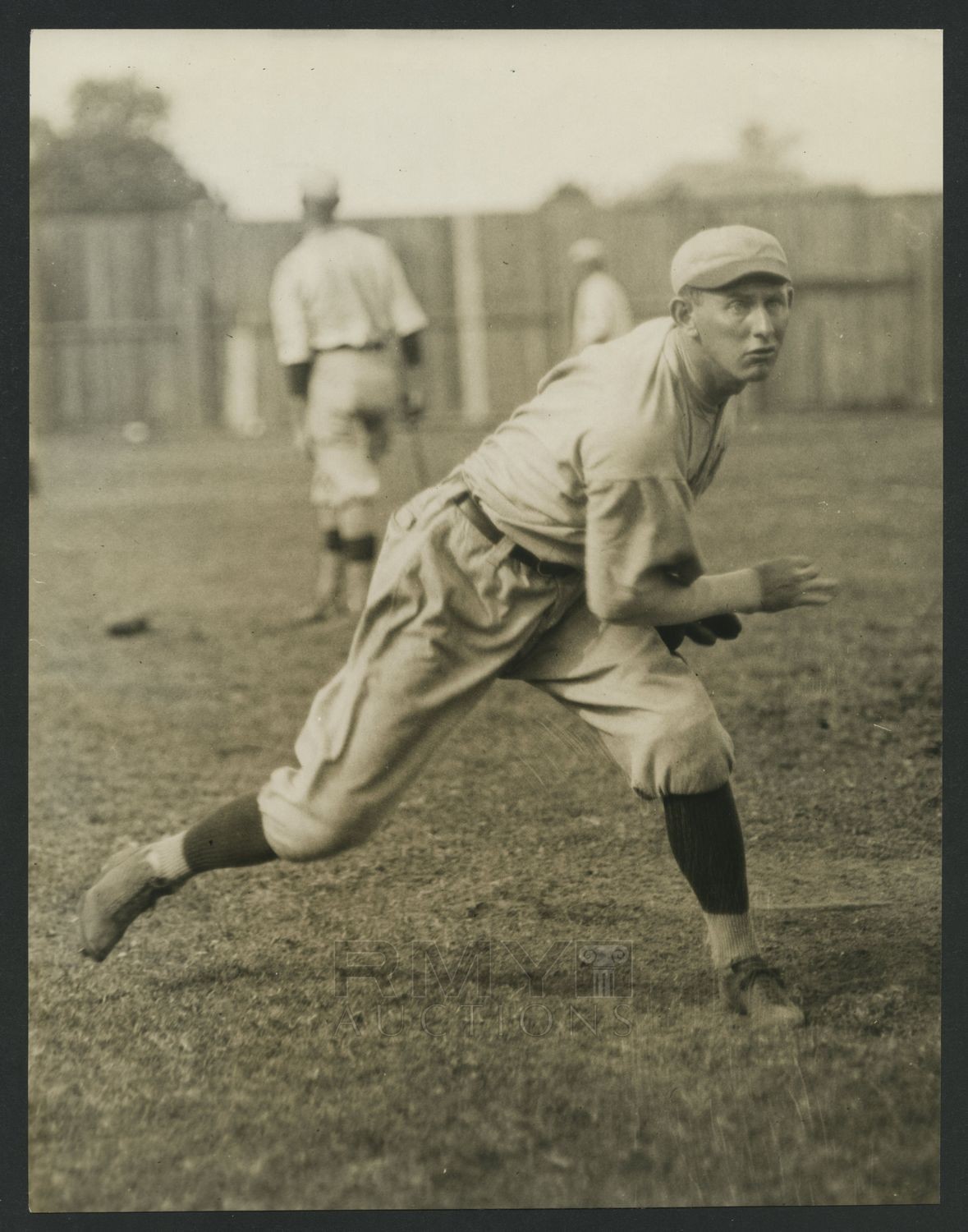
A native of Severance, Kansas, Chapman was a catcher, who played for the Chicago Cubs in 1912, the Cincinnati Reds in 1913, the St. Louis Terriers of the Federal League in 1914 and 1915, and the St. Louis Browns in 1916. Only in the FL was he anything like a regular player. His lifetime batting average was just .198, with 1 home run and 44 RBIs.
There is no memorial to him at Wrigley Field in Chicago, home of the Cubs; Great American Ball Park in Cincinnati, home of the Reds; or Busch Stadium in St. Louis, home of the Cardinals.
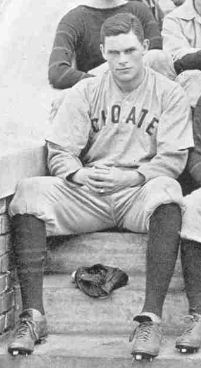
Eugene Mayer also dies while serving in World War I on this day. The former halfback, sprinter, long jumper, shot putter and law school graduate at the University of Virginia, a native of Norfolk, never gets to play in the nascent NFL, because he dies at Camp Joseph E. Johnston in Jacksonville, Florida, a casualty of the Spanish Flu Epidemic. "Buck" Mayer was 26, and was posthumously elected to the Virginia Sports Hall of Fame.
Buck Mayer

*

October 21, 1918 was a Monday. The War Department had ordered that the baseball season end a month early, in September, and that all players obey the "work or fight order": Enlist, or get a job in an industry essential to the war effort, or get an otherwise necessary job (like police or firemen), or be subject to the military draft. Football was in midweek. Professional basketball barely existed. And hockey season hadn't started yet. So there were no scores on this historic day.

Monday, October 17, 2022

October 17, 1967: The Death of Don Holleder

October 17, 1967: Major Don Holleder, U.S. Army, is shot and killed by a Viet Cong sniper while attempting to rescue a wounded soldier and bring him aboard a helicopter, in the Battle of Ong Thanh. He was 33.

The Buffalo native was a star athlete at Aquinas Institute in Rochester, and was recruited to the football team at the U.S. Military Academy by Vince Lombardi, then an assistant to their head coach, Colonel Earl "Red" Blaik. He was an All-American end in 1954, but was moved to quarterback in 1955, and led the team to a 6-3 record, including an upset of Navy that made him the 1st athlete from any of the service academies to be shown on the cover of Sports Illustrated. He graduated the following Spring, and one of his classmates was Norman Schwarzkopf, later field commander of all allied troops in the Persian Gulf War.

Although drafted by the New York Giants, he would have had to sit out his military commitment. (Which might have worked out, because Charlie Conerly would have retired as quarterback by then, but the Giants got Y.A. Tittle instead.) He stayed in the Army until his death, including a tenure as an assistant coach at West Point, and was buried at Arlington National Cemetery.

In 1974, his high school's football stadium, Aquinas Memorial Stadium, was renamed Holleder Memorial Stadium. Professional soccer's Rochester Lancers played there, including their home leg of the 1970 North American Soccer League Final, in which they beat the Washington Darts, before surviving the D.C. leg to be named NASL Champions.

Holleder Stadium was torn down in 1985, and Holleder Technology Park is now on the site, on Holleder Parkway. That same year, he was elected to the College Football Hall of Fame, and West Point's arena was named the Donald W. Holleder Center.

*

October 17, 1967 was a Tuesday. On the same day, the musical Hair opened at the Public Theater in New York. I have a separate entry for that event.

Baseball season had ended 5 days earlier, when the St. Louis Cardinals beat the Boston Red Sox in Game 7 of the World Series. Football was in midweek. A new hockey season was underway, but no games were scheduled.

There were 4 games in the NBA:

The New York Knicks open their season, their last at the old Madison Square Garden, where they beat the San Francisco Warriors 124-122. In his 1st professional game, Walt Frazier -- not yet nicknamed "Clyde" -- does not play. Walt Bellamy leads the Knicks with 16 points, but will be traded for Dave DeBusschere, in what turns out to be a title-making trade.

Their last game at the 49th-50th Street and 8th-9th Avenue Garden was on February 10, 1968, and they beat the Philadelphia 76ers 115-97. Their 1st game at the 31st-33rd Street and 7th-8th Avenue Garden was on February 14, and they beat the San Diego Rockets 114-102.

* The Detroit Pistons beat the Cincinnati Royals, 131-108 at Cobo Hall (now Huntington Place) in Detroit. Dave Bing scored 35 points for the Pistons. The arena was named for Albert Cobo, Mayor of Detroit from 1950 to 1957. Bing would serve as Mayor from 2009 to 2014.

* The Los Angeles Lakers beat the Chicago Bulls, 107-105 at the Chicago Stadium. Bob Boozer scored 36 in defeat.

* And, in only their 2nd game ever, the San Diego Rockets lost to the St. Louis Hawks, 123-105 at the San Diego Sports Arena (now the Pechanga Arena). The Hawks moved to Atlanta the following season. The Rockets moved to Houston in 1971.

And there was 1 game in the brand-new American Basketball Association: The Houston Mavericks beat the Denver Rockets, 102-85 at the Auditorium Arena in Denver. This was the 2nd game for the Rockets, who, in anticipation of being admitted to the NBA, and with that league already having a team named the Rockets in Houston, changed their name to that of the long-defunct first Denver team in the NBA: The Denver Nuggets.

Wednesday, October 12, 2022

October 12, 1918: Harry Glenn Dies In Service

October 12, 1918: Harry Glenn, a former major league baseball player, dies while serving in the U.S. Army during World War I.
Harry Melville Glenn was born on June 9, 1890 in Shelburn, Indiana. Nicknamed "Husky," he played as a catcher in the minor leagues from 1910 to 1918. In 1915, he played 6 games for the St. Louis Cardinals, appearing in 6 games, getting 5 hits in 16 at-bats for a .313 batting average. He also had a run batted in.
He was drafted to serve in the U.S. Army in August 1918, while still playing for the St. Paul Saints of the American Association. He was stationed in St. Paul, as an aviation mechanic. He caught pneumonia, and these were the days before antibiotics were developed. On October 12, 1918, just 1 month before the Armistice ended the war, Glenn died at the age of 28.
He was 28 years old. There is no memorial to him at Busch Stadium, current home of the Cardinals. He was 1 of 8 major league players to die in "The War to End All Wars." Another, former New York Yankees outfielder Alex Burr, died in a "friendly fire" incident in France, on the same day as Glenn. I have a separate entry honoring him.
*
October 12, 1918 was a Saturday. Another former player, Alex Burr, also died on this day. And the Cloquet Fire broke out in Minnesota. I have a separate entry for these events.
The War Department had ordered that the baseball season end a month early, in September, and that all players obey the "work or fight order": Enlist, or get a job in an industry essential to the war effort, or get an otherwise necessary job (like police or firemen), or be subject to the military draft. Hockey season hadn't started yet. Professional basketball barely existed.
And even college football was affected by the manpower drain of the war. That day, the following schools played military teams: The Universities of California, Chicago, Illinois, Minnesota and Texas; Lehigh University; and Texas A&M.
These intercollegiate games were played that day:
* Georgia Tech beat Furman, 118-0 at Grant Field in Atlanta. It had been 2 years and 5 days since Tech had beaten Cumberland College 222-0, college football's all-time biggest blowout.
* Ohio State beat Denison University, 34-0 at Ohio Field in Columbus. Before coaching Ohio State to glory, Woody Hayes would graduate from Denison in 1935.
* Michigan State beat Hillsdale College, 66-6 at College Field in East Lansing, Michigan. Hillsdale, of Hillsdale, Michigan, no longer fields sports teams.
* Iowa beat Coe College, 27-0 at Iowa Field in Iowa City. Coe is now an NCAA Division III school.
* And the Multnomah Athletic Club, a semi-pro team, beat the University of Oregon, 20-0 at Hayward Field in Eugene, Oregon.

October 12, 1918: The Yankee Who Died In War

October 12, 1918: A player for the New York Yankees dies for America in a war. And, most likely, you've never heard of him.
Alexander Thomson Burr was born on November 1, 1893 in Chicago. Usually listed as "Alex Burr" in baseball reference sources, but known as "Tom Burr" to his friends, he went east to attend the Choate prep school (now Choate Rosemary Hall) in Wallingford, Connecticut, and became a star pitcher. He then attended Williams College in Williamstown, in the Berkshire Mountains, in the northwestern corner of Massachusetts, bordering the States of New York and Vermont.
He signed a pro contract before ever appearing in a college game, so he never played for Williams. But he didn't last long. Frank Chance, the legendary Chicago Cubs manager now struggling to lift the Yankees to success, was impressed with him in Spring Training, and brought him north with the club.
But Tom Burr appeared in exactly 1 major league game, on April 21, 1914, at the Polo Grounds, and not as a pitcher. He played center field for the New York Yankees -- not yet an exalted position. He only played in the field, in the 10th inning, had no fielding chances, and never came to bat -- a true "Moonlight Graham." The Yankees went on to beat the Washington Senators 3-2.
He was soon released, and never reached the majors again. He played 7 games for the Jersey City Skeeters of the International League. He went back to Williams, but when the U.S. got into World War I in April 1917, he enlisted in the U.S. Army without getting his degree, and became a pilot.

On October 12, 1918, just 1 month before the Armistice ended the war, Tom Burr was killed in action in a plane crash, in Cazaux, France. It was an accident: Rather than being shot down, another U.S. pilot crashed into him -- what became known as "friendly fire." His plane caught fire, and crashed into a lake. It took 12 days to find his body.
He wasn't quite 25 years old, and was buried at Arlington National Cemetery. He was 1 of 8 major league players killed in "The War to End All Wars." Another, former St. Louis Cardinals catcher Harry Glenn, died of pneumonia the same day as Burr. I have a separate entry honoring him.
For all their history, and for all their attention to it, the Yankees make no mention at Yankee Stadium of the one and only player from their ranks to have died in military service. This becomes all the more glaring when you remember how much longtime team owner George Steinbrenner, whose prep school was Culver Military Academy in Culver, Indiana, pandered to patriotism and to our armed forces, down to the Monument to the 9/11 victims and rescuers in Yankee Stadium's Monument Park.

Where did The Boss go to college? Williams, also the alma mater of Tom Burr. You'd think he would have seen some kind of memorial there, and remembered it.
*
October 12, 1918 was a Saturday. Another player, Harry Glenn, also died in service on this day, albeit from pneumonia rather than a combat wound. And the Cloquet Fire broke out in Minnesota. I have separate entries for these events.
The War Department had ordered that the baseball season end a month early, in September, and that all players obey the "work or fight order": Enlist, or get a job in an industry essential to the war effort, or get an otherwise necessary job (like police or firemen), or be subject to the military draft. Hockey season hadn't started yet. Professional basketball barely existed.
And even college football was affected by the manpower drain of the war. That day, the following schools played military teams: The Universities of California, Chicago, Illinois, Minnesota and Texas; Lehigh University; and Texas A&M.
* Georgia Tech beat Furman, 118-0 at Grant Field in Atlanta. It had been 2 years and 5 days since Tech had beaten Cumberland College 222-0, college football's all-time biggest blowout.
* Ohio State beat Denison University, 34-0 at Ohio Field in Columbus. Before coaching Ohio State to glory, Woody Hayes would graduate from Denison in 1935.
* Michigan State beat Hillsdale College, 66-6 at College Field in East Lansing, Michigan. Hillsdale, of Hillsdale, Michigan, no longer fields sports teams.
* Iowa beat Coe College, 27-0 at Iowa Field in Iowa City. Coe is now an NCAA Division III school.
* And the Multnomah Athletic Club, a semi-pro team, beat the University of Oregon, 20-0 at Hayward Field in Eugene, Oregon.

December 31, 1999 & January 1, 2000: The Millennium

December 31, 1999:  The Millennium arrives. The people of planet Earth survived. At a terrible cost. But we hadn't destroyed ourselves. ...