Showing posts with label iowa. Show all posts

Saturday, November 19, 2022

November 19, 1997: The McCaughey Septuplets

November 19, 1997: Septuplets are born to Bobby and Kenny McCaughey (pronounced like "McCoy") in Des Moines, Iowa: Kenny Jr., Alexis, Natalie, Kelsey, Nathan, Brandon and Joel. They were the world's first seven-baby birth to all survive infancy.

The McCaugheys already had one daughter, Mikayla, born on January 3, 1996. While under treatment with ovulation-stimulating Metrodin, Bobbi became pregnant with seven fetuses. She and Kenny declined "selective reduction," which would have aborted one or more to give the others a better chance, saying that they would "put it in God's hands."

The 4 boys and 3 girls were born prematurely, at the Iowa Methodist Medical Center, delivered by a scheduled Caesarean section, all within 6 minutes, attended by a team of 40 specialists.

The babies attracted the attention of the entire country. TV networks jockeyed for chances to interview the parents. They received gifts including a 5,500-square-foot house, a fan, 2 years' worth of diapers (I don't want to know how that was calculated), clothes, and the State of Iowa offered full college scholarships to any State-run university upon their graduation from high school.

The parents received a phone call from President Bill Clinton, and the surviving Dionne Quintuplets -- Yvonne, Annette and Cecile -- wrote them an open letter, congratulating the parents, but warning them to keep the children out of the public eye, and to try not to fall into the same pitfalls as their own parents did in Canada, 62 years earlier.

On The Tonight Show, Jay Leno had dancers dress up as giant babies, performing as "The Dancing Septuplets." Not that he or anyone affiliated with the show could have known at the time, but, in hindsight, this was in bad taste: Alexis and Nathan both have cerebral palsy, and use walkers to get around.

By the time of the septuplets turned 10 in 2007, the family was declining most requests for interviews, other than annual stories with the KCCI-Channel 8, the CBS affiliate in Des Moines, and the magazine Ladies' Home Journal. TLC, formerly known as The Learning Channel, made a documentary about them for their 13th birthday.

The 7 kids graduated from Carlisle High School in 2016. Rather than go to any of the State schools, 4 of them -- Natalie, Kelsey, Nathan and Joel -- accepted another of the scholarship offers they received at birth, from Hannibal-LaGrange University in Hannibal, Missouri, which is affiliated with their faith, the Southern Baptist Convention. Kenny Jr. and Alexis stayed close to home, going to Des Moines Area Community College. Brandon enlisted in the U.S. Army.
The McCaughey Septuplets, October 2022

Older sister Mikayla got married in 2015, and had a baby boy in 2017. Brandon is still in the Army, holds the rank of Sergeant, and is married with a daughter. Kenny Jr. is a cabinetmaker, married, and his first child is due within days of this posting. Kelsey is married, and works as a medical receptionist. Natalie is married, and working on her master's degree in athletic training. The rest are single: Joel and Nathan work at IT jobs, and Alexis works at a day care center.

*

November 19, 1997 was a Wednesday. Baseball season was over. Football was in midweek. There were 8 games played in the NBA:

* The New Jersey Nets beat the Boston Celtics, 108-100 at the Continental Airlines Arena at the Meadowlands.

* The Philadelphia 76ers beat the Washington Bullets, 97-86 at the CoreStates Center (now the Xfinity Mobile Arena) in Philadelphia.

* The Charlotte Hornets beat the Portland Trail Blazers, 106-92 at the Charlotte Coliseum.

* The Miami Heat beat the Los Angeles Clippers, 122-113 at the Miami Arena.

* The Orlando Magic beat the Cleveland Cavaliers, 96-93 in overtime at the Gund Arena (now the Rocket Mortgage FieldHouse) in Cleveland.

* The San Antonio Spurs beat the Golden State Warriors, 108-87 at the Alamodome in San Antonio.

* The Los Angeles Lakers beat the Minnesota Timberwolves, 118-93 at The Forum outside Los Angeles in Inglewood, California.

* And the Seattle SuperSonics beat the Vancouver Grizzlies, 107-87 at the KeyArena in Seattle.

And there were 7 games in the NHL:

* The New York Rangers lost to the Tampa Bay Lightning, 6-3 at the Ice Palace (now the Benchmark International Arena) in Tampa.

* The New York Islanders beat the Detroit Red Wings, 3-2 at the Joe Louis Arena in Detroit.

* The Carolina Hurricanes beat the Montreal Canadiens, 2-1 at the Greensboro Coliseum.

* The Toronto Maple Leafs beat the Philadelphia Flyers, 3-1 at Maple Leaf Gardens in Toronto.

* The Boston Bruins and the Pittsburgh Penguins played to a tie, 3-3 at the Civic Arena in Pittsburgh.

* The Dallas Stars beat the Edmonton Oilers, 3-2 at the Reunion Arena in Dallas.

* And the Chicago Blackhawks beat the Mighty Ducks of Anaheim, 4-0 at the Arrowhead Pond of Anaheim (now the Honda Center).

Sunday, November 13, 2022

November 13, 1969: Vice President Spiro Agnew's "Media Speech"

November 13, 1969: Vice President Spiro Agnew delivers a speech at the Hotel Fort Des Moines in Des Moines, Iowa, as part of the Midwest Regional Republican Conference, an annual meeting of campaign strategists.

The speech was written by William Safire, later a Pulitzer Prize-winning longtime conservative columnist for The New York Times. Ten days earlier, President Richard Nixon had delivered a speech written by Safire, outlining his policy of "Vietnamziation," a process of slowly but surely turning the responsibility of defending South Vietnam over to the country itself, and pulling U.S. troops out.

Nixon appealed to what he called "the great silent majority of Americans" for support, and he did gain support for the plan in opinion polls.

But not everyone agreed, and Nixon thought that he was being undermined by the national networks' news broadcasts: The CBS Evening News with Walter Cronkite, The Huntley-Brinkley Report with Chet Huntley and David Brinkley on NBC (not yet NBC Nightly News), and The ABC Evening News (not yet World News Tonight) with Howard K. Smith and Frank Reynolds. Nixon thought the newsmen, their correspondents, and their interviewees weren't giving him a fair shake.

Nixon had been through this before: When he ran for Governor of California in 1962, he lost badly, and blamed the media, telling them the next morning, "Just think of how much fun you'll be missing. You don't have Nixon to kick around anymore, because, gentlemen, this is my last press conference." He lied, running for President in 1968, and winning.

He took Governor Spiro T. Agnew of Maryland as his running mate. Agnew had been Baltimore County Executive, and won the Governorship as a liberal Republican against a segregationist Democrat. At first, Agnew was seen as tough but fair. But his response to the riot in Baltimore after Martin Luther King's assassination on April 4, 1968 got Nixon's attention, and he was nominated for Vice President. His image as a moderate would soon be shattered by remarks of what we would now call "casual racism," and he very nearly cost Nixon the election.

As Vice President, he tended to give speeches that showed he had an acute affinity for alliteration. Safire, who later wrote a column titled "Language Maven," enjoyed writing for him, giving him the phrases "the nattering nabobs of negativism," "the professional pessimists," "the troubadours of trouble," and "the 4-H Club: The Hopeless, Hysterical Hypochondriacs of History."

Safire was Jewish, and it was more likely one of Nixon's other speechwriters, the Catholic Patrick J. Buchanan, who gave Agnew the line "the vicars of vacillation." And, while this phrase didn't reflect anyone's religion, or offer any alliteration, I suspect it was also Buchanan who had Agnew call the media "an effect corps of impudent snobs."

Agnew did not use that line in this speech, which all 3 networks broadcast live, an unprecedented forum for a sitting Vice President who, at the time, was not also a candidate for President. Among his remarks:

No nation depends more on the intelligent judgment of its citizens. And no medium has a more profound influence over public opinion. Nowhere in our system are there fewer checks on such vast power. So nowhere should there be more conscientious responsibility exercised than by the news media. The question is, "Are we demanding enough of our television news presentations?" "And are the men of this medium demanding enough of themselves?"

Monday night, a week ago, President Nixon delivered the most important address of his Administration, one of the most important of our decade. His subject was Vietnam. My hope, as his at that time, was to rally the American people to see the conflict through to a lasting and just peace in the Pacific. For 32 minutes, he reasoned with a nation that has suffered almost a third of a million casualties in the longest war in its history.

When the President completed his address -- an address, incidentally, that he spent weeks in the preparation of -- his words and policies were subjected to instant analysis and querulous criticism. The audience of 70 million Americans gathered to hear the President of the United States was inherited by a small band of network commentators and self-appointed analysts, the majority of whom expressed in one way or another their hostility to what he had to say.

It was obvious that their minds were made up in advance. Those who recall the fumbling and groping that followed President Johnson's dramatic disclosure of his intention not to seek another term have seen these men in a genuine state of non-preparedness. This was not it.

One commentator twice contradicted the President's statement about the exchange of correspondence with Ho Chi Minh. Another challenged the President's abilities as a politician. A third asserted that the President was following a Pentagon line. Others, by the expressions on their faces, the tone of their questions, and the sarcasm of their responses, made clear their sharp disapproval.

To guarantee in advance that the President's plea for national unity would be challenged, one network (meaning ABC) trotted out Averell Harriman for the occasion. Throughout the President's address, he waited in the wings. When the President concluded, Mr. Harriman recited perfectly. He attacked the Thieu government as unrepresentative. He criticized the President's speech for various deficiencies. He twice issued a call to the Senate Foreign Relations Committee to debate Vietnam once again. He stated his belief that the Vietcong or North Vietnamese did not really want a military takeover of South Vietnam. And he told a little anecdote about a "very, very responsible" fellow he had met in the North Vietnamese delegation.

All in all, Mr. Harriman offered a broad range of gratuitous advice challenging and contradicting the policies outlined by the President of the United States. Where the President had issued a call for unity, Mr. Harriman was encouraging the country not to listen to him.

A word about Mr. Harriman. For 10 months, he was America's chief negotiator at the Paris peace talks, a period in which the United States swapped some of the greatest military concessions in the history of warfare for an enemy agreement on the shape of the bargaining table. Like Coleridge's Ancient Mariner, Mr. Harriman seems to be under some heavy compulsion to justify his failures to anyone who will listen. And the networks have shown themselves willing to give him all the air time he desires.

Now, every American has a right to disagree with the President of the United States, and to express publicly that disagreement. But the President of the United States has a right to communicate directly with the people who elected him, and the people of this country have the right to make up their own minds, and form their own opinions, about a Presidential address without having the President's words and thoughts characterized through the prejudices of hostile critics before they can even be digested.

Agnew was underestimating the intelligence of TV viewers. He believed they were incapable of making up their minds about what Nixon said before any opposing views could be aired. He also underestimated their ability to decide for themselves about what Harriman, also a former Governor of New York, and others opposing Nixon had said.

Agnew continued:

When Winston Churchill rallied public opinion to stay the course against Hitler's Germany, he didn't have to contend with a gaggle of commentators raising doubts about whether he was reading public opinion right, or whether Britain had the stamina to see the war through. When President Kennedy rallied a nation in the Cuban missile crisis, his address to the people was not chewed over by a roundtable of critics who disparaged the course of action he'd asked America to follow.

And when those speeches were given, they were on the subject of existential threats to the countries involved. North Vietnam was not Nazi Germany. Nor was it the Soviet Union. And there had already been plenty of doubt about what America was doing in Vietnam. Americans were very much used to questioning their leaders on that subject. If they hadn't been, Nixon -- and, by extension, Agnew -- could never have been elected.

So for Agnew to suggest that Nixon's words should go unchallenged was an authoritarian gesture. And the American people didn't like that. He wrapped up:

In tomorrow's edition of The Des Moines Registeryou'll be able to read a news story detailing what I said tonight. Editorial comment will be reserved for the editorial page, where it belongs. Should not the same wall of separation exist between news and comment on the nation's networks?

Now, my friends, we'd never trust such power, as I've described, over public opinion in the hands of an elected Government. It's time we questioned it in the hands of a small and unelected elite. The great networks have dominated America's airwaves for decades. The people are entitled to a full accounting of their stewardship.

At the conclusion of the speech, all 3 network's anchors interviewed their own network's president, to give their own response. Frank Stanton of CBS gave the best one, calling the speech "an unprecedented attempt by the Vice President of the United States to intimidate a news medium which depends for its existence upon government licenses."

The networks were not intimidated. As the years went on, all 3 would be rather harsh toward Nixon -- and Agnew. They couldn't convince people not to re-elect the Republican ticket in 1972. But when Agnew fell under investigation for tax fraud and bribery, the networks covered it as a serious news story worthy of investigation, keeping whatever glee they may have had to themselves.

Agnew resigned his office on October 10, 1973, cutting a plea deal to avoid prison time. That same month, the Watergate scandal that had engulfed Nixon got worse, and ABC's Smith became the 1st network anchor to issue an on-air editorial calling for Nixon's resignation.

Early the next year, Dan Rather, then CBS' White House correspondent, stood up to ask Nixon a question during a press conference. Upon introducing himself, he got a round of applause from his colleagues. Nixon, smiling, asked him, "Are you running for something?" Rather, not smiling, answered, "No, Mr. President. Are you?"

The Republicans hated Rather for the rest of his career, and hated CBS above all networks, until the 1990s, when NBC spun off the network MSNBC, which frequently challenged the conservative movement's own favorite network, Fox News Channel.

Speaking of which: Spiro Agnew died on September 17, 1996, at the age of 83. Exactly 20 days later, Fox News Channel went on the air. Something tells me he would have been just fine with the way they have conducted themselves since then.

*

November 13, 1969 was a Thursday. Scottish actor Gerard Butler was born on this day.

Baseball season was over. Football was in midweek. There were 3 games played in the NBA:

* The New York Knicks beat the Chicago Bulls, 114-99 at the new Madison Square Garden.

* The Philadelphia 76ers beat the Phoenix Suns, 124-110 at the Arizona Veterans Memorial Coliseum in Phoenix.

* And the Seattle SuperSonics beat the Detroit Pistons, 117-113 at the Seattle Center Coliseum.

There were 2 games played in the American Basketball Association. The Indiana Pacers beat the Miami Floridians, 115-109 at the Dinner Key Auditorium in Miami. And the Kentucky Colonels beat the Denver Rockets, 109-104 at Freedom Hall in Louisville.

And there were 2 games in the NHL. The Boston Bruins beat the Detroit Red Wings, 3-1 at the Boston Garden. And the St. Louis Blues beat the Pittsburgh Penguins, 4-0 at the St. Louis Arena.

November 13, 1942: The Sullivan Brothers Are Lost

Left to right: Joe, Frank, Al, Matt, and George

November 13, 1942: The cruiser USS Juneau is sunk by the Japanese destroyer Amatsukaze, while it was trying to bring troop reinforcements to Guadalcanal, in the South Pacific, east of Papua New Guinea, northeast of Australia, and north of New Zealand. Of the 697 men on board, only 10 survived.

Among those lost were 5 brothers from a single family. The U.S. Department of War later drew up a policy to never put 2 members of the same family in the same military installation. The 5 Sullivan brothers, of Waterloo, Iowa, were:

George Thomas Sullivan, 27 (born December 14, 1914), Gunner's Mate Second Class. George had been previously discharged in May 1941 as Gunner's Mate Third Class, but had re-enlisted after the attack on Pearl Harbor.

Francis Henry Sullivan, 26 (born February 18, 1916), Coxswain. "Frank" had been previously discharged in May 1941 as Seaman First Class, but had also re-enlisted.

Joseph Eugene "Joe" Sullivan, 24 (born August 28, 1918), Seaman Second Class.

Madison Abel "Matt" Sullivan, 23 (born November 8, 1919), Seaman Second Class. And:

Albert Leo "Al" Sullivan, 20 (born July 8, 1922), Seaman Second Class.

The brothers left their parents, and a sister, Genevieve, born between Frank and Joe. and their parents. Genevieve had enlisted in the WAVES (Women Accepted for Volunteer Emergency Service), to avenge her boyfriend, Bill Ball, who had been killed at Pearl Harbor. "Gen" lived on until 1975.

Al was the only one who was married, to Katherine, and the only one with a child, Jimmy, then 2 years old. He grew up to enlist in the Navy as well. Joe and Matt each left behind a fiancée.

The "Fighting Sullivan Brothers" became national heroes. President Franklin D. Roosevelt sent a letter of condolence to their parents. Pope Pius XII sent a letter of regret, a silver religious medal, and a rosary.

In 1944, Twentieth Century-Fox released the film The Fighting Sullivans, starring Thomas Mitchell as father Tom, Selena Royle as mother Alleta, Edward Ryan as Al, John Campbell as Frank, James Cardwell as George, John Alvin as Mat, George Offerman as Joe, Anne Baxter as Al's widow Katherine.

The Amatuskaze did not survive the war, either: On April 6, 1945, it was attacked by B-25s off Amoy (an island now controlled by China and named Ziamen), resulting in enough damage that it had to be scuttled.

The U.S. Navy would pay tribute to those lost with later ships:

* USS The Sullivans, a destroyer already under construction but not yet named when the brothers died, in service from 1943 to 1965, seeing action in World War II, the Korean War and the Vietnam War. Jimmy Sullivan served aboard her for a time. She is now a museum ship, part of the Buffalo and Erie County Naval & Military Park.

* USS Juneau, a cruiser active from 1946 to 1955, serving in the Korean War.

USS Juneau, an amphibious transport dock, active from 1969 to 2008. It was commissioned at the height of the Vietnam War, served as the Navy's main cleanup vessel after the Exxon Valdez disaster in 1989 (appropriate, since Juneau is the capital of Alaska, the State where that happened), and transported troops to the Persian Gulf War.

* USS The Sullivans, a destroyer, launched in 1995 and still in active service as of November 13, 2022. As with her predecessor, her motto is the brothers' motto: "We stick together."

*

November 13, 1942 was a Friday -- a Friday the 13th. Baseball was out of season. The NBA hadn't been founded yet. There were no games scheduled in the NHL. And the NFL was in midweek. But there was one score on this historic day, and it was in college football: Wake Forest beat George Washington University, 20-0 at Griffith Stadium in Washington.

Sunday, October 30, 2022

October 30, 1930: Grant Wood's Painting "American Gothic" Is Introduced

October 30, 1930: Grant Wood's painting American Gothic is put on display. It becomes an American classic.

Grant DeVolson Wood was born on February 13, 1891 in Anamosa, Iowa, and grows up in nearby Cedar Rapids. He enrolled at the Art Institute of Chicago, and designed camouflage scenes for the U.S. Army during World War I. He spent the early 1920s teaching art in the Cedar Rapids public schools, and the late 1920s studying art in Europe.
A self-portrait, 1932

In August 1930, he was driven around Eldon, Iowa by John Sharp, a young local painter. He saw the Dibble House on Finney Avenue. Built in 1882 by railroad worker Charles Dibble, it was a typical small farmhouse, but Wood sketched it on the back of an envelope in the car. His first biographer, Darrell Garwood, wrote that he "thought it a form of borrowed pretentiousness, a structural absurdity, to put a Gothic-style window in such a flimsy frame house.
A recent photo of the house

The house was then owned by Selma Jones-Johnston, and Wood gained her permission to paint a portrait, with the house in the background. But instead of the Johnston family, he painted "the kind of people I fancied should live in that house." His models were his sister, Nan Wood Graham (1899-1990), wearing a colonial-print apron; and his family's dentist, Dr. Byron McKeeby (1867-1950), holding a pitchfork.

The age difference has always caught people's attention: McKeeby was 63 years old, and Nan was 31, although, standing next to him, and with the grayish-blue background, her blonde hair could be considered gray. But in a letter written in 1941, Wood confirmed, "The prim lady with him is his grown-up daughter."

Wood entered the painting in a competition at the Art Institute of Chicago, and a museum patron convinced the jury to award the painting a bronze medal, and the Institute to buy the painting, where it remains to this day.

When the image appeared in the Cedar Rapids Gazette, the people of Iowa were angry that Wood had depicted them as "pinched, grim-faced, puritanical Bible-thumpers." (Or did he hit a nerve? Find video of the Republican side of the Iowa Caucuses sometime.) Many observers from outside the Hawkeye State considered it a criticism of rural and/or small-town American live, such as the novels Winesburg, Ohio by Sherwood Anderson and Main Street by Sinclair Lewis. Wood said his aim was the complete opposite, saying, "I had to go to France to appreciate Iowa."

But the Great Depression was on, and it got deeper. The old man and the grown daughter began to be seen as a depiction of the American pioneer spirit, standing strong against hardships like the economic disaster, banks alternating between predation and their own failure, and the Dust Bowl. 

Wood taught art at the University of Iowa, but developed pancreatic cancer, and died on February 12, 1942, only 50 years old. As he had married and divorced, and had no children -- it has been suggested that he was gay -- Nan inherited his estate. Upon her death, she willed his artistic legacy to the Figge Art Museum in Davenport, Iowa.

In 1991, the last private owner of the American Gothic House donated it to the State Historical Society of Iowa. The historic site now includes the house, in its original form, and a visitors center. The Society has rented it to a series of live-in caretakers.

*

October 30, 1930 was a Thursday. Baseball season was over. The NFL was in midweek. The NBA hadn't been founded yet. And the NHL season didn't start for another 12 days. But there was 1 score on this historic day, a college football game: The University of South Carolina beat another Palmetto State school, the Charleston military college The Citadel, 13-0 at the County Fairgrounds in Orangeburg, South Carolina.

Monday, September 12, 2022

September 13, 1936: Bob Feller, Baseball Prodigy

September 13, 1936: The Cleveland Indians sweep a doubleheader from the Philadelphia Athletics, 5-2 and 5-4 at League Park in Cleveland. In the opener, Bob Feller set an American League record with 17 strikeouts. He also walked 9 batters. But he allowed only 2 runs on 2 hits, and went the distance. So it was a very strong performance.

It was his 11th major league appearance. He was 17 years and 315 days old.

Robert William Andrew Feller was born on November 3, 1918 in Van Meter, Iowa, about 20 miles west of the State Capitol in Des Moines. In their 1981 book The 100 Greatest Players In Baseball History, Lawrence S. Ritter and Donald Honig wrote, "Bob Feller remains baseball's only prodigy." The book was written after the exploits of Mickey Mantle, Herb Score and Tony Conigliaro; but those of Dwight Gooden and Bryce Harper have not changed this.

"Rapid Robert" debuted with the Cleveland Indians in 1936, right after high school graduation. In his 1st game, on July 19, he pitched the last inning of a 9-5 loss away to the Washington Senators, and presaging the control issues he would have early in his career, walked 2 batters, but allowed no hits and no runs. On August 23, after 6 relief appearances, he made his 1st major league start. He struck out 15 batters, still a record for a 1st major league start. He walked 4, allowed 1 run on 6 hits, and the Indians beat the St. Louis Browns, 4-1.

In addition to those 17- and 15-strikeout games, he had 2 10-strikeout games. He went 5-3 with a 3.44 ERA. Pretty good for a 17-year-old making 8 starts. He went 9-7 in 1937, again starting late because he was finishing high school. In 1938, his 1st full season, he went 17-11, and led the AL with 240 strikeouts. He also broke his own single-game AL strikeout record, with 18. It would be another 36 years before an AL pitcher fanned 19 in a 9-inning game.

Despite missing nearly 4 full seasons due to World War II, Feller went 266-162, with a 3.25 ERA, 2,581 strikeouts, and 3 no-hitters. He helped the Indians win the AL Pennant in 1948 and 1954, and the World Series in 1948. He was elected to the Hall of Fame in his 1st year of eligibility, and became one of baseball's foremost elder statesmen, living until 2010.

*

September 13, 1936 was a Sunday. It was too early for the NFL season to start. In addition to the Tribe's sweep of the A's, these games were played:

* The New York Yankees swept the St. Louis Browns, 10-7 and 13-1 at Sportsman's Park in St. Louis. Kemp Wicker won the opener, in relief of Lefty Gomez. Johnny Murphy, normally a reliever, went the distance in the nightcap. Over the 2 games, Lou Gehrig went 3-for-7 with 2 home runs, 2 walks, and 3 RBIs. Rookie Joe DiMaggio went 5-for-9 with 3 home runs, a walk, and 6 RBIs.

* A doubleheader was split at the Polo Grounds. The New York Giants won the 1st game, 8-4. Freddie Fitzsimmons won it. The St. Louis Cardinals won the 2nd game, 4-3. Dizzy Dean got the save with 2 innings of relief of winning pitcher Roy Parmelee. Giant manager Bill Terry, in his last month as an active player, went 1-for-4 with an RBI in the 1st game, and drew a walk as a pinch-hitter in the 2nd game. Over the 2 games, Mel Ott went 4-for-9 with 2 home runs and 4 RBIs.

* A doubleheader was split at Ebbets Field. The Brooklyn Dodgers won the 1st game, 6-3. The Chicago Cubs won the 2nd game, 9-7.

* A doubleheader was split at National League Park, a.k.a. the Bee Hive, in Boston. The Cincinnati Reds won the 1st game, 2-1. The Boston Bees won the 2nd game, 6-1. This was the 1st of 5 seasons that the former Boston Braves tried to distance themselves from a horrible 1935 season by changing the names of their team and their stadium. It didn't take hold with the public, and in 1941, the names "Boston Braves" and "Braves Field" were restored.

* A doubleheader was split at Baker Bowl in Philadelphia. The Pittsburgh Pirates won the 1st game, 5-3. The Philadelphia Phillies won the 2nd game, 4-3. Over the 2 games, Paul Waner went 3-for-6 with 2 walks and an RBI, and Lloyd Waner went 3-for-4 with 2 walks and an RBI.

* The Boston Red Sox beat the Detroit Tigers, 7-4 at Navin Field in Detroit. (It was renamed Briggs Stadium in 1938, and Tiger Stadium in 1961.) Jimmie Foxx went 2-for-4 with a home run, a walk, and 2 RBIs. Hank Greenberg was injured, and did not play.

* And the Chicago White Sox and the Washington Senators were not scheduled -- which seems odd for a Sunday, but, according to Baseball-Reference.com, there is no explanation. No mention of a rainout. If there was, then it was never made up.

Sunday, September 11, 2022

September 11, 1941: Charles Lindbergh Destroys His Hero Reputation

This picture is not from that speech.
The WMCA microphone gives it away
as in New York, probably at Madison Square Garden.

September 11, 1941: Charles Lindbergh gives a speech in Des Moines, Iowa. For 14 years, he has been America's biggest hero. Never again.

At the request of the U.S. Department of War, Lindbergh, who in 1927 became the 1st person to fly an airplane from the North American continent to the European continent, traveled to Nazi Germany several times between 1936 and 1938, to evaluate German aviation. General Henry "Hap" Arnold, eventually the only U.S. Air Force general to hold five-star rank, wrote in his autobiography, "Nobody gave us much useful information about Hitler's air force, the Luftwaffe, until Lindbergh came home in 1939." Lindbergh also undertook a survey of aviation in the the Soviet Union in 1938.

In 1938, Hugh Wilson, the American Ambassador to Germany, hosted a dinner for Lindbergh with Germany's air chief, Generalfieldmarschall Hermann Göring. At this dinner, Göring presented Lindbergh with the Commander Cross of the Order of the German Eagle.

Lindbergh's acceptance proved controversial after Kristallnacht, an anti-Jewish pogrom in Germany a few weeks later. Lindbergh declined to return the medal, later writing, "It seems to me that the returning of decorations, which were given in times of peace and as a gesture of friendship, can have no constructive effect. If I were to return the German medal, it seems to me that it would be an unnecessary insult. Even if war develops between us, I can see no gain in indulging in a spitting contest before that war begins."

Lindbergh subsequently accepted an invitation to inspect the rising power of the Luftwaffe. Impressed by German technology, and the apparently-large number of aircraft at their disposal, and influenced by the staggering number of deaths from World War I, he opposed U.S. entry into the impending European conflict. Invited by the French government to tell what he had been shown -- which was eventually discovered to have been exaggerated, for the Nazis' benefit -- Lindbergh's testimony influenced France into trying to avoid conflict with Nazi Germany through the Munich Agreement.

At the urging of Joseph P. Kennedy, the U.S. Ambassador to Britain, Lindbergh wrote a secret memo to the British warning that a military response by Britain and France to Hitler's violation of the Munich Agreement would be disastrous. He claimed that France was militarily weak, and Britain over-reliant on its Royal Navy. In both cases, he had a point. But he also urgently recommended that they strengthen their air power to force Hitler to redirect his aggression against what he called "Asiatic Communism." Lindbergh's bigotry was showing.

On September 15, 1939, 2 weeks after the Nazis began World War II by invading Poland, Lindbergh gave a nationwide radio address, in which he called for isolationism, and indicated some pro-German sympathies and anti-Semitic insinuations about Jewish ownership of the media, saying, "We must ask who owns and influences the newspaper, the news picture, and the radio station... If our people know the truth, our country is not likely to enter the war."

In fact, Lindbergh was fooling himself. Most of the nation's media was owned by conservative Republicans, not eager to go to war against Hitler, who had been opposing Communists and labor unions. Henry Luce, who ran Time magazine, and named Lindbergh the magazine's first "Man of the Year" in 1927, was an exception. And even he, born in China to American missionaries, was more eager to defend China from Imperial Japan than to defend Britain and France from Nazi Germany. Again, there was a matter of racism involved.

In a 1939 article for Reader's Digest, Lindbergh expressed pro-eugenics views: "We can have peace and security only so long as we band together to preserve that most priceless possession, our inheritance of European blood, only so long as we guard ourselves against attack by foreign armies and dilution by foreign races." He said that certain races have "demonstrated superior ability in the design, manufacture, and operation of machines," and that "The growth of our western civilization has been closely related to this superiority."

What's more, Lindbergh, raised in Minnesota but born in the "Motor City" of Detroit as the son of a former Congressman from Michigan, developed a friendship with the automobile pioneer Henry Ford, who was well known for his anti-Semitic newspaper, The Dearborn IndependentIn a famous comment about Lindbergh to Detroit's former FBI field office special agent in charge in July 1940, Ford said: "When Charles comes out here, we only talk about the Jews."

In late 1940, Lindbergh became the spokesman of the isolationist America First Committee, soon speaking to overflow crowds at Madison Square Garden in New York and Soldier Field in Chicago, with millions listening by radio. He argued emphatically that America had no business attacking Germany.

Lindbergh justified this stance in writings that were only published posthumously: "I was deeply concerned that the potentially gigantic power of America, guided by uninformed and impractical idealism, might crusade into Europe to destroy Hitler without realizing that Hitler's destruction would lay Europe open to the rape, loot and barbarism of Soviet Russia's forces, causing possibly the fatal wounding of Western civilization."

In his testimony before the House Committee on Foreign Affairs on January 23, 1941, opposing the Lend-Lease bill, Lindbergh proposed that the United States negotiate a neutrality pact with the Nazis. President Franklin D. Roosevelt publicly decried Lindbergh's views as those of a "defeatist and appeaser." On April 28, Lindbergh resigned his colonel’s commission in the U.S. Army Air Corps Reserve, writing that he saw "no honorable alternative," given that Roosevelt had publicly questioned his loyalty.

At an America First rally at the Des Moines Coliseum in Iowa on September 11 -- which has been a problematic date in American history, going back at least as far as 1776 -- broadcast live over national radio, Lindbergh accused 3 groups of "pressing this country toward war: The British, the Jewish, and the Roosevelt Administration":

It is not difficult to understand why Jewish people desire the overthrow of Nazi Germany. The persecution they suffered in Germany would be sufficient to make bitter enemies of any race.

No person with a sense of the dignity of mankind can condone the persecution of the Jewish race in Germany. But no person of honesty and vision can look on their pro-war policy here today without seeing the dangers involved in such a policy both for us and for them. Instead of agitating for war, the Jewish groups in this country should be opposing it in every possible way for they will be among the first to feel its consequences.

Tolerance is a virtue that depends upon peace and strength. History shows that it cannot survive war and devastations. A few far-sighted Jewish people realize this and stand opposed to intervention. But the majority still do not.

Their greatest danger to this country lies in their large ownership and influence in our motion pictures, our press, our radio and our government.

Lindbergh continued, telling half-truths:

I am not attacking either the Jewish or the British people. Both races, I admire. But I am saying that the leaders of both the British and the Jewish races, for reasons which are as understandable from their viewpoint as they are inadvisable from ours, for reasons which are not American, wish to involve us in the war.

We cannot blame them for looking out for what they believe to be their own interests, but we also must look out for ours. We cannot allow the natural passions and prejudices of other peoples to lead our country to destruction.

His message was popular throughout many Northern and Midwestern communities, with large populations of German-Americans favorable to their ancestral homeland, and Irish-Americans who did not want their country to fight for Britain. But the South was anglolphilic, and supported a pro-British foreign policy.

What's more, Jewish Americans called Lindbergh out for his apparent anti-Semitism. And Americans of British, French, Dutch and Polish descent were furious with him. So were those of Russian and Ukrainian descent, as it had been nearly 3 months since Hitler had broken his Non-Aggression Pact and invaded the Soviet Union. These communities within America all turned on Lindbergh, their admiration of him turning to disgust.

Even his own wife, Anne, a poet of some renown, saw that he had wrecked his reputation. Writing in her diary, she did him, and herself, no favors: "I have the greatest faith in Charles as a person‍ -- in his integrity, his courage, and his essential goodness, fairness, and kindness‍ -- his nobility really... How then explain my profound feeling of grief about what he is doing? If what he said is the truth (and I am inclined to think it is), why was it wrong to state it? He was naming the groups that were pro-war. No one minds his naming the British or the Administration. But to name 'Jew' is un-American‍ -- even if it is done without hate or even criticism. Why?"

FDR blew his stack over the speech. To Treasury Secretary Henry Morgenthau, who was Jewish, he said, "If I should die tomorrow, I want you to know this: I am absolutely convinced Lindbergh is a Nazi." And he wrote to Secretary of War Henry Stimson: "When I read Lindbergh's speech I felt that it could not have been better put if it had been written by (Nazi propaganda minister Joseph) Goebbels himself. What a pity that this youngster has completely abandoned his belief in our form of government and has accepted Nazi methods because apparently they are efficient."

Still, despite 3 naval confrontations with German ships, FDR found too much opposition from Congress to get a Declaration of War on the Nazis. Then came December 7, and the attack of Nazi ally Japan upon the American naval base at Pearl Harbor in Hawaii. FDR asked Congress for a Declaration of War against Japan the next day, and got it. Three days later, Nazi Germany declared war against America, and Congress responded in kind.

Lindbergh did offer to fight for America, but, approaching his 40th birthday, he was denied the opportunity until 1944, serving as a private consultant to aviation companies in the interim. He flew 50 combat missions -- all in the Pacific Theater of the war, against Asiatic Japan, not European Germany.

After World War II, Lindbergh became an unofficial goodwill ambassador to the Germany that was being rebuilt, in part in America's image. But, while there, he had several affairs, and fathered several illegitimate children, which was not revealed to the public during his lifetime.

In 1969, due to his status as an aviation pioneer, he was invited to watch the Florida launch of Apollo 11, the 1st mission to land on the Moon. Other than that, he lived a very private life until his death in 1974. But his reputation never recovered from the Des Moines speech.

Sixty years later to the day after Lindbergh's speech, airplanes were used to attack America again. What he would have thought about it, only he would have known.

In his 2004 novel The Plot Against America, Jewish-American author Philip Roth imagined that Lindbergh had given his Des Moines speech over a year earlier, before the 1940 Republican Convention that nominated Wendell Willkie to oppose FDR, who was running for a 3rd term, on the basis that only he could stop Nazi Germany from taking over the world.

In this novel, an America less aware of Nazi atrocities, and more receptive to rhetoric in Germany's favor, rallied behind Lindbergh's isolationist message, and he was nominated for President, and defeated Roosevelt. His Administration became one that treated Jews as badly as black people were treated in the South.

It is revealed in the narrative that the reason Lindbergh was so willing to act as a puppet for the Nazis is that what was generally believed about the 1932 kidnapping of his toddler son wasn't true, that the son was alive and well in Germany, and that this would remain true as long as Lindbergh did the Nazis' bidding. A chilling miniseries version aired on HBO in 2020.

The Des Moines Coliseum, site of Lindbergh's September 11, 1941 speech, opened in 1908. It hosted speeches by Presidents Theodore Roosevelt, William Howard Taft, Woodrow Wilson and Herbert Hoover -- but not Franklin Roosevelt. It served as home court for the Drake University basketball team, and hosted other sporting and entertainment events until it burned down in 1949. The site is now occupied by a federal courthouse.

*

September 11, 1941 was a Thursday. These baseball games were played that day:

* The New York Yankees lost to the Detroit Tigers, 5-4 at Yankee Stadium. Al Benton outpitched Marius Russo, both of them going the full 12 innings. Joe DiMaggio went 1-for-6. In the top of the 6th inning, catcher Bill Dickey was injured, and replaced by Ken Silvestri. This ended up being critical.

In the top of the 12th, Dutch Meyer singled, Russo mishandled Tuck Stainback's intended sacrifice bunt, Barney McCosky struck out, Rudy York was intentionally walked, and Pinky Higgins grounded back to Russo. But Silvestri was out of position, so, instead of trying to throw Meyer out at the plate, Russo threw to 3rd, forcing out Stainback, and Higgins was then thrown out at 1st for the 3rd out. But Meyer had already scored, and the run counted, and it made the difference.

Not that much of a difference, though: The Yankees had already clinched the American League Pennant.

* The New York Giants beat the Cincinnati Reds, 6-0 at Crosley Field in Cincinnati. Bob Carpenter pitched a 4-hit shutout. Mel Ott went 0-for-1... with 4 walks. Billy Jurges went 1-for-5, but the hit was a 3-run double.

* The Brooklyn Dodgers beat the St. Louis Cardinals, 6-4 at Sportsman's Park in St. Louis. Dolph Camilli hit a home run for the Dodgers. Dixie Walker singled home the winning run in the top of the 11th inning.

These teams were in a tense fight for the National League Pennant, and this win put the Dodgers up by 2 games. Stan Musial would make his major league debut for the Cardinals on September 17. It didn't help this season, as the Dodgers clinched the Pennant on September 25. But the Cardinals would win 4 of the next 5 Pennants, and remain the Dodgers' most competitive opponents for the rest of the 1940s.

* The Philadelphia Athletics beat the Chicago White Sox, 2-1 at Shibe Park in Philadelphia.

* The Cleveland Indians swept a doubleheader from the Washington Senators, 8-5 and 3-2 at Griffith Stadium in Washington.

* A doubleheader was split at Forbes Field in Pittsburgh. The Pittsburgh Pirates won the opener, 7-5. The Boston Braves won the nightcap, 10-0. Tom Earley allowed 9 hits, but kept the shutout.

* The Boston Red Sox and the St. Louis Browns were not scheduled. At the time, the Red Sox' Ted Williams was batting .413.

* And the Chicago Cubs and the Philadelphia Phillies were also not scheduled.

Wednesday, August 31, 2022

August 31, 1969: Rocky Marciano's Plane Crash

August 31, 1969: Rocky Marciano and 2 others are killed when their Cessna 172, flying from Midway Airport in Chicago to Des Moines, crashes near Newton, Iowa, 30 miles from their destination. Marciano was a day short of his 46th birthday.

He was born on September 1, 1923, as Rocco Francis Marchegiano, outside Boston in Brockton, Massachusetts. "The Brockton Blockbuster" first fought for the Heavyweight Championship of the World in 1952, against Jersey Joe Walcott, and got knocked down in the 1st round. He got up, and knocked Walcott out in the 13th round. In the rematch, he knocked Walcott out in the 1st.

Like Jack Dempsey, he was a nice guy out of the ring, and hell in it. Like his idol, Joe Louis, he won a lot of fights where he seemed to be losing. His holding of the title made him the 1st Heavyweight Champion to be embraced by television viewers. The fact that he was white and ethnic, not black like Louis or later Champions like Floyd Patterson, Sonny Liston and Muhammad Ali, shouldn't have helped, but did.

He retired in 1956, at 49-0, with 43 knockouts. Among his victims were former Heavyweight Champions Louis, Walcott and Ezzard Charles, and reigning Light Heavyweight Champion Archie Moore, whom he beat in what turned out to be his last fight. He is the only Heavyweight Champion who retired undefeated, and stayed retired. He became an announcer for fights, and even hosted a talk show where he would interview a celebrity and then show a famous fight, sometimes one of his own.

As with Buddy Holly 10 years earlier, the pilot was inexperienced flying at night and in bad weather, and crashed in rural Iowa.

*

August 31, 1969 was a Sunday. These Major League Baseball games were played that day:

* The New York Yankees beat the expansion Kansas City Royals, 5-3 at Yankee Stadium. Fritz Peterson was the winning pitcher. Roy White went 1-for-3 with 2 RBIs. Thurman Munson had made his major league debut that month, but on this day, the catcher was Frank Fernández, who had an unusual day: no official at-bats, 4 walks, and a run scored.

* The New York Mets split a doubleheader with the San Francisco Giants at Candlestick Park in San Francisco. The Mets won the opener, 8-0. Tom Seaver pitched a shutout, allowing 7 hits and 3 walks, striking out 11. The Mets got good production from the bottom of their order: Ron Swoboda, Jerry Grote and Al Weis each had 2 RBIs, while Seaver himself had 1 on a single.

The Giants won the nightcap, 3-2. Ron Taylor walked Jim Davenport with the bases loaded in the bottom of the 11th inning, messing up a good start by Jim McAndrew. Swoboda hit a home run. Willie Mays did not play in either game.

* The Baltimore Orioles beat the California Angels, 5-4 at Memorial Stadium in Baltimore. Frank Robinson went 2-for-3 with a walk and an RBI. Brooks Robinson went 1-for-4 with an RBI.

* The Washington Senators beat the Oakland Athletics, 8-3 at Robert F. Kennedy Stadium in Washington. The Senators got home runs from Frank Howard, Mike Epstein, Ken McMullen and Bernie Allen, as Casey Cox outpitched Jim "Catfish" Hunter. Reggie Jackson went 2-for-3 with a walk and an RBI.

* The Chicago Cubs beat the Atlanta Braves, 8-4 at Atlanta Stadium (later Atlanta-Fulton County Stadium). Ken Holtzman not only outpitched Phil Niekro, but hit a home run for the Cubs. So did Billy Williams. Ernie Banks went 0-for-4. Hank Aaron went 1-for-4.

* The Cincinnati Reds beat the St. Louis Cardinals, 7-5 at Crosley Field in Cincinnati. Johnny Bench and Tony Pérez hit home runs, and Pete Rose went 3-for-4 with an RBI.

* The Detroit Tigers beat the expansion Seattle Pilots, 7-2 at Tiger Stadium in Detroit. Al Kaline did not play in this game, but Willie Horton hit 2 home runs, and Don Wert hit one. Earl Wilson outpitched Gene Brabender. Maybe the Pilots could have used Jim Bouton. Alas, they had traded him to Houston a few days earlier, as told in Bouton's book Ball Four.

* The Chicago White Sox beat the Cleveland Indians, 7-6 at Comiskey Park in Chicago.

* The Minnesota Twins beat the Boston Red Sox, 6-2 at Metropolitan Stadium in the Minneapolis suburb of Bloomington, Minnesota. Harmon Killebrew and Ted Uhlaender hit home runs. Carl Yastrzemski went 1-for-4.

Killebrew won the American League home run race with 49. Howard hit 48. After getting to 31 by the All-Star Break, Reggie Jackson ended up with 47.

* The Pittsburgh Pirates beat the Houston Astros, 6-4 at the Astrodome in Houston. Roberto Clemente went 0-for-2 with 3 walks. Willie Stargell went 1-for-5 with 2 RBIs. The Astros used 4 pitchers. Jim Bouton was not one of them. This game did not make a fellow proud to be an Astro.

* The Los Angeles Dodgers beat the Philadelphia Phillies, 4-1 at Dodger Stadium in Los Angeles.

* And the National League's 2 expansion teams played a doubleheader at San Diego Stadium (later renamed Jack Murphy Stadium and Qualcomm Stadium). The San Diego Padres won the 1st game, 5-2. The Montreal Expos won the 2nd game, 6-1. In contrast to the AL, where the Royals only lost 93 games and the Pilots 98, the Expos and Padres both lost 110, bad even by the standards of 1st-year teams.

Friday, August 12, 2022

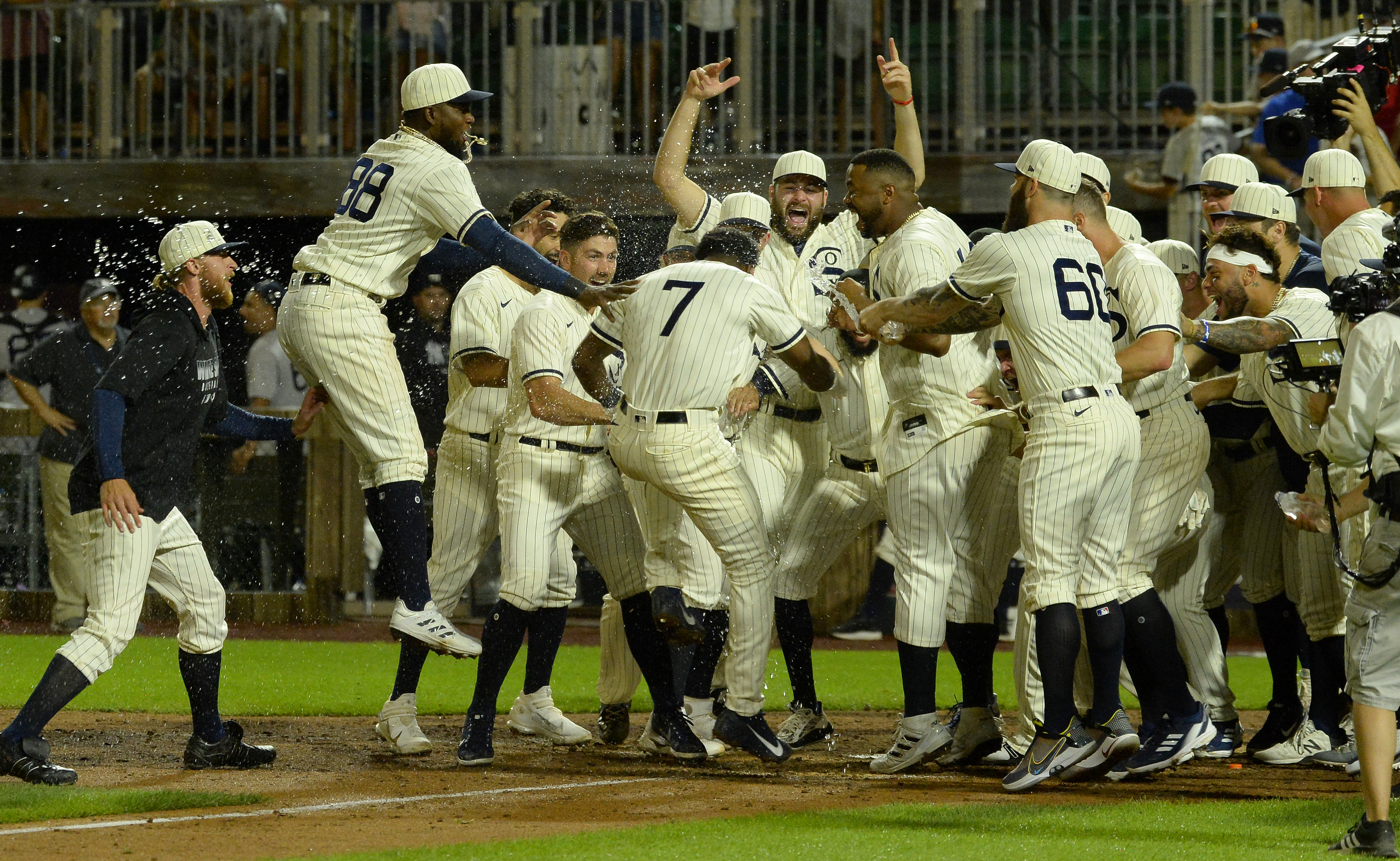
August 12, 2021: The 1st MLB Field of Dreams Game

August 12, 2021: Major League Baseball holds its 1st "Field of Dreams" game. For all that MLB officials have gotten wrong, this was one time when they really got it right.

The story begins in 1982, with the publication of Shoeless Joe, a novel by W.P. Kinsella. The book's narrator is Ray Kinsella, a farmer in Iowa, who cuts down a section of his corn to build a baseball field, after hearing a voice say, "If you build it, he will come." At first, he believes that "he" is Shoeless Joe Jackson, a great hitter and left fielder who helped the Chicago White Sox win the 1917 World Series and the 1919 American League Pennant, but was one of 8 White Sox players banned from baseball for life for their role in purposely losing, or "throwing," the 1919 World Series to the Cincinnati Reds.

Ray tells of his father, John Kinsella, who lived in Chicago at that time, who considered Jackson his all-time hero, and never believed any of the charges against Jackson -- who, like the other 7, was acquitted of criminal charges. Baseball banned them anyway. John was already about 60 when Ray was born, and when Ray was 17, they had a falling-out, and Ray left home. They never saw each other again.

Upon seeing the field, Jackson comes back to life. He brings the other "Black Sox" back with him, and eventually players from other teams whose careers came to unfortunate ends, through mistreatment, or injury, or death.

A scene in the book, but not in the movie, tells of an old farmer near Ray who tells of being the oldest living former Chicago Cub, but Ray looked in The Baseball Encyclopedia, and didn't find the old guy's name. Hence, he's lying. But a young version of the guy comes out of the cornfield in a period-accurate Cub uniform, and gets clobbered, paying for his older version's lies. The older version dies shortly thereafter, and is buried beneath center field, wearing a modern Cubs cap.

Finally, another figure appears: John Kinsella, looking younger than Ray ever saw him, wearing a New York Highlanders (forerunner of the Yankees) uniform, even though he never got out of the low minors. This allows them to reconcile.

In 1989, a film version was released, titled Field of Dreams, starring Kevin Costner as Ray, Amy Madigan (a big White Sox fan in real life) as his wife Annie, Ray Liotta as Jackson, James Earl Jones as reclusive writer Terence Mann (they changed it from the book, where the writer was J.D. Salinger, because they wanted to avoid a lawsuit), Frank Whaley as the young Archie "Moonlight" Graham, Burt Lancaster as the older Dr. Archibald Graham, and Dwier Brown as John Kinsella.

The movie is loved by baseball fans, but more for its fantasy than its accuracy. For example, Liotta batted righthanded, even though Jackson was a lefthander. Most fans consider the previous year's Bull Durham, starring Costner as a minor-league catcher, to be the better movie. Maybe, but Field of Dreams is the better story.

The farm where the main action was filmed is in Iowa: 4 miles east of downtown Dyersville, 25 miles west of Dubuque, 77 miles northeast of Iowa City, and 210 miles northwest of Chicago. Don Lansing, who owned the land, maintained the field as a tourist attraction -- farming being a hard way to make a living at the time, probably a good idea. He staged games between retired players and celebrity teams. 

Unlike the mortgage-saving maneuver in the movie, where $20 a pop was charged to see the ghost players, Lansing did not charge for admission or parking, but made extra cash from a small souvenir shop he'd built. By the time he sold the property in 2011, to Go The Distance Baseball, LLC, for $4.5 million, it was getting 65,000 visitors a year. By 2018, Go The Distance had a controlling interest bought by White Sox Hall-of-Famer Frank Thomas, and attendance had gone up to 100,000 a year, due to the number of events being staged there.

Someone gave Thomas the idea to stage a regular-season game there, and it was set for August 13, 2020, a Thursday night, between the closest team to the site and the team most identified with the site, the Chicago White Sox, who would thus be the "home team"; and baseball's most popular team, but also its most hated: The New York Yankees.

The COVID-19 epidemic wiped out 2/3rds of the 2020 baseball season, and made it impossible to build the 7,800-seat stadium, adjacent to the original Field of Dreams, in time, although the new field would have been ready. So the game was rearranged for a year later, August 12, 2021.
The "major league" field at left, the original field at right

The dimensions of the field were set at those of Comiskey Park, the White Sox' home from 1910 to 1990, at the time of its closing: 352 feet down the lines, 380 to the power alleys, and 402 to center. But no fence: The corn acted as the "outfield wall," and anything hit into the corn on the fly was a home run; while any ball that bounced and rolled into the corn was a ground-rule double. There were modern amenities: Lights, a video board in left field, and, in another tribute to Comiskey Park, a fireworks-shooting system built into the center-field corn.

MLB and Fox Sports went all-out, beginning the broadcast by having Costner walk out of the cornfield into center field, across the field, and to a microphone at home plate, where he made a short speech about how the movie reminded us all of the beauty of the game. Maddie Poppe, winner of American Idol in 2018 (at that time, a show on Fox, now on ABC), sang the National Anthem.

Both teams wore replica uniforms like those they wore in 1919. Lance Lynn started for the White Sox, and Andrew Heaney for the Yankees. The White Sox scored first, in the bottom of the 1st inning, on a home run by José Abreu. More home runs were hit: For the Bronx Bombers, Aaron Judge in the 3rd, and Brett Gardner in the 6th; for the South Side Hit Men, Eloy Jiménez in the 3rd, and Seby Zavala in the 4th.

The 9th inning provided a storybook ending for this fanciful setting. Judge hit another home run, and Giancarlo Stanton also hit one, turning the score from 7-4 White Sox to 8-7 Yankees. But with 1 out in the bottom of the 9th, Zack Britton walked Zavala. Cliché Alert: Walks can kill you. The next batter was Tim Anderson. He hit a drive to the opposite field, and even the very tall Judge couldn't catch it. Home run. Ballgame: White Sox 9, Yankees 8.

The fireworks went off, just as they would have from 1960 to 1990 at Comiskey, or since 1991 at the stadium now named Guaranteed Rate Field. It was the 15th time in their shared 119-season history that a White Sox player had hit what would now be called a walkoff home run against the Yankees. The 1st time? It just had to be, and it was: By Joe Jackson, on July 20, 1919, in the season commemorated by the book, the film, and the game.

Fox announcer Joe Buck said, "Well, you can throw the party, but you never know how it's going to turn out." Hall of Fame pitcher John Smoltz, Buck's broadcast partner, said, "Unreal." 

Len Kasper, the radio voice of the White Sox, said, "I’m not really sure MLB could have done an event better than the Field of Dreams Game. Yes, the game was bonkers and the finish was Oscar worthy, but the entire thing — the scenery, the park, the weather, the people involved, the vibe — it was just perfect. Unforgettable experience.”

It was a great idea. It was a great production. And it was a great game. For me, the only bad part was the result.

A 2nd edition was played on August 11, 2022. Again making some sense, it was the National League's turn this game, with the other Chicago team, the Cubs, facing the team the White Sox played in the 1919 World Series, the Cincinnati Reds. The Cubs scored 3 runs in the 1st inning and coasted the rest of the way, winning 4-2.

There will be no game at the site in 2023, as the site is adding facilities to house youth baseball and softball. No one wants to see construction equipment shattering the fantasy. "It's a lot going on," Frank Thomas told the Des Moines Register, Iowa's largest newspaper. "They don't want to come back if the stadium's not prepared." Hopefully, the game will resume in 2024, and become baseball's answer to the NHL Winter Classic.

*

August 12, 2021 was a Thursday. These other MLB games were played on that day:

* The New York Mets swept a doubleheader from the Washington Nationals at Citi Field, 5-4 and 4-1. Under the rule thankfully in effect only in the 2020 and 2021 seasons, doubleheader games were limited to 7 games each.

* The Tampa Bay Rays beat the Boston Red Sox, 8-1 at Fenway Park in Boston.

* The Philadelphia Phillies beat the Los Angeles Dodgers, 2-1 at Citizens Bank Park in Philadelphia.

* The Detroit Tigers beat the Baltimore Orioles, 6-4 at Camden Yards in Baltimore.

* The Cincinnati Reds beat the Atlanta Braves, 12-3 at Truist Park in the Atlanta suburb of Cumberland, Georgia.

* The St. Louis Cardinals beat the Pittsburgh Pirates, 7-6 at PNC Park in Pittsburgh.

* The Oakland Athletics beat the Cleveland Indians, 17-0 at Progressive Field in Cleveland. Mitch Moreland hit 2 home runs. Chris Bassitt (6 innings) and 3 relievers pitched a 3-hit shutout.

* The Milwaukee Brewers beat the Chicago Cubs, 17-4 at Wrigley Field.

* The Arizona Diamondbacks beat the San Diego Padres, 12-3 at Chase Field in Phoenix.

* The Los Angeles Angels beat the Toronto Blue Jays, 6-3 at Angel Stadium of Anaheim.

* The San Francisco Giants beat the Colorado Rockies, 7-0 at Oracle Park in San Francisco. Logan Webb (6 innings) and 2 relievers pitched 4-hit shutout.

* The Seattle Mariners beat the Texas Rangers, 3-1 at T-Mobile Park in Seattle.

* And the Houston Astros, the Kansas City Royals, the Miami Marlins and the Minnesota Twins were not scheduled.

December 31, 1999 & January 1, 2000: The Millennium

December 31, 1999:  The Millennium arrives. The people of planet Earth survived. At a terrible cost. But we hadn't destroyed ourselves. ...