Showing posts with label africa. Show all posts

Monday, December 26, 2022

December 26, 1951: "The African Queen" Premieres

Katharine Hepburn and Humphrey Bogart

December 26, 1951: The African Queen premieres, based on the 1935 novel by C.S. Forester, and directed by John Huston. It stars Humphrey Bogart and Katharine Hepburn.

The film is set in August 1914, in German East Africa (now the nations of Burundi, Rwanda and Tanzania). Samuel Sayer (Robert Morley) and his sister Rose (Hepburn) are British missionaries. They are occasionally supplied by the steamboat African Queen, piloted by Charlie Allnut, not exactly a missionary's kind of guy. (He was a Cockney in the book, but Bogart didn't think he could do the accent, so the character was rewritten as a Canadian, so he was still a citizen of the British Empire.)

Charlie tells them that war has broken out (the one that would later be known as World War I), and that they should get out of German territory. They refuse, but German colonial troops burn down the village, and Samuel is killed. Charlie helps Rose bury him, and takes her upriver.

Charlie says the British are unable to attack the Germans because of the presence of a large gunboat, the Königin Luise (Queen Louise, named for the wife of King Frederick William III of Prussia), patrolling a large lake downriver. Rose comes up with a plan to convert the African Queen into a torpedo boat, and sink the Königin Luise. After first thinking that she's nuts, Charlie goes along with the plan.

The Königin Luise returns, and Charlie and Rose steam the African Queen out onto the lake in darkness, intending to set her on a collision course. A strong storm strikes, causing water to pour into the African Queen through the torpedo holes. Eventually the boat capsizes, throwing Charlie and Rose into the water. Charlie loses sight of Rose in the storm.

Charlie is captured and taken aboard the Königin Luise, where he is interrogated by German officers. Believing that Rose has drowned, he makes no attempt to defend himself against accusations of spying, and the German captain sentences him to death by hanging. Rose is brought aboard the ship just after Charlie's sentence is pronounced. The captain questions her, and Rose proudly confesses the plot to sink the Königin Luise, deciding that they have nothing to lose. The captain sentences her to be executed with Charlie, both as British spies.

Charlie asks the German captain to marry them before they are executed, as is allowed by the law of most countries. The captain agrees, and after conducting the briefest of marriage ceremonies, is about to carry out the execution when the Königin Luise is rocked by a series of explosions, quickly capsizing. The ship has struck the overturned submerged hull of the African Queen and detonated the torpedoes. The newly married couple is able to escape the sinking ship and swim to safety together.

Much of the film was shot on location in Uganda and the Belgian Congo (now the Democratic Republic of the Congo). This was unusual for that era, especially for a color film that used large, cumbersome "Three-Strip" cameras. The cast and crew endured sickness and spartan living conditions during their time on location, and Huston used his off-time to do a lot of hunting. This led to Clint Eastwood directing and starring in the thinly-disguised 1990 film White Hunter Black Heart.

Hepburn got sick. Bogart later said that he and Huston were the only members of the cast and crew who didn't, because they were drinking whiskey, not the local water. Given Bogie's well-known proclivities, I believe him.

The film was nominated for 4 Academy Awards: Bogart for Best Actor, Hepburn for Best Actress, Huston for Best Director, and Huston and James Agee for Best Screenplay. Only Bogart won. It was his only win.

The small steamboat used to depict the African Queen was contemporary to the time, built in 1912 in Britain, for service in Africa. At one time it was owned by actor Fess Parker, best known for playing Davy Crockett. The boat was restored, and is now on display in another location connected with Bogart: Key Largo, Florida.

In 1977, CBS aired a TV-movie with the same title, but as a sequel to the original film, with Warren Oates as Charlie and Mariette Hartley as Rose. The film was meant as the pilot for a series, but it was not picked up.

In 1999, Shakespeare in Love won the Academy Award for Best Picture. In that film, Judi Dench played Queen Elizabeth I. The ceremony was hosted by Whoopi Goldberg, who came out in costume as Elizabeth I, complete with whiteface makeup, and said, "I am the African Queen!"

*

December 26, 1951 was a Wednesday. Baseball was out of season. Football was in midweek. There were 3 games played in the NBA:

* The New York Knicks lost to the Milwaukee Hawks, 78-76 at the Baltimore Coliseum. This was the 1st half of a doubleheader. The Knicks had reached the NBA Finals the previous year, and would again, while the Hawks were a lousy team, and moved to St. Louis in 1955, and then to Atlanta in 1968. Nevertheless, the Hawks won this game.

* In the nightcap, the Baltimore Bullets beat the Philadelphia Warriors, 103-99 in triple overtime. So fans could pay for 48 minutes of basketball, and ended up getting 111 minutes.

* And the Fort Wayne Pistons beat the Boston Celtics, 94-86 at North Side High School in Fort Wayne, Indiana. As late as 1952, an NBA team was playing its home games in a high school gymnasium.

There were 2 games played in the NHL. The New York Rangers beat the Detroit Red Wings, 1-0 at the old Madison Square Garden. And the Montreal Canadiens beat the Toronto Maple Leafs, 3-2 at Maple Leaf Gardens in Toronto. The Boston Bruins and the Chicago Black Hawks were not scheduled.

And in English soccer, at a time when teams played back-to-back, home-and-home games on Christmas Day and Boxing Day, North London team Arsenal had beaten Hampshire team Portsmouth 4-1 the day before, but Portsmouth gained a 1-1 draw on this day, at Fratton Park.

Saturday, November 12, 2022

November 13, 1902: Joseph Conrad Publishes "Heart of Darkness"

November 13, 1902: Joseph Conrad publishes Youth: a Narrative, and Two Other Stories. They are, in the order in which they appear in the book: Youth: a Narrative; Heart of Darkness; and The End of the Tether.

Heart of Darkness had previously been serialized in Blackwood's magazine in 3 issues: February, March and April 1899. Unlike the other 2 stories, it is widely remembered and read today.

Józef Teodor Konrad Korzeniowski was born on December 3, 1857 in Berdychiv, Ukraine, to parents of Polish nobility. He grew up in Warsaw, the capital of Poland. His father ran a merchant marine business, and sent him to Marseille, France to take the business up. By 1878, he was serving in Britain's version, and began to immerse himself in English-language culture.

A voyage to the Congo Free State in 1890 made him a writer. The Congo was not merely a colony of Belgium: It was personally owned by Leopold II, King of the Belgians, and its riches, including diamond mines, went to him. And he didn't care who had to live, and die, or under what conditions, to get it. He had an endless supply of black men to work for his white overseers; and if they died, there would be more to take their places.

Seeing all this made his innate depression worse. His mental discomfort was on top of physical ones: He claimed gout, malaria, swollen hands that made writing difficult, and that every novel cost him a tooth. But his 1896 marriage to Englishwoman Jessie George not only made him happy, but enabled him to write more. They had 2 sons, Borys and John.

Heart of Darkness is narrated by Charles Marlow, who tells of his assignment as steamer captain for a Belgian company in the African interior. This was the period where the terms "Darkest Africa" and "the Dark Continent" were common, and referred not just to the skin of the native people, but to the dangers of a vast land where cities were few and far between. After all, 1902 was the year that Cecil Rhodes, who linked Cairo and Cape Town by telegraph, and had tried to do so by road, killing thousands as a result, died.

Marlow meets Kurtz, an ivory trader working on a trading station far up the river, who has "gone native," and is the object of Marlow's expedition. His reputation precedes him: His mother was half-English, his father was half-French, and thus "All Europe contributed to the making of Kurtz." As the reader finds out at the end, Kurtz is a multitalented man: Painter, musician, writer, promising politician.

At first, Kurtz, like so many Europeans before him, wanted to bring "civilization" to the natives. However, over the course of his stay in Africa, he becomes corrupted. With the help of technology superior to that of the natives, Kurtz monopolizes his position as a demigod among native Africans. He takes his pamphlet and scribbles in, at the very end, the words "Exterminate all the brutes!"

Despite being strongly impressed by Kurtz, Marlow is under orders to return him to the coast via steamboat. But as he does so, it becomes clear that Kurtz is dying from jungle fever. Kurtz dies on the boat. His last words: "The horror! The horror!"

Having already gained a literary reputation in Britain with novels like Lord Jim (1900), Heart of Darkness made Conrad a star. His later novels included Nostromo (1904) and The Secret Agent (1907, popularizing that term a year before James Bond's creator, Ian Fleming, was born). He died on August 3, 1924, in Bishopsborne, Kent, England, outside London. He was 66.

Just one week after his similarly chilling adaptation of H.G. Wells' War of the Worlds in 1938, Orson Welles starred in a CBS radio adaptation of Heart of Darkness. He wanted to make a film version, with the Kurtz character being adapted into a Fascist dictator, but no film studio would touch it. (So much for "The Jews run Hollywood.")

In 1958, the CBS anthology TV series Playhouse 90 aired a 90-minute play version, with Roddy McDowall as Marlow, Boris Karloff as Kurtz, plus actresses Inga Swenson and Eartha Kitt. The best-known adaptation is Francis Ford Coppola's 1979 film Apocalypse Now, moving the setting to the Vietnam War, and starring Martin Sheen as a U.S. Army Captain assigned to "terminate" rogue Colonel Walter E. Kurtz, played by Marlon Brando at his most eccentric.

In 1993, TNT adapted Heart of Darkness, starring Tim Roth as Marlow and John Malkovich as Kurtz. The 2019 film Ad Astra is basically Heart of Darkness in space, starring Brad Pitt and Tommy Lee Jones.

*

November 13, 1902 was a Thursday. Baseball season was over. Professional basketball barely existed, and professional hockey only existed under the table. There was 1 score in college football: Davidson College beat the Georgia Institute of Technology, 7-6 at Brisbine Park in Atlanta.

Georgia Tech finished the season 0-6-2. "The horror." Davidson, located in the Charlotte, North Carolina suburb of the same name, finished 4-4-1. Since 1954, they have not competed at the top level of college football, settling in 1989 at Division I-AA, now the Football Championship Subdivision (FCS).

Wednesday, November 9, 2022

November 10, 1871: Dr. Livingstone & Mr. Stanley

Henry Morton Stanley

November 10, 1871: Henry Morton Stanley, a 30-year-old Welshman living in America, and working as a reporter for the New York Herald, achieves the goal he was hired to achieve, 2 years earlier: Find Dr. David Livingstone (the E was silent), the 58-year-old Scottish missionary and physician who had tended to the tribes of Britain’s colonies in Africa, but hadn’t been heard from since he had last left Britain in 1866.

The meeting happened in Ujiji, in what is now Tanzania. As they came face to face, Stanley tipped his hat, and asked, "Dr. Livingstone, I presume?" Livingstone's less-remembered response was, "Yes. I feel thankful that I am here to welcome you."
David Livingstone

But Livingstone was already ill, and didn’t want to leave the people he had come to accept as friends. He died 2 years later, from a combination of malaria and dysentery, and was hailed as one of the most revered Britons of the Victoria Era. Stanley lived on until 1904. Both men left writings that were complimentary toward Africans, but also heavily pro-colonization. So their legacies are mixed.

*

November 10, 1871 was a Friday. Baseball season was over. Basketball, and hockey as we know it, had yet to be invented. And 1871 is the only year since 1868 when no college football games recognized by the NCAA as official were played. So there were no scores on this historic day.

Tuesday, November 8, 2022

November 8, 1942: Operation Torch: D-Day In North Africa

November 8, 1942: Operation Torch is launched, the Allied invasion of Nazi-held North Africa in World War II. Landing points include several points in Morocco, including Casablanca; and the Algerian cities of Algiers and Oran. At the time, Morocco and Algeria were French colonies, but were heavily influenced by Nazi-controlled "Vichy France."

The invasion is planned by Lieutenant General Dwight D. Eisenhower, who would learn from both the successes and mistakes of Operation Torch a year and a half later, when planning the Allied invasion of Western Europe, codenamed Operation Overlord, a.k.a. "D-Day."

By Thanksgiving Day, November 26, the Allies were in control of Morocco. On that day, the film 
Casablanca premiered, set in early December 1941, right before America entered The War due to the Japanese attack on Pearl Harbor.
Since Axis forces including Vichy French, this also marks the last battle ever fought between English or British troops and French troops.
Among the American soldiers stationed in Casablanca at the time was Sergeant George Goldberg, later to rename himself George Golden, my future grandfather. A Yankee Fan from The Bronx, he was nominally Jewish, but hated organized religion, believing it to be the cause of all human strife. But, as they were determined to wipe the Jews off the face of the Earth, he hated the Nazis more than he hated religion, and enlisted.
Grandpa was a photographer in civilian life, and my mother once showed me some pictures he'd taken in the service. One showed a very tall French general, conferring with 2 of his officers. Grandpa may not have known who the general was, but, clearly, he was a man of some importance. It turned out to be Charles de Gaulle. If a soldier tried to take a picture of an army's commanding officer like that today, he'd be in big trouble.

Grandpa also served with the invading U.S. Army in Italy. In both cases, his ultimate commanding officer --- aside, of course, from his Commander-in-Chief, President Franklin D. Roosevelt -- was Major General, later Lieutenant General, George S. Patton, "Old Blood and Guts."

Also on this day, Ángel Tomás Cordero Jr. is born in Santurce, Puerto Rico, the same hometown as Roberto Clemente. The 1st Puerto Rican elected to the United States Racing Hall of Fame, the son of renowned jockey and horse trainer Angel Cordero Sr. won 7,057 races, including the Kentucky Derby in 1974, 1976 and 1985; the Preakness Stakes in 1980 and 1984; the Belmont Stakes in 1976; 4 Breeders' Cup races, 3 Jockey Club Gold Cups, and an Arlington Million. He is still alive.

He came into controversy at the 1980 Preakness. He was riding Codex, and came upon Genuine Risk, who, 2 weeks earlier, had become the 1st filly in 65 years to win the Kentucky Derby. Jacinto Vásquez, Genuine Risk's Panamanian jockey and, as a fellow Hispanic, something of a rival to Cordero, got a little too close. Cordero nudged Codex over and bumped Genuine Risk, affecting the outcome of the race. Don't judge Cordero too harshly: Vásquez later got involved in some shady things, while this remained the only blot on Cordero's career.

*

November 8, 1942 was a Sunday. Baseball season was over. The NBA wasn't founded yet. But there were 2 games played in the NHL. The Chicago Black Hawks and the Detroit Red Wings played to a 3-3 tie at the Olympia Stadium in Detroit.

And the New York Rangers lost to the Montreal Canadiens, 10-4 at the Montreal Forum. Among the Canadiens players who scored was a rookie with his 1st NHL goal. His name was Maurice Richard. There would be 543 more.

And there were 5 games played in the NFL:

* The New York Giants beat the Philadelphia Eagles, 14-0 at Shibe Park in Philadelphia.

* The NFL version of the Brooklyn Dodgers lost to the Chicago Bears, 35-0 at Ebbets Field.

* The Washington Redskins beat the Chicago Cardinals, 28-0 at Griffith Stadium in Washington.

* The Green Bay Packers beat the Cleveland Rams, 30-12 at Cleveland Municipal Stadium. The Rams would win the NFL Championship in 1945, but, due to low attendance, moved to Los Angeles the next season.

* And the Pittsburgh Steelers beat the Detroit Lions, 35-7 at Briggs Stadium (later renamed Tiger Stadium) in Detroit.

Also on this day, Alessandro Mazzola is born in Turin, Italy, where his father, Valentino Mazzola, was a star with soccer team Torino, but died with most of his teammates in a plane crash in 1949, known as the Superga Disaster.

Sandro and his brother, Ferruccio Mazzola, overcame the loss of their father, and both played top-flight calcio (what the Italians call soccer). Ferruccio (1945-2013) was a midfielder for several teams, helping Rome club Lazio win its 1st Serie A (national league) title in 1974, alongside future New York Cosmos star Giorgio Chinaglia.

Sandro Mazzola was an attacking midfielder who played 17 seasons for Internazionale Milano, leading La Grande Inter to league titles in 1963, 1965, 1966 and 1971, and the European Cup in 1964 and 1965. He and Ferruccio were briefly teammates in 1967, when Inter again reached the European Cup Final, losing to Celtic. Between them, the father and 2 sons won 10 league titles.

Sandro helped Italy win Euro 1968, but they lost the Final of the 1970 World Cup, because the manager, Ferruccio Valcareggi, could never find a way to put the 2 great Milan-based stars of the era, Sandro Mazzola of Inter and Gianni Rivera of AC Milan, together in the same lineup. Sandro also played in the 1966 and 1974 World Cups. Sandro became a commentator for Italian network RAI, including for Italy's wins in the 1982 and 2006 World Cups, and is still active in that role.

Thursday, November 3, 2022

November 3, 1942: The Battle of El Alamein

An unidentified soldier (left) and General Montgomery
in a tank at El Alamein

November 3, 1942: Field Marshal Erwin Rommel begins Nazi Germany's retreat from the Second Battle of El Alamein, on the Mediterranean coast of Egypt, 160 miles west of the national capital of Cairo. This was the beginning of the end for his Afrika Corps, and for the Nazis' control of anything in Africa.

There had been a First Battle of El Alamein, from July 1 to 27, 1942, but it was regarded as a stalemate. This Second Battle began on October 23. It ended the Axis threat to Egypt, the Suez Canal, and the Middle Eastern and Persian oil fields.

The battle was a big morale-booster for the Allies, who hadn't had a major victory since the sinking of the Nazi battleship Bismarck, a year and a half earlier. It remains the most significant victory led by the British Army since Waterloo in 1815. (I say "led by" because the U.S. led the D-Day invasion of 1944.) Aside from air support, the United States of America had nothing to do with this win. It was British Empire troops, including from India, Australia, New Zealand and South Africa; with aid from Free France and Greece.

These troops were under the command of Lieutenant-General Bernard Law Montgomery, who thus became Britain's most important military commander since Arthur Wellesley, the Duke of Wellington, at Waterloo. He was promoted to Field Marshal, and was named 1st Viscount Montgomery of Alamein after the war. He lived until 1976.

Five days after the British victory at El Alamein, the Allies launched Operation Torch, invading North Africa through Morocco. That meant that, like Europe, North Africa was now a war on two fronts. Rommel's reputation as the brilliant "Desert Fox" would not be damaged, but he would not be on the winning side of this war. He wouldn't even live to see the end of it.

*

November 3, 1942 was a Tuesday. Baseball season was over. Football season was over. The NBA hadn't been founded yet. And the NHL season hadn't started yet. So there were no scores on this historic day.

Saturday, October 29, 2022

October 30, 1888: The Rudd Concession Is Signed

Cecil Rhodes

October 30, 1888: The Rudd Concession is signed in Bulawayo, Matabeleland, in southern Africa. The consequences for "The Dark Continent" were dire.

Charles Rudd was a business associate of Cecil Rhodes. The concession involved strong-arming King Lobengula of the Northern Ndebele into granting Rhodes exclusive mining rights to the region for his recently formed diamond company, De Beers. This led to the formation of the British South Africa Company, which later led to annexing the region for the British Empire, which of course later led to apartheid.

Rhodes, who became Prime Minister of the Cape Colony from 1890 to 1896, didn’t care. As far as he was concerned, if you weren’t white, you were beneath him: He was quoted as saying, "I contend that we are the first race in the world, and that the more of the world we inhabit the better it is for the human race."

At the time of his death in 1902, De Beers controlled 90 percent of the world's diamond production. Rhodes left a lot of that blood money to establish the Rhodes Scholarship. Protests at the University of Cape Town resulted in the statue of Cecil Rhodes being removed in 2015.

He even named the land he stole after himself. The country name Rhodesia persisted until 1980, when, after the natives finally won a civil war, it was renamed Zimbabwe.

*

October 30, 1898 was a Tuesday. Baseball season had just ended. Football was in midweek. And professional basketball and hockey did not yet exist. So there were no scores on this historic day.

Sunday, October 23, 2022

October 23, 1995: Def Leppard Play 3 Concerts on 3 Continents in 30 Hours

Left to right: Rick Savage, Vivian Campbell,
Phil Collen, Rick Allen, Joe Elliott

October 23, 1995: English heavy metal band Def Leppard, having released their greatest hits album Vault, decided to mark the occasion by playing three acoustic shows on three different continents on the same day, as a special "Vaulting The World" publicity event.
"It was the band’s idea to do something weird and wacky," lead singer Joe Elliott said, as the band boarded a plane at London's Gatwick Airport ahead of the 2 hour, 45 minute flight to Tangier, Morocco in Africa for their first gig of the whirlwind tour at Hercules Cave. (The city is officially "Tangier," but "Tangiers" is sometimes also used.)
"We haven't actually had the chance to nail this person's head to a coffee table yet who actually came up with this three gigs in one day lark," Elliott later said. "But, I mean, it is a challenge, and we do like a bit of a challenge."
The quintet’s second gig took place at the Bottom Line club in West London, with Leppard playing "Little Wing" by Jimi Hendrix, "Ziggy Stardust" by David Bowie, and "You Can't Always Get What You Want" by The Rolling Stones, along with their own hits "Animal," "Two Steps Behind" and "Pour Some Sugar On Me."
The same three covers, plus a set-closing run through T. Rex's "Bang A Gong (Get It On)," featured in the band’s final show of the day, at the Commodore Ballroom in Vancouver, British Columbia, Canada. With that show starting at 10:45 PM local time, Leppard technically played their 3 shows in 30 hours. But, as the time difference meant it was 6:45 AM in London, the record of 3 concerts on 3 continents in 1 day was allowed to stand.
"The audience was stunning," Elliott said of the Vancouver crowd. "It was like Beatlemania, with people moshing - moshing! - during our acoustic set."
"Would we do it all again?" the singer asked, rhetorically, with the record in the bag. "Yes. Would I do it all again next week? No fucking way."
*
October 23, 1995 was a Monday. It was an off-day between Games 2 and 3 of the World Series, which the Atlanta Braves would win in 6 games over the Cleveland Indians. On ABC Monday Night Football, the New England Patriots beat the Buffalo Bills, 27-14 at Foxboro Stadium in the Boston suburb of Foxborough, Massachusetts.
The NBA season started 11 days later. There were 2 games played in the NHL. The Montreal Canadiens beat the Los Angeles Kings, 6-3 at the Montreal Forum. And the Colorado Avalanche beat the Mighty Ducks of Anaheim, 3-1 at the McNichols Arena in Denver.

Friday, October 21, 2022

October 21, 1956: The Mau Mau Rebellion Ends

October 21, 1956: The Mau Mau Rebellion ends, with the capture of the rebels' leader, Field Marshal Dedan Kimathi.

The Mau Mau rebellion, also known as the Mau Mau uprising, Mau Mau revolt or Kenya Emergency, was a war in the British Kenya Colony (1920–1963) between the Kenya Land and Freedom Army (KLFA), also known as the Mau Mau, and the British authorities.

Dominated by the Kikuyu people, Meru people and Embu people, the KLFA also comprised units of Kamba and Maasai peoples who fought against the white European colonist-settlers in Kenya, the British Army, and the local Kenya Regiment (British colonists, local auxiliary militia, and pro-British Kikuyu people).

However, the rebellion survived until after Kenya's independence from Britain, driven mainly by the Meru units led by Field Marshal Musa Mwariama and General Baimungi. Baimungi, one of the last Mau Mau generals, was killed shortly after Kenya attained self-rule.

The KLFA failed to capture widespread public support, due to a British policy of divide and rule. The Mau Mau movement remained internally divided, despite attempts to unify the factions. The British, meanwhile, applied the strategy and tactics they developed in suppressing the Malayan Emergency (1948–60).

Suppressing the Mau Mau Uprising in the Kenyan colony cost Britain £55 million, and caused at least 11,000 deaths among the Mau Mau and other forces, with some estimates considerably higher. This included 1,090 executions by hanging. The rebellion was marked by war crimes and massacres committed by both sides.

In August 1952, Jomo Kenyatta told a Kikuyu audience "Mau Mau has spoiled the country... Let Mau Mau perish forever." Kenyatta, who became the 1st Prime Minister of Kenya after independence in 1963, described the conflict in his memoirs as a civil war rather than a rebellion. 

*

October 21, 1956 was a Sunday. Actress Carrie Fisher was born, the daughter of actress Debbie Reynolds and singer Eddie Fisher, and later the half-sister of actress Joely Fisher. Paul Levitz was also born that day. Although he wrote for DC Comics, he was more important for the writers and artists he hired as an executive with them, enabling the company's revival in the 1980s.

Baseball season had ended 11 days earlier, with the New York Yankees winning Game 7 of the World Series over the Brooklyn Dodgers. The NBA season began 6 days later. There were 2 games played in the NHL. The New York Rangers beat the Chicago Black Hawks, 4-1 at the old Madison Square Garden. And the Boston Bruins and the Detroit Red Wings played to a tie, 3-3 at the Olympia Stadium in Detroit. The Montreal Canadiens and the Toronto Maple Leafs were not scheduled.

And these NFL games were played:

* The New York Giants beat the Pittsburgh Steelers, 38-10 at Yankee Stadium.

* The Chicago Cardinals beat the Philadelphia Eagles, 20-6 at Connie Mack Stadium in Philadelphia.

* The Washington Redskins beat the Cleveland Browns, 20-9 at Griffith Stadium in Washington.

* The Detroit Lions beat the San Francisco 49ers, 20-17 at Briggs Stadium in Detroit. (It was renamed Tiger Stadium in 1961.)

* The Chicago Bears beat the Baltimore Colts, 58-27 at Wrigley Field in Chicago.

* And the Green Bay Packers beat the Los Angeles Rams, 42-17 at Milwaukee County Stadium.

Friday, October 7, 2022

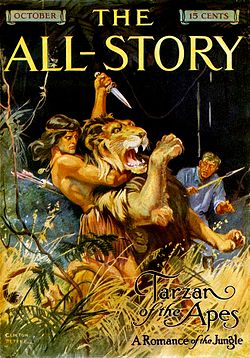
October 7, 1912: The Debut of Tarzan

The debut cover

October 7, 1912: The All-Story Magazine prints a story by Edgar Rice Burroughs: Tarzan of the Apes: A Romance of the Jungle. It is the debut of one of the most famous fictional characters ever created. And while American audiences have tended to accentuate each syllable, pronouncing his name "TAR-ZAN," it was originally "TAR-zin," with the accent only on the 1st syllable.

While modern readers might define "romance" as "emotional attraction towards another person and the courtship behaviors undertaken to express the feelings," from the late 18th Century onward, the word was then understood within the realm of "Romanticism," a movement that broke away from neoclassicism, and emphasized nature, the imagination and emotions.

In Burroughs' story, John Clayton, Viscount Greystoke, the son of a British lord, the Earl of Greystoke, and his wife, who were marooned on the coast of West Africa by mutineers. When Tarzan was an infant, his mother died, and his father was killed by Kerchak, leader of the ape tribe by whom Tarzan was adopted.

Soon after his parents' death, Tarzan became a feral child, and his tribe of apes is known as the Mangani, great apes of a species unknown to the science of the time. Kala is his ape mother. She gives him the name "Tarzan," meaning "White Skin."

His jungle upbringing gives him abilities far beyond those of ordinary humans. These include climbing, clinging, and leaping as well as any great ape. He uses branches, swings from vines to travel at great speed, and can use his feet like hands, a skill acquired among the anthropoid apes. He prefers going barefoot, because he relies on the flexibility of bare feet.

His strength, speed, stamina, agility, reflexes, and swimming skills are extraordinary; he has wrestled not just full-grown apes, but also gorillas, lions, rhinos, crocodiles, pythons, leopards, tigers, and, in the most fantasy-laden stories, sharks, giant seahorses and dinosaurs. He is a skilled tracker, and uses his exceptional hearing and keen sense of smell to follow prey or avoid predators.

As originally depicted, Tarzan is very intelligent and articulate, and does not speak in broken English as the classic movies of the 1930s depict him. He can communicate with many species of jungle animals, and has been shown to be a skilled impressionist, able to mimic the sound of a gunshot perfectly.

Tarzan is literate in English before he first encounters other English-speaking people. His literacy is self-taught after several years in his early teens, by visiting the log cabin of his infancy and looking at children's primer/picture books. He eventually reads every book in his father's portable book collection, and is fully aware of geography, basic world history, and his family tree.

He is "found" by traveling Frenchman Paul D'Arnot, who teaches him the basics of human speech and returns with him to civilization. When Tarzan first encounters D'Arnot, he tells him (in writing): "I speak only the language of my tribe -- the great apes who were Kerchak's; and a little of the languages of Tantor, the elephant, and Numa, the lion, and of the other folks of the jungle I understand."

But he proves that he can learn a new language in days, ultimately speaking many languages, including that of the great apes, French, English, Finnish, Dutch, German, Swahili, other Bantu languages, Arabic, Ancient Greek, Ancient Latin, and Mayan.

At the age of 18, Tarzan meets a young American woman named Jane Porter. She, her father, and others of their party are marooned on the same coastal jungle area where Tarzan's human parents were 20 years earlier. When Jane returns to the United States, Tarzan leaves the jungle in search of her, his one true love.

Contrary to what many fans would come to believe, in The Return of Tarzan, published in magazine form in 1913 and in book form in 1915, Tarzan and Jane marry. In later books, he lives with her for a time in England. They have one son, Jack, who takes the ape name Korak, meaning "The Killer."

Tarzan is contemptuous of what he sees as the hypocrisy of civilization, so Jane and he return to sub-Saharan Africa, making their home on an extensive estate in British East Africa that becomes a base for Tarzan's later adventures. (British East Africa would become Kenya.)

Born on September 1, 1875 in Chicago, Edgar Rice Burroughs wrote 24 Tarzan novels, 11 John Carter of Mars novels, and many other works of adventure, including fantasy and science fiction, before dying on March 19, 1950 in Encino, California, at the age of 74.
Elmo Lincoln starred in the 1st Tarzan film, the silent, black & white Tarzan of the Apes in 1918. In 1932, Olympic swimming Gold Medalist Johnny Weissmuller starred in Tarzan, the Ape Man, the 1st of 12 films in which Maureen O'Sullivan (mother of Mia Farrow) played Jane. The first film introduced "the Tarzan Yell," which has become as synonymous with the character as as this version's broken English, wearing nothing but a loincloth, and swinging from the vines. The scene where Jane asks him his name, and he goes, "Tarzan, Jane, Tarzan, Jane," got mixed up in the public mind, and the incorrect phrase, "Me Tarzan, you Jane" entered the lexicon.

The 2nd film, Tarzan and His Mate, in 1934, was one of the most controversial films of all time. It's "His Mate," not "His Wife." At no time in the film are they said to married. But they sleep together, Jane is shown showering in silhouette, and, with a body double subbing for O'Sullivan, she is shown swimming naked in a river -- while Tarzan keeps his loincloth on. It was the movie that made the keepers of "The Hays Code," the moral guardians of the American film industry, get serious.

The films would show Tarzan joined by a chimpanzee named Cheetah, and, starting in 1939 with Tarzan Finds a Son!, by Johnny Sheffield, then 8 years old, as the older version of a baby that Cheetah had rescued and brought to Tarzan and Jane, whom this version of Tarzan, not the most imaginative of men, names "Boy."
From the 1939 film Tarzan Finds a Son! Left to right:
Jiggs Jr. as Cheeta, Johnny Sheffield as Boy,
Johnny Weissmuller as Tarzan, and Maureen O'Sullivan as Jane. 

Weissmuller died in 1984, O'Sullivan in 1998, Sheffield in 2010.

Lex Barker took over for 5 films from 1949 to 1953, then Gordon Scott for 6 from 1955 to 1960, then Jock Mahoney for 1 in 1962 and another in 1963, and Mike Henry for 3 from 1966 to 1968. At the same time as the Henry films, Ron Ely starred in a Tarzan series for NBC.  That series, as well as the films of Mahoney and Henry, did not include Jane or Boy, but did have Cheeta.

In 1981, Miles O'Keefe starred in Tarzan, the Ape Man, with Bo Derek as Jane, and her real-life husband John Derek directing. It was universally panned, and considered soft-core pornography. A much-better-regarded film came in 1984, with French actor Christopher Lambert in Greystoke: The Legend of Tarzan, Lord of the Apes. Casper Van Dien starred in Tarzan and the Lost City in 1998, the same year a Disney cartoon musical was released, with Tony Goldwyn voicing Tarzan. Swedish actor Alexander Skarsgård starred in The Legend of Tarzan in 2016.

It has been suggested that Tarzan is the 2nd-most popular fictional character of all time, behind only Sherlock Holmes. The imitations of him, or at least the stories of jungle adventure after him, have been many. Frank Buck, hunter and animal collector, with his 1930 book Bring 'em Back Alive and the works based on it. King Kong and his copy, Mighty Joe Young. Jungle Jim. The cartoon parody George of the Jungle, and the parody of that on PBS' The Electric Company, Jennifer of the Jungle. Congo Bill and Congorilla.  

In 1947, The Andrews Sisters had a hit with "Civilization," with its chorus of, "Bongo, bongo, bongo, I don't wanna leave the Congo, oh no no no no no. Bingo, bangle, bungle, I'm so happy in the jungle, I refuse to go." In 1969, Ray Stevens, master of novelty songs, had a hit with "Gitarzan." In 1970, The Kinks had a hit with "Apeman."

The character of Sheena debuted in comic books in 1938. She was played on TV by model Nellie "Irish" McCalla in 1955. McCalla admitted that she couldn't act, but she looked good in the outfits. Tanya Roberts starred in a 1984 film version of Sheena, and Gena Lee Nolin played her in a new TV series in 2000. Ironically, the name "Sheena" comes from Gaelic, and is a variation of Jane, the feminine version of John. So Sheena, the closest thing pop culture has to a female Tarzan, is really "Jane." Even Sheena has been copied, with Marvel Comics' Shanna, the She-Devil.

*

October 7, 1912 was a Monday. It was the day before the start of the World Series, which the Boston Red Sox would win over the New York Giants in 8 games. Yes, 8: Game 2 would be called due to darkness while tied, and the Series would, as it was supposed to, continue until one team or the other had won 4 games.

But there was one score on this historic day, and it was in college football: The University of Iowa beat Iowa State Teachers College, 35-7 at Iowa Field in Iowa City. ISTC, located in Cedar Falls, became the State College of Iowa in 1961, and the University of Northern Iowa in 1967. In 1973, they began playing in NCAA Division II. In 1981, they moved up to Division I-AA, now the Football Championship Subdivision (FCS).

Wednesday, July 6, 2022

July 6, 1967: The Nigerian Civil War

July 6, 1967: A civil war breaks out in Nigeria, the most populous country on the African continent.

At the time, the country was run by a military dictatorship. The Igbo ethnic group, living in the southeastern part of the country, led by Lieutenant Colonel Chukwuemeka "Emeka" Odumegwu Ojukwu, felt it could no longer coexist with the federal government, dominated by the Hausa-Fulanis, who were Muslim and came from the northern part, and were conducting pogroms against the Igbos living in the north.

So the Igbos separated from Nigeria, and declared the independence of the Republic of Biafra. Nigeria's dictator, General Yakubu Gowon, attacked. Within a year, his troops had surrounded Biafra, and captured coastal oil facilities and the city of Port Harcourt. A blockade was imposed, as a deliberate method which achieved its intention: The mass starvation of Biafran civilians. Biafra surrendered on January 15, 1970, and was reintegrated into Nigeria.

There were about 100,000 overall military casualties, while between 500,000 and 2 million Biafran civilians died of starvation. Alongside the concurrent Vietnam War, the Nigerian Civil War was one of the first wars in human history to be televised to a global audience. In mid-1968, images of malnourished and starving Biafran children saturated the mass media of Western country. It inspired the formation of Doctors Without Borders.

The United States' official position, under the Presidencies of both Lyndon Johnson and Richard Nixon, was one of neutrality, considering Nigeria as "a responsibility of Britain," but some interpret the refusal to recognize Biafra as favoring the Nigerian government.

The war also resulted in the political marginalization of the Igbo people, as Nigeria has not had another Igbo President since the end of the war, leading some Igbo people to believe they are being unfairly punished for the war.

Ojukwu fled to the Ivory Coast in exile. Gowon ruled Nigeria until he was overthrown in a military coup in 1975, while he was at a summit meeting in Uganda. He went into exile in Britain.

In 1981, newly democratically elected Nigerian President Shehu Shagari granted amnesty to Ojukwu, allowing him to return to Nigeria without facing political or legal consequences from the war. Ojukwu spent the remainder of his life unsuccessfully attempting to return to Nigerian politics as a democratically elected politician rather than a military ruler. He died in 2011, in London, at the age of 78.

Shagari also pardoned Gowon, for crimes ranging from genocide to "looting half of the Central Bank of Nigeria." However, he has never returned to his homeland. He has, however, worked to fight diseases in Africa, including AIDS, Guinea worm and malaria. As of July 6, 2022, he is still alive.

In 1983, another military coup led to a Nigerian dictatorship. In 1999, the country returned to democracy, and has observed it ever since.

*

July 6, 1967 was a Thursday. Baseball was the only sport in season in North America, and only 3 games were scheduled:

* The Baltimore Orioles beat the Chicago White Sox, 3-1 at Comiskey Park in Chicago. Brooks Robinson went 0-for-4. Frank Robinson did not play.

* The St. Louis Cardinals beat the Cincinnati Reds, 6-5 at Busch Memorial Stadium in St. Louis. Orlando Cepeda went 3-for-5 with a home run and 3 RBIs, including singling Bobby Tolan home to win this game in the bottom of the 9th inning. Roger Maris went 0-for-4 with a walk. Pete Rose went 3-for-4. Lou Brock only appeared as a pinch-hitter, and struck out.

* And the Houston Astros beat the Chicago Cubs, 4-3 at the Astrodome in Houston. Ernie Banks went 2-for-4 with an RBI.

Thursday, June 30, 2022

June 30, 1960: The No-Longer Belgian Congo Leads the Year of Africa

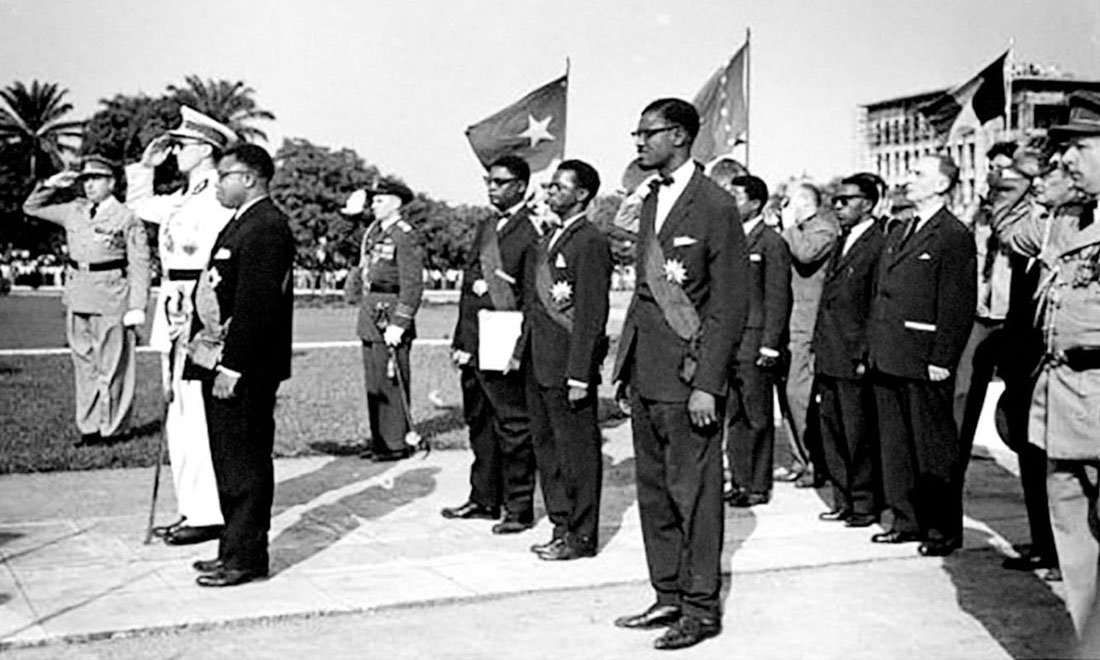
President Patrice Lumumba stands at center

June 30, 1960: The Republic of the Congo declares its independence from the Kingdom of Belgium. No longer will it be "The Belgian Congo."

It had to be called that, because France also had a colony it called "Congo." That one gained its independence on August 15. It had been nicknamed, for its capital, "Congo-Brazzaville," as opposed to formerly Belgian "Congo-Kinshasa." The name "Congo" originally referred to the river in both of those nations in West Africa, or to the Basin thereof.

These nations gained their independence from France in 1960, unless otherwise mentioned: Cameroon kicked off "The Year of Africa" by declaring independence on January 1, Togo on April 27, Mali on June 20, Madagascar on June 26, and Somalia from Italy on July 1. In addition, on April 27, Ghana left the British Commonwealth, and became a Republic.

And then, in August, 9 more nations gained their independence from France: Dahomey on the 1st, Niger (not to be confused with Nigeria) on the 3rd, Upper Volta on the 5th, the Ivory Coast (they prefer their French name, Côte d'Ivoire) on the 7th, Chad on the 11th, the Central African Republic on the 13th, France's Congo on the 15th, and Gabon on the 17th. And on the 20th, Senegal separated from the Mali Federation, and became independent. Nigeria gained independence from Britain on October 1, and, closing it out, Mauritania from France on November 28.

Dahomey became Benin in 1975, and Upper Volta became Burkina Faso in 1984. The former Belgian Congo/Congo-Kinshasa became Zaire in 1971, and "The Democratic Republic of the Congo" in 1997.

*

June 30, 1960 was a Thursday. These baseball games were played that day:

* The New York Yankees beat the Kansas City Athletics, 10-3 at Yankee Stadium. Ralph Terry, not yet the Yankee World Series hero of 1962, went the distance for the win; while Don Larsen, the Yankee World Series hero of 1956, didn't get out of the 3rd inning for the A's. Bill "Moose" Skowron hit 2 home runs, and the Yankees also got home runs from Mickey Mantle, Roger Maris and Tony Kubek. Yogi Berra did not play.

* The Boston Red Sox beat the Detroit Tigers, 11-7 at Fenway Park in Boston. Ted Williams hit his 505th career home run. Al Kaline went 1-for-4. Rocky Colavito went 2-for-4 with 2 home runs and 5 RBIs.

* The Los Angeles Dodgers beat the Philadelphia Phillies, 10-6 at Connie Mack Stadium in Philadelphia. The Brooklyn "Boys of Summer" were pretty much done: Duke Snider did not play, and Gil Hodges did so only as a pinch-hitter, and did not reach base.

* The Baltimore Orioles beat the Cleveland Indians, 9-1 at Memorial Stadium in Baltimore. Brooks Robinson went 1-for-3 with a walk.

* The Chicago White Sox beat the Washington Senators, 4-2 at Griffith Stadium in Washington. Joe Ginsberg doubled home the winning run in the top of the 10th inning.

* A doubleheader was split at Forbes Field in Pittsburgh. The San Francisco Giants won the opener, 11-0. Jack Sanford pitched a 3-hit shutout. The Pittsburgh Pirates won the nightcap, 11-6. Dick Stuart, already known as a bad fielder but not yet with the nicknames Dr. Strangeglove or Stonefingers, went 4-for-5 with 3 home runs and 7 RBIs.

Over the 2 games, Willie Mays went 6-for-9 with a home run in each game, a walk, and 5 RBIs; Willie McCovey went 3-for-5 with a walk (only appearing as a pinch-hitter in the nightcap, but getting a hit); and Roberto Clemente went 1-for-6 with 2 walks and an RBI.

* The Chicago Cubs beat the Milwaukee Braves, 11-5 at Wrigley Field in Chicago. Ernie Banks went 3-for-6 with a home run and 3 RBIs. Hank Aaron went 1-for-2 with 2 walks and an RBI.

* And the Cincinnati Reds and the St. Louis Cardinals were not scheduled.

June 30, 1936: Emperor Haile Selassie's Plea Falls On Deaf Ears

June 30, 1936: Emperor Haile Selassie of Ethiopia speaks before the League of Nations, at the Palais Wilson on the shore of Lake Geneva in Switzerland.

Ethiopia was one of the few independent nations in Africa when Italy invaded on October 2, 1935, in fascist dictator Benito Mussolini's bid to create a new Roman Empire. At the end of the year, for his resistance, Time magazine named Haile Selassie its Man of the Year. On May 7, 1936, Italy completed its annexation of the country. Two days later, Mussolini declared the colony of Italian East Africa, also including Eritrea and Somalia.

Like all who had sat on his throne, Haile Selassie claimed to trace his lineage back to the affair between Solomon, one of the Biblical Kings of Israel, and the Queen of Sheba, known in modern Ethiopia as Makeda. But now, the man known to his people as King of Kings, Lord of Lords, Elect of God, and Lion of Judah had been overthrown, and had to flee his country.

The League of Nations had been founded after World War I, by President Woodrow Wilson (hence, the name of the its assembly hall), in the hopes of preventing small conflicts, especially to prevent them from becoming bigger conflicts, as the fight between Serbia and the Austrian Empire in July 1914 snowballed into World War I.

But America's U.S. Senate refused to ratify the Treaty of Versailles, which had created the League. Thus, America, and the large moral authority it had gained from winning the war, were not in the league. Therefore, the League was considerably weaker than it could have been.

Still, Haile Selassie believed that, if he told the League what the Italians were doing in his country, they would respond, and help. Although fluent in French, the League's working language, the Emperor delivered his speech in his native language, Amharic, translated for the Assembly. He said:

I, Haile Selassie I, Emperor of Ethiopia, am here today to claim that justice which is due to my people, and the assistance promised to it eight months ago, when fifty nations asserted that aggression had been committed in violation of international treaties.
There is no precedent for a Head of State himself speaking in this assembly. But there is also no precedent for a people being victim of such injustice and being at present threatened by abandonment to its aggressor. Also, there has never before been an example of any Government proceeding to the systematic extermination of a nation by barbarous means, in violation of the most solemn promises made by the nations of the earth that there should not be used against innocent human beings the terrible poison of harmful gases.
It is to defend a people struggling for its age-old independence that the head of the Ethiopian Empire has come to Geneva to fulfil this supreme duty, after having himself fought at the head of his armies...
Apart from the Kingdom of the Lord there is not on this earth any nation that is superior to any other. Should it happen that a strong Government finds it may with impunity destroy a weak people, then the hour strikes for that weak people to appeal to the League of Nations to give its judgment in all freedom. God and history will remember your judgment...
On behalf of the Ethiopian people, a member of the League of Nations, I request the Assembly to take all measures proper to ensure respect for the Covenant. I renew my protest against the violations of treaties of which the Ethiopian people has been the victim. I declare in the face of the whole world that the Emperor, the Government and the people of Ethiopia will not bow before force; that they maintain their claims that they will use all means in their power to ensure the triumph of right and the respect of the Covenant...
It is us today. It will be you tomorrow...
I ask the fifty-two nations, who have given the Ethiopian people a promise to help them in their resistance to the aggressor, what are they willing to do for Ethiopia? And the great Powers who have promised the guarantee of collective security to small States on whom weighs the threat that they may one day suffer the fate of Ethiopia, I ask what measures do you intend to take?
Representatives of the World: I have come to Geneva to discharge in your midst the most painful of the duties of the head of a State. What reply shall I have to take back to my people?
The League's reply was pathetic: Only partial and ineffective sanctions on Italy. It is often said that the League of Nations effectively collapsed due to its failure to condemn Italy's invasion of Ethiopia. 
He spent his exile in Bath, England. Back in Ethiopia, one of his daughters died in captivity, and his sons-in-law were executed. Another daughter died in childbirth shortly after the restoration.
But the restoration did come. When Britain declared war on Nazi Germany on September 3, 1939, it also declared war on Italy, as part of the same Axis. On January 18, 1941, a combined force of Ethiopian, British Empire, Free France and Free Belgium troops invaded. On May 5, the Italians surrendered, and Haile Selassie entered the capital of Addis Ababa, and addressed his people again.
By that point, the League of Nations had only a skeleton staff. For all intents and purposes, it existed only on paper. In 1946, with the United Nations already operating, the League Assembly voted to dissolve the League.
*
June 30, 1936:  was a Tuesday. These baseball games were played that day:

* The New York Yankees swept a doubleheader from the Boston Red Sox, 10-5 and 6-3 at Yankee Stadium. Lou Gehrig went 3-for-6 with a home run in each game, 3 walks and 4 RBIs. Rookie Joe DiMaggio went 3-for-9 with an RBI. For the Sox, Jimmie Foxx 3-for-7 with 2 walks and 2 RBIs.

* The New York Giants lost to the Boston Bees, 7-6 at National League Park in Boston. This was the 1st season for which the Boston Braves tried to abandon their losing tradition by changing the name of their team and their ballpark, Braves Field. After 5 years, they realized it wasn't working.

* And the St. Louis Cardinals swept a doubleheader from the Pittsburgh Pirates, 2-1 and 4-3 at Forbes Field in Pittsburgh.

December 31, 1999 & January 1, 2000: The Millennium

December 31, 1999:  The Millennium arrives. The people of planet Earth survived. At a terrible cost. But we hadn't destroyed ourselves. ...