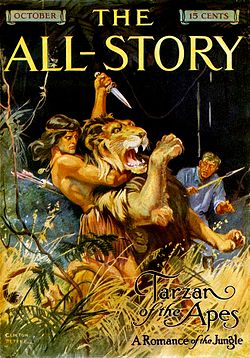
The debut cover
October 7, 1912: The All-Story Magazine prints a story by Edgar Rice Burroughs: Tarzan of the Apes: A Romance of the Jungle. It is the debut of one of the most famous fictional characters ever created. And while American audiences have tended to accentuate each syllable, pronouncing his name "TAR-ZAN," it was originally "TAR-zin," with the accent only on the 1st syllable.
While modern readers might define "romance" as "emotional attraction towards another person and the courtship behaviors undertaken to express the feelings," from the late 18th Century onward, the word was then understood within the realm of "Romanticism," a movement that broke away from neoclassicism, and emphasized nature, the imagination and emotions.
In Burroughs' story, John Clayton, Viscount Greystoke, the son of a British lord, the Earl of Greystoke, and his wife, who were marooned on the coast of West Africa by mutineers. When Tarzan was an infant, his mother died, and his father was killed by Kerchak, leader of the ape tribe by whom Tarzan was adopted.
Soon after his parents' death, Tarzan became a feral child, and his tribe of apes is known as the Mangani, great apes of a species unknown to the science of the time. Kala is his ape mother. She gives him the name "Tarzan," meaning "White Skin."
His jungle upbringing gives him abilities far beyond those of ordinary humans. These include climbing, clinging, and leaping as well as any great ape. He uses branches, swings from vines to travel at great speed, and can use his feet like hands, a skill acquired among the anthropoid apes. He prefers going barefoot, because he relies on the flexibility of bare feet.
His strength, speed, stamina, agility, reflexes, and swimming skills are extraordinary; he has wrestled not just full-grown apes, but also gorillas, lions, rhinos, crocodiles, pythons, leopards, tigers, and, in the most fantasy-laden stories, sharks, giant seahorses and dinosaurs. He is a skilled tracker, and uses his exceptional hearing and keen sense of smell to follow prey or avoid predators.
As originally depicted, Tarzan is very intelligent and articulate, and does not speak in broken English as the classic movies of the 1930s depict him. He can communicate with many species of jungle animals, and has been shown to be a skilled impressionist, able to mimic the sound of a gunshot perfectly.
Tarzan is literate in English before he first encounters other English-speaking people. His literacy is self-taught after several years in his early teens, by visiting the log cabin of his infancy and looking at children's primer/picture books. He eventually reads every book in his father's portable book collection, and is fully aware of geography, basic world history, and his family tree.
He is "found" by traveling Frenchman Paul D'Arnot, who teaches him the basics of human speech and returns with him to civilization. When Tarzan first encounters D'Arnot, he tells him (in writing): "I speak only the language of my tribe -- the great apes who were Kerchak's; and a little of the languages of Tantor, the elephant, and Numa, the lion, and of the other folks of the jungle I understand."
But he proves that he can learn a new language in days, ultimately speaking many languages, including that of the great apes, French, English, Finnish, Dutch, German, Swahili, other Bantu languages, Arabic, Ancient Greek, Ancient Latin, and Mayan.
At the age of 18, Tarzan meets a young American woman named Jane Porter. She, her father, and others of their party are marooned on the same coastal jungle area where Tarzan's human parents were 20 years earlier. When Jane returns to the United States, Tarzan leaves the jungle in search of her, his one true love.
Contrary to what many fans would come to believe, in The Return of Tarzan, published in magazine form in 1913 and in book form in 1915, Tarzan and Jane marry. In later books, he lives with her for a time in England. They have one son, Jack, who takes the ape name Korak, meaning "The Killer."
Tarzan is contemptuous of what he sees as the hypocrisy of civilization, so Jane and he return to sub-Saharan Africa, making their home on an extensive estate in British East Africa that becomes a base for Tarzan's later adventures. (British East Africa would become Kenya.)
Born on September 1, 1875 in Chicago, Edgar Rice Burroughs wrote 24 Tarzan novels, 11 John Carter of Mars novels, and many other works of adventure, including fantasy and science fiction, before dying on March 19, 1950 in Encino, California, at the age of 74.

Elmo Lincoln starred in the 1st Tarzan film, the silent, black & white Tarzan of the Apes in 1918. In 1932, Olympic swimming Gold Medalist Johnny Weissmuller starred in Tarzan, the Ape Man, the 1st of 12 films in which Maureen O'Sullivan (mother of Mia Farrow) played Jane. The first film introduced "the Tarzan Yell," which has become as synonymous with the character as as this version's broken English, wearing nothing but a loincloth, and swinging from the vines. The scene where Jane asks him his name, and he goes, "Tarzan, Jane, Tarzan, Jane," got mixed up in the public mind, and the incorrect phrase, "Me Tarzan, you Jane" entered the lexicon.
The 2nd film, Tarzan and His Mate, in 1934, was one of the most controversial films of all time. It's "His Mate," not "His Wife." At no time in the film are they said to married. But they sleep together, Jane is shown showering in silhouette, and, with a body double subbing for O'Sullivan, she is shown swimming naked in a river -- while Tarzan keeps his loincloth on. It was the movie that made the keepers of "The Hays Code," the moral guardians of the American film industry, get serious.
The films would show Tarzan joined by a chimpanzee named Cheetah, and, starting in 1939 with Tarzan Finds a Son!, by Johnny Sheffield, then 8 years old, as the older version of a baby that Cheetah had rescued and brought to Tarzan and Jane, whom this version of Tarzan, not the most imaginative of men, names "Boy."

From the 1939 film Tarzan Finds a Son! Left to right:
Jiggs Jr. as Cheeta, Johnny Sheffield as Boy,
Johnny Weissmuller as Tarzan, and Maureen O'Sullivan as Jane.
Weissmuller died in 1984, O'Sullivan in 1998, Sheffield in 2010.
Lex Barker took over for 5 films from 1949 to 1953, then Gordon Scott for 6 from 1955 to 1960, then Jock Mahoney for 1 in 1962 and another in 1963, and Mike Henry for 3 from 1966 to 1968. At the same time as the Henry films, Ron Ely starred in a Tarzan series for NBC. That series, as well as the films of Mahoney and Henry, did not include Jane or Boy, but did have Cheeta.
In 1981, Miles O'Keefe starred in Tarzan, the Ape Man, with Bo Derek as Jane, and her real-life husband John Derek directing. It was universally panned, and considered soft-core pornography. A much-better-regarded film came in 1984, with French actor Christopher Lambert in Greystoke: The Legend of Tarzan, Lord of the Apes. Casper Van Dien starred in Tarzan and the Lost City in 1998, the same year a Disney cartoon musical was released, with Tony Goldwyn voicing Tarzan. Swedish actor Alexander Skarsgård starred in The Legend of Tarzan in 2016.
It has been suggested that Tarzan is the 2nd-most popular fictional character of all time, behind only Sherlock Holmes. The imitations of him, or at least the stories of jungle adventure after him, have been many. Frank Buck, hunter and animal collector, with his 1930 book Bring 'em Back Alive and the works based on it. King Kong and his copy, Mighty Joe Young. Jungle Jim. The cartoon parody George of the Jungle, and the parody of that on PBS' The Electric Company, Jennifer of the Jungle. Congo Bill and Congorilla.
In 1947, The Andrews Sisters had a hit with "Civilization," with its chorus of, "Bongo, bongo, bongo, I don't wanna leave the Congo, oh no no no no no. Bingo, bangle, bungle, I'm so happy in the jungle, I refuse to go." In 1969, Ray Stevens, master of novelty songs, had a hit with "Gitarzan." In 1970, The Kinks had a hit with "Apeman."
The character of Sheena debuted in comic books in 1938. She was played on TV by model Nellie "Irish" McCalla in 1955. McCalla admitted that she couldn't act, but she looked good in the outfits. Tanya Roberts starred in a 1984 film version of Sheena, and Gena Lee Nolin played her in a new TV series in 2000. Ironically, the name "Sheena" comes from Gaelic, and is a variation of Jane, the feminine version of John. So Sheena, the closest thing pop culture has to a female Tarzan, is really "Jane." Even Sheena has been copied, with Marvel Comics' Shanna, the She-Devil.
*
October 7, 1912 was a Monday. It was the day before the start of the World Series, which the Boston Red Sox would win over the New York Giants in 8 games. Yes, 8: Game 2 would be called due to darkness while tied, and the Series would, as it was supposed to, continue until one team or the other had won 4 games.
But there was one score on this historic day, and it was in college football: The University of Iowa beat Iowa State Teachers College, 35-7 at Iowa Field in Iowa City. ISTC, located in Cedar Falls, became the State College of Iowa in 1961, and the University of Northern Iowa in 1967. In 1973, they began playing in NCAA Division II. In 1981, they moved up to Division I-AA, now the Football Championship Subdivision (FCS).


No comments:
Post a Comment