Showing posts with label university of southern california. Show all posts

Sunday, December 4, 2022

December 4, 1926: The 1st Notre Dame vs. USC Game

December 4, 1926: The University of Notre Dame and the University of Southern California play each other in football, at the Los Angeles Memorial Coliseum. It was the 1st meeting between the schools, and the birth of a great rivalry.

So why do a school based in South Bend, Indiana and one based in Los Angeles, California play each other, just about every year? Blame Bonnie Rockne and Marion Wilson, the wives of, respectively, Notre Dame head coach Knute Rockne and USC athletic director Gwynn Wilson.

In 1926, USC, already a traditional power in West Coast college football, had an open date on their schedule, and were looking for a major opponent to fill it. The Wilsons went to Lincoln, Nebraska to watch Notre Dame, themselves already a traditional power nationwide, play the University of Nebraska on Thanksgiving Day. Nebraska won, 17-0.

Mr. Wilson approached Mr. Rockne about the idea of the Fighting Irish coming to L.A. to play USC. He didn't want to do that much traveling. After all, this was still the early days of airplanes, and the year the federal highway system was founded, so most long-distance travel was still done by train. But Mrs. Wilson told Mrs. Rockne that a trip every 2 years to sunny Southern California was better than one to snowy, hostile Nebraska. Mrs. Rockne talked Mr. Rockne into it, and the game was played on December 4, 1926, at the Coliseum. Notre Dame won, 13-12, and Rockne called it the greatest game he'd ever seen.

For the 1927 and 1929 games, Notre Dame had the home field, and since their on-campus Cartier Field topped out at 30,000 seats, they chose to play at Soldier Field in Chicago. Their 7-6 win in 1927 and their 13-12 win in 1929 were both seen by about 120,000 people, among the largest crowds in college football history.

Notre Dame Stadium opened on the South Bend campus in 1930. It long had a capacity of 59,075, until a 1997 renovation expanded it to 77,622. And so, every year, from 1930 onward, they've traded home fields -- except for the World War II seasons of 1943, '44 and '45, when wartime travel restrictions made intersectional college football games inappropriate, with even the major bowl games restricting themselves to matchups of teams from their own regions.

But every year since 1946, USC has hosted the game at the Coliseum in even-numbered years, usually on the Saturday of Thanksgiving weekend; while Notre Dame had hosted it in South Bend in odd-numbered years, usually in the middle of October, because the weather is usually better in the Midwest then than it would be in late November.

And, since 1951, it has always been broadcast on national television. When it's at USC, ABC broadcasts it in prime time. When it's at NBC, since 1991, they've broadcast it, leading to jokes about NBC standing for "Notredame Broadcasting Company."

In 1931, USC won in South Bend for the 1st time, coming from 14-0 down to win 16-14 on Johnny Baker's 33-yard field goal with 1 minute left, ending Notre Dame's 26-game unbeaten streak, a streak that had been intact despite Rockne's death in a plane crash early in the year. In 1938, Notre Dame went into the game ranked Number 1, but USC beat them, 13-0. In 1948, Notre Dame went into the game ranked Number 1 and with a 21-game winning streak, but USC held them to a 14-14 tie.

In 1964, Notre Dame went into the game ranked Number 1, but USC beat them, 20-17. In 1968, USC went into the game ranked Number 1, but Notre Dame tied them, 21-21. In 1972, Anthony Davis scored 6 touchdowns in a win. In 1974, Notre Dame led 24-0, but USC won 55-24. It was "The Anthony Davis Game," as A.D. scored 4 times.

From 1983 to 1993, Notre Dame beat USC 11 straight times, with a tie in 1994 and another Irish win in 1995. It became a running gag on the TV show Live! with Regis and Kathie Lee: The Monday morning after the game, Kathie Lee Gifford would take a dollar bill and slip it to Regis Philbin, because he, a Notre Dame graduate, had a bet with Kathie Lee's husband, Frank Gifford, an ABC sportscaster and one of USC football's biggest legends. From 2002 to 2009, USC won 8 straight years, including the 2005 game won with the supposedly illegal push of Reggie Bush into the end zone in South Bend.

Including the game of November 26, 2022, a 38-27 USC win, Notre Dame leads the rivalry, 48-37, with 5 ties. The teams play for the Jeweled Shillelagh, a trophy that goes to the winning team each year. Although it's not the kind of thing you normally show in public.
Take a guess as to why.
 
Alabama, Michigan or Ohio State fans might object, but it could be argued that Notre Dame and USC are the two greatest college football programs. Notre Dame have won 11 National Championships, 22 bowl games, and 7 Heisman trophies -- but no Conference Championships, since they've never been in a conference. USC have won 11 National Championships, 39 Conference Championships, 36 bowl games, and 8 Heisman Trophies.

UPDATE: As of the 2025 season, Notre Dame leads, 51-37-5. But USC's move to the Big Ten Conference -- a move that the Midwest-based Notre Dame should have made decades ago, but never has -- led to scheduling issues that prevented games between the schools for the 2026, '27, '28 and '29 seasons. They've agreed to play in 2030, '31, '32 and '33, but early in the season, instead of in the middle when it's Notre Dame's turn to host and late when it's USC's.


*

December 4, 1926 was a Saturday. In English soccer, Arsenal defeated Manchester-area team Bury, 1-0 at the Arsenal Stadium, nicknamed Highbury for its North London neighborhood.

I have a separate entry for this event.

There was 1 score in the NFL: The Frankford Yellow Jackets beat the Chicago Bears, 7-6 at Shibe Park in Philadelphia. This game was considered big enough to move from the Jackets' usual home, Frankford Stadium in North Philadelphia. The Jackets went on to win the NFL Championship.

Baseball was out of season. Professional basketball was hardly major league at this point. There were 5 games in the NHL:

* The New York Rangers lost to the Detroit Cougars, 1-0 at the Border Cities Arena (now the Windsor Arena) in Windsor, Ontario, Canada, across the Detroit River from Detroit. The Cougars moved to the Olympia Stadium in Detroit in 1927, became the Detroit Falcons in 1930, and became the Detroit Red Wings in 1932.

* The New York Americans beat the Toronto St. Patrick's, 1-0 at the Mutual Street Arena in Toronto. The St. Patricks became the Maple Leafs in 1927.

* The Chicago Black Hawks beat the Montreal Maroons, 5-3 at the Montreal Forum.

* The Ottawa Senators beat the Montreal Canadiens, 4-1 at the Ottawa Auditorium.

* And the Boston Bruins beat the Pittsburgh Pirates, 4-3 at the Duquesne Gardens in Pittsburgh. Harry Oliver scored the winning goal, 7:25 into overtime. 

Wednesday, November 30, 2022

November 30, 1974: The Anthony Davis Game

November 30, 1974: The University of Southern California hosts the University of Notre Dame in football at the Los Angeles Memorial Coliseum.

USC vs. Notre Dame is the biggest inter-sectional rivalry in American college football, and has been since it was established in 1926. No other pair of traditional rivals has as many National Championships, or as many Heisman Trophy winners. Notre Dame has had more 1st-round picks in the NFL Draft than any other school, and USC is 2nd in that regard. And both teams' fans are regarded as insufferable by pretty much everyone who hasn't bought into the schools' respective myths.

In odd-numbered years, the game is played at Notre Dame Stadium in South Bend, Indiana, in mid-to-late October, when the leaves are changing. In even-numbered years, the game is played at the Los Angeles Memorial Coliseum, on the Saturday of Thanksgiving weekend, when it would be too cold to play it in the Midwest.

It had been 10 years since USC had upset Notre Dame to end their National Championship hopes. Since then, Ara Parseghian had led Notre Dame to the National Championship in 1966 and 1973, and John McKay had led USC to it in 1967 and 1972, and were both still in charge.

Notre Dame went into the game at 9-1. Their only loss had been at home to Purdue. Their only ranked opponent was Number 17 University of Pittsburgh, whom they beat at home. Nevertheless, being Notre Dame, they were still the media darlings, and were ranked Number 5.

USC came in at 8-1-1. They lost their opener away to Number 20 Arkansas. But they beat Pitt, who were then ranked Number 8, away. They were held to a tie by the University of California at home. The week before, they beat UCLA to clinch the Pacific-Eight Conference title, and were ranked Number 8 coming in. As usual, ABC broadcast the game nationally.

Notre Dame took a 24-0 lead in the 2nd quarter. In 2021, for a USC-themed website, Trojan linebacker Kevin Bruce wrote:

The entire game was the typical uber-physical and nasty play on the field. Lots of punching, poking, grabbing and chippy-yacking after most plays. It was only the vague deep-down stirring of playing disciplined football just in case we could claw our way back into this game that prevented a fullout bar fight on the field in the first, as had happened several times in the last few years.

USC scored a touchdown before the end of the half, but the extra point was blocked: 24-6. McKay told his team at intermission that they still had a very good chance to win if they just calmed down, focused on scoring on their opening drive of the 2nd half, and executed better on defense.

(McKay liked to use the word "execution." In 1976, he left USC to become the 1st coach of an NFL expansion team, the Tampa Bay Buccaneers. He went from 3 National Championships to an 0-26 start. When asked what he thought of his team's "execution," he said, "I'm for it.")

Bruce again:

I'm delighted to be able to tell you as an eyewitness and active participant what really happened on that magical day in November 1974. This was the day that Sports Illustrated called "17 minutes that shook LA." This was an earthquake that was very selective. Only Notre Dame was damaged by it, which I for one, think is a best practice. The only thing missing was Traveler stomping on that annoying little green leprechaun. 

In the 1961 Rose Parade in Pasadena, a USC events director saw Richard Saukko riding his white horse, Traveler. Saukko was talked into riding his horse around the Coliseum track at USC football games. The tradition has continued. The rider is often called Tommy Trojan, like the famous on-campus statue, but the character does not have an official name. The rider continues to ride a horse named Traveler around the field before every game, after every win, and following every touchdown, although the Coliseum's 1995 renovation has removed the track.

Notre Dame kicked off to start the 2nd half, and Anthony Davis returned the ball 102 yards for a touchdown. He scored twice more, as USC put up 49 points in 16 minutes and 31 seconds of game time, to win going away, 55-24.

Davis later said that, on his last run into the end zone, he saw a nun waving a crucifix at him, saying, "You must be the Devil! Nobody does that to Notre Dame!" Well, Anthony Davis did that to Notre Dame.
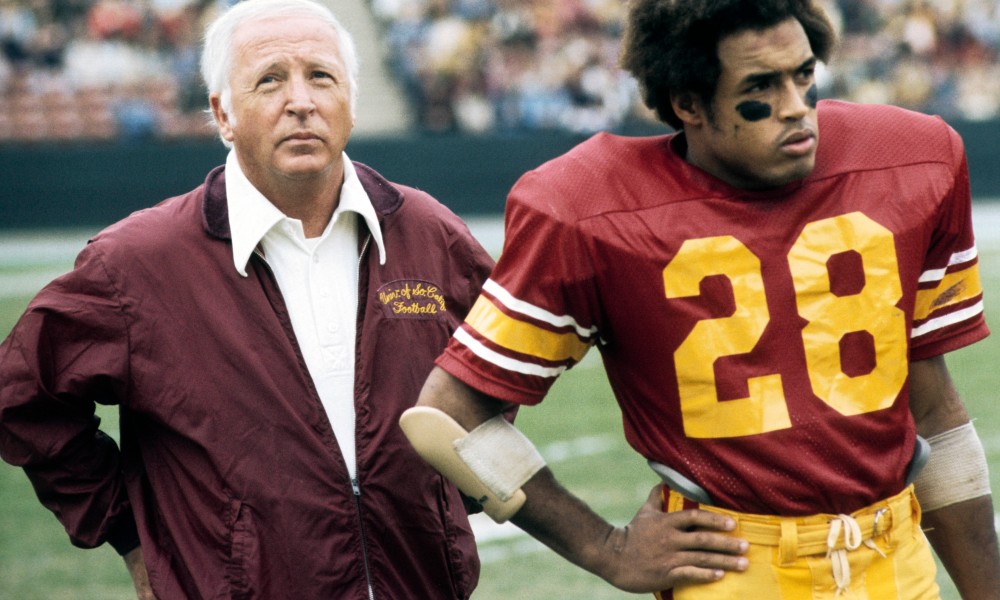
John McKay and Anthony Davis

Joe Jares, the Sports Illustrated writer quoted above by Bruce, said that the loss was "the worst disaster for the Irish since the potato famine." This was the final regular season game for Notre Dame's Hall of Fame head coach Ara Parseghian, who announced his retirement after the year. Parseghian was sick over what transpired and reportedly said "he was damn tired" of seeing Traveler running around the track every time USC scored.

USC fans call it "The Comeback." Notre Dame fans call it "That Game," or worse. USC had already clinched the title in the league then known as the Pacific-Eight Conference the week before, beating intra-city rival UCLA.

Davis finished 2nd in the Heisman Trophy voting, to Ohio State running back Archie Griffin. He played in 4 different professional football leagues: The World Football League (WFL), with the Southern California Sun in 1975; the Canadian Football League (CFL), with the Toronto Argonauts in 1976; the NFL, with McKay's Tampa Bay Buccaneers in 1977, the Houston Oilers in 1978, and the Los Angeles Rams, back at the Coliseum and again with Haden as quarterback, later in 1978; and the United States Football League (USFL), with the Los Angeles Express, again at the Coliseum, in 1983.

He later became a successful real estate developer, but, like so many other football players, his head-on collisions led to CTE and brain impairment. As of November 30, 2022, he is still alive.

*

November 30, 1974 was a Saturday. These other notable college football games were played that day:

* Rivalry: Number 1 Oklahoma beat Oklahoma State, 44-13 at Owen Field in Norman. The Sooners won the Big Eight Conference title, and were undefeated at 11-0. However, they were on probation, due to recruiting violations, and were not eligible for the UPI coaches' poll National Championship, or a bowl game appearance, or even a television appearance. Nevertheless, the AP sportswriters' poll awarded them their National Championship.

* Number 16 Baylor beat Rice, 24-3 at Baylor Stadium (later Floyd Casey Stadium) in Waco, Texas. Baylor clinched the Southwest Conference title.

* Rivalry: Navy beat Army, 19-0 at John F. Kennedy Stadium in Philadelphia.

* Rivalry: Boston College beat Holy Cross, 38-6 at Alumni Stadium outside Boston in Chestnut Hill, Massachusetts.

* Rivalry: Georgia Tech beat Georgia, 34-14 at Sanford Stadium in Athens.

* Rivalry: Florida beat Miami, 31-7 at Florida Field in Gainesville.

* Rivalry: Heavily favored Tennessee were held to a tie by Vanderbilt, 21-21 at Dudley Field (now FirstBank Stadium) in Nashville.

* Mississippi (Ole Miss) beat Tulane, 26-10 at Tulane Stadium in New Orleans. This was Tulane's last game at their old stadium. The following season, they moved into the Superdome.

* Louisiana State (LSU) beat Utah, 35-10 at Tiger Stadium in Baton Rouge, Louisiana. I have no idea why this one was set up: It sounds more like a bowl game.

* Rivalry: Arizona beat Arizona State, 10-0 at Arizona Stadium in Tucson.

* And Rutgers lost to Hawaii, 28-16 at Honolulu Stadium. Hawaii played 1 more game there, losing to Arizona State the next week, and opened the new Aloha Stadium the next season.

* The day before, Number 2 Alabama beat Number 7 Auburn, 17-13 at Legion Field in Birmingham. 'Bama won the Southeastern Conference title.

* Also the day before, Number 17 Texas upset Number 8 Texas A&M, 32-3 at Memorial Stadium in Austin.

* And the day before that, Thanksgiving, Number 10 Penn State beat Number 18 Pittsburgh, 31-10 at Three Rivers Stadium in Pittsburgh. Penn State went on to beat Baylor in the Cotton Bowl.

* Number 8 Nebraska were idle, having lost a game, and the Big 8 title, to Oklahoma the week before. They beat Florida in the Sugar Bowl.

* Number 3 Ohio State were idle, having beaten then-Number 2 Michigan for the Big Ten Conference title. USC, with Davis, went on to beat Ohio State, with Griffin, in the Rose Bowl. With Number 1 Oklahoma (through their own fault) and Number 5 Michigan (through a dumb Big 10 rule) both ineligible for a bowl, and Number 2 Alabama and Number 3 Ohio State both losing their bowl games, the latter to Number 5 Ohio State, UPI named USC its National Champion.

Notre Dame went on to beat Alabama in the Orange Bowl. It was Parseghian's last game: He retired, and joined ABC's broadcast crew. Dan Devine succeeded him as head coach. A year after that, McKay left for Tampa Bay, and was succeeded by John Robinson.

Baseball was out of season. There were 6 games in the NBA:

* The New York Knicks beat the Buffalo Braves, 118-111 at Madison Square Garden. Bob McAdoo scored 36 points and grabbed 18 rebounds in defeat for the Braves.

* The Washington Bullets beat the Seattle SuperSonics, 122-90 at the Capital Centre in the Washington suburb of Landover, Maryland.

* The Milwaukee Bucks beat their arch-rivals, the Chicago Bulls, 101-99 in double overtime at the Milwaukee Exposition, Convention Center and Arena, or "The MECCA." Since 2014, it has been named the UW-Panther Arena.

* The Phoenix Suns beat the Houston Rockets, 112-100 at the Arizona Veterans Memorial Coliseum in Phoenix.

* The Golden State Warriors beat their arch-rivals, the Los Angeles Lakers, 128-118 at the Oakland Coliseum Arena. Rick Barry scored 43 points.

* And the Portland Trail Blazers beat the New Orleans Jazz, 117-85 at the Veterans Memorial Coliseum in Portland.

There were 4 games in the American Basketball Association:

* The Virginia Squires beat the Indiana Pacers, 121-120 at the Hampton Coliseum outside Norfolk in Hampton, Virginia. George McGinnis scored 38 in defeat for the Pacers.

* The Kentucky Colonels beat the San Diego Conquistadors, 109-100 at Freedom Hall in Louisville, Kentucky.

* The Utah Stars beat the San Antonio Spurs, 110-103 at the HemisFair Arena in San Antonio.

* And the Denver Nuggets beat the Spirits of St. Louis, 128-109 at the Denver Auditorium Arena.

There were 7 games in the NHL:

* The New York Islanders lost to the Vancouver Canucks, 3-0 at the Pacific Coliseum in Vancouver.

* The Montreal Canadiens beat the St. Louis Blues, 7-1 at the Montreal Forum.

* The Toronto Maple Leafs beat the Washington Capitals, 7-1 at Maple Leaf Gardens in Toronto.

* The Buffalo Sabres and the Pittsburgh Penguins played to a tie, 5-5 at the Civic Arena in Pittsburgh.

* The Minnesota North Stars beat the Chicago Black Hawks, 5-3 at the Metropolitan Sports Center in the Minneapolis suburb of Bloomington, Minnesota.

* The Detroit Red Wings beat the Kansas City Scouts, 1-0 at the Kemper Arena (now the Hy-Vee Arena) in Kansas City.

* The Los Angeles Kings beat the Boston Bruins, 2-0 at The Forum outside Los Angeles in Inglewood, California.

* And the New York Rangers, the Philadelphia Flyers, the California Golden Seals and the Atlanta Flames were not scheduled.

There were 2 games in the World Hockey Association. The Chicago Cougars beat the Minnesota Fighting Saints, 7-5 at the St. Paul Civic Center in St. Paul, Minnesota. And the Cleveland Crusaders beat the Houston Aeros, 5-4 at the Sam Houston Coliseum in Houston.

And in English soccer, Arsenal beat Yorkshire team Middlesbrough, 2-0 at the Arsenal Stadium, a.k.a. Highbury, in North London.

Monday, November 28, 2022

November 28, 1964: USC Upsets Notre Dame

November 28, 1964: As occasionally happens, the game between the University of Southern California and the University of Notre Dame becomes one of the most important games of the college football season.

USC vs. Notre Dame is the biggest inter-sectional rivalry in American college football, and has been since it was established in 1926. No other pair of traditional rivals has as many National Championships, or as many Heisman Trophy winners. Notre Dame has had more 1st-round picks in the NFL Draft than any other school, and USC is 2nd in that regard. And both teams' fans are regarded as insufferable by pretty much everyone who hasn't bought into the schools' respective myths.

In odd-numbered years, the game is played at Notre Dame Stadium in South Bend, Indiana, in mid-to-late October, when the leaves are changing. In even-numbered years, the game is played at the Los Angeles Memorial Coliseum, on the Saturday of Thanksgiving weekend, when it would be too cold to play it in the Midwest.

In 1964, the Fighting Irish had a new head coach, Ara Parseghian. He had played for Woody Hayes at Miami University of Ohio and Paul Brown with the Cleveland Browns; coached under Hayes at Miami; succeeded him at that job when Hayes was hired at Ohio State, then coached at Northwestern.

In that 1st season, he had quarterback John Huarte, who would win the Heisman Trophy; defensive tackle Alan Page, who would be elected to the Pro Football Hall of Fame; and linebacker Jim Lynch, whose Kansas City Chiefs would beat Page's Minnesota Vikings in Super Bowl IV, 5 years later.

They won their 1st 9 games, most of them easily, although one of them should have been an omen, a visit to the University of Pittsburgh where they came away with only a 17-15 win. And none of their opponents had been nationally ranked. Still, they went into the season finale at USC ranked Number 1.

John McKay was in his 5th season at USC, and had already won a National Championship in 1962. Despite having the next season's Heisman winner, running back Mike Garrett, the Trojans did not have a good season. While Notre Dame had beaten Michigan State, 34-7 at home, USC lost to them, 17-7 away. They also lost to Ohio State in Columbus and the University of Washington at home. That dropped them to 4-3.

Their next game was away to Stanford, whom Notre Dame had beaten at home, 28-6. But the Trojans got on their horses and beat Stanford, 15-10. After a week off, they played arch-rival UCLA, and won, 34-13. It may not have been clear that they were ready to face the Number 1 team in the country. Nevertheless, 83,840 fans plowed into the Los Angeles Memorial Coliseum to watch it.

Sure enough, Notre Dame led 17-0 at the half. But in the 3rd quarter, USC drove down the field, and Garrett scored on a 1-yard run to get on the board. With 4:45 left, Craig Fertig threw a 23-yard touchdown pass to Fred Hill, but the extra point was missed.

But their defense held the Irish, and, with 1:35 to go, Fertig threw a 15-yard pass to Rod Sherman, and USC led, 20-17. Their defense held again, and one of the biggest upsets in recent college football was complete.

Neither team went to a bowl game. Notre Dame bounced back, and won the National Championship in 1966; USC, the year after. McKay would lead USC to another in 1972, while Parseghian led Notre Dame to one the following year. Then came 1974, and another epic game between the teams.

*

November 28, 1964 was a Saturday. This was also the day that "Leader of the Pack" by The Shangri-Las hit Number 1. I have a separate entry for that event.

These other notable college football games were played:

* Rivalry: Army beat Navy, 11-8 at John F. Kennedy Stadium in Philadelphia.

* Rivalry: Boston College beat Holy Cross, 10-8 at Alumni Stadium outside Boston in Chestnut Hill, Massachusetts.

* Rivalry: Georgia beat Georgia Tech, 7-0 at Sanford Stadium in Athens, Georgia.

* Rivalry: Florida beat Miami, 12-10 at Florida Field (now Ben Hill Griffin Stadium) in Gainesville, Florida.

* Rivalry: Vanderbilt beat Tennessee, 7-0 at Dudley Field (now FirstBank Stadium) in Nashville.

* Rivalry: Oklahoma beat Oklahoma State, 21-16 at Lewis Field (now Pickens Stadium) in Stillwater, Oklahoma.

* Rivalry: Texas Christian University (TCU) beat Southern Methodist University (SMU), 17-6 at the Cotton Bowl in Dallas.

* Rivalry: Arizona beat Arizona State, 30-6 at Arizona Stadium in Tucson.

Two days earlier, on Thanksgiving Day:

* Rivalry: Number 2 Alabama beat Auburn, 21-14 at Legion Field in Birmingham, Alabama. 'Bama won the Southeastern Conference title. 

* Rivalry: Number 5 Texas beat Texas A&M, 26-7 at Memorial Stadium in Austin, Texas.

* Idle: Number 3 Arkansas, who had beaten Texas, and won the Southwest Conference title; Number 6 Michigan, who had won the Big Ten Conference title; Number 7 Nebraska, who, despite losing the week before to arch-rival Oklahoma, had won the Big Eight Conference title; Number 8 Louisiana State University (LSU); Number 9 Oregon State, who had won the title in the Athletic Association of Western Universities (AAWU), the league that became the Pacific-Eight (or Pac-8) the next year; Number 10 Ohio State, which had blown the Big 10 title by losing their finale to Michigan; and New Jersey teams Rutgers and Princeton.

And so, at a time when the National Championship was awarded by the Associated Press' sportswriters' poll after the regular season, with Notre Dame's loss, Alabama, coached by Bear Bryant and quarterbacked by Joe Namath, rose to Number 1.

But Texas beat Alabama in the Orange Bowl, and Arkansas beat Nebraska in the Cotton Bowl, to earn a share of the National Championship with Alabama. Michigan beat Oregon State in the Rose Bowl, and LSU beat Syracuse in the Sugar Bowl.

Both the NFL and the AFL played the next day, plus games 2 days earlier, on Thanksgiving. The CFL played its championship game, the Grey Cup, and the BC Lions beat the Hamilton Tiger-Cats, 34-24 at Exhibition Stadium in Toronto. It was the 1st Grey Cup for the Vancouver-based team. I have a separate entry for this event.

Baseball was out of season. There were 4 games in the NBA:

* The New York Knicks beat the St. Louis Hawks, 106-91 at the old Madison Square Garden.

* The Boston Celtics beat the Cincinnati Royals, 129-98 at the Boston Garden.

* The Philadelphia76ers beat the Detroit Pistons, 101-93 at Cobo Hall (now Huntington Place) in Detroit.

* And the San Francisco Warriors beat their arch-rivals, the Los Angeles Lakers, 109-106 at the Civic Auditorium in San Francisco. Just another day at the office for Wilt Chamberlain: 40 points and 30 rebounds.

There were 2 games played in the NHL. The New York Rangers beat the Toronto Maple Leafs, 4-1 at Maple Leaf Gardens in Toronto. The Montreal Canadiens beat the Boston Bruins, 2-1 at the Montreal Forum. The Detroit Red Wings and the Chicago Black Hawks were not scheduled.

And in English soccer, Manchester United beat Arsenal, 3-2 at the Arsenal Stadium, a.k.a. Highbury, in North London.

Tuesday, September 27, 2022

September 27, 1946: CHARGE!

Tommy Walker

September 27, 1946: The familiar sports sound of, "Da da da DAT da DAH! Charge!" makes its debut.

Thomas Luttgen Walker was born on November 8, 1922 in Milwaukee. This Tommy Walker is not the character from The Who's rock opera Tommy. But this one also has a musical legacy, connected to sports.

Both a placekicker on the University of Southern California football team and a trumpeter in the school's marching band, he wrote a fanfare that he said was a combination of cavalry charge calls and "The Call to the Post" at horse races.

After playing it, "Da da da DAT da DAH!" he would yell, "Trojan warriors, charge!" That night, at the Los Angeles Memorial Coliseum, USC opened their season by beating Washington State, 13-7. Eventually, the "Trojan warriors" part was dropped, and it is now universally known as "Charge!"

Walker later became the director of events at nearby Disneyland, produced the Opening Ceremony of the 1984 Olympic Games in his adopted hometown of Los Angeles, and died in 1986, shortly after producing the TV broadcast of the Centennial celebrations for the Statue of Liberty.

A New York Yankees legend said that Eddie Layton invented "Charge!" when he debuted as Yankee Stadium organist in 1967. He didn't, and never claimed he did. But, at that time, he did invent the rhythm that gets played there before "Charge!": "DUN dun dun dun DUN dun dun dun... " Mike Burke, then president of the Yankees, heard the fans clapping along with it, and told him to make it a regular thing. He did, and began following it with "Charge!" He remained at the Stadium organ until 2003, and died a year later.
Eddie Layton

Sports Illustrated cleared the matter up in a 1990 article, showing that it was Tommy Walker who created "Charge!"

*

September 27, 1946 was a Friday. Aside from USC's win over "Wazzu," there were 8 college football games played:

* Auburn beat Southern Mississippi, 13-12 at Cliff Hare Stadium (now Jordan-Hare Stadium) in Auburn, Alabama.

* Drake University beat Texas Western University (now the University of Texas at El Paso, or UTEP), 7-2 at the Sun Bowl in El Paso.

* Furman beat Wofford, 31-0 at Sirrine Stadium in Greenville, South Carolina.

* Georgia beat Clemson, 35-12 at Sanford Stadium in Athens, Georgia.

* The University of Houston beat West Texas A&M, 14-12 at Buffalo Stadium in Canyon, Texas.

* Kansas beat the University of Denver, 21-13 at Hilltop Stadium in Denver.

* The University of Miami beat William & Mary, 13-3 at Burdine Stadium (later renamed the Orange Bowl) in Miami.

* And Wake Forest beat Boston College, 12-6 at Alumni Field (predecessor to Alumni Stadium) outside Boston in Chestnut Hill, Massachusetts.

There were 6 baseball games played that day:

* The Boston Red Sox beat the Washington Senators, 5-4 at Fenway Park in Boston. Ted Williams went 2-for-3 with 2 RBIs.

* The Cincinnati Reds beat the Pittsburgh Pirates, 8-0 at Crosley Field in Cincinnati. Joe Beggs pitches a 5-hit shutout

* The Cleveland Indians beat the Detroit Tigers, 9-8 at Briggs Stadium in Detroit (renamed Tiger Stadium in 1961). Hank Greenberg went 0-for-4 with a walk. Bob Feller pitched 5 innings in relief of Bob Kuzava. If you know of Feller as one of the greatest starting pitchers of all time, and of Kuzava as a fine reliever for the New York Yankees in the early 1950s, and this seems strange to you, it gets stranger: Kuzava was credited with the win, despite not going 5 innings, and Feller with the save. Under today's rules, Feller would have been given the win.

* The Chicago White Sox swept a doubleheader from the St. Louis Browns at Comiskey Park in Chicago, 7-3 and 8-3.

* And the Chicago Cubs beat their arch-rivals, the St. Louis Cardinals, 7-2 at Sportsman's Park in St. Louis. The Cardinals won the National League Pennant, anyway, and beat the Red Sox in the World Series.

Tuesday, January 4, 2022

January 4, 2006: USC vs. Texas, "The Game of the Century"

January 4, 2006: The Rose Bowl game is held in the stadium of the same name, in the Los Angeles suburb of Pasadena, California.

Traditionally, the Rose Bowl features the Champions of the league currently known as the Pacific-12 (or Pac-12) Conference against those of the Big Ten Conference. But the drive to a Playoff to determine a true National Champion for college football has tweaked that: After 55 consecutive seasons, all on New Year's Day except for years in which January 1 fell on a Sunday, moving the game to January 2, with a Big 10 vs. PCC/AAWU/Pac-8/Pac-10 matchup, starting with the 2001-02 season, 8 of the last 20 Rose Bowls have not paired up those leagues' newly-crowned titlists. (UPDATE: The shattering of the Pac-12 in 2023 ended the idea forever, especially with 4 of their teams joining the Big 10.)

And the 2006 game was one of them. True, the University of Southern California, winners of more titles in that league than any other team, winners of more Rose Bowls than any other team, and winners of more National Championships than any team in that league, had won the Pac-12 title again. And they had won the National Championship in each of the last 2 seasons, led by the last 2 Heisman Trophy winners, quarterback Matt Leinart and running back Reggie Bush. And they finished the regular season ranked Number 1 in every poll, including the Bowl Championship Series rankings.

But their opponents, the team that finished Number 2 in every poll, including the BCS, would not be the Big 10 Champions. That would be Pennsylvania State University, a.k.a. Penn State, who were ranked Number 3 in the BCS, and went on to win the Orange Bowl in Miami against Florida State University, the Atlantic Coast Conference Champions, on January 3.

No, the Number 2 team was the University of Texas. The most successful team in the since-concluded history of the Southwest Conference, they were now the Champions of the Big 12 Conference, formed in 1996 when half of the SWC teams were absorbed into the former Big Eight Conference. Texas was led by a spectacular quarterback, Vince Young, who could run and throw with equal aplomb.

Under head coach Pete Carroll, the USC Trojans had been Number 1, wire to wire, going 12-0. They had scored 70 at home to Arkansas, 66 at home to arch-rival and then-Number 11 UCLA, 63 away to Hawaii, 55 at home to Washington State, 51 away to Washington, 51 at home to Stanford, 50 at home to then-Number 16 Fresno State, 45 away to then-Number 24 Oregon, 42 at home to Arizona, 38 away to then-Number 14 Arizona State, 35 at home to the University of California, and 34 away to then-Number 9 Notre Dame. The Notre Dame game was a nationally-televised thriller, ending 34-31, and that was the only real close game the Trojans had all season.

Under head coach Mack Brown, the Texas Longhorns also came into the game 12-0, and were ranked Number 2 the entire season. The offense that Young led was every bit as impressive as USC's: They hung 66 on Kansas at home, 62 on Baylor University away, 60 on Louisiana-Lafayette at home, 52 on then-Number 10 Texas Tech at home, 51 on Rice at home, 51 on Missouri away, 47 on Oklahoma State away, 45 on Oklahoma on neutral ground in Dallas, 42 on then-Number 24 Colorado at home, and 40 on arch-rival Texas A&M away.

What's more, the Longhorns had a bigger win than USC did. On September 10, they traveled to Ohio State, then Number 4, and beat them 25-22. The Buckeyes were the only team that stayed within 10 points of Texas. In the Big 12 Championship Game in Houston, the 'Horns throttled Colorado, 70-3.

No question about it, if there was any team that could give USC a run for its money, it was Texas. USC had won 34 straight games. Texas had won 19 straight. Something had to give.

These were 2 of the titans of college football. USC had, to this point, won 35 Conference Championships. They also claimed 17 National Championships, but only 5 of these have been definitive under the current poll system, which has been in place since 1936: 1962, 1967, 1972, 2003 and 2004. (In 1978, the polls were split: UPI took USC, and the AP took Alabama.) Texas claimed 31 Conference Championships, and 8 National Championships, but only 1963 and 1969 were officially recognized by the NCAA.

This game was being hyped as "The Game of the Century," as had a few others in college football history. But this was the 21st Century, so there wasn't a previous game to live up to, unless you want to count Ohio State's dethroning of the University of Miami in the 2003 Fiesta Bowl.

A crowd of 93,988 crammed into the Rose Bowl stadium. An estimated 36 million more, making it the most-watched college football game ever, watched on ABC as Keith Jackson (who was calling his last game, and picked a great way to go out) and Pro Football Hall of Fame quarterback Dan Fouts, himself a Pac-8 veteran (University of Oregon), called the action. LeAnn Rimes sang the National Anthem.

Texas kicked off. USC couldn't do much on their opening possession. But they got the ball right back on a Texas fumble, and took a 7-0 lead to the end of the 1st quarter. Early in the 2nd quarter, Bush tried a lateral pass, but no one was there to receive it, and Texas recovered, leading to a field goal that made it 7-3.

A USC interception led to a Texas drive that ended in a lead-changing touchdown, although the extra point had been missed. Texas scored another touchdown, and USC added a field goal to make it 16-10 Texas at the half.

In the 3rd quarter, a USC drive ended with a LenDale White touchdown, and put the Trojans up 17-16. But Young led the 'Horns back, and scored himself, and Texas had a 23-17 lead. USC gambled on a 4th-and-1 from the Texas 12, and White scored again. That made it 24-23, and near the end of the 3rd quarter, Texas missed a field goal attempt.

Bush scored a touchdown early in the 4th quarter. The USC defense held Texas on their next possession, resulting in a field goal that made it 31-26 Trojans. USC scored again to make it 38-26 with 6 minutes and 42 seconds left, and it looked like they had done something no team had ever done: Win 3 straight NCAA Division I-A football championships.

Young refused to give up, leading a touchdown drive that made it 38-33 USC with 3:58 left. Now, it was the Longhorn defense's turn to be heroes, and they held USC to just 1 1st down. With 2:13 to go, USC faced 4th-and-2 at the Texas 45. Carroll decided to go for it. Leinart handed off to White, and he was held to 1 yard. (To the dismay of Seattle fans, this would not remain Carroll's greatest coaching blunder.) With 2:09 left, Texas needed to go 56 yards. (A field goal would only have made it 38-36.)

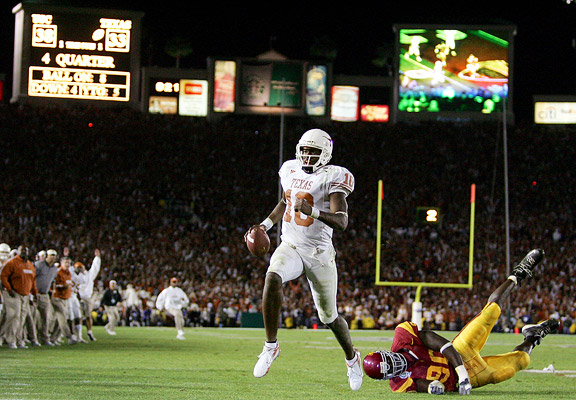
Young drove the Longhorns into Trojan territory. They got a big boost from a foolish face-mask penalty. They got to the 9-yard line, on 4th-and-5. A 1st down could have been gained without scoring a touchdown. The Longhorns went into their preferred formation, the shotgun. Young took the snap. His receivers were covered. He ran for the right sideline, got a key block from Justin Blalock, turned the corner, and dashed into the end zone with his 3rd rushing touchdown of the game. He got into the end zone again for the 2-point conversion. It was 41-38 Texas.

USC got the ball back with only 16 seconds left. It wasn't enough to for them to get into range for a tying field goal. Leinart only got them to the Texas 43. Had he time for 1 more play, a field goal from there would have been 60 yards.

But the clock had run out, and Texas were the undisputed National Champions for the 1st time in 36 years. The 2006 Rose Bowl, the 21st Century's 1st real Game of the Century, had lived up to the hype.

Soon, it would come out that USC had engaged in all kinds of recruiting violations. The NCAA vacated their last 2 wins of the 2004 season, all 12 in 2005, and both National Championships. They also revoked Bush's Heisman Trophy, the only time that has ever happened. The Trojans have since won the Pac-10 in 2006, '07 in '08, and the Pac-12 in 2017. But their mystique took a major hit. 

Texas has only won the Big 12 once since, in 2009. They advanced to the National Championship Game, but lost to Alabama. They are in roughly the same position as USC: Usually one of the better teams in the country, but not up to their previous standards.

(UPDATE: In 2024, USC became one of the Pac-12 teams that moved to the Big 10, and Texas moved from the Big 12 to the Southeastern Conference.)

Reggie Bush had a decent pro career, but Matt Leinart turned out to be an injury-plagued journeyman. Both went into network studio work. Vince Young saw his career damaged by poor management by his coaches and by his own struggles with mental illness. As of 2022, he works for the University of Texas athletic department.

Of the coaches: Pete Carroll went on to win a Super Bowl with the Seattle Seahawks, joining Paul Brown, Jimmy Johnson and Barry Switzer as the only head coaches to win both a National Championship and a World Championship. But he will be forever remembered for his play-calling in the next year's Super Bowl, which cost the Seahawks back-to-back titles. Mack Brown, who had rebuilt the program at North Carolina before moving on to Texas, has gone back to North Carolina and done it again.

*

January 4, 2006 was a Wednesday. It was the off-season for Major League Baseball. The NFL was between Playoff weekends. There were 9 games played that day in the NBA. Neither of the New York Tri-State Area teams were involved in any of them:

* The Toronto Raptors beat the Orlando Magic, 121-97 at the Air Canada Centre in Toronto. It's now named the Scotiabank Arena. Jameer Nelson scored 31 for the Magic, but it was far from enough.

* The Boston Celtics beat the Charlotte Bobcats, 109-106 at the TD Garden in Boston. Paul Pierce of the Celtics led all scorers with 31 points. The Bobcats would change their named to the Charlotte Hornets in 2014, after the former team by that name, now in New Orleans, gave it up to become the Pelicans. Speaking of whom:

* The New Orleans/Oklahoma City Hornets, playing their home games at the Ford Center in Oklahoma City while their usual arena was being repaired following Hurricane Katrina, hosted the Miami Heat, and beat them 107-92. In spite of this, the Heat went on to win the NBA Championship that season. The Ford Center is now named the Paycom Center.

* The Seattle SuperSonics beat the Chicago Bulls, 101-97 at the United Center in Chicago. The Sonics became the Oklahoma City Thunder in 2008.

* The Cleveland Cavaliers beat the Milwaukee Bucks, 91-84 at the Bradley Center in Milwaukee. LeBron James scored 32 for the Cavs.

* The Minnesota Timberwolves beat the Dallas Mavericks, 91-78 at the Target Center in Minneapolis.

* The San Antonio Spurs beat the Portland Trail Blazers, 106-75 at the SBC Center in San Antonio. It's now the Frost Bank Center.

* The Denver Nuggets beat the Indiana Pacers, 106-86 at the Pepsi Center in Denver. It's now named the Ball Arena, which makes sense at Nuggets games, if not at Colorado Avalanche games.

* And the Phoenix Suns beat the Philadelphia 76ers, 105-85 at the America West Arena in Phoenix. It is now named the Mortgage Matchup Center.

There were 5 games played in the NHL that day, only 1 of them involving a team from the New York Tri-State Area:

* The New York Islanders beat the Florida Panthers, 4-3 at the Nassau Coliseum. Mark Parrish scored the winning goal, 2:15 into overtime.

* The Ottawa Senators beat the Washington Capitals, 3-1 at the MCI Center in Washington. It's now named the Capital One Arena.

* The Carolina Hurricanes beat the Atlanta Thrashers, 4-3 at the RBC Center (now the Lenovo Center) in Raleigh. The Thrashers became the new Winnipeg Jets in 2011.

* The Nashville Predators beat the St. Louis Blues, 4-3 at the Savvis Center in St. Louis. It's now named the Enterprise Center.

* And the Dallas Stars beat the Vancouver Canucks, 3-1 at the American Airlines Center in Dallas. 

Saturday, January 1, 2022

January 1, 1963: The Wildest Rose Bowl

The opposing Captains before the game. Left to right:
Marv Marinovich and Ben Wilson of USC,
Steve Underwood and Pat Richter of Wisconsin.

January 1, 1963: The Rose Bowl is set to decide the National Championship of college football. The University of Southern California, a.k.a. USC, is ranked Number 1, 11-0, and Champions of the American Association of Western Universities (AAWU), the league now known as the Pacific-Twelve Conference. They are coached by John McKay, and quarterbacked by Pete Beathard, whose older brother Bobby Beathard would be elected to the Pro Football Hall of Fame as an executive.

The Trojans were not merely picking on a weak league, either. When they played the University of Washington, at home at the Los Angeles Memorial Coliseum, Washington were ranked Number 9 in the country. They also beat Number 8 Duke at home, and won away to Southern Methodist University (SMU) in Dallas, Iowa, Illinois and Stanford, and beat Navy, with future Heisman Trophy-winning quarterback Roger Staubach, at the Coliseum. In their last 2 games, they had beaten their 2 biggest rivals, both at home: The University of California at Los Angeles (UCLA) and the University of Notre Dame.

Facing them was the team from the University of Wisconsin, ranked Number 2, 8-1, and Champions of the Big Ten Conference. They were coached by Milt Bruhn, and led by the passing combination of Ron Vander Kelen to Pat Richter.

The Badgers had lost away to Ohio State, 14-7. That was no shame, as Ohio State were one of the teams awarded a share of the previous season's National Championship. But, like USC, the Badgers had beaten Notre Dame at home (Camp Randall Stadium in Madison, Wisconsin), beaten Illinois away, and also beaten Iowa, albeit at home.

They had also beaten Michigan away, beaten then-Number 1 Northwestern at home, and beaten their arch-rivals, then-Number 5 Minnesota, at home, to take the Big 10 title. Despite USC having the better record and, for all intents and purposes, the home-field advantage, Wisconsin were favored by 2 points.

Each team scored a touchdown in the 1st quarter. USC added 2 more in the 2nd quarter, to take a 21-7 lead. They scored another in the 3rd quarter, and were up, 28-7. Wisconsin scored another touchdown, but USC scored 2 more, and, early in the 4th quarter, were leading, 42-14. The game looked wrapped up.

It wasn't. A Wisconsin drive led to a 13-yard touchdown run by Lou Holland. 42-21 USC. Vander Kelen threw to Gary Kroner for a 4-yard touchdown. 42-28 USC. A band snap on a USC punt went through the end zone, making a safety for Wisconsin. 42-30 USC. And then Vander Kelen threw a 19-yard pass to Richter for a touchdown. With less than a minute to go, USC's lead was cut to 42-37.

Needless to say, the Badgers attempted an onside kick. The Trojans recovered, and that seemed to be the end of things. Not quite: Wisconsin held USC to a three-and-out. The Trojans had to punt. It would be the last play of the game. But the Badgers nearly blocked the punt. If they had, they would have had a chance of taking it in for a winning touchdown, 43-42. Instead, the punt got off, and USC had won, 42-37, giving them the National Championship.

McKay would lead USC to 3 more National Championships, in 1967, 1972 and 1974. Wisconsin would not win another Big 10 title for 31 years, until 1993, and the 1994 Rose Bowl would be their 1st win in "The Granddaddy of Them All," a 21-16 win over UCLA.

*

January 1, 1963 was a Tuesday. In the other New Year's Day bowl games:

* Number 3 Mississippi, a.k.a. Ole Miss, beat Number 6 Arkansas, 17-13 in the Sugar Bowl, at Tulane Stadium in New Orleans.

* Number 5 Alabama beat Number 8 Oklahoma, 17-0 in the Orange Bowl, at the stadium of the same name in Miami.

* And Number 7 Louisiana State University, a.k.a. LSU, beat Number 4 Texas, 13-0 in the Cotton Bowl, at the stadium of the same name in Dallas.

The NFL Championship was decided 2 days earlier, when the Green Bay Packers beat the New York Giants, 16-7 at Yankee Stadium. The AFL Championship was decided a week before that, as the Dallas Texans (who became the Kansas City Chiefs the next season) beat the Houston Oilers, 20-17, in double overtime, the longest game in pro football history to that point. And baseball was out of season.

There was 1 game played in the NBA that New Year's Day: The Cincinnati Royals beat the New York Knicks, 112-106 at the Cincinnati Gardens. Oscar Robertson scored 32 points.

There were 2 games played in the NHL. The Boston Bruins beat the Toronto Maple Leafs, 3-0 at the Boston Garden. And the Chicago Black Hawks beat the Detroit Red Wings, 4-2 at the Chicago Stadium. The Montreal Canadiens and the New York Rangers were not scheduled.

December 31, 1999 & January 1, 2000: The Millennium

December 31, 1999:  The Millennium arrives. The people of planet Earth survived. At a terrible cost. But we hadn't destroyed ourselves. ...