Showing posts with label usc trojans. Show all posts

Sunday, December 4, 2022

December 4, 1926: Poland's Ekstraklasa Is Formed

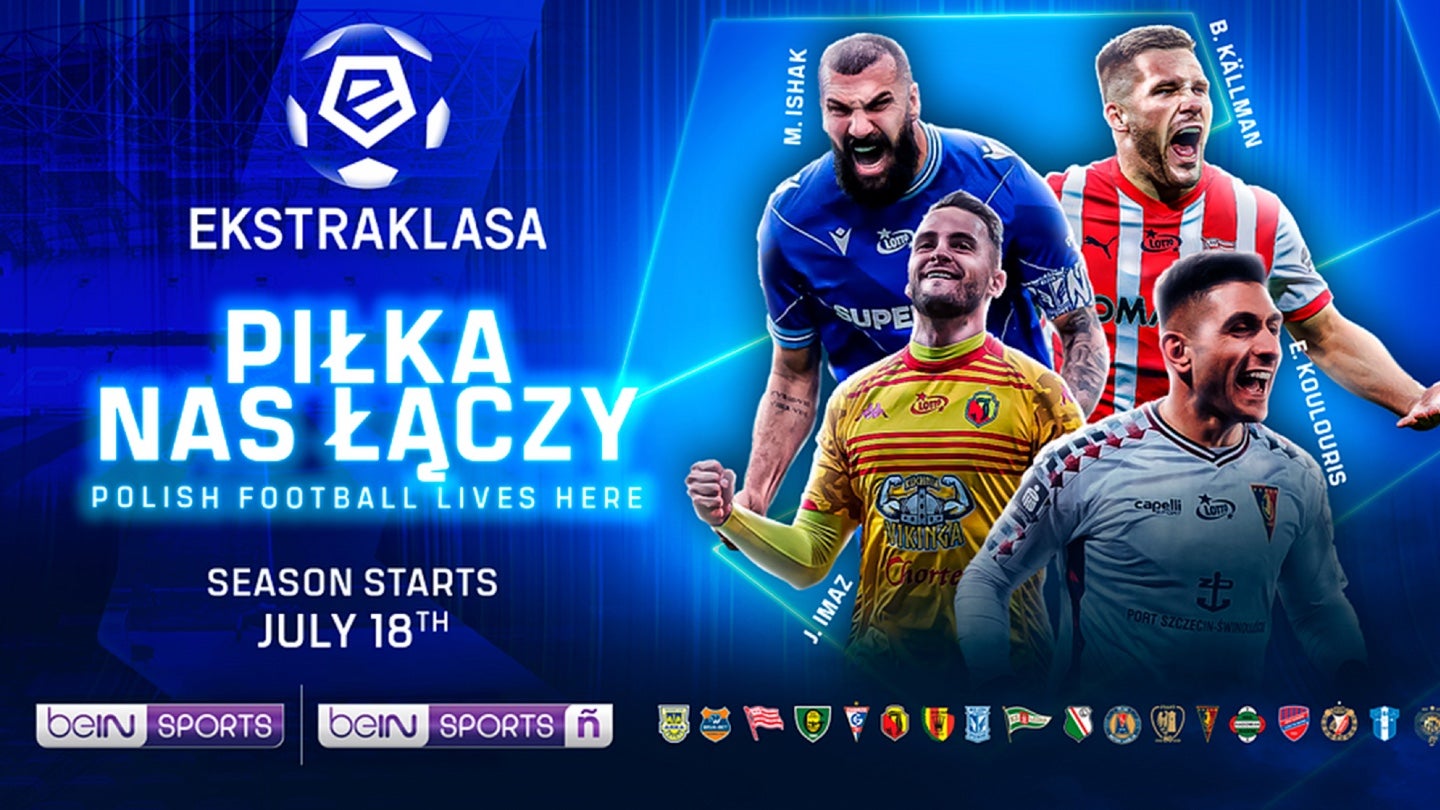
December 4, 1926, 100 years ago: The Ekstraklasa is formed, as the top level of Polish soccer. Or football. Or, as it's known in Poland, piłka nożna. However, the announcement of the founding wasn't made until March 1, 1927, so 1927-28 was its 1st season of play.

From its founding until 1948, it was known simply as the Liga, or the League. From 1949 to 2004, it was "I Liga," or "pierswsza liga," or "first league." In 2004, it was renamed the Ekstraklasa, or "top league," and was sponsored by Poland's top communications company, then known as Idea, so it was "Idea Ekstraklasa." After just 1 year, the company rebranded, and the league became "Orange Ekstraklasa."

In 2011, another communications company bought the sponsorship, and it was the T-Mobile Ekstraklasa. In 2016, the national lottery bought the rights, and so it became the Lotto Ekstraklasa. Since 2019, the rights have been held by Powszechna Kasa Oszczędności Bank Polski, or "General Savings Bank, Bank of Poland," and is known as the PKO Bank Polski Ekstraklasa.

Somehow, the league survived the Great Depression of the 1930s, the Nazi occupation of 1939-45, and the Communist rule of 1945-89. It is more popular than ever. However, the best Polish players tend not to stay: Kazimierz Deyna, Jerzy Dudek and Wojciech zczęsny went to England's Football League, Jan Domarski went to what is now Ligue 1 in France, Władysław Żmuda and now Piotr Zieliński went to Italy's Serie A, and Robert Lewandowski and Jakub Błaszczykowski went to Germany's Bundesliga.

Legia Warsaw, the leading team in the national capital, and founded by the Polish Army, have won the most titles, 15. Górnik Zabrze and Wisła Kraków have each won 14. Ruch Chorzów have won 13. Lech Poznań have won 8. Cracovia, in Kraków, have won 5, but none since 1948. Pogoń Lwów won 4, but were dissolved when World War II ended in 1945, because the city of Lwów was transferred to the Soviet Union, and later to Ukraine, under the name Lviv.

There have been 2 titles each won by ŁKS Łódź, Polonia Bytom, Polonia Warsaw, Stal Mielec, Śląsk Wrocław, Warta Poznań and Zagłębie Lubin. There have been 1 title each for Garbarnia Kraków, Szombierki Bytom and Piast Gliwice
The championship trophy

The Polish Cup, or Puchar Polski, has been won by Legia Warsaw 19 times (including 7 League and Cup "Doubles," in 1955, 1956, 1994, 1995, 2013, 2016 and 2018); Górnik Zabrze 6 times (including 3 Doubles, in 1965, 1971, 1972); 5 times by Lech Poznań (including a Double in 1984); 4 times by Wisła Kraków (including a Double in 2003); 4 times by Zagłębie Sosnowiec, the most of any Cup winner that has never won the League; 3 times each by Ruch Chorzów (including a Double in 1974), GKS Katowice and Amica Wronki; twice each by Raków Częstochowa, Śląsk Wrocław, Polonia Warsaw, Arka Gdynia and Lechia Gdańsk; and once each by Jagiellonia Białystok, ŁKS Łódź, Widzew Łódź, Cracovia, Gwardia Warsaw, Wisła Plock, Stal Rzeszów, Miedź Legnica, Dyskobolia Grodzisk and Zawisza Bydgoszcz.
The Polish Cup

(UPDATE: Raków Częstochowa won their 1st Ekstraklasa in 2023. Jagiellonia Białystok won their 1st in 2024. Lech Poznań won it in 2025 and 2026, making for 10 titles. Legia won the Cup in 2023 and 2025, for 19 wins. Wisła Kraków won a 5th Cup in 2024. Górnik Zabrze won a 7th Cup in 2026.)

My ancestors came from Borki Wielkie, in Masuria, in northeastern Poland, a section that had belonged to East Prussia and thus the German Empire. The closest major city to it isn't even in Poland: It's Kaliningrad, Russia, 78 miles north. Gdańsk is 140 miles northwest, and Warsaw is 160 miles south. So if there are any family members left there, who would they support? Most likely, Legia, as they are the default team for the country, the most successful, and thus also the most popular -- but also, as with the Yankees, the most hated.

To my regret as an American soccer fan of Polish descent, Polish teams have not done well in European tournaments. ŁKS Łódź won the Intertoto Cup in 1965 and 1967. Wisła Kraków won it in 1969, 1970 and 1973. The best performance of any Polish team in the European Cup/UEFA Champions League was Legia, reaching the Semifinal in 1970; and Widzew Łódź, reaching the Semifinal in 1983.

To my further regret, Poland's record in international competition is poor. Out of 21 World Cups staged from 1930 to 2018, they have played in only 8, having withdrawn in 1934 and 1954, and refusing to enter in 1930 and 1950. They reached the Semifinals in 1974 and 1982; the Quarterfinals in 1978; the Round of 16 in 1938 and 1986; and the Group Stage in 2002, 2006 and 2018. (UPDATE: They reached the Round of 16 in 2022, but did not qualify in 2026.)

The European Championships were established in 1960, and they didn't qualify until 2008. They qualified as co-hosts with Ukraine in 2012, and reached the knockout stage for the 1st time in 2016, getting to the Quarterfinals.

*

December 4, 1926 was a Saturday. In English soccer, Arsenal defeated Manchester-area team Bury, 1-0 at the Arsenal Stadium, nicknamed Highbury for its North London neighborhood.

There was 1 score in college football: Notre Dame beat USC, 13-12. It was the 1st meeting between the schools, and the birth of a great rivalry. I have a separate entry for this event.

There was 1 score in the NFL: The Frankford Yellow Jackets beat the Chicago Bears, 7-6 at Shibe Park in Philadelphia. This game was considered big enough to move from the Jackets' usual home, Frankford Stadium in North Philadelphia. The Jackets went on to win the NFL Championship.

Baseball was out of season. Professional basketball was hardly major league at this point. There were 5 games in the NHL:

* The New York Rangers lost to the Detroit Cougars, 1-0 at the Border Cities Arena (now the Windsor Arena) in Windsor, Ontario, Canada, across the Detroit River from Detroit. The Cougars moved to the Olympia Stadium in Detroit in 1927, became the Detroit Falcons in 1930, and became the Detroit Red Wings in 1932.

* The New York Americans beat the Toronto St. Patrick's, 1-0 at the Mutual Street Arena in Toronto. The St. Patricks became the Maple Leafs in 1927.

* The Chicago Black Hawks beat the Montreal Maroons, 5-3 at the Montreal Forum.

* The Ottawa Senators beat the Montreal Canadiens, 4-1 at the Ottawa Auditorium.

* And the Boston Bruins beat the Pittsburgh Pirates, 4-3 at the Duquesne Gardens in Pittsburgh. Harry Oliver scored the winning goal, 7:25 into overtime.

December 4, 1926: The 1st Notre Dame vs. USC Game

December 4, 1926: The University of Notre Dame and the University of Southern California play each other in football, at the Los Angeles Memorial Coliseum. It was the 1st meeting between the schools, and the birth of a great rivalry.

So why do a school based in South Bend, Indiana and one based in Los Angeles, California play each other, just about every year? Blame Bonnie Rockne and Marion Wilson, the wives of, respectively, Notre Dame head coach Knute Rockne and USC athletic director Gwynn Wilson.

In 1926, USC, already a traditional power in West Coast college football, had an open date on their schedule, and were looking for a major opponent to fill it. The Wilsons went to Lincoln, Nebraska to watch Notre Dame, themselves already a traditional power nationwide, play the University of Nebraska on Thanksgiving Day. Nebraska won, 17-0.

Mr. Wilson approached Mr. Rockne about the idea of the Fighting Irish coming to L.A. to play USC. He didn't want to do that much traveling. After all, this was still the early days of airplanes, and the year the federal highway system was founded, so most long-distance travel was still done by train. But Mrs. Wilson told Mrs. Rockne that a trip every 2 years to sunny Southern California was better than one to snowy, hostile Nebraska. Mrs. Rockne talked Mr. Rockne into it, and the game was played on December 4, 1926, at the Coliseum. Notre Dame won, 13-12, and Rockne called it the greatest game he'd ever seen.

For the 1927 and 1929 games, Notre Dame had the home field, and since their on-campus Cartier Field topped out at 30,000 seats, they chose to play at Soldier Field in Chicago. Their 7-6 win in 1927 and their 13-12 win in 1929 were both seen by about 120,000 people, among the largest crowds in college football history.

Notre Dame Stadium opened on the South Bend campus in 1930. It long had a capacity of 59,075, until a 1997 renovation expanded it to 77,622. And so, every year, from 1930 onward, they've traded home fields -- except for the World War II seasons of 1943, '44 and '45, when wartime travel restrictions made intersectional college football games inappropriate, with even the major bowl games restricting themselves to matchups of teams from their own regions.

But every year since 1946, USC has hosted the game at the Coliseum in even-numbered years, usually on the Saturday of Thanksgiving weekend; while Notre Dame had hosted it in South Bend in odd-numbered years, usually in the middle of October, because the weather is usually better in the Midwest then than it would be in late November.

And, since 1951, it has always been broadcast on national television. When it's at USC, ABC broadcasts it in prime time. When it's at NBC, since 1991, they've broadcast it, leading to jokes about NBC standing for "Notredame Broadcasting Company."

In 1931, USC won in South Bend for the 1st time, coming from 14-0 down to win 16-14 on Johnny Baker's 33-yard field goal with 1 minute left, ending Notre Dame's 26-game unbeaten streak, a streak that had been intact despite Rockne's death in a plane crash early in the year. In 1938, Notre Dame went into the game ranked Number 1, but USC beat them, 13-0. In 1948, Notre Dame went into the game ranked Number 1 and with a 21-game winning streak, but USC held them to a 14-14 tie.

In 1964, Notre Dame went into the game ranked Number 1, but USC beat them, 20-17. In 1968, USC went into the game ranked Number 1, but Notre Dame tied them, 21-21. In 1972, Anthony Davis scored 6 touchdowns in a win. In 1974, Notre Dame led 24-0, but USC won 55-24. It was "The Anthony Davis Game," as A.D. scored 4 times.

From 1983 to 1993, Notre Dame beat USC 11 straight times, with a tie in 1994 and another Irish win in 1995. It became a running gag on the TV show Live! with Regis and Kathie Lee: The Monday morning after the game, Kathie Lee Gifford would take a dollar bill and slip it to Regis Philbin, because he, a Notre Dame graduate, had a bet with Kathie Lee's husband, Frank Gifford, an ABC sportscaster and one of USC football's biggest legends. From 2002 to 2009, USC won 8 straight years, including the 2005 game won with the supposedly illegal push of Reggie Bush into the end zone in South Bend.

Including the game of November 26, 2022, a 38-27 USC win, Notre Dame leads the rivalry, 48-37, with 5 ties. The teams play for the Jeweled Shillelagh, a trophy that goes to the winning team each year. Although it's not the kind of thing you normally show in public.
Take a guess as to why.
 
Alabama, Michigan or Ohio State fans might object, but it could be argued that Notre Dame and USC are the two greatest college football programs. Notre Dame have won 11 National Championships, 22 bowl games, and 7 Heisman trophies -- but no Conference Championships, since they've never been in a conference. USC have won 11 National Championships, 39 Conference Championships, 36 bowl games, and 8 Heisman Trophies.

UPDATE: As of the 2025 season, Notre Dame leads, 51-37-5. But USC's move to the Big Ten Conference -- a move that the Midwest-based Notre Dame should have made decades ago, but never has -- led to scheduling issues that prevented games between the schools for the 2026, '27, '28 and '29 seasons. They've agreed to play in 2030, '31, '32 and '33, but early in the season, instead of in the middle when it's Notre Dame's turn to host and late when it's USC's.


*

December 4, 1926 was a Saturday. In English soccer, Arsenal defeated Manchester-area team Bury, 1-0 at the Arsenal Stadium, nicknamed Highbury for its North London neighborhood.

I have a separate entry for this event.

There was 1 score in the NFL: The Frankford Yellow Jackets beat the Chicago Bears, 7-6 at Shibe Park in Philadelphia. This game was considered big enough to move from the Jackets' usual home, Frankford Stadium in North Philadelphia. The Jackets went on to win the NFL Championship.

Baseball was out of season. Professional basketball was hardly major league at this point. There were 5 games in the NHL:

* The New York Rangers lost to the Detroit Cougars, 1-0 at the Border Cities Arena (now the Windsor Arena) in Windsor, Ontario, Canada, across the Detroit River from Detroit. The Cougars moved to the Olympia Stadium in Detroit in 1927, became the Detroit Falcons in 1930, and became the Detroit Red Wings in 1932.

* The New York Americans beat the Toronto St. Patrick's, 1-0 at the Mutual Street Arena in Toronto. The St. Patricks became the Maple Leafs in 1927.

* The Chicago Black Hawks beat the Montreal Maroons, 5-3 at the Montreal Forum.

* The Ottawa Senators beat the Montreal Canadiens, 4-1 at the Ottawa Auditorium.

* And the Boston Bruins beat the Pittsburgh Pirates, 4-3 at the Duquesne Gardens in Pittsburgh. Harry Oliver scored the winning goal, 7:25 into overtime. 

Friday, December 2, 2022

December 2, 1915: What Became the Pac-12 Conference Is Founded

December 2, 1915: The Pacific Coast Conference is founded. It will evolve into the league known as the Pac-12.

The 4 original members were the University of California, at Berkeley, usually called "Cal" for sports purposes, and "Berkeley" for everything else; the University of Oregon, at Eugene; Oregon Agricultural College, which became Oregon State University in 1961, located in Corvallis; and the University of Washington, in Seattle.

Washington State College, in Pullman, was admitted in 1917, and was renamed Washington State University in 1959. Stanford University, in Palo Alto, California, between San Francisco and San Jose, was admitted in 1918.

The University of Southern California, a.k.a. USC, in Los Angeles, was admitted in 1922. So was the University of Idaho, in Moscow, just a few miles across a State Line from Washington State. The University of Montana, in Missoula, was admitted in 1924, but left in 1950. And the University of California at Los Angeles, a.k.a. UCLA, a campus which didn't even exist until 1919, was admitted in 1928.

Scandals broke out at several schools in the 1950s, leading to the PCC's disbanding in 1959. Cal, Stanford, UCLA, USC and Washington formed the Athletic Association of Western Universities (AAWU). Washington State joined in 1962, and Oregon and Oregon State joined in 1964. Idaho decided not to join.

In 1968, the league renamed itself the Pacific-8 Conference, Pac-8. In 1978, 2 members of the Western Athletic Conference (WAC), the University of Arizona and Arizona State University, joined, making the league the Pacific-10, or Pac-10. In 2011, Colorado left the Big 12, and Utah left the Mountain West Conference, both joining the Pac-10, which became the Pac-12: "Pacific" was no longer part of the league's official name.
From its inception in 1902 until 2001, the Rose Bowl in the Los Angeles suburb of Pasadena, California usually invited the top team on the West Coast to participate. This included the champions of the PCC (1916-59), the AAWU (1960-68), the Pac-8 (1969-78) and the Pac-10 (1979-2001). With the coming of the Bowl Championship Series (BCS) and then the National Championship Playoff (NCP), the Rose Bowl has not always featured a Pac-12 team, but it does seem to prefer one.

USC have been the league's representative in the Rose Bowl 34 times, Stanford 15, Washington 14, UCLA 12, Cal and Oregon 8 each, Washington State 4, Oregon State 3, Arizona State 2 and Utah 1. Arizona and Colorado have never played in the Rose Bowl. The Rose Bowls of 2002, 2005, 2011, 2018 and 2021 did not feature a Pac-12 team. (UPDATE: In 2023, Utah reached a 2nd Rose Bowl. In 2024, there was no Pac-12 team in the game.)

The Pac-12 has won more NCAA Championships across the sports spectrum than any other league. USC became the dominant school in football. In men's basketball, it was UCLA, but Arizona have done better in recent times. USC and Arizona State have been dominant in baseball, UCLA and Oregon in track, Stanford in women's basketball and soccer. 

The rivalries are intense: USC and UCLA; Cal and Stanford, "The Big Game"; Oregon and Oregon State, "The Civil War"; Washington and Washington State, "The Apple Cup"; and Arizona and Arizona State, "The Duel in the Desert."

On June 30, 2022, UCLA and USC announced plans to leave the Pac-12 for the Big Ten Conference, starting in 2024. For old-time Pac-8/10/12 fans, this must have seemed like what New England baseball fans felt when they saw Red Sox heroes Wade Boggs, Roger Clemens and Johnny Damon go to the New York Yankees. It is feared that this move will break the Pac-12.

UPDATE: In 2023, Colorado announced it would leave the Pac-12, and rejoin the Big 12. This was, almost immediately, followed by Arizona, Arizona State and Utah also heading for the Big 12, and Oregon and Washington bolting for the Big Ten. And, in what is, at least in terms of names, the most absurd move, Cal and Stanford announced they were joining the Atlantic Coast Conference (ACC).

As of December 2, 2023, the Pac-12 appears to be going into the 2024-25 schoolyear with just 2 members: Oregon State and Washington State. The NCAA has announced that it has given the Pac-12 until 2026 to have enough members to meet its bylaws. A merger with the WAC or the Mountain West is possible.

*

December 2, 1915 was a Thursday. Baseball was out of season. Football was in midweek. Professional basketball barely existed. And the hockey season was about to start. So there were no scores on this historic day.

Wednesday, November 30, 2022

November 30, 1974: The Anthony Davis Game

November 30, 1974: The University of Southern California hosts the University of Notre Dame in football at the Los Angeles Memorial Coliseum.

USC vs. Notre Dame is the biggest inter-sectional rivalry in American college football, and has been since it was established in 1926. No other pair of traditional rivals has as many National Championships, or as many Heisman Trophy winners. Notre Dame has had more 1st-round picks in the NFL Draft than any other school, and USC is 2nd in that regard. And both teams' fans are regarded as insufferable by pretty much everyone who hasn't bought into the schools' respective myths.

In odd-numbered years, the game is played at Notre Dame Stadium in South Bend, Indiana, in mid-to-late October, when the leaves are changing. In even-numbered years, the game is played at the Los Angeles Memorial Coliseum, on the Saturday of Thanksgiving weekend, when it would be too cold to play it in the Midwest.

It had been 10 years since USC had upset Notre Dame to end their National Championship hopes. Since then, Ara Parseghian had led Notre Dame to the National Championship in 1966 and 1973, and John McKay had led USC to it in 1967 and 1972, and were both still in charge.

Notre Dame went into the game at 9-1. Their only loss had been at home to Purdue. Their only ranked opponent was Number 17 University of Pittsburgh, whom they beat at home. Nevertheless, being Notre Dame, they were still the media darlings, and were ranked Number 5.

USC came in at 8-1-1. They lost their opener away to Number 20 Arkansas. But they beat Pitt, who were then ranked Number 8, away. They were held to a tie by the University of California at home. The week before, they beat UCLA to clinch the Pacific-Eight Conference title, and were ranked Number 8 coming in. As usual, ABC broadcast the game nationally.

Notre Dame took a 24-0 lead in the 2nd quarter. In 2021, for a USC-themed website, Trojan linebacker Kevin Bruce wrote:

The entire game was the typical uber-physical and nasty play on the field. Lots of punching, poking, grabbing and chippy-yacking after most plays. It was only the vague deep-down stirring of playing disciplined football just in case we could claw our way back into this game that prevented a fullout bar fight on the field in the first, as had happened several times in the last few years.

USC scored a touchdown before the end of the half, but the extra point was blocked: 24-6. McKay told his team at intermission that they still had a very good chance to win if they just calmed down, focused on scoring on their opening drive of the 2nd half, and executed better on defense.

(McKay liked to use the word "execution." In 1976, he left USC to become the 1st coach of an NFL expansion team, the Tampa Bay Buccaneers. He went from 3 National Championships to an 0-26 start. When asked what he thought of his team's "execution," he said, "I'm for it.")

Bruce again:

I'm delighted to be able to tell you as an eyewitness and active participant what really happened on that magical day in November 1974. This was the day that Sports Illustrated called "17 minutes that shook LA." This was an earthquake that was very selective. Only Notre Dame was damaged by it, which I for one, think is a best practice. The only thing missing was Traveler stomping on that annoying little green leprechaun. 

In the 1961 Rose Parade in Pasadena, a USC events director saw Richard Saukko riding his white horse, Traveler. Saukko was talked into riding his horse around the Coliseum track at USC football games. The tradition has continued. The rider is often called Tommy Trojan, like the famous on-campus statue, but the character does not have an official name. The rider continues to ride a horse named Traveler around the field before every game, after every win, and following every touchdown, although the Coliseum's 1995 renovation has removed the track.

Notre Dame kicked off to start the 2nd half, and Anthony Davis returned the ball 102 yards for a touchdown. He scored twice more, as USC put up 49 points in 16 minutes and 31 seconds of game time, to win going away, 55-24.

Davis later said that, on his last run into the end zone, he saw a nun waving a crucifix at him, saying, "You must be the Devil! Nobody does that to Notre Dame!" Well, Anthony Davis did that to Notre Dame.
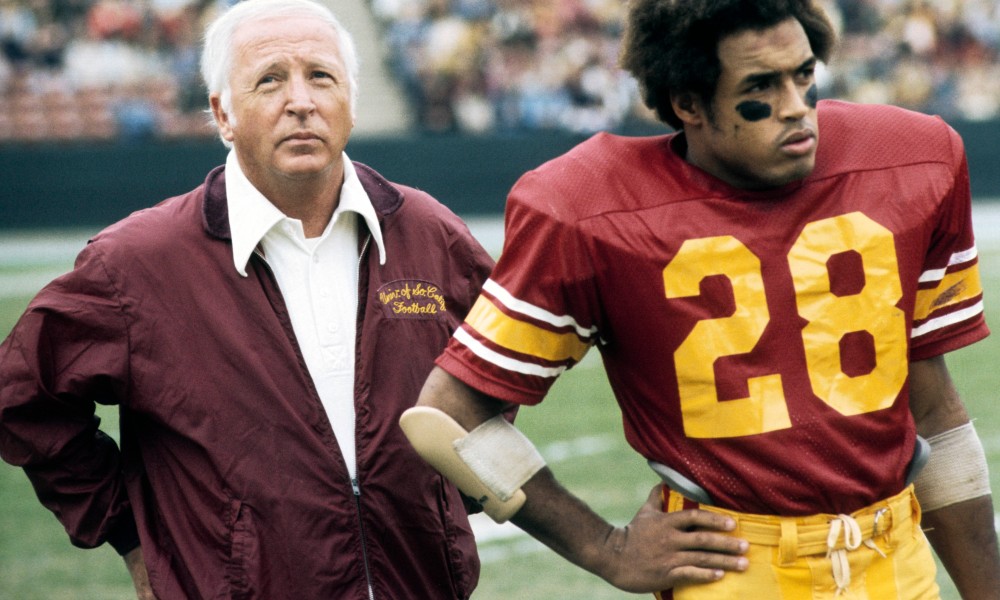
John McKay and Anthony Davis

Joe Jares, the Sports Illustrated writer quoted above by Bruce, said that the loss was "the worst disaster for the Irish since the potato famine." This was the final regular season game for Notre Dame's Hall of Fame head coach Ara Parseghian, who announced his retirement after the year. Parseghian was sick over what transpired and reportedly said "he was damn tired" of seeing Traveler running around the track every time USC scored.

USC fans call it "The Comeback." Notre Dame fans call it "That Game," or worse. USC had already clinched the title in the league then known as the Pacific-Eight Conference the week before, beating intra-city rival UCLA.

Davis finished 2nd in the Heisman Trophy voting, to Ohio State running back Archie Griffin. He played in 4 different professional football leagues: The World Football League (WFL), with the Southern California Sun in 1975; the Canadian Football League (CFL), with the Toronto Argonauts in 1976; the NFL, with McKay's Tampa Bay Buccaneers in 1977, the Houston Oilers in 1978, and the Los Angeles Rams, back at the Coliseum and again with Haden as quarterback, later in 1978; and the United States Football League (USFL), with the Los Angeles Express, again at the Coliseum, in 1983.

He later became a successful real estate developer, but, like so many other football players, his head-on collisions led to CTE and brain impairment. As of November 30, 2022, he is still alive.

*

November 30, 1974 was a Saturday. These other notable college football games were played that day:

* Rivalry: Number 1 Oklahoma beat Oklahoma State, 44-13 at Owen Field in Norman. The Sooners won the Big Eight Conference title, and were undefeated at 11-0. However, they were on probation, due to recruiting violations, and were not eligible for the UPI coaches' poll National Championship, or a bowl game appearance, or even a television appearance. Nevertheless, the AP sportswriters' poll awarded them their National Championship.

* Number 16 Baylor beat Rice, 24-3 at Baylor Stadium (later Floyd Casey Stadium) in Waco, Texas. Baylor clinched the Southwest Conference title.

* Rivalry: Navy beat Army, 19-0 at John F. Kennedy Stadium in Philadelphia.

* Rivalry: Boston College beat Holy Cross, 38-6 at Alumni Stadium outside Boston in Chestnut Hill, Massachusetts.

* Rivalry: Georgia Tech beat Georgia, 34-14 at Sanford Stadium in Athens.

* Rivalry: Florida beat Miami, 31-7 at Florida Field in Gainesville.

* Rivalry: Heavily favored Tennessee were held to a tie by Vanderbilt, 21-21 at Dudley Field (now FirstBank Stadium) in Nashville.

* Mississippi (Ole Miss) beat Tulane, 26-10 at Tulane Stadium in New Orleans. This was Tulane's last game at their old stadium. The following season, they moved into the Superdome.

* Louisiana State (LSU) beat Utah, 35-10 at Tiger Stadium in Baton Rouge, Louisiana. I have no idea why this one was set up: It sounds more like a bowl game.

* Rivalry: Arizona beat Arizona State, 10-0 at Arizona Stadium in Tucson.

* And Rutgers lost to Hawaii, 28-16 at Honolulu Stadium. Hawaii played 1 more game there, losing to Arizona State the next week, and opened the new Aloha Stadium the next season.

* The day before, Number 2 Alabama beat Number 7 Auburn, 17-13 at Legion Field in Birmingham. 'Bama won the Southeastern Conference title.

* Also the day before, Number 17 Texas upset Number 8 Texas A&M, 32-3 at Memorial Stadium in Austin.

* And the day before that, Thanksgiving, Number 10 Penn State beat Number 18 Pittsburgh, 31-10 at Three Rivers Stadium in Pittsburgh. Penn State went on to beat Baylor in the Cotton Bowl.

* Number 8 Nebraska were idle, having lost a game, and the Big 8 title, to Oklahoma the week before. They beat Florida in the Sugar Bowl.

* Number 3 Ohio State were idle, having beaten then-Number 2 Michigan for the Big Ten Conference title. USC, with Davis, went on to beat Ohio State, with Griffin, in the Rose Bowl. With Number 1 Oklahoma (through their own fault) and Number 5 Michigan (through a dumb Big 10 rule) both ineligible for a bowl, and Number 2 Alabama and Number 3 Ohio State both losing their bowl games, the latter to Number 5 Ohio State, UPI named USC its National Champion.

Notre Dame went on to beat Alabama in the Orange Bowl. It was Parseghian's last game: He retired, and joined ABC's broadcast crew. Dan Devine succeeded him as head coach. A year after that, McKay left for Tampa Bay, and was succeeded by John Robinson.

Baseball was out of season. There were 6 games in the NBA:

* The New York Knicks beat the Buffalo Braves, 118-111 at Madison Square Garden. Bob McAdoo scored 36 points and grabbed 18 rebounds in defeat for the Braves.

* The Washington Bullets beat the Seattle SuperSonics, 122-90 at the Capital Centre in the Washington suburb of Landover, Maryland.

* The Milwaukee Bucks beat their arch-rivals, the Chicago Bulls, 101-99 in double overtime at the Milwaukee Exposition, Convention Center and Arena, or "The MECCA." Since 2014, it has been named the UW-Panther Arena.

* The Phoenix Suns beat the Houston Rockets, 112-100 at the Arizona Veterans Memorial Coliseum in Phoenix.

* The Golden State Warriors beat their arch-rivals, the Los Angeles Lakers, 128-118 at the Oakland Coliseum Arena. Rick Barry scored 43 points.

* And the Portland Trail Blazers beat the New Orleans Jazz, 117-85 at the Veterans Memorial Coliseum in Portland.

There were 4 games in the American Basketball Association:

* The Virginia Squires beat the Indiana Pacers, 121-120 at the Hampton Coliseum outside Norfolk in Hampton, Virginia. George McGinnis scored 38 in defeat for the Pacers.

* The Kentucky Colonels beat the San Diego Conquistadors, 109-100 at Freedom Hall in Louisville, Kentucky.

* The Utah Stars beat the San Antonio Spurs, 110-103 at the HemisFair Arena in San Antonio.

* And the Denver Nuggets beat the Spirits of St. Louis, 128-109 at the Denver Auditorium Arena.

There were 7 games in the NHL:

* The New York Islanders lost to the Vancouver Canucks, 3-0 at the Pacific Coliseum in Vancouver.

* The Montreal Canadiens beat the St. Louis Blues, 7-1 at the Montreal Forum.

* The Toronto Maple Leafs beat the Washington Capitals, 7-1 at Maple Leaf Gardens in Toronto.

* The Buffalo Sabres and the Pittsburgh Penguins played to a tie, 5-5 at the Civic Arena in Pittsburgh.

* The Minnesota North Stars beat the Chicago Black Hawks, 5-3 at the Metropolitan Sports Center in the Minneapolis suburb of Bloomington, Minnesota.

* The Detroit Red Wings beat the Kansas City Scouts, 1-0 at the Kemper Arena (now the Hy-Vee Arena) in Kansas City.

* The Los Angeles Kings beat the Boston Bruins, 2-0 at The Forum outside Los Angeles in Inglewood, California.

* And the New York Rangers, the Philadelphia Flyers, the California Golden Seals and the Atlanta Flames were not scheduled.

There were 2 games in the World Hockey Association. The Chicago Cougars beat the Minnesota Fighting Saints, 7-5 at the St. Paul Civic Center in St. Paul, Minnesota. And the Cleveland Crusaders beat the Houston Aeros, 5-4 at the Sam Houston Coliseum in Houston.

And in English soccer, Arsenal beat Yorkshire team Middlesbrough, 2-0 at the Arsenal Stadium, a.k.a. Highbury, in North London.

Monday, November 28, 2022

November 28, 1964: USC Upsets Notre Dame

November 28, 1964: As occasionally happens, the game between the University of Southern California and the University of Notre Dame becomes one of the most important games of the college football season.

USC vs. Notre Dame is the biggest inter-sectional rivalry in American college football, and has been since it was established in 1926. No other pair of traditional rivals has as many National Championships, or as many Heisman Trophy winners. Notre Dame has had more 1st-round picks in the NFL Draft than any other school, and USC is 2nd in that regard. And both teams' fans are regarded as insufferable by pretty much everyone who hasn't bought into the schools' respective myths.

In odd-numbered years, the game is played at Notre Dame Stadium in South Bend, Indiana, in mid-to-late October, when the leaves are changing. In even-numbered years, the game is played at the Los Angeles Memorial Coliseum, on the Saturday of Thanksgiving weekend, when it would be too cold to play it in the Midwest.

In 1964, the Fighting Irish had a new head coach, Ara Parseghian. He had played for Woody Hayes at Miami University of Ohio and Paul Brown with the Cleveland Browns; coached under Hayes at Miami; succeeded him at that job when Hayes was hired at Ohio State, then coached at Northwestern.

In that 1st season, he had quarterback John Huarte, who would win the Heisman Trophy; defensive tackle Alan Page, who would be elected to the Pro Football Hall of Fame; and linebacker Jim Lynch, whose Kansas City Chiefs would beat Page's Minnesota Vikings in Super Bowl IV, 5 years later.

They won their 1st 9 games, most of them easily, although one of them should have been an omen, a visit to the University of Pittsburgh where they came away with only a 17-15 win. And none of their opponents had been nationally ranked. Still, they went into the season finale at USC ranked Number 1.

John McKay was in his 5th season at USC, and had already won a National Championship in 1962. Despite having the next season's Heisman winner, running back Mike Garrett, the Trojans did not have a good season. While Notre Dame had beaten Michigan State, 34-7 at home, USC lost to them, 17-7 away. They also lost to Ohio State in Columbus and the University of Washington at home. That dropped them to 4-3.

Their next game was away to Stanford, whom Notre Dame had beaten at home, 28-6. But the Trojans got on their horses and beat Stanford, 15-10. After a week off, they played arch-rival UCLA, and won, 34-13. It may not have been clear that they were ready to face the Number 1 team in the country. Nevertheless, 83,840 fans plowed into the Los Angeles Memorial Coliseum to watch it.

Sure enough, Notre Dame led 17-0 at the half. But in the 3rd quarter, USC drove down the field, and Garrett scored on a 1-yard run to get on the board. With 4:45 left, Craig Fertig threw a 23-yard touchdown pass to Fred Hill, but the extra point was missed.

But their defense held the Irish, and, with 1:35 to go, Fertig threw a 15-yard pass to Rod Sherman, and USC led, 20-17. Their defense held again, and one of the biggest upsets in recent college football was complete.

Neither team went to a bowl game. Notre Dame bounced back, and won the National Championship in 1966; USC, the year after. McKay would lead USC to another in 1972, while Parseghian led Notre Dame to one the following year. Then came 1974, and another epic game between the teams.

*

November 28, 1964 was a Saturday. This was also the day that "Leader of the Pack" by The Shangri-Las hit Number 1. I have a separate entry for that event.

These other notable college football games were played:

* Rivalry: Army beat Navy, 11-8 at John F. Kennedy Stadium in Philadelphia.

* Rivalry: Boston College beat Holy Cross, 10-8 at Alumni Stadium outside Boston in Chestnut Hill, Massachusetts.

* Rivalry: Georgia beat Georgia Tech, 7-0 at Sanford Stadium in Athens, Georgia.

* Rivalry: Florida beat Miami, 12-10 at Florida Field (now Ben Hill Griffin Stadium) in Gainesville, Florida.

* Rivalry: Vanderbilt beat Tennessee, 7-0 at Dudley Field (now FirstBank Stadium) in Nashville.

* Rivalry: Oklahoma beat Oklahoma State, 21-16 at Lewis Field (now Pickens Stadium) in Stillwater, Oklahoma.

* Rivalry: Texas Christian University (TCU) beat Southern Methodist University (SMU), 17-6 at the Cotton Bowl in Dallas.

* Rivalry: Arizona beat Arizona State, 30-6 at Arizona Stadium in Tucson.

Two days earlier, on Thanksgiving Day:

* Rivalry: Number 2 Alabama beat Auburn, 21-14 at Legion Field in Birmingham, Alabama. 'Bama won the Southeastern Conference title. 

* Rivalry: Number 5 Texas beat Texas A&M, 26-7 at Memorial Stadium in Austin, Texas.

* Idle: Number 3 Arkansas, who had beaten Texas, and won the Southwest Conference title; Number 6 Michigan, who had won the Big Ten Conference title; Number 7 Nebraska, who, despite losing the week before to arch-rival Oklahoma, had won the Big Eight Conference title; Number 8 Louisiana State University (LSU); Number 9 Oregon State, who had won the title in the Athletic Association of Western Universities (AAWU), the league that became the Pacific-Eight (or Pac-8) the next year; Number 10 Ohio State, which had blown the Big 10 title by losing their finale to Michigan; and New Jersey teams Rutgers and Princeton.

And so, at a time when the National Championship was awarded by the Associated Press' sportswriters' poll after the regular season, with Notre Dame's loss, Alabama, coached by Bear Bryant and quarterbacked by Joe Namath, rose to Number 1.

But Texas beat Alabama in the Orange Bowl, and Arkansas beat Nebraska in the Cotton Bowl, to earn a share of the National Championship with Alabama. Michigan beat Oregon State in the Rose Bowl, and LSU beat Syracuse in the Sugar Bowl.

Both the NFL and the AFL played the next day, plus games 2 days earlier, on Thanksgiving. The CFL played its championship game, the Grey Cup, and the BC Lions beat the Hamilton Tiger-Cats, 34-24 at Exhibition Stadium in Toronto. It was the 1st Grey Cup for the Vancouver-based team. I have a separate entry for this event.

Baseball was out of season. There were 4 games in the NBA:

* The New York Knicks beat the St. Louis Hawks, 106-91 at the old Madison Square Garden.

* The Boston Celtics beat the Cincinnati Royals, 129-98 at the Boston Garden.

* The Philadelphia76ers beat the Detroit Pistons, 101-93 at Cobo Hall (now Huntington Place) in Detroit.

* And the San Francisco Warriors beat their arch-rivals, the Los Angeles Lakers, 109-106 at the Civic Auditorium in San Francisco. Just another day at the office for Wilt Chamberlain: 40 points and 30 rebounds.

There were 2 games played in the NHL. The New York Rangers beat the Toronto Maple Leafs, 4-1 at Maple Leaf Gardens in Toronto. The Montreal Canadiens beat the Boston Bruins, 2-1 at the Montreal Forum. The Detroit Red Wings and the Chicago Black Hawks were not scheduled.

And in English soccer, Manchester United beat Arsenal, 3-2 at the Arsenal Stadium, a.k.a. Highbury, in North London.

Friday, November 18, 2022

November 18, 1967: USC vs. UCLA: "The Game of the Century"

O.J. Simpson's 4th quarter touchdown

November 18, 1967: One of college football's occasional "Games of the Century" is played. And the schools involved were based just 10 miles apart, and even shared a stadium at the time.

The University of California at Los Angeles (UCLA) was founded in 1919 as the southern branch of the University of California, with its main branch in Berkeley, outside San Francisco. It became a separate school in 1927.

Located 12 miles west of downtown Los Angeles, in a neighborhood called Westwood, it is a State-sponsored school, and by 1967, it had already produced such legendary athletes as Jackie Robinson, Bob Waterfield and Rafer Johnson. At the time, it had a quarterback who was a favorite for the Heisman Trophy, Gary Beban; and the best player in college basketball, Lew Alcindor, who would later change his name to Kareem Abdul-Jabbar.

Since 1967, it's produced football quarterback Troy Aikman; basketball legends Bill Walton, Ann Meyers, Reggie Miller and Russell Westbrook; baseball players Chase Utley and Gerrit Cole; tennis legends Arthur Ashe and Jimmy Connors; track icons Jackie Joyner-Kersee and her sister-in-law Florence Griffith Joyner; and soccer stars Cobi Jones and Brad Friedel.

The University of Southern California (USC) was founded in 1880, and is a private school. Its campus, 4 miles south of City Hall, effectively marks the border between downtown L.A. and the South Central ghetto.

Its football program then had the other favorite for the 1967 Heisman Trophy, running back Orenthal James "O.J. Simpson." It had already produced the 1965 Heisman winner, Mike Garrett; and also Red Badgro, Frank Gifford and Willie Wood. In the late 1920s, they had a player named Marion Morrison, but his misbehavior got him kicked off the team. He stayed in L.A., became an actor, and changed his name to John Wayne.

Since 1967, USC has produced Heisman winners Charles White, Marcus Allen, Carson Palmer, Matt Leinart and Reggie Bush, and other football stars like Ron Mix, Sam Cunningham, Lynn Swann, Anthony Munoz, Ronnie Lott, Willie McGinest, Junior Seau, Troy Polamalu, Bruce Matthews, Bruce's brother Clay Matthews Jr., and Clay's son Clay Matthews III.

Their highly successful baseball program had already produced Tom Seaver, and has since gone on to produce Bobby Valentine, Dave Kingman, Fred Lynn, Mark McGwire, Randy Johnson, Mark Prior, Barry Zito, and Bret and Aaron Boone.

In basketball, they had already produced Bill Sharman, and went on to produce Paul Westphal, Cheryl Miller, Lisa Leslie and Cynthia Cooper. They produced Olympic swimming Gold Medalist and actor Buster Crabbe, diving Gold Medalist Dr. Sammy Lee, swimming Gold Medalist Murray Rose, shot put Gold Medalist Parry O'Brien; and have since produced pole vault Gold Medalist Bob Seagren and swimming Gold Medalist John Naber.

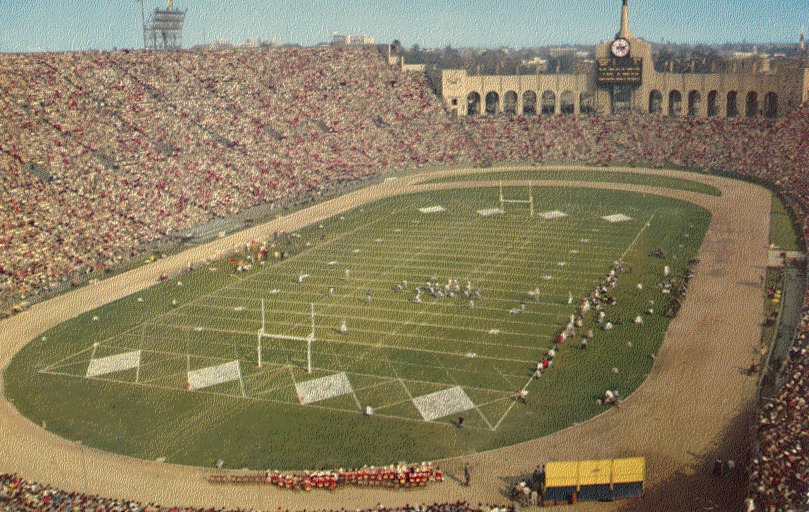
The Los Angeles Memorial Coliseum opened in 1923, and USC had played football there ever since. UCLA began playing there in 1933. The Coliseum had hosted the Olympic Games in 1932, the NFL's Los Angeles Rams since 1946, and, 10 months earlier, the 1st Super Bowl. But, to Los Angelenos, it never hosted a bigger game than this one. The attendance was 90,772 -- as opposed to the Super Bowl, just 61,946.
UCLA started the season by beating then-Number 9 Tennessee at home. They won away to Pittsburgh, Washington State and Penn State. They beat Cal at home, and Stanford away. Then came a blemish on their record: A 16-16 draw against Oregon State. 

USC started with home wins over Washington State and then-Number 5 Texas, beating Michigan State away, rising to Number 1. They continued, beating Stanford at home, beating then-Number 5 Notre Dame away, Washington away, Oregon at home, and Cal away.

But, 7 days after forging the tie with UCLA, Oregon State struck again, beating USC in Corvallis. That same day, UCLA rebounded with a 48-0 home win over Washington.

They rebounded with a 48-0 home win over Washington, and went into the the battle with USC ranked Number 1. USC was Number 4. A crowd of 90,772 filed into the Coliseum to watch UCLA in powder blue and USC in cardinal red face off in front of a national audience on ABC. The winner had the inside track to the Championship of the Athletic Association of Western Universities (the league now known as the Pacific-Twelve), the AAWU's berth in the Rose Bowl, and a shot at the National Championship.

It was billed as "The Game of the Century," despite that label having been used just a year earlier for Notre Dame vs. Michigan State. USC was favored by 3 points. Admission: $6.00 -- about $50 in today's money.

Each team scored a touchdown in the 1st quarter: First UCLA on a 12-yard run by Greg Jones, then USC when Pat Cashman intercepted a pass that Beban had intended for Jones, returning it 55 yards for a touchdown.

In the 2nd quarter, Zenon Andrusyshyn of UCLA missed a field goal attempt, and Simpson had a 12-yard touchdown run, dragging 2 UCLA tacklers into the end zone. At halftime, the Trojans led, 14-7.

Beban was not about to let down his effort in the game, and in the Heisman debate with O.J. In the 3rd quarter, he threw a 53-yard touchdown pass to George Farmer, tying the game. USC coach John McKay noticed that Andrusyshyn tended to make low kicks, so he sent 6-foot-8 linebacker Bill Hayhoe into the middle of the line, and he blocked 2 field goal attempts. The game remained 14-14 at the end of 3 quarters.

Early in the 4th quarter, Beban, battling a rib injury, threw a touchdown pass to Dave Nuttall. But, just as he had blocked those field goal attempts, now, Hayhoe blocked Andrusyshyn's extra point attempt. It was 20-14 UCLA, but that block would matter.
Gary Beban

With 10:38 left to play, and 3rd and 7 from the USC 36, USC quarterback Toby Page called an audible known as "23 blast." Simpson remembered thinking it was a terrible call. It wasn't: A key block from Dan Scott enabled O.J. to cut back to the middle, and run 64 yards for a touchdown. Rikki Aldridge kicked the extra point, and it was 21-20 USC.

Beban's injuries became too much for him, and he was unable to get the Bruins back across midfield. The 21-20 score held to the end, and USC had won. Any 1 of the 3 kicks that Hayhoe blocked would have made a difference, either giving UCLA a 23-21 win, or forging a 21-21 tie -- or forcing USC to decide, trailing 21-20 at the end, to decide whether to go for a 21-21 tie or a two-point conversion and a 22-21 win.

Chris Schenkel and former Oklahoma coach Bud Wilkinson called the game for ABC. Keith Jackson, then in only his 2nd season with ABC, narrated the taped highlights, and called it the greatest game he ever saw. So did Giles Pellerin, a USC graduate who saw every game the school played from 1925 until 1998, when he died while watching the USC-UCLA game, 797 games in a row.

Beban was unable to play the next week, and UCLA lost at home to Syracuse. They were not invited to a bowl game. Nevertheless, in one of the closest votes in the award's history, Beban was awarded the Heisman Trophy. UCLA ended the season 7-2-1, ranked Number 10.

USC had no more regular-season games. They went to the Rose Bowl, to face Indiana, then ranked Number 4, and won, 14-3, clinching the National Championship.

Simpson was a junior, so he returned for 1968, and seemed headed for another National Championship. They beat ranked opponents in Minnesota (away), Miami, Stanford (away), Cal and Oregon State. And, again, they beat UCLA, 28-16. And O.J. easily won the Heisman.

However, traditionally, when USC plays Notre Dame, it's in the middle of the season when it's the Fighting Irish's turn to host, to avoid the November cold of northern Indiana; and at the end of the season when it's the Trojans' turn, so it's in L.A. and warm. Notre Dame was ranked Number 9 at the time, and escaped with a 21-21 tie. It dropped them to Number 2, and sent them to the Rose Bowl to face Number 1 Ohio State. The Buckeyes' ended the Trojans' 12-game winning streak, 27-16, and won the National Championship.

O.J. went on to have a sensational pro career, at least on an individual basis, rushing for 11,236 yards, 2nd all-time at the time of his retirement. He set records, since broken, for rushing yards in a season (2,003 in 1973) and in a game (273 in a 1976 contest). He became one of the most popular athletes of his generation, and also gained praise as an actor. Team-wise, he was less successful: His Buffalo Bills played in only 1 Playoff game, smacking into the Pittsburgh Steel Curtain, although O.J. did score a touchdown in the game.

Beban -- like Simpson, a native of San Francisco -- had considerably worse luck than that. He was drafted by the Los Angeles Rams, so he didn't have to move, even playing in the Coliseum. But they already had All-Pro Roman Gabriel as their quarterback. And the Rams had already messed this situation up recently: They drafted the 1962 Heisman winner, Terry Baker, and he couldn't win the starting job from Gabriel, either.

So, before Beban signed a contract, the Rams traded his rights to the Washington Redskins, who already had future Hall-of-Famer Sonny Jurgensen. Sonny was 34, so trading for his replacement was a good idea. And the 'Skins had one of the greatest quarterbacks ever as their head coach, Otto Graham. But Sonny remained the starter, and Beban was released on the eve of the 1970 season. He was cut by the Denver Broncos before the 1971 season, and never played again.

Like Simpson, he was elected to the College Football Hall of Fame. But rather than being elected to the Pro Football Hall of Fame, his pro career consisted of 5 appearances, 1 incomplete pass, 5 rushes for 18 yards, and 1 trick play where he caught a pass for 12 yards.

Beban became a broadcaster for UCLA football, and a successful real estate executive. Chances are, even he would have been unable to sell the house where Nicole Brown Simpson and Ronald Goldman were murdered on June 12, 1994; or the house where O.J. Simpson was arrested for those crimes 5 days later. Perhaps, even before that, Gary Beban would not have been willing to trade lives with O.J. Simpson; certainly, he would not have wanted to do so afterward.

*

November 18, 1967 was a Saturday. These other notable college football games were played:

* Number 2 Tennessee faced Mississippi, a.k.a. "Ole Miss," on somewhat neutral ground at the Liberty Bowl in Memphis. Tennessee won, 20-7, wrapping up the Southeastern Conference title.

* Number 3 Purdue beat Michigan State, 21-7 at Ross-Ade Stadium in West Lafayette, Indiana. The week before, they had beaten Minnesota. But the following week, they lost to arch-rival Indiana in Bloomington, forcing a 3-way tie for the Big Ten title.

Purdue couldn't go to the Rose Bowl, anyway: The Big Ten then had a rule that none of its teams could go to the Rose Bowl in back-to-back years, and despite the fact that Minnesota had beaten Indiana, seemingly breaking that tie, Minnesota had gone more recently, and so the league presidents voted to send Indiana instead, where they were beaten by USC.

* Number 6 Wyoming beat Texas-El Paso, 21-19 at the Sun Bowl in El Paso, Texas. Wyoming thus clinched the Western Athletic Conference Championship, but lost to Louisiana State in the Sugar Bowl.

* Number 7 Oklahoma beat Kansas, 14-10 at Memorial Stadium in Norman, Oklahoma. Oklahoma won the Big Eight title, and then beat Tennessee in the Orange Bowl. But the winner of that game would only have won the National Championship if USC had lost the Rose Bowl, which they didn't.

* Number 9 Notre Dame beat Georgia Tech, 36-3 at Grant Field in Atlanta. Notre Dame went on to beat the University of Miami in the Orange Bowl.

* Texas A&M, not ranked at the time, beat Rice, 18-3 at Rice Stadium in Houston. A&M beat arch-rival Texas on Thanksgiving to clinch the Southwest Conference title, and beat Alabama in the Cotton Bowl.

* Penn State, not ranked at the time, beat Ohio University (definitely not Ohio State), 35-14 at Beaver Stadium in State College, Pennsylvania. They went to the Gator Bowl, finishing in a 17-17 tie with Florida State.

* Yale beat Princeton, 29-7 at Palmer Stadium in Princeton, New Jersey, to wrap up the Ivy League title. They still had to play Harvard, and don't ever tell anybody from either school that "The Game" is meaningless. Yale won it, 24-20 at the Yale Bowl in New Haven, Connecticut.

* New York City's only real remaining college football team, Columbia, lost to Penn, 26-6 at Franklin Field in Philadelphia.

* And New Jersey's biggest team, Rutgers, lost to Holy Cross, 21-10 at Rutgers Stadium in Piscataway.

* My high school, East Brunswick in Middlesex County, New Jersey, beat Sayreville, 41-0 away.

The brand-new American Basketball Association had no games scheduled for the day. Probably for the best, giving that this was, along with the following Saturday and New Year's Day, 1 of the 3 biggest dates on the college football calendar, thus interfering with attendance and TV ratings. But 5 NBA games were scheduled:

* The New York Knicks lost to the Baltimore Bullets, 101-93 at the old Madison Square Garden. They would move into the new Garden 3 months later.

* The Boston Celtics beat the Philadelphia 76ers, 116-111 at The Spectrum in Philadelphia. For the Sixers, Billy Cunningham scored 31 points, Hal Greer 22, and Wilt Chamberlain only 8, but he also had 33 rebounds and 6 assists. For the Celtics, Sam Jones and Bailey Howell both scored 33.

* The Chicago Bulls beat the Detroit Pistons, 132-130 at the Chicago Stadium.

* The Los Angeles Lakers beat the St. Louis Hawks, 127-107 at the Kiel Auditorium in St. Louis.

* And the San Francisco Warriors beat the San Diego Rockets, 142-124 at the San Diego Sports Arena. (The building is now named the Pechanga Arena. The Rockets, an expansion team that year, moved to Houston in 1971.)

There were 5 games in the newly-expanded NHL:

* The New York Rangers lost to the Boston Bruins, 3-1 at the Boston Garden.

* The Toronto Maple Leafs and the Chicago Black Hawks played to a tie, 2-2 at Maple Leaf Gardens in Toronto.

* The Philadelphia Flyers and the Minnesota North Stars played to a tie, 2-2 at the Metropolitan Sports Center in the Minneapolis suburb of Bloomington, Minnesota.

* The Pittsburgh Penguins beat the St. Louis Blues, 5-3 at the St. Louis Arena.

* The Oakland Seals beat the Montreal Canadiens, 2-1 at the Oakland Coliseum Arena.

* And the Detroit Red Wings and the Los Angeles Kings were not scheduled.

Also, Arsenal drew with Leicester City, 2-2 at Filbert Street in Leicester. 
Thursday, October 27, 2022

October 28, 1922: The Rose Bowl Stadium Opens

October 28, 1922: The Rose Bowl stadium opens in the Los Angeles suburb of Pasadena, California. And the matchup for the opener couldn't have been better: A battle of unbeatens.

The University of California, from the system's main campus in Berkeley, outside San Francisco, was 4-0, and took on the 5-0 team from the University of Southern California, based in Los Angeles. A safety gave Cal a 2-0 lead at halftime, and the Golden Bears held on 2 goal-line stands, before adding a touchdown and a field goal to beat USC, 12-0.

On January 1, 1923, the Rose Bowl game, previously played at the 40,000-seat Tournament Park, was played there for the 1st time. This time, USC won, beating Penn State 14-3. The Rose Bowl has been played there annually since, except for 1942, when concerns over the bombing of Pearl Harbor led it to be moved to Durham, North Carolina, where host Duke lost to Oregon State; and 2021, when it was moved to Arlington, Texas due to COVID restrictions.

Originally a horseshoe, an expansion in 1928 made it the largest stadium in the country. Attendance peaked at 106,869, for the 1973 Rose Bowl, in which USC beat Ohio State 42-17. A renovation in 2013, with wider seats, dropped seating capacity to 92,542.

It was the home field for Caltech from 1923 to 1976, California State University at Los Angeles from 1957 to 1969, the North American Soccer League's the Los Angeles Wolves in 1968 and Los Angeles Aztecs in 1978 and '79, and MLS' Los Angeles Galaxy from 1996 to 2002. UCLA have played home games there sine 1982.

It has also hosted the 1983 Army-Navy Game (Navy won, 42-13), 8 games of the 1994 World Cup (including the U.S.' win over Colombia and loss to Romania, and Brazil's win over Italy in the Final), 4 games of the 1999 Women's World Cup (including the U.S.' win over China in the Final), cycling at the 1932 Olympics, and soccer at the 1984 Olympics.

And it has hosted 5 Super Bowls: XI, 1977, the Oakland Raiders beating the Minnesota Vikings 32-14; XIV, 1980, the Pittsburgh Steelers beating the Los Angeles Rams 31-19; XVII, 1983, the Washington Redskins beating the Miami Dolphins 27-17; XXI, 1987, the New York Giants beating the Denver Broncos 39-20; and XXVII, 1993, the Dallas Cowboys beating the Buffalo Bills 52-17.

*

October 28, 1922 was a Saturday. There was another major college football milestone: For the 1st time, a football game is broadcast on live nationwide radio. The year before, the University of Chicago had become one of the first colleges to send its football team to play a team outside its home region, beating Princeton University 9-0 at Palmer Stadium in Princeton, New Jersey. Now, they would have a rematch at Stagg Field on the South Side of Chicago.

The Princeton Tigers entered the game 4-0, the Chicago Maroons 3-0. After 3 quarters, thanks to 3 touchdowns by John Thomas, Chicago led 18-7. Then came the kind of collapse people would still be talking about nearly a century later if it had happened on TV and the footage had been preserved. The Maroons fumbled, the Tigers recovered, and took it in for a 40-yard touchdown. Harry Crum scored for Princeton in the closing minutes, and, since Princeton made their PATs, and Chicago didn't make theirs, the Tigers emerged victorious, 21-18.

On the basis of the win over Chicago, Eastern and Midwestern sportswriters proclaimed Princeton to be the National Champions after the season. Western writers gave the title to Cal. No playoff in those days. Bowl games? Cal had won the Rose Bowl in 1920 and tied it in 1921, but in 1922 and 1923, they didn't go. From September 25, 1920 to October 3, 1925, under coach Andy Smith, the Golden Bears had a 50-game unbeaten streak, still the longest in college football history: Played 50, won 46, tied 4, lost exactly none.

Coaching took a severe toll on Smith, who went just 6-3 with Cal in 1925. On a visit to Philadelphia, where he had coached the University of Pennsylvania from 1909 to 1912, he was hospitalized with pneumonia, and died on January 8, 1926, only 49 years old. His career coaching record was 116-32-13, including 74-16-7 at Cal.

This was also the day that Benito Mussolini's Fascists marched on Rome. I have a separate entry for that event. And on the opposite end of the political spectrum, if not quite on the opposite end of the Eurasian continent, the Communists finally completed their conquest of Russia, as the Red Army conquered the Siberian port city of Vladivostok. The Reds would be in power in Russia for the next 69 years, the Fascists in Italy for 21 years.

Also on this day, basketball coach Butch van Breda Kolff and French soccer star Ernest Vaast were born.

The Major League Baseball season had ended earlier in the month, with the New York Giants winning the World Series over the New York Yankees. There was, as yet, no major professional basketball league. The National Hockey League's new season was still a few weeks away. The nascent National Football League did play games that weekend, but all the next day, Sunday.

But, being a Saturday, there were college football games. In addition to Cal vs. USC and Princeton vs. Chicago, including the following:

In New York City, New York University played Rhode Island State at Ohio Field in The Bronx, and won 23-7. Fordham University played Westminster College of Pennsylvania at Fordham Field, also in The Bronx, and won 12-0. Columbia University wasn't so lucky: They played Williams College of Massachusetts, at South Field, just south of their famed Low Library in the Morningside Heights section of Manhattan, and lost 13-10.

And, aside from Princeton the main team in New Jersey, Rutgers University went to Morgantown and lost to West Virginia University 28-0.

Also, in English soccer, Arsenal lost to Newcastle United, 2-1 at the Arsenal Stadium, a.k.a. Highbury, in North London.

October 28, 1922: The March On Rome

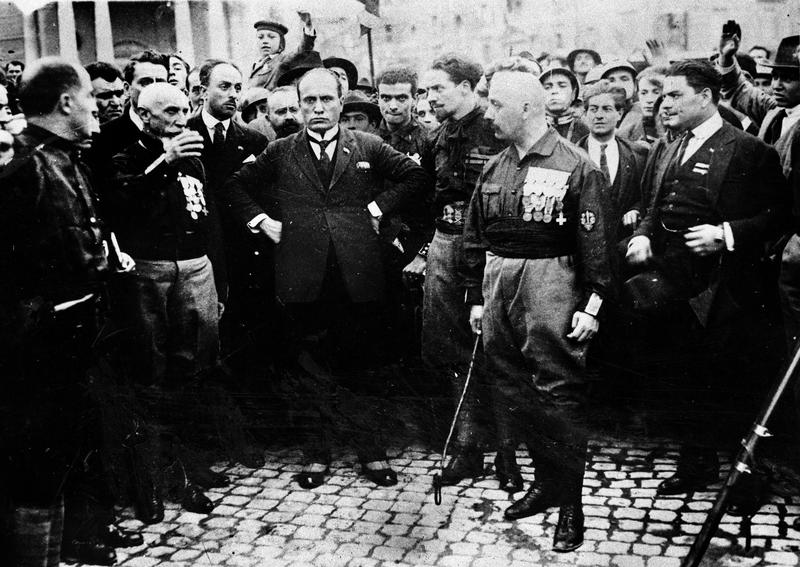
October 28, 1922: The March on Rome takes place. It was an organized mass demonstration by 25,000 right-wing Blackshirt paramilitary men, representing the National Fascist Party, led by Benito Mussolini, seeking to rescue Italy from the economic and social chaos of the post-World War I world.

Prime Minister Luigi Facta told King Victor Emmanuel III that he wanted to declare a state of siege, but the King, conservative like most European monarchs tended to be then, and sympathetic to the Fascists, overruled him. The next day, the King dismissed Facta, and gave the job to Mussolini.

For the next 21 years, Mussolini ruled Italy with an iron fist, having opponents killed, including Socialist Party leader Giacomo Matteotti in 1924; aiding the Fascist movement in Spain during that country's Civil War of 1936 to 1939; and expanding Italy's influence into Africa, taking over Libya and Ethiopia, in an attempt to establish a new Roman Empire with himself as Caesar.

Mussolini considered Fascism to be the direct opposite of liberalism. In article in the 1932 edition of the Enciclopedia Italiana, he wrote, "Fascism should more appropriately be called Corporatism because it is a merger of state and corporate power." As the 1930s proved, Fascism also includes militarism and nationalism, which, inevitably, includes bigotry -- if not at first, then, eventually, lurching toward it and eventually carrying it out on a governmental level.

He also launched what would later be called a "cult of personality," in which the leader and the nation became inseparable, much as King Louis XIV of France once proclaimed, "I am the state."

The American journalist George Seldes, whom Mussolini had befriended on the way up in the hopes of gaining American patrons, turned on him after gaining power. Seldes then wrote a biography of Mussolini, titled Sawdust Caesar. 

And in aiding the Fascists in Spain, led by Generalissimo Francisco Franco, Mussolini sent troops, which became known as Franco's Italian Army. That name would later be adopted by a family that owned an Italian restaurant in Pittsburgh, to honor Pittsburgh Steelers running back Franco Harris, whose mother grew up in Italy under Mussolini -- but whose father was an African-American soldier who participated in the liberation of Italy from Fascism, and married her and took her to America.

While Harris always showed appreciation to the restaurateurs and the other Steeler fans, it is not known if it made him uncomfortable to know what Francisco Franco did in Spain and Benito Mussolini did in Ethiopia, before that country was liberated.

Mussolini was deposed in 1943, and executed in 1945. And that old saying, "At least he made the trains run on time"? It was a myth: On the average, the trains in Italy ran no better than they did before he took over.

At heart, Italy is a conservative country. But, since World War II, more of its governments have been left of center rather than right. When one government falls, it is usually replaced by another leftward one. An exception was Silvio Berlusconi, the broadcast executive whose Forza Italia party is economically and socially conservative. He served as Prime Minister in 1994 and '95, from 2001 to 2006, and 2008 to 2011.

But on September 25, 2022, a right-wing party named Fratelli d'Italia, meaning "Brothers of Italy," won the most seats, and built a coalition that made its Leader -- ironically, given the name of the party, a woman, Giorgia Meloni -- the new Prime Minister. She will be Italy's furthest-right head of government since Mussolini, noticeably further to the right than Berlusconi.

*

October 28, 1922 was a Saturday. The Major League Baseball season had ended earlier in the month, with the New York Giants winning the World Series over the New York Yankees. There was, as yet, no major professional basketball league. The National Hockey League's new season was still a few weeks away. The nascent National Football League did play games that weekend, but all the next day, Sunday.

But, being a Saturday, there were college football games. One was the 1st football game ever broadcast on live nationwide radio. The year before, the University of Chicago had become one of the first colleges to send its football team to play a team outside its home region, beating Princeton University 9-0 at Palmer Stadium. Now, they would have a rematch at Stagg Field on the South Side of Chicago.

The Princeton Tigers entered the game 4-0, the Chicago Maroons 3-0. After 3 quarters, thanks to 3 touchdowns by John Thomas, Chicago led 18-7. Then came the kind of collapse people would still be talking about nearly a century later if it had happened on TV and the footage preserved. The Maroons fumbled, the Tigers recovered, and took it in for a 40-yard touchdown. Harry Crum scored for Princeton in the closing minutes, and, since Princeton made their PATs and Chicago didn't, the Tigers emerged victorious, 21-18. 

Another battle of unbeatens took place at the new Rose Bowl stadium in the Los Angeles suburb of Pasadena. The University of California, from the system's main campus in Berkeley, outside San Francisco, was 4-0, and took on the 5-0 team from the University of Southern California, based in Los Angeles. A safety gave Cal a 2-0 lead at halftime, and the Golden Bears held on 2 goal-line stands, before adding a touchdown and a field goal to win 12-0. I have a separate entry for this event.

On the basis of the win over Chicago, Eastern and Midwestern sportswriters proclaimed Princeton to be the National Champions after the season. Western writers gave the title to Cal. No playoff in those days. Bowl games? Cal had won the Rose Bowl in 1920 and tied it in 1921, but in 1922 and 1923, they didn't go. From September 25, 1920 to October 3, 1925, under coach Andy Smith, the Golden Bears had a 50-game unbeaten streak, still the longest in college football history: Played 50, won 46, tied 4, lost exactly none.

Coaching took a severe toll on Smith, who went just 6-3 with Cal in 1925. On a visit to Philadelphia, where he had coached the University of Pennsylvania from 1909 to 1912, he was hospitalized with pneumonia, and died on January 8, 1926, only 49 years old. His career coaching record was 116-32-13, including 74-16-7 at Cal.

In New York City, New York University played Rhode Island State at Ohio Field in The Bronx, and won 23-7. Fordham University played Westminster College of Pennsylvania at Fordham Field, also in The Bronx, and won 12-0. Columbia University wasn't so lucky: They played Williams College of Massachusetts, at South Field, just south of their famed Low Library in the Morningside Heights section of Manhattan, and lost 13-10.

And, aside from Princeton the main team in New Jersey, Rutgers University went to Morgantown and lost to West Virginia University 28-0.

Also, Arsenal FC lost to Newcastle United, 2-1 at the Arsenal Stadium, a.k.a. Highbury, in North London. 

Saturday, October 1, 2022

October 1, 1965: The Indonesia Coup Attempt

October 1, 1965: Members of the 30 September Movement assassinate 6 Indonesian Army Generals in an abortive coup d'état in the national capital of Jakarta.

At 7:00 AM, Radio Republik Indonesia broadcast a message from Lieutenant-Colonel Untung Syamsuri, the commander of the Presidential guard, stating that the 30 September Movement, an internal army organization, had taken control of strategic locations in Jakarta, with the help of other military units, in order to forestall a coup attempt by a "General's Council" aided by America's Central Intelligence Agency (CIA), intent on removing President Sukarno on 5 October, which Indonesia celebrates as "Army Day."

Sukarno took up residence in the Bogor Palace, a presidential palace in Bogor, East Java, while Omar Dhani and D.N. Aidit, implicated in the coup, fled the country. Led by Suharto, commander of the Army's Strategic Reserve, the army regained control of all the installations previously held by forces of the 30 September Movement.

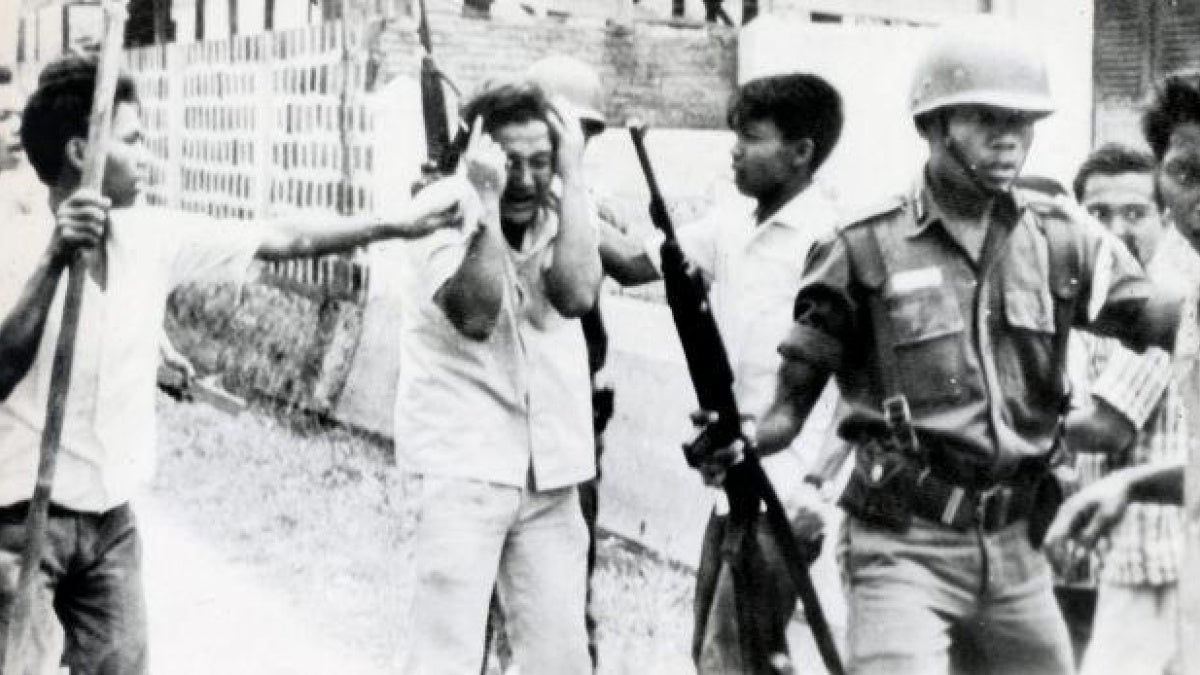
In the days and weeks that followed, the army, socio-political, and religious groups blamed the coup attempt on the Communist Party of Indonesia (PKI). Soon, a mass purge was underway, which resulted in the imprisonment and deaths of actual or suspected Communist Party members and sympathizers. It is believed that at least 500,000 people were killed as a result of these reprisals. (The country's population was about 100 million at the time; in 2022, it's about 275 million.)

The United States and other Western states have steadfastly denied any responsibility for the terrible violence that followed the attempted coup of October 1, 1965. That violence, they have maintained, was the product of domestic political forces over which outside powers had little, if any, influence. Later evidence proved this to be a lie.

In 1978, Australian novelist Christopher Koch published The Year of Living Dangerously, about the experiences of his brother, journalist Philip Koch, during those events. In 1982, another Australian, director Peter Weir, filmed a movie version.

The legacy of Kusno Sosrodihardjo, a.k.a. Sukarno, the 1st President of Indonesia, is, to say the least, complicated. He sided with Japan in World War II, because they were fighting the natives' Dutch colonial overlords. Once The War ended, he declared independence, with himself as President, but it took 4 years for the Netherlands to agree to let what they called "the Dutch East Indies" go.

But it was hard to keep such a large, diverse, spread-out island nation together. In 1959, Sukarno introduced what he called "Guided Democracy," which was a lot more guided than democratic. The 1965 coup sent the nation into chaos. Finally, in 1967, General Suharto removed Sukarno from power, and he was still under house arrest when he was hospitalized prior to his death in 1970. Suharto was even worse, and had to resign under pressure in 1998, living until 2008.

*

October 1, 1965 was a Friday. Basketball and hockey seasons were a few days away. No games were played in the NFL or the AFL. There was 1 notable college football game played: The University of Southern California (USC) beat Oregon State, 26-12 at the Los Angeles Memorial Coliseum.

And these baseball games were played:

* The Pittsburgh Pirates beat the Chicago Cubs, 2-1 at Forbes Field in Pittsburgh. Roberto Clemente went 1-for-4. Ernie Banks went 0-for-4.

* A doubleheader was split at Cleveland Municipal Stadium. The Baltimore Orioles won the opener, 2-0. Dave McNally pitched a 2-hit shutout. The Cleveland Indians won the nightcap, 3-2. Between the 2 games, Brooks Robinson went 2-for-7 with a walk and an RBI.

* The Chicago White Sox beat the Kansas City Athletics, 6-1 at Comiskey Park in Chicago.

* The Houston Astros beat the St. Louis Cardinals, 4-2 at the Astrodome in Houston. Lou Brock went 0-for-4. Steve Carlton pitched a scoreless 8th inning.

* The Milwaukee Braves beat the Los Angeles Dodgers, 2-0 at Dodger Stadium in Los Angeles. Denny Lemaster pitched a 5-hit shutout. Hank Aaron went 0-for-1 with 2 walks. The next day, though, the Dodgers beat the Braves, and clinched the National League Pennant.

* The Cincinnati Reds beat the San Francisco Giants, 17-2 at Candlestick Park in San Francisco. A bad loss for the Giants, worse in terms of the Pennant chase than it was in terms of the final score. The Reds got home runs from Frank Robinson, Gordy Coleman, Deron Johnson and Pete Rose. 

For the Giants, Willie Mays went 1-for-3 with a walk. Warren Spahn pitched to 3 batters in the top of the 17th inning. He walked Johnny Edwards, Leo Cardenas reached on an error, and Sammy Ellis singled. Those would be the last batters Spahn ever faced.

* The New York Mets and the Philadelphia Phillies were rained out at Shea Stadium. The game was made up as part of a doubleheader the next day. The Phillies won the 1st game, 6-0. Jim Bunning pitched a 2-hit shutout. The 2nd game went 18 innings, before the rain came back and the umpires called it. In other words, in 1 day, the Mets played 27 innings, and didn't score 1 single solitary run.

* The Detroit Tigers and the Washington Senators were rained out at District of Columbia Stadium in Washington. (It was renamed Robert F. Kennedy Memorial Stadium in 1969.) The game was made up as part of a doubleheader the next day. The Tigers swept, 9-1 and 6-2. Al Kaline was injured, and did not play in either game.

* And the New York Yankees, the Boston Red Sox, the Los Angeles Angels and the Minnesota Twins were not scheduled.

December 31, 1999 & January 1, 2000: The Millennium

December 31, 1999:  The Millennium arrives. The people of planet Earth survived. At a terrible cost. But we hadn't destroyed ourselves. ...