
O.J. Simpson's 4th quarter touchdown
November 18, 1967: One of college football's occasional "Games of the Century" is played. And the schools involved were based just 10 miles apart, and even shared a stadium at the time.
The University of California at Los Angeles (UCLA) was founded in 1919 as the southern branch of the University of California, with its main branch in Berkeley, outside San Francisco. It became a separate school in 1927.
Located 12 miles west of downtown Los Angeles, in a neighborhood called Westwood, it is a State-sponsored school, and by 1967, it had already produced such legendary athletes as Jackie Robinson, Bob Waterfield and Rafer Johnson. At the time, it had a quarterback who was a favorite for the Heisman Trophy, Gary Beban; and the best player in college basketball, Lew Alcindor, who would later change his name to Kareem Abdul-Jabbar.
Since 1967, it's produced football quarterback Troy Aikman; basketball legends Bill Walton, Ann Meyers, Reggie Miller and Russell Westbrook; baseball players Chase Utley and Gerrit Cole; tennis legends Arthur Ashe and Jimmy Connors; track icons Jackie Joyner-Kersee and her sister-in-law Florence Griffith Joyner; and soccer stars Cobi Jones and Brad Friedel.
The University of Southern California (USC) was founded in 1880, and is a private school. Its campus, 4 miles south of City Hall, effectively marks the border between downtown L.A. and the South Central ghetto.
Its football program then had the other favorite for the 1967 Heisman Trophy, running back Orenthal James "O.J. Simpson." It had already produced the 1965 Heisman winner, Mike Garrett; and also Red Badgro, Frank Gifford and Willie Wood. In the late 1920s, they had a player named Marion Morrison, but his misbehavior got him kicked off the team. He stayed in L.A., became an actor, and changed his name to John Wayne.
Since 1967, USC has produced Heisman winners Charles White, Marcus Allen, Carson Palmer, Matt Leinart and Reggie Bush, and other football stars like Ron Mix, Sam Cunningham, Lynn Swann, Anthony Munoz, Ronnie Lott, Willie McGinest, Junior Seau, Troy Polamalu, Bruce Matthews, Bruce's brother Clay Matthews Jr., and Clay's son Clay Matthews III.
Their highly successful baseball program had already produced Tom Seaver, and has since gone on to produce Bobby Valentine, Dave Kingman, Fred Lynn, Mark McGwire, Randy Johnson, Mark Prior, Barry Zito, and Bret and Aaron Boone.
In basketball, they had already produced Bill Sharman, and went on to produce Paul Westphal, Cheryl Miller, Lisa Leslie and Cynthia Cooper. They produced Olympic swimming Gold Medalist and actor Buster Crabbe, diving Gold Medalist Dr. Sammy Lee, swimming Gold Medalist Murray Rose, shot put Gold Medalist Parry O'Brien; and have since produced pole vault Gold Medalist Bob Seagren and swimming Gold Medalist John Naber.
The Los Angeles Memorial Coliseum opened in 1923, and USC had played football there ever since. UCLA began playing there in 1933. The Coliseum had hosted the Olympic Games in 1932, the NFL's Los Angeles Rams since 1946, and, 10 months earlier, the 1st Super Bowl. But, to Los Angelenos, it never hosted a bigger game than this one. The attendance was 90,772 -- as opposed to the Super Bowl, just 61,946.
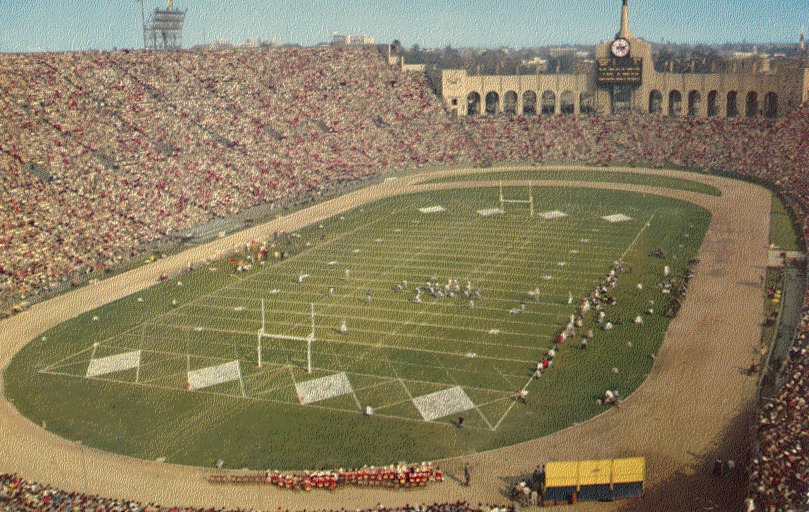
UCLA started the season by beating then-Number 9 Tennessee at home. They won away to Pittsburgh, Washington State and Penn State. They beat Cal at home, and Stanford away. Then came a blemish on their record: A 16-16 draw against Oregon State.
USC started with home wins over Washington State and then-Number 5 Texas, beating Michigan State away, rising to Number 1. They continued, beating Stanford at home, beating then-Number 5 Notre Dame away, Washington away, Oregon at home, and Cal away.
But, 7 days after forging the tie with UCLA, Oregon State struck again, beating USC in Corvallis. That same day, UCLA rebounded with a 48-0 home win over Washington.
They rebounded with a 48-0 home win over Washington, and went into the the battle with USC ranked Number 1. USC was Number 4. A crowd of 90,772 filed into the Coliseum to watch UCLA in powder blue and USC in cardinal red face off in front of a national audience on ABC. The winner had the inside track to the Championship of the Athletic Association of Western Universities (the league now known as the Pacific-Twelve), the AAWU's berth in the Rose Bowl, and a shot at the National Championship.
It was billed as "The Game of the Century," despite that label having been used just a year earlier for Notre Dame vs. Michigan State. USC was favored by 3 points. Admission: $6.00 -- about $50 in today's money.
Each team scored a touchdown in the 1st quarter: First UCLA on a 12-yard run by Greg Jones, then USC when Pat Cashman intercepted a pass that Beban had intended for Jones, returning it 55 yards for a touchdown.
In the 2nd quarter, Zenon Andrusyshyn of UCLA missed a field goal attempt, and Simpson had a 12-yard touchdown run, dragging 2 UCLA tacklers into the end zone. At halftime, the Trojans led, 14-7.
Beban was not about to let down his effort in the game, and in the Heisman debate with O.J. In the 3rd quarter, he threw a 53-yard touchdown pass to George Farmer, tying the game. USC coach John McKay noticed that Andrusyshyn tended to make low kicks, so he sent 6-foot-8 linebacker Bill Hayhoe into the middle of the line, and he blocked 2 field goal attempts. The game remained 14-14 at the end of 3 quarters.
Early in the 4th quarter, Beban, battling a rib injury, threw a touchdown pass to Dave Nuttall. But, just as he had blocked those field goal attempts, now, Hayhoe blocked Andrusyshyn's extra point attempt. It was 20-14 UCLA, but that block would matter.

Gary Beban
With 10:38 left to play, and 3rd and 7 from the USC 36, USC quarterback Toby Page called an audible known as "23 blast." Simpson remembered thinking it was a terrible call. It wasn't: A key block from Dan Scott enabled O.J. to cut back to the middle, and run 64 yards for a touchdown. Rikki Aldridge kicked the extra point, and it was 21-20 USC.
Beban's injuries became too much for him, and he was unable to get the Bruins back across midfield. The 21-20 score held to the end, and USC had won. Any 1 of the 3 kicks that Hayhoe blocked would have made a difference, either giving UCLA a 23-21 win, or forging a 21-21 tie -- or forcing USC to decide, trailing 21-20 at the end, to decide whether to go for a 21-21 tie or a two-point conversion and a 22-21 win.
Chris Schenkel and former Oklahoma coach Bud Wilkinson called the game for ABC. Keith Jackson, then in only his 2nd season with ABC, narrated the taped highlights, and called it the greatest game he ever saw. So did Giles Pellerin, a USC graduate who saw every game the school played from 1925 until 1998, when he died while watching the USC-UCLA game, 797 games in a row.
Beban was unable to play the next week, and UCLA lost at home to Syracuse. They were not invited to a bowl game. Nevertheless, in one of the closest votes in the award's history, Beban was awarded the Heisman Trophy. UCLA ended the season 7-2-1, ranked Number 10.
USC had no more regular-season games. They went to the Rose Bowl, to face Indiana, then ranked Number 4, and won, 14-3, clinching the National Championship.
Simpson was a junior, so he returned for 1968, and seemed headed for another National Championship. They beat ranked opponents in Minnesota (away), Miami, Stanford (away), Cal and Oregon State. And, again, they beat UCLA, 28-16. And O.J. easily won the Heisman.
However, traditionally, when USC plays Notre Dame, it's in the middle of the season when it's the Fighting Irish's turn to host, to avoid the November cold of northern Indiana; and at the end of the season when it's the Trojans' turn, so it's in L.A. and warm. Notre Dame was ranked Number 9 at the time, and escaped with a 21-21 tie. It dropped them to Number 2, and sent them to the Rose Bowl to face Number 1 Ohio State. The Buckeyes' ended the Trojans' 12-game winning streak, 27-16, and won the National Championship.
O.J. went on to have a sensational pro career, at least on an individual basis, rushing for 11,236 yards, 2nd all-time at the time of his retirement. He set records, since broken, for rushing yards in a season (2,003 in 1973) and in a game (273 in a 1976 contest). He became one of the most popular athletes of his generation, and also gained praise as an actor. Team-wise, he was less successful: His Buffalo Bills played in only 1 Playoff game, smacking into the Pittsburgh Steel Curtain, although O.J. did score a touchdown in the game.
Beban -- like Simpson, a native of San Francisco -- had considerably worse luck than that. He was drafted by the Los Angeles Rams, so he didn't have to move, even playing in the Coliseum. But they already had All-Pro Roman Gabriel as their quarterback. And the Rams had already messed this situation up recently: They drafted the 1962 Heisman winner, Terry Baker, and he couldn't win the starting job from Gabriel, either.
So, before Beban signed a contract, the Rams traded his rights to the Washington Redskins, who already had future Hall-of-Famer Sonny Jurgensen. Sonny was 34, so trading for his replacement was a good idea. And the 'Skins had one of the greatest quarterbacks ever as their head coach, Otto Graham. But Sonny remained the starter, and Beban was released on the eve of the 1970 season. He was cut by the Denver Broncos before the 1971 season, and never played again.
Like Simpson, he was elected to the College Football Hall of Fame. But rather than being elected to the Pro Football Hall of Fame, his pro career consisted of 5 appearances, 1 incomplete pass, 5 rushes for 18 yards, and 1 trick play where he caught a pass for 12 yards.
Beban became a broadcaster for UCLA football, and a successful real estate executive. Chances are, even he would have been unable to sell the house where Nicole Brown Simpson and Ronald Goldman were murdered on June 12, 1994; or the house where O.J. Simpson was arrested for those crimes 5 days later. Perhaps, even before that, Gary Beban would not have been willing to trade lives with O.J. Simpson; certainly, he would not have wanted to do so afterward.
*
November 18, 1967 was a Saturday. These other notable college football games were played:
* Number 2 Tennessee faced Mississippi, a.k.a. "Ole Miss," on somewhat neutral ground at the Liberty Bowl in Memphis. Tennessee won, 20-7, wrapping up the Southeastern Conference title.
* Number 3 Purdue beat Michigan State, 21-7 at Ross-Ade Stadium in West Lafayette, Indiana. The week before, they had beaten Minnesota. But the following week, they lost to arch-rival Indiana in Bloomington, forcing a 3-way tie for the Big Ten title.
Purdue couldn't go to the Rose Bowl, anyway: The Big Ten then had a rule that none of its teams could go to the Rose Bowl in back-to-back years, and despite the fact that Minnesota had beaten Indiana, seemingly breaking that tie, Minnesota had gone more recently, and so the league presidents voted to send Indiana instead, where they were beaten by USC.
* Number 6 Wyoming beat Texas-El Paso, 21-19 at the Sun Bowl in El Paso, Texas. Wyoming thus clinched the Western Athletic Conference Championship, but lost to Louisiana State in the Sugar Bowl.
* Number 7 Oklahoma beat Kansas, 14-10 at Memorial Stadium in Norman, Oklahoma. Oklahoma won the Big Eight title, and then beat Tennessee in the Orange Bowl. But the winner of that game would only have won the National Championship if USC had lost the Rose Bowl, which they didn't.
* Number 9 Notre Dame beat Georgia Tech, 36-3 at Grant Field in Atlanta. Notre Dame went on to beat the University of Miami in the Orange Bowl.
* Texas A&M, not ranked at the time, beat Rice, 18-3 at Rice Stadium in Houston. A&M beat arch-rival Texas on Thanksgiving to clinch the Southwest Conference title, and beat Alabama in the Cotton Bowl.
* Penn State, not ranked at the time, beat Ohio University (definitely not Ohio State), 35-14 at Beaver Stadium in State College, Pennsylvania. They went to the Gator Bowl, finishing in a 17-17 tie with Florida State.
* Yale beat Princeton, 29-7 at Palmer Stadium in Princeton, New Jersey, to wrap up the Ivy League title. They still had to play Harvard, and don't ever tell anybody from either school that "The Game" is meaningless. Yale won it, 24-20 at the Yale Bowl in New Haven, Connecticut.
* New York City's only real remaining college football team, Columbia, lost to Penn, 26-6 at Franklin Field in Philadelphia.
* And New Jersey's biggest team, Rutgers, lost to Holy Cross, 21-10 at Rutgers Stadium in Piscataway.
* My high school, East Brunswick in Middlesex County, New Jersey, beat Sayreville, 41-0 away.
The brand-new American Basketball Association had no games scheduled for the day. Probably for the best, giving that this was, along with the following Saturday and New Year's Day, 1 of the 3 biggest dates on the college football calendar, thus interfering with attendance and TV ratings. But 5 NBA games were scheduled:
* The New York Knicks lost to the Baltimore Bullets, 101-93 at the old Madison Square Garden. They would move into the new Garden 3 months later.
* The Boston Celtics beat the Philadelphia 76ers, 116-111 at The Spectrum in Philadelphia. For the Sixers, Billy Cunningham scored 31 points, Hal Greer 22, and Wilt Chamberlain only 8, but he also had 33 rebounds and 6 assists. For the Celtics, Sam Jones and Bailey Howell both scored 33.
* The Chicago Bulls beat the Detroit Pistons, 132-130 at the Chicago Stadium.
* The Los Angeles Lakers beat the St. Louis Hawks, 127-107 at the Kiel Auditorium in St. Louis.
* And the San Francisco Warriors beat the San Diego Rockets, 142-124 at the San Diego Sports Arena. (The building is now named the Pechanga Arena. The Rockets, an expansion team that year, moved to Houston in 1971.)
There were 5 games in the newly-expanded NHL:
* The New York Rangers lost to the Boston Bruins, 3-1 at the Boston Garden.
* The Toronto Maple Leafs and the Chicago Black Hawks played to a tie, 2-2 at Maple Leaf Gardens in Toronto.
* The Philadelphia Flyers and the Minnesota North Stars played to a tie, 2-2 at the Metropolitan Sports Center in the Minneapolis suburb of Bloomington, Minnesota.
* The Pittsburgh Penguins beat the St. Louis Blues, 5-3 at the St. Louis Arena.
* The Oakland Seals beat the Montreal Canadiens, 2-1 at the Oakland Coliseum Arena.
* And the Detroit Red Wings and the Los Angeles Kings were not scheduled.
Also, Arsenal drew with Leicester City, 2-2 at Filbert Street in Leicester.


No comments:
Post a Comment