Showing posts with label 1908. Show all posts

Sunday, December 25, 2022

December 26, 1908: The Shocking Triumph of Jack Johnson

December 26, 1908: Jack Johnson, a 30-year-old black man from Texas, known as the Galveston Giant, knocks out Canadian fighter Tommy Burns at Sydney Stadium in Sydney, Australia. This makes Johnson the 1st black man to win the Heavyweight Championship of the World.
Sydney Stadium, built 1908, demolished 1970

(Johnson wasn't really a giant: He was 6 feet even, but a solid 200 pounds at his peak fighting condition.)

It was what we would now call a technical knockout: It was stopped after the 14th round, because Burns, considerably lighter and possibly ill with the flu, was totally outmatched.

Ironically, Burns might well be totally forgotten today had he won the fight. After all, who remembers who he beat for the title? (It was Marvin Hart.)

This "conquest of the white man," and his flamboyant lifestyle, made Johnson the most hated man in America. Even many black people hated him, for making them look bad. He didn't care: He was still going to be Jack Johnson.

So America's white establishment looked for a "Great White Hope" who could beat Johnson. Four times in 1909, a fighter was put up against Johnson:

* Philadelphia Jack O'Brien, the Light Heavyweight Champion, fought him in Philadelphia. It was a draw, but O'Brien didn't want a rematch.

* Tony Ross fought him in Pittsburgh, and Johnson beat him.

* Al Kaufman fought him in San Francisco, and Johnson beat him.

* Stanley Ketchel, the Middleweight Champion, a vicious fighter known as the Michigan Assassin, made a deal with Johnson, the same deal that O'Brien had made with him: They would fight to a draw, and thus split the proceeds from the film rights. It was a good plan. Except Ketchel got greedy, for the title and the money, and knocked Johnson down. All that did was make Johnson mad, and he not only knocked Ketchel out, he knocked out a bunch of his teeth. The film of the fight is clear enough to see Johnson brushing Ketchel's teeth out of his glove.

Now, the search for a Great White Hope became truly intense. Novelist Jack London, tapping into the racism of the time, had a nationally syndicated newspaper column, and used it to address Jim Jeffries, who had been Heavyweight Champion from 1899 to 1904, and retired undefeated to an alfalfa farm outside Los Angeles. London wrote, "Jeff, it's up to you."

Johnson was willing to fight Jeffries. Having waited so long for his shot at the title, he knew he had no right to duck anybody. Jeffries had gotten fat in his retirement. He went on a crash diet and exercise program, and actually got back down to his usual fighting weight. But losing so much weight so soon weakened him. And the fight was the middle of the desert, in Reno, Nevada. Jeffries was used to California heat, but not this kind of heat, and the South Texas native Johnson was used to it. And Johnson was in peak physical condition.

So the fight was a mismatch. It was scheduled for a maximum of 45 rounds, which sounds brutal for the modern era, where the norm became 15, and eventually 12 by the 1980s. Jeffries hung on for 12 rounds, but in the 13th, Johnson did what (it was said -- the records may be wrong) no other fighter had ever done: He knocked Jeffries down. Jeffries got up. He shouldn't have, because Johnson knocked him out in the 15th.

In 1912, Johnson was arrested for violating the Mann Act, which forbade "transporting women across State lines for immoral purposes." The woman in question was Lucille Cameron. Contrary to what is often reported, Cameron was not already Johnson's wife, which would have made the charge impossible to prove in court -- not that an all-white jury would have cared. But she refused to cooperate, and soon married Johnson.

In 1913, Johnson was arrested on the Mann Act again. This time, in a Chicago courtroom presided over by Judge Kenesaw Mountain Landis, later to become the 1st Commissioner of Baseball and the perpetuator of the sport's "color line," Johnson was convicted by an all-white jury, and sentenced to a year and a day in prison.

He skipped bail, and escaped first to Canada, then to France. Having only defended his title once since the Jeffries fight, he could now only do so abroad. On December 19, 1913, in Paris, in the 1st-ever Heavyweight Championship fight between 2 black men, he may have recognized the significance, and held back a little, as he fought Battling Jim Johnson (no relation) to a rather lackluster draw. In 1914, he defeated Frank Moran in Paris. In early 1915, he knocked Jack Murray out in Buenos Aires, Argentina.

Finally, it all caught up with him. Jess Willard, a 6-foot-6 Kansan, became the latest "Great White Hope." On April 5, 1915, at Oriental Park, a horse racing track in Havana, Cuba, in a fight scheduled for 45 rounds, and held in heat even worse than in Reno 4 years earlier, perhaps he finally got tired of being Jack Johnson, and threw the fight. Or maybe, at 37, the oldest Heavyweight Champion ever (and he would remain so until Jersey Joe Walcott in 1951), he just wasn't in shape anymore. Willard knocked him out in the 26th round.

Jack and Lucille Johnson continued to live abroad. Finally, on July 20, 1920, Jack crossed the border from Mexico to America, and surrendered to federal agents. He was taken to the federal penitentiary at Leavenworth, Kansas (with some irony, in Willard's home State), and began serving his sentence. He was released early, on July 9, 1921.

Lucille was the 3rd of what turned out to be 4 wives for Jack Johnson. Only the 1st was black. On June 10, 1946, he was driving on U.S. Route 1 near Franklinton, North Carolina, when he crashed into a telegraph pole, and died. He was 68 years old.

*

December 26, 1908 was a Saturday. Baseball was out of season. Football season had ended. Professional basketball did not exist. And the biggest hockey league of the time, the Eastern Canada Amateur Hockey Association, didn't start its season for another 11 days.

But there were scores. It was Boxing Day, and, in Britain, there was a tradition of soccer teams playing each other on back-to-back days, a home-and-home series on Christmas Day and Boxing Day. On the 25th, Woolwich Arsenal and Leicester Fosse played each other to a 1-1 draw at the Filbert Street stadium in Leicester. On the 26th, they played at The Arsenal's home, the Manor Ground, in Plumstead, South-East London, and Arsenal won, 2-1. Eventually, Woolwich Arsenal would move to North London, and become simply Arsenal Football Club; while Leicester Fosse became Leicester City.

Sunday, November 27, 2022

November 28, 1908: The Marianna Mine Disaster

November 28, 1908: An an explosion occurs in the Marianna Mine, which kills 154 men and leaves only 1 survivor.

Marianna, about 40 miles south of Pittsburgh, was built as a mining town for the Pittsburgh Buffalo Company in 1907, and was incorporated in 1910. At the time of its construction, the Marianna Mine was among the most modern and well equipped in the world. The town's brick homes were designed to offer indoor bathrooms, fenced yards and other amenities making living conditions very attractive for the time.

The explosion occurred at 10:55 AM. Although the mine was quickly refurbished by the Pittsburgh Buffalo Company, the colliery's fortunes flagged. This was one of several disasters, including a few in 1908 alone, that catalyzed public advocacy for mine safety, leading to the establishment of the U.S. Bureau of Mines in 1910. USBM research on safer blasting material and the prevention of mine gas and dust explosions resulted in reduced occurrence of mine disasters.

By 1914, the mine was sold to the Union Coal and Coke Company, and later to Bethlehem Steel, which continued to extract coal until 1988, when the main conveyor caught fire. The fire was extinguished, but the mine closed anyway.

*

November 28, 1908 was a Saturday. This was Thanksgiving Weekend, and most of the major rivalry games were played 2 days before, on Thanksgiving Day itself. Only 2 games of note were played on this day. Army beat Navy, 6-4 at Franklin Field in Philadelphia; and the University of Denver beat Colorado College, 6-4 at Washburn Field in Colorado Springs. Remember: At the time, a touchdown was worth 5 points, to be followed by an attempt at an extra point; and a field goal was worth 4 points.

Sunday, November 13, 2022

November 14, 1908: Cornell vs. Chicago In the Snow

Stagg's Maroons. Note the shape of the ball.

November 14, 1908: American football has had several "snow bowls" in its history. This may have been the first.

Alone among the schools that would later be included in "the Ivy League," Cornell University is nowhere near what would come to be called "the Northeast Corridor." Dartmouth College, in Hanover, New Hampshire, isn't quite on it. But the rest are. From north to south: Harvard University in Cambridge, Massachusetts, across the Charles River from Boston; Brown University in Providence, Rhode Island; Yale University in New Haven, Connecticut; Columbia University in New York City; Princeton University in Princeton, New Jersey; and the University of Pennsylvania in Philadelphia.

In contrast, Cornell is not only, by far, the newest of the Ivies, having been founded by Ezra Cornell in 1865, but it is the furthest away: In Ithaca, New York, 223 miles northwest of Midtown Manhattan, and just 51 miles southwest of Syracuse University, which, like its Keystone State counterpart, Pennsylvania State University in State College, is a convenient marker separating "the Northeast" as a region of the United States from "the Midwest."

Nevertheless, because of its inclusion with the Ivy League, Cornell is generally considered a "Northeastern" school, and so its contest on this date with the University of Chicago was considered an "intersectional" matchup.

UC's location on the South Side of the Midwest's biggest city belies the fact that, if there was a Midwestern equivalent to the Ivy League, it would be one of the schools in it, as would the school just north of the city in Evanston, Illinois, which, reflecting the early history of America, is named Northwestern University. Both UC and NU started out in the league that would become known as the Big Ten Conference. UC dropped its football program in 1940, and despite looking so bad, so many times, over the ensuing years, that it seems like they'd dropped football, Northwestern remains in the Big Ten.

Chicago came into the game 4-0, having beaten Purdue, Indiana, Illinois and Minnesota, and only Illinois had gotten close. Cornell had not been as dominant in their wins, but they still came in at 6-0, having beaten Hamilton, Oberlin, Colgate, the University of Vermont, Penn State and Amherst.

The game was played at Marshall Field in Chicago. The stadium was named for the department store of the same name, which was named by its owner, of the same name, a major UC donor. But both teams were coached by the men for whom their next home field would be named: UC by Amos Alonzo Stagg, who, along with his fellow Yalie, Walter Camp, had done so much to create American football through standardization of the rules; and Cornell by Henry Schoellkopf.

Speaking of those rules: It was a different time. The forward pass had been legalized only 2 years before, but there were still restrictions on it, and it was rarely used. It would not be a factor in this game, even if the weather had been good. The field was 110 yards long, kickoffs were done at midfield, it was 3 downs to gain 10 yards, a touchdown was worth 5 points, and a field goal was worth 4 points.

In 1912, these would all be changed: The field would become 100 yards, a team would kick off from its own 40-yard line, it would be 4 downs to gain 10 yards, a touchdown would be worth 6 points, and a field goal would be worth 3. Men who could kick the ball a long way would still be important, but not nearly as important, moving American football even further from its English ancestors, soccer and rugby.

As for that weather: It snowed throughout the game, making running difficult, kicking and punting harder, and passing would have seemed to be all but impossible. It probably didn't help however many fans came out -- no attendance figure appears to have been recorded -- that both teams traditionally wore red: Cornell's teams have always been called the Big Red, while Chicago's were the Maroons.

Cornell scored in the middle of the first half, on a touchdown pass from Gardner to Mowe. The extra point was good, and their 6-0 lead held until the final minute of play. In the Chicago Daily Tribune, I.E. Sanborn wrote, "In a hard fought, exciting but poorly played game Chicago and Cornell broke-even on Marshall field yesterday, the final score being 6 to 6, leaving the question of supremacy between east and west suspended in the snow laden air."

Hard to believe that both UC and Cornell have good journalism schools.

Sanborn called the tying play a "triangular pass," "Steffen to Page to Schommer." Walter Steffen, later a city Alderman and Judge, was the captain and quarterback; Harlan Page, later UC's basketball and baseball coach, was an end; and John Schommer, who has been called basketball's first superstar, was a halfback.

So the "triangular pass" was probably a forward pass from Steffen to Page, and then a lateral from Page to Schommer. What would later be called a "hook and ladder," which, as Don Shula, who pulled it off a few times, pointed out is a corruption of its original name, "hook and lateral."

The following week, Chicago won a close one over Wisconsin, to finish 5-0-1, to win the league title. Cornell beat Trinity College of Connecticut. However, in what had already become their traditional Thanksgiving Day rivalry game, they went to Philadelphia to play Penn, and lost. They finished 7-1-1. Had there been an Ivy League at the time, Penn would have won the title.

*

November 14, 1908 was a Saturday. These other notable college football games were played:

* Harvard beat Dartmouth, 6-0 at Harvard Stadium in Boston.

* Brown beat Vermont, 12-0 at Andrews Field in Providence, Rhode Island.

* Syracuse beat Tufts, 28-0 at Archbold Stadium in Syracuse, New York.

* Army played Washington & Jefferson to a tie, 6-6 on The Plain in West Point, New York.

* Navy beat Penn State, 5-0 at Worden Field in Annapolis, Maryland.

* North Carolina beat South Carolina, 22-0 at Campus Athletic Field in Chapel Hill, North Carolina.

* The Carlisle Indian School -- with Jim Thorpe as a freshman -- beat the University of Pittsburgh, 6-0 at Exposition Park in Pittsburgh.

* Georgia and Alabama played to a tie, 6-6 at the Birmingham Fairgrounds in Birmingham, Alabama.

* Tennessee beat Clemson, 6-5 at Waite Field in Knoxville, Tennessee.

* In an intersectional matchup, Ohio State beat Vanderbilt, 17-6 at Dudley Field in Nashville.

* In yet another intersectional matchup, this one a battle of unbeatens like Cornell vs. Chicago, Penn beat Michigan, 29-0 at Ferry Field in Ann Arbor, Michigan. 

* Illinois beat Purdue, 15-6 at Stuart Field in West Lafayette, Indiana.

* Missouri beat Washington University of St. Louis, 40-0 at Rollins Field in Columbia, Missouri.

* Kansas beat Nebraska, 20-5 at Nebraska Field in Lincoln.

* In what would have been a battle of unbeatens had Princeton not lost to Dartmouth at the Polo Grounds the week before, Yale beat Princeton, 11-6 at University Field in Princeton, New Jersey.

* In contrast, New Jersey's other major team played a much less significant game, but won it: Rutgers beat Muhlenberg, 15-5 at Neilson Field in New Brunswick.

Monday, November 7, 2022

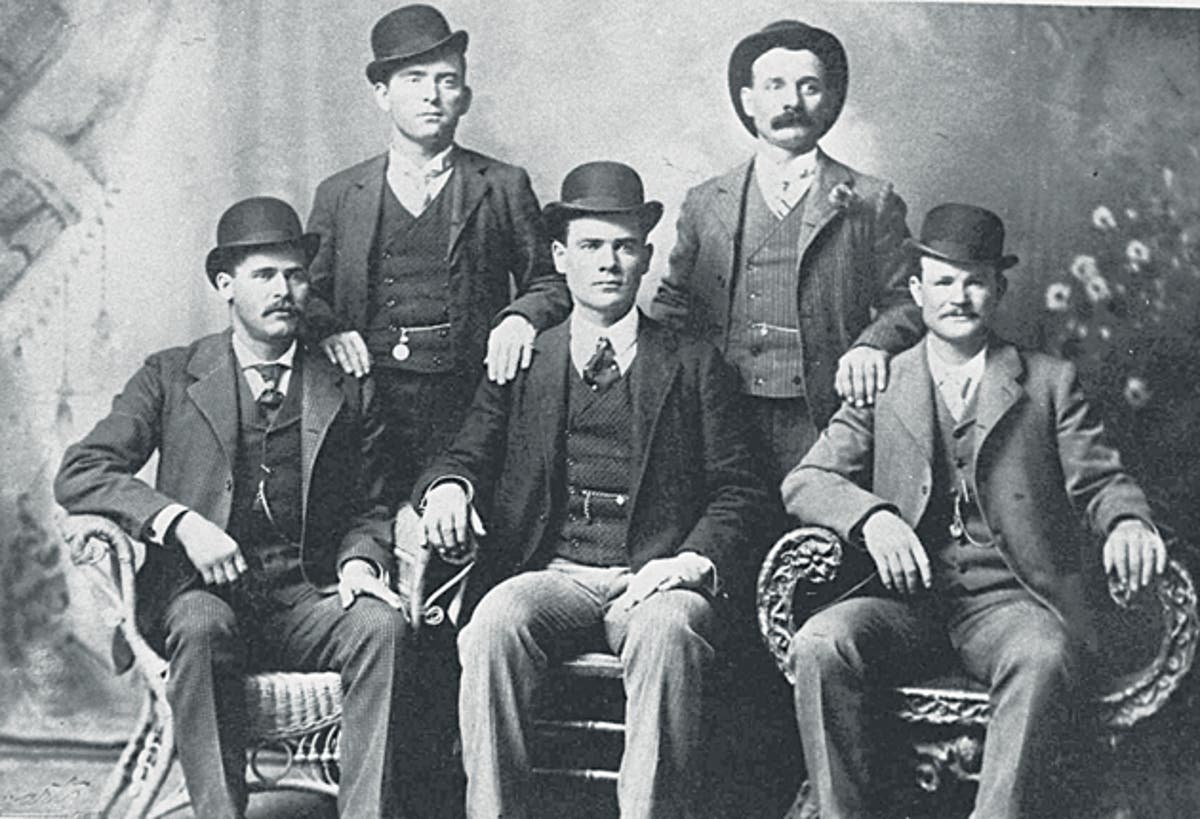
November 7, 1908: The Deaths (?) of Butch Cassidy & the Sundance Kid

The 1899 "Fort Worth Five" photo.
Top row, left to right: William Carver and Harvey Logan.
Bottom row, left to right: Harry Longabaugh (the Sundance Kid),
Ben Kilpatrick, and Robert Parker (Butch Cassidy).

November 7, 1908: In San Vicente, Bolivia, soldiers engage in a shootout with 2 men who had robbed the payroll of a silver mine. The robbers were found dead: Apparently, with both men wounded, one shot the other to put him out of his misery, and then used his last bullet on himself.
The local authorities confirmed that these men were the robbers, but they did not know the men's names. The widely-accepted story is that the men were Robert Leroy Parker and Harry Alonzo Longabaugh -- a.k.a. the American outlaws known as Butch Cassidy and the Sundance Kid, respectively.
Butch and Sundance were the last of the major Wild West outlaws. From 1889 to 1901, with their Wild Bunch gang, they robbed banks and trains throughout the Rocky Mountain States, especially Parker's native Utah (which gained Statehood in 1896). In 1901, along with Longabaugh's girlfriend Etta Place, they escaped to New York, and then took a ship to South America: First to Argentina, then to Chile, and finally to Bolivia, in the hopes of becoming respectable ranchers.
But they couldn't make an honest living, so they turned back to robbery, which is why they had to leave Argentina and then Chile. Finally, in 1906, Place got tired of living on the run, and went back to America. History loses track of her after that.
Attempts to determine whether Butch and Sundance actually were the men killed in the San Vicente shootout have thus far failed. It has been alleged, including by Cassidy's sister, that Butch left Bolivia and was still alive as late as 1937. (He would have been 72.) A suggestion that Sundance was still alive as late as 1936 has been proven by DNA testing to be false, but, so far, that's as close as DNA testing has come to proving anything. Among the stories, it has been suggested that Etta may have been alive as late as 1966.
For all we know, the old Utah and Wyoming bank and train robbers of the 1890s may well have had a good laugh about it all for a long time thereafter.
Among the depictions of Butch and Sundance: The 1951 film The Texas Rangers (played by John Doucette and Ian MacDonald, respectively), the 1956 film The Three Outlaws (Neville Brand and Alan Hale Jr.), a 1958 episode of Tales of Wells Fargo (only Butch appears, played by a young Charles Bronson), the 1969 film Butch Cassidy and the Sundance Kid (Paul Newman and Robert Redford, with Katharine Ross as Etta), the 1979 film Butch and Sundance: The Early Days (Tom Berenger and William Katt), the 1994 TV-movie The Gambler V: Playing for Keeps (Scott Paulin and Brett Cullen, with Mariska Hargitay as Etta), and the 2004 TV-movie The Legend of Butch & Sundance (David Clayton Rogers and Ryan Browning, with Rachelle Lefevre as Etta).
*
November 7, 1908 was a Saturday. Baseball was out of season. Basketball and hockey were not yet professional. But there was college football to be played. Among the games:
* The Polo Grounds in New York hosted a crowd of 10,000, as undefeated Dartmouth (5-0-1) beat previously undefeated Princeton (5-0-3), 10-6.
* Harvard and the Carlisle Indian School (with Jim Thorpe not yet playing) were both 6-0-1 when facing each other in Cambridge, Massachusetts, and Harvard won, 17-0.
* Yale, undefeated, blew a 10-0 lead at home in New Haven, Connecticut, and escaped with a 10-10 with Brown.
* The University of Pennsylvania beat Lafayette, 34-4 at the original Franklin Field (built in 1895, replaced in 1922) in Philadelphia. They finished 11-0-1, and were recognized as the National Champions. A 6-6 tie with Carlisle was the only blemish on their record, though it should be noted that they didn't play either Harvard, Yale or Princeton. They did go on to beat Michigan, though.
* The University of Pittsburgh undefeated, stayed that way, beating the school that would become their arch-rivals, West Virginia, 11-0 at Exposition Park, home of baseball's Pirates. In their 1st 7 games, Pitt had outscored their opponents 128-4. But they lost 3 of their last 4 games, all at home.
* Army beat Springfield, 6-5 at West Point, New York.
* Navy beat Villanova, 30-6 at Annapolis, Maryland.
* Michigan beat Kentucky, 62-0 at Ann Arbor, Michigan.
* Notre Dame beat Indiana, 11-0 at Washington Park in Indianapolis.
* New York University lost to Rensselaer Polytechnic Institute. RPI beat NYU, 11-0 in Troy, New York.
* And Rutgers could only manage a 6-6 tie with Delaware.

Thursday, November 3, 2022

November 3, 1908: William Howard Taft Is Elected President

November 3, 1908: William Howard Taft, the U.S. Secretary of War, is elected the 27th President of the United States. The nominee of the Republican Party defeats William Jennings Bryan, who had been nominated by the Democratic Party for the 3rd time. Taft gets 51.6 percent of the popular vote, and wins the Electoral Vote 321 to 162.

Theodore Roosevelt chose not to run for what would have been a 3rd term, and chose Taft, who would really have preferred to have been named Chief Justice of the U.S. Supreme Court. TR warned Taft to not let the press take his picture on the golf course. Despite this warning, and his weight, which made him look ridiculous on the golf course, it happened, and TR called him onto the carpet.

Taft was a physical heavyweight, reaching a peak of 355 pounds, our heaviest President -- although Donald Trump may have broken this record. Taft was no lightweight intellectually, either: He was a graduate of Yale University, although he returned to his hometown to go to law school, at the University of Cincinnati. When TR read him the riot act over the golf pictures, Taft stood up for himself, and said, "Mr. President, you play tennis. That's a more elitist sport than golf!" TR said, "Yes, but I don't let the press take my picture while I do it!"

Taft won anyway, mainly because Bryan was running for the 3rd time, and the issue that had first vaulted him to prominence, the free coinage of silver, was no longer as effective when there wasn't a depression on, as there was when he first ran in 1896. One of the Taft slogans was, "Vote for Taft this time. You can vote for Bryan anytime."

The Democrats tried to suggest that Taft would be nothing but Roosevelt's puppet. That only helped him, as the Republicans made buttons and signs reading, "U-N-I, Ted." A campaign song was launched: "Get on the raft with Taft, boys, get in the winning boat!"

Taft is remembered largely for his, well, largeness. However, the story that he got stuck in a bathtub in the White House is not true. Nor is it true that, on Opening Day at the Washington Senators' American League Park (predecessor to Griffith Stadium) on April 14, 1910, he inadvertently invented the seventh-inning stretch, by getting up to stretch his legs, making everyone else stand out of respect to the President. That may have happened at some point in the game, but the stretch had been invented years earlier. What Taft did start that day was the tradition of the President throwing out the ceremonial first ball at the Washington team's home opener.

And while TR was known as "the trust buster," Taft actually broke up more monopolies than Roosevelt did. Nevertheless, Taft ended up running his Presidency as a conservative, far from the progressive vision that TR had expected.

As a result, TR tried to regain the office in 1912. But, as the incumbent, Taft controlled the party machinery. TR ran as a 3rd party candidate, and finished 2nd. They split the Republican vote, and Democrat Woodrow Wilson got elected as a plurality candidate. Wilson appointed Bryan his Secretary of State, but Bryan resigned in 1915, because he was a pacifist, Wilson seemed to be inching too closely to going to war.

Roosevelt and Taft patched things up, and Wilson's successor, Warren Harding, appointed Taft to be Chief Justice -- the only President to also have served on the Supreme Court. Today, "Teddy 26" and "Bill 27" are part of the Washington Nationals' "Racing Presidents."

Taft was the 1st President to be buried at Arlington National Cemetery, across the Potomac River from Washington, in Arlington, Virginia. Only John F. Kennedy has joined him. There are high schools named for Taft in New York (The Bronx), Chicago, San Antonio and Los Angeles. There's a William Howard Taft University in Denver, and a Taft Law School in the Los Angeles suburb of Santa Ana, California.
Statue of Taft as Chief Justice,
University of Cincinnati Law School

His father Alphonso Taft had served as U.S. Attorney General and Secretary of War. His son Robert Taft served as Senate Majority Leader, and ran for President in 1940, 1948 and 1952. Robert's son, Robert Taft Jr., served Ohio in both houses of Congress. And his son, Bob Taft, served as Governor.

Taft was played by Ross Durfee in The Winds of Kitty Hawk in 1978, Victor Buono in Backstairs at the White House in 1979, and Walter Massey in The Greatest Game Ever Played in 2005.

Henry L. Stimson served as Secretary of War under Taft, and later again under Franklin Roosevelt. He lived until 1950, making him last surviving member of Taft's Cabinet.

*

November 3, 1908 was a Tuesday. The baseball season -- one of the wildest ever, with 3-team races going down to the wire in both Leagues, including "Merkle's Boner" and its aftermath -- was over. Saturday had been standardized as the weekday for college football. Football barely existed on a professional level, and basketball and hockey were still all-amateur. So there were no scores on this historic day.

But there was an event on this day that would have an effect on sports: Bronislau Nagurski was born in Rainy River, Ontario. He grew in International Falls, Minnesota. "Bronko" wasn't big by today's standards, but, at 6-foot-3 and 230 pounds, he was enormous for his era. He could do it all: Block, run, catch, tackle, even throw every once in a while. He helped the Chicago Bears win the NFL Championship in 1932 and 1933, and, during the manpower shortage of World War II, came out of retirement to help them do it again in 1943.

He was a charter inductee into the Pro Football Hall of Fame in 1963. When John Madden named his "All-Madden All-Millennium Team" in 1999, the 1st 3 names he chose were Jim Thorpe, and the 1930-34 Chicago running tandem of Red Grange and Nagurski -- the prototypes, respectively, of the modern speedy halfback and the big, bruising fullback.

Monday, October 24, 2022

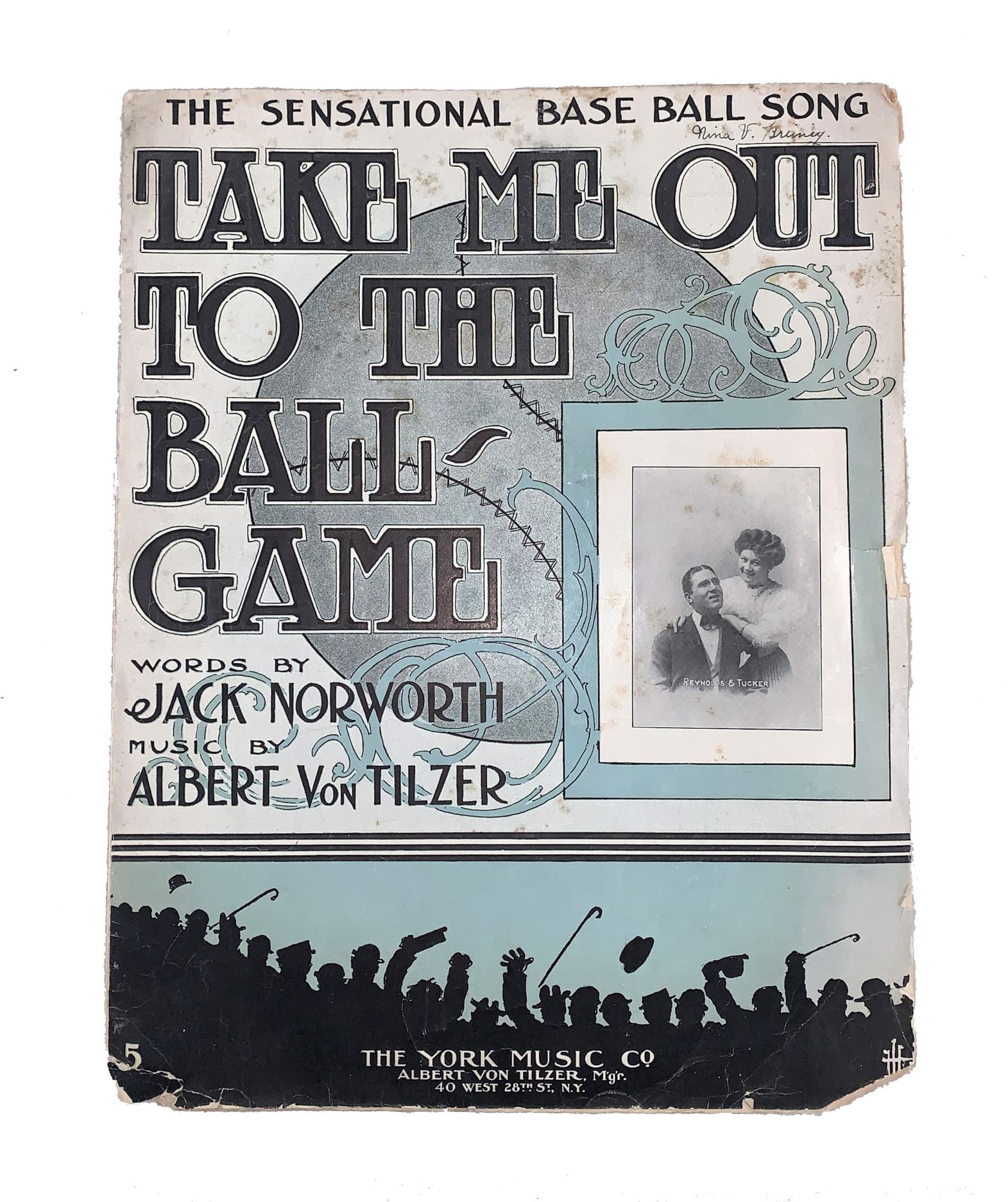
October 24, 1908: "Take Me Out to the Ballgame" Is Introduced

October 24, 1908: Baseball's anthem, "Take Me Out to the Ballgame," is introduced by singer Bill Murray -- no relation to the later actor who got his start on Saturday Night Live. At the time the song was written by composer Albert Von Tilzer and lyricist Jack Norworth (words), neither had ever seen a game. But Norworth had seen an advertising sign on the new (opened 1904) New York Subway:
BASE BALL
TO-DAY
POLO GROUNDS

And he was inspired to write a song about an Irish girl -- apparently his favorite subject, as so many of his songs had an Irish theme, not surprising for New York City at that time:

Katie Casey was baseball mad.
Had the fever and had it bad.

Just to root for her hometown crew
every sou, Katie blew.

On a Saturday, her young beau
called to see if she'd like to go
to see a show
but Miss Kate said no,
I'll tell you what you can do:

Take me out to the ballgame.
Take me out with the crowd.

Buy me some peanuts and Cracker Jack.
I don't care if I never get back.
Let me root, root, root for the home team.
If they don't win, it's a shame.
For it's one, two, three strikes, you're out
at the old ballgame.

Katie Casey saw all the games.
Knew all the players by their first names.
Told the umpire he was wrong,
all along, good and strong.

When the score was just two to two,
Katie Casey, she had the clue.

Just to cheer up the boys she knew,
She made the gang sing this song.


Take me out to the ballgame.
Take me out with the crowd.

Buy me some peanuts and Cracker Jack.
I don't care if I never get back.
Let me root, root, root for the home team.
If they don't win, it's a shame.
For it's one, two, three strikes, you're out
at the old ballgame.

A "sou" is a penny. Sometimes that archaic lyric is changed to "Every cent, Katie spent."
Norworth probably named her after the title character in the most famous baseball poem, "Casey at the Bat," written in 1888 and thus still relatively new. In 1927, Norworth rewrote the song, and the girl subject became Nellie Kelly -- a better rhyme, and still Irish. But most people don't even know there are verses: They only sing the chorus.
Edward Meeker made the first recording, but Murray appears to have been the first to sing it live. Murray had also recorded "Tessie," which became a ballpark chant for Boston Red Sox fans in 1903. Ironically, Murray was a fan of the New York Highlanders, the team that would become the Yankees. In an even greater irony, Von Tilzer didn't see a live major league game until 1928, and Norworth didn't until 1940.

It apparently took until 1934 for the song to be played at a major league game. In 1976, Chicago White Sox owner Bill Veeck noticed that, while organist Nancy Faust was playing it during the 7th Inning Stretch, broadcaster Harry Caray was leaning out of the press box, and inviting fans to sing the song with him. So Veeck piped Harry and the fans into the public-address system at Comiskey Park, and a tradition was born.

Harry took it with him across town to Wrigley Field, and, with the Cubs' partnership with cable-TV "superstation" WGN, made the singing of that song at that stage of the game a national phenomenon. (And probably saved Wrigley for at least 2 more generations.)

Unfortunately, Harry always got the words wrong, and, to this day, the celebrities the Cubs have brought on to sing it in Harry's place since his death in 1998 -- including that other Bill Murray, a noted Cub fan -- have repeated his mistakes: They sing, "Take me out to the crowd," and, "I don't care if I ever get back."

In 1994, I heard it played at Mercer County Waterfront Park (now Arm & Hammer Park), home of the Trenton Thunder of the Class AA Eastern League. The Thunder didn't do too well in that 1st season of professional baseball in New Jersey in the modern era, and it inspired me to sing, "I don't think this team's gonna come back, for it's root, root, root for the home team, if they don't win, it's the same."

*

October 24, 1908 was a Saturday. The only games played on this day were in college football. Some of them:

* The Carlisle Indian School, outside Harrisburg, Pennsylvania, made an early inroads into public consciousness, achieving a 6-6 tie with the University of Pennsylvania at the original Franklin Field. A freshman named Jim Thorpe scored Carlisle's touchdown, but also missed 3 field goals, any one of which could have won the game. Both teams had come into the game unbeaten: Carlisle at 5-0, Penn at 7-0.

* Another matchup of unbeatens took place at Worden Field, on the campus of the U.S. Naval Academy in Annapolis, Maryland. Navy played Harvard University, and this one also ended in a 6-6 tie.

* Yale University beat Washington and Jefferson University, 38-0 at Yale Field in New Haven, Connecticut.

* The University of Pittsburgh beat Bucknell University, 22-0 at Exposition Park in Pittsburgh, home of the Pittsburgh Pirates -- until the following June 30, when Forbes Field opened.

* Michigan beat Ohio State, 10-6 at Ohio Field in Columbus.

* Georgia Tech beat Alabama, 11-6 at Ponce de Leon Park in Atlanta, home of minor-league baseball's Atlanta Crackers.

* In New York City, Fordham and New York University were idle.

* In New Jersey, Rutgers lost to Haverford College, 9-5 in the Philadelphia suburb of Haverford, Pennsylvania. Princeton played the next day, held to a 0-0 tie by Syracuse at University Field in Princeton.

In that other kind of football, Woolwich Arsenal beat Manchester-area team Bury, 4-0 at the Manor Ground in Plumstead, Kent, now part of Southeast London.

Friday, October 14, 2022

October 14, 1908: Any Team Can Have a Bad Century

October 14, 1908: The Chicago Cubs win the World Series. This had happened just 368 days earlier. It would not happen again for another 39,466 days.

The Cubs may have been the defending Champions, but they had a rough time getting back to the World Series. Led by the poetic infield of shortstop Joe Tinker, 2nd baseman Johnny Evers, and 1st baseman and manager Frank Chance, they battled the New York Giants and the Pittsburgh Pirates to the last day of the season -- and beyond.

Because of what became known as the Fred Merkle Game on September 23, the Cubs and Giants finished tied for 1st, and the Pirates were 1 game back. On October 8, the Merkle Game was replayed, the Cubs beat the Giants, 4-2, to win the National League Pennant.

Their opponents were the Detroit Tigers, they, too, had a 3-way race that took the American League Pennant to the final day. Led by Ty Cobb, the Tigers finished just half a game ahead of the Cleveland Naps (the pre-Indians and pre-Guardians were named for their manager and 2nd baseman, Napoleon Lajoie), and a game and a half ahead of the Chicago White Sox.

Game 1 of the World Series was played at Bennett Park in Detroit on October 10. The Cubs led 5-1 going to the bottom of the 7th, the Tigers took a 6-5 lead into the 9th, then the Cubs scored 5 in the 9th to win, 10-6. Mordecai "Three-Finger" Brown was the winning pitcher.

The Cubs won Game 2, 6-1. The Series shifted to Chicago for Game 3, and the Tigers won it, 8-3 at the West Side Grounds. Brown pitched a 4-hit shutout in Game 4, and the Cubs won, 3-0. Back in Detroit, the Cubs scored a run in the top of the 1st in Game 5, and that was all that Orval Overall, the winning pitcher in Game 2, would need. The Cubs got another run in the 5th, and the final score was 2-0.

The Cubs would win the Pennant again in 1910, 1918, 1929, 1932, 1935, 1938 and 1945 -- but lost all 7 World Series. They didn't make the postseason again until 1984, including late-season collapses in 1969 and 1977, with a whole lot of mediocrity in between. Their greatest broadcaster, Jack Brickhouse, was quoted as saying, "Any team can have a bad century."

It got worse. They had a shocking collapse in the 1984 NL Championship Series. They lost the NLCS in far less dramatic fashion in 1989. They had an inspiring run to the Playoffs in 1998, but got swept in the NL Division Series. In 2003, they won the NLDS, their 1st win in any postseason series since the 1908 World Series, but had their most shocking loss of all in the NLCS. In 2007 and 2008, for the 1st time in 100 years, they reached the postseason in back-to-back years, but lost in the NLDS both times.

In the 1989 film Back to the Future Part II, the Cubs were shown winning the 2015 World Series, against a team from Miami with an alligator logo, obviously in the American League. It was a joke, because the Cubs never won the World Series. They never even won the Pennant. It seemed like a wild guess about the future, played for laughs.

It became less funny in 1991, when Miami was awarded an expansion team, to begin play in 1993, and to originally be known as the Florida Marlins, for the National League, making Cubs vs. Miami in the World Series impossible. It became considerably less funny in 2003, when a Cub collapse gave the Marlins the Pennant. And it became less funny still in the actual 2015, when the Cubs did make it to the NLCS, but lost to the New York Mets, the same team that had victimized them in 1969, though there was some payback in 1984.

Somehow, in 2016, they bounced back, winning 103 games to take the NL Central Division, then beating the San Francisco Giants in the NLDS, and then beating the Los Angeles Dodgers in the NLCS, to win their 1st Pennant since 1945. Or, as songwriter Steve Goodman, a Cubs fan who died during their ill-fated run to the 1984 Playoffs, put it...

You know the law of averages says
anything will happen that can.
But the last time the Cubs won a National League Pennant
was the year we dropped the bomb on Japan.  

Finally, on November 2, 2016, in Game 7 of that year's World Series, the Cubs became World Champions again.

UPDATE: The Cubs have a team Hall of Fame. Inducted from their 1906-10 dynasty have been Tinker, Evers, Chance, outfielder Frank "Wildfire" Schulte, 3rd baseman Henry "Heinie" Zimmerman, and pitchers Brown, Overall and Ed Reulbach.

*

October 14, 1908 was a Wednesday. This was the only score on this historic day: Football was in midweek, professional basketball barely existed, and it was too early for a new hockey season to begin.

Sunday, October 9, 2022

October 10, 1908: The 1st Highway

October 10, 1908: The Long Island Motor Parkway opens. It is the world's 1st highway, the first road designed exclusively for automobile use, the first concrete highway in the United States, and the first to use overpasses and bridges to eliminate intersections.

It was funded by William Kissam Vanderbilt II, the great-grandson of ferry and railroad tycoon Cornelius Vanderbilt, and an auto racing enthusiast who created the Vanderbilt cup race in 1904.

The road was originally planned to stretch for 70 miles, in and out of New York City, as far as Riverhead, the seat of Suffolk County, and the point of division for the north and south forks of Long Island. Only 45 miles were constructed, and on October 10, 1908, a 10-mile-long section opened as far as modern Bethpage.

It hosted races in 1908 and on the full road in 1909 and 1910, but an accident in the 1910 Vanderbilt Cup, killing two riding mechanics, led the New York State legislature to ban racing except on race tracks, ending its career as a racing road.

By 1911, the road was extended as far east as Lake Ronkonkoma. Its western stretch was also extended from Great Neck, Nassau County to what is now the Fresh Meadows neighborhood of Queens.

Roadway design advances of the 1920s rendered the road obsolete less than 20 years after construction. At the same time, Robert Moses was planning the Northern State Parkway. In 1929, the owners and some Long Island officials proposed that New York State should buy the road, and integrate it into the state parkway system, despite its narrow roadway (varying from 16 to 22 feet wide) and steep bridges not meeting new standards. Moses opposed the idea, stating that the Long Island Motor Parkway had been "a white elephant for the last twenty years."

The completion of the Northern State Parkway signaled the end for the road. In 1937, the portion of the Long Island Motor Parkway in Suffolk County was donated to Suffolk County. In July 1938, the remainder of the parkway's land was given to Nassau County and the Long Island State Parks Commission.

Most of the road in Queens is a bicycle trail from Cunningham Park to Alley Pond Park. The Nassau County roadway has been redeveloped, or turned into a right of way for Long Island Power Authority (LIPA) transmission lines.
Pretty much all of what's left looks something like this. 

*

October 10, 1908 was a Saturday. Game 1 of the World Series was played at Bennett Park in Detroit. The Chicago Cubs led 5-1 going to the bottom of the 7th, the Detroit Tigers took a 6-5 lead into the 9th, then the Cubs scored 5 in the 9th to win, 10-6. Mordecai "Three-Finger" Brown was the winning pitcher. The Cubs won the Series in 5 games.

Professional basketball barely existed. It was too early for a new hockey season to begin. Among the college football games played that day were these:

* Army beat Trinity College of Hartford, Connecticut, 33-0 on The Plain at West Point, New York.

* The Carlisle Indian School beat Syracuse, 12-0 at Archbold Stadium in Syracuse, New York.

* Rutgers lost to Lehigh, 12-0 at Lehigh Field in Bethlehem, Pennsylvania.

* Princeton and Lafyette played to a tie, 0-0 at University Field in Princeton, New Jersey.

* The University of Pennsylvania beat Pennsylvania State University: Penn 6, Penn State 0 at the original Franklin Field in Philadelphia.

* Navy beat Dickinson College, 22-0 at Worden Field in Annapolis, Maryland. Like the Carlisle Indian School, Dickinson was based in Carlisle, Pennsylvania.

* In a Washington vs. Baltimore matchup, Georgetown beat Johns Hopkins, 22-4 at Georgetown Field in Washington.

* In what would later become a major rivalry, the University of Michigan and Michigan State Agricultural College played to a tie, 0-0 at College Field in East Lansing. MSAC became Michigan Agricultural College in 1909, Michigan State College in 1925, and Michigan State University in 1955.

* The University of Chicago beat Indiana, 29-6 at Stagg Field in Chicago.

* And in an intra-State rivalry, Kansas beat Kansas State, 12-6 at McCook Field in Lawrence, Kansas.

And in English soccer, South-East London team Woolwich Arsenal, later to be Arsenal F.C., the North London team I would one day support, beat Manchester City, 3-0 at the Manor Ground in Plumstead.

Friday, October 7, 2022

October 8, 1908: The Merkle Playoff

Three-Finger Brown

October 8, 1908: In a make-up game necessitated by 19-year-old 1st baseman Fred Merkle's baserunning "boner" on September 23, the New York Giants met the Chicago Cubs at the Polo Grounds to decide the National League Pennant. Officially, Major League Baseball does not recognize this game as a "Playoff," but as a makeup of the September 23 game.

Both teams were 98-55, with the Pittsburgh Pirates, led by Honus Wagner, just 1 game behind them at 97-56. The Giants won 11 of their last 16, the Cubs 8 of their last 10, and the Pirates 9 of their last 10 before losing a makeup game against the Cubs on October 4, which eliminated them and kept the Cubs in position to win the Pennant, if they could win the makeup game against the Giants. It was the greatest Pennant race in National League history, and would remain its only real 3-team race until 1964.

And, judging from the newspaper accounts collected in G.H. Fleming's 1981 book The Unforgettable Season, we can only imagine that ESPN would have had wild coverage of the race, and that social media would have been absolutely poisonous.

Officially, the 1890-1911 version of the Polo Grounds was full to about 40,000 people. Unofficially, reports have suggested anywhere from 80,000 to 250,000 outside. This could very well have been the most people that ever showed up for a baseball game, regardless of whether they got in or not. Reports at the time told of people who died falling out of trees trying to watch, and of a man electrocuted while trying to watch from the elevated railway which then overlooked the ballpark.

Giant manager John McGraw, "the Little Napoleon," of course, started his best pitcher, the best pitcher in the game at that point, Christy Mathewson, who was 37-10. "Matty" had told McGraw, "I'm not fit to pitch today. I'm dog-tired." Although he had a full 4 days' worth of rest, he'd previously pitched 384 innings that season -- even in the Dead Ball Era, that was a lot -- and from September 12 to October 3, had pitched 10 games in 22 days, including 2 relief appearances.

Cub manager Frank Chance, "the Peerless Leader," started Jack Pfeister, who was only 12-10 on the season, but whose record against the McGrawmen earned him the nickname "Jack the Giant Killer." Jack would kill no Giants today: He began by hitting Fred Tenney with a pitch (in spite of all the passions running around the game, it was definitely not intentional), then walked Buck Herzog, picked Herzog off 1st base, gave up a double to Mike Donlin to score Tenney, and walked Cy Seymour.

Chance went against his name and took no more chances. He removed Pfeister, and brought in his best pitcher, the one man in the National League (along with Ed Walsh of the Chicago White Sox and Addie Joss of the Cleveland Naps in the American League) who could challenge Mathewson for the title of baseball's best pitcher: The man whose childhood farm accident had left him with a grip that gave him the best curveball in baseball at the time, Mordecai "Three-Finger" Brown. Brown got Art Devlin and Harry "Moose" McCormick out to end the threat.

It was still 1-0 New York in the bottom of the 3rd. Joe Tinker led off with a triple, and was singled home by Johnny Kling. Johnny Evers drew a walk. Frank "Wildfire" Schulte hit a double that scored Kling. Chance helped his own cause with a 2-run double. It was 4-1 Chicago, and the Polo Grounds crowd grew despondent.

Brown allowed a run in the bottom of the 7th, and the crowd picked up a little. But no more. The final score would be Cubs 4, Giants 2. The Cubs had their 3rd straight Pennant.

The game over, the Cubs, knowing that the crowd would be furious over having the Pennant "stolen" from them, made a mad dash for the clubhouse in center field. Most of them made it, but someone took a dagger and slashed Chance on the shoulder, and he had to be stitched up.

McGraw ordered pocket watches made, and given to all the Giant players, inscribed "THE REAL CHAMPIONS 1908." And for the rest of his life -- he lived until 1934, outliving Chance by 10 years -- he stood by Merkle, calling him the smartest player he'd ever managed, in spite of the "Bonehead" nickname that still stuck to him.

The Cubs went on to beat the Detroit Tigers, with young superstar Ty Cobb, in the World Series. They didn't win another Series for 108 years. The Giants would win 7 over that stretch, although they left New York for San Francisco after the 1957 season.

Merkle, as it turned out, outlived every Cub who played in the game, except for right fielder Jimmy Slagle, who outlived him by 2 months, both dying in 1956. The last survivor from either the September 23 game or the October 8 game was Giant shortstop Al Bridwell, who lasted until 1969.

As the last survivor, Bridwell was interviewed about it by Giant fan Lawrence S. Ritter for his 1966 book of baseball interviews The Glory of Their Times. He got the hit that would have scored the run in the September 23 game, had Merkle actually touched 2nd base, and, for all the grief it brought Merkle, told Ritter he wished he'd never gotten that hit.

October 8, 1908 was a Thursday. There was 1 other game in the major leagues that day. The Washington Senators beat the New York Highlanders, 7-5 at American League Park in Washington. Earle Gardner -- not to be confused with Earle Stanley Gardner, author of the Perry Mason novels -- went 4-for-5 for the Highlanders, to no avail. They finished 51-103, the most losses in franchise history to this day. In 1913, they would officially change their name to what many observers were already calling them: The New York Yankees.

Saturday, October 1, 2022

October 2, 1908: Ed Walsh vs. Addie Joss

Addie Joss (left) and Ed Walsh

October 2, 1908:  In a wild 3-team American League race, every bit as tight as the 3-team race going on in the National League at the same time, the AL has perhaps its greatest pitching duel ever, between 2 future Hall-of-Famers, at League Park in Cleveland.

Big Ed Walsh of the White Sox strikes on 15 batters, setting a new AL record that stood for 30 years. It was his 40th win of the season. But it's not enough, as Addie Joss, a.k.a. the Human Hairpin for his slender build and his tight pitching motion, pitches a perfect game for the Cleveland Naps, who win, 1-0. Joss advanced to 24-11. Walsh "fell" to 39-15.

Napoleon Lajoie, one of the greatest all-around players of the era, a member of the 3,000 Hits Club and a great fielder, too, was the Cleveland team's 2nd baseman and manager. They were renamed the Naps in his honor in 1903, after being named the Blues. He left after the 1914 season, and they were renamed the Indians, which they would remain until becoming the Cleveland Guardians in 2022.

So the ChiSox and the Naps had played the greatest game in the American League's 8-year history, with both really needing it to win the Pennant. And yet, neither team does. The Detroit Tigers do, the Naps finishing half a game behind, the White Sox 1 1/2 behind: Detroit 90-63, Cleveland 90-64, Chicago 88-64.

Why wasn't the Tigers' missing 154th game made up? I don't know: Neither The Unforgettable Season by G.H. Fleming nor Crazy '08 by Cait Murphy explains why.

It's the 2nd of 3 straight Pennants for the Tigers. The ChiSox had won in 1901 and 1906. The Naps/Indians will not get this close to a Pennant again until they win it all in 1920.

Joss died of meningitis on April 14, 1911, the eve of what would have been his 10th in the major leagues. He was only 31. In 1978, the Baseball Hall of Fame gave him a special waiver on the rule that says players must have played at least 1 game in at least 10 different seasons to qualify for election, since he would have pitched in 1 such game had he been stricken just 1 week later. He was soon elected. It was deserved: He was 160-97, his WHIP of 0.968 is the lowest ever, and his ERA of 1.89 is the 2nd-lowest.

The lowest? Walsh, at 1.82. And his WHIP, exactly 1.000, is 2nd all-time to Joss. He would pitch a no-hitter of his own in 1911. He went 192-126 for his career. And, unlike Joss, he played on a Pennant winner, as the White Sox won the 1906 World Series. He died on May 26, 1959, the day Harvey Haddix pitched a perfect game for 12 innings for the Pittsburgh Pirates, but lost the game to the Milwaukee Braves in the 13th inning.

*

October 2, 1908 was a Friday, the start of the last weekend of one of baseball's greatest regular seasons. Both Leagues had 3-way races.

* The Detroit Tigers beat the St. Louis Browns, 7-6 at Bennett Park in Detroit. Ty Cobb went 1-for-3 with 2 walks and 2 RBIs.

* The New York Highlanders lost to the Washington Senators, 12-2 at Hilltop Park in Manhattan. The proto-Yankees went 51-103 that season, and it remains the most games they've ever lost in a season.

* The Boston Red Sox lost to the Philadelphia Athletics, 8-1 at Columbia Park in Philadelphia.

* In the National League, the New York Giants beat the Philadelphia Phillies, 7-2 at Baker Bowl in Philadelphia.

* The Chicago Cubs beat the Cincinnati Reds, 5-0 at the Palace of the Fans in Cincinnati. Mordecai "Three-Finger" Brown pitched a 4-hit shutout.

* The Pittsburgh Pirates swept a doubleheader from the St. Louis Cardinals at Robison Field in St. Louis, 7-4 and 2-1. Over the 2 games, Honus Wagner went 3-for-8 with an RBI.

* And the Brooklyn Superbas (Dodgers) beat the Boston Doves (Braves), 3-2 at Washington Park in Brooklyn.

Friday, September 30, 2022

October 1, 1908: Ford Introduces the Model T

October 1, 1908: The Ford Motor Company begins producing the Model T, a.k.a. "The Tin Lizzie." By 1913, Henry Ford would use the assembly line to crank out a near-continuous stream of them, saying, "You can have any color car you want, as long as it's black." 

He offered his workers $5.00 a day -- $159 in 2022 money. That works out to about $800 a week -- before taxes. He believed that a man should be able to buy the very thing his labor built. Ford was unusual in that he gave his black workers the same pay rate as his white workers.

But he wasn't as enlightened as this would suggest: He was a notorious anti-Semite. He was also a micromanager who tried to run his workers' lives. And when they tried to unionize, he hired a security firm to beat up striking workers. He eventually caved in.

In 1913, Ford started using an assembly line to build his cars. He was not the first executive to adopt the idea, nor even the first in the American automobile industry. But he was the popularizer of it, because it reduced the time to produce a single car from 12 hours and 30 minutes to 2 hours and 40 minutes.

He sold over 1 million Model Ts in 19 years, helping to make Detroit the automotive capital of the world. In 1927, he introduced a successor, a nicer car called the Model A. The song he commissioned to introduce it said, "Henry's made a lady out of Lizzie."

*

October 1, 1908 was a Thursday. These baseball games were played that day:

* The New York Highlanders beat the Washington Senators, 2-1 at Hilltop Park in Manhattan. It was a bad season for the team that officially became the Yankees in 1913, but, on this occasion, a battle of Hall-of-Famers was won by Jack Chesbro over Walter Johnson.

* The New York Giants, in a furious 3-way race for the National League Pennant, split a doubleheader with the Philadelphia Phillies at Baker Bowl in Philadelphia. The Giants won the 1st game, 4-3, with Christy Mathewson going the distance. The Phillies won the 2nd game, 6-2.

* The Brooklyn Superbas beat the Boston Doves, 2-1 at Washington Park in Brooklyn. Superbas? They had been managed by Ned Hanlon, and there had been a famous circus troupe known as Hanlon's Superbas. They became the Dodgers in 1911. Doves? Their owner was John Dovey. They became the Braves in 1912.

* The Philadelphia Athletics beat the Boston Red Sox, 5-2 at Columbia Park in Philadelphia.

* The Chicago Cubs, in that 3-way fight with the Giants for the Pennant, beat the Cincinnati Reds, 6-0 at the Palace of the Fans in Cincinnati. Ed Reulbach pitched a 2-hit shutout.

* The Pittsburgh Pirates, the 3rd team in that Pennant fight, and the St. Louis Cardinals were not scheduled to play that day.

* The the Chicago White Sox, the Cleveland Naps (who became the Indians in 1915), the Detroit Tigers and the St. Louis Browns were also not scheduled. The White Sox, Naps and Tigers were in a tight 3-way race for the American League Pennant.

Thursday, September 22, 2022

September 23, 1908: Merkle's Boner

September 23, 1908: The New York Giants thought they'd beaten the Chicago Cubs, 2-1, in a big game in a dogfight of a 3-way Pennant race that also involved the Pittsburgh Pirates.

Only they hadn't. Al Bridwell had singled home the winning run, but the fans came running onto the field at the Polo Grounds in New York. And the runner on 1st base, a 19-year-old rookie named Fred Merkle, got scared, and ran for the clubhouse that stood behind the center field fence.

He didn't touch 2nd base.

This had happened many times before. The rule stating that a player had to get to the base was usually not enforced under such circumstances. You know: "Everybody does it."

But Cub 2nd baseman Johnny Evers saw this, and yelled for the ball, got it, stepped on 2nd, and got the attention of umpire Hank O'Day, who called the force play at 2nd. This time, the rule was enforced, Merkle was out, and the run didn't count.

Play could not be restored, as there was no way to clear the field of fans. By all rights, the Giants should have been declared losers by forfeit, for an inability to control their home grounds. Instead, it went into the books as a 1-1 tie.

I won't bore you with the details of the recriminations that went back and forth between the Giants and the Cubs, and between the Giants and the National League office, other than to say it was ugly, and it looked more like Republicans vs. Democrats than rival sports teams. I'll cut right to the chase: The NL race finished in a tie between those 2 teams, with the Pirates just 1 game back. And the league office ordered the September 23 game to be replayed on October 8.

Despite having Christy Mathewson, perhaps the greatest pitcher the game has ever known and the most popular athlete of the time, starting that game, the Giants lost, 4-2, with the Cubs bringing in for relief one Mordecai Peter Centennial Brown, known as Three-Finger Brown because of a childhood accident that left him with only 3 usable fingers, and as a result with a nasty curveball.

Merkle was 19, and for the rest of his life, he was known as "Bonehead," and the play became known as "Merkle's Boner." He played on until 1922, and was hardly a bad player.

In 1950, the Giants held an old-timers' day at the Polo Grounds, and invited Merkle. He accepted. When introduced, the fans -- most of them not old enough to have been there 42 years earlier, but nearly all having heard his sad story -- gave him a standing ovation.

Merkle deserved a better fate even than that. Even his manager, John McGraw, said it wasn't his fault. McGraw, along with Connie Mack 1 of the 1st 2 managers elected to the Hall of Fame, said it was the team that let Merkle down, not vice versa. If one of the sorest losers in the game's history could forgive Merkle, and later Giants fans could...

Baseball still thinks of him as the Bonehead. And for a man who has been dead since 1956 and is unable to defend himself, that's just not fair. On the 100th Anniversary of the game in question, in the spirit of ESPN, I wrote The Top 5 Reasons You Can't Blame Fred Merkle for the New York Giants Losing the 1908 National League Pennant. 

Though the Cubs won that 1908 World Series, for whatever reason, or collection of reasons, they did not win another until 2016 -- 108 years. They did not even win a Pennant from 1945 to 2016. Some spoke of the Curse of the Billy Goat. But did the Cubs win that 1908 Pennant unfairly? Is there a Curse of Fred Merkle? After all, the Goat Curse came in 1945. How do you explain the Cubs' 0-6 record in World Series play from 1909 to 1944?

I don't think Merkle was a mean enough person to put a curse on the Giants, even if such a thing were possible. I think the Cubs' century-long drought was attributable to bad management. We who are baseball fans, instead of blaming Fred Merkle for his "boner," or even forgiving him, should declare that there's nothing to forgive. Let him rest in peace.

*

September 23, 1908 was a Wednesday. There was a full slate of games that day, in addition to the Merkle's Boner game:

* The New York Highlanders lost to the Cleveland Naps, 9-3 at League Park in Cleveland. Frank LaPorte hit a home run for the Highlanders, but it was for naught. Jack Chesbro was the losing pitcher, and only pitched 2 more games for the team. In 1913, the Highlanders officially changed their name to what many people were already calling them: The Yankees. The Naps were named for their manager and 2nd baseman, Napoleon "Nap" Lajoie. After he left in 1914, they changed their name to the Cleveland Indians.

Lajoie did not have an official at-bat in this game, but drew a walk and was hit by a pitch, and scored both times.

League Park was torn down and replaced by another ballpark of the same name in 1910, which was home to the Indians until 1946.

* The Brooklyn Superbas lost to the Pittsburgh Pirates, 2-1 at Washington Park in Brooklyn. Honus Wagner went 2-for-4 for the Pirates. The Brooklyn team had once been managed by Ned Hanlon, and there was a famous circus troupe named Hanlon's Superbas. The team became the Dodgers in 1911, the Robins under the managing of Wilbert Robinson in 1914, and the Dodgers again in 1932, before moving to Los Angeles in 1958.

* The Boston Doves swept a doubleheader from the St. Louis Cardinals at the South End Grounds in Boston. The hosts won the 1st game 7-2, and the 2nd game 4-1. They were then named for their owners, brothers George and John Dovey. In 1912, they were bought by James Gaffney, an officer in the Tammany Hall political organization, a "Brave," and he changed the name of the team to the Boston Braves.

* The Cincinnati Reds beat the Philadelphia Phillies, 1-0 at Baker Bowl in Philadelphia.

* The Boston Red Sox beat the Detroit Tigers, 4-1 at Bennett Park in Detroit. Tris Speaker went 0-for-4, but won. Ty Cobb went 2-for-4, but lost. Cy Young outpitched Will Bill Donovan. Bennett Park was torn down before the 1912 season, with a new ballpark built on the site. It was named Navin Field, renamed Briggs Stadium in 1938, and renamed Tiger Stadium in 1961.

* The Chicago White Sox beat the Philadelphia Athletics, 3-2 in 10 innings at South Side Park in Chicago.

* And the St. Louis Browns beat the Washington Senators, 5-4 at Sportsman's Park in St. Louis. That ballpark was torn down in the off-season, and replaced by another ballpark of the same name, which lasted until 1966.

December 31, 1999 & January 1, 2000: The Millennium

December 31, 1999:  The Millennium arrives. The people of planet Earth survived. At a terrible cost. But we hadn't destroyed ourselves. ...