Showing posts with label red grange. Show all posts

Sunday, December 18, 2022

December 18, 1932: The NFL Moves Indoors

December 18, 1932: A Playoff game is held to determine the Champion of the National Football League. Snow forces the young League indoors for the 1st time.

There had been controversies for the League title in 1921 and 1925, so having a definitive title game would have helped. This time, there would be no questions.

The Chicago Bears, owned and coached by NFL founder George Halas, and with the all-time greatest running back tandem of Red Grange and Bronko Nagurski, were the best team in the League. Their record was 6 wins, 1 loss... and 6 ties.

They began the season badly, not scoring at all in their 1st 4 games. Their 1st 3 games were all scoreless ties, away to the Green Bay Packers, away to New York's Staten Island Stapletons, and against the Chicago Cardinals. And then the Bears lost 2-0 at home to the Green Bay Packers, so they were 0-3-1.

For a reason I haven't been able to find, the Cardinals shared Wrigley Field with the Bears and baseball's Chicago Cubs for the 1932 season, instead of playing their home games at the White Sox' Comiskey Park like they usually did. So while the 0-0 tie between the Chicago teams was at Wrigley, it was officially a home game for the Cardinals.

The Bears snapped out of it. The Stapletons came into Wrigley, and the Bears beat them, 27-7. The Bears made an Eastern swing, and tied the Boston Braves (the team that would become the Washington Redskins) 7-7, and beat the New York Giants 28-8. With 3 straight home games, they tied the Portsmouth Spartans, 13-13; beat the football version of the Brooklyn Dodgers, 20-0, and beat the Cardinals, 34-0.

Portsmouth, Ohio, across the Ohio River from Portsmouth, Kentucky, about 100 miles east of Cincinnati, was one of those small Midwestern cities like the ones that founded the NFL: Green Bay, Wisconsin; Decatur, Illinois, from whence the Bears came; Muncie, Indiana; Canton, Ohio; Rochester, New York. Of those, only Green Bay survives today.

The Spartans began in 1930, and were 5-6-3. But under head coach George "Potsy" Clark, they started 1931 out at 8-0, before falling to 11-3, and finishing 2nd in the NFL to the Packers. With a backfield -- both offensive and defensive in those days -- of Earl "Dutch" Clark (no relation to Potsy), Glenn Presnell, LeRoy "Ace" Gutowski and Roy "Father" Lumpkin, they were 5-1-3 when they hosted the Bears at Universal Stadium on November 27, the Sunday after Thanksgiving. The game ended in a 7-7 tie.

The Spartans played just 1 more game, beating the Packers, 19-0 at home. The Bears played 2 more, both at Wrigley, beating the Giants 6-0 and the Packers 9-0. The Bears had finished 6-1-6, the Spartans 6-1-4. Under current rules, with winning percentage being the decider, and ties being counted as half a win and half a loss, the title would actually have gone to the Packers: Their 10-3-1 record gave them a winning percentage of .750, to the Bears' .692 and the Spartans' .636. Of course, under current rules, every team would have played the same number of games: The Packers had played 14, the Bears 13, the Spartans 11.

But ties weren't counted, and so the percentages were actually Bears .857, Cardinals .857, and Packers .769. After winning the NFL Championship in each of the preceding 3 seasons, Green Bay were out, and there was a tie for the title. So a Playoff game was set for Sunday, December 18, at Wrigley Field, since it had more seats than Universal Stadium. The Spartans did not object: Money from gate receipts mattered more than home-field advantage. It was the depth of the Great Depression, after all, between the electoral rejection of Herbert Hoover and the Inauguration of Franklin Delano Roosevelt.

But Chicago was hit by snow, and it stayed cold all week. It was impossible to play the game at Wrigley, or at Comiskey, or at Soldier Field, or at the University of Chicago's Stagg Field, or at Northwestern University's Dyche Stadium.

In 1929, the Chicago Stadium, on the West Side, opened as the new home of the NHL's Chicago Black Hawks. In 1930, the Bears and the Cardinals had played a postseason charity exhibition game indoors there. George Halas suggested to Potsy Clark that they move the Playoff game to the Stadium. Since the only other option was to wait until an outdoor stadium was available, by which point his team might have gotten stale in waiting, he agreed.
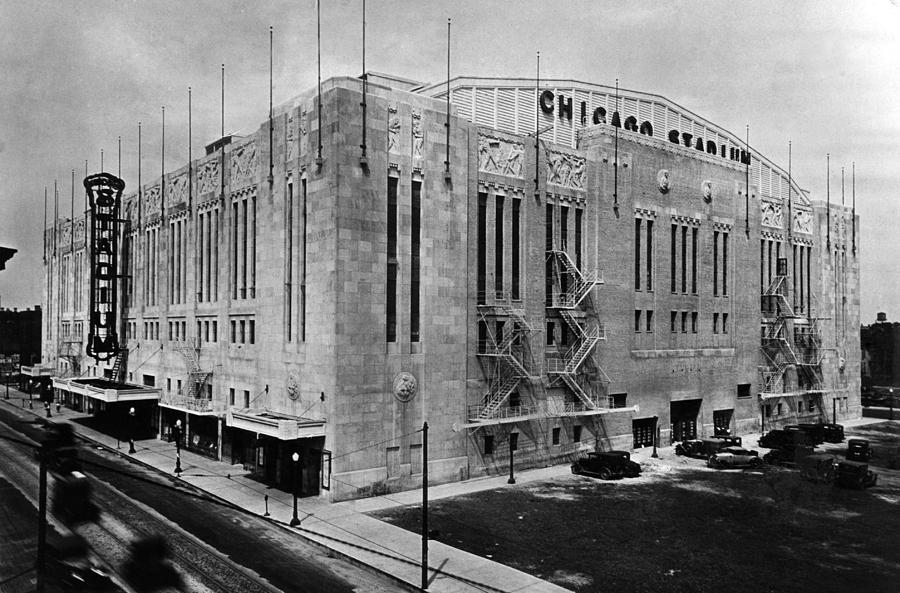
A week before the game, the concrete surface had tanbark, the bark of oak trees, placed atop it, for a Salvation Army-sponsored circus. Elephant manure that had seeped into the surface produced an odor that caused a Bears player to throw up on the field. And because of the limited dimensions of the indoor arena, special rules were adopted for the game:

  • The tanbark-covered field itself was only 80 yards long -- 60 yards between the goal lines -- and 45 yards wide, 10 yards narrower than the regulation width at the time.
  • The goalposts were moved from the endlines to the goal lines.
  • Every time a team crossed the 10-yard line, the ball was moved back 20 yards to allow for the shortened field.
  • For the first time, all plays started with the ball on or between the hash marks, which were 10 yards from the sidelines.
  • The forward pass, officially legal only from 5 yards behind the line of scrimmage, was legalized from anywhere behind the line of scrimmage.
  • Drop kicks (still relatively common) and field goals would not be used in the game, for fear of footballs going into the stands, and the referees running out of them.

The high temperature for that Sunday in Chicago was 20 °F, warmer than anticipated earlier in the week. Attendance was listed at 11,198 -- about half the heated Stadium's capacity, but probably more than would have braved the cold at Wrigley, had the snow been removed from the field to make playing a game there possible. The host Bears wore white jerseys, the Spartans purple.

With terrible footing on the mulch, limited room for the offenses to work, and the circumstances of the era making the NFL a defense-oriented league at the time, anyway, the defenses dominated the game's 1st 3 quarters, with the game remaining scoreless. Bears quarterback John Doehling's 1st pass flew into the stands, as did most punts and kickoffs, rendering the fear that caused the cancellation of dropkicks and field goals very real. One punt collided with a Black Hawks sign. Another hit Al Melgard, the Stadium's organist. Only 1 punt had the chance to be returned.
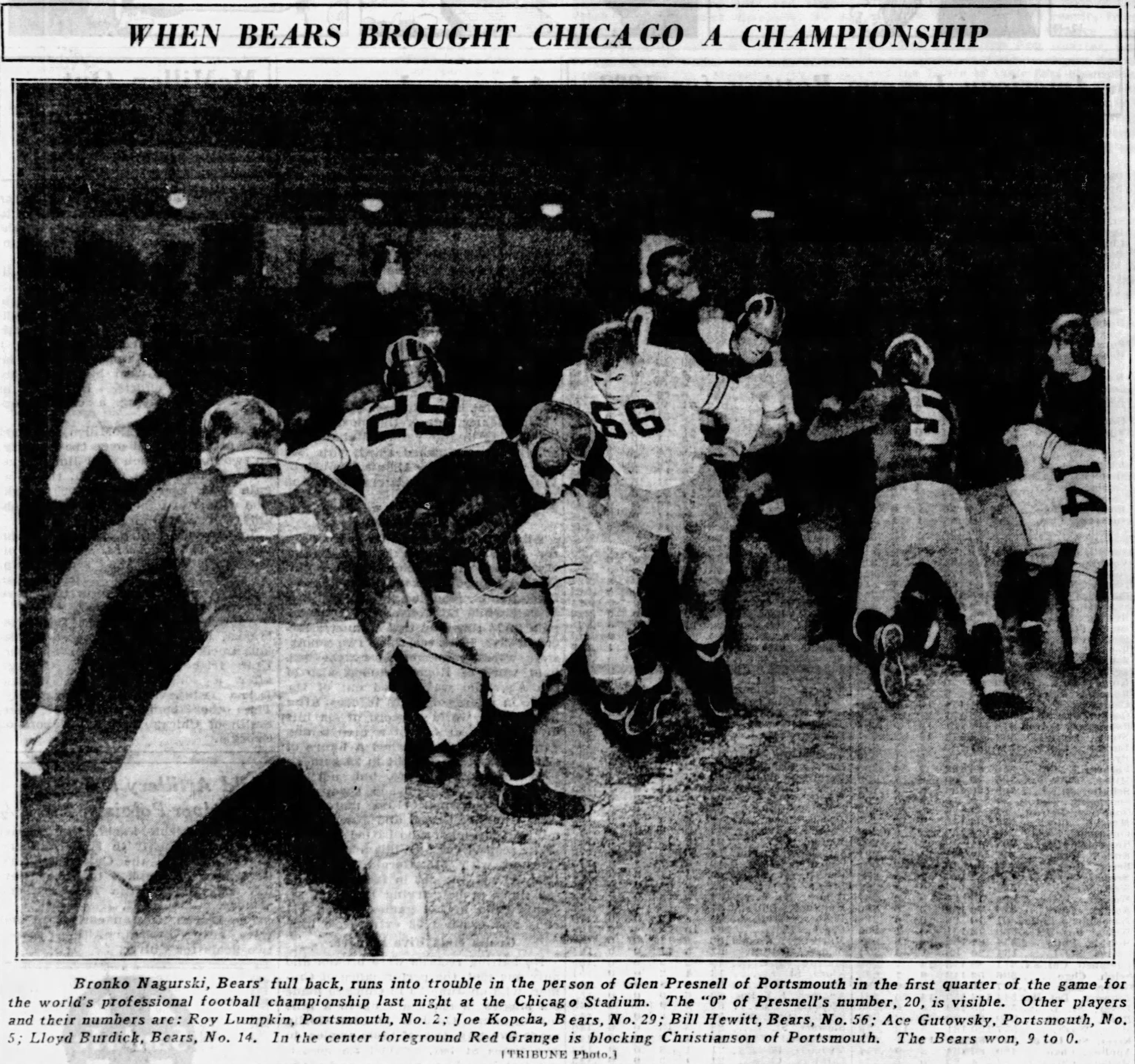
On one drive, the Spartans were in position to score when Presnell tripped before he could reach the end zone. In the 4th quarter, the Bears scored on a controversial touchdown: Carl Brumbaugh handed the ball off to Nagurski, who pulled up and threw to Grange in the end zone for the score. The Bears later scored a safety after the Spartans fumbled the ball out of their end zone, making the final score 9-0, and the Bears were Champions.

To eliminate the circumstances of the 1932 Playoff -- barring the weather, which, of course, even George Halas couldn't control, or at least buy control of -- the NFL got seriously revamped prior to the 1933 season. The liberalized passing rules required by the smaller field from the Playoff were written into the regular rules. So was the creation of hashmarks, to keep the ball closer to midfield, lengthwise. Putting the goalposts on the goal line was kept, until they were moved back to the end line in 1974. 

The League was divided into an Eastern Division and a Western Division, with each team playing each of its Division opponents home and away, no more, no less; and each Division winner facing the other in an NFL Championship Game, to determine a definitive title-winner.

The Western Division winner would host the Championship Game in odd-numbered years, the Eastern winner in even-numbered years. The Bears won the 1st such game, beating the Giants, 23-21 at Wrigley. The following year, the Giants beat the Bears at the Polo Grounds in New York.

All these changes, and a slimmer football that was introduced for the 1934 season, led to more scoring, and fewer ties, and helped increase the NFL's popularity. It was these changes that turned the NFL from what could still be called a minor league into a major league.

In 1934, Detroit radio executive George Richards bought the Spartans, and moved them, making them the Detroit Lions. They won the NFL Championship in 1935. The 8,500-seat Universal Stadium, the Spartans' former home, is one of the few remaining relics of the early NFL: It has been renamed Spartan Municipal Stadium, after both of the teams famous for playing there, the other being Portsmouth's Notre Dame High School.

Today, Portsmouth is home to about 18,000 people. It was the hometown of Major League Baseball stars Al Bridwell, Del Rice, Rocky Nelson, Al Oliver, Gene Tenace and Larry Hisle; baseball executive Branch Rickey; opera singer Kathleen Battle; Ohio Governor Ted Strickland; and "singing cowboy" Roy Rogers.

In 1968, the American Football League's Houston Oilers moved into the Astrodome. In 1970, with the rest of the AFL, they were merged into the NFL. On September 27, 1970, they played the NFL's 1st indoor regular-season game, losing to the Miami Dolphins, 20-10. In 2022, out of the NFL's 32 teams, 10 play under domes, 5 of them having retractable roofs, allowing both indoor and outdoor games. The Chicago Bears are not one of them, but the Detroit Lions, who used to be the Portsmouth Spartans, are.

*

December 18, 1932 was a Sunday. Baseball was out of season. The NBA hadn't been founded yet. There were 2 games in the NHL. Chicago Stadium was available because the Chicago Black Hawks were on the road, and played the New York Americans to a tie, 0-0 at Madison Square Garden. And the Detroit Red Wings, in their 1st season under that name, beat the Boston Bruins, 2-1 at the Olympia Stadium in Detroit.

Saturday, December 17, 2022

December 17, 1933: The 1st NFL Championship Game

Hewitt's lateral to Karr

December 17, 1933: The 1st official NFL Championship Game is played. Appropriately, it's between the League's founding team, the Chicago Bears; and its team in the biggest market, the New York Giants.

There had been controversies for the League title in 1921 and 1925, so having a definitive title game would have helped. In 1932, the Bears and the Portsmouth Spartans (who became the Detroit Lions in 1934) finished tied for first: The Bears were 6-1-6, the Spartans 6-1-4. (At the time, ties were not counted in winning percentage.) So a playoff game was set, and the Bears won it, 9-0.

So, for the 1933 season, the NFL was divided into Eastern and Western Divisions, and the winners were to meet in a Championship Game. The Giants won the East, going 11-3. The Bears won the West, 10-2-1. So the decider was set for Wrigley Field. (Until the Super Bowl began, regardless of which team had the better record, the West winners would host the game in odd-numbered years, and the East winners would do so in even-numbered years.

Coached by Steve Owen, the Giants had some fantastic players: Quarterback Harry Newman, running back Ken Strong, end Ray Flaherty, and the man regarded for decades to come as the best center in NFL history, Mel Hein.

George Halas, one of the co-founders of the NFL, coached the Bears. They had 2 of the defining players of NFL history, speedy halfback Harold "Red" Grange and bruising fullback Bronislau "Bronko" Nagurski. They also had center George Trafton, tackles Link Lyman and George Musso, and end Bill Hewitt, who famously played without a helmet, at a time when that was still allowed, even though everybody knew it was a bad idea. All of them are in the Pro Football Hall of Fame.

Another difference in this new season was a liberalization of the passing rules. The Bears, the 1st NFL team to use the T formation, took advantage of this. The Giants had not done so as much. Nevertheless, when meeting with the officials before the game, Newman told them the Giants would be trying some trick plays, checking to ensure they would be legal.

The game kicked off at 1:45 PM Central Time (2:45 Eastern). It was broadcast on Chicago radio station WGN and a few other stations, but not on a national network. Nor was it broadcast on radio in New York.

Early in the game, the Giants' offensive line shifted, so that Hein was now on the end, and thus an eligible receiver. Hein snapped the ball to Newman, who handed it right back to him, then ran out to fake a run. While the Bears keyed on Newman, Hein took off. By the time the Bears caught on and caught up with him, he had gotten to the Bears' 15-yard line. But Chicago managed to, as their later fight song said "Bear Down," and hold the Giants to a field goal attempt, which the normally reliable Strong missed.

Jack Manders, so reliable he was known as "Automatic Jack," kicked field goals in each of the 1st 2 quarters, and the Bears led 6-0. But just before the half, Newman threw a 29-yard touchdown pass to Badgro, and the Giants went into the locker room up 7-6.

Manders kicked another field goal in the 3rd quarter, but a Giant drive resulted in Max Krause scoring from the 1-yard line, making it 14-9 New York. Finally, late in the quarter, Nagurski, not known as a passer, or as a jumper -- his style was to take the ball, crash into the line, and let the defenders fall where they may -- threw a jump pass to Bill Karr, who ran it in 8 yards for a touchdown, and the Bears led, 16-14.

The Giants had another trick play in them, early in the 4th quarter. Newman took off on a 30-yard run, then lateraled to Strong, who finished the touchdown, and then kicked the extra point. It was 21-16 Giants.

The minutes ticked away, and another Manders field goal would have done the Bears no good. Quarterback Carl Brumbaugh drove them to the Giants' 36 with less than 2 minutes left. He passed to Hewitt, and the Giant defense was ready to tackle him. But pulled the "hook and ladder play": He spun and lateraled to Karr, who took it in for a touchdown. The Bears led, 23-21.

The Giants got the ball back, and there was still time for them to get within Strong's field goal range. They got to their own 40, and again set Hein up as an eligible receiver. Running back Dale Burnett tried an option pass, and Hein was wide open on the Bear 30. But the pass was a bad one, and fell well short.

There was time for one more play. Newman passed to Badgro, who was ready to copy the earlier Hewitt-to-Karr hook and ladder. But this was the era of two-platoon football, where, no matter how big a star you were, you had to play both offense and defense. And there was no bigger star in football than Grange. He immediately figured out what was about to happen, and ran to Badgro, and wrapped his arms around Badgro's arms. Any lateral Badgro made wouldn't go very far. The clock ran out. Halas, eventually the grand old man of football, would later call it the greatest defensive play he ever saw.

The Bears were NFL Champions for the 3rd time, having won it in controversial fashion in 1921, and then definitively in 1932. The Giants had won in 1927, and would get revenge over the Bears in 1934, in the Polo Grounds, in a frigid contest known as The Sneaker Game.

These 2 teams would also meet in the NFL Championship Game in 1941, 1946, 1956 and 1963, with the Giants winning only in 1956. They've since met in the NFC Playoffs in the seasons of 1985, with the Bears winning; and 1990, with the Giants winning; and, each time, it was a good omen, as the winner went on to win the Super Bowl.

In 1981, John Thorn left his comfort zone, baseball, and published Pro Football's 10 Greatest Games. He included this game as the earliest of them.

In 2019, in connection with their 100th Season (not their 100th Anniversary, which was the next year), the Bears did fan balloting for their 100 Greatest Players. From the 1932 and 1933 NFL Champions, they chose running backs Red Grange and Bronislau "Bronko" Nagurski, guards Joe Kopcha and George Musso, tackle William "Link" Lyman, and ends Luke Johnsos and Bill Hewitt. From the 1934 team that didn't quite do it, they named halfback Beattie Feathers.

*

December 17, 1933 was a Sunday. It was the only football game played that day. Baseball was out of season. There was no NBA yet. There were 3 games played in the NHL:

* The New York Rangers and the Boston Bruins played to a tie, 2-2 at the old Madison Square Garden.

* The New York Americans and the Detroit Red Wings played to a tie, 4-4 at the Olympia Stadium in Detroit.

* And the Chicago Black Hawks beat the Montreal Canadiens, 4-1 at the Chicago Stadium. 

Tuesday, December 6, 2022

December 6, 1925: Red Grange Saves the NFL

December 6, 1925: The New York Giants football team, in its 1st season of play, is in deep financial trouble, in spite of a 10-3 record to this point -- 8-2 against NFL teams. Too few fans have come out to the Polo Grounds that team owners Tim and Jack Mara are afraid that their team will financially fail. And if the NFL's New York team fails, so will the League.

Red Grange to the rescue. Harold Edward Grange, "the Galloping Ghost" out of the University of Illinois, the most famous (or, at least, the most-hyped) player in the history of college football, comes in with his new teammates, the Chicago Bears.

A crowd of 68,000 people pays to get into the Polo Grounds, more than the Giants' last 3 home games combined. It's believed that another 8,000 crashed the gate, making the 74,000 crowd the biggest in the NFL's 6-season history to that point.

The Ghost lives up to the hype: He scores a touchdown on a 35-yard interception return, runs for 53 yards on 11 carries, catches a 23-yard pass, and completes 2 of 3 passes for 32 yards. And he is part of a defense that recorded a shutout. He could do everything except kick.

The Bears win, 19-0, but that's beside the point: The gate receipts from all the people coming out to see Grange mean that the Giants will be able to play the 1926 season. In 1927, they finish 1st, taking the 1st of what is now 8 NFL Championships, including 4 Super Bowls.

The Bears? They were a good team throughout the 1st decade of NFL play, winning the title in 1921, but won't win another title until 1932. By that point, Grange will be joined by Bronislau "Bronko" Nagurski, and they will win the title in 1933 as well.

Grange was the template for every speedy scatback who followed him: Steve Van Buren, Doak Walker, Frank Gifford, Lenny Moore, Paul Hornung, Gale Sayers, O.J. Simpson, Tony Dorsett, Marcus Allen, Walter Payton, Terrell Davis, Marshall Faulk, Chris Johnson, Joe Mixon.

Nagurski is the model for every big bruising fullback to come: Clarke Hinkle, Marion Motley, Tank Younger, Jim Taylor, Jim Brown, Larry Csonka, Franco Harris, John Riggins, Roger Craig, Emmitt Smith, Terrell Davis, Jerome Bettis, Adrian Peterson.

This -- not the 1958 NFL Championship Game that the Giants lost to the Baltimore Colts at Yankee Stadium -- is not only the biggest football game ever played in New York City; it is the most important game in the history of American professional football. If Grange had, for whatever reason, been unable to play in it, the Giants would have folded, and the NFL would probably have gone down the tubes during the Great Depression.

This might have opened the door for soccer, with its working-class roots and its ethnic appeal (most U.S. soccer teams at that point were ethnically based), to become America's Fall and Winter sport, possibly also hurting basketball and hockey. If you want to know why "football" made it in America, and "futbol" didn't until the 1970s, this, as much as America's natural distrust for "foreign" things, is the moment.

Even at the time, the 1920s, "The Roaring Twenties," was called "The Golden Age of Sports." It was Babe Ruth in baseball, Howie Morenz in hockey, Jack Dempsey in boxing, Paavo Nurmi in track, Bill Tilden in tennis, Bobby Jones in golf, and Man o' War in horse racing. In football, it was the Galloping Ghost, Red Grange.

Grange played until 1934, and became a broadcaster. He lived until 1991.

*

December 6, 1925 was a Sunday. These other NFL games were played that day:

* The Pottsville Maroons beat the Chicago Cardinals, 21-7 at Comiskey Park in Chicago. This led to the most controversial awarding of the NFL Championship in the League's history

* The Green Bay Packers beat the Providence Steam Rollers, 13-10 at the Cycledrome in Providence. The Steam Rollers debuted in 1916, joined the NFL for the 1925 season, won its Championship in 1928, and folded due to the Depression in 1933.

* The Cleveland Bulldogs beat the Canton Bulldogs, 6-0 at Dunn Field in Cleveland. (League Park used that name from 1921 to 1927.) Despite being just 60 miles apart, the cities' respective Bulldogs were separate teams.

* While baseball was in the off-season, and the NBA wasn't founded yet, there was also 1 NHL game played on this day. The Pittsburgh Pirates beat the Toronto St. Patricks, 6-3 at the Duquesne Gardens in Pittsburgh.

While the St. Patricks became the Toronto Maple Leafs in 1927, the Pirates -- as the NFL's Steelers were from their 1933 debut through 1939, named after the baseball team in town -- are not the forerunners of the Pittsburgh Penguins. In 1930, they moved across Pennsylvania, and became the Philadelphia Quakers. After one of the worst seasons in NHL history, both on the ice and at the Depression-addled box office, they folded.

Saturday, November 26, 2022

November 26, 1925: Red Grange Makes His Professional Debut

November 26, 1925: Red Grange, just 5 days past his last game for the University of Illinois, plays his first professional football game. (That was within the rules at the time, as there was no NFL Draft, let alone restrictions connected to it.)

I don't think I can underestimate how big an event this was considered to be. This was "The Golden Age of Sports," and, what Babe Ruth was to baseball, Jack Dempsey to boxing, Man o' War to horse racing, Howie Morenz to hockey, Paavo Nurmi to track, Bill Tilden to tennis, and Bobby Jones to golf, Red Grange was to football. He had Peyton Manning and Tom Brady levels of hype at a time when the only real form of mass media was newspapers. Radio broadcasting was in its infancy, television was still in the experimental stage, and newsreels weren't much yet.

It is the annual Thanksgiving Day tussle between Chicago's NFL teams, the Bears and the Cardinals, and Cubs Park -- which was renamed Wrigley Field the next season -- is packed to the gills, 39,000 people, to watch the Galloping Ghost put on his Number 77 jersey for the Bears -- in the same colors as UI, dark blue and orange, and the first truly famous uniform number in North American sports. The game ends in a scoreless tie.

(The NHL already had uniform numbers, but was still not thought of as an American game, so Howie Morenz's 7 was not yet famous outside Canada. And Major League Baseball wouldn't adopt numbers until 1929, so Babe Ruth hadn't yet begun wearing 3.)

Both Chicago teams finished 9-2, but the Cardinals had only 1 tie, while the Bears had 3. Under the rules then in effect, the standings were decided by winning percentage, with a tie counting as half a win, and not every team played the same number of games against in-league opponents. So the Cardinals had a winning percentage of .846, and the Bears .643. And that wasn't even the most controversial part. The Pottsville Maroons went 10-2, with no ties, so their percentage was .833. I described how the title was settled in the Cardinals' favor in a separate post.

The uneven scheduling was a big reason why the NFL was not exactly "major league" yet, and also a big reason why it needed a big name like Grange. Even having Jim Thorpe didn't help. The Philadelphia-based Frankford Yellow Jackets played 17 games. The Bears played 14. The Green Bay Packers played 13. The Cardinals, the Maroons, the Cleveland Bulldogs played 12. The New York Giants, the Detroit Panthers, the Rock Island Independents played 11. The Providence Steam Roller played 10. The Buffalo Bisons and the Columbus Tigers played 9. The Kansas City Cowboys, the Dayton Triangles, and the Canton Bulldogs -- not to be confused with nearby Cleveland -- played 8. The Rochester Jeffersons played 7. And struggling teams that soon went out of business played fewer: The Milwaukee Badgers 5, the Indiana-based Hammond Pros 4, and the Minnesota-based Duluth Kelleys 3.

Grange is one of the greatest all-around players in football history, a sensational running back and one of the best defensive backs of his era. He is also, by far, the most important player in the history of the NFL: If he had failed, the NFL might never have become bigger than it was in 1925, and likely would have gone out of business during the Great Depression, and another sport would have had to fill the gap between the end of the World Series in October and Opening Day in April. Maybe it would have been that other "football."

But Grange did succeed, and, along with his coach George Halas and his contemporary Jim Thorpe, he was one of the first 3 men elected to the Pro Football Hall of Fame.

*

November 26, 1925, as are all Thanksgiving Days, was a Thursday. Also on this day, the New York Giants, an NFL team in its 1st season, won 7-0 over the Staten Island Stapletons, a non-NFL team founded in 1915, and played in the Stapleton neighborhood of Staten Island. The game was played at the Stapes' home, Thompson Stadium, which stood from 1924 to 1933, and the attendance is listed as 10,000, which might be a sellout.

The Stapes did not join the NFL until the 1929 season, and the Great Depression knocked them out in 1932. Berta A. Dreyfus Intermediate School is now on the site of Thompson Stadium, at 101 Warren Street.

The Kansas City Cowboys and the Cleveland Bulldogs, neither of them drawing very well (which would shock later fans in those cities), played at Clarkin Field in Hartford, Connecticut. The Cowboys won, 17-0. Since New England was then, and remains now, a big region for high school football on Thanksgiving, the attendance for this game was listed as only 1,000. The Cowboys played 1 more season before folding, the Bulldogs 1 more after that.

The Pottsville Maroons beat the Green Bay Packers, 31-0 at Minersville Park in Pottsville. The Maroons lasted until 1929.

And the Rock Island Independents beat the Detroit Panthers, 6-3 at Navin Field (later renamed Briggs Stadium and Tiger Stadium) in Detroit. Both teams lasted 1 more year.

Among the major college rivalry games played that day:

* Virginia and North Carolina played to a tie, 3-3 at Emerson Field in Chapel Hill, North Carolina.

* Alabama beat Georgia, 27-0 at Rickwood Field in Birmingham, Alabama.

* Kentucky beat Tennessee, 23-20 at Stoll Field in Lexington, Kentucky.

* Texas A&M 28 beat Texas, 28-0 at Kyle Field in College Station.

* Colorado A&M (which became Colorado State) beat Wyoming, 40-0 at Colorado Field in Fort Collins.

* And Utah State beat Utah, 10-6 at Cummings Field in Salt Lake City.

Not rivalries, but also (in my opinion) noteworthy:

* Syracuse beat Columbia, 16-5 at Baker Field in Upper Manhattan.

* The University of Pennsylvania beat Cornell, 7-0 at Franklin Field in Philadelphia.

* The University of Pittsburgh beat Penn State, 23-7 at Pitt Stadium in Pittsburgh. (It had opened 2 months earlier, on September 26, with a 28-0 win over Washington & Lee University.

* Nebraska beat Notre Dame, 17-0 at Memorial Stadium in Lincoln, Nebraska.

* Oklahoma beat Oklahoma State, 35-0 at Memorial Stadium in Norman.

Monday, October 17, 2022

October 18, 1924: Red Grange & the Four Horsemen

This photo of Red Grange is colorized, but is otherwise real.

October 18, 1924: Two of the most iconic games in the history of college football are played.

Harold Edward Grange was born on June 13, 1903, in Forksville, in the mining country of Northeastern Pennsylvania -- 6 days before Lou Gehrig was born 200 miles to the southeast in East Harlem, Manhattan. He was born 15 days after entertainer Bob Hope, 5 days before early film singer Jeannette MacDonald, 9 days before Baseball Hall of Fame pitcher Carl Hubbell and bank robber John Dillinger, and 12 days before British writer George Orwell.

His father was the foreman on a lumber camp, and eventually moved the family to Wheaton, Illinois, about 30 miles west of Chicago, where 4 of his brothers lived, and he became that small city's Chief of Police. His son Harold, nicknamed Red because of his hair, got a job delivering ice, a hard job because ice is heavy. (A gallon of water weighs over 8 pounds. Now imagine it hard as a rock.) It made him strong, and he was fast, too. He was nicknamed "The Wheaton Iceman" well before "The Galloping Ghost." He made $37.50 a week -- about $548 in today's money.

Red lettered in football, baseball, basketball and track at Wheaton High School, all 4 years, 16 varsity letters. He was a State Champion in the high jump, the long jump and the 100-yard dash.

The school is now known as Wheaton Warrenville South High School, and also counts astronomer Edwin Hubble, journalist Bob Woodward, and the comedian brothers John and Jim Belushi among its alumni. The colors are orange and black -- not quite the same colors as Red would wear for the Illini and the Bears, but close. The school's stadium is named Red Grange Field.

In his 1st game at the University of Illinois, in Champaign in the east-central part of the State, on October 6, 1923, Grange scored 3 touchdowns against Nebraska, a very strong team at the time. Coached by Bob Zuppke, Illinois went 8-0, beating teams by an average score of 17-3. After a 9-6 win away to Iowa, they didn't allow a point for the rest of the season.

The Helms Athletic Foundation awarded Illinois the National Championship. This notoriety allowed Illinois to raise the money to build a new stadium, as a memorial to the school's alumni who had fallen in World War I a few years earlier.

On October 18, 1924, Red Grange led the Illini onto the field at Memorial Stadium in Champaign for its dedication game against the University of Michigan. A player now largely forgotten outside Michigan, Bennie Oosterbaan, led the Wolverines, who were favored to win the National Championship. (Michigan and Notre Dame did not play each other that season. They have not always played, occasionally feuding, and this was during one of the feuds.)

Grange returned the opening kickoff 95 yards for a touchdown. He ran 67 yards for a touchdown. He ran 56 yards for a touchdown. He ran 44 yards for a touchdown.

All this was accomplished in the 1st 12 minutes of the ballgame.

He later passed for another touchdown, and returned a kick for another. He accounted for 6 touchdowns in Illinois' 39-14 victory.

Keep in mind: Michigan was already the most honored college football program west of the Ivy League. In spite of the achievements of Knute Rockne and George Gipp, Notre Dame was not yet Notre Dame. But Michigan, under the guidance of legendary coach Fielding Yost (and, this season only, George Little), was already Michigan, which, despite their recent struggles to beat arch-rival Ohio State, remains the defining football school of that league.

*

Grange's performance is often called the best one-man game in college football history. But it wasn't even the most talked-about game played that day. There was another game that made this day, as far as college football was concerned, the peak of the "Roaring Twenties." Did I mention Notre Dame? Yes, yes, I did:

At the Polo Grounds in New York, the South Bend, Indiana-based University of Notre Dame beats Army -- the U.S. Military Academy at West Point, New York -- 13-7. The Fighting Irish were led by their 4-man backfield: Quarterback Harry Stuhldreher, left halfback Jim Crowley, right halfback Don Miller and fullback Elmer Layden. Layden scored a touchdown in the 2nd quarter, Crowley in the 3rd.

Army were favored to win, but there was precedent: Notre Dame had shocked them in 1913, with quarterback Gus Dorais and end Knute Rockne, for all intents and purposes, introducing the passing game to a wide audience, and making Notre Dame more than just what we would now call a "mid-major" Catholic school in the Midwest like DePaul or Marquette. Now, with Rockne as head coach, the Fighting Irish -- although Miller was of English descent, and Stuhldreher, German -- pulled off a much less surprising upset.

George Strickler, a Notre Dame student, was what we would now call a publicity director. At halftime, he mentioned Rudolph Valentino's 1921 silent film epic The Four Horsemen of the Apocalypse (although that term comes from the Bible's Book of Revelation), in the press box. The great syndicated sports columnist Grantland Rice, based out of the New York Herald Tribune, ran with it, and wrote this opening paragraph, the most famous piece of sportswriting ever:

Outlined against a blue-gray October sky, the Four Horsemen rode again. In dramatic lore their names are Death, Destruction, Pestilence, and Famine. But those are aliases. Their real names are: Stuhldreher, Crowley, Miller and Layden. They formed the crest of the South Bend cyclone before which another fighting Army team was swept over the precipice at the Polo Grounds this afternoon as 55,000 spectators peered down upon the bewildering panorama spread out upon the green plain below.

They don't write 'em like that anymore: Not only was the 1920s, as Rice himself later billed it, the Golden Age of Sports, it was the golden age of sportswriting, with Rice joined by such men as Ring Lardner, Paul Gallico, Jimmy Cannon and Damon Runyon.

To further plant the idea of the Four Horsemen in people's minds, the 4 of them were posed on horseback, wearing full uniforms and holding footballs. From left to right: Miller, Layden, Crowley, Stuhldreher. A set of statues representing that photo is now at Notre Dame's Guglielmo Athletic Complex.
(As far as I know, nobody ever asked Red Grange to pose as a ghost, or with a man dressed as a ghost, or on a galloping horse.) 

Over the Horsemen's 3 seasons -- freshmen were not eligible to play varsity football at the time -- Notre Dame won 27 games and lost only 2, both away to Nebraska, plus a tie in an earlier game with Army. They won the 1924 National Championship, defeating Ernie Nevers' Stanford squad in the 1925 Rose Bowl, with Layden returning 2 interceptions for touchdowns. (Notre Dame would then refuse all bowl invitations until the 1969 season.)

None of the Four Horsemen was over 6 feet tall, and none was listed as weighing more than 162 pounds. But this was typical of football players of the Roaring Twenties. And no one today can question their toughness: In their 30 games together, they played in primitive protective equipment, played offense and defense, excelling on both sides, and played all 60 minutes, with no substitutions. The offensive line that protected them was nicknamed the "Seven Mules," to emphasize their crucial but less glamorous function.

(The Mules didn't become famous in their own right, with one exception: The center, Adam Walsh, would go on to coach the Cleveland Rams to the 1945 NFL Championship, and then become their 1st head coach in Los Angeles the following season.)

It was the Four Horsemen, and Rockne's subsequent publicity campaigns through the beginnings of mass media in the 1920s, that made Notre Dame iconic. Even George Gipp wasn't as famous in life as the 1928 Notre Dame-Army game, in which Rockne made up the "Win one for the Gipper" story, and the later film Knute Rockne, All-American, with Pat O'Brien as Rockne and young Ronald Reagan as Gipp, would make him in death.

*

Having made legends out of the Four Horsemen, Grantland Rice took pen in hand (or, more likely, tapped out on his typewriter), and wrote this about Grange:

A streak of fire, a breath of flame
Eluding all who reach and clutch;
A gray ghost thrown into the game
That rival hands may never touch;
A rubber bounding, blasting soul
Whose destination is the goal

Red Grange of Illinois!

Although Rice had called Grange "a gray ghost" (and he certainly appears as such in the few surviving film clips of him playing, all black and white, of course), Warren Brown, writing for the Chicago American, gave him the nickname "the Galloping Ghost."

A year later, on Halloween, October 31, 1925, Illinois traveled to Philadelphia to play the University of Pennsylvania at Franklin Field. The playing surface was a muddy mess, and few expected Grange to move well on it. He did, scoring 3 touchdowns and setting up the Illini's other touchdown, in a 24-2 win. Rice covered this game as well, and wrote:

There are two shapes now moving
Two ghosts that drift and glide
And which of them to tackle
Each rival must decide.
They shift with spectral swiftness
Across the swarded range
And one of them's a shadow
And one of them is Grange.

Runyon added, "This man Red Grange of Illinois is three or four men and a horse rolled into one for football purposes. He is Jack Dempsey, Babe Ruth, Al Jolson, Paavo Nurmi and Man o' War. Put them all together, they spell Grange."

Zuppke would later say, "An All-American consists of a fast back, weak opposition, and a poet in the press box." But he also said, "I will never have another Grange, but neither will anyone else. They can argue all they like about the greatest football player who ever lived, but I was satisfied I had him when I had Red Grange." A statue of Grange now stands outside Memorial Stadium -- essentially, the house than Zuppke and Grange built.

Grange's 77 became the 1st celebrated uniform number in American sports -- especially since Major League Baseball wouldn't have uniform numbers until 1929. When asked how he got the famous double-digit, he said, "The guy in front of me got 76, and the guy behind me got 78." It wasn't a choice, and it's not like Wheaton had uniform numbers at the time. (In case you're wondering about the Four Horsemen, I looked it up: Layden wore 5, Miller 16, Crowley 18 and Stuhldreher 32. And George Gipp wore 66.)

*

How did the Four Horsemen do in the pros? Not especially well. Pro football was then still frowned upon, as a backwater game at best, and as outright dishonorable at worst. Zuppke himself was of two minds about it: George Halas, who had helped Illinois gain a share of the 1918 Big Ten title (before going into the U.S. Navy and helping the Chicago-based Great Lakes Naval Training Center team win the 1919 Rose Bowl), remembered him lamenting that players graduated just as they were really learning how to play. But Zuppke also stopped speaking to Halas and Grange for many years after they turned pro, eventually reconciling with both of them.

The Horsemen only played 1 professional game together, at the end of the 1925 season, for the Waterbury Blues against a team from Adams, Massachusetts, at Hartford, Connecticut (about halfway between), and won 34-0. (Imagine Patrick Mahomes passing to Stefon Diggs, with Derrick Henry and Dalvin Cook in his backfield, and the other 7 players on his own team and the 11 on the other side being college players, and you'll get the idea of what it was like.) The Horsemen were paid $5,000 apiece -- about $78,000 in today's money, for a little over 2 hours' performance. Then as now, nice work if you can get it.

Stuhldreher, from the football-crazy town of Massillon, Ohio (also hometown of Yankee Legend Tommy Henrich), and Layden, from Davenport, Iowa (part of the "Quad Cities" that were then represented in the NFL by Illinois' Rock Island Independents), had a team built around them and named for them, the Brooklyn Horsemen. They played in the original American Football League in 1926. When that league folded, the Brooklyn Horsemen were absorbed into the NFL, which still needed the publicity, and played 3 games in that league's '26 season.

Stuhldreher ended his playing career after that season, and was named head coach at Villanova, and later at the University of Wisconsin, managing a decent record but no conference titles in 24 years. He then worked for U.S. Steel, and wrote a couple of books about football. He died in 1965, only 63 years old.

Layden went on to be the head coach at Pittsburgh's Duquesne University, getting them into the 1934
Festival of Palms Bowl, the forerunner of Miami's Orange Bowl. He then became head coach at Notre Dame, and in 1941 was offered the post of Commissioner of the NFL, serving 5 seasons and guiding them through the difficulties caused by the manpower shortage from the World War II draft. He then went into business in Chicago, and died in 1973, age 70.

Miller, from Defiance, Ohio, about halfway between Toledo and Fort Wayne (and the only 1 of the 4 from anywhere near South Bend), coached at Georgia Tech, and then practiced law. He was appointed a U.S. Attorney for the Cleveland area by President Franklin D. Roosevelt, and died in 1979, age 77.

Crowley, from the football-crazy town of Green Bay, Wisconsin -- Packer co-founder Earl "Curly" Lambeau had played for Rockne at Notre Dame -- became an assistant coach at Georgia, and head coach at Michigan State and Fordham.

At Fordham, in The Bronx, he coached a team that challenged for the National Championship in 1937 and '38, with a line known as the Seven Blocks of Granite, including 2 future Pro Football Hall-of-Famers. Alex Wojciechowicz starred for the Philadelphia Eagles and the Detroit Lions. The other never played a down of pro ball, and is in the Hall as a coach: Vince Lombardi. (Longtime Giants owner Wellington Mara didn't play, but was also a student at Fordham at this time.)

Crowley enlisted in the Navy in World War II, and coached the Navy's renowned North Carolina Pre-Flight School team at Chapel Hill, with Paul "Bear" Bryant and Johnny Vaught, later to become coaching legends at Alabama and Mississippi, respectively, as assistant coaches.

Crowley then coached the Chicago Rockets of the All-America Football Conference, including receiving legend Elroy "Crazy Legs" Hirsch. He later became chairman of the Pennsylvania State Athletic Commission, and was the last survivor of the Four Horsemen, living until 1986, at the age of 83.

Grange played his last college game on November 21, 1925, a 14-9 Illinois win away to Ohio State. His collegiate obligation complete, he signed with Halas' Chicago Bears. At the time, this was legal: There was no NFL Draft, nor any rule preventing the signing. Five days after his college finale, he suited up for the Bears against the Chicago Cardinals at Wrigley Field (in its last season under the name Cubs Park) on Thanksgiving Day, resulting in a 0-0 tie.

The Bears went to New York to play the Giants on December 6, and the gate receipts from that full house at the Polo Grounds -- New Yorkers coming to see Grange, not the home team -- may have saved the Giant franchise, and possibly even the League. He would play in the NFL until 1934, helping the Bears win the NFL Championship in 1932 and 1933, teaming with Bronislau "Bronko" Nagurski.

Grange became the template for the speedy halfback, Nagurski that for the big bruising fullback. Think of Grange's "descendants" as being Steve Van Buren, Doak Walker, Lenny Moore, Paul Hornung, Gale Sayers, Walter Payton, Barry Sanders and Christian McCaffrey; and Nagurski's as being Marion Motley, Tank Younger, Jim Brown, Jim Taylor, Larry Csonka, Franco Harris, John Riggins, Emmitt Smith, Terrell Davis, Jerome Bettis, Adrian Peterson and Derrick Henry.

Grange went on to become a broadcaster. In 1963, he was a charter inductee into the Pro Football Hall of Fame. He died on January 28, 1991, at the age of 87.

*

October 18, 1924 was a Saturday. The baseball season had ended 8 days earlier, with the Washington Senators beating the New York Giants in the World Series, the only World Championship that a Washington baseball team would win until 2019. There was no NBA yet. The NHL season didn't start until November 29.

Despite it being a Saturday, there was NFL action on the day. The Frankford Yellow Jackets beat the Columbus Tigers, 23-7 at Frankford Stadium in Northeast Philadelphia. The Jackets had to play on Saturdays because, until 1933, playing professional sports on Sundays was illegal in Pennsylvania.

The Tigers had been known as the Columbus Panhandles, and went out of business after the 1926 season. That year, the Yellow Jackets won the NFL Championship. But the Great Depression did them in, and they folded in 1931. Philadelphia returned to the NFL in 1933, with the Eagles, but there is no connection between them and the Jackets.

Among the other college games played that day:

* The University of Chicago beat Indiana, 23-0 at Stagg Field in Chicago.

* Purdue beat Northwestern, 7-3 at Northwestern Field in Evanston, Illinois.

* Ohio State beat Ohio Wesleyan, 10-0 at Ohio Stadium in Columbus.

* Iowa beat Lawrence University of Appleton, Wisconsin, 13-5 at Iowa Field in Iowa City.

* Minnesota and Wisconsin played to a 7-7 tie at Camp Randall Stadium in Madison, Wisconsin.

* Nebraska beat Colgate, 35-7 at Memorial Stadium in Lincoln, Nebraska.

* USC beat Oregon Agricultural, 17-3 at Multnomah Stadium in Portland, Oregon. Oregon Agricultural would become Oregon State, and what's now Providence Park would be built on the site of Multnomah Stadium.

* Alabama beat Sewanee, of Sewanee, Tennessee, 14-0 at Rickwood Field in Birmingham, Alabama.

* Georgia Tech beat Penn State, 15-13 at Grant Field in Atlanta.

* Southern Methodist University beat Texas, 10-6 at Armstrong Field, SMU's home, in Dallas.

* Harvard beat Holy Cross, 12-6 at Harvard Stadium in Boston.

* Yale and Dartmouth played to a tie, 14-14 at the Yale Bowl in New Haven, Connecticut.

* Among New York City teams, New York University beat their arch-rivals, City College of New York. NYU beat CCNY, 7-0 , at NYU's home field, Ohio Field in The Bronx.

* Columbia lost to Penn, 10-7 at Franklin Field in Philadelphia.

* Fordham beat St. Stephen's College, 26-0 at Fordham Field in The Bronx. St. Stephen's, of Annandale-on-Hudson, New York, later became Bard College, and now compete in NCAA Division III.

* In New Jersey, Princeton beat Navy, 17-14 at Palmer Stadium.

* And Rutgers beat Cornell, 10-0 at Schoellkopf Field in Ithaca, New York.

Also, Arsenal drew with Aston Villa, 1-1 at the Arsenal Stadium, a.k.a. Highbury, in North London.

Sunday, October 16, 2022

October 16, 1927: Red Grange Gets His Knee Wrecked

October 16, 1927: The Chicago Bears beat the NFL version of the New York Yankees, 12-0 at Wrigley Field in Chicago. Hall of Fame center and (as we would say today) nose tackle George Trafton tackles his once-and-future Bears teammate, Red Grange, the biggest star in football at the time, and wrecks Grange's knee.

That tackle may have changed the history of football: "After that," the Galloping Ghost said, "I was just another straight-ahead runner, and the world is full of straight-ahead runners." The greatest player in the game missed the rest of the 1927 season and all of 1928, before going back to the Bears in 1929, and, like many great athletes forced to go both ways, changed his focus and improved his defense, making a game-saving tackle at the end of the 1933 NFL Championship Game, which his coach and team owner, George Halas, called "the greatest defensive play I ever saw."

But Grange was essentially done as a superstar at age 24, and played his last game at 31. And the reason was that tackle by Trafton. Although Trafton was considered a mean player, no one has ever suggested that this was a dirty play.
George Trafton

If Grange had failed in his rookie season of 1925, the NFL might well have folded. But, going in the other direction, if Grange had been able to do in New York what he'd done in Chicago, the NFL might have gotten much bigger much sooner -- and maybe, today, we'd have a surviving football team in New York named after baseball's Yankees, not one named after baseball's Giants. After all, it was going from Boston to New York that made Babe Ruth what he became. Instead of the greatest player of the early days of the NFL, Grange might have been recognized as the greatest player in the 1st 100 years of the League.

*

October 16, 1927 was a Sunday. German novelist Günter Grass, a winner of the Nobel Prize for Literature, was born on this day.

Baseball season had ended the week before, with the New York Yankees sweeping the Pittsburgh Pirates in the World Series. The NBA hadn't been founded yet. And the NHL season didn't start until November 15. But these other NFL games were played that day:

* The New York Giants lost to the Cleveland Bulldogs, 6-0 at the Polo Grounds.

* The Pottsville Maroons beat the Providence Steam Roller, 6-3 at the Providence Cycledrome.

* The Frankford Yellow Jackets beat the Buffalo Bisons, 23-0 at Bison Stadium in Buffalo.

* The Green Bay Packers beat the Chicago Cardinals, 13-0 at Green Bay City Stadium.

* And the Dayton Triangles and the Duluth Eskimos each had a bye week.

December 31, 1999 & January 1, 2000: The Millennium

December 31, 1999:  The Millennium arrives. The people of planet Earth survived. At a terrible cost. But we hadn't destroyed ourselves. ...