Showing posts with label omaha. Show all posts

Monday, December 12, 2022

December 12, 1917: Boys Town Is Founded

December 12, 1917: Boys Town is founded in Omaha, Nebraska by Father Edward J. Flanagan, as a home for wayward boys.

Edward Joseph Flanagan was born on July 13, 1886 in Leabeg, County Roscommon, Ireland. He came to America in 1904, and was ordained as a priest in the Roman Catholic Church in 1912. He first visited Omaha when he contracted pneumonia, and had to temporary leave the seminary to stay with his brother there. In 1916, he established a homeless shelter there, and became a U.S. citizen in 1919.

Boys Town grew out of his shelter, at a camp 10 miles west of downtown Omaha. He did not believe in the reform school model, which he thought too punitive. Following the long-established Catholic model of following the wisdom of ancient Greek philosopher Aristotle, "Give me a child until he is 7, and I will show you the foundations of the man," he stated, "There's no such thing as a bad boy."

Under Flanagan's direction, Boys Town grew to be a large community with its own boy-mayor, schools, chapel, post office, cottages, gymnasium, and other facilities. Boys between the ages of 10 and 16 could receive an education there and learn a trade.

Flanagan's work became widely known, especially after the 1938 release of an MGM film, Boys Town, starring Spencer Tracy as Flanagan and Mickey Rooney as one of the boys. Flanagan was allowed to review the script before filming, some of which took place at the complex. Tracy won an Academy Award for Best Actor for his performance.

General Douglas MacArthur, who was leading the Allied occupation of Japan, invited Flanagan to Japan and Korea in 1947 to advise on child welfare. He also invited him to review conditions the next year in occupied territory in Austria and Germany, where Flanagan traveled in 1948. While in Germany, Flanagan died of a heart attack on May 15. He was 61 years old. He is interred at Dowd Memorial Chapel of the Immaculate Conception Parish in Boys Town.

Monsignor Robert P. Hupp had experience working with troubled girls. He had served from 1946 to 1950 as chaplain, teacher, and athletic coach for a girls' home. He was appointed to run Boys Town in 1973. In 1978, he accepted five girls into the Boys Town residential program in what was to be a small, short-term test. By 1985, 26 girls were citizens of Boys Town.

In 1943, Boys Town adopted as its image and logo a picture of a boy carrying a younger boy on his back, captioned, "He ain't heavy, Father, he's my brother," a phrase originating with the United Free Church of Scotland. They felt it epitomized the importance of their residents caring for each other and having someone care about them.

In 1969, songwriters Bobby Scott and Bob Russell collaborated on a song based on the idea, "He Ain't Heavy, He's My Brother." Scott loved the idea, and admitted, "I just got rid of the idea of the priest." In 1970, the song was a hit for both The Hollies and Neil Diamond, and has been recorded by many singers since.

In 2022, the original Village of Boys Town in Nebraska houses about 400 children, and is 1 of 9 such locations run by the organization across America.

*

December 12, 1917 was a Wednesday. This was also the day of the Saint-Michel-de-Maurienne troop train derailment in France. I have a separate entry for that event.

Baseball was out of season. Football season was pretty much over. Professional basketball barely existed. And the 1st NHL season was a week away from starting. So there were no scores on this historic day.

Wednesday, December 7, 2022

December 7, 1970: The Kneefall In Warsaw

December 7, 1970: The Chancellor of the Federal Republic of Germany makes a deeply symbolic apology to Poland, a nation that Germany so deeply hurt in World War II.

Herbert Ernst Karl Frahm was born in 1913 in the German Empire. His family survived World War I, and he joined a socialist party as a teenager. To cover his tracks as the Nazi Party took control of Germany, he adopted the pseudonym "Willy Brandt." He escaped the Nazis in 1940, reaching neutral Sweden, and remained there for the duration of World War II, returning in 1946, and adopting "Willy Brandt" as his legal name in 1948.

In 1949, the Allied occupation forces began to draw back. The American, British and French sectors were united as the Federal Republic of Germany, a.k.a. West Germany. The Soviet sector became the German Democratic Republic, known in the West as East Germany. That same year, Brandt was elected to the FRG's national legislature, the Bundestag.

In 1957, he was elected Mayor of West Berlin, and was at the side of President John F. Kennedy at City Hall on June 26, 1963, when Kennedy gave the speech where he declared, "All free men, wherever they may live, are citizens of Berlin. Therefore, as a free man, I take pride in the words, 'Ich bin ein Berliner.'"

In 1965, Brandt ran for Chancellor, but lost. But the victorious government fell apart the following year, and Brandt resigned as Mayor to accept the post of Foreign Minister. In 1969, he ran for Chancellor again, and won.
Brandt wanted to normalize relations between his side of Germany and Eastern Europe, a policy he called Ostpolitik. On August 12, 1970, 25 years after the end of World War II, he signed the Treaty of Moscow with the Soviet Union.

And on December 7, he visited Warsaw, the capital of Poland. He signed the Treaty of Warsaw, and laid a wreath at a monument to the Warsaw Ghetto Uprising. Then he got down on his knees, and knelt there for about 30 seconds.

It became known as Der Kniefall von Warschau (The Kneefall in Warsaw). Brandt later said that he believed, at that moment, "Just laying the wreath is not enough." He added, "At the abyss of German history, and under the weight of millions of murdered people, I did what people do when language fails."

Der Spiegel (The Mirror), Germany's leading news magazine, took a poll: 48 percent thought the gesture was excessive, 41 percent said it was appropriate, and 11 percent had no opinion. But the international reaction was highly supportive. Time magazine named Brandt its Man of the Year. The Nobel Peace Prize for 1970 had already been awarded, to American food scientist Norman Borlaug. But Brandt was awarded it in 1971. And in 1972, Brandt's Social Democratic Party won its biggest election victory ever, to this day.

Brandt had to resign in 1974, when it was revealed that one of his aides had been compromised by East Germany. He lived until 1992, long enough to see the Berlin Wall fall and Germany reunited.

On December 6, 2000, just short of the 30th Anniversary of the event, a monument to Brandt was unveiled near the monument to the Warsaw Ghetto Uprising.

*

December 7, 1970 was a Monday. This was the 1st NFL season of ABC Monday Night Football, and, on that night, the Cleveland Browns beat the Houston Oilers, 21-10 at the Astrodome.

There was 1 NBA game played. The Cincinnati Royals beat the San Francisco Warriors, 124-113. This game was played on neutral ground, at the Civic Auditorium in Omaha, Nebraska. The Royals' organization must have had their interest piqued, because, 2 seasons later, they moved, and became the Kansas City-Omaha Kings, playing most of their home games at the Kansas City Municipal Auditorium, but a few at the Civic Auditorium. This arrangement held for 3 seasons, and then they played only in Kansas City from 1975 to 1985, before moving to Sacramento.

There were no games played in the American Basketball Association. There were 5 played in the NHL:

* The New York Rangers beat the expansion Vancouver Canucks, 4-1 at Madison Square Garden.

* The expansion Buffalo Sabres beat the Minnesota North Stars, 1-0 at the Buffalo Memorial Auditorium.

* The Boston Bruins beat the Pittsburgh Penguins, 6-3.

* The St. Louis Blues beat the Detroit Red Wings, 4-2 at the Olympia Stadium in Detroit.

* The Chicago Black Hawks beat the Toronto Maple Leafs, 6-2 at the Chicago Stadium.

* And the Montreal Canadiens, the Philadelphia Flyers, the Los Angeles Kings and the California Golden Seals were not scheduled. 

Wednesday, October 5, 2022

October 5, 1988: Dan Quayle Proves He Is No Jack Kennedy

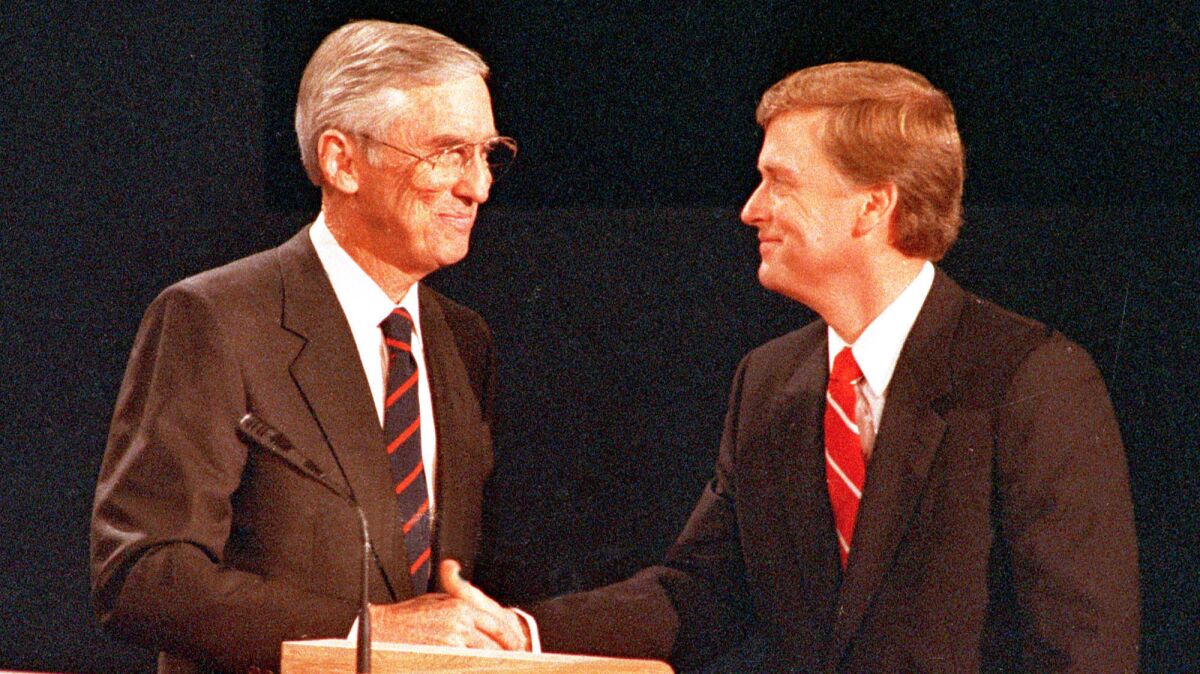
October 5, 1988: The Omaha Civic Auditorium is home to the Vice Presidential Debate. The Republican Party's nominee, Dan Quayle, is just 41, but has been in the Senate for 8 years, and represented an Indiana district in the House of Representatives for 4 years before that. That's 12 years in the Congress, compared to the 14 years that John F. Kennedy had when he was elected President in 1960.
So when he's asked about his qualifications for the Presidency, in the event his running mate, the incumbent Vice President, George H.W. Bush, should win but die in office, or resign, or be impeached and removed, Quayle says, "I have far more experience than many others that sought the office of Vice President of this country. I have as much experience in the Congress as Jack Kennedy did when he sought the Presidency."
The Democratic Party's nominee, Senator Lloyd Bentsen of Texas, was 67 years old, was first elected to Congress in 1948 and to the Senate in 1970. He had run for President in 1976, but hadn't done well. He had been told by those preparing for this debate to expect this comparison.
He points out the flaw in Quayle's reasoning: "Senator, I served with Jack Kennedy. I knew Jack Kennedy. Jack Kennedy was a friend of mine. Senator, you're no Jack Kennedy."
It had been just 25 years since JFK was assassinated, and his time in office was still fresh in many people's memories. Quayle's comparison had left many of them offended, and they cheered Bentsen's rejoinder.
Instead of saying, "I didn't say I was, Senator. I was comparing our experiences," as an intelligent man might have, Quayle got hissy and, incorrectly, said, "That was really uncalled for, Senator." Bentsen replied, "You are the one that was making the comparison, Senator. And I'm one who knew him well. And, frankly, I think you are so far apart in the objectives you choose for your country that I did not think the comparison was well-taken."
Before this debate, Quayle looked like, as Saturday Night Live would say, a "Not Ready for Prime Time Player." After it, he looked like a naive idiot. Ron Brown, chairman of Jesse Jackson's Presidential campaign and soon to be elected Chairman of the Democratic National Committee, used an old expression, saying that Quayle "looked like a deer caught in the headlights." Had these been the Presidential nominees, Bentsen would have won in a landslide.
But this debate turned out to be little more than an entertaining footnote in the campaign. Bush won in a landslide, defeating Governor Michael Dukakis of Massachusetts, winning 40 States for 411 Electoral Votes. No nominee of either party has come close to those totals since.
Quayle proved to be so bad at the job of Vice President, he's never been seriously considered for the Republican nomination for President, despite being younger than the Party's nominees in 1996, 2000, 2004, 2008 and 2016, and mere days older than their 2012 nominee.
Once, he was talking about how important role models are. Turns out, he was a role model -- for the stupidity, ignorance and extremism that the Republican Party has since embraced wholesale.
The Omaha Civic Auditorium opened in 1954, and was demolished in 2016. It was also famous for being the site of Elvis Presley's concert on June 19, 1977, taped for a CBS special, intended for the Christmas season. But the performance was so bad that CBS was going to shelve it permanently -- until he died, and then they showed it on October 3 of that year.


*

October 5, 1988 was a Wednesday. Football was in midweek. The NHL season began the next day; the NBA season, not until November 4.

Game 2 of the National League Championship Series was played at Dodger Stadium in Los Angeles. The New York Daily News had hired New York Mets pitcher David Cone to write a postseason diary. After the Mets' win last night in Game 1, he unfavorably compared Los Angeles Dodgers closer Jay Howell with Met closer Randy Myers: "We saw Howell throwing curveball after curveball and we were thinking: This is the Dodgers' idea of a stopper? Our idea is Randy, a guy who can blow you away with his heat. Seeing Howell and his curveball reminded us of a high school pitcher."

That got the Dodgers mad, and they take it out on the Mets' Game 2 starter -- who happens to be Cone. They Dodgers score a run in the 1st and 4 in the 2nd, and win, 6-3. The series is tied.

Big mistake, Coney. It's worth mentioning that he was not yet with the Mets when they won the 1986 World Series. It's also worth mentioning that, from this day forward, the Mets have never won another World Series. Cone would go on to win 5 World Series, including 4 with the Yankees.

Game 1 of the American League Championship Series was also played, at Fenway Park in Boston. Rick Honeycutt outpitched Bruce Hurst, and was backed by a home run from José Canseco, and the Oakland Athletics beat the Boston Red Sox, 1-0. The A's went on to sweep this series, and were heavily favored to beat the Dodgers in the World Series. But the Dodgers won the Series in 5 game.

Tuesday, June 28, 2022

June 28, 1947: The 1st College World Series

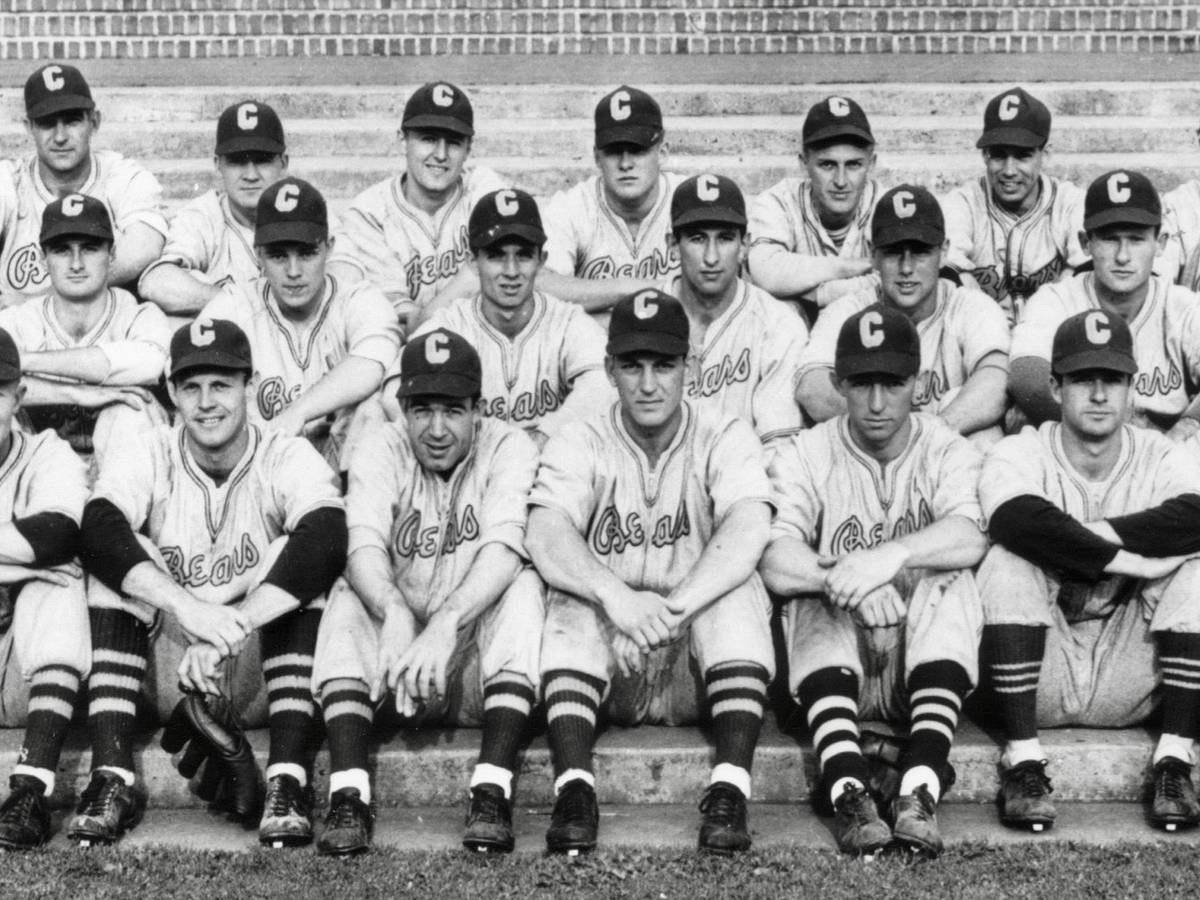
The 1947 Cal Golden Bears, National Champions

June 28, 1947: The 1st NCAA Baseball Tournament Final, the 1st College World Series, is played at Hyames Field, on the campus of Western Michigan University, in Kalamazoo, Michigan. It is an East vs. West matchup, as the University of California, having already won the day before, 17-4, defeat Yale University again, 8-7.

The Cal team featured Jackie Jensen, who would also play for them in the 1949 Rose Bowl. He went on to win the World Series with the New York Yankees in 1952, 1953 and 1956; win the American League Most Valuable Player award with the Boston Red Sox in 1958; make 3 All-Star Games; appear on the TV series Home Run Derby at the start of the 1960 season; and retire due to a fear of flying, after just 199 career home runs.

He remains the only player ever to play in the World Series, the College World Series, and the Rose Bowl. Chuck Essegian is the only other player to play in both the major-league World Series (in his case, with the 1959 Los Angeles Dodgers) and the Rose Bowl (1952, with Stanford).

Yale returned to the CWS in 1948, losing to another West Coast team, the University of Southern California (USC). Both times, Yale's 1st baseman was George H.W. Bush, who didn't play in Major League Baseball, but went into politics, eventually being elected the 41st President of the United States in 1988.

After its 1st 2 seasons, in Kalamazoo, the tournament was moved to Lawrence Stadium in Wichita, Kansas for 1949. Since 1950, it has been held in Omaha, Nebraska, first at what became known as Johnny Rosenblatt Stadium, and then, from 2011 onward, at Charles Schwab Field Omaha.

In 2008, with the rise of women's college softball, the names of the tournaments have been the Men's College World Series and the Women's College World Series. Both tournaments start with 64 teams, in 8 regions, and the 8 regional winners play in the CWS, in 2 4-team double-elimination tournaments, with the winners of each bracket playing a best-2-out-of-3 championship series.

Given the regional ability to play more games in better weather, it is not surprising that the most successful teams have been in the Sun Belt. USC have won 12 National Championships, Louisiana State University (LSU) 6, the University of Texas 6, Arizona State 5; and 4 each have been won by Arizona, the University of Miami, and California State University at Fullerton. Among Winter States, the University of Minnesota and Oregon State University have done the best, winning 3 each.

The Women's College World Series, though not yet under that name, was 1st played in 1969. As with the men, the Sun Belt dominates: The University of California at Los Angeles (UCLA) have won 12 titles, while Arizona have won 8, Oklahoma 6, and no other school has won more than 2.

(UPDATE: In 2023, the LSU men and the Oklahoma women each won a 7th title. The Oklahoma women won an 8th in 2024.)

*

June 28, 1947 was a Saturday. These baseball games were played that day:

* The New York Yankees beat the Philadelphia Athletics, 5-2 at Shibe Park in Philadelphia. Randy Gumpert went the distance for the win. George McQuinn and Tommy Henrich hit home runs. Joe DiMaggio went 1-for-2 with 2 walks. Rookie Yogi Berra went 2-for-4.

* The New York Giants beat the Philadelphia Phillies, 14-6 at the Polo Grounds.

* The Brooklyn Dodgers lost to the Boston Braves, 5-4 at Braves Field in Boston. Earl Torgeson doubled Tommy Holmes home with the winning run in the bottom of the 9th inning. For the Dodgers, Johnny "Spider" Jorgenson and Fred "Dixie" Walker hit home runs. They were among the players phased out after this Pennant-winning season, because they couldn't get along with Jackie Robinson, who went 1-for-3 with 2 walks.

* The Boston Red Sox beat the Washington Senators, 8-0 at Griffith Stadium in Washington. Denny Galehouse pitched a 4-hit shutout. Ted Williams went 2-for-3 with 2 walks and an RBI.

* The Cleveland Indians beat the Chicago White Sox, 3-2 at Cleveland Municipal Stadium.

* The Detroit Tigers beat the St. Louis Browns, 6-3 at Briggs Stadium (later Tiger Stadium) in Detroit.

* The Chicago Cubs swept a doubleheader from the Pittsburgh Pirates, 6-2 and 6-5 at Wrigley Field in Chicago.

* And the St. Louis Cardinals beat the Cincinnati Reds, 8-7 at Sportsman's Park in St. Louis. Stan Musial went 2-for-4 with a walk and 2 RBIs.

Wednesday, June 8, 2022

June 8, 1935: Omaha Wins the Triple Crown

June 8, 1935: Omaha becomes the 3rd horse to win American thoroughbred racing's Triple Crown. The 2nd was his father, Gallant Fox. They remain the only father and son to win the Triple Crown.

Foaled at Claiborne Farm in Paris, Kentucky, Omaha was trained by "Sunny Jim" Fitzsimmons, just as Gallant Fox was. He was ridden by William "Smokey" Saunders, who would become the 1st Canadian jockey to win the Triple Crown. (Ron Turcotte, aboard Secretariat in 1973, would become the 2nd.) He won only 1 race as a 2-year-old, but finished 2nd in a few, suggesting hope for his 3-year-old season.

Despite a weak finish in the Wood Memorial, and a sloppy track at Churchill Downs, Omaha won the Kentucky Derby by a length and a half over Roman Soldier. The Preakness Stakes was run only 1 week later, and Omaha won it by 6 lengths over Firehorn. Famously, Omaha wouldn't stay still for the victory photo.

Between the Preakness and the Belmont, Omaha was run in the Withers Stakes, at Aqueduct in Queens, and lost to Rosemont by a length and a half. The Belmont was 12 days later, 7 miles to the east. Rosemont and Firethorn were both entered. But it rained, and the track was muddy, just like in the Derby, just the way Omaha liked it. He started slow, but put on a stretch run, and beat Firethorn by a length and a half, with Rosemont further back. The Triple Crown was won.

In 1936, as a 4-year-old, he was put on a ship to England, and, running on grass for the 1st time, and running clockwise for the 1st time, won his 1st 2 races, and finished 2nd in the next 2, after which he was retired to stud.

His sons never won any major races, but his later descendants have included 3 Kentucky Derby winners -- which, of course, are also counted among the descendants of Gallant Fox. Omaha died in 1959, Fitzsimmons in 1966, and Saunders in 1986.

*

June 8, 1935 was a Saturday. These baseball games were played:

* A doubleheader was split at Fenway Park in Boston. The New York Yankees won the opener, 12-6. The Boston Red Sox won the nightcap, 4-2. Over the 2 games, Lou Gehrig went 4-for-5 with a home run, 3 walks and 5 RBIs.

* The Brooklyn Dodgers were leading the Philadelphia Phillies, 3-2 after 5 innings at Baker Bowl in Philadelphia, when the game was called due to rain.

* The Philadelphia Athletics beat the Washington Senators, 4-3 at Griffith Stadium in Washington. Jimmie Foxx went 1-for-3 with 2 walks.

* The Pittsburgh Pirates beat the Cincinnati Reds, 14-8 at Forbes Field in Pittsburgh.

* The Cleveland Indians beat the St. Louis Browns, 3-2 at League Park in Cleveland.

* The Chicago White Sox beat the Detroit Tigers, 3-2 at Comiskey Park in Chicago. Hank Greenberg hit a home run, and the Tigers went on to win the World Series, anyway.

* The St. Louis Cardinals swept a doubleheader from their arch-rivals, the Chicago Cubs, 5-4 and 6-5 at Sportsman's Park in St. Louis. In the bottom of the 9th of the 1st game, Jack Rothrock singled, and Johnny "Pepper" Martin scored on a subsequent error. James "Ripper" Collins won the 2nd game with a home run in the bottom of the 11th inning.

Jay "Dizzy" Dean did not pitch in either game. His brother, Paul Dean, who hated being called "Daffy," started the 1st game, was relieved, didn't get to be the winning pitcher, then got to be the winning pitcher in relief in the 2nd game.

* And the New York Giants and the Boston Braves were supposed to play at the Polo Grounds, but got rained out. It was made up as part of a doubleheader on August 4. The Giants swept, 9-2 and 3-1. Hal Schumacher won the opener, Carl Hubbell the nightcap. Over the 2 games, Giant player-manager Bill Terry went 2-for-8 with 2 RBIs, and Mel Ott went 2-for-7 with 2 walks. Travis Jackson went 3-for-5 with a home run and 4 RBIs in the 1st game, before Terry gave him the 2nd game off.

December 31, 1999 & January 1, 2000: The Millennium

December 31, 1999:  The Millennium arrives. The people of planet Earth survived. At a terrible cost. But we hadn't destroyed ourselves. ...