Showing posts with label tcu horned frogs. Show all posts

Thursday, December 8, 2022

December 8, 1914: The Southwest Conference Is Founded

December 8, 1914: The Southwest Intercollegiate Athletic Conference is founded at the Rice Hotel in Houston, Texas, after previous organizing meetings in May at the Oriental Hotel in Dallas. L. Theo Bellmont, the athletic director at the University of Texas, convened the meetings that led to the league's foundation. 

The 8 original members were the University of Arkansas, in Fayetteville; Baylor University, of Waco, Texas; the University of Oklahoma, in Norman; Oklahoma A&M University, of Stillwater; Rice University, of Houston; Southwestern University; of Georgetown, Texas; the University of Texas, in Austin; and Texas A&M University, in College Station.

Southwestern dropped out in 1917. Southern Methodist University, a.k.a. SMU, of Dallas, joined in 1918. Oklahoma left for the league that became the Big Eight Conference in 1919, and Oklahoma A&M followed them in 1925, becoming Oklahoma State in 1958. Phillips University, of Enid, Oklahoma, was a member only for the 1920-21 schoolyear. Texas Christian University, a.k.a. TCU, of Fort Worth, joined in 1923.

That membership remained steady until 1956, when Texas Tech University, of Lubbock, were admitted. The University of Houston joined in 1972. So it was a 9-team league, with Arkansas and 8 Texas-based teams.

From its founding in 1937 to 1995, the Cotton Bowl Classic in Dallas usually invited the SWC football champion to participate. Of those 59 appearances: Texas made 16, Texas A&M 9, Arkansas 8, TCU 6, SMU 4, Rice 4, Houston 4, and Baylor and Texas Tech 2 each. There was no SWC team in the 1940 Cotton Bowl.

The Texas Longhorns dominated in football, and so every other school in the league hated them. Their rivalry with Texas A&M, usually on Thanksgiving Weekend, sometimes on Thanksgiving Day, inspired the saying, "If football is a religion in Texas, then this game is a holy war." The Longhorns also built a significant rivalry with Arkansas, culminating in the 1969 "Game of the Century." But many Texas fans consider Oklahoma, then of the Big 8, to be their biggest rival.

The intra-"Metroplex" rivalry of SMU in Dallas and TCU in Fort Worth is pretty intense, and resulted in an earlier "Game of the Century" in 1935. And intra-city rivals Houston and Rice can get pretty heated.

Houston made a pair of NCAA Final Fours before joining the SWC, and then became the league's premier basketball school. Texas, Texas A&M and Rice became great baseball schools, while Arkansas became one of the country's greatest track programs.

In 1991, Arkansas announced it was leaving the SWC for the Southeastern Conference (SEC). That left the SWC with only the 8 Texas schools. They could have added another school from the Lone Star State, possibly the University of Texas at El Paso: UTEP were then a member of the Western Athletic Conference, and their (relative) proximity to New Mexico and New Mexico State made for easier and cheaper travel.

Instead, in the 1995-96 schoolyear, Texas, Texas A&M, Texas Tech and Baylor applied for, and received, membership to the Big 8. The 4 remaining SWC schools -- Texas Christian, Southern Methodist, Houston and its crosstown rival Rice -- joined other leagues: Houston joined Conference USA, and the other 3 joined the WAC, though all would join C-USA at some point.

Thus did 2 of the great college sports leagues, the Big 8 and the SWC, come to an end, but a better league, the Big Twelve Conference, was formed. The 4 Texas schools and the 2 Oklahoma schools formed the South Division, the other teams the North Division.

But that league did not hold: Nebraska went to the Big Ten, Colorado went to the Pac-10, and Texas, Texas A&M and Oklahoma all left for the Southeastern Conference. The Big 12 had a connection to the old SWC, but little remains of that Texas (and Arkansas) collegiate sports tradition.

*

December 8, 1914 was a Tuesday. Baseball season was over. Football was in midweek. Professional basketball barely existed. There was professional hockey, in the forms of Eastern Canada's National Hockey Association, and Western Canada's Pacific Coast Hockey Association.

The NHA season didn't begin until December 26, but the PCHA season opened on December 8, with 1 game: The Vancouver Millionaires beat the Portland Rosebuds, 6-3 at the Portland Ice Arena. The Millionaires would win the PCHA title, and beat the NHA Champion Ottawa Senators for the Stanley Cup. No Vancouver team has won the Cup since.

This was also the day that Philadelphia Athletics manager Connie Mack, needing a quick infusion of cash, sold his best player, 2nd baseman Eddie Collins, ending his 1st dynasty, and beginning the A's tradition of "fire sales." I have a separate entry for that event.

Wednesday, November 30, 2022

November 30, 1935: The Game That Made Texas Football

November 30, 1935: If, as they say, football is a religion in the State of Texas, then this was their moment of evangelism, when they spread their gospel throughout the land.

Dallas is the largest city in North Texas. Fort Worth is the 2nd-largest. Dallas is home to Southern Methodist University. Fort Worth is home to Texas Christian University, affiliated with a different Protestant sect, the Disciples of Christ. SMU's Ownby Stadium and TCU's Amon G. Carter Stadium are just 40 miles apart, making their schools among the closest major rivals in college football. (For comparison's sake, in the State's biggest football rivalry, Texas and Texas A&M are 104 miles apart.)

Ownby Stadium was named for its benefactor, Jordan C. Ownby. Amon G. Carter was the publisher of the city's largest newspaper, the Fort Worth Star-Telegram, a.k.a. the Startle-gram. Left his fortune, his daughter Ruth Carter Stevenson spent much of it to found Fort Worth's Amon Carter Museum Museum of American Art, the most popular museum dedicated to art about the American West.

As with any other pair of big cities that are relatively close -- such as Minneapolis and St. Paul, Tampa and St. Petersburg, San Francisco and Oakland, etc. -- Dallas and Fort Worth don't like each other, despite all that they have in common. Fort Worthers think Dallasites are stuck-up, what with their nouveau riche money in oil, banking and insurance. Dallasites point to the fact that Fort Worth is known for its stockyards, and think of Fort Worthers as their country cousins, bumpkins.

From 1916 to 1921, interrupted by serving in World War I, Leo Robert Meyer, nicknamed Dutch because he was of German descent and people tended not to be able to tell the difference between "Dutch," from the Netherlands, and "Deutsch," the Germans' name for themselves, played end for TCU.

In 1923, he was named an assistant coach for them. In 1934, he was named head coach, and would remain so until 1952. He also coached baseball there, on and off, from 1926 to 1957; and basketball from 1934 to 1937. He was also their athletic director from 1950 to 1963, and lived until 1982, age 84.

In 1981, TCU graduate Dan Jenkins, the college football expert for Sports Illustrated, wrote an article for their College Preview Issue about growing up in Fort Worth as a TCU fan. He was just about to turn 7 when this game was played, but seemed to remember it well. He also claimed to remember Dutch Meyer once telling his players, "Football is a game played by men! Not by a bunch of damn sissies and city slickers from Dallas!"

And how did the "men" play for the Horned Frogs of TCU in 1935? Pretty well: They came into the game 10-0, their defeated opponents including Texas, Texas A&M and Arkansas. They were led by a quarterback named Sammy Baugh. Slingin' Sammy was the greatest passer Texas had ever seen -- maybe the greatest anybody had ever seen to that point.

And how did the "bunch of damn sissies and city slicers from Dallas" play for the Mustangs of SMU that year? Equally well: They came into the game 10-0, their defeated opponents including Texas, Arkansas, and UCLA at the Los Angeles Memorial Coliseum. They had a game at Texas A&M yet to come. Their best player was halfback Bob Wilson.

They were coached by William Madison "Matty" Bell, who had also played end, although not at the school he was coaching now, but at Centre College in Kentucky. He had been TCU's head coach from 1923 to 1928, with Meyer on his staff. So perhaps Meyer was taking this personally.

So the rivals came into the game undefeated, with the championship of the Southwest Conference on the line. It could have even been for the National Championship, because the Rose Bowl was talking about inviting the winner. Four weeks earlier, Notre Dame had beaten Ohio State in a game that was called "The Game of the Century" by some people. But in Texas, this game was called "The Game of the Century." NBC decided to broadcast it live on radio to the entire country. A crowd of 36,000 packed into Carter Stadium to watch it in person.

The only scoring in the 1st quarter was an SMU touchdown. The Mustangs scored again early in the 2nd quarter. But Baugh led the Frogs on a touchdown drive, and the half ended 14-7 SMU. It remained that way through the 3rd quarter, but Baugh led a touchdown drive early in the 4th quarter, and the game was tied.

With 9 minutes left to play, and a 4th down and long to go, Bob Finley faked a punt and threw to Wilson, who took the ball in for a touchdown. The extra point was missed, so SMU's lead was 20-14, giving TCU fans hope of winning, 21-20.

With the clock winding down, Baugh took the Horned Frogs down the field, and got to the SMU 35-yard line. But on the final play, he threw into the end zone, and his receiver was too well-covered, and SMU's 20-14 lead held. SMU's band played "California, Here I Come."

Grantland Rice, the nation's leading syndicated sports columnist, covered the game, called it "one of the greatest football games ever played." It is credited with elevating the Southwest Conference to the college football equivalent of "major league" status. In 2017, The Dallas Morning News ranked it the greatest game ever played between the 2 rivals. However, having taken place in the age of radio, it tends to get passed over in "Game of the Century" discussions in Texas, in favor of the nationally-televised 1969 game between Texas and Arkansas.

SMU still had to play Texas A&M, but beat them, after which they were, indeed, invited to the Rose Bowl. But they lost it to Stanford. TCU went to San Francisco to play their last scheduled regular-season game, beating Santa Clara University. They were invited to the Sugar Bowl in New Orleans, and beat Louisiana State.

TCU, in spite of their loss to SMU, were named National Champions by the Williamson System. SMU, in spite of their loss to Stanford, were named National Champions by the Dickinson System, the Houlgate System, and, retroactively, by the Berryman System and the Sagarin Ratings. The University of Minnesota were selected as National Champions by United Press (UP, forerunners of United Press International or UPI), the Billingsley Report, the Boand System, the Helms Athletic Foundation, the Litkenhous System, the Poling System, and retroactively by the College Football Researchers Association and the National Championship Foundation.

This system didn't work too well. For the 1936 season, the Associated Press (AP) began polling the sportswriters who covered college football. Usually, they got it right. UP/UPI, which polled the nation's head coaches, usually named a National Champion, and it usually matched the AP's selection. On the occasions when it didn't, their selection was usually justifiable, if not the better choice. Still, this system proved unsatisfying. The Bowl Championship Series made things better, and the current College Football National Playoff system better still, but there have been flaws in every system yet tried.

Baugh went on to a great career with the NFL's Washington Redskins, and was a charter inductee into the College and Pro Football Halls of Fame. TCU won a legitimate National Championship in 1938, with another great quarterback, Heisman Trophy winner Davey O'Brien. But for the rest of the 20th Century, they tended to struggle, before a revival in the early 21st Century.

None of SMU's players did much in the pros, but they had a better record over the next few decades than TCU. In 1982, they nearly won the National Championship with their "Pony Express" backfield of Eric Dickerson and Craig James. But their cheating on top of cheating led them to become the 1st, and still the only, college football program ever to receive the NCAA's "death penalty," in 1986. They started play again in 1989, and they've been what college basketball fans call a "mid-major" school ever since. But then, so have TCU.

Carter Stadium still stands, with significant modernization. Ownby Stadium was demolished in 1998, and Gerald J. Ford Stadium was built on the site. Again, the new stadium was named for its funder. He was not related to Gerald R. Ford, the 38th President of the United States -- although that Gerald Ford was an All-American football player in 1935, a center at the University of Michigan.

*

November 30, 1935 was a Saturday. Comedian and director Woody Allen was born on this day.

These other notable college football games were played that day:

* Army beat Navy, 28-6 at Franklin Field in Philadelphia.

* Georgia Tech beat Georgia, 19-7 at Grant Field in Atlanta.

* Mississippi beat Mississippi State, 14-6 at Hemingway Stadium (now Vaught-Hemingway Stadium) in Oxford, Mississippi.

* Louisiana State beat Tulane, 41-0 at Tulane Stadium.

* Washington University beat crosstown rivals Saint Louis University, 26-0 at Walsh Memorial Stadium.

* Columbia beat Dartmouth, 13-7 at Baker Field in Manhattan.

* And Princeton beat Yale, 38-7 at the Yale Bowl in New Haven, Connecticut.

Actually, most of the big rivalries that weekend were played 2 days earlier, on Thanksgiving Day: Fordham beat New York University 21-0 in front of 72,000 at Yankee Stadium, Pittsburgh and next-door neighbors Carnegie Tech (now Carnegie-Mellon) played to a 0-0 tie, Kentucky beat Tennessee, Missouri and Kansas played to a 0-0 tie, Oklahoma beat Oklahoma State, and Utah and Utah State played to a 14-14 tie.

And, most important from the Lone Star State's perspective, for if football is a religion there, then this is its holy war: Texas A&M beat Texas, 20-6 at Kyle Field in College Station.

Baseball was out of season. The NBA hadn't been founded yet. There were 3 NHL games played that day:

* The New York Americans beat the Boston Bruins, 2-1 at the old (but then still relatively new) Madison Square Garden.

* The Montreal Maroons beat the Detroit Red Wings, 3-2 at the Montreal Forum.

* And the Toronto Maple Leafs beat their arch-rivals, the Montreal Canadiens, 8-3 at Maple Leaf Gardens in Toronto.

And in English soccer, North London team Arsenal went to Yorkshire, and played Huddersfield Town to a draw, 0-0 at Leeds Road in Huddersfield.

Tuesday, January 4, 2022

January 4, 2010: College Football's "NIT"

January 4, 2010: The Fiesta Bowl is held, at the University of Phoenix Stadium -- now named State Farm Stadium -- in the Phoenix suburb of Glendale, Arizona. This game is not for college football's national championship. But there were those who believed it should have been.

Boise State University, home of Albertsons Stadium and its garish blue artificial field known as the "Smurf Turf," were the Champions of the Western Athletic Conference (WAC). They were 13-0, having beaten then-Number 16 Oregon at home, Miami University of Ohio at home, Fresno State away, Bowling Green away, the University of California at Davis at home, the University of Tulsa away, Hawaii away, San Jose State at home, Louisiana Tech away, arch-rival Idaho at home, Utah State away, Nevada at home, and New Mexico State at home.

They had risen to Number 6 in the country. However, the WAC was not one of the "Power Five Conferences" that tended to get its teams admitted to the Bowl Championship Series: The Atlantic Coast Conference (ACC), the Southeastern Conference (SEC), the Big Ten Conference, the Big Twelve Conference, and the Pacific-Twelve Conference (Pac-12). And, with only 1 win over a ranked team, it was decided that the Broncos weren't worthy of the Playoff.

Texas Christian University, a.k.a. TCU, had one been a member of the Southwest Conference (SWC), one of college football's "major leagues." But that league had folded in 1996, and so the Fort Worth-based Horned Frogs moved on, eventually landing in the Mountain West Conference, a school that had grown out of the WAC.

In the 2009 season, they had beaten Virginia away, Texas State at home, Clemson away, arch-rival Southern Methodist University (SMU) at home, the Air Force Academy away, Colorado State at home, then-Number 16 Brigham Young University (BYU) away, the University of Nevada at Las Vegas (UNLV) at home, San Diego State away, then-Number 16 Utah at home, Wyoming away, and New Mexico at home. They had risen to Number 3, and they did have wins over 2 ranked teams, 1 more than Boise State.

There were 3 other undefeated teams heading into the bowl games. Alabama was ranked Number 1, and Texas Number 2, and so they were sent to the BCS National Championship Game, to be held in the Rose Bowl stadium in Pasadena, California. Number 3 TCU and Number 6 Boise State would have to settle for the Fiesta Bowl. The University of Cincinnati also had to settle: They faced Number 5 Florida in the Superdome in New Orleans.

Since neither the WAC nor the MWC, which grew out of the WAC, is a "Power Five" conference, this was a consolation prize: Whoever won was still going to be undefeated, but wouldn't get to be called National Champions. It was, essentially, college football's version of the NIT. As far as I know, no one publicly called it it that at the time, but among the taglines used were the Separate But Equal Bowl, the Quarantine Bowl, the Fiasco Bowl, and the BCS Kids' Table.

Boise State took an early lead when Brandyn Thompson intercepted an Andy Dalton pass, and returned it 51 yards for a touchdown. Kyle Brotzman added a field goal in the 2nd quarter. In the last minute of the 1st half, Dalton threw a 30-yard touchdown pass to Curtis Clay, bringing the Frogs to within 10-7. Late in the 3rd quarter, Ross Evans tied it with a 29-yard field goal.

Midway through the 4th quarter, the score was still 10-0. Bosie State had 4th down on their own 33-yard line, but pulled a fake punt: Brotzman threw a 30-yard pass to Kyle Efaw. The drive continued until Doug Martin ran the ball in from 2 yards, and Boise State won, 17-10.

Despite remaining undefeated, the Broncos only rose to Number 4 in the polls. Alabama beat Texas, 37-21, and were crowned National Champions. All Boise State could do was complain.

Florida ended Cincinnati's pretentions to the National Championship, 51-24. Still, Boise State fans thought they deserved a shot at Alabama -- a team with 6 All-Americans, including the Heisman Trophy winner, running back Mark Ingram.

*

January 4, 2010 was a Monday. That was the only bowl game played that day. There was no Monday Night Football game in the NFL. Baseball was out of season.

There were 4 games played in the NBA:

* The Miami Heat beat the Atlanta Hawks, 92-75 at the American Airlines Center (now the Kaseya Center) in Miami.

* The Oklahoma City Thunder beat the Chicago Bulls, 98-85 at the United Center in Chicago.

* The New Orleans Hornets beat the Utah Jazz, 91-87 at the Delta Center (then known as the EnergySolutions Arena) in Salt Lake city.

* And the Los Angeles Clippers beat the Portland Trail Blazers, 105-95 at the Staples Center (now the Crypto.com Arena) in Los Angeles.

Two games were played in the NHL. In an "Original Six" matchup, the New York Rangers beat the Boston Bruins, 3-2 at Madison Square Garden. And the Los Angeles Kings beat their arch-rivals, the San Jose Sharks, 6-2 at the SAP Center in San Jose. (The Anaheim Ducks' arch-rivals are the Kings, but not vice versa.)

This was also the day that the Burj Khalifa opened in Dubai, United Arab Emirates, shattering the record for the tallest building in the world. I have a separate entry for that event.

Saturday, January 1, 2022

January 1, 1937: The 1st Cotton Bowl

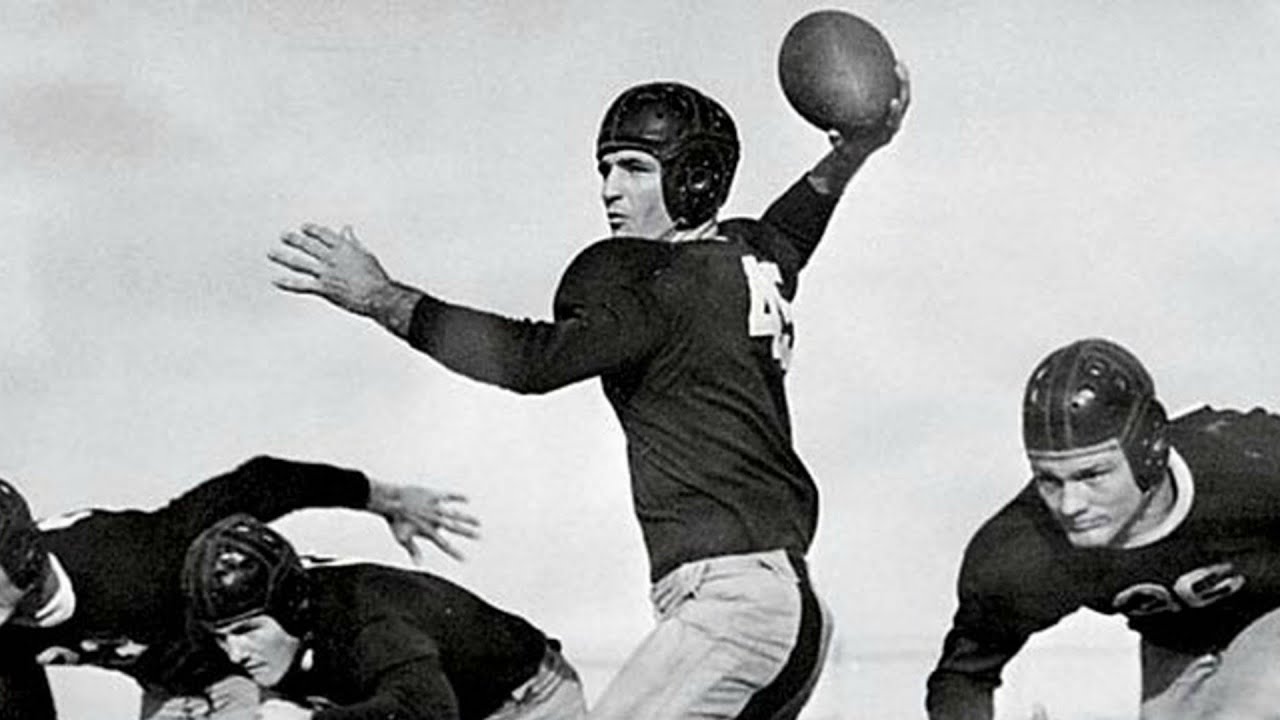
Slingin' Sammy Baugh

January 1, 1937: The 1st Cotton Bowl -- or, as it's officially known, the Cotton Bowl Classic -- is played at Fair Park Stadium on the Texas State Fair Grounds in Dallas. Texas Christian University (TCU) defeat Marquette University, 10-6.

This was the last collegiate game for Sammy Baugh, the greatest quarterback that football had yet seen, who threw a 55-yard pass for the Horned Frogs' only touchdown.

Before the Cotton Bowl, Fair Park had hosted the Dixie Classic 3 times: In 1922, 1925 and 1934. That game never caught on, but the dream of a New Year's Day bowl game in Dallas, like the Rose Bowl in Pasadena, California, wouldn't go away. And on New Year's Day 1935, the sunny cities of Miami and New Orleans began hosting the Orange Bowl and the Sugar Bowl, respectively.

So oil executive J. Curtis Sanford financed the game out of his own pocket. The Fair Grounds stadium was subsequently expanded to 37,000 seats, and renamed the Cotton Bowl, after the South's most famous agricultural product.

TCU had won its 1st title in the Texas Intercollegiate Athletic Association in 1920, and won SWC titles in 1929, 1932, 1938, 1944, 1951, 1955, 1958 and 1959, before going into a decline. They won one last SWC title in 1994, before the league split up in 1996. They won titles in the Western Athletic Conference in 1999 and 2000; in Conference USA in 2002; in the Mountain West Conference in 2005, 2009, 2010 and 2011; and in the Big 12 Conference in 2014.

The inaugural Cotton Bowl would be the only bowl appearance for Marquette, a Catholic school in Milwaukee. They dropped their program in 1960, and have never reinstated it. Known as the Golden Avalanche until then, they became the Warriors, before the appeal to drop Native American mascots took hold there in 1994. They have been the Golden Eagles ever since, and basketball has been their most successful sport, winning the National Championship in 1977 after reaching the Final in 1974.

Southern Methodist University (SMU), based in Dallas, used the Cotton Bowl stadium as their home field. The success of star running back Doak Walker, who led them to victory in the 1948 and 1949 Cotton Bowls, led to the stadium receiving an upper deck, and the nickname "The House That Doak Built." Walker won the Heisman Trophy in 1948, and finished 2nd in the voting in 1949.
The Cotton Bowl stadium

In 2010, the Cotton Bowl Classic was moved to the Dallas Cowboys' new AT&T Stadium in suburban Arlington, about halfway between the downtowns of Dallas and Fort Worth. It was never held at the Cowboys' previous home, Texas Stadium in suburban Irving, although SMU did play their home games there from 1979 to 1986. Today, the Cotton Bowl stadium's main purpose is soccer games and the annual Texas vs. Oklahoma game on the 2nd Saturday in October, the week of the State Fair.
The game, officially "The Cotton Bowl Classic," would have an affiliation with the Southwest Conference. Every year from its start in 1937 until 1995, the last year of the SWC, a team from that league would be in it, usually the league Champion. The breakup of the SWC ended the official relationship, but it still featured a former SWC team in 1998, 1999, 2000, 2002, 2003, 2005, 2006, 2008, 2009, 2011, 2012, 2013 and 2015.

The Cotton Bowl has hosted teams that won the National Championships for the calendar years of 1950, Tennessee; 1959, Syracuse; 1963 and 1969, Texas; 1964, Arkansas; 1977, Notre Dame; 2015, Alabama; and 2018, Clemson.

*

January 1, 1937 was a Friday. Also on this day, the Rose Bowl was played in the stadium of the same name, outside Los Angeles in Pasadena, California. The University of Pittsburgh beat the University of Washington, 21-0.

In the Orange Bowl, at Miami Field in Miami, Duquesne beat Mississippi State, 13-12.

In the Sugar Bowl, at Tulane Stadium in New Orleans, Santa Clara University beat Louisiana State University (LSU), 21-14.

And in the Sun Bowl, at Jones Stadium in El Paso, Texas, Hardin-Simmons University beat Texas Mines, 34-6. Texas College of Mines was renamed Texas Western University in 1948, and the University of Texas at El Paso (UTEP) in 1966.

One game was played in the NHL: The Chicago Black Hawks beat the Detroit Red Wings, 4-2 at the Chicago Stadium.

December 31, 1999 & January 1, 2000: The Millennium

December 31, 1999:  The Millennium arrives. The people of planet Earth survived. At a terrible cost. But we hadn't destroyed ourselves. ...