Showing posts with label rangers fc. Show all posts

Friday, December 30, 2022

December 30, 1899: Ibrox Stadium Opens

December 30, 1899: Ibrox Park opens in the Ibrox neighborhood, on the West Side of Glasgow, Scotland. Home to Rangers Football Club, it hosted its 1st game 2 days later, on January 1, 1900, against the team that had already become their "Old Firm" arch-rivals, Celtic F.C., who won, 3-2.

This was the 2nd Ibrox Park, built just to the west of the 1st one, which Rangers had called home since 1887. While playing there, Rangers had won the Scottish Football League in 1891 and 1899. After moving to the 2nd Ibrox, they raised their title total to a national record 54: Adding them in 1900, '01, '02, '11, '12, '13, '18, '20, '21, '23, '24, '25, '27, '28, '29, '30, '31, '33, '34, '35, '37, '39, '47, '49, '50, '53, '56, '57, '59, '61, '63, '64, '75, '76, '78, '87, '89, '90, '91, '92, '93, '94, '95, '96, '97, '99, 2000, '03, '05, '09, '10 and '11.

(Unlike England, Scotland did not suspend league "football" for the duration of World War I. They did, however, suspend it for the duration of World War II.)

The stadium has been the site of 3 fatal disasters. On April 5, 1902, shortly after kickoff of a match between the national teams of Scotland and England, a section of terracing collapsed, causing 125 people to fall 50 feet to the ground below, killing 25 of them. Repairs were made, and also an expansion, raising capacity from the original 40,000 to 63,000.

The stadium was expanded again in 1929. On January 2, 1939 -- it has been tradition for the "Old Firm" rivals to play on New Year's Day, or on January 2 if January 1 falls on a Sunday -- Rangers beat Celtic, 2-1, in front of 118,567. This remains the largest attendance for a football match in any league in the United Kingdom.

The stadium got lights in 1953. Safety legislation cut capacity to about 80,000. But Ibrox Park had the worst fan safety record in Britain. Two fans died on September 16, 1961, when a barrier collapsed on Stairway 13, resulting in a crush. Stairway 13 was a popular exit from the East Terracing due to its proximity to the Copland Road subway station and parking areas for the Rangers supporters' coaches, but it was often overcrowded and very steep.

After this incident, Rangers installed safety measures, but further injuries were sustained in crushes on Stairway 13 in both 1967 and 1969. On October 23, 1968, the main stand was hit by fire. Just 7 months later, there was another fire, which destroyed more than 200 seats behind the directors box.

But when people speak of "The Ibrox Disaster," they usually mean what happened after the Old Firm game on January 2, 1971, when 66 people died of asphyxiation, due to another crush on Stairway 13. The game itself ended in a 1–1 draw, with Colin Stein scoring a late equalizer for Rangers. This led to a widespread belief that the crush had been caused by fans who had left the game early, but had turned back when they heard the roar that greeted the Rangers goal.

A public inquiry discounted this initial story. It established that the crowd had been travelling in the same direction when the crush happened, with it perhaps being precipitated by some bending over to pick up items that had been discarded during the goal celebrations. The downward force of the crowd leaving the stadium meant that when people started to fall there was no means of preventing a crush.

Adjustments made after the passage of the Safety of Sports Grounds Act 1975 cut the capacity of Ibrox to 44,000 by 1981. The Taylor Report, which applied to Scotland was well as England, led to a total rebuilding of each stand, which was completed in 1997, at which point Ibrox Park was officially renamed Ibrox Stadium. Capacity is now 50,817, all-seater.

In 2012, financial issues forced the liquidation of Rangers Football Club, ending them after 140 years. A new organization was founded, and a team of the same name took up residence at Ibrox, climbing up the Scottish "football pyramid." In 2021, they won the Scottish Premier League. Rangers fans count this as a 55th title. The rest of Scotland, who treat Rangers the way Englishmen treat Manchester United, and Americans treat the New York Yankees, do not.

*

December 30, 1899 was a Saturday. Among the games in English soccer, Leicester Fosse and Woolwich Arsenal played to a 0-0 draw at Filbert Street in Leicester, in the East Midlands. Woolwich Arsenal moved from South London to North London in 1913, becoming simply Arsenal. Leicester Fosse became Leicester City in 1919.

But in North America, there were no scores on this historic day.

Monday, November 21, 2022

November 21, 1945: Dynamo Moscow Kicks Off Sports' Cold War

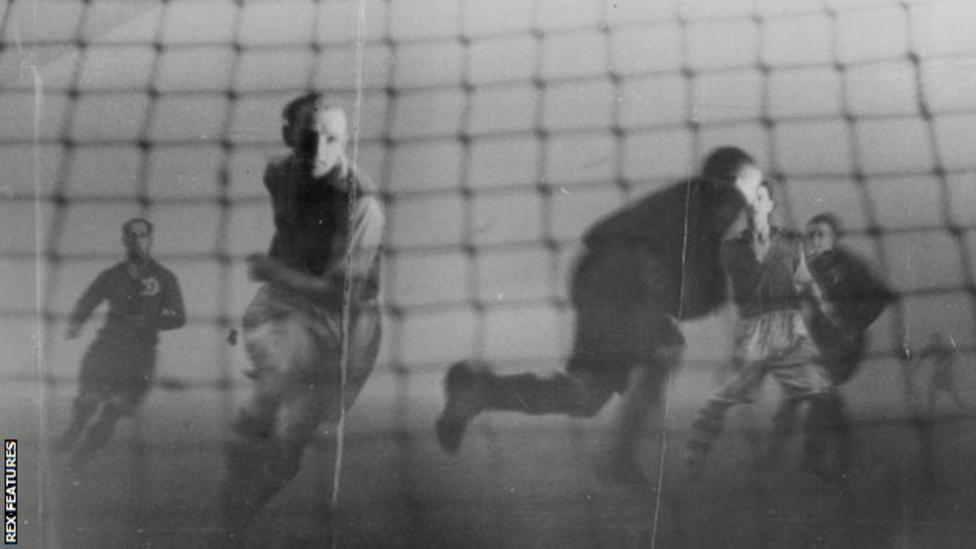
Yes, the fog was that thick.

November 21, 1945: The most-hyped game of the 1st visit of a Soviet soccer team to England, the sport's traditional birthplace, takes place. In hindsight, it can be called the event that kicked of the sports division of the Cold War.

In Communist countries, sports clubs, and the teams they fielded, were sponsored by state-owned industries. The countries' armies sponsored teams named "Central Club of the Army," or "CSKA" in Slavic languages. The national railroads sponsored teams named "Lokomotiv." The auto industry sponsored teams named "Torpedo." The teams most hated by the citizens, but with the most funding from the government and the most favorable decisions from government-appointed officials, were named "Dynamo."

Football Club Dynamo Moscow won the Soviet Top League in 1936, 1937, 1940 and 1945; and were regarded, along with Spartak Moscow, as the best team in the Soviet Union. So when World War II came to an end, Dynamo wanted to test themselves against what was seen as the best competition in the world: The British.

This was the age of radio. Television existed, but it hadn't yet done much to cover sports. Most of what people knew about sports was what they read in newspapers. So there was very little information on Dynamo for the British teams they would be facing, and their fans -- and vice versa: Dynamo knew very little about their opponents.

Interviewed for a 2001 documentary, Dynamo forward Konstantin Beskov said, "Until those games, we only knew that England was the motherland of football, that English football was the best in the world." One of Britain's national newspapers, The Evening Standard, wrote, "Don't expect much from Dynamo. They are only beginners, blue-collars, amateurs." They would regret that dismissive derision.

On Tuesday, November 13, Dynamo visited Chelsea Football Club, at Chelsea's West London stadium, Stamford Bridge. Officially, the crowd was 75,000 people. It was probably much more than that, given English "footie" fans' propensity to jam themselves into those vast "standing terraces." It's a wonder there weren't more disasters like Ibrox in 1971 and Hillsborough in 1989.

Chelsea, prior to the 1960s rarely even a good team, much less a challenge for Dynamo, took a 2-0 lead. Just before the half, Dynamo were awarded a penalty. Leonid Solovyov hit the post with his shot, and the Soviet side went into the locker room embarrassed. Whatever was said to them in the locker room, it worked: They came back to tie the game, 2-2, fell behind 3-2, and then tied it again near the end of the game, to end it 3-3.

Tommy Lawton, the former star of Liverpool team Everton FC who had recently been signed by Chelsea, said, "Dynamo were one of the fastest teams I have ever seen in my life. They flash the ball from man to man in bewildering fashion, often while standing still." Chelsea Captain John Harris said, "At least two of Lawton's kicks were of such a type that no goalkeeper would catch, but Khomich jumped like a tiger and caught them." The Soviet goalie was known as Tiger Khomich from then on.

On Saturday, November 17, Dynamo visited Cardiff City Football Club. England's Football Association, of which City were then 1 of 3 Welsh members, refused to rearrange their schedule to accommodate Dynamo, so City were the only team available, and they were in Division Three, equivalent to Class AA in modern baseball.

Wales, full of coal mines, steel mills and dockworkers, was openly sympathetic to socialism, and welcomed the Soviet team with open arms. But City were completely overwhelmed, as Dynamo beat them, 10-1.

The team with which Dynamo were most familiar, and the team they truly wanted to test themselves against, was Arsenal Football Club, winners of the Football League in 1931, '33, '34, '35 and '38. Dynamo badly wanted to play Arsenal at their North London home, the Arsenal Stadium, nicknamed Highbury for its neighborhood.

Having made trips to the Continent, including an annual home-and-home series on Armistice Day, November 11, with Racing Club de France in London and Paris, Arsenal were happy to make themselves available for this soccer "summit." But they could not do the same for Highbury: It had been commandeered by the British government at the outset of World War II, as an Air Raid Precaution Centre, and had not yet been returned to the club's control. Since 1939, Arsenal had been playing home games at White Hart Lane, the home of their arch-rivals, Tottenham Hotspur, a.k.a. Spurs, 4.7 miles to the north.

A dirty little secret had gotten out: Dynamo had "drafted" 4 star players from other Soviet teams, including Spartak Moscow and CSKA Moscow. So the FA made arrangements for teams to "loan" some players to Arsenal, including Stanley Matthews of Staffordshire team Stoke City, a winger known as "The Wizard of Dribble," and possibly England's best player at the time. Another loanee was Stan Mortensen of Lancashire team Blackpool. With massive hypocrisy, the Soviets complained.

(In 1953, Blackpool, having acquired Matthews, won the FA Cup Final, with Mortensen scoring the only hat trick in the history of the Final, but Matthews had put on such a show that it's still remembered as "The Matthews Final.")

The game was set for Wednesday, November 21, but, as so often happened in those days before environmental regulations were passed, leading to outsiders nicknaming London "The Smoke," a thick fog settled over White Hart Lane. Still, the place was sold out, 54,000 strong, and the FA didn't want to issue refunds, so the game went on. The Soviet officials insisted on a Soviet referee, Nikolay Latyshev, who had accompanied the team. The FA agreed.

Writer George Orwell, who had recently published Animal Farm (Nineteen Eighty-Four was yet to come), was in attendance, and called the match "War minus the shooting." The Soviet players, knowing Matthews was the best player on either side of the pitch, targeted him for rough treatment.

Both goalies, Khomich and Arsenal's Wyn Griffiths, took more physical assaults than shots with the ball. Griffiths sustained a concussion, and had to be replaced for the 2nd half. Harry Brown, goalkeeper for West London team Queens Park Rangers, was in attendance, and, since the Soviets had negotiated for the right to a substitution, something the FA wouldn't allow in League and cup ties until 1966, they allowed Brown to step in for Griffiths.

Dynamo scored first, but Ronnie Rooke equalized shortly thereafter. Shortly before the half, there were 3 goals within a span of 4 minutes: Mortensen put Arsenal up 2-1, then he took another Matthews feed to make it 3-1, and then Beskov put the ball past Griffiths to make it 3-2.

The 2nd half was a travesty. Solovyov scored to tie it up, but multiple witnesses claimed he was blatantly offside. Latyshev let the goal stand. A little later, Arsenal thought they should have been awarded a penalty, but Latyshev denied it. Shortly after that, he sent Arsenal midfielder George Drury off for throwing a punch. No one else claimed to see the punch.

Vsevolod Bobrov, who became one of the Soviet Union's first great hockey players as well, received a Solovyov pass while offside, and scored. The goal was allowed to stand. Rooke was nearly brought down by a rugby-style tackle by Dynamo Captain Mikhail Semichastniy, opening a cut on his forehead, but elbowed him out of the way, giving him a black eye, and driving a 25-yard shot that beat Khomich. But instead of rightly allowing the goal and sending Semichastniy off, Latyshev waved off the goal and called Rooke for a foul.

So instead of what it should have been, 4-2 to The Arsenal, with Arsenal having 11 players on the pitch and Dynamo having 10 at most, it was 4-3 to Dynamo, with Arsenal down to 10 and Dynamo fielding... no one was sure how many. Dynamo took advantage of the fog to put more players on, with some accounts saying it was now 15 against 10.

The match ended 4-3 to Dynamo. The Daily Mail wrote, "It was one of the most exciting games 54,000 people never saw." Unusually for the paper known in modern times as the Daily Fail, it was the truth.

The controversy threatened to cancel the 4th and final game on the tour. But the FA were making too much money to bow to the wishes of the fans, and the finale went on. On Wednesday, November 28, Dynamo were hosted by Rangers Football Club, Scotland's most successful team, at Ibrox Stadium in Glasgow. Despite Bobrov scoring what The Daily Telegraph called "as perfect a goal as has ever been scored at Ibrox," Rangers held on for a 2-2 draw.

Dynamo had finished the tour with 2 wins, 2 draws, and no losses. But all the goodwill they had generated in their games against Chelsea and Cardiff City was thrown away by their actions against Arsenal. The game with Rangers did them no good in the eyes of the British, or European, sporting public.

Dynamo would win the Soviet Top League again in 1949, 1954, 1955, 1957, 1959, 1963 and 1976. But they never won it again. Nor have they won its replacement, the Russian Premier League. They have long since been surpassed as Moscow's top team by Spartak and CSKA, and St. Petersburg team Zenit have also surpassed them among Russia's teams.

Nikolay Latyshev, the referee for the Arsenal-Dynamo match, went on to officiate at the 1962 World Cup Final, which featured a team from what was then a Communist nation, Czechoslovakia. But none of his calls in the game were considered controversial, and Brazil defeated the Czechs.

*

November 21, 1945 was a Wednesday. Actress Goldie Hawn was born on this day.

Baseball was out of season. Football was in midweek. The NBA hadn't been founded yet. Only 1 game was played in the NHL: The Boston Bruins beat the Montreal Canadiens, 3-0 at the Boston Garden.

Monday, October 17, 2022

October 17, 1987: The Old Firm's "Shame Game"

October 17, 1987: What might be the nastiest match in the history of what might be the world's nastiest sports rivalry takes place. It became known as "The Shame Game."

Rangers Football Club was founded in 1872, as a soccer team for the Protestant citizens of Glasgow, Scotland. Their arch-rivals are Celtic Football Club, a team founded in 1888, by and for Irish Catholics living in Glasgow. The former's Ibrox Stadium, on the west side of Glasgow, and the latter's Celtic Park, on the east side, are separated by just 5 miles -- but, Cliché Alert: They might as well be on opposite sides of the world.

These 2 teams -- Rangers, in blue shirts, like their counterparts in New York hockey and Texas baseball; and Celtic, in green and white stripes, giving them the nickname "The Hoops" -- have dominated Scottish soccer, and, together, are known as "The Old Firm."

But perhaps no 2 teams in all of sport hate each other as much, because religion is thrown into the mix. It has made both teams much bigger than they ordinarily would have been. Celtic, not the University of Notre Dame, are the most famous Catholic-themed sports team in the world. They, not Notre Dame and not the Boston Celtics, are the most famous Irish-themed sports team in the world. They can call upon that heritage in ways that Rangers have tried to do with the world's Protestants, but just can't.

This game, at Ibrox, followed a 1-0 Celtic win at Celtic Park on August 29, and was truly nasty. An altercation after 17 minutes between Celtic's Frank McAvennie and Rangers goalkeeper Chris Woods resulted in both being shown red cards, thus getting sent off. Rangers defenders Terry Butcher and Graham Roberts were also involved, with Butcher receiving a yellow card for dissent. This was a time when teams were limited to naming 2 possible substitutes, and didn't use one of them on a goalkeeper, resulting in position players having to occasionally take the goalie's place, as Roberts did in this case.

Andy Walker scored in the 33rd minute, and an own goal by Butcher 2 minutes later made it 2-0 Celtic. Things got worse for Rangers early in the 2nd half, when Butcher received a 2nd yellow card, resulting in a sendoff, and Rangers were down to 9 men. But in the 65th minute, Ally McCoist, perhaps Rangers' greatest player ever, scored to pull them to within 2-1. And in the 90th minute, Richard Gough tied it up.

After the final whistle, Roberts walked over to the fans, and waved his fans, who took this to mean he was "conducting" their singing; songs which included anti-Catholic chants, infuriating the Celtic fans.

Three days later, the Procurator Fiscal ordered a Police enquiry into the events of the match. The Rangers trio of Woods, Butcher and Roberts, and Celtic's McAvennie, were later charged with breach of the peace, and appeared at Court. After a trial lasting several days, Butcher and Woods were convicted and fined, Roberts was found "not proven" (a verdict that exists in courts in Scotland, but not in "England and Wales" or in the United States), and McAvennie was found not guilty.

The teams usually play on or close to New Year's Day, and on January 2, 1988, Celtic won 2-0 at Celtic Park. On March 20, they played at Ibrox again, and Celtic won, 2-1. Celtic won the title with 72 points, 10 ahead of Edinburgh-based Heart of Midlothian (a.k.a. "Hearts"), and 12 ahead of Rangers. Celtic also won the Scottish Cup, beating Dundee United in the Final. Rangers fans had to be content with the Scottish League Cup, including a Final win over Aberdeen.

*

October 17, 1987 was a Saturday. Game 1 of the World Series was played, the 1st Series game ever played indoors. Dan Gladden and Steve Lombardozzi backed Frank Viola with home runs, and the Minnesota Twins beat the St. Louis Cardinals, 10-1 at the Metrodome in Minneapolis.

By a weird turn of events, the song "U Got The Look" peaked at Number 2 n Billboard magazine's Hot 100 singles chart on this date. The song was written and performed by Prince, a Minneapolis native, and contains the line, "Boy versus girl in the World Series of love."

Among the college football games played on the day were these:

* Number 1 Oklahoma beat Kansas State, 59-10 at KSU Stadium (now Bill Snyder Family Stadium) in Manhattan, Kansas. Oklahoma had an undefeated regular season, and won the Big 8 Conference title.

* Number 2 Nebraska beat Number 12 Oklahoma State, 35-0 at Lewis Field (now Boone Pickens Stadium) in Stillwater, Oklahoma. Nebraska were undefeated and ranked Number 1, until November 21, when they lost to Number 2 Oklahoma, costing them the Big 8 title and a shot at the National Championship. They were invited to the Fiesta Bowl, anyway.

* Number 3 University of Miami had the week off. They were then an independent, and thus ineligible for any Conference Championship. The season before, they had gone into the Fiesta Bowl at Number 1, but lost the National Championship to Number 2 Penn State. This time, they again went undefeated in the regular season, were ranked Number 2, played in the Orange Bowl, at their home venue, the Orange Bowl stadium, and beat Number 1 Oklahoma to win the National Championship.

* Number 4 Florida State beat the University of Louisville, 32-9 at Doak Campbell Stadium in Tallahassee, Florida. Florida State were then an independent, and thus ineligible for any Conference Championship. Two weeks earlier, they had lost to the University of Miami, costing them a shot at the National Championship. They were invited to the Fiesta Bowl, where they beat Nebraska.

* Number 5 Auburn beat Georgia Tech, 20-10 at Grant Field in Atlanta. Auburn had been tied by Tennessee 3 weeks earlier, and would lose a non-conference game to Florida State 3 weeks later. But they still went undefeated in Southeastern Conference play, and thus won the league title.

* Number 6 Louisiana State University beat Kentucky, 34-9 at Tiger Stadium in Baton Rouge, Louisiana. A loss to Alabama 3 weeks later cost them the SEC title and a shot at the National Championship.

* Number 7 Clemson beat Duke, 17-10 at Memorial Stadium in Clemson, South Carolina. Clemson won the Atlantic Coast Conference title.

* Rivalry: Number 8 Tennessee were upset by Alabama, 41-22 at Legion Field in Birmingham, Alabama. This loss in their annual 3rd Saturday in October contest with 'Bama cost Tennessee a shot at the SEC title, and they ended up going to the Peach Bowl, where they beat Indiana.

* Number 9 UCLA beat Number 16 Oregon, 41-10 at the Rose Bowl in the Los Angeles suburb of Pasadena, California.

* Number 10 Penn State were upset by Number 13 Syracuse, 48-21 at the Carrier Dome (now the JMA Wireless Dome) in Syracuse, New York. Syracuse were an independent, so there was no Conference Championship for them to win. But they were undefeated in the regular season, and were invited to the Sugar Bowl, where they played Auburn to a tie. Nevertheless, they went into that game at Number 4, and would not have had a chance at the National Championship. Penn State were invited to the Florida Citrus Bowl, and lost to Clemson.

* Rivalry: Number 15 Arkansas were upset by Texas, 16-14 at War Memorial Stadium in Little Rock, Arkansas.

* Number 19 Michigan State beat Northwestern, 38-0 at Ryan Field in the Chicago suburb of Evanston, Illinois. (Due to force of habit, I originally typed that as "the Chicago cuburb.")

* The University of Southern California beat the University of Washington, 37-23 at Husky Stadium in Seattle. Neither team was ranked at the time. USC won the Pacific-10 Conference title. Michigan State pulled off a rare feat in college football, even rarer in those pre-Playoff, pre-BCS days: They beat a team twice in one season, opening the year by beating USC, and ending it by beating them again in the Rose Bowl.

* Rivalry: North Carolina beat North Carolina State, 17-14 at Carter-Finley Stadium in Raleigh, North Carolina.

* Texas A&M, then unranked, beat Baylor, 34-10 at Baylor Stadium (later Floyd Casey Stadium) in Waco, Texas. A&M went on to win the Southwest Conference, and beat Notre Dame in the Cotton Bowl.

* Among the service academies, Army lost to Colgate, 22-20 at Michie Stadium in West Point, New York; Navy beat the University of Pennsylvania, 38-28 at Franklin Field in Philadelphia; and Air Force lost to Number 11 Notre Dame, 35-14 at Falcon Stadium in Colorado Springs, Colorado.

* And Rutgers beat Boston College, 38-24 at the old Rutgers Stadium in Piscataway, New Jersey.

The NBA season hadn't started yet. There were 9 games in the NHL:

* The New York Rangers lost to the Washington Capitals, 4-3 at the Capital Centre in the Washington suburb of Landover, Maryland.

* The New York Islanders lost to the Philadelphia Flyers, 4-3 at the Nassau Coliseum.

* The New Jersey Devils lost to the Hartford Whalers, 4-3 at the Hartford Civic Center (now the PeoplesBank Arena). Sylvain Turgeon, who would play the 1989-90 season with the Devils, scored the winning goal for the Whalers, with 1:01 left in overtime.

* The Buffalo Sabres beat the Quebec Nordiques, 6-3 at the Colisée de Québec.

* The Montreal Canadiens beat the Pittsburgh Penguins, 3-2 at the Montreal Forum.

* In an "Original Six" matchup, the Toronto Maple Leafs beat the Detroit Red Wings, 7-4 at Maple Leaf Gardens in Toronto.

* The Winnipeg Jets beat the Minnesota North Stars, 5-2 at the Metropolitan Sports Center in the Minneapolis suburb of Bloomington, Minnesota.

* The Chicago Blackhawks beat the St. Louis Blues, 3-2 at the St. Louis Arena.

* And the Edmonton Oilers beat the Boston Bruins, 4-3 at the Northlands Coliseum in Edmonton. This turned out to be a preview of the Stanley Cup Finals, where the Oilers swept the Bruins.

Sunday, January 2, 2022

January 2, 1971: The Ibrox Disaster

Stairway 13 after the disaster

January 2, 1971: The Ibrox Disaster occurs, at Ibrox Park in Glasgow, Scotland. (It was renamed Ibrox Stadium in 1997.) There were 66 deaths, over 200 injuries.

The stadium opened in 1899, as the home of Rangers Football Club, a soccer team for the Protestant citizens of Glasgow. Their arch-rivals were Celtic Football Club, a team founded by and for Irish Catholics living in Glasgow.

These 2 teams -- Rangers, in blue shirts, like their counterparts in New York hockey and Texas baseball; and Celtic, in green and white stripes, giving them the nickname "The Hoops" -- have dominated Scottish soccer, and, together, are known as "The Old Firm."

But perhaps no 2 teams in all of sport hate each other as much, because religion is thrown into the mix. It has made both teams much bigger than they ordinarily would have been. Celtic, not the University of Notre Dame, are the most famous Catholic-themed sports team in the world. They can call upon that heritage in ways that Rangers have tried to do with the world's Protestants, but just can't.

There had previously been a disaster at Ibrox on April 5, 1902, during a British Home Championship match between Scotland and England that ended 1-1. A section of the newly built West Tribune Stand collapsed, killing 25 people and injuring about 500 others. In 1961, 2 people were killed in a crush on the narrow Stairway 13, the exit closest to Copland Road subway station. In 1967, 8 fans were injured there. In 1969, there was an incident there, injuring 26 people.
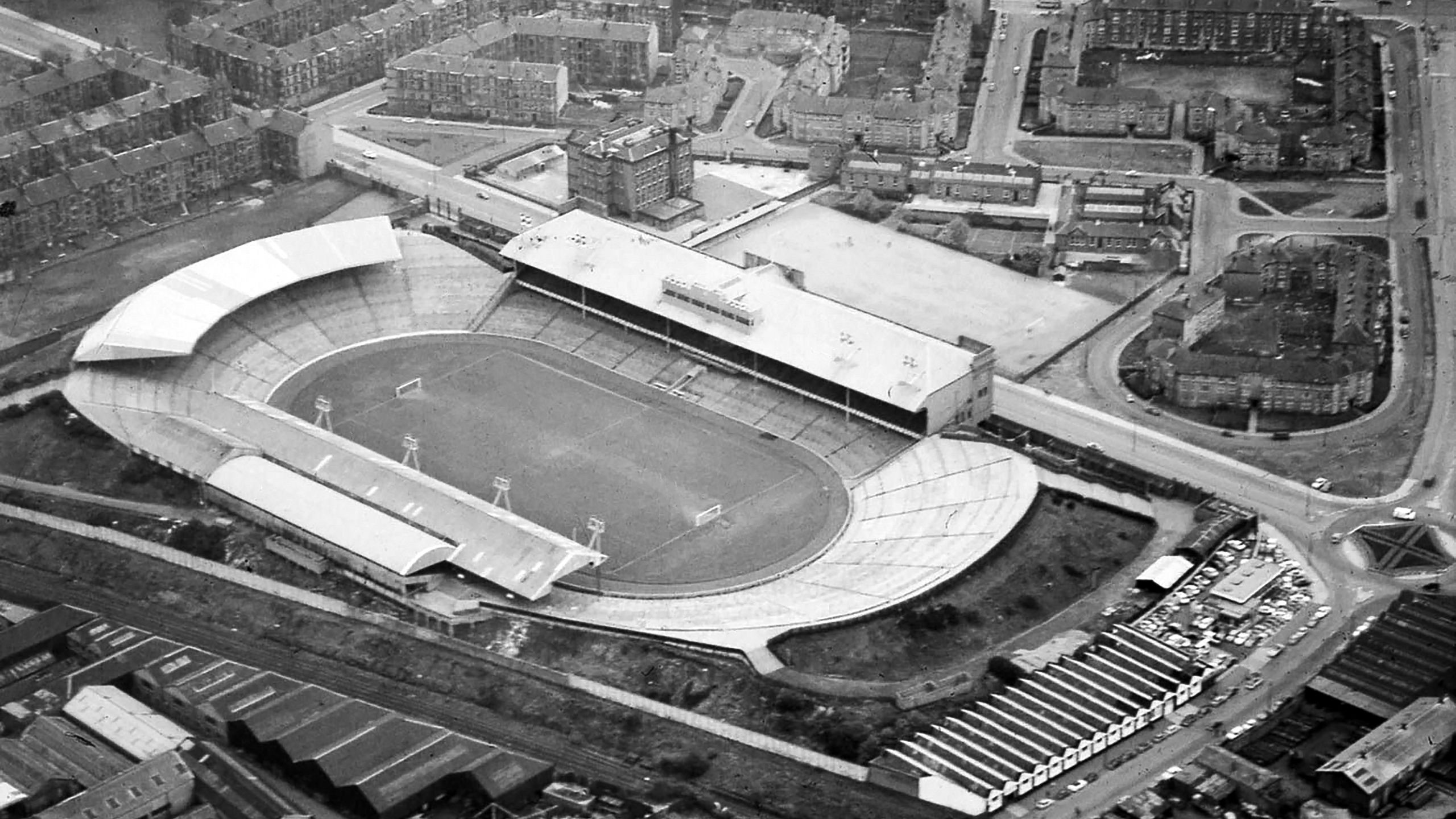
Ibrox Park, as it was named, and would have appeared, in 1971

On January 2, 1971, the teams took the pitch at Ibrox, and over 80,000 people attended. The game remained scoreless until the 90th minute, when Jimmy "Jinky" Johnstone, often regarded as Celtic's greatest player ever, scored. And so, thinking the game was sure to end in a 1-0 defeat, many of the Rangers fans got up to leave.

But in stoppage time, Colin Stein (like Celtic's manager, John "Jock" Stein, that's pronounced "STEEN," and isn't Jewish or German), scored an equalizer for Rangers. Hearing the roar of the fans who hadn't left, some of those who did turned around and tried to go back to see what had happened.

This proved fatal on Stairway 13. It is widely believed that someone tripped and fell, causing a domino effect. Bodies ended up being stacked up to 6 feet deep. Among the 66 deaths were 31 teenagers, and 5 children who were schoolmates from Fife.

The incident happened so late that the on-pitch people, including the players, and the fans still in the stands, didn't know what happened until after the game was over. The players for Celtic included 18-year-old forward Kenny Dalglish, who would become a star for the team, and later in England for Liverpool Football Club. He would be present for the Heysel Stadium Disaster of 1985, where 39 died; and the Hillsborough Stadium Disaster of 1989, which would surpass the Ibrox Disaster of 1971 as the deadliest sporting disaster in the history of the British Isles.

Rangers F.C. were sued, and, knowing the case was unwinnable, they settled. Ibrox soon underwent a renovation, including a new Stairway 13. While the Hillsborough Disaster was the catalyst for all English stadiums converting to all-seater, the Ibrox Disaster led to most Scottish stadiums doing so far sooner, and Ibrox was all-seater by 1981. Today, it seats 50,817.
A recent photo of Ibrox Stadium

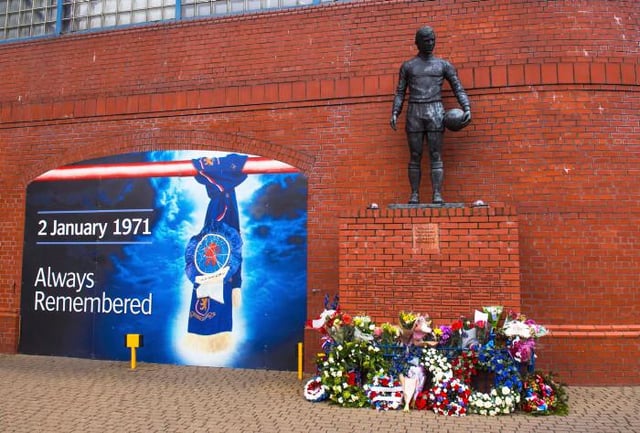
In 2001, on the 30th Anniversary of the tragedy, a monument with the names of the victims was dedicated. It includes a statue of John Grieg, their Captain in 1971, and often regarded as their greatest player ever.
In 2011, on the 40th Anniversary, Grieg and Billy McNeill, Celtic's Captain at the time (though he was injured and unavailable to play in the game in question), led the current versions of their respective teams out for a pregame ceremony.
Foreground: McNeill (left) and Grieg.
Background: 2011 Captains Scott Brown (left) and David Weir.
Celtic won the game, 2-0.

*

January 2, 1971, like most English and Scottish "football" matchdays in the pre-Premier League era, was a Saturday. Oddly, the team that ended up winning England's Football League Division One and its FA Cup, Arsenal F.C. of North London, did not play that day. Nor did they play the day before, New Year's Day, as they usually do. Indeed, no games were played in Division One that weekend.

In America, it was the off-season for Major League Baseball. No games were played in the NFL, although the Conference Championship Games were played the next day. The Baltimore Colts won the AFC Championship, beating the Oakland Raiders 27-17 at Memorial Stadium in Baltimore. And, in the last NFL game played at Kezar Stadium in San Francisco, the Dallas Cowboys won the NFC Championship by beating the San Francisco 49ers, 17-10. Two weeks later, the Colts beat the Cowboys in Super Bowl V, 16-13 at the Orange Bowl in Miami.

There were 8 games played in the NBA that day:

* The New York Knicks lost to the Atlanta Hawks, 112-108 at Madison Square Garden. Walt Frazier led all scorers with 28 points in defeat.

* The Boston Celtics beat the Philadelphia 76ers, 125-120 at The Spectrum in Philadelphia.

* The Cincinnati Royals beat the Buffalo Braves, 115-103 at the Buffalo Memorial Auditorium. The Royals moved in 1972 to become the Kansas City Kings, and moved again in 1985, to Sacramento. The Braves were a 1st-year expansion team, who became the San Diego Clippers in 1978 and the Los Angeles Clippers in 1984.

* The Baltimore Bullets beat the Detroit Pistons, 108-99 at Cobo Hall in Detroit. Dave Bing scored 33 points for the Pistons in defeat. The Bullets moved to Washington in 1973, and were renamed the Washington Wizards in 1997.

* The Milwaukee Bucks beat the Cleveland Cavaliers, 118-73 at the Milwaukee Arena. In 1974, it was renamed the Milwaukee Exposition, Convention Center and Arena, or "The MECCA." Since 2014, it has been named the UW-Panther Arena. Lew Alcindor, still a year and a half from changing his name to Kareem Abdul-Jabbar, led all scorers with 27 points.

If you don't know what happened in the NBA's 1970-71 season, reading the score will make it less of a surprise to learn that the Cavs were a 1st-year expansion team, and the Bucks went on to win the NBA Championship.

* The San Diego Rockets beat the Los Angeles Lakers, 109-108 in overtime at the San Diego Sports Arena. The Rockets moved to Houston before the next season.

* The Phoenix Suns beat the San Francisco Warriors, 122-116 in overtime at the Cow Palace in the San Francisco suburb of Daly City, California. The next season, the Warriors moved across San Francisco Bay, into the Oakland Coliseum Arena, and renamed themselves the Golden State Warriors.

* And the Chicago Bulls beat the Portland Trail Blazers, 136-113 at the Portland Memorial Coliseum. Bob Love of the Bulls led all NBA scorers on the day with 36 points.

There were 4 games played in the American Basketball Association:

* The New York Nets lost to the Carolina Cougars, 118-99 at the Greensboro Coliseum.

* The Virginia Squires beat the Pittsburgh Condors, 137-126 at the Hampton Coliseum.

* The Indiana Pacers beat the Kentucky Colonels, 134-132 at Freedom Hall in Louisville. In a losing cause, Dan Issel, who had starred at the University of Kentucky before playing for the Colonels (and later for the NBA's Denver Nuggets), scored 44, more than any other NBA or ABA player that day.

* And the Utah Stars beat the Texas Chaparrals, 134-109 at the Salt Palace in Salt Lake City. The Stars would win the ABA Championship that season, but would not be among the 4 ABA teams invited to join the NBA season. Those would be the Nets, the Pacers, the Nuggets, and the Chaparrals, who became the San Antonio Spurs in 1973.

There were 6 games played in the NHL that day:

* The New York Rangers beat the Pittsburgh Penguins, 3-1 at the Civic Arena in Pittsburgh. Jim Neilson, Arnie Brown and Pete Stemkowski scored for the Broadway Blueshirts.

* The Chicago Black Hawks beat the Philadelphia Flyers, 3-1 at The Spectrum in Philadelphia.

* The Montreal Canadiens beat the California Golden Seals, 5-3 at the Montreal Forum. Based in Oakland, the Golden Seals became the Cleveland Barons in 1976, and were merged with the Minnesota North Stars in 1978. They remain the last team in the North American "Big Four" sports leagues to close up operations.

* In the 1st game of the Saturday Hockey Night In Canada doubleheader on CBC, the Toronto Maple Leafs walloped the Detroit Red Wings, 13-0 at Maple Leaf Gardens in Toronto. Norm Ullman, Darryl Sittler, Billy MacMillan and Paul Henderson each scored 2 goals; and 1 each was scored by Mike Pelyk, Dave Keon, Garry Monahan, Brian Spencer and Jim Harrison.

* The Minnesota North Stars and the Los Angeles Kings played to a tie, 3-3 at The Forum in the Los Angeles suburb of Inglewood, California.

* And in the 2nd game of the Hockey Night In Canada doubleheader, the St. Louis Blues beat the Vancouver Canucks, 3-1 at the Pacific Coliseum in Vancouver. The 1970 expansion, including the Canucks, enabled the CBC to stage these prime-time doubleheaders: One in Eastern Canada, one in Western Canada, both starting at 7:00 PM local time.

Actors Taye Diggs and Renée Elise Goldsberry, both Broadway stars, were born on this day. 

December 31, 1999 & January 1, 2000: The Millennium

December 31, 1999:  The Millennium arrives. The people of planet Earth survived. At a terrible cost. But we hadn't destroyed ourselves. ...