Showing posts with label television. Show all posts

Saturday, December 31, 2022

December 31, 1972: Color TV Sets Overtake Black-and-White

A 1972 Zenith print ad,
complete with period-typical shag carpeting

December 31, 1972: The end of the year leads the Federal Communications Commission to announce that this is the 1st year that Americans bought more color television sets than black-and-white sets, and the 1st year that a majority of American homes had color TV sets.

Although all-electronic color television sets were introduced in the U.S. in 1953, high prices and the scarcity of color programming greatly slowed its acceptance in the marketplace. It would take until the 1965-66 TV season for most American shows that had not already switched to color to do so.

But it still took until 1972 for color sets to overtake black-and-white sets. Indicative of this was TV Guide magazine making a switch: Until then, when they listed a show in color, it would have an icon next to it, a white "C" on a black background. Afterward, if a program was a black-and-white broadcast, such an old movie or a TV rerun, the icon next to the listing would be a black "BW" on a white background.

Oddly, while Britain developed what Americans would come to call "network television" in 1936, and we didn't really do so until 1947, their BBC and ITV didn't switch to color broadcasting until 1969.

*

December 31, 1972 was a Sunday. This was also the day that baseball star Roberto Clemente was killed in a plane crash. I have a separate entry for that event.

It was the off-season for baseball. The NFL played its Conference Championship Games:

* Although the Miami Dolphins had an undefeated regular season, the Pittsburgh Steelers hosted the AFC Championship Game at Three Rivers Stadium, because the NFL was still using a rotating system for hosting the title game, not home field advantage.

Eight days after the franchise's 1st-ever Playoff win, on the Franco Harris "Immaculate Reception," the Steelers led 10-7 in the 3rd quarter. But the Dolphins came from behind to win, 21-17.

* The Washington Redskins dominated the defending NFL Champions, the Dallas Cowboys, 26-3 at Robert F. Kennedy Stadium. Head coach George Allen led his veteran "Over-the-Hill Gang" to the team's 1st Playoff win in 30 years. 

But the Dolphins would complete the perfect season by beating the Redskins in Super Bowl VII, 2 weeks later at the Los Angeles Memorial Coliseum.

There were no games played in the NBA or the ABA on New Year's Eve 1972. There were 3 NHL games played that day:

* The New York Rangers beat the St. Louis Blues, 6-1 at Madison Square Garden. 

* The Detroit Red Wings and the Minnesota North Stars played to a tie, 4-4 at the Olympia Stadium in Detroit. 

* And the Chicago Black Hawks beat the Buffalo Sabres, 4-2 at Chicago Stadium. 

And there were 3 games played in the World Hockey Association, which was in its 1st season:

* The New England Whalers beat the New York Raiders, 3-0 in the other game played on Madison Square Garden ice that day.

* The Quebec Nordiques beat the Ottawa Nationals, 8-4 at Le Colisée de Québec. Rene Levesque must have loved that.

* And the Philadelphia Blazers beat the Los Angeles Sharks, 3-1 at the Los Angeles Memorial Sports Arena.

Sunday, November 6, 2022

November 6, 1947: "Meet the Press," TV's Longest-Running Show, Debuts

November 6, 1947: Meet the Press debuts on NBC. It is still on the air after 75 years, making it the longest-running program in television history, anywhere in the world.

Oddly for its era, the 1st moderator was a woman, Martha Rountree. She was succeeded in 1953 by Ned Brooks, who held the post until 1965, Lawrence Spivak until 1975, Bill Monroe (not the country singer) until 1984, Marvin Kalb until 1987, Chris Wallace until 1989, Garrick Utley until 1991, and then its longest-running host, Tim Russert, until his death in 2008. He was succeeded by David Gregory, and then Chuck Todd was named host in 2014, and still is.

(Brooks died in 1969, Spivak in 1994, Rountree in 1999, Monroe in 2011, and Utley in 2014. As of November 6, 2022, Kalb, Wallace and Gregory are still alive.)

Incumbent Presidents who have appeared: Jimmy Carter, Bill Clinton, George W. Bush, Barack Obama, Donald Trump and Joe Biden.

Herbert Hoover appeared on the show as an old man in 1955. Franklin Roosevelt, Harry Truman and Dwight D. Eisenhower never appeared on the show. John F. Kennedy appeared as a member of the House of Representatives, as a Senator, and as a Presidential nominee. Lyndon Johnson appeared as Senate Minority Leader, Senate Majority Leader, as Presidential candidate, and as Vice Presidential nominee.

Richard Nixon appeared as a member of each house of Congress, as Vice President, as candidate for President, and while out of office, but never as the incumbent President. Gerald Ford appeared as House Minority Leader and Vice President. Ronald Reagan appeared as Governor of California and candidate for President. George H.W. Bush appeared as Chairman of the Republican National Committee, as candidate for President, and as Vice President.

Athletes do not usually appear on the show, often mocked as Meet the Depressed and Press the Meat.
But Russert, a Buffalo native, loved to interview them. During Autumn, he would conclude the show's usual tagline with a reference to his hometown team: "If it's Sunday, it's Meet the Press. Go Bills."

Russert liked to challenge Democrats and Republicans alike, and, with a graphic or a clip ready to go, made, "Senator, let me show you... " the 5 scariest words in Washington. Today, Todd shows an obvious favoritism toward conservatives, which has earned him the nickname "Chuck Toad."

*

November 6, 1947 was, oddly given the program in question, not a Sunday. It was a Thursday. So no football games were played. Baseball was out of season. Basketball season was a week away from starting. 

There were 2 games in the NHL that day. The New York Rangers lost to the Detroit Red Wings, 2-1 at the Olympia Stadium in Detroit. And the Montreal Canadiens beat the Toronto Maple Leafs, 3-0 at the Montreal Forum. The Boston Bruins and the Chicago Black Hawks were not scheduled.

Saturday, October 22, 2022

October 22, 1939: The 1st NFL Game On Television

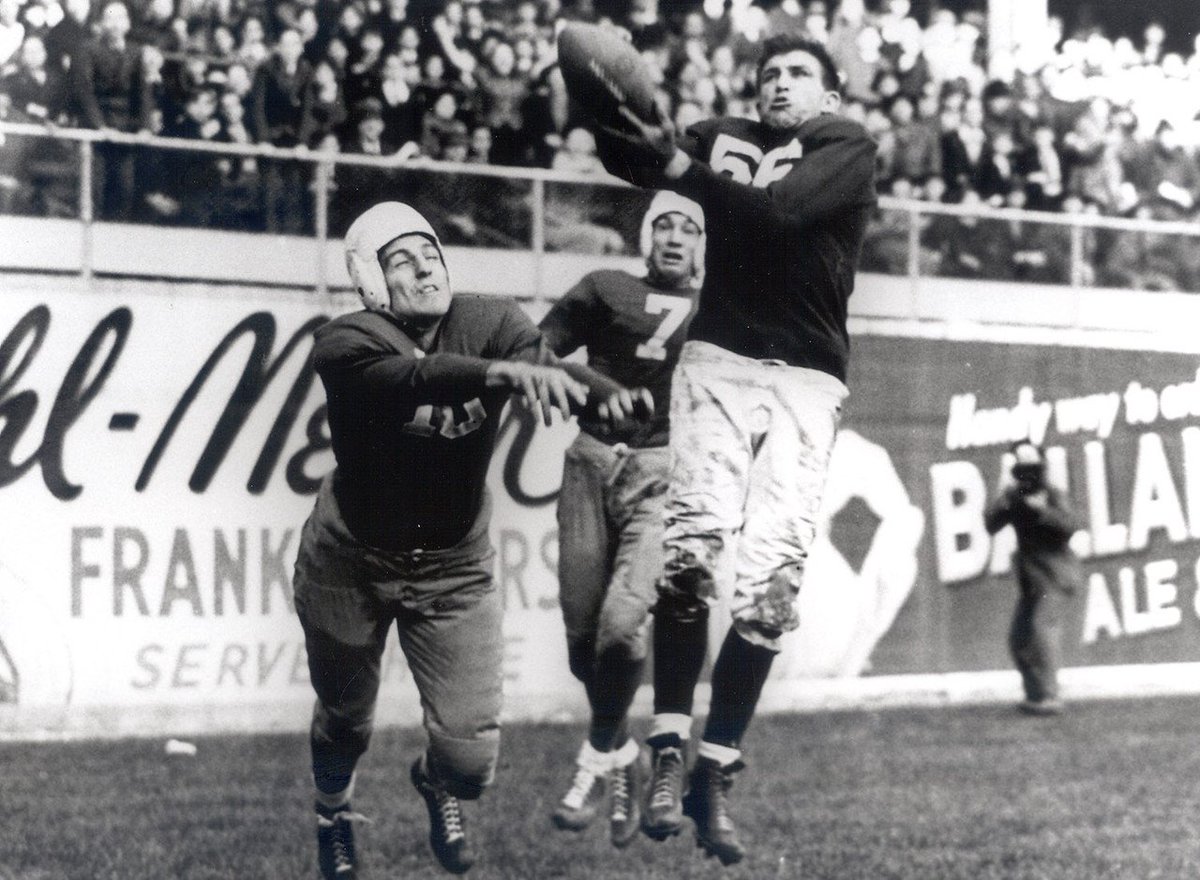
The only known photograph of the game.
Number 7 is Ace Parker. Number 56 is Bill Hewitt.
Both men are in the Pro Football Hall of Fame.
No, Hewitt hasn't lost his helmet: He didn't wear one
until the NFL passed a rule requiring it in 1940.

October 22, 1939: For the 1st time, a professional football game is televised, on experimental New York station W2XBS, the forerunner of WNBC-Channel 4. The Brooklyn Dodgers -- yes, there was an NFL team with that name -- play the Philadelphia Eagles at Ebbets Field in Brooklyn. The Dodgers win, 23-14, before only 13,057 fans.

There's no record of how many people paid to watch it in person, but there were apparently less than 300 TV sets capable of receiving the signal. No footage of the game survives, not even on newsreel.

The Dodgers struck first, on a 1-yard run by Clarence "Pug" Manders, who was in the middle of a run of 3 straight Pro Bowls. In the 2nd quarter, Fran Murray scored on a 1-yard run of his own for the Eagles. It remained 7-7 at the half, but the Dodgers took over: Ralph Kercheval kicked field goals of 44, 38 and 45 yards, and future Hall-of-Famer Clarence "Ace" Parker threw a 47-yard touchdown pass to Perry Schwartz. The Eagles added a 22-yard touchdown pass from Davey O'Brien, winner of the 1938 Heisman Trophy with Texas Christian, to Hall-of-Famer Bill Hewitt, but that would be as close as the Eagles got.

Football and television is an epic love story, but it was far from love at first sight. It would really take another 19 years, and the 1958 NFL Championship Game -- Baltimore Colts 23, New York Giants 17, in overtime at Yankee Stadium -- for it to become more than a flirtation. If there is an event that can be called "the wedding," it's probably Super Bowl III, 10 years after that, on January 12, 1969.

But the couple is inseparable, partly because of the shared TV revenue which allows Green Bay, Wisconsin, with a metropolitan area of 300,000 people, to compete on the same level as New York City, with a metro area of nearly 24 million people. It's also why the Big Ten Conference wanted to add Rutgers and the University of Maryland: Between the markets of New York, Philadelphia, Baltimore and Washington, they added about 40 million.

The NFL's TV revenue is so big (How big is it?), it's been said that the NFL can shut the doors of all 16 stadiums hosting games in a given weekend, with a total official attendance of zero, and still make a profit.

*

October 22, 1939 was a Sunday. George Cohen, the right back on the England team that won the 1966 World Cup, was born on this day.

The baseball season was over, the NHL season hadn't begun yet, and the NBA hadn't yet been founded. But there were 4 other NFL games founded:

* The New York Giants beat the Chicago Bears, 16-13 at the Polo Grounds.

* The Washington Redskins beat the Pittsburgh Pirates, 21-14 at Forbes Field in Pittsburgh. The Pirates, like the Giants named for their city's oldest baseball team, became the Pittsburgh Steelers the next season.

* The Cleveland Rams beat the Chicago Cardinals, 24-0 at Comiskey Park in Chicago. The Rams moved to Los Angeles in 1946, St. Louis in 1995, and back to Los Angeles in 2016. The Cardinals moved to St. Louis in 1960, and Arizona in 1988.

* And the Green Bay Packers beat the Detroit Lions, 26-7 at City Stadium in Green Bay. 

Friday, September 2, 2022

September 2, 1963: The Birth of Half-Hour Evening News On National TV Networks

September 2, 1963: The CBS Evening News becomes the first network TV news broadcast to go from 15 to 30 minutes. NBC and ABC will follow suit later in the month.

CBS' first installment includes videotape footage (which is still not all that common), in black and white, of their anchorman, Walter Cronkite, who had taken over as anchorman a year earlier, interviewing President John F. Kennedy, spending Labor Day weekend at the family compound at Hyannis Port, Massachusetts. It was taped in the morning, Cronkite and the videotape were flown to New York in the afternoon, and the footage was broadcast that night, at 7:00 PM, U.S. Eastern Time.

Among the subjects discussed is civil rights. In June, Kennedy had asked Congress to pass a civil rights bill. He was planning to run for re-election on the success of that bill, which was still working its way through Congress:

Cronkite: How seriously do you think this civil rights situation is going to affect your chances, assuming you will be the nominee of the Democratic Party next year, in 1964?

Kennedy: Well, obviously it is going to be an important matter. It has caused a good deal of feeling, I suppose, against the administration in the South. Also, I suppose, in other parts of the country. Whenever you have an issue upon which people feel so strongly, quite obviously, it has its political effects, so I would say it would be an important matter.

On the other hand, I am hopeful that both parties, Republicans and Democrats, will commit themselves to the same objective of equality of opportunity. I would be surprised if the Republican Party which, after all, is the party of Lincoln, and is proud of that fact, as it should be, I would be surprised if they did not also support the right of every citizen to have equal opportunities, equal chance under the Constitution...

Cronkite: Do you think you will lose some Southern States in '64?

Kennedy: I lost some in '60, so I suppose I will lose some, maybe more in '64. I don't know. It is too early, to tell but I would think -- I am not sure that I am the most popular political figure in the country today in the South, but that is all right. I think that we will have to wait to see a year and a half from now -- a year now. It is not that long.

Cronkite: Are you making any estimate as to who your opponent might be in '64?

Kennedy: No, there are a good many of them. There are a good many of them.

Cronkite: Do you have any choice as to who you would like to run against, either to put the issues before the people or otherwise?

Kennedy: No. That is a great mistake. I know some Republicans chose me in '60 as their favorite candidate, so I don't think I can choose anybody. I will let them choose.

Cronkite also wanted to discuss the war in Vietnam. The interview has been cited as evidence by people who think JFK would have ended the war in 1964, or early in his second term, in 1965:

Cronkite: Mr. President, the only hot war we've got running at the moment is of course the one in Vietnam, and we have our difficulties there, quite obviously.
Kennedy: I don't think that unless a greater effort is made by the government to win popular support that the war can be won out there. In the final analysis, it is their war. They are the ones who have to win it or lose it. We can help them, we can give them equipment, we can send our men out there as advisers, but they have to win it, the people of Vietnam, against the Communists.
We are prepared to continue to assist them, but I don't think that the war can be won unless the people support the effort, and, in my opinion, in the last 2 months, the government has gotten out of touch with the people.
But, a minute later, JFK said something that suggested the opposite, that he would keep troops there beyond the next election, comparing the struggle against Communism in Southeast Asia with the struggle against Fascism in Europe, 20 years earlier:

Kennedy: But I don't agree with those who say we should withdraw. That would be a great mistake. I know people don't like Americans to be engaged in this kind of an effort. Forty-seven Americans have been killed in combat with the enemy, but this is a very important struggle even though it is far away.
We took all this, made this effort to defend Europe. Now, Europe is quite secure. We also have to participate -- we may not like it -- in the defense of Asia.
We'll never know: Just 81 days later, the decision was taken out of Kennedy's hands. Cronkite would deliver that news, too.

A related note: A survey showed that 1963 was the first year in which a majority of Americans said that they got more of their news from TV than from newspapers. Of course, the New York newspaper strike of December 8, 1962 until March 31, 1963 may have had something to do with that.

*

September 2, 1963 was a Monday. Since it was a holiday, Labor Day, several baseball teams played doubleheaders. These games were played:

* The New York Yankees split a doubleheader with the Detroit Tigers, at Tiger Stadium in Detroit. The Yankees won the opener, 5-4. Whitey Ford outpitched Frank Lary, known as "The Yankee Killer" for several wins against the team earlier in his career. Joe Pepitone hit a home run. Yogi Berra went 0-for-2 with 2 walks, Roger Maris went 0-for-3 with a walk, and neither appeared in the nightcap. Mickey Mantle only appeared as a pinch-hitter, and did not reach base.

The Tigers won the nightcap, 2-1. Hank Aguirre outpitched Stan Williams. Mantle went 2-for-4 with a walk. Over the 2 games, Al Kaline went 1-for-6 with a walk and 2 RBIs.

* The New York Mets split with the Cincinnati Reds at the Polo Grounds. The Mets won the 1st game, 5-3. The Reds won the 2nd game, 1-0. Jim Maloney pitched a 3-hit shutout, striking out 13, to gain his 20th win of the season. Frank Robinson left the 1st game early, returned for the 2nd game, and went 0-for-5 on the day. Pete Rose, soon to be named the National League Rookie of the Year, went 4-for-9 with 2 RBIs.

* The Boston Red Sox swept the Baltimore Orioles, 4-3 and 2-0 at Fenway Park in Boston. Though a Red Sox fan, President Kennedy did not make the 75-mile trip northwest from Hyannis Port to Fenway that day. Bob Heffner pitched a 5-hit shutout in the 2nd game. Over the 2 games, Carl Yastrzemski went 3-for-7 with a walk. Brooks Robinson went 0-for-3 in the 1st game, and did not play in the 2nd game.

* A doubleheader was split at Cleveland Municipal Stadium. The Cleveland Indians won the 1st game, 15-3. The Washington Senators won the 2nd game, 8-7.

* A doubleheader was split at Comiskey Park in Chicago. The Los Angeles Angels won the 1st game, 7-5. The Chicago White Sox won the 2nd game, 8-7.

* In the only single game of the day, the Philadelphia Phillies beat the Milwaukee Braves, 9-4 at Milwaukee County Stadium. Hank Aaron hit the 334th home run of his career. He was not yet 30 years old.

* The Minnesota Twins swept the Kansas City Athletics, 6-2 and 3-1 at Metropolitan Stadium in the Minneapolis suburb of Bloomington, Minnesota. Over the 2 games, Harmon Killebrew went 2-for-8 with a home run and 2 RBIs.

* The St. Louis Cardinals swept the Pittsburgh Pirates, 6-1 and 6-2 at the first Busch Stadium (formerly the last Sportsman's Park) in St. Louis. Bob Gibson won the 1st game, and the only run he gave up was a home run to Roberto Clemente. In 1967, Clemente would hit a line drive off Gibson's leg, breaking his fibula, and causing him to miss a month of the season.

Stan Musial, entering his final month as an active player, did not play in the 1st game, but went 1-for-4 with an RBI in the 2nd game.

* The Los Angeles Dodgers swept the Houston Colt .45s, 7-3 and 7-1 at Dodger Stadium in Los Angeles. Sandy Koufax won the 1st game, Johnny Podres the 2nd game. The Colts became the Houston Astros in 1965.

* And the Chicago Cubs swept the San Francisco Giants, 7-5 and 6-0 at Candlestick Park in San Francisco. Ernie Banks went 0-for-1 before getting hurt in the 1st game, and didn't play in the 2nd, in which Ron Santo hit 2 home runs, in support of Glenn Hobbie, who pitched a 2-hit shutout. Willie Mays went 0-for-2 in the 1st game, and did not play in the 2nd.

Friday, August 26, 2022

August 26, 1939: The 1st Baseball Game On Television

August 26, 1939: The Brooklyn Dodgers host a doubleheader against the Cincinnati Reds at Ebbets Field. The 2nd game is the 1st Major League Baseball game ever broadcast on television.

In 1935, Larry MacPhail was the general manager of the Reds. He made them the 1st MLB team ever to play under lights. He also put their games on regular radio for the first time, and his broadcaster was Walter "Red" Barber, a rural Floridian who adjusted well to a big city.

In 1938, these two redheads adjusted to a much larger city, New York, when MacPhail was named general manager of the Dodgers, and brought Barber with him, breaking the "gentlemen's agreement" that none of the City's teams would broadcast their games on radio.

MacPhail also made Ebbets Field the 1st of the City's 3 ballparks to put up lights. It may not have been a coincidence that the 1st night game there was against the Reds. Fortunately for baseball history, but unfortunately for the Dodgers, this game, on June 15, 1938, was the game in which the Reds' Johnny Vander Meer became the only man, to this date, to pitch back-to-back no-hitters in the major leagues.

On April 30, 1939, the New York World's Fair got underway in Flushing Meadow-Corona Park in Queens, across Roosevelt Avenue from where Shea Stadium and Citi Field would later be constructed. The opening, with a dedication by President Franklin D. Roosevelt, himself a New Yorker, was the 1st broadcast of W2XBS, New York's 1st television station.

Run by RCA, the Radio Corporation of America, W2XBS was going to be the centerpiece of a new TV network, to go along with the radio network they had established in 1926, the National Broadcasting Company, NBC. Now, it was going to broadcast baseball, and Red Barber was going to call the action.

But only for the 2nd game. The 1st game was won by the Reds, 5-2. This was not surprising: The Dodgers were a team on the rise, and would finish 3rd in the National League that season; but the Reds went on to win the next 2 NL Pennants.

Bucky Walters, the Reds' ace, won his 21st game of the season, outpitching Luke Hamlin. Walters would finish the season 27-11. If there had been a Cy Young Award back then, he surely would have won the NL's edition that season. Hamlin didn't pitch badly, but was undone by 2 errors by his teammates.

Between games, the telecast began. Barber gave a recap of the opener, and conducted interviews, including with Dodger manager and shortstop Leo Durocher. It was the beginning of a long and productive relationship between Barber and television -- and one between Durocher and television, as "Leo the Lip" used the medium, as he had already used print and radio, for his own cynical ends.

The 2nd game was the rescheduling of a game originally set for June 12, postponed not due to weather, but because it was the Opening Day of the Baseball Hall of Fame. Hugh Casey, better known as a reliever, started for Brooklyn, and Johnny Niggeling did so for Cincinnati. As the home team's starting pitcher, Casey thus became the 1st Major League Baseball player to play on television.

The Dodgers got on the board in the bottom of the 2nd inning. Art Parks led off with a single, and Dolph Camilli hit a home run. They broke the game open in the 3rd: Pete Coscarart led off with a single, and Cookie Lavagetto doubled him home. Dixie Walker grounded out, but Parks singled again, and Camilli doubled him home. Al Todd drew a walk, and Ernie Koy singled home Parks and Camilli. The Dodgers led 6-0.

The Reds reached Casey for a run in the 8th, but that was it: The Dodgers won 6-1, and the few hundred people capable of watching this game outside Ebbets Field (where a full house of 33,535 paid to watch) got their money's worth.

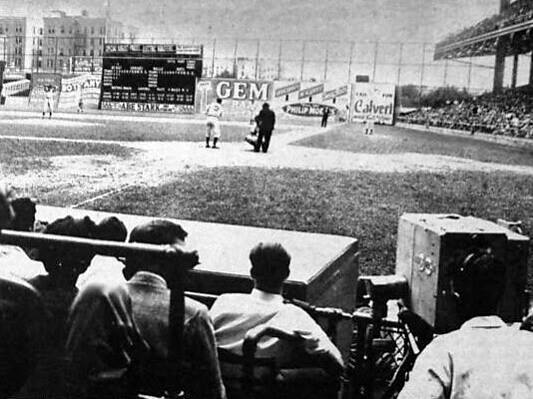
Sadly, it appears that no record of this game survives: Not the original TV broadcast, not a radio recording, not a film. The photograph at the top of the page is allegedly from that game.

Later in 1939, W2XBS would also become the 1st TV station in the world to broadcast college football and the 1st to broadcast pro football. In 1940, it became the 1st American TV station to broadcast a National Hockey League game (a British station had telecast a hockey game in London in 1938), the 1st to broadcast a religious service (Easter Mass from St. Patrick's Cathedral, a short walk from the RCA Building at Rockefeller Center), and the 1st to broadcast a political convention (the Republican Convention in Philadelphia, nominating Wendell Willkie to run against FDR, unsuccessfully as it turned out).

On July 1, 1941, the Federal Communications Commission (FCC) gave licenses to W2XBS and W2XAB, which was owned by the Columbia Broadcasting Service, CBS. Doing so on the same day meant that neither could claim to be the 1st. W2XBS became WNBT, broadcasting on Channel 4. They changed their call letters to WRCA in 1954, and to WNBC in 1960. W2XAB broadcast on Channel 2, and became WCBW, and then WCBS in 1946.

The other New York VHF TV stations:

* Channel 5 went on the air on May 2, 1944, on the DuMont Network, with its call letters being WABD, for its founder, Allen B. DuMont, went independent when DuMont folded in 1956, became WNEW in 1958, and WNYW when it became a Fox station in 1956.

* Channel 13 went on the air on May 13, 1948, as an independent station, WATV. It became WNTA in 1958, and WNDT in 1962. That year, it joined National Educational Television (NET), America's 1st "public television" network. In 1970, NET became the Public Broadcasting Service, PBS, and the station's call letters were changed to WNET. Why not WPBS? Those call letters were not already being used, but were subsequently given to a PBS station in Watertown, New York, on the St. Lawrence River, Channel 16.

* Channel 11 went on the air on June 15, 1948, as WPIX, the call letters referring to its ownership by the New York Daily News, "New York's Picture Newspaper." This was not unusual: Many radio TV stations were founded by newspapers. WPIX continues to use the Daily News Building on East 42nd Street as its headquarters, even though the paper has moved its offices elsewhere. The station joined Warner Brothers in 1995, becoming part of The WB. When The WB and UPN merged in 2006 to form The CW, WPIX went along with it.

* Channel 7 went on the air on August 10, 1948, as WJZ, an ABC station, becoming WABC in 1953.

* Channel 9 went on the air on October 11, 1949, as WOR, an independent station, becoming WWOR when bought by MCA in 1987, moved to United Paramount Network (UPN) in 1995, and to MyNetwork in 2006, following the WB/UPN merger.

*

August 26, 1939 was a Saturday. It was the off-season for the NFL and the NHL, and the NBA hadn't been founded yet. Here are the other MLB games that were played that day:

* The New York Yankees beat the St. Louis Browns, 6-1 at Sportsman's Park in St. Louis. Irving "Bump" Hadley went the distance. The Yankees hit no home runs, but got 2 hits each from Joe DiMaggio, Red Rolfe, Joe Gordon and Babe Dahlgren, who had replaced Lou Gehrig at 1st base.

* The New York Giants swept a doubleheader from the Pittsburgh Pirates at the Polo Grounds. The Jints won the opener 6-2, and the nightcap 8-0, as Cliff Melton pitched a 3-hit shutout.

* The St. Louis Cardinals swept a doubleheader from the Philadelphia Phillies at Shibe Park in Philadelphia. The Cards won the 1st game 5-0, as Curt Davis allowed 10 hits, but kept the shutout. The Cards won the 2nd game 11-4.

* The Chicago Cubs swept a doubleheader from the Boston Bees at Braves Field in Boston. This was during the stretch when the Braves, trying to change their identity after a horrible 1935 season, changed their name, with their ballpark being nicknamed "The Bee Hive." It didn't take, and they went back to being named the Braves in 1941. Both games in this doubleheader ended 8-1 in the Cubs' favor.

* It was also Chicago beating Boston in the American League, as the Chicago White Sox beat the Boston Red Sox, 5-4 at Comiskey Park in Chicago.

* The Cleveland Indians beat the Philadelphia Athletics, 7-5 at League Park in Cleveland.

* And the Detroit Tigers beat the Washington Senators, 6-3 at Briggs Stadium in Detroit. That ballpark would be renamed Tiger Stadium in 1961.

Also, Arsenal opened what turned out to be their shortest Football League season by drawing with Wolverhampton Wanderers, 2-2 at Molineux Stadium in Wolverhampton, outside Birmingham in England's West Midlands. Two weeks later, the League would suspend play due to the start of World War II. 

Friday, July 1, 2022

July 1, 1941: Network Television Debuts In New York

Logo adopted for NBC radio in 1943

July 1, 1941: WNBT, owned by the National Broadcasting Company, begins broadcasting out of New York City, on Channel 4. It becomes WRCA on October 18, 1954, and WNBC on May 22, 1960.

On the exact same day, WCBW, owned by the Columbia Broadcasting Service, begins broadcasting on Channel 2. It becomes WCBS on November 1, 1946.

The Federal Communications Commission licensed them with the instruction to sign on simultaneously on July 1, so that neither of the 2 major broadcasting networks, NBC nor CBS, could claim exclusively to have the 1st commercial television station in New York City. (ABC, the American Broadcasting Company, was founded in 1943, an offshoot of NBC until then called "the NBC Blue Network.") But NBC cheated, going on the air at 1:30 PM, a full hour before the time to which CBS had agreed.

New York’s other VHF TV stations:

* WABD, Channel 5, began airing on the DuMont network on May 2, 1944; moved to Metromedia on August 6, 1956; became WNEW on September 7, 1958; and joined the Fox network and became WNYW on March 7, 1986.

* WATV, Channel 13, began airing as an independent station on May 15, 1948; switched to National Educational Television (NET) and the letters WNDT on September 16, 1962; and became WNET, with NET becoming the Public Broadcasting Service (PBS) on October 1, 1970.

* WPIX, Channel 11, began airing as an independent station on June 15, 1948; joined The WB Network on January 11, 1995; and moved to The CW on September 17, 2006.

* WJZ, Channel 7, began airing on ABC on August 10, 1948; and became WABC on March 1, 1953.

* WOR, Channel 9, began airing as an independent station on October 11, 1949; became WWOR on April 29, 1987; joined UPN on January 16, 1995; and moved to MyNetwork on September 17, 2006.

*

July 1, 1941 was a Tuesday. Rod Gilbert, a Hockey Hall-of-Famer who is still the all-time leading scorer for the New York Rangers, was born on this day.

Baseball was the only sport in season at the time, and these games were played on that day, most of them broadcast on radio, but none on television:

* The New York Yankees swept a doubleheader from the Boston Red Sox at Yankee Stadium. In the opener, Joe DiMaggio went 2-for-4, in support of Marius Russo, extending his hitting streak to 43 games, as the Yankees won, 7-2.

In the nightcap, DiMaggio went 1-for-3 with an RBI, making it 44 straight, tying the major league record set in 1897 by Willie Keeler, then with the National League's Baltimore Orioles. (Keeler would be an original Yankee, or rather an original New York Highlander, from 1903 to 1909.) Bill Dickey hit a home run in support of Ernie "Tiny" Bonham, and the Yankees led, 9-2 after 5 innings, when the game was called due to darkness. Yankee Stadium didn't get permanent lights until 1946, using temporary lights to host boxing cards.

Ted Williams went 2-for-6 in the doubleheader, en route to a .406 batting average for the season. DiMaggio would break Keeler's record the next day, extending his streak to 56 straight games with a hit, before Cleveland stopped him on July 17.

* The New York Giants lost to the Boston Braves, 6-4 at Braves Field in Boston.

* The Brooklyn Dodgers lost to the Philadelphia Phillies, 6-4 at Ebbets Field. Stan Benjamin singled home 2 runs of Hugh Casey in the top of the 10th inning. The Dodgers went on to win the Pennant, anyway, but this was a foreshadowing of Casey's trouble against the Yankees in the World Series.

* The Philadelphia Athletics beat the Washington Senators, 10-1 at Shibe Park in Philadelphia.

* The Detroit Tigers beat the Chicago White Sox, 5-1 at Comiskey Park in Chicago.

* The St. Louis Cardinals beat the Pittsburgh Pirates, 11-7 at Forbes Field in Pittsburgh.

* The Cleveland Indians beat the St. Louis Browns, 10-6 at Sportsman's Park in St. Louis.

* And the Chicago Cubs were supposed to play the Cincinnati Reds at Crosley Field in Cincinnati, but the game was rained out, and was never made up. 

Sunday, June 19, 2022

June 19, 1926: NBC Is Founded

TTheir 1979-86 logo. It's my favorite because
it's the only one they've ever used
that combines the letter N with a peacock.

June 19, 1926: The Radio Corporation of America (RCA) founds the National Broadcasting Company (NBC), the 1st major broadcast network in America.

RCA was then owned by General Electric (GE), American Telephone and Telegraph (AT&T), Westinghouse, and United Fruit Company (forerunner of Chiquita Brands). In 1932, GE had to sell its shares of RCA, due to antitrust charges.

In 1986, with Ronald Reagan as President, and the federal government no longer caring about antitrust laws -- AT&T had been broken up in 1982, but that was a process begun under the Carter Administration -- GE was able to buy RCA, and therefore NBC, in its entirety. In 2011, Comcast bought NBC from GE, and remains the owner.

The 4 longest-continuously-running television series in American history are all still currently running on NBC: The weekly news program Meet the Press, which debuted in 1947; the morning news and entertainment program Today, or The Today Show, 1952; The Tonight Show, originally just Tonight, 1954; and Saturday Night Live, which, since 1975, has tried to do for Saturday what The Tonight Show does for weeknights.

RCA chairman David Sarnoff made NBC the first coast-to-coast radio network. In 1927, he established a 2nd radio network, which became known as NBC Blue or "The Blue Network." In 1939, he began to move NBC into television. In 1943, antitrust laws forced him to sell Blue, which became ABC. By 1947, NBC had beaten CBS in the race to become the 1st nationwide TV network.
Microphone logo, 1943-57 

In 1948, NBC became the 1st network to televise the two major American political parties' national nominating conventions. Their teaming of Chet Huntley and David Brinkley to do cover the conventions in 1956 led to the two of them co-anchoring the 1st half-hour nightly news broadcast, The Huntley-Brinkley Report, which lasted until 1970.

Huntley-Brinkley was replaced by the much more generically-titled NBC Nightly News, with John Chancellor as anchor. He was succeeded by Tom Brokaw in 1982, Brokaw was followed by Brian Williams in 2005, and Williams was succeeded by Lester Holt in 2015. (UPDATE: In 2025, Holt was succeeded by Tom Llamas.)

In 1957, NBC debuted its Peacock logo, designed to symbolize the transition to color television. It would be shown with the following announcement: "The following program is brought to you in living color on NBC."
Peacock logo, 1957-75

Its official name is Johnny Chimes, after the three-note programming cue that NBC has used since 1929: "G3 E4 C4." In 1959, NBC introduced the animated "Snake" logo that would appear at the end of every broadcast, with the Chimes playing as the animation played out. It also appeared at the base of every sportscaster's microphone.
But the Snake never proved as popular as the Chimes, which remained NBC's main identifier on radio, or the Peacock, which became even more identified with the network. So much so that, when they decided to retire the Peacock in 1975, there was an uproar. The Snake was retired at the same time, but few people cared. The Peacock was used for the last time to start The Tonight Show on New Year's Eve, December 31, 1975. And host Johnny Carson roasted the network over it. He could do that: The network was not going to fire its most popular employee over a few non-profane jokes.
This 50th Anniversary logo never caught on.

The Peacock was brought back in 1979, in a combination of the new "N" logo. In 1986, NBC dropped the N, switching from an 11-feathered Peacock facing the viewer's left, which every version thus far had been, to a 6-feathered Peacock facing right, which they have used ever since.
NBC was a sports pioneer. Their 1st coast-to-coast broadcast of anything was the 1927 Rose Bowl. NBC became the 1st network to broadcast a baseball game, in 1939; a football game, that same year, first at the college level, then in the NFL; the 1st to broadcast the World Series, in 1947; and the 1st to broadcast coast-to-coast in color, with the Rose Bowl again, in 1962.

In the 1966 season, NBC owned the broadcast rights to the American Football League, while CBS held those to the NFL. As part of the leagues' merger that season, both got to cover Super Bowl I. Regrettably, due to the high cost of videotape, which led to so many events, sports and otherwise, being taped over, no complete color videotape copy of Super Bowl I exists.

This is also true for most of NBC's World Series broadcasts up until 1975. Some black & white copies, meant as backups, survive. It's only because of a resourceful New York sports fan that the 1969 "miracles," the Jets' win in Super Bowl III and the Mets' home games (3, 4 & 5) in the World Series, have been saved in their entirety. (The subsequent 1970 NBA Finals, won by the Knicks, were on ABC.)

NBC's headquarters is at 30 Rockefeller Plaza, on 6th Avenue between 49th and 50th Streets in Midtown Manhattan. Nicknamed "30 Rock," it has officially been known as the RCA Building from its opening 1933 to 1988, the GE Building from then until 2015, and the Comcast Building ever since.
NBC also owns the cable networks CNBC and Bravo, the Spanish-language network Telemundo, and the streaming service Hulu; and, with Microsoft, co-owns the cable network MSNBC. (UPDATE: In 2026, NBC restructured its cable holdings, creating the holding company Versant, and MSNBC became MS NOW.)

NBC's affiliates for major league cities include:

* New York: WNBC-4 (formerly W2XBS, WNBT and WRCA)
* Philadelphia: WCAU-10 (formerly KYW-3)
* Baltimore: WBAL-11
* Washington: WRC-4
* Boston: WBTS-15 (formerly WBZ-4)
* Atlanta: WXIA-11
* Tampa: WFLA-8
* Miami: WTVJ-6
* Pittsburgh: WPXI-11
* Cleveland: WKYC-3
* Cincinnati: WLWT-5
* Detroit: WDIV-4
* Chicago: WMAQ-5
* Milwaukee: WTMJ-4
* Minneapolis: KARE-11
* St. Louis: KSDK-5
* Kansas City: KSHB-41
* Dallas: KXAS-5
* Houston: KPRC-2
* Denver: KUSA-9
* Phoenix: KPNX-12
* San Diego: KNSD-39
* Los Angeles: KNBC-4
* San Francisco: KNTV-11
* Seattle: KING-5

*

June 19, 1926 was a Saturday. These baseball games were played that day:

* The New York Yankees beat the Chicago White Sox, 6-5 at Comiskey Park in Chicago. Babe Ruth went 2-for-3 with a walk and 2 RBIs. Lou Gehrig went 2-for-4.

* The New York Giants lost to the Pittsburgh Pirates, 4-2 at the Polo Grounds.

* The Brooklyn Robins (as the Dodgers were known while Wilbert Robinson was their manager from 1914 to 1931) beat the Chicago Cubs, 7-1 at Ebbets Field.

* The St. Louis Cardinals swept a doubleheader from the Boston Braves, 4-0 and 3-2 at Braves Field in Boston. Jesse Haines pitched a 7-hit shutout in the opener. Over the 2 games, Rogers Hornsby, player-manager for the Redbirds, went 3-for-9 with an RBI.

* The Cincinnati Reds swept a doubleheader from the Philadelphia Phillies, 8-2 and 14-8 at Baker Bowl in Philadelphia.

* The Boston Red Sox beat the Cleveland Indians, 8-3 at League Park in Cleveland. Tris Speaker, player-manager for the Tribe, went 0-for-3 with a walk.

* The Detroit Tigers beat the Philadelphia Athletics, 5-3 at Navin Field (later Briggs Stadium and Tiger Stadium) in Detroit. Ken Holloway outpitched Lefty Grove. Ty Cobb, player-manager for the Tigers, went 2-for-3 with 2 RBIs. For the A's, Jimmie Foxx went 0-for-3.

* And the St. Louis Browns beat the Washington Senators, 9-4 at Sportsman's Park in St. Louis.

Sunday, May 22, 2022

May 22, 1972: The 1st Home Video Game System

May 22, 1972: The Magnavox Odyssey is released. It is the 1st home video game system.

It would be followed in 1977 by the Atari Video Computer System (VCS, later rebranded as the 2600), in 1979 by Mattel Intellivision, and in 1982 by the Atari 5200 SuperSystem and ColecoVision. Games for personal computers and later mobile systems like Nintendo GameBoy would lead to improved graphics.

Eventually, individual games would become legends, and even obsessions: Grant Theft Auto, Call of Duty, Halo, and the Arkham series of games involving DC Comics' superhero Batman.

*

May 22, 1972 was a Monday. Screenwriter Max Brooks was born on that day, the son of comedian-director Mel Brooks and his wife, actress Anne Bancroft.

Football was out of season. The NHL season ended 11 days earlier, when the Boston Bruins beat the New York Rangers for the Stanley Cup. The NBA season ended 4 days before that, when the Los Angeles Lakers beat the New York Knicks for the title.

Only 5 Major League Baseball games were scheduled for that day:

* The Montreal Expos beat the Philadelphia Phillies, 6-3 at Jarry Park in Montreal. This was the only game in the east of North America.

* The Chicago White Sox beat the Texas Rangers, 7-6 at Arlington Stadium in the Dallas suburb of Arlington, Texas. Tom Egan doubled home the winning run in the top of the 12th inning.

* The Houston Astros beat the San Diego Padres, 7-0 at San Diego Stadium. Larry Dierker pitched a 4-hit shutout.

* The San Francisco Giants beat their arch-rivals, the Los Angeles Dodgers, 9-8 at Dodger Stadium in Los Angeles. Dave Kingman hit 2 home runs.

* And the Oakland Athletics beat the California Angels, 6-3 at the Oakland Coliseum. Catfish Hunter outpitched Nolan Ryan. Reggie Jackson went 2-for-4 with a home run, a walk and 3 RBIs.

Monday, May 9, 2022

May 9, 1961: TV as a "Vast Wasteland"

May 9, 1961: Newton N. Minow, Chairman of the Federal Communications Commission (FCC), gives a speech at the convention of the National Association of Broadcasters in Washington, D.C.

A 35-year-old Jewish lawyer from Milwaukee, he had worked in the law firm of former Governor Adlai Stevenson of Illinois, the Democratic Party's nominee for President in 1952 and 1956, and worked on both Stevenson campaigns. In 1960, he worked for Senator John F. Kennedy of Massachusetts, and when JFK won, he appointed Minow to be Chairman of the FCC.

Minnow titled his speech "Television and the Public Interest." It becomes known for 2 words -- but not the 2 words he'd hoped would stick in people's minds, "Public Interest."

In hindsight, the speech addressed the end of a "Golden Age of Television" that had run through the 1950s, contrasting the highbrow programs of that decade with what had appeared on American television in 1960 and 1961. He specifically cited the CBS anthology programs Westinghouse Studio One (which aired from 1948 to 1958) and Playhouse 90 (so named because it was 90 minutes long, running from 1956 to 1960).

He mentioned a handful of praiseworthy shows that were still in production, including yet another CBS anthology show, The Twilight Zone. He also cited some documentaries, and recent variety specials led by singer Bing Crosby and dancer Fred Astaire. But he warned that such programs were the exception rather than the rule:

When television is good, nothing -- not the theater, not the magazines or newspapers -- nothing is better. But when television is bad, nothing is worse. I invite each of you to sit down in front of your own television set when your station goes on the air and stay there, for a day, without a book, without a magazine, without a newspaper, without a profit and loss sheet or a rating book to distract you. Keep your eyes glued to that set until the station signs off. I can assure you that what you will observe is a vast wasteland.

You will see a procession of game shows, formula comedies about totally unbelievable families, blood and thunder, mayhem, violence, sadism, murder, Western bad men, Western good men, private eyes, gangsters, more violence, and cartoons. And endlessly, commercials, many screaming, cajoling, and offending. And most of all, boredom.

True, you'll see a few things you will enjoy. But they will be very, very few. And if you think I exaggerate, I only ask you to try it.

He stated that "Most young children today spend as much time watching television as they do in the schoolroom," and that cartoons and violence typical of children's television of the era was wholly unacceptable, comparable to feeding a child nothing but "ice cream, school holidays and no Sunday school."

He also used newspapers as a comparison, noting that although comic strips and advice columns were newspapers' most popular items, they were not featured on the front pages because (according to Minow) the newspapers were still voluntarily bound to the public interest despite being outside the purview of the FCC, something Minow believed television had abandoned, as it had become too beholden to Nielsen Ratings.

A partial solution Minow proposed was the expansion of non-commercial educational television, which was not yet as widespread as the major broadcast networks. He would get his wish the following year, as National Educational Television (NET) was founded. In 1970, it became the Public Broadcasting Service (PBS).

The phrase "vast wasteland" was suggested to Minow by his friend, reporter and freelance writer John Bartlow Martin. He had recently watched 20 consecutive hours of television, as research for a magazine piece, and concluded it was "a vast wasteland of junk." During the editing process, Minow cut the words "of junk."

In the years that followed, Minow often remarked that the two words best remembered from the speech are "vast wasteland," but the two words he wishes would be remembered were "public interest."

But the networks had pretty much already set their schedules for the 1961-62 TV season. There was time to change them. But, perhaps out of laziness, or perhaps because they were run by rich men who didn't like anyone telling them what to do, few substantive changes were made.

Minow was mocked by many for his scolding. When Sherwood Schwartz created the TV show Gilligan's Island, not only did he make it outlandish enough to offend Minow and people who agreed with him, but he named the ill-fated boat the S.S. Minnow. (A "minnow" is a small fish.)

In a 2011 interview marking the 50th Anniversary of the speech, Minow stated that consumer choice, fueled by the 1980s multi-channel transition, was the most important improvement in television in the decades since his speech. But it was a "Good-news, bad-news" development: He lamented that this increased choice had eliminated the shared experience of the medium.

Minow served 2 years as FCC Chairman, and said that his greatest contribution was persuading Congress to pass legislation clearing the way for communications satellites. He told JFK, whose speech setting landing on the Moon by the end of the 1960s as a goal came 16 days later, "Communications satellites will be much more important than sending man into space, because they will send ideas into space. Ideas last longer than men."

Kennedy considered this, and founded Intelsat, a satellite services provider. In 1962, Telstar 1 was launched. In 1965, Intelsat 1, a.k.a. the Early Bird, was launched.

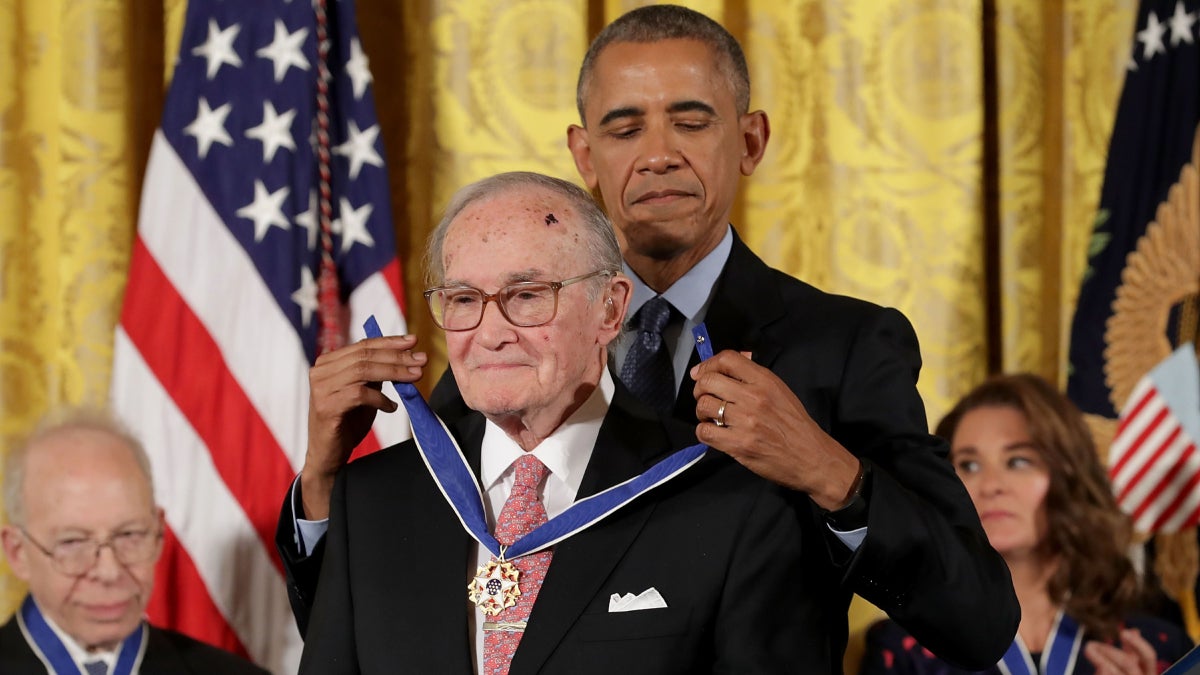
Minow sat on the board of governors for NET/PBS, and served as the network's chairman from 1978 to 1980. He returned to the practice of law, and taught at Northwestern University outside Chicago. President Barack Obama, who once worked in his law office -- thus providing an uninterrupted connection between Democratic nominees for President from Adlai Stevenson in 1952 to Joe Biden in 2020 -- awarded him the Presidential Medal of Freedom.
As of May 9, 2022, Newton Minow is the last notable official of the Kennedy Administration still alive, age 96. (UPDATE: He died on May 6, 2023, at 97.)

*

May 9, 1961 was a Tuesday. Actor John Corbett was born. Whether, as Chris Stevens on Northern Exposure and Aiden Shaw on Sex and the City, he contributed to that "vast wasteland," is a matter of opinion.

These baseball games were played that day:

* The New York Yankees lost to the Kansas City Athletics, 5-4 at Kansas City Municipal Stadium. Luis Arroyo would set a major league record that season with 26 saves, but this game would not be one of them. In the 8th inning, in relief of Whitey Ford, he allowed 4 runs, wasting home runs by Tony Kubek and Moose Skowron. Mickey Mantle and Roger Maris each went 0-for-4. This game was telecast in New York on WPIX-Channel 11, and in Kansas City on WDAF-Channel 4.

* The Los Angeles Dodgers beat the Philadelphia Phillies, 5-2 at Connie Mack Stadium in Philadelphia, in a game called due to rain after 6 innings. This game was telecast in Los Angeles on KTTV-Channel 11, and in Philadelphia on WFIL-Channel 6.

* The Pittsburgh Pirates beat the San Francisco Giants, 9-6 at Forbes Field in Pittsburgh. Roberto Clemente went 3-for-4 with a home run and 4 RBIs. Willie Mays went 2-for-4 with a walk and an RBI. This game was telecast in Pittsburgh on KDKA-Channel 2, and in San Francisco on KTVU-Channel 2.

* A doubleheader was split at Tiger Stadium in Detroit. The Detroit Tigers won the opener, 7-2. The Washington Senators won the nightcap, 5-4. Over the 2 games, Al Kaline went 3-for-6 with 2 walks and an RBI. These games were telecast in Detroit on WJBK-Channel 2, and in Washington on WTOP-Channel 9.

* The Chicago White Sox beat the Cleveland Indians, 4-2 at Comiskey Park in Chicago. This game was telecast in Chicago on WGN-Channel 9, and in Cleveland on WJW-Channel 8.

* The Milwaukee Braves beat the Chicago Cubs, 8-5 at Milwaukee County Stadium. Ernie Banks went 2-for-3 with 2 home runs and 4 RBIs. Joe Adcock had 2 home runs for the Braves, and Hank Aaron went 1-for-4.

The Braves were the last major league team not yet broadcasting their games on television, but would start the next season, on WTMJ-Channel 4. That helped reduce attendance, and led to their 1966 move to Atlanta. In contrast, the Cubs had been broadcasting their games on the aforementioned WGN since 1948, and they still do, because, in their case, TV boosted attendance.

* The Baltimore Orioles beat the Minnesota Twins, 13-5 at Metropolitan Stadium in the Minneapolis suburb of Bloomington, Minnesota. Jim Gentile hit 2 home runs. Brooks Robinson went 1-for-2 with 2 walks and an RBI. Harmon Killebrew went 1-for-4 with a walk and an RBI. This game was telecast in Baltimore on WJZ-Channel 13, and in Minneapolis on WTCN-Channel 11.

* The Los Angeles Angels beat the Boston Red Sox, 8-7 at Wrigley Field in Los Angeles. (The PCL's Los Angeles Angels had been a Cubs farm team, and their ballpark had been built to look like Cubs Park in Chicago, which was renamed Wrigley Field after the L.A. park already had the name.) Carl Yastrzemski hit his 1st major league home run. There would be 451 more. This game was telecast in Boston on WHDH-Channel 5, and in Los Angeles on KHJ-Channel 9.

* And the Cincinnati Reds and the St. Louis Cardinals were rained out at Crosley Field in Cincinnati. The game was made up as part of a doubleheader on June 20. The Reds won the 1st game, 4-3. Don Blasingame drew a bases-loaded walk in the bottom of the 11th inning. The Cards won the 2nd game, 6-3. Over the 2 games, Frank Robinson went 3-for-6 with 3 walks and 2 RBIs. Stan Musial went 1-for-4 in the 1st game, then sat out the 2nd game. These games were broadcast in Cincinnati on WLWT-Channel 5, and in St. Louis on KSD-Channel 5.

Note that some of these TV stations have since changed their call letters.

December 31, 1999 & January 1, 2000: The Millennium

December 31, 1999:  The Millennium arrives. The people of planet Earth survived. At a terrible cost. But we hadn't destroyed ourselves. ...