
May 9, 1961: Newton N. Minow, Chairman of the Federal Communications Commission (FCC), gives a speech at the convention of the National Association of Broadcasters in Washington, D.C.
A 35-year-old Jewish lawyer from Milwaukee, he had worked in the law firm of former Governor Adlai Stevenson of Illinois, the Democratic Party's nominee for President in 1952 and 1956, and worked on both Stevenson campaigns. In 1960, he worked for Senator John F. Kennedy of Massachusetts, and when JFK won, he appointed Minow to be Chairman of the FCC.
Minnow titled his speech "Television and the Public Interest." It becomes known for 2 words -- but not the 2 words he'd hoped would stick in people's minds, "Public Interest."
In hindsight, the speech addressed the end of a "Golden Age of Television" that had run through the 1950s, contrasting the highbrow programs of that decade with what had appeared on American television in 1960 and 1961. He specifically cited the CBS anthology programs Westinghouse Studio One (which aired from 1948 to 1958) and Playhouse 90 (so named because it was 90 minutes long, running from 1956 to 1960).
He mentioned a handful of praiseworthy shows that were still in production, including yet another CBS anthology show, The Twilight Zone. He also cited some documentaries, and recent variety specials led by singer Bing Crosby and dancer Fred Astaire. But he warned that such programs were the exception rather than the rule:
When television is good, nothing -- not the theater, not the magazines or newspapers -- nothing is better. But when television is bad, nothing is worse. I invite each of you to sit down in front of your own television set when your station goes on the air and stay there, for a day, without a book, without a magazine, without a newspaper, without a profit and loss sheet or a rating book to distract you. Keep your eyes glued to that set until the station signs off. I can assure you that what you will observe is a vast wasteland.
You will see a procession of game shows, formula comedies about totally unbelievable families, blood and thunder, mayhem, violence, sadism, murder, Western bad men, Western good men, private eyes, gangsters, more violence, and cartoons. And endlessly, commercials, many screaming, cajoling, and offending. And most of all, boredom.
True, you'll see a few things you will enjoy. But they will be very, very few. And if you think I exaggerate, I only ask you to try it.
He stated that "Most young children today spend as much time watching television as they do in the schoolroom," and that cartoons and violence typical of children's television of the era was wholly unacceptable, comparable to feeding a child nothing but "ice cream, school holidays and no Sunday school."
He also used newspapers as a comparison, noting that although comic strips and advice columns were newspapers' most popular items, they were not featured on the front pages because (according to Minow) the newspapers were still voluntarily bound to the public interest despite being outside the purview of the FCC, something Minow believed television had abandoned, as it had become too beholden to Nielsen Ratings.
A partial solution Minow proposed was the expansion of non-commercial educational television, which was not yet as widespread as the major broadcast networks. He would get his wish the following year, as National Educational Television (NET) was founded. In 1970, it became the Public Broadcasting Service (PBS).
The phrase "vast wasteland" was suggested to Minow by his friend, reporter and freelance writer John Bartlow Martin. He had recently watched 20 consecutive hours of television, as research for a magazine piece, and concluded it was "a vast wasteland of junk." During the editing process, Minow cut the words "of junk."
In the years that followed, Minow often remarked that the two words best remembered from the speech are "vast wasteland," but the two words he wishes would be remembered were "public interest."
But the networks had pretty much already set their schedules for the 1961-62 TV season. There was time to change them. But, perhaps out of laziness, or perhaps because they were run by rich men who didn't like anyone telling them what to do, few substantive changes were made.
Minow was mocked by many for his scolding. When Sherwood Schwartz created the TV show Gilligan's Island, not only did he make it outlandish enough to offend Minow and people who agreed with him, but he named the ill-fated boat the S.S. Minnow. (A "minnow" is a small fish.)
In a 2011 interview marking the 50th Anniversary of the speech, Minow stated that consumer choice, fueled by the 1980s multi-channel transition, was the most important improvement in television in the decades since his speech. But it was a "Good-news, bad-news" development: He lamented that this increased choice had eliminated the shared experience of the medium.
Minow served 2 years as FCC Chairman, and said that his greatest contribution was persuading Congress to pass legislation clearing the way for communications satellites. He told JFK, whose speech setting landing on the Moon by the end of the 1960s as a goal came 16 days later, "Communications satellites will be much more important than sending man into space, because they will send ideas into space. Ideas last longer than men."
Kennedy considered this, and founded Intelsat, a satellite services provider. In 1962, Telstar 1 was launched. In 1965, Intelsat 1, a.k.a. the Early Bird, was launched.
Minow sat on the board of governors for NET/PBS, and served as the network's chairman from 1978 to 1980. He returned to the practice of law, and taught at Northwestern University outside Chicago. President Barack Obama, who once worked in his law office -- thus providing an uninterrupted connection between Democratic nominees for President from Adlai Stevenson in 1952 to Joe Biden in 2020 -- awarded him the Presidential Medal of Freedom.
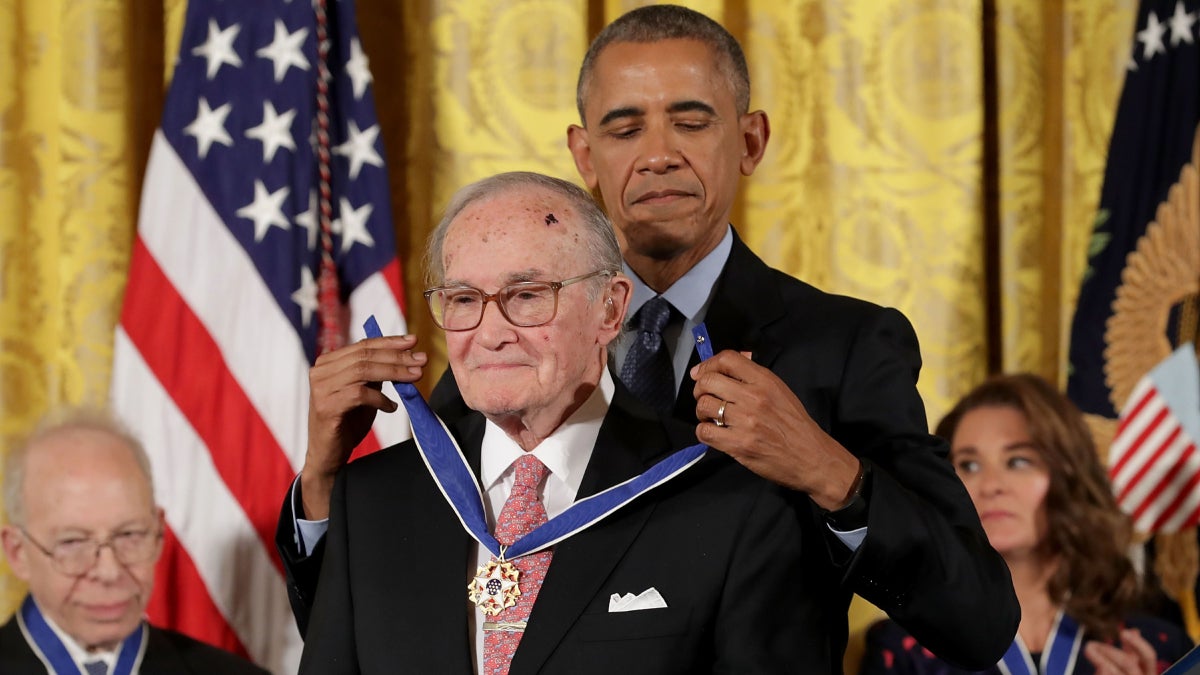
As of May 9, 2022, Newton Minow is the last notable official of the Kennedy Administration still alive, age 96. (UPDATE: He died on May 6, 2023, at 97.)
*
May 9, 1961 was a Tuesday. Actor John Corbett was born. Whether, as Chris Stevens on Northern Exposure and Aiden Shaw on Sex and the City, he contributed to that "vast wasteland," is a matter of opinion.
These baseball games were played that day:
* The New York Yankees lost to the Kansas City Athletics, 5-4 at Kansas City Municipal Stadium. Luis Arroyo would set a major league record that season with 26 saves, but this game would not be one of them. In the 8th inning, in relief of Whitey Ford, he allowed 4 runs, wasting home runs by Tony Kubek and Moose Skowron. Mickey Mantle and Roger Maris each went 0-for-4. This game was telecast in New York on WPIX-Channel 11, and in Kansas City on WDAF-Channel 4.
* The Los Angeles Dodgers beat the Philadelphia Phillies, 5-2 at Connie Mack Stadium in Philadelphia, in a game called due to rain after 6 innings. This game was telecast in Los Angeles on KTTV-Channel 11, and in Philadelphia on WFIL-Channel 6.
* The Pittsburgh Pirates beat the San Francisco Giants, 9-6 at Forbes Field in Pittsburgh. Roberto Clemente went 3-for-4 with a home run and 4 RBIs. Willie Mays went 2-for-4 with a walk and an RBI. This game was telecast in Pittsburgh on KDKA-Channel 2, and in San Francisco on KTVU-Channel 2.
* A doubleheader was split at Tiger Stadium in Detroit. The Detroit Tigers won the opener, 7-2. The Washington Senators won the nightcap, 5-4. Over the 2 games, Al Kaline went 3-for-6 with 2 walks and an RBI. These games were telecast in Detroit on WJBK-Channel 2, and in Washington on WTOP-Channel 9.
* The Chicago White Sox beat the Cleveland Indians, 4-2 at Comiskey Park in Chicago. This game was telecast in Chicago on WGN-Channel 9, and in Cleveland on WJW-Channel 8.
* The Milwaukee Braves beat the Chicago Cubs, 8-5 at Milwaukee County Stadium. Ernie Banks went 2-for-3 with 2 home runs and 4 RBIs. Joe Adcock had 2 home runs for the Braves, and Hank Aaron went 1-for-4.
The Braves were the last major league team not yet broadcasting their games on television, but would start the next season, on WTMJ-Channel 4. That helped reduce attendance, and led to their 1966 move to Atlanta. In contrast, the Cubs had been broadcasting their games on the aforementioned WGN since 1948, and they still do, because, in their case, TV boosted attendance.
* The Baltimore Orioles beat the Minnesota Twins, 13-5 at Metropolitan Stadium in the Minneapolis suburb of Bloomington, Minnesota. Jim Gentile hit 2 home runs. Brooks Robinson went 1-for-2 with 2 walks and an RBI. Harmon Killebrew went 1-for-4 with a walk and an RBI. This game was telecast in Baltimore on WJZ-Channel 13, and in Minneapolis on WTCN-Channel 11.
* The Los Angeles Angels beat the Boston Red Sox, 8-7 at Wrigley Field in Los Angeles. (The PCL's Los Angeles Angels had been a Cubs farm team, and their ballpark had been built to look like Cubs Park in Chicago, which was renamed Wrigley Field after the L.A. park already had the name.) Carl Yastrzemski hit his 1st major league home run. There would be 451 more. This game was telecast in Boston on WHDH-Channel 5, and in Los Angeles on KHJ-Channel 9.
* And the Cincinnati Reds and the St. Louis Cardinals were rained out at Crosley Field in Cincinnati. The game was made up as part of a doubleheader on June 20. The Reds won the 1st game, 4-3. Don Blasingame drew a bases-loaded walk in the bottom of the 11th inning. The Cards won the 2nd game, 6-3. Over the 2 games, Frank Robinson went 3-for-6 with 3 walks and 2 RBIs. Stan Musial went 1-for-4 in the 1st game, then sat out the 2nd game. These games were broadcast in Cincinnati on WLWT-Channel 5, and in St. Louis on KSD-Channel 5.
Note that some of these TV stations have since changed their call letters.


No comments:
Post a Comment