Showing posts with label lester patrick. Show all posts

Thursday, November 10, 2022

November 10, 1934: The 1st Father to Coach His Own Son In the NHL

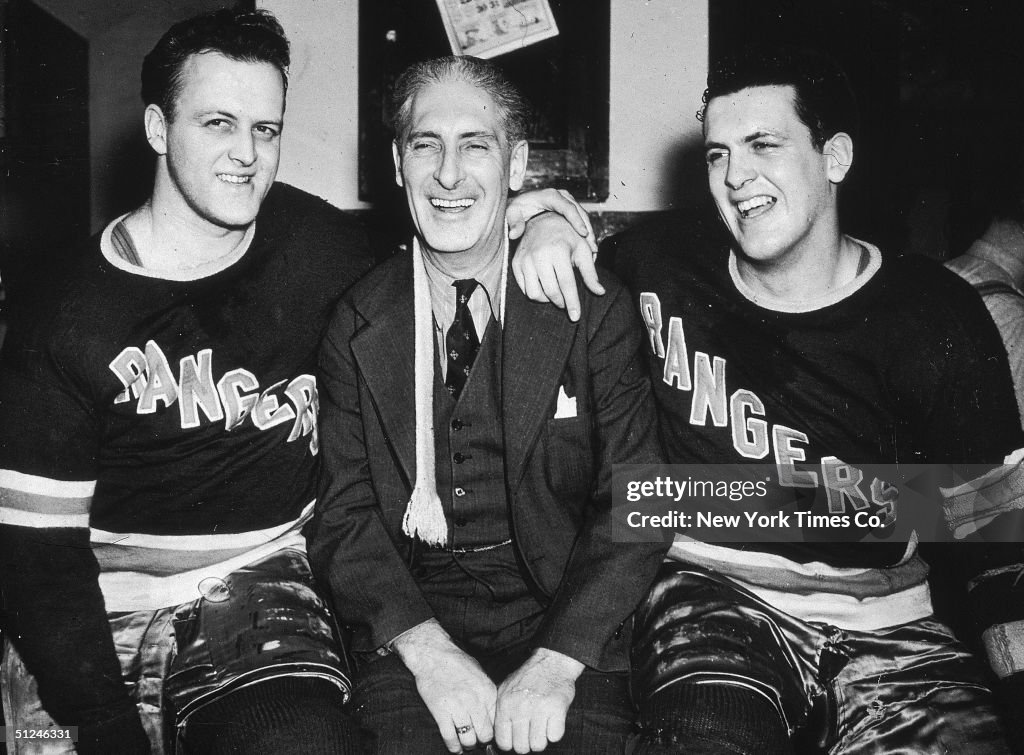
Left to right: Lynn, Lester and Muzz Patrick.
They had just won the 1940 Stanley Cup.

November 10, 1934: The St. Louis Eagles beat the New York Rangers, 4-2 at the St. Louis Arena. It is only the 2nd NHL game played in St. Louis, as the Ottawa Senators had moved there. After the 1934-35 season, the Eagles will fold, the former giants of Ottawa now fully doomed by the Great Depression.

But this game has another significance. Lester Patrick, the head coach and general manager of the Rangers, put Joseph Lynn Patrick, who went by his middle name, into the game. Lynn did not participate in the scoring, and he was not assessed a penalty. This was the 1st game in which a father coached his son in an NHL game.

Born in 1912 in Victoria, British Columbia, Canada, where his father and his uncle Frank were running a team called the Victoria Aristocrats, Lynn, a left wing, struggled at first, leading to the kind of booing from the New York fans that his father had feared.

But he soon won the fans over, and would play for the Rangers through the 1943 season, including winning the 1940 Stanley Cup, before serving in World War II -- in the U.S. Army, not in Canada's. His brother Murray, known as Muzz Patrick, a defenseman, joined him in 1938, and also served overseas. Each brother played 1 more season for the Rangers, in 1945-46.

The Rangers then named Lynn the head coach of their farm team, the New Haven Ramblers, playing 16 games for them while coaching them. He coached the Rangers in the 1948-49 and 1949-50 seasons, getting them into the 1950 Stanley Cup Finals. Offered more money by the Boston Bruins, he coached them until 1955, and remained as their general manager until 1964.

In 1967, he became the 1st head coach and general manager of the expansion St. Louis Blues, who played at the site of his NHL debut, the St. Louis Arena. He quickly handed the coaching duties over to Scotty Bowman, in his 1st NHL head job. He led them into the 1968, 1969 and 1970 Stanley Cup Finals. Patrick briefly served as an interim coach in 1974-75, and again in 1975-76.

On January 26, 1980, Lynn drove away from the St. Louis Arena, suffered a heart attack, and crashed his car. It's not clear whether the heart attack or the crash killed him. He was 67 years old.

Lynn's son, Craig Patrick, played in the NHL and the WHA, mostly for teams that have since moved or folded. In 1980, he was an assistant to Herb Brooks on the U.S. team that won the Gold Medal at the Winter Olympics in Lake Placid, New York.

He also coached the Rangers (twice), and was the GM who built the Pittsburgh Penguins' Stanley Cup winners of 1991 and '92. After serving in the front offices of the Columbus Blue Jackets and the Buffalo Sabres, he is back with the Penguins, as a scout. Glenn Patrick, another son of Lynn, briefly played in the NHL.

Muzz served as Ranger GM from 1954 and 1964, and coached the Rangers on 3 separate occasions over that span. He lived until 1998, age 83. Muzz's son Dick starred in hockey at Dartmouth College, and is a longtime executive with the Washington Capitals, now the team President. His son, Chris Patrick, is the associate general manager. When the Caps won the Stanley Cup in 2018, they became the 6th and 7th members of the family to win the Cup.

The NHL annually awards the Lester Patrick Trophy for service to hockey in America. It was posthumously awarded to Lynn Patrick in 1989. Lester Patrick received it in 2000, and his nephew Dick Patrick received it in 2012. Lester, Frank, Lynn and Craig are in the Hockey Hall of Fame.

Despite his surname, and having played for the Rangers from 1984 to 1994 -- he was traded just before they began the Playoff run that ended with a Cup win -- James Patrick is not related to the Lester Patrick family.

He is, however, a member of a notable Canadian sports family. His father, Stephen, anglicized the surname from the Ukrainian Patrebka, and was an All-Star guard who won 4 Grey Cups with the CFL's Winnipeg Blue Bombers, before serving in the Manitoba legislature. Steve Patrick Jr. was an NHL right wing, including playing with his brother James on the Rangers from 1984 to 1986. And Steve Jr.'s son Nolan has been a center with the Philadelphia Flyers and the Vegas Golden Knights.

*

November 10, 1934 was a Saturday. Julián Javier, the All-Star 2nd baseman who helped the St. Louis Cardinals win 2 World Series, was born on this day.

There was 1 other game in the NHL: The Toronto Maple Leafs beat the Montreal Canadiens, 2-1 at Maple Leaf Gardens. Harvey "Busher" Jackson scored the winning goal, 5:37 into overtime.

Baseball season was over. The NBA hadn't been founded yet. These were among the college football games played that day:

* Minnesota beat Indiana, 30-0 at Memorial Stadium in Minneapolis. Minnesota won the Big Ten Conference title, and were recognized as National Champions.

* Illinois beat arch-rival Northwestern, 14-3 at Dyche Stadium in the Chicago suburb of Evanston, Illinois.

* Kansas State beat Missouri, 29-0 at Memorial Stadium in Manhattan, Kansas. K-State went on to win the title in the Big Six Conference, which became the Big Seven, the Big Eight, and finally the Big Twelve.

* In a Philadelphia vs. Pittsburgh matchup, Temple University beat Carnegie Tech (the school now known as Carnegie-Mellon University), 34-6 at Temple Stadium in Philadelphia. Temple finished the regular season undefeated at 7-0-2.

* Bucknell University beat Washington & Jefferson University, 13-7 at Cameron Stadium in the Pittsburgh suburb of Washington, Pennsylvania.

* The University of Miami lost to Rollins College, 14-0 in Orlando, Florida. Despite their 5-2-1, Miami were invited to play in the 1st-ever Orange Bowl, at Miami Field. Bucknell beat them, 26-0.

* In a major boost for the pride of Southern football, Georgia beat Yale, 14-7 at the Yale Bowl in New Haven, Connecticut.

* Alabama beat Clemson, 40-0 at Denny Stadium (now Bryant-Denny Stadium) in Tuscaloosa, Alabama. Although 'Bama went "only" 7-0 in league play, while Tulane went 8-0, they and Tulane were named Co-Champions by the Southeastern Conference. Since Alabama were undefeated over the full season, 10-0, and Tulane were not, Alabama were invited to play in the Rose Bowl.

* Tulane lost to Colgate, 20-0, before a crowd of 40,000 at Yankee Stadium. Colgate were no slouches, going 7-1 that season, their only loss to Ohio State, which tied Illinois for 2nd in the Big 10 behind Minnesota. At 9-1, Tulane hosted a bowl game at their Tulane Stadium on New Year's Day, inviting undefeated Temple, in what became the 1st Sugar Bowl. Tulane won, 20-14.

* Stanford beat the University of Washington, 24-0 at the original Stanford Stadium in the San Francisco suburb of Palo Alto, California. Stanford won the Pacific Coast Conference title, but went on to lose the Rose Bowl to Alabama, 29-13.

* Army beat Harvard, 27-6 at Harvard Stadium in Boston.

* Navy beat Notre Dame, 10-6 before 54,571 fans at Cleveland Municipal Stadium. Since then, Navy have played Notre Dame 88 times, and have won only 11.

* The University of Pennsylvania beat Penn State, 3-0 at Franklin Field in Philadelphia.

* Among New York City teams: Columbia beat Brown, 39-0 at Baker Field in Manhattan; Fordham beat West Virginia, 27-20 at the Polo Grounds; and in an arch-rivalry, New York University beat City College of New York at Ohio Field in The Bronx: NYU 38, CCNY 13.

* In New Jersey, Princeton beat Lehigh, 54-0 at Palmer Stadium in Princeton; while Princeton's rivals, Rutgers, beat Lehigh's rivals, Lafayette, 27-6 at Neilson Field in New Brunswick.

And in English soccer, the defending Football League Champions, North London team Arsenal, went to Blundell Park in Cleethorpes, Lincolnshire, and played Grimsby Town to a 2-2 draw.

Thursday, April 14, 2022

April 14, 1928: New York Holds Three Titles At Once

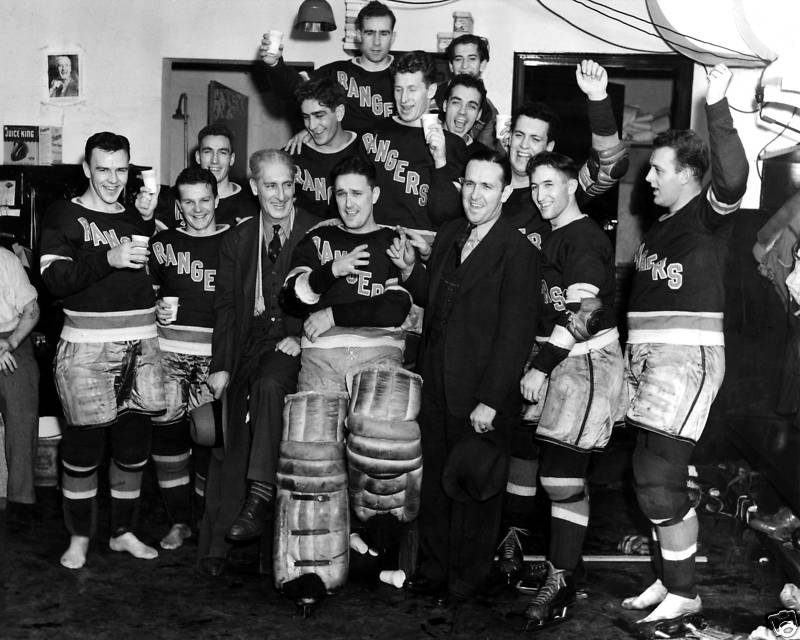
The 1928 New York Rangers. Lester Patrick is center, top row.

April 14, 1928: The New York Rangers win the Stanley Cup, in only their 2nd season. They beat the Montreal Maroons, 2-1 at the Montreal Forum, and win the Stanley Cup Finals, 3 games to 1.

The Maroons won Game 1, 2-0. In Game 2, Ranger goaltender Lorne Chabot has to leave the game due to an eye injury. And while the rules of the time allowed a team to use an emergency goalie, the opposing team has to consent to the affected team's choice. Alex Connell of the Ottawa Senators and Hugh McCormick of the amateur Montreal Victorias were in attendance. But the Maroons refused to allow either to be used.

So Lester Patrick, the Rangers' head coach and general manager, suits up, putting on jersey Number 16, and gets in goal.

Patrick had once been one of the best players in hockey. A defenseman, he had helped the Montreal Wanderers win the Stanley Cup in 1906 and 1907. So had Art Ross, who would be the first coach and GM of the Boston Bruins. Patrick and Ross would both be elected to the Hockey Hall of Fame as players, despite their greatest contributions being as executives.

Lester and his brother Frank Patrick became executives, building the arenas in the 2 main cities of British Columbia: The largest city, Vancouver; and the capital city, Victoria. In 1925, Lester coached the Victoria Cougars to win the Cup -- the last non-NHL team to do it. In 1926, he was hired as the Rangers' 1st head coach and general manager.

He was 44 years old, had played just 1 game in the last 2 years, and had only played in goal once in his life. But he stepped up, put on the gear, and allowed just 1 goal, in a game the Rangers won on an overtime goal by Frank Boucher, 2-1.

Chabot was ready to go for Game 3, and the Rangers won it, 2-0. They won Game 4, 1-0. And they won Game 5, 2-1, with Boucher scoring both goals.

Hail the Champions: Number 1, goaltender Lorne Chabot; 2, right wing Alex Gray; 3, defenseman Ivan "Ching" Johnson (though Irish, somebody in those politically-incorrect days thought he looked Chinese and the name stuck); 4, Clarence "Taffy" Abel ("Taffy" is a common nickname for people of Welsh descent); 5, right wing and Captain Bill Cook; 6, left wing Frederick "Bun" Cook, Bill's brother; 7, center Frank Boucher; 8, right wing Billy Boyd; 9, left wing Murray Murdoch; 10, left wing Paul Thompson; 11, center Lawrence "Laurie" Scott; 12, defenseman Leo Bourgeault; 14, defenseman Frank "Patsy" Callighen; and 16, goaltender Lester Patrick.

Patrick, Boucher, Johnson, and both Cook brothers would be elected to the Hall of Fame. Murdoch turned out to be the last survivor of this team, living until 2001. 

All the games were played at the Forum. The Madison Square Garden Corporation's most lucrative tenant was the Ringling Brothers Barnum & Bailey Circus, which always came to New York in April, and this led to problems for the Rangers, and, later on, the Knicks, if they made it to their sports' finals. This time, it didn't matter: The Rangers won 3 out of 4 in Montreal.

The Rangers would win the Cup again in 1933. In 1940, with Patrick still the GM but Boucher having replaced him as head coach, they won it again. Not until 1994 would the Rangers win the Cup without both Patrick and Boucher being directly involved.

Oddly, given that he is the most important person in Ranger history, the Rangers have not retired a number for Patrick. You say he only wore 16 for 1 night? Well, the Knicks retired a number for Red Holzman, the coach who led them to the 1970 and 1973 NBA Championships, and he never played for them. (He did, however, play for the Rochester Royals as they beat the Knicks in the 1951 NBA Finals.) They hung a banner bearing the number 613, for the number of games he won as Knick head coach. So why not retire a number for Patrick?

Come to think of it, Number 7 is retired, but not for Boucher, the first man to wear it for the Rangers, and the most important player they've ever had -- yes, more important than Mark Messier. It's retired for Rod Gilbert, their all-time leading scorer.

There is a greater significance to this victory. The New York Yankees had won the World Series on October 8, 1927. And the football version of the New York Giants had won the NFL Championship on December 11, 1927. Both still held their titles on April 14, 1928. This meant that, for the 1st time, a city (or a metropolitan area, but, in this case, a single city) held the World Championships in 3 different sports at the same time.

In spite of the fact that the NBA debuted in 1946, making titles in 4 sports possible and titles in 3 out of 4 sports more possible, having them in 3 sports has happened only once since: Detroit, with the Tigers winning the 1935 World Series, the Lions the 1935 NFL Championship, and the Red Wings the 1936 Stanley Cup, having all 3 from April 11 to October 6, 1936 (when the Yankees won the next World Series).

New York nearly won another "Treble" in 1933, when the Rangers won the Cup and the baseball Giants won the World Series, but the football Giants lost the Championship Game. Baltimore nearly did it, with the Orioles winning the 1970 World Series and the Colts winning Super Bowl V, but the Bullets lost the 1971 NBA Finals. Boston nearly did it in 2007-08 with the Red Sox and the Celtics, but the New England Patriots couldn't get the job done; and in 2018-19, but the Bruins fell in Game 7.

Pittsburgh did 2 with the Pirates and Steelers in 1979-80, and with the Steelers and Penguins in 2009, but their 3rd team didn't get close either time. Philadelphia had all 4 teams reach their Finals in 1980-81, but only the Phillies won theirs.

For all their sports successes, neither Chicago, nor Los Angeles, nor San Francisco has come close to holding titles in 3 sports at once: They've each done 2, but never gotten a 3rd team into the Finals. (San Francisco had the '74 A's, the '75 Warriors and the '77 Raiders, but that's not quite close enough.)

*

April 14, 1928 was a Saturday. The baseball season had started, and there were 4 major league games played on that day:

* The Washington Senators and the Boston Red Sox were tied 0-0 after 5 innings at Fenway Park in Boston, when the game was called due to rain.

* The Cincinnati Reds beat the Pittsburgh Pirates, 5-0 at Redland Field in Cincinnati. (It was renamed Crosley Field in 1934.) Red Lucas pitched a 5-hit shutout.

* The Cleveland Indians beat the Detroit Tigers, 8-6 at Navin Field in Detroit. (It was renamed Briggs Stadium in 1938, and Tiger Stadium in 1961.)

* And the Chicago Cubs beat the St. Louis Cardinals, 4-1 at Sportsman's Park in St. Louis.

And in English soccer, Arsenal drew 0-0 with Yorkshire team Huddersfield Town, at the Arsenal Stadium, a.k.a. Highbury, in North London.

Wednesday, April 13, 2022

April 13, 1940: The New York Rangers Win the Stanley Cup (And Not Another for 54 Years)

April 13, 1940: The New York Rangers win the Stanley Cup.

Stop laughing. You remember the "NINE-teen-FOR-ty!" chant that used to be used before June 14, 1994? Well, this is what it was about.

The Rangers beat the Toronto Maple Leafs in 6 games, taking Game 6 and the Cup 3-2 at Maple Leaf Gardens, on a goal by Bryan Hextall, 2 minutes and 7 seconds into overtime.

Hail the Champions:

General Manager Lester Patrick (Hall of Fame)
Head Coach Frank Boucher (HOF, Captain of the Rangers' 1928 & '33 Cup-winers)
1 Dave Kerr, goaltender
2 Art Coulter, defenseman and Captain (HOF)
3 Erhardt "Ott" Heller, defenseman
4 Alex Shibicky, left wing
5 Mac Colville, right wing
6 Neil Colville, center (HOF, also played as a defenseman, Mac's brother)
7 Phil Watson, center
8 Walter "Babe" Pratt, defenseman (HOF)
9 Lynn Patrick, left wing (HOF, Lester's son)
10 Clint Smith, center (The last survivor of this team, living until 2009)
12 Bryan Hextall, right wing (HOF)
14 Kilby MacDonald, left wing
15 Murray "Muzz" Patrick, defenseman (Lester's other son)
16 Alf Pike, center
17 Stan Smith, center

In the photo above, Kerr is flanked by Patrick and Boucher.

In those days, the Rangers were, with some justification, known as "the Classiest Team in Hockey." And their fans were hailed as classy, and knowledgeable. And no one said that the Rangers sucked. Or stunk.

That was a long time ago. Sometimes, it seems like a galaxy far, far away.

During the following season, the mortgage on the 1925 version of Madison Square Garden was paid off. The management of the Madison Square Garden Corporation celebrated by symbolically burning the mortgage papers in the bowl of the Cup. This led some hockey fans to believe that the Cup, which is regarded almost as a sacred object, had been "desecrated," leading the "hockey gods" to place a curse on the Rangers.

The result was "The Curse of 1940." The Rangers not only did not win the Cup again for 54 years, but had some bizarre events happen to them along the way. They have since won just 1 Stanley Cup in 82 years, while the nearby New York Islanders, who didn't begin play until 1972, won 4 straight, although none since 1983; and the even-closer, but across a State Line, New Jersey Devils, who arrived in 1982, won 3 Cups in a span of 9 years, although none since 2003.

When they won on June 14, 1994, Ranger broadcaster Sam Rosen said, "This one will last a lifetime!" He was right: For any Ranger fan born on April 14, 1940 or later, that one has lasted a lifetime.

*

April 13, 1940 was a Saturday. This was the only NHL game played that day. The NBA hadn't yet been founded. The NFL was out of season. And the baseball season didn't start for 3 more days.

England's Football Association had suspended Football League play for the duration of World War II. But it set up separate wartime leagues for the North and South regions of England, preventing teams from traveling too far, in order to save fuel for the war effort. In one of these games, Arsenal, the North London team I support, hosted Portsmouth of Hampshire at the Arsenal Stadium, nicknamed Highbury for its neighborhood, and won, 3-2.

Thursday, April 7, 2022

April 7, 1928: The Lester Patrick Game

April 7, 1928: Game 2 of the Stanley Cup Finals is played at the Montreal Forum, between the host Montreal Maroons and the New York Rangers. The Maroons had won the Cup in only their 2nd season, 1926. Now, the Rangers stood to do the same.

Except the Maroons won Game 1, 2-0. And on this night, in the 2nd period of Game 2, with the game still 0-0, Ranger goaltender Lorne Chabot had to leave the game after being struck in the eye with a puck. While the rules of the time allowed a team to use an emergency goalie, the opposing team has to consent to the affected team's choice. Alex Connell of the Ottawa Senators was in attendance. So was Hugh McCormick of the Montreal Victorias, an amateur team that, in the pre-professional era, had won the Stanley Cup in 1895, 1897, 1898 and 1899. But the Maroons refused to allow either to be used.

Lester Patrick, the Rangers' head coach and general manager, had once been one of the best players in hockey. A defenseman, he had helped the Montreal Wanderers win the Stanley Cup in 1906 and 1907. So had Art Ross, who would be the first coach and GM of the Boston Bruins. Patrick and Ross would both be elected to the Hockey Hall of Fame as players, despite their greatest contributions being as executives.

Lester and his brother Frank Patrick became executives, building the arenas in the 2 main cities of British Columbia: The largest city, Vancouver; and the capital city, Victoria. In 1925, Lester coached the Victoria Cougars to win the Cup -- the last non-NHL team to do it. In 1926, he was hired as the Rangers' 1st head coach and general manager.

He was 44 years old, had played just 1 game in the last 2 years, and had only played in goal once in his life. But he stepped up, put on the gear, including a Rangers jersey with Number 16 on the back, and took his place in the Ranger goal.

He allowed just 1 goal, in a game the Rangers won, 7:05 into overtime, on a goal by Frank Boucher, 2-1.

Chabot was ready to go for Game 3, and the Rangers won it, 2-0. They won Game 4, 1-0. And they won Game 5, 2-1, with Boucher scoring both goals.

Led by Patrick, the Rangers would win the Cup again in 1933. In 1940, with Patrick still the GM but Boucher having replaced him as head coach, they won it again. He was head coach from 1926 to 1939, and general manager from 1926 to 1946. In 1947, he was elected to the Hockey Hall of Fame. He died in 1960, at the age of 76. Not until 1994 would the Rangers win the Cup without both Patrick and Boucher being directly involved.

Oddly, given that he is the most important person in Ranger history, the Rangers have not retired a number for Patrick. You say he only wore 16 for 1 night? Well, the Knicks retired a number for Red Holzman, the coach who led them to the 1970 and 1973 NBA Championships, and he never played for them. (He did, however, play for the Rochester Royals as they beat the Knicks in the 1951 NBA Finals.) They hung a banner bearing the number 613, for the number of games he won as Knick head coach. So why not retire a number for Patrick?

*

April 7, 1928 was a Saturday. Baseball was in Spring Training. Football was out of season. Professional basketball existed on what was basically a minor-league level.

There were scores in English soccer. Among them was a North London Derby: Tottenham Hotspur beat Arsenal, 2-0 at White Hart Lane.

Wednesday, March 30, 2022

March 30, 1925: The Last Non-NHL Stanley Cup Winners

March 30, 1925: The Stanley Cup is awarded, but not to the Champions of the National Hockey League. That has never happened again.

The Montreal Canadiens won the Cup in 1924, led by the legendary goaltender Georges Vézina, and a pair of young stars, center Howie Morenz and left wing Aurèle Joliat, all of them early inductees into the Hockey Hall of Fame. They won Cup by winning the NHL Championship, then beating the Champions of the West Coast Hockey League, the Calgary Tigers. They won the NHL Championship again in 1925, and again prepared to face the WCHL Champions for the Cup.

Unlike the season before, the WCHL Champions would not have to qualify for the Finals by beating the Champions of the Pacific Coast Hockey Association. The PCHA folded, and 2 teams from the Province of British Columbia, the capital city's Victoria Cougars and the biggest city's Vancouver Maroons (formerly the Millionaires, 1915 Cup winners), were admitted to the WCHL. The Cougars beat the Tigers for the title, setting up the Finals against the Canadiens.

The Cougars were loaded with experience: Goaltender Harry "Hap" Holmes, center Frank Foyston and winger Jack Walker had each won the Cup with both the 1914 Toronto Blueshirts and the 1917 Seattle Metropolitans. Defenseman and Captain Clem Loughlin had won the Allan Cup, the championship of Canadian senior amateur hockey, with the 1915 Winnipeg Monarchs. Left wing Jocko Anderson had won the Allan Cup with a military team, the Winnipeg 61st Battalion.

Left wing Harry Meeking (not to be confused with later Toronto star and broadcaster Harry Meeker) had won the Cup with the 1918 Toronto Arenas. Center Frank Frederickson was a member of the Winnipeg Monarchs, the team that Canada sent to represent them in 1920, the 1st time the sport was played in the Olympics, and they won the Gold Medal. And their head coach, Lester Patrick, had won the Cup playing for the Montreal Wanderers in 1906 and 1907.

The Stanley Cup Finals were a best-3-out-of-5 series that season. Game 2 was played in the Denman Arena in Vancouver, and the rest were played at the Patrick Arena in Victoria. Both arenas had been built with funds raised by Lester Patrick and his brother Frank.

The Cougars won Game 1, 5-2. Walker and defenseman Gord Fraser each scored 2 goals. They won Game 2, 3-1, with Walker again scoring 2 goals. The Canadiens kept the series alive by winning Game 3, 4-2, with Morenz scoring a hat trick. But the Cougars ran away with Game 4, 6-1. Frederickson scored 2 goals, and the Cougars were the World Champions.
A Cougars sweater, on display at the Hockey Hall of Fame

For the 1925-26 season, the WCHL was renamed the Western Hockey League. The Cougars won the title again, but lost the Stanley Cup Finals to the Montreal Maroons. The WHL folded, and the Cup became an NHL-only trophy.

That folding opened the door for expansion in the NHL, and 3 new teams were added. The owners of the Detroit franchise signed all the players from Victoria, and named their new team the Detroit Cougars. New owners renamed them the Detroit Falcons in 1930, and another change in ownership made them the Detroit Red Wings in 1932. Since the Cougars are considered a separate franchise, the Red Wings do not claim the 1925 Stanley Cup among their achievements, nor does the NHL recognize it as such.

The owners of the Chicago team signed the players from the Portland Rosebuds, forming the Chicago Blackhawks. The other new team, the New York Rangers, signed Lester Patrick as head coach and general manager, and he signed several WHL players.

The 1925 Cup remains the last one won by a team from outside the NHL. In 1954, the Cleveland Barons, winners of the Calder Cup, the Championship of the American Hockey League, reminded the NHL that the Cup was a challenge trophy, and challenged the holders, the Red Wings, for the Cup. The NHL rejected this challenge, and got away with it.

This was also, through the 2020-21 season, the last Cup won by a team from the Province of British Columbia, of which Victoria is the capital city. The Vancouver Canucks were founded in 1970, and have been to the Finals 3 times -- 1982, 1994 and 2011 -- losing all 3.

*

March 30, 1925 was a Monday. Baseball was in Spring Training. Football was out of season. And professional basketball was still minor-league at this point. So there were no other scores on this historic day.

Wednesday, March 16, 2022

March 17, 1906: Hockey's "Greatest Game Ever Played"

The 1906 Wanderers. Lester Patrick is in the center
of the top row of players.

March 17, 1906: A hockey game is played. It gets called the sport's "greatest game ever played." Maybe, by the standards of the time, it was. But it would be surpassed, many times over. Still, some game had to be the first "game of the century" in the sport.

And what's really weird by modern standards is, the team that got clobbered in it was declared the champions.

The Eastern Canada Amateur Hockey Association was wrapping up its 1st season, and there was a tie for 1st place, between the Montreal Wanderers and the Ottawa Hockey Club, both of whom finished 9-1. Although the Ottawa HC never deviated from that official name, by the time of their 1st Stanley Cup win in 1903, they were known as "The Silver Seven." By 1908, they were nicknamed the Senators, and it is by this name that they would become best known.

(Yes, "Silver Seven." At the time, there were 7 players on the ice, including a "rover," who switched between offense and defense. The National Hockey Association, the 1st pro league, founded in 1910, didn't use it, and most leagues stopped by the 1920s.)

The 9 most-used members of the Silver Seven were goaltender Billy Hague; defensemen Harvey Pulford (also their Captain) and Arthur Moore; rovers Frank McGee and Harry "Rat" Westwick; centers Tommy and Harry Smith; and wingers Alf Smith (also their head coach) and Billy Gilmour. Alf and Tommy Smith, Pulford, McGee, Westwick, Gilmour would be elected to the Hockey Hall of Fame. They had already won the Stanley Cup in 1903, 1904 and 1905.

The Wanderers, known as "the Little Men of Iron," are probably better-remembered today, if only because their Captain, rover Lester Patrick, would go on to coach and manage the New York Rangers. Their memory is also stronger due to a player they would acquire the following year, defenseman Art Ross, who would go on to coach and manage the Boston Bruins. Each man would eventually have an NHL Division and an NHL trophy named for him. And yet, for all they achieved as what the Hockey Hall of Fame calls "Builders," they were elected as "Players." This would also be true for Jack Adams, later the coach and general manager of the Detroit Red Wings.

Joining Patrick (and eventually Ross, and another 1907 Wanderer, William "Hod" Stuart) in the Hall of Fame, were forwards Frank "Pud" Glass, Ernie "Moose" Johnson and Ernie Russell. Oddly, Cecil Blachford, both their Captain and their head coach, has not been elected. Nor have their defensemen, Billy Strachan and Rod Kennedy; or their goaltender, Henri "Doc" Menard.

They finished in a tie for the title. Each team had handed the other their only loss. So the Stanley Cup would be decided by a tiebreaker series: Two games, one at each team's home rink, totals goals to decide it. Game 1 was a wipeout, as the Wanderers won, 9-1 at the Montreal Arena. Russell scored 4 goals, Glass 3, Johnson 2.

Game 2 was played at Dey's Arena in Ottawa, in front of 5,400 fans, believed to be a record for a hockey game at that point. Among the attendees was Albert Grey, the 4th Earl Grey, Governor-General of Canada (representative of the country's head of state, King Edward VII of Britain), and the man who would go on to donate the championship trophy for Canadian football, the Grey Cup. (His grandfather, Charles, the 2nd Earl, is the namesake of Earl Grey tea. Lord Stanley of Preston, who had donated the Stanley Cup in 1893, had also been Governor-General.)

All the Wanderers had to do to win the Stanley Cup was avoid losing this game by 8 or more goals. But that proved difficult, as the Silver Seven took advantage of the home ice and the home crowd. They also took advantage of a rule that allowed them to "bring in a ringer," Percy LeSueur, the goalie from the Smiths Falls Senators of Smiths Falls, Ontario, about 50 miles southwest of Ottawa. LeSueur would go on to the Hall of Fame.

Still, Johnson scored 12 minutes in, to give the Wanderers a 9-goal lead. But then, the Silver Seven exploded. Before the 1st half ended (they played 2 halves then, not 3 periods), McGee scored twice and Harry Smith once. In the 2nd half, Harry scored, Westwick scored, and Harry scored 3 more goals. The last of these came with 10 minutes to play, tying the series at 10-10 on aggregate, and bringing a 5-minute standing ovation.

But history would not remember the Wanderers for the greatest choke in hockey history. Patrick pulled their fat out of the fire, scoring with 90 seconds left, and then once more just before time expired. The Silver Seven had won the game, 9-3; but had lost the series, 12-10.

The next day's edition of the Toronto Globe called Game 2 the "greatest game of hockey ever played on Canadian ice, or any other." The Sporting News would later call it the "Greatest Hockey Game in History."

At some point during the game, Earl Grey's top hat had been knocked off. A fan found it, and, after the game, gave it to the Wanderers' Moose Johnson.

The Wanderers would lose the Cup to the Kenora Thistles in 1907, then regain it later that year, and win it again in 1908 and 1910. They would join the NHA in 1910 and the NHL in 1917, but the Montreal Arena burned down during their 1st season, and they went out of business.

The Silver Seven/Senators rebuilt, and won the Cup in 1909 and 1911. They would also be founding members of the NHA and the NHL, winning the Cup in 1920, 1921, 1923 and 1927. But the Great Depression did them in, and they moved in 1934, becoming the St. Louis Eagles, playing 1 season, and folding.

*

March 17, 1906 was a Saturday. Baseball was in Spring Training. Football was out of season. Professional basketball barely existed. In English soccer, Woolwich Arsenal, eventually to become the North London team I would support, beat East Midlands team Derby County, 1-0 at the Manor Ground in Plumstead, South-East London.

Thursday, January 20, 2022

January 21, 1907: The Kenora Thistles Win the Stanley Cup

The 1907 Kenora Thistles. Notice that the Stanley Cup
is little more than a bowl at this point.

January 21, 1907: The Kenora Thistles win the Stanley Cup. If you've never heard of them, that's probably due to the distance of time. Maybe they would have stood out more if they still used the name their city used until 1904: Rat Portage.

The history of the name extends beyond the time of white settlers arriving in the region. The name Rat Portage had its origin in the Ojibwa name Waszush Onigum, which, roughly translated, means portage to the country of the muskrats. A shortened and somewhat corrupted version, Rat Portage, was adopted by the Hudson’s Bay Company in naming their post, then located on Old Fort Island on the Winnipeg River. When the post was moved to the mainland and a town grew up around it, the name Rat Portage was assumed by the community.

The town of Rat Portage was renamed in 1905 by using the first two letters of itself and the neighboring towns of Keewatin and Norman to form the City of Kenora. According to Canada's 2021 Census, it has a population of 14,967. It was roughly the same in 1907, so it was, and remains, the smallest municipality ever to win the Stanley Cup.

It is on the Lake of the Woods in southwestern Ontario, 1,160 miles northwest of Toronto. It's considerably closer to Winnipeg, Manitoba: 130 miles east. It's 135 miles northwest of the U.S. border crossing at International Falls, Minnesota; 250 miles northeast of Grand Forks, North Dakota; 300 miles northwest of Duluth; 330 miles northeast of Fargo; and 430 miles north of Minneapolis. In other words, it's one of those places that nobody discovers by accident: You have to want to go there.

The Rat Portage Thistles were founded in 1894, and changed their name to the Kenora Thistles with the city. The players chose "Thistles" because they were mostly of Scottish heritage. For distance reasons, they joined the Manitoba Hockey Association instead of the Ontario Hockey Association. They won league titles in 1901, 1903 and 1905. In 1903 and 1905, they challenged the Ottawa Hockey Club for the Stanley Cup, but lost both times.

They were MHA Champions again in 1906, but scheduling issues meant that they couldn't challenge the Montreal Wanderers, who had dethroned Ottawa, until January 1907. Taking advantage of the new professionalism of their league, the club hired Art Ross and Joe Hall from the Wheat City Hockey Club of Brandon, Manitoba. (Since 1936, that city has had a junior team called the Brandon Wheat Kings.)

So the Thistles took the ice with Eddie Giroux in goal, Art Ross and Silas "Si" Griffis on defense, former Ottawa star Harry "Rat" Westwick as "rover" (hockey was 7-a-side back then), and a forward line of Billy McGimsie centering team Captain Tommy Phillips on the left and Roque "Roxy" Beaudro on the right.

The Wanderers, nicknamed "the Little Men of Iron," and also mostly staffed by Scots, had William "Riley" Hern in goal, Rod Kennedy and William Hodgson "Hod" Stuart on defense, Captain Lester Patrick as rover, and Ernie Russell centering Ernie "Moose" Johnson on the left and Frank "Pud" Glass on the right. Jack Marshall was a spare player. Center Cecil Blachford was injured in their previous series against Ottawa.

It was a two-games-total-goals series, with both games played at the Montreal Arena. On January 17, 1907, the Thistles won, 4-2. On January 21, the Thistles won again, 8-6. So the Thistles swept, and won, 12 goals to 8.

On their return to Kenora later in January, the Thistles were warmly received: A reception at the Opera House saw each player given a commemorative cup by the city, among other gifts. The team's dire financial situation meant that an admission was charged for the celebratory banquet, unusual for similar events at the time.

There were signs of improved finances, though. The owners of the Victoria Rink, where the team played, stated their intention to build a 4,000 to 5,000-seat replacement rink. This would have made it the largest rink west of Toronto, and dwarfed the 1,000-seat Victoria Rink then in use. This was suggested as a solution to the team's financial issues, since they would earn a portion of each ticket sold.

Since the Cup was still a challenge trophy, the Thistles were challenged by Brandon Wheat City. In games played at the Winnipeg Auditorium, the Thistles won 8-6 on March 16, and 4-1 on March 18. The Wanderers challenged the Thistles right after this, and objected to the conditions at the Victoria Rink, so the games were again played at the Winnipeg Auditorium. The Wanderers won on March 23, 7-2. The Thistles won on March 25, 6-5, but this was not enough, as the Wanderers won on aggregate, 12 goals to 8.

Following the tradition that had already been established with the Cup's introduction in 1893, the Wanderers had their names engraved on the Cup. Unlike previous winners, who wrote on the side of the bowl, the Wanderers had the result and their players' names engraved inside it, on the bottom of the bowl. The inscription is still there today.
Beaudro, Geroux and McGimsie retired before the 1907-08 season. Tommy Phillips was signed by Ottawa. Unable to compete with rising professionalism, and unable to get the new arena they were told they would get from the city, the Thistles fell apart, and folded at the end of the season.

Ross, Hall, Griffis, McGimsie, Phillips, Hern, Stuart, Patrick, Russell, Johnson, Marshall and Blachford would all be elected to the Hockey Hall of Fame. Ross and Patrick were elected as players, but would become better known as coaches and executives, with the Boston Bruins and the New York Rangers, respectively. Phillips and Stuart were among the charter inductees into the Hockey Hall of Fame in 1945.

A new Kenora Thistles played in the Manitoba Junior Hockey League from 1926 to 1940. Another played from 1952 to 1959, winning an intermediate amateur title in 1953. The Kenora Muskies were founded in the MJHL in 1968, won a regular-season title before losing in the Playoffs in 1971, changed their name to the Kenora Thistles in 1975, and folded in 1982.

Yet another Kenora Thistles played in a league named Hockey Northwestern Ontario, founded in 2006, and won division titles in 2010, '11 and '12, before folding  in 2016. The current Thistles play in the Manitoba U-18 AAA Hockey League.

*

January 21, 1907 was a Monday. There were no other scores on this historic day: Baseball and football were out of season, and basketball was all-amateur.

December 31, 1999 & January 1, 2000: The Millennium

December 31, 1999:  The Millennium arrives. The people of planet Earth survived. At a terrible cost. But we hadn't destroyed ourselves. ...