Showing posts with label john madden. Show all posts

Saturday, September 10, 2022

September 10, 1978: The Holy Roller Play

September 10, 1978: The San Diego Chargers host their arch-rivals, the Oakland Raiders, at San Diego Stadium. (Built in 1967, it was renamed Jack Murphy Stadium in 1981, Qualcomm Stadium in 1997, and SDCCU Stadium in 2017, before being demolished in 2020).

Coached by John Madden, the Raiders had won the Super Bowl 2 years earlier, and were still considered one of the best teams in the NFL. But the Chargers were a team on the rise, with head coach Don Coryell putting his "Air Coryell" attack into place, as quarterback Dan Fouts threw to receivers Charlie Joiner and John Jefferson, and tight end Kellen Winslow.

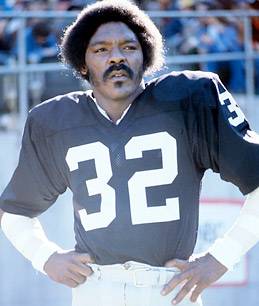
The Chargers led 20-14 as the clock wound down, and the Raiders launched a last drive. With 10 seconds left, they had the ball at the Chargers' 14-yard line. Raider quarterback Ken Stabler faded back, but was sacked by Woodrow Lowe. He fumbled the ball.

In so doing, the ball moved forward. Running back Pete Banaszak tried to pick the ball up on the 12, but fell. In so doing, he moved the ball further forward. Tight end Dave Casper also tried to grab the ball. He couldn't. He kicked the ball into the end zone. Finally, he fell on it, in the end zone. The play was ruled a touchdown for the Raiders.

On the film, Ted Giannoulas, in the original version of his San Diego Chicken costume, can be seen fainting at the seemingly unfair touchdown call. Madden ran onto the field, and asked Jerry Markbreit, one of the better referees in NFL history, if the touchdown was going to count. Markbreit said it did. Tie game. When Errol Mann kicked the extra point, the Raiders had won, 21-20.

The Chargers were shocked, and insisted that the call be overturned, because the Raiders had batted the ball forward. Except, at the time, there was no rule against that. One would be put in place the following season, making it illegal for the offensive team to advance a fumble, to prevent this from ever happening again. But that did the Chargers no good. It became known as "the Holy Roller Play."

The Chargers finished the season 9-7, and missed the Playoffs. Had they won the game, they would have been 10-6, and made the Playoffs.

Looking back on it for an NFL Films interview, Markbreit said, "To me, it was just a fumble that turned into a touchdown."

In 2008, in an NFL Films interview for the 30th Anniversary of the play, Stabler finally came clean, admitting that he threw the ball forward. Therefore, the correct ruling should have been an incomplete pass. The clock would have stopped, and there would have been time for one more play. Of course, with their luck, the Raiders would have scored a touchdown on that play.

Things like this, and the Jack Tatum hit on Darryl Stingley a month earlier, are why people hated the Raiders, back when they were good enough to be hated. Things like those are why nobody has any sympathy for the Raiders and their fans when they whine about the Immaculate Reception (for which they have absolutely no case) and the Tuck Rule Game (for which they have a damn good case).

*

September 10, 1978 was a Sunday. These other NFL games were played that day:

* The New York Giants lost to the Dallas Cowboys, 34-24 at Giants Stadium in the Meadowlands.

* The New York Jets beat the Buffalo Bills, 21-20 at Rich Stadium (later Ralph Wilson Stadium) in the Buffalo suburb of Orchard Park, New York.

* The Miami Dolphins beat the Baltimore Colts, 42-0 at Memorial Stadium in Baltimore.

* The Washington Redskins beat the Philadelphia Eagles, 35-30 at Robert F. Kennedy Stadium in Washington.

* The Detroit Lions beat the Tampa Bay Buccaneers, 15-7 at Tampa Stadium.

* The Pittsburgh Steelers beat the Seattle Seahawks, 21-10 at Three Rivers Stadium in Pittsburgh.

* The Cleveland Browns beat their in-State rivals, the Cincinnati Bengals, 13-10 at Cleveland Municipal Stadium. Don Cockroft kicked a 27-yard field goal to win it in overtime.

* The Green Bay Packers beat the New Orleans Saints, 28-17 at Milwaukee County Stadium.

* The New England Patriots beat the football version of the St. Louis Cardinals, 16-6 at Busch Memorial Stadium in St. Louis.

* The Houston Oilers beat the Kansas City Chiefs, 20-17 at Arrowhead Stadium in Kansas City.

* The Los Angeles Rams beat the Atlanta Falcons, 10-0 at the Los Angeles Memorial Coliseum.

* The Chicago Bears beat the San Francisco 49ers, 16-13 at Candlestick Park in San Francisco.

* And the next night, on ABC Monday Night Football, the Minnesota Vikings beat the Denver Broncos, 12-9 at Metropolitan Stadium in the Minneapolis suburb of Bloomington, Minnesota. Rick Danmeier kicked 4 field goals, including a 44-yarder for the win in overtime.

These games were played in Major League Baseball:

* The New York Yankees beat the Boston Red Sox, 7-4 at Fenway Park in Boston. This was the final game of the 4-game sweep known as "The Boston Massacre," as the Bronx Bombers outscored the BoSox 42-9. I have separate entries for all 4 of those games. After being 14 games behind the Red Sox on July 20, the Yankees had now tied them for 1st place in the American League Eastern Division.

The Yankees knocked Bobby Sprowl out of the box in the 1st inning. Ed Figueroa pitched well, and Goose Gossage stopped a Sox rally in the 9th. Reggie Jackson went 2-for-5 with 2 RBIs. Carl Yastrzemski, who had long been one of the great clutch hitters in baseball history, went 0-for-3 with a walk.

* The New York Mets beat the Pittsburgh Pirates, 11-9, completing a 4-game sweep at Shea Stadium. Dwight Bernard was the winning pitcher, in relief of Jerry Koosman. Willie Stargell had an RBI single as a pinch-hitter.

* The Chicago Cubs beat the Montreal Expos, 6-3 at the Olympic Stadium in Montreal.

* The St. Louis Cardinals beat the Philadelphia Phillies, 8-6 at Veterans Stadium in Philadelphia. Mike Schmidt went 1-for-4 with a walk. Ken Reitz tripled home the winning run in the top of the 10th inning.

* The Los Angeles Dodgers beat the Atlanta Braves, 11-5 at Atlanta-Fulton County Stadium.

* The Cincinnati Reds beat the San Francisco Giants, 8-1 at Riverfront Stadium in Cincinnati. Johnny Bench hit a home run. Pete Rose went 1-for-4.

* The Cleveland Indians beat the Detroit Tigers, 7-4 at Tiger Stadium in Detroit.

* The Chicago White Sox beat the Seattle Mariners, 2-1 at Comiskey Park in Chicago.

* The Minnesota Twins beat the Milwaukee Brewers, 3-1 at Metropolitan Stadium in the Minneapolis suburb of Bloomington, Minnesota. The Twins won in spite of Rod Carew going 0-for-4. They got a home run from Glenn Borgmann. Paul Molitor went 0-for-5. Robin Yount did not play.

* The California Angels beat the Kansas City Royals, 13-3 at Anaheim Stadium (now Angel Stadium of Anaheim). Carney Lansford went 4-for-5. Don Baylor went 2-for-5 with 5 RBIs, including a grand slam. Nolan Ryan went the distance, striking out 12. George Brett went 2-for-3.

* The Houston Astros beat the San Diego Padres, 3-2 at the Astrodome in Houston. Dave Winfield went 1-for-3 with a walk and an RBI.

* A doubleheader, forced by the previous day's rainout, was split at the Oakland Coliseum. The Texas Rangers won the opener, 8-3. The Oakland Athletics won the nightcap, 2-1.

* And the Baltimore Orioles and the Toronto Blue Jays were rained out at Exhibition Stadium in Toronto. The game was never made up.

Friday, August 12, 2022

August 12, 1978: The Darryl Stingley Game

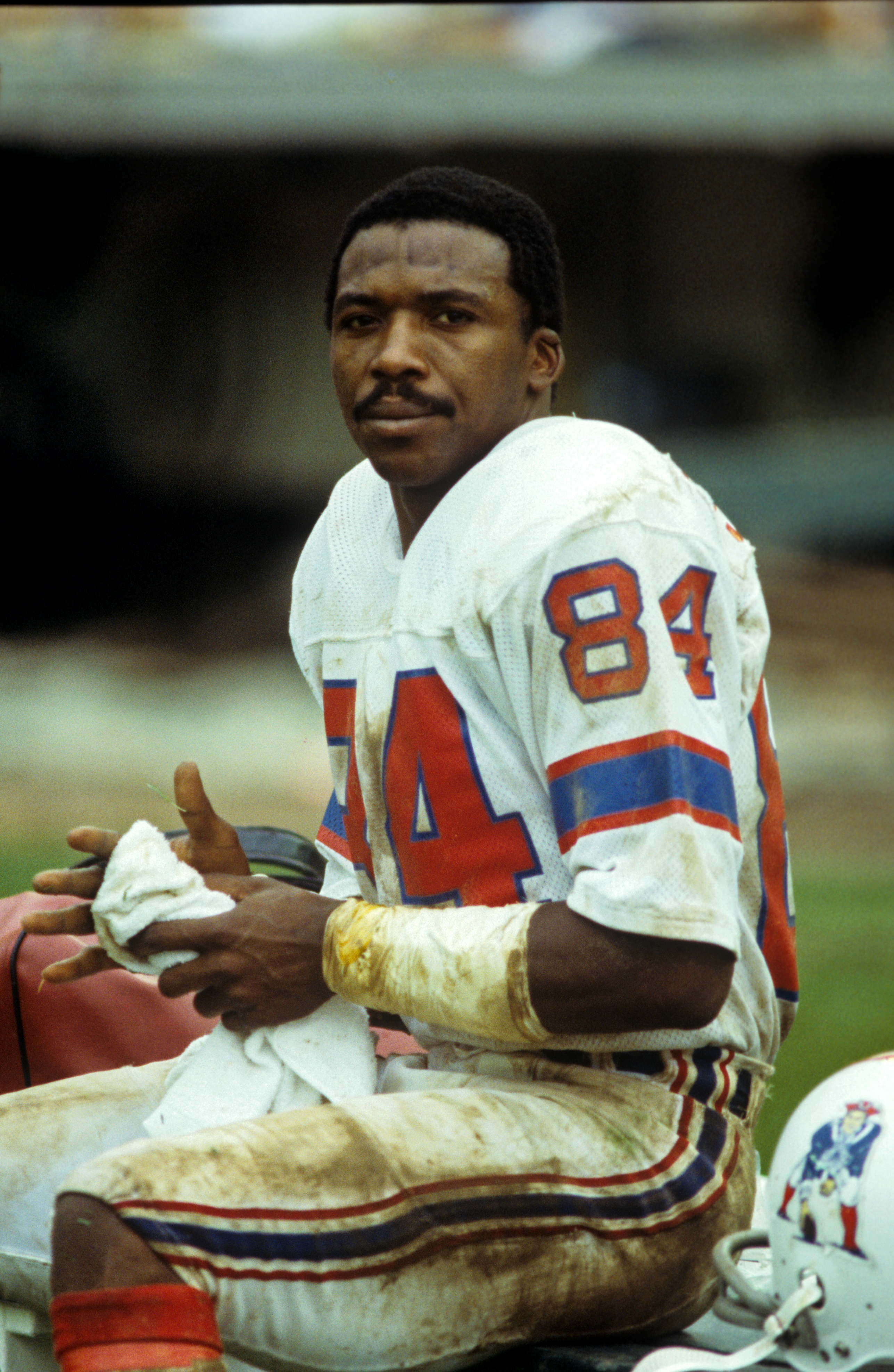
August 12, 1978: Darryl Stingley, a wide receiver for the New England Patriots, suffers one of the worst injuries in the history of football -- willfully inflicted on him in a preseason exhibition game.

Darryl Floyd Stingley was born on September 18, 1951 in Chicago. A running back at John Marshall High School, he was moved to receiver at Purdue University. In 1973, he was selected for the North-South Shrine Game and the Chicago College All-Star Game.

That year, the New England Patriots had perhaps their best draft ever, taking these 3 players in the 1st round: John Hannah, a guard from Alabama that Sports Illustrated would eventually call, on its cover, "The best offensive lineman of all time"; Sam Cunningham, the running back from the University of Southern California who was said to have done more to integrate the Southeastern Conference in 60 minutes against Alabama than the entire Civil Rights Movement; and Stingley.

In 5 seasons with the Pats -- what should have been his 1st 5 seasons -- Stingley caught 110 passes for 1,883 yards and 14 touchdowns. He also ran for 244 yards and 2 touchdowns. He also returned kicks. In 1976, he helped the Pats win the AFC Wild Card berth. (Only 1 to a Conference at the time.) On September 18, 1977, the day he turned 26, he did something no NFL player had done before, nor has since: He ran for a touchdown and caught a pass for another on his birthday. The Pats beat the Kansas City Chiefs, 21-17.
As the 1978 season approached, with a good quarterback in Steve Grogan throwing to him and to a new receiver, Stanley Morgan, and a line anchored by Hannah giving them time to let plays unfold, the Patriots were primed for a successful era, and Stingley should have been just entering his prime.

Instead, he never played another regular season game.

On August 12, the Patriots played a preseason exhibition game against the Oakland Raiders at the Oakland-Alameda County Coliseum. The Raiders had long been known as the dirtiest team in the League. Especially on defense. They had players like linebacker Ted Hendricks, "the Mad Stork." They had linebacker Phil Villapiano, whose name means "soft town," but he's actually from Asbury Park, New Jersey, a very tough town, and he lived up to it. (While in high school, he transferred from Asbury Park High to nearby Ocean Township High, considerably more suburban, but was still Asbury Park tough.) They had cornerback Lester Hayes, known -- for the way he bothered opponents, not women or kids -- as "Lester the Molester."

And they had cornerback Jack Tatum, who grew up outside New York in Passaic, New Jersey, a member of Ohio State's 1968 National Champions, a man who would title his autobiography They Call Me Assassin. When he hit a player, the player didn't see stars. The player was lucky to see anything.
The Patriots won this game, 21-7, but hardly anybody cared -- and not just because it was an exhibition game that didn't count for anything other than personnel assessment.

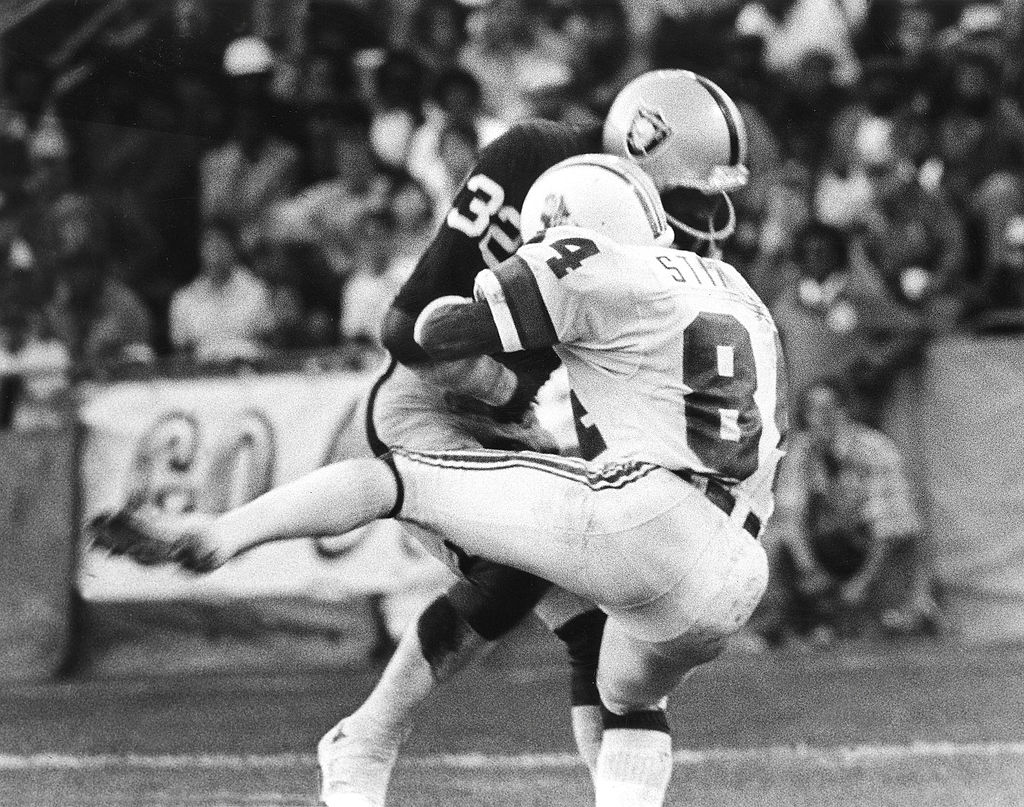
Grogan threw a pass, intended for Stingley, but it was a little off. Stingley reached for it. In came Tatum, like a speeding freight train, throwing his shoulder at Stingley's head. This compressed his spinal cord, and broke his fourth and fifth cervical vertebrae.

Although controversial, the hit was not against NFL rules at the time, as it was not helmet-to-helmet contact -- it was shoulder-to-helmet contact. No penalty was called on the play. Since then, the NFL has banned all blows to the head or neck of a defenseless player, and has disallowed players to launch themselves in tackling defenseless players.

Boston Globe reporter John Powers recalled, "You knew, right away, that it was bad. Darryl just lay there, motionless. And I remember, later on, seeing the doctor, asking him how long Darryl's going to be out, is he going to be able to play next year? And he said, 'You don't understand: Darryl's never going to walk again.'" He eventually regained some movement in his right arm, but that would be it. He spent the rest of his life in a wheelchair.

Just when it looked like things couldn't get any worse for Stingley and the Patriots, they did -- not medically, but officially. The injury came just after Stingley had finished negotiating a contract extension that would have made him one of the highest paid receivers in the NFL. The new contract was to be announced when the Patriots returned from the West Coast. Instead, it was never signed. The Patriots agreed to pay for all of Stingley's medical expenses for the rest of his life, as well as his and his children's education.

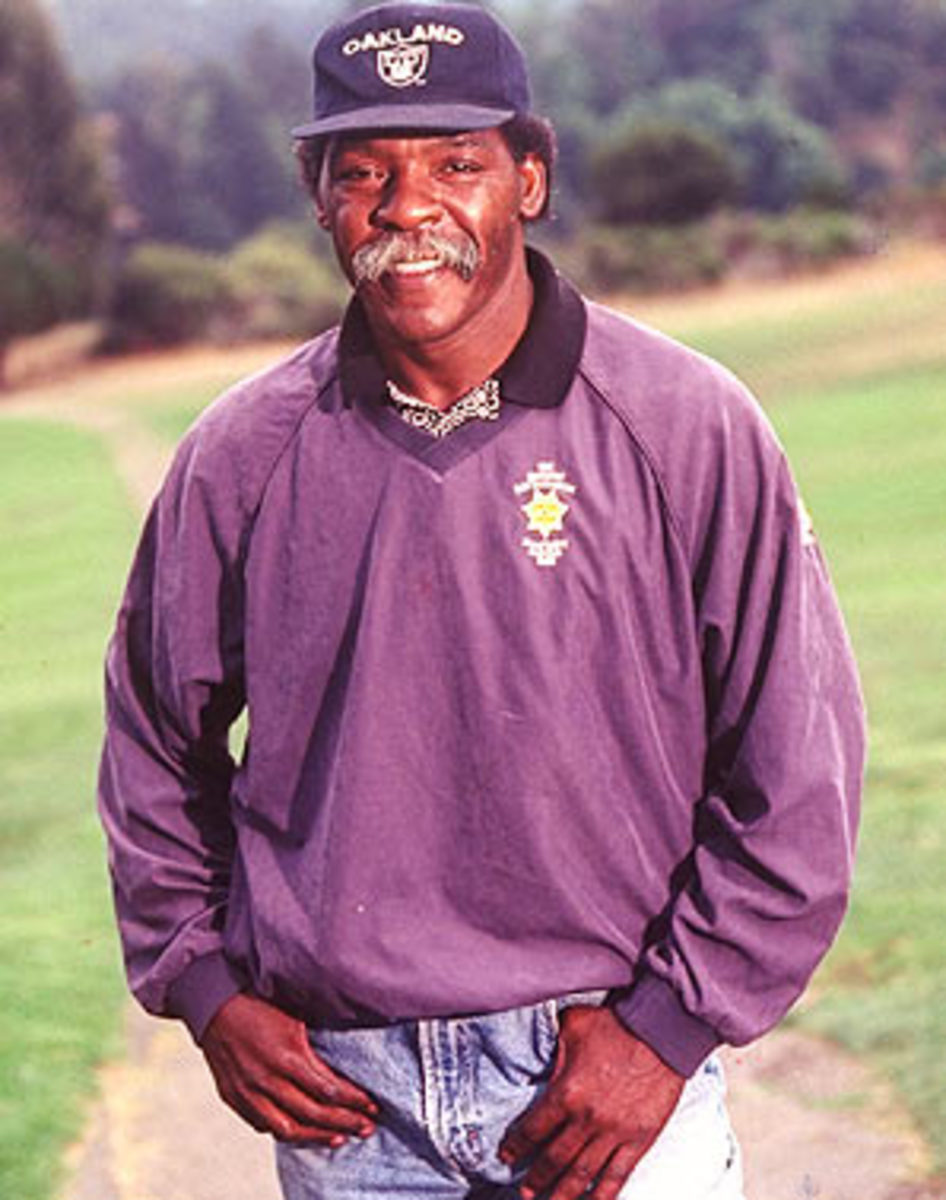
Raider head coach John Madden went right to the hospital after the game, and he and Stingley became friends for life. Gene Upshaw, the Raiders' Hall of Fame guard, also befriended Stingley, and, later, as Director of the NFL Players' Association, used Stingley's example to secure benefits for disabled players.

Oddly, the Patriots actually got better without Stingley. They set an NFL record for most team rushing yards in a season, 3,165, which stood for 40 years. Cunningham ran for 768 yards, Horace Ivory for 693, Andy Johnson for 675, and quarterback Grogan for 539. They also set a record that still stands with 181 1st downs rushing. 

They won their 1st Division title in 15 years, but lost to the Houston Oilers in the Divisional Playoffs. They finally reached the Super Bowl in the 1985 season, as the generation of Patriot players that Stingley played with, including Grogan, Hannah, Morgan, Steve Nelson and Julius Adams was winding down. (Cunningham had retired by then, and Grogan had already been replaced as starting quarterback by Tony Eason, although Grogan did play in the Pats' Super Bowl XX clobbering at the hands of the Chicago Bears.)

Their Playoff run included a win against the Raiders, after which Raider linebacker Matt Millen picked a fight with Patrick Sullivan, Patriot general manager and son of founding owner Billy Sullivan, due to the heckling he was doing against the Raider players. Interviewed after the game, with a Band-Aid on his forehead but otherwise unscathed, the younger Sullivan, remembering Stingley, and also the Raiders' controversial 1976 Playoff win over them, the infamous "Ben Dreith Game" for referee Dreith seemingly handing the Raiders the win, said, "We're just getting back for Jack Tatum, and all of the crap that their football team has put on our football team over the years!"

In 1992, Stingley completed his correspondence course, and received his bachelor's degree from Purdue. He said he had forgiven Tatum, but also criticized him for not reaching out to him at the time. In 1993, he started a nonprofit organization to help troubled youth in his old neighborhood, the West Side of Chicago. He had a daughter and 4 children, including Derek Stingley, a defensive back in the Arena Football League. His grandson, Derek Stingley Jr., is a defensive back who helped Louisiana State win the 2019 National Championship, and was the 3rd pick in the 2022 NFL Draft, by the Houston Texans.

Darryl Stingley died on April 5, 2007, due to heart disease and pneumonia, complications of his paralysis. He was 55, and had lived to see the Patriots' 1st 5 Super Bowl appearances, and their 1st 3 Super Bowl wins.
With Raymond Berry, Hall of Fame receiver for the Baltimore Colts,
then head coach of the Patriots, before Super Bowl XX, 1986

Tatum played another 3 seasons. Madden said the Stingley hit "was something that ate on him for his whole life." Just as Chuck Bednarik had attempted to see Frank Gifford in the hospital after a scary hit in 1960, Tatum claimed he had tried to see Stingley in the hospital, but was turned away. With Bednarik, he was turned away by hospital officials. Tatum claimed it was Stingley's family that wouldn't let him see Darryl, something the family still denies.

Tatum never apologized, not for that hit, nor for any other, saying, "It's unrealistic. If you want to play football for a living, you're going to get injured."
Despite 3 Pro Bowl appearances and his role in helping the Raiders win Super Bowl XI, he has never been elected to the Pro Football Hall of Fame. The College Football Hall, yes; the Pro Football Hall, no. If he hadn't done what he did to Stingley, would he be in? I believe so. But he did do it. If he had publicly apologized, would he be in? Maybe.

He worked in the Raider organization, and then became a successful real-estate developer. With some irony, while Stingley lost the use of his legs, Tatum lost his legs due to diabetes. The disease forced him into needing a kidney transplant, but he died on July 27, 2010, before it could happen. He was 61.

When asked to make a comment about Tatum's death, Grogan, who never met the man off the field, said, "I have a hard time trying to find something nice to say... I just can't do it."

*

August 12, 1978 was a Saturday. NFL exhibition games were played, but it was too early for college football. These Major League Baseball games were played:

* The New York Yankees lost to the Baltimore Orioles, 6-4 at Memorial Stadium. Lee May and Pat Kelly hit home runs to support Mike Flanagan, and knock Jim Beattie out of the box after just 2 innings. Thurman Munson and Lou Piniella each got 2 hits, Chris Chambliss had a 2-run single, and Reggie Jackson singled as a pinch-hitter for Cliff Johnson (starting at DH because Flanagan was a lefthander), but it wasn't enough.

This series was drenched with rain. This game had 2 rain delays, the game the night before was shortened to 6 innings with the Yankees winning, and the next day's game was marred by the Oriole grounds crew -- the Yankees and their fans have always believed they were ordered to do so by manager Earl Weaver -- dumped rain off the tarp and onto the field, to get the game called, and get the score reverted to what it was at the start of the inning, turning a Yankee lead into a rain-shorted Oriole win. The Yankees won the series finale on the Monday, and continued their epic comeback to repeat as World Series winners.

* The New York Mets lost to the St. Louis Cardinals, 5-1 at Shea Stadium. Jerry Morales and Steve Swisher (father of later Yankee star Nick Swisher) each got 3 hits. Lou Brock did not play, and Keith Hernandez only appeared as a late defensive replacement. John Denny over 7 innings and Roy Thomas over the last 2 allowed only 1 hit, a single by John Stearns to lead off the bottom of the 7th.

* The Montreal Expos beat the Chicago Cubs, 4-3 at the Olympic Stadium in Montreal. Each team scored 2 runs in the 12th inning, after only scoring 1 apiece in the previous 11 innings. Tom Hutton singled home the winning run in the bottom of the 14th inning.

* The Boston Red Sox swept a doubleheader from the Milwaukee Brewers at Fenway Park, 3-1 and 11-4. Jim Wright went the distance to win the opener, and Carlton Fisk hit a home run. Bob Stanley won the nightcap, supported by a home run by Jim Rice. Over the 2 games, Robin Yount went 1-for-9 with an RBI. Carl Yastrzemski, still hitting hard at age 39, didn't play in either game. Nor did Paul Molitor, about to turn 22 and having a fine rookie season.

* The Philadelphia Phillies beat the Pittsburgh Pirates, 10-1 at Veterans Stadium in Philadelphia. Willie Stargell did not play.  Mike Schmidt went 0-for-3, but did draw 2 walks. Greg Luzinski and Bob Boone hit home runs, and Richie Hebner went 4-for-5 with 2 RBIs, in support of Randy Lerch.

* The Toronto Blue Jays beat the Kansas City Royals, 5-2 at Exhibition Stadium in Toronto. George Brett did not play.

* The Texas Rangers beat the Cleveland Indians, 6-1 at Cleveland Municipal Stadium.

* The Chicago White Sox beat the Detroit Tigers, 6-3 at Comiskey Park.

* The Minnesota Twins beat the Oakland Athletics, 6-3 at Metropolitan Stadium in the Minneapolis suburb of Bloomington, Minnesota. Rod Carew went 2-for-4.

* The Houston Astros beat the Atlanta Braves, 5-2 at the Astrodome in Houston.

* The San Diego Padres beat the Cincinnati Reds, 4-2 at San Diego Stadium (later Jack Murphy Stadium and Qualcomm Stadium). Pete Rose and Johnny Bench both went 1-for-4.

* The San Francisco Giants beat their arch-rivals, the Los Angeles Dodgers, 3-2 at Dodger Stadium in Los Angeles.

* And a doubleheader was split at the Kingdome in Seattle. The California Angels won the 1st game, 7-5, when Danny Goodwin singled home the winning run in the top of the 10th inning. The Seattle Mariners won the 2nd game, 5-3.

Sunday, January 9, 2022

January 9, 1977: The Oakland Raiders Win the Big One

Fred Biletnikoff (left) and Ken Stabler

January 9, 1977: This remains the earliest day in the calendar year on which a Super Bowl has been held, and the earliest definitive pro football "world championship" since 1959, when the NFL Championship Game was still held in December, and alone, without an AFL Championship Game to leave the world championship disputed.

Perhaps being played so early explains why "The Autumn Wind" finally made its presence felt in Winter.

The Oakland Raiders were founded with the American Football League in 1960. By 1963, with Al Davis beginning to run things as head coach and "managing general partner," they were a 10-4 team. In 1966, Davis stuck to the management side of things, and hired John Rauch as head coach.

In 1967, he hired John Madden to be linebackers coach. They won the AFL Championship, losing to the Green Bay Packers of Vince Lombardi in Super Bowl II. A year later, the Raiders lost the AFL Championship Game to the New York Jets. Rauch resigned, and Madden was named his successor as head coach.

Davis built a team in his own image. Nasty. Sometimes weird. Someone once compared them to "the Island of Misfit Toys" in the 1964 Christmas special Rudolph the Red-Nosed Reindeer. But with Davis running the organization, and Madden running the team, they built a record that made them one of professional football's iconic franchises. They inspired NFL Films head Steve Sabol, in 1974, to write a poem:

The Autumn Wind is a pirate
blustering in from sea.
With a rollicking song,
he sweeps along,
swaggering boisterously.

His face is weather-beaten.
He wears a hooded sash,
with a silver hat
about his head,
and a bristling black mustache.

He growls as he storms the country,
a villain big and bold,
and the trees all shake
and quiver and quake,
as he robs them of their gold.

The Autumn Wind is a Raider
pillaging just for fun.
He'll knock you 'round
and upside-down
and laugh when he's conquered and won.

Sabol showed the poem to Davis, and he loved it, saying, "This is what the Oakland Raiders are all about." So Sabol had NFL Films' regular voiceover performer, John Facenda, record it, and then played it over highlights of the team. And that's how the Oakland Raiders, the toughest football team of its era, became the only NFL team with an official team poem, something you'd expect from a more literary city like New York or Boston.

The mustache was a reference to old perceptions of pirates. In fact, most of the Raiders didn't have mustaches, and even the pirate logo on their helmet doesn't have one. "Bucco Bruce," the original helmet logo of the Tampa Bay Buccaneers, did.

But the team did enjoy its "villain" image. Defensive end Ben Davidson, who did grow a horseshoe mustache, was regarded as the dirtiest player in the AFL. Linebacker Ted Hendricks, already known as "The Mad Stork" when starring for the Baltimore Colts, burnished his Hall of Fame credentials with the Raiders, being nicknamed "Kick 'em in the Head Ted."

Safety Jack Tatum was the hardest hitter in the game, so mean he leveled an unnecessary hit on New England Patriot receiver Darryl Stingley in 1978. In a preseason exhibition. Stingley was paralyzed. Tatum titled his memoir They Call Me Assassin.

And the quarterback was no exception. Ken Stabler, prior to the arrival of Steve Young, was the best lefthanded quarterback football had ever seen. He could have been mistaken for a member of the Hell's Angels, the drug-dealing motorcycle gang founded in Oakland years before the Raiders arrived. He had the long hair, the mustache, and the bushy beard. And he had the attitude: He would do whatever it takes to beat you from the long bomb to "those 14-yard and 16-yard darts," as one writer described him at the time.

Off the field, though, he wasn't mean. He was a country boy from Alabama who enjoyed a good time. He once said, "There's nothing wrong with reading a playbook by the light of a jukebox." Someone once read him a quote by novelist Jack London: "I would rather that my spark should burn out in a brilliant blaze than be stifled by dry rot," and asked Stabler what he thought it meant. He thought for a few seconds, and said, "Throw deep."

To later fans, who knew him as a broadcaster, or as the creator of the video game series that bears his name, John Madden seemed to be too nice a guy to coach the Raiders. Nothing could be further from the truth: That personality made him exactly the kind of guy who should have been their coach. Most coaches in those days acted like domineering fathers. He was more like the cool older brother, who would teach you things that Dad wouldn't teach you. The players related to him: White and black, urban and rural, the straight-laced and the party animal, the merely mischievous and the truly dirty.

He gave his players one rule, and only one: "Be on time." That gave them a freedom that most coaches wouldn't give. He coached them for 10 seasons, and went 103-32-7. He was the Light Side of the Raider Force, Al Davis was the Dark Side, and, together, they built something that wasn't always good, but was must-see TV, long after John left for the broadcast booth.

But the Raiders had difficulty winning big games. In 1968, his last year as an assistant, they beat the New York Jets in a regular-season game remembered as "The Heidi Bowl," but lost the AFL Championship Game to the Jets. In 1969, they lost the AFL Championship Game to the Kansas City Chiefs. In 1970, the 1st post-merger season, they lost the AFC Championship Game to the Baltimore Colts.

They missed the Playoffs in 1971. In 1972, they thought they had the Pittsburgh Steelers beaten in a Divisional Playoff, before a play known as "The Immaculate Reception." Various Raiders insisted that the play was illegal for various reasons: The pass hit Frenchy Fuqua, not Jack Tatum, therefore all Steeler players were ineligible receivers; Franco Harris caught the ball when it was on the ground, therefore it was an incomplete pass; and Phil Villapiano was illegally blocked by John McMakin, therefore the ball should have been placed at the spot of the foul, and then 5 yards marked off, negating the touchdown.

It's been nearly half a century. Every piece of footage of the play that has ever been found has proven that the ball hit Tatum, and never hit Fuqua. Every footage found shows McMakin's block was legal. And no footage found has yet shown the ball hitting the ground as Harris caught it. Still, Madden said he would never get over the play: "No matter how many times I watch the films of the Immaculate Reception play, I never know for sure what happened."

The Raiders lost the 1973 AFC Championship Game to the Miami Dolphins. In 1974, they dethroned the 3-time defending AFC Champion Dolphins in a wild game at the Oakland Coliseum that became known as "The Sea of Hands," but lost to the Steelers again in the AFC Championship Game. They lost to the Steelers again in the 1975 AFC Championship Game.

Finally, in 1976, after a 13-1 regular season, and a controversial Playoff win over the New England Patriots, they beat the Steelers, and advanced to Super Bowl XI. On January 9, 1977, they walked onto the field at the Rose Bowl, in the Los Angeles suburb of Pasadena, California.

Their opponents were the Minnesota Vikings. In contrast to the Raiders' rather plain combination of silver, black and white -- they wore their white jerseys on this day -- the Vikings wore purple and white, with gold trim. They had a strong defense, with a nickname that made them seem as fearsome as the Raiders, taken from a rock and roll novelty song from 1958: The Purple People Eaters. Tackle Alan Page, ends Carl Eller and Jim Marshall, and safety Paul Krause, the NFL's all-time leader in interceptions, are all in the Hall of Fame.

Their offense was nearly unpredictable, largely due to their quarterback. Fran Tarkenton was known as the Scrambler, because chasing him out of the pocket was often a bad idea, as he ran and searched for open receivers, such as Sammy White and Ahmad Rashad, or perhaps running back Chuck Foreman. And if he couldn't find one, he kept running. He finished his career with more passes, more completions, more touchdown passes, more passing yards, and more rushing yards than any quarterback before him. He, center Mick Tinglehoff and offensive tackle Ron Yary are also in the Hall of Fame, as is head coach Bud Grant.

But the Vikings were also a team that "couldn't win the big one." Despite having won 8 of the last 9 titles in their Division, they had lost Super Bowls IV, VIII and IX. Now, 2 teams known for falling apart when it mattered most were playing for the biggest prize of all. Something had to give.

It remains the only Super Bowl to not have the National Anthem played or sung before it. Instead, singer Vikki Carr sang "America the Beautiful." Kickoff was at 12:30 PM Pacific Time -- 3:30 Eastern. It remains the last Super Bowl to have been played entirely in daylight.

The Raiders' opening drive ended when kicker Errol Mann hit the left upright on a 29-yard field goal attempt. Later, Fred McNeill of the Vikings blocked a punt by the Raiders' Ray Guy, who had never had one blocked before. But the Vikings' Brent McClanahan fumbled the ball away on the Raider 3-yard line.

That began a Raider drive to end the quarter, but they could only get a 24-yard field goal from Mann. They could easily have been up 14-0. Instead, it was just 3-0.

But after holding the Vikings and forcing them to punt, Stabler went to work, tossing to Fred Biletnikoff, Dave Casper and Cliff Branch, finally finding Casper in the end zone to put the Raiders up 10-0. They held the Vikings again, and Pete Banaszak ran the ball in for a touchdown to make it 16-0. But, again, Mann missed a close kick, this time the extra point. The Raiders should have been up by 28. Instead, they were up by 16.

Still, they had held the Vikings to just 1 1st down. They got 3 more, but were still well short of the Raider end zone when the half expired. To this day, the Vikings have been in 4 Super Bowls, scoring a grand total of zero points in those games' 1st halves.

Midway through the 3rd quarter, Stabler drove the Raiders again, and, from 40 yards out, Mann did not miss. His field goal made it 19-0. In their 3 1/2 Super Bowls to that point, the Vikings had scored only 20. A roughing-the-passer penalty on Hendricks gave the Vikings a chance, and Tarkenton threw a touchdown pass to Sammy White, making it 19-7.

The Raiders had to punt on their next drive, and Tarkenton got the Vikings to the Raider 37. It looked like the momentum had shifted. But Willie Hall intercepted a pass, and Stabler nearly got into the end zone with a 48-yard pass to Biletnikoff. Banaszak ran it in 2 players later, and the game was effectively over at 26-7.

On the Vikings' next drive, veteran cornerback Willie Brown intercepted a Tarkenton pass, and ran it 75 yards for a touchdown. Mann missed the extra point again, but at 32-7, nobody cared. The Vikings added a touchdown with 25 seconds left, but few people cared about that, either. It ended Raiders 32, Vikings 14.

Biletnikoff was named the game's Most Valuable Player. For the Raiders: Stabler, Biletnikoff, Casper, Hendricks, Brown, Guy, guard Gene Upshaw and offensive tackle Art Shell were elected to the Pro Football Hall of Fame. So were coach Madden and owner-GM Davis.

The Raiders would win a 2nd title in the 1980 season, under head coach Tom Flores, beating the Philadelphia Eagles in Super Bowl XV. They moved to Los Angeles in 1982, and Flores guided them to a 3rd title in the 1983 season, beating the team then known as the Washington Redskins in Super Bowl XVIII.

It is noteworthy that, from the Giants' Pennant of October 3, 1962 to the 49ers' NFC Championship of January 10, 1982, the City of San Francisco had no league champions in any sport, while the City of Oakland had 8: The 1967 AFL Champion Raiders; the 1969 ABA Champion Oaks; the 1972, 1973 and 1974 World Series Champion Athletics; the 1975 NBA Champion Warriors; and the 1976 and 1980 NFL Champion Raiders.

The Raiders went into a down period, but reached the AFC Championship Game in 1990. They moved back to Oakland, and won another AFC Championship in 2002, losing Super Bowl XXXVII to the other pirate-themed team in the NFL, the Tampa Bay Buccaneers. In 2020, they left Oakland again, moving to Las Vegas.

The Vikings haven't been to a Super Bowl since, losing the NFC Championship Game for the seasons of 1987 (losing to the Redskins), 1998 (despite finishing the regular season 15-1, losing in overtime to the Atlanta Falcons), 2000 (getting slaughtered 41-0 by the New York Giants at the Meadowlands), 2009 (losing in overtime to the New Orleans Saints) and 2017 (getting clobbered by the Philadelphia Eagles, denying them a chance to play Super Bowl LII in their home stadium in Minneapolis).

*

January 9, 1977 was a Sunday. Obviously, no other football games were played on the day. Baseball was out of season. There were 3 games played in the NBA:

* The Los Angeles Lakers beat the Detroit Pistons, 124-118 at Cobo Hall in Detroit.

* The Portland Trail Blazers beat the San Antonio Spurs, 150-113 at the Portland Memorial Coliseum. Despite the high score, no player on either side scored more than 22 points.

* And the Seattle SuperSonics beat the New Orleans Jazz, 92-76 at the Seattle Center Coliseum.

There were 3 games played in the NHL that day:

* The New York Rangers lost to the Los Angeles Kings, 5-4 at Madison Square Garden.

* The Buffalo Sabres beat the Cleveland Barons, 7-4 at the Buffalo Memorial Auditorium. After the 1978 season, the Barons and the Minnesota North Stars, both going broke, were merged, with all of the Barons' assets, including players, transferred to the Stars. The Barons remain the last team in North America's "Big Four" sports leagues to go out of business.

* And in an "Original Six" matchup, the Boston Bruins beat the Chicago Black Hawks, 4-2 at the Chicago Stadium.

And there were 3 games played in the World Hockey Association:

* The Quebec Nordiques beat the San Diego Mariners, 5-2 at the Colisée de Québec. San Diego to Quebec City is about as far as you can go on a North American sports roadtrip.

* The Winnipeg Jets beat the Birmingham Bulls, 4-1 at the Winnipeg Arena.

* And the Edmonton Oilers beat the Indianapolis Racers, 5-3 at the Northlands Coliseum in Edmonton.

December 31, 1999 & January 1, 2000: The Millennium

December 31, 1999:  The Millennium arrives. The people of planet Earth survived. At a terrible cost. But we hadn't destroyed ourselves. ...