Showing posts with label university of oklahoma. Show all posts

Friday, November 25, 2022

November 25, 1971: Nebraska vs. Oklahoma, "The Game of the Century"

Number 20: Johnny Rodgers

November 25, 1971: One of college football's occasional "Games of the Century" is played.

They seemed to be coming every year. 1966 saw Michigan State vs. Notre Dame, in the Big Ten region if not a Big Ten game in its own right. 1967 saw USC vs. UCLA, in the league now known as the Pac-12. 1969 saw Texas vs. Arkansas, in the now-defunct Southwest Conference. In 1971, it was the turn of the league then known as the Big 8, now the Big 12.

For many years, the University of Nebraska's big rival was the University of Oklahoma. The rivalry was usually played on Thanksgiving weekend. In 1959, Nebraska beat Oklahoma, ending the Sooners' 74-game conference winning streak. In 1963, Nebraska won a game that the Big 8 refused to postpone, despite President Kennedy's assassination the day before.

On November 25, 1971, the Nebraska Cornhuskers and the Oklahoma Sooners met at Oklahoma Memorial Stadium, a.k.a. Owen Field, in Norman. The 'Huskers had won the National Championship the season before, were riding a 28-game unbeaten streak (27-0-1, without losing since October 11, 1969), and were ranked Number 1 in the country. The Sooners ranked Number 2. The entire country was watching that Thanksgiving Day.

Each team had a superstar running back. Nebraska, coached by Bob Devaney, had Johnny Rodgers, also a great receiver, from Omaha, running as the last back in the "I formation." He was known as "Johnny the Jet" and "Johnny R Superstar." The nickname clearly came from the theme song to the Broadway musical Jesus Christ Superstar, although it's not known if Nebraska fans made up a song for it, the way fans of London soccer team Arsenal made one up for "Charlie George, superstar."

Oklahoma had Greg Pruitt, a Houston native, running out of the wishbone offense, installed by coach Chuck Fairbanks, after he was impressed at how the Sooners' other big rivals, the University of Texas, ran it under coach Darrell Royal. (Ironically, Royal had played quarterback at Oklahoma.)

Chris Schenkel and Bud Wilkinson, who had established the Oklahoma dynasty before retiring (there were 2 other head coaches between him and Fairbanks), called the game for ABC, and the largest college football audience ever to that point, 55 million people, watched. It kicked off at 2:00 PM Central Time (3:00 Eastern, the ABC broadcast beginning 10 minutes before).
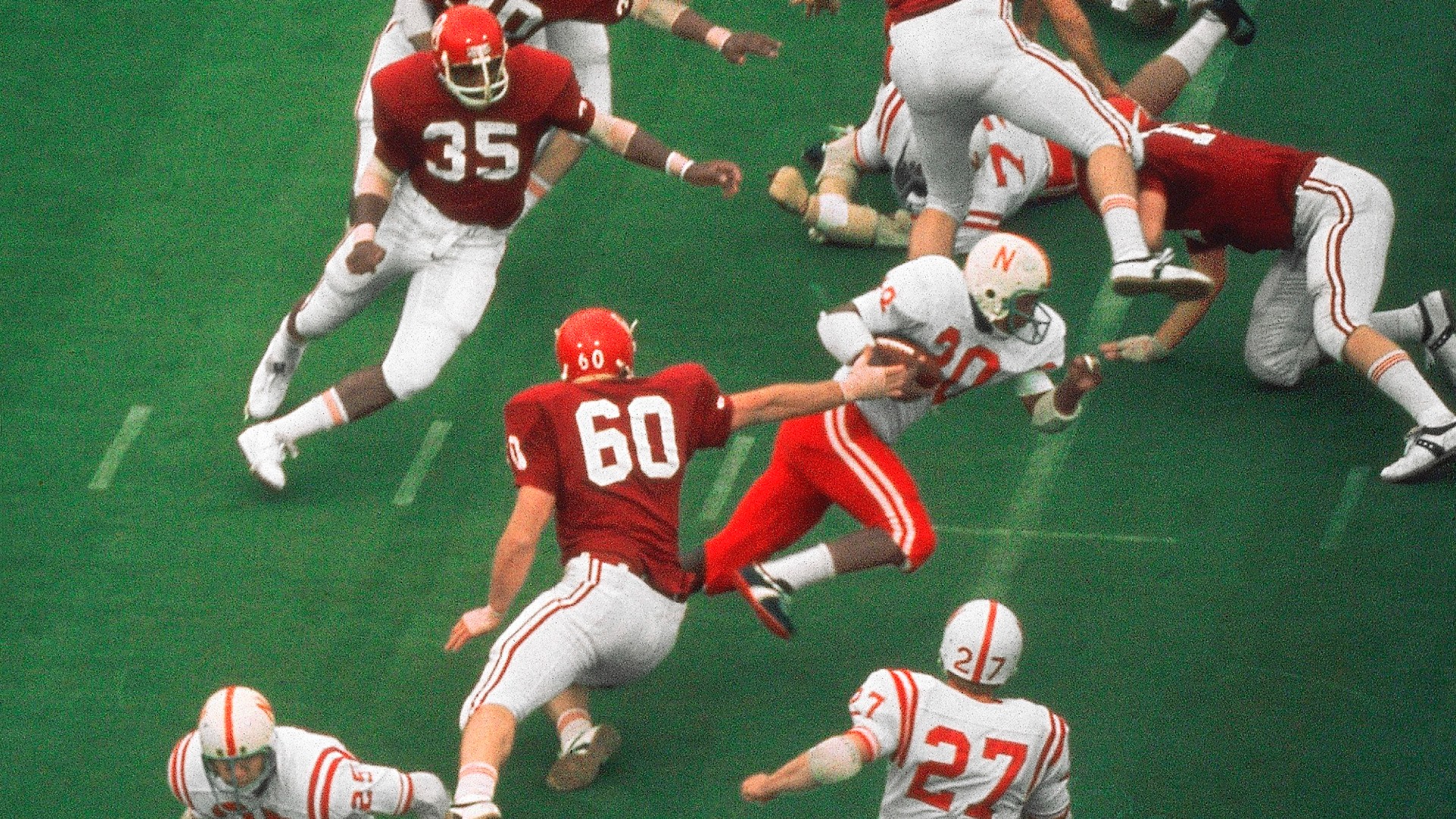
Nebraska stopped Oklahoma's 1st possession, and the Sooners had to punt. Rodgers returned the punt 72 yards for a touchdown. Twice in the 1st half, the Sooners fumbled the ball away. Rich Glover, the 'Huskers' middle guard, toyed with the Oklahoma offensive line.

The Sooners kicked a field goal, then teach team scored a touchdown in the 2nd quarter. But quarterback Jack Mildren led the Sooner offense on a long drive at the end of the 1st half, and Oklahoma had a 17-14 lead. It was the 1st time Nebraska had been behind all season long.

But a 3rd Sooner fumble led to the 'Huskers retaking the lead, and they expanded it to 28-17 late in the 3rd quarter, on Jeff Kinney's 3rd touchdown of the day. But near the end of the 3rd quarter, Mildren led the Sooners on another drive, and it was 28-24 'Huskers. He did it again, and with 7:10 left in regulation, Oklahoma led, 31-28.

The 'Huskers made the most of the time they had left. They got to the Sooner 48, and Husker quarterback Jerry Tagge through to Rodgers, who made a 2nd "signature play" in 1 game, breaking tackles and getting to the 15. Kinney scored his 4th touchdown of the game with 1:38 left. Oklahoma got the ball back, but the 'Huskers sacked Mildren on 3rd and 4th down to put it away. Final score: Nebraska 35, Oklahoma 31.

Nebraska thus clinched the Big 8 title, kept the Number 1 ranking, and set themselves up for the National Championship. They did have 1 more regular-season game, traveling to Hawaii, and they won, 45-3. They closed with another Number 1 vs. Number 2 matchup, beating Alabama in the Orange Bowl in Miami, 38-6.

Oklahoma only dropped to Number 3, and also had 1 more regular-season game, against in-State rival Oklahoma State. They traveled to Stillwater, and beat the Cowboys, 58-14. The aforementioned Alabama beat their big rivals, Auburn, in "the Iron Bowl" in Birmingham, 2 days after Thanksgiving, and Auburn, holding their Number 5 ranking, played Oklahoma in the Sugar Bowl in New Orleans. Oklahoma won, 40-22. Nevertheless, they finished the season with only the Sugar Bowl trophy, while Nebraska were the National Champions and the Big Eight Conference Champions.

Nebraska's 31-game unbeaten streak (30-0-1) ended with the opening game of the 1972 season, 20-17 against UCLA at the Los Angeles Coliseum. Then they went 9-0-1, with only a tie against Iowa State further marring their record. They had gone 40-1-2 over 3 years, a staggering total, for a .942 winning percentage. Then they hosted Oklahoma at Memorial Stadium in Lincoln on Thanksgiving, and the Sooners got some revenge, 17-14. 

After beating Notre Dame in the 1973 Orange Bowl, Devaney retired as Nebraska head coach, becoming athletic director, and elevating his offensive coordinator Tom Osborne to the head job. Osborne had a great deal of success, winning 13 Conference Championships, and 12 bowl games including 9 of those traditionally contested on New Year's Day; but also some staggering near-misses for the National Championship, before winning it in the 1994, 1995 and (in a split poll) 1997 seasons.

Nebraska's Johnny Rodgers was awarded the Heisman Trophy for the 1972 season. The San Diego Chargers took him with their 1st round pick in the 1973 NFL Draft. Instead, he signed with the Montreal Alouettes of the Canadian Football League. He won a Rookie of the Year award, 2 Most Valuable Player awards, and the 1974 Grey Cup (CFL Championship.)

In 1977, with the Chargers still holding his NFL rights, he signed with them. But he was plagued with injuries, and retired after the 1978 season, having played only 17 NFL games.

Oklahoma's Greg Pruitt had a much better pro career. He made 5 Pro Bowls, 4 with the Cleveland Browns and 1 with the Los Angeles Raiders, and was a member of the Raiders' Super Bowl XVIII winners in 1984. Both Rodgers and Pruitt were elected to the College Football Hall of Fame, but neither made it to the Pro Football Hall of Fame.

In 1978, Nebraska won the regular-season game, as Number 4 beating Number 1 Oklahoma, but a rematch was set up in the Orange Bowl (which then took the Big 8 winner), and Oklahoma won it. In 1987, Oklahoma were Number 2 when they beat Number 1 Nebraska.

The Big 8's 1996 conversion into the Big 12 put the teams in separate divisions, as Oklahoma and Oklahoma State were put in with the 4 teams brought in from Texas to form the South Division, to balance the divisions out, ending Huskers-Sooners as an annual rivalry.

Nebraska's 2011 move to the Big Ten made the matchup even rarer: They stopped playing each other after Oklahoma beat them in the 2010 Big 12 Championship Game. They finally met again on September 18, 2021, in Norman, to celebrate the 50th Anniversary of that Game of the Century. Oklahoma won, 23-16.

Overall, Oklahoma leads the rivalry 46-38-3, but it's 43-23 Oklahoma since 1943, 11-8 Nebraska since 1988, and 7-2 Oklahoma since 2000.

*

November 25, 1971 was Thanksgiving Day, so it was a Thursday. 'Huskers-Sooners was 1 of 4 college football games played that day. Number 7 Georgia beat Georgia Tech, 28-24 at Grant Field in Atlanta. Number 12 Texas beat Texas A&M, 34-14 at Kyle Field in College Station, Texas. And Number 18 Mississippi, a.k.a. Ole Miss, beat Mississippi State, 48-0 at Hemingway Stadium in Oxford, Mississippi. (It's now named Vaught-Hemingway Stadium.)

In the NFL doubleheader, NBC telecast the opener, and the Detroit Lions beat the Kansas City Chiefs, 32-21 at Tiger Stadium in Detroit. (Remember: This was 50 years ago.) CBS aired the nightcap, and the Dallas Cowboys beat the Los Angeles Rams, 28-21 at Texas Stadium in the Dallas suburb of Irving Texas.

There were 3 games played in the NBA. The Phoenix Suns beat the Detroit Pistons, 122-103 at the Arizona Veterans Memorial Coliseum in Phoenix. The Philadelphia 76ers beat the Golden State Warriors, 112-111 at the Oakland Coliseum Arena. And the Los Angeles Lakers beat the Seattle SuperSonics, 139-115 at the Seattle Center Coliseum.

There were 2 games played in the American Basketball Association. The New York Nets lost to the Kentucky Colonels, 133-117 at Freedom Hall in Louisville. And the Virginia Squires beat the Pittsburgh Condors, 131-118 at the Civic Arena in Pittsburgh.

And 1 game was played in the NHL: The Boston Bruins beat the Philadelphia Flyers, 4-2 at the Boston Garden.

Also, actress Christina Applegate was born.

Wednesday, November 16, 2022

November 16, 1957: Notre Dame Ends Oklahoma's 47-Game Winning Streak

November 16, 1957: The University of Oklahoma football team takes a 47-game winning streak into a home game with the University of Notre Dame, the last team to have beaten them.

Notre Dame had beaten Oklahoma on September 26, 1953, at Oklahoma Memorial Stadium (a.k.a. Owen Field, now Gaylord Family Memorial Stadium) in Norman, Oklahoma, en route to a National Championship. The following week, Oklahoma were held to a tie by the University of Pittsburgh. The week after that, they beat arch-rival Texas, and it was off to the races from there. Coach Charles "Bud" Wilkinson's Sooners ran the table, finishing 9-1-1.

They won all 10 games in 1954, but finished behind both Ohio State and UCLA in the last national poll. They won all 11 games in 1955, and this time, they were rewarded with the National Championship. They won all 10 games in 1956, and were again awarded the National Championship. Running back Tommy McDonald was the star of these teams, before going on to a Hall of Fame career as a flanker with the Philadelphia Eagles. In 1956, McDonald finished 2nd to Paul Hornung of the Notre Dame for the Heisman Trophy, and, in a rare height for an offensive lineman, Oklahoma center Jerry Tubbs finished 3rd.

The Sooners kept going in 1957, winning away to Number 8 Pitt, then beating Iowa State at home, Texas in the Cotton Bowl, Kansas and Colorado at home, then Kansas State and Number 19 Missouri on the road. That made them 7-0, with a 47-game winning streak, and a 48-game unbeaten streak, both all-time records in college football.

Notre Dame began the 1957 season by winning their 1st 4 games, over Purdue, Indiana, then-Number 10 Army and Pittsburgh. But they lost their next 2, home to Number 16 Navy and away to Number 2 Michigan State. They entered the game unranked, but perhaps harshly so.

Still, Oklahoma were a 19-point favorite and the Number 2-ranked team in the nation going in, so anyone predicting that Notre Dame would beat Oklahoma was just guessing. Sports Illustrated, founded 3 years earlier, was not guessing: They put the Sooners on the cover, with the headline, "WHY OKLAHOMA IS UNBEATABLE."
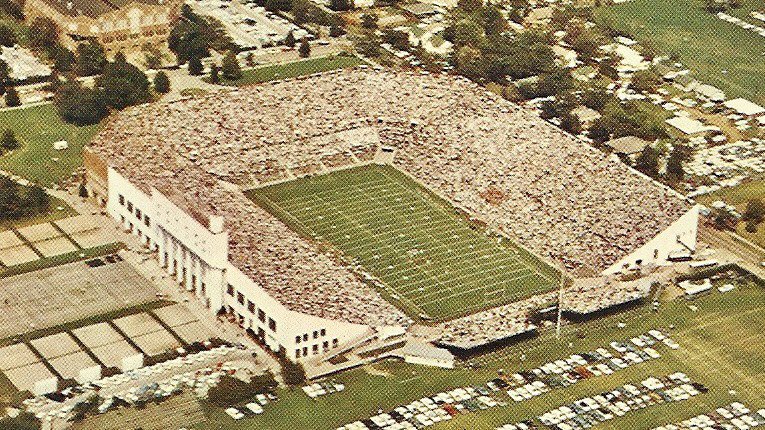
Oklahoma Memorial Stadium, 1957

Notre Dame didn't get the memo. Their defense proved every bit as tough as Oklahoma's. Midway through the 4th quarter, the game was still scoreless. The Fighting Irish launched an 80-yard drive, and, on the drive's 20th play, on 4th and goal from the 3-yard-line, quarterback Bob Williams pitched the ball to running back Dick Lynch, later an All-Pro for the New York Giants, and put Notre Dame on top, 7-0.

Oklahoma had one last chance, but, with less than 1 minute left, Williams intercepted a pass, and the 7-0 score held to the final gun, and most people in the crowd of 63,170 were stunned.

Oklahoma shook the loss off, beating Nebraska and Oklahoma State, winning the Big Seven Conference title, and they beat Duke in the Orange Bowl. They finished the season ranked Number 4. Notre Dame weren't as lucky: The win over Oklahoma raised them to Number 9, but they lost their next game, home to Iowa. They beat USC at home, and then beat SMU in the Cotton Bowl (the stadium, not the game), and finished Number 9.

In a weird twist of events, the longest winning streak in the history of men's college basketball is 88 games, set by UCLA from 1971 to 1974. The last team to beat them before the streak began, and the team that beat them to end it? In each case, it was Notre Dame. Unlike Oklahoma football, however, both UCLA losses to Notre Dame were on the Notre Dame campus in South Bend, Indiana.

*

November 16, 1957 was a Saturday. Among the other college football games played that day were these:

* Oklahoma may have had the most shocking defeat of the day, or even of the decade, but they weren't even the highest-ranked team to lose that day. Texas A&M went in ranked Number 1, but were upset by Number 20 Rice, 7-6 at Rice Stadium in Houston. Rice went on to win the Southwest Conference title.

* Number 3 Auburn beat Georgia, 6-0 at Memorial Stadium in Columbus, Georgia.

* Number 4 Michigan State beat Minnesota, 42-13 at Spartan Stadium in East Lansing, Michigan.

* Number 5 Iowa were slightly upset by Number 6 Ohio State, 17-13 at Ohio Stadium in Columbus. Ohio State won the Big Ten Conference title.

* Number 7 Tennessee were slightly upset by Number 8 Mississippi, 14-7 at Crump Stadium in Memphis. "Ole Miss" went on to win the Southeastern Conference title, and beat Texas in the Sugar Bowl.

* Number 9 Navy beat George Washington University, 52-0 at Memorial Stadium in Baltimore. Navy beat Rice in the Cotton Bowl, in large part due to running back Pete Dawkins, who won the Heisman Trophy the next season.

* Number 10 Army beat Tulane, 20-14 at Michie Stadium in West Point, New York.

* Number 11 Duke beat Number 14 Clemson, 7-6 at Duke Stadium (now Wallace Wade Stadium) in Durham, North Carolina.

* Number 15 Illinois were upset by Wisconsin, 24-13 at Camp Randall Stadium in Madison, Wisconsin.

* Number 16 Oregon beat Southern California (USC), 16-7 at the Los Angeles Memorial Coliseum. Oregon won the Pacific Coast Conference title. But the Ohio State beat Oregon in the Rose Bowl, and were awarded the National Championship by UPI.

* In New York City, Columbia lost to the University of Pennsylvania, 28-6 at Baker Field in Manhattan.

* And in New Jersey, Rutgers lost to William & Mary, 38-7 at Cary Field in Williamsburg, Virginia; and Princeton lost to Yale, 20-13 at Palmer Stadium in Princeton.

There were 3 games played in the NBA:

* The New York Knicks lost to the Detroit Pistons, 109-105 at the old Madison Square Garden.

* The Boston Celtics beat the Philadelphia Warriors, 111-89 at the Boston Garden. Bill Russell scored 28 points and set a new NBA record with 49 rebounds. Three years later, with the Warriors, Wilt Chamberlain said a record which has never seriously been approached, against Russell and the Celtics, with 55 rebounds. But the Celtics won the game.

* And the St. Louis Hawks beat the Syracuse Nationals, 118-101 at the Kiel Auditorium in St. Louis.

And the NHL's entire "Original Six" were in action:

* The New York Rangers beat the Montreal Canadiens, 4-2 at the Montreal Forum.

* The Boston Bruins beat the Toronto Maple Leafs, 4-2 at Maple Leaf Gardens in Toronto.

* And the Detroit Red Wings beat the Chicago Black Hawks, 1-0 at the Chicago Stadium.

And in English soccer, Arsenal beat Hampshire team Portsmouth, 3-2 at Highbury in North London.

Friday, October 21, 2022

October 21, 1984: Billy Sims, Martyr to Artificial Turf

October 21, 1984: Billy Sims wrecks his knee, landing on the ungiving and unforgiving turf of the Metrodome in Minneapolis. The 1978 Heisman Trophy winner from the University of Oklahoma never plays another down.

Incredibly, he had already gained 103 yards for the Detroit Lions in the game against the Minnesota Vikings, and the Lions won, 16-14.

Forced to retire after gaining 5,106 rushing yards, and 2,072 receiving yards, in only 4 1/2 seasons, what should have been a Hall of Fame career gets cut in half.

After a series of failed businesses, forcing him to sell his Trophy, he succeeded with the Billy Sims Barbecue restaurant chain, enabling him to buy his Trophy back. He has been elected to the College Football Hall of Fame, and a statue of him, along with those of Oklahoma's other Heisman winners, stands in Heisman Park outside their stadium.

The Lions have retired Number 20, making it the only number in North American sports retired for 3 players: Sims, later running back Barry Sanders (himself a Heisman winner at Oklahoma State), and earlier defensive back Lem Barney.

Forced to play under a permanent roof at the Silverdome in the Detroit suburb of Pontiac, Michigan, the Lions had to continue to play on artificial turf. This proved dangerous in 1991, when offensive tackle Mike Utley was flipped on a play, landing on his hand, and breaking his neck. He remained paralyzed for several years, and only learned to take a few steps after years of difficulty. In 2002, the Lions opened Ford Field, at the edge of downtown Detroit. It has FieldTurf, which is a softer surface.

*

October 21, 1984 was a Sunday. These other NFL games were played that day:

* The New York Giants lost to the Philadelphia Eagles, 24-10 at Veterans Stadium in Philadelphia.

* The New York Jets beat the Kansas City Chiefs, 28-7 at Giants Stadium in the Meadowlands.

* The Miami Dolphins beat the New England Patriots, 44-24 at Sullivan Stadium (formerly Schafer Stadium, later Foxboro Stadium) in the Boston suburb of Foxborough, Massachusetts.

* The Chicago Bears beat the Tampa Bay Buccaneers, 44-9 at Tampa Stadium.

* The Denver Broncos beat the Buffalo Bills, 37-7 at Rich Stadium (formerly Ralph Wilson Stadium) in the Buffalo suburb of Orchard Park, New York.

* The Cincinnati Bengals beat their arch-rivals, the Cleveland Browns, 12-9 at Riverfront Stadium in Cincinnati.

* The Indianapolis Colts, in their 1st season after moving from Baltimore, beat the Pittsburgh Steelers, 17-16 at the Hoosier Dome in Indianapolis.

* The football version of the St. Louis Cardinals beat the Washington Redskins, 26-24 at Busch Memorial Stadium in St. Louis.

* The Seattle Seahawks beat the Green Bay Packers, 30-24 at Milwaukee County Stadium

* The Dallas Cowboys beat the New Orleans Saints, 30-27 at Texas Stadium in the Dallas suburb of Irving, Texas.

* The San Francisco 49ers beat the Houston Oilers, 34-21 at the Astrodome in Houston.

* The Los Angeles Raiders beat the San Diego Chargers, 44-37 at Jack Murphy Stadium in San Diego.

* And the next night, on ABC Monday Night Football, the Los Angeles Rams beat the Atlanta Falcons, 24-10 at Atlanta-Fulton County Stadium.

Baseball season ended a week earlier, when the Detroit Tigers won the World Series, beating the San Diego Padres in 5 games. So Detroit sports fans had 7 days to feel good about things.

The NBA season started 5 days later. There were 6 games in the NHL:

* The New York Rangers beat their arch-rivals, the New York Islanders, 6-5 at Madison Square Garden.

* The Philadelphia Flyers beat their arch-rivals, the Pittsburgh Penguins, 4-2 at The Spectrum in Philadelphia.

* The Buffalo Sabres beat the Minnesota North Stars, 8-6 at the Buffalo Memorial Auditorium. 

* The Chicago Black Hawks beat the Los Angeles Kings, 5-2 at the Chicago Stadium.

* The Winnipeg Jets beat the Boston Bruins, 3-2 at the Winnipeg Arena.

* And the Edmonton Oilers beat their arch-rivals, the Calgary Flames, 6-4 at the Northlands Coliseum in Edmonton.

Wednesday, October 19, 2022

October 20, 1923: Oklahoma Memorial Stadium Opens

October 20, 1923: Oklahoma Memorial Stadium opens on the campus of the University of Oklahoma in Norman, 20 miles south of Oklahoma City. The Sooners defeat Washington University of St. Louis 62-7. Just 7 days earlier, Oklahoma had visited Nebraska, which would become their arch-rivals in the Conference alternately known as the Big Six, the Big Seven, the Big Eight and the Big Twelve, for the opening of their Memorial Stadium in Lincoln, and lost.
Originally, the stadium seated 16,000. It was expanded to 32,000 in 1929, 55,000 in 1949, 61,000 in 1957, 71,000 in 1975, 75,000 in 1980, 81,000 in 2003, and 86,000 in 2016, before a seat-widening reduced capacity to 80,126 in 2019.
Since 1905, the Sooners had played at Boyd Field. Bennie Owen, head football coach from 1905 to 1926, basketball coach from 1908 to 1921, baseball coach from 1906 to 1922, and athletic director from 1907 to 1934, directed its replacement's construction. In his honor, the playing surface was named Owen Field. That surface was artificial from 1970 to 1993, but has been natural grass again since then.
In 2002, after a gift from the Gaylord family, publishers of the State's largest newspaper, the Daily Oklahoman, the structure was renamed Gaylord Family Oklahoma Memorial Stadium.
Since moving into "The Palace On the Prairie," the Sooners have claimed 47 Conference Championships: 1938, '43, '44, '46, '47, '48, '49, '50, '51, '52, '53, '54, '55, '56, '57, '58, '59, '62, '67, '68, '72, '73, '74, '75, '76, '77, '78, '79, '80, '84, '85, '86, '87, 2000, '02, '04, '06, '07, '08, '10, '12, '15, '16, '17, '18, '19 and '20. And they claim 7 National Championships: 1950, 1955 and 1956 under head coach Bud Wilkinson; 1974, 1975 and 1985 under Barry Switzer; and 2000 under Bob Stoops.
They have had 7 players win the Heisman Trophy: Running backs Billy Vessels in 1952, Steve Owens in 1969, and Billy Sims in 1978; and quarterbacks Jason White in 2003, Sam Bradford in 2008, Baker Mayfield in 2017 and Kyler Murray in 2018. Their legendary players have also included 1950s receiver Tommy McDonald, 1950s linebacker Jerry Tubbs, 1970s running backs Greg Pruitt and Joe Washington, 1970s defensive end Lee Roy Selmon, 1980s defensive tackle Tony Casillas, 1980s linebacker Brian Bosworth, and 2000 quarterback Josh Heupel.
Unfortunately for Oklahoma, the stadium's most famous game was one they lost: The 1971 "Game of the Century," in which they came in at Number 2 and Nebraska at Number 1, and Nebraska won, to win the Big Eight title, and go on to the National Championship.
*
October 20, 1923 was a Saturday. These other notable college football games were played that day:
* In an unusual North vs. South matchup, Army beat Auburn, 28-6 on The Plain at West Point, New York.
* Navy lost to Penn State, 21-3 at Beaver Field (not to be confused with the later Beaver Stadium) in State College, Pennsylvania.
* Fordham lost to Lehigh, 7-0 at Taylor Stadium in Bethlehem, Pennsylvania.
* Columbia lost to the University of Pennsylvania, 19-7 at Franklin Field in Philadelphia. This was only the 4th game at the new Franklin Field, which had replaced the one that had stood there since 1895.
* Rutgers beat New York University (NYU), 7-3 at Neilson Field in New Brunswick, New Jersey.
* Princeton lost to Notre Dame, 25-2 at Palmer Stadium in Princeton.
* Syracuse beat the University of Pittsburgh, 3-0 at Yankee Stadium. It was the 1st college football game played there.
* Harvard beat Holy Cross, 6-0 at Harvard Stadium in Boston.
* In what would later become an arch-rivalry, Michigan beat Ohio State, 23-0 at Ferry Field in Ann Arbor, Michigan.
* The University of Chicago beat nearby Northwester University, 13-0 at Stagg Field in Chicago.
* The University of Missouri and Saint Louis University played to a 0-0 tie at Sportsman's Park in St. Louis.
This was also the day that Zev, America's leading thoroughbred racehorse, beat Papyrus, Britain's leading thoroughbred, in a match race at Belmont Park. I have a separate entry for that event.
Also on this day, "Beat Generation" writer Philip Whalen was born. 

Sunday, October 9, 2022

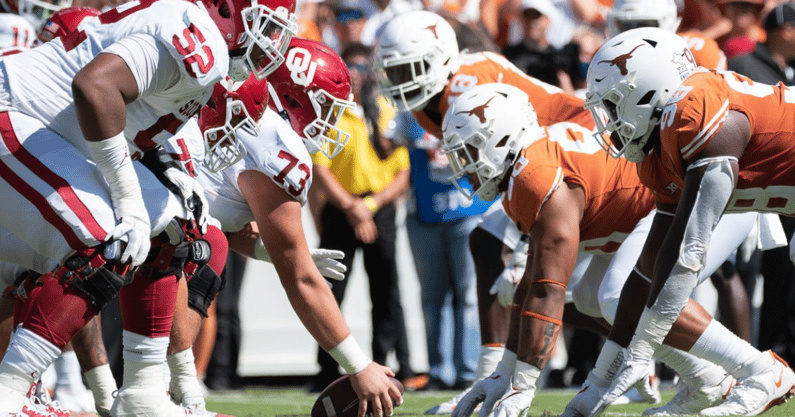
October 10, 1900: The 1st Red River Showdown

October 10, 1900: The University of Texas and the University of Oklahoma play each other in football for the 1st time, on the Texas campus in Austin. This was 7 years before Oklahoma gained Statehood. Texas wins, 28-2.

The game became an institution, and has several nicknames: The Red River Showdown (the Red River separates the States), the Red River Rivalry, the Red River Classic and the Red River Shootout. It was played in Austin from 1900, 1901, 1902, 1903, 1904, 1907, 1909, 1910, 1911 and 1923; Norman in 1901, 1903 (played twice in those seasons), 1908 and 1922; Oklahoma City in 1905 and 1906; Houston in 1913; and in Dallas every other time, including every season since 1929. A deal has been made to keep the game at the Cotton Bowl through at least 2025.
The fact that it's played in Texas would seem to give the Longhorns an unfair advantage. However, each school gets half the tickets, and it's actually closer to the OU campus in Norman (190 miles) than it is to the UT campus in Austin (197 miles).
As of the 2022 game, Texas' 49-0 win, the biggest blowout in the rivalry's history, Texas leads the rivalry 63-50-5. Oklahoma beat Texas in the 2018 Big 12 Conference Championship Game, which was also played in the Dallas area, but at the Cowboys' new AT&T Stadium in suburban Arlington.
A running joke is that, unlike the Longhorns' rivalries with Texas A&M and Arkansas, and the Sooners' with Oklahoma State and Nebraska, this is a rivalry not for the people but the rich, and that millionaires have bet ranches and oil wells on the outcome, many regretting it.

*

October 10, 1900 was a Wednesday, not a Saturday as is the case for most college football games today. There were other games played that day:

* Columbia and Williams College played to a 0-0 tie at Columbia Field in Manhattan.

* Manhattan College lost to Lafayette College, 11-0 at March Field in Easton, Pennsylvania.

* Princeton beat Penn State, 26-0 at Osborne Field in Princeton, New Jersey.

* Bowdoin College beat Colby College, 68-0 in Brunswick, Maine.

* Harvard beat cross-State Amherst, 18-0 at Soldiers' Field in Boston.

* Yale beat Bates College, 50-0 at Yale Field in New Haven, Connecticut.

* The University of Pennsylvania beat Dickinson College, 35-0 at the original Franklin Field in Philadelphia.

* And Illinois beat Chicago Physicians and Surgeons College, 6-0 at Illinois Field in Champaign, Illinois. CPSC is now part of the University of Illinois system, the University of Illinois College of Medicine.

And there was 1 baseball game played: The Philadelphia Phillies beat the Boston Beaneaters, 5-2 at National League Park in Philadelphia. In 1912, the Boston team of the National League, having gone through several names, settled on "Braves." The following season, the Phillies' ballpark was renamed Baker Bowl.

This was also the birthdate of actress Helen Hayes, known as "The First Lady of the American Theater."

December 31, 1999 & January 1, 2000: The Millennium

December 31, 1999:  The Millennium arrives. The people of planet Earth survived. At a terrible cost. But we hadn't destroyed ourselves. ...