Showing posts with label lew burdette. Show all posts

Monday, October 10, 2022

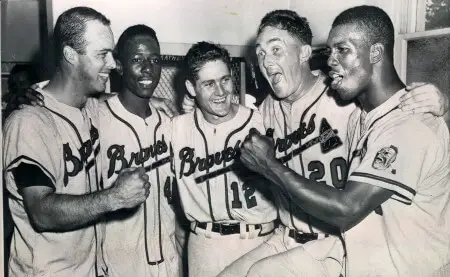
October 10, 1957: The Milwaukee Braves Win the World Series

Left to right: Eddie Mathews, Hank Aaron,
Bob Hazle, Don McMahon and Wes Covington.

October 10, 1957: Game 7 of the World Series. Warren Spahn, the only remaining Brave from the 1948 Boston Pennant winners, is the intended starter for the Milwaukee Braves, but he's got the flu. So manager Fred Haney turns to Lew Burdette on 2 days' rest.

Lew comes through, notching his 3rd win and 2nd shutout of the Series, as the Braves beat the Yankees 5-0. A 4-run 3rd inning does the job, including a double by Eddie Mathews, followed by a single by Hank Aaron. The last out, in front of a stunned 61,207 at Yankee Stadium, is Skowron grounding to Mathews, who steps on 3rd base for a force play.
It was stunning because most people outside the Upper Midwest -- the Braves' "territory" at the time included Wisconsin, the Upper Peninsula of Michigan, and States that would later belong to the Minnesota Twins, such as Minnesota, North Dakota, South Dakota and even northern Iowa -- didn't give the Braves a chance. Some Yankees had actually called Milwaukee "Bushville" for the way they'd reacted to their team, after having been a minor-league town for half a century.

Many years later, in 2012, John Klima would title his book about the '57 Braves Bushville Wins! The Wild Saga of the 1957 Milwaukee Braves and the Screwballs, Sluggers, and Beer Swiggers Who Canned the New York Yankees and Changed Baseball. It's a wonder he had room for the actual book.

Burdette, a 30-year-old righthander from West Virginia, is named the Series MVP, having tossed 24 consecutive scoreless innings -- longest in Series play to that point except for Babe Ruth's 29 2/3rds -- and posted a 0.64 ERA in his 3 Fall classic victories. Oh yeah: The losing pitcher in Game 7 was the previous season's Series hero, Don Larsen.

At the time, the Yankees were criticized for having traded Burdette to the Braves in 1951, for All-Star pitcher Johnny Sain. However, Sain helped the Yankees win 3 World Series; the Braves won just 1 with Burdette.

Amazingly, considering how long their careers lasted, this was the only World Championship won by either Aaron or Spahn. But it was the 2nd for Red Schoendienst, Del Rice and Nippy Jones, who had been on the 1946 St. Louis Cardinals. And Mathews would win another, closing his career with the 1968 Detroit Tigers.

This remains the only World Series ever won by a Milwaukee team, 65 years later. Despite all that talent, the Braves lost the Series in 1958, and never got back into the Series until 1991. From 1914 (in Boston) to 1995 (in Atlanta), this was the only World Series they won in a span of 81 years.

*

October 10, 1957 was a Thursday. This was the day that Ayn Rand's novel Atlas Shrugged was published. I have a separate entry for that event.

I don't know if Rand paid attention to sports. She probably just shrugged at it. She had, she believed, more important things to be concerned with.

Game 7 of the World Series was the only baseball game played. Football was in midweek. The NBA season wouldn't start for another 12 days.

There were 2 games played in the NHL. The New York Rangers beat the Detroit Red Wings, 3-2 at the Olympia Stadium in Detroit. And the Montreal Canadiens beat the Chicago Black Hawks, 5-1 at the Montreal Forum. The Toronto Maple Leafs and the Boston Bruins were not scheduled.

Tuesday, August 30, 2022

August 30, 1951: The Sain-Burdette Trade

Johnny Sain

August 30, 1951: The New York Yankees trade pitcher Lew Burdette to the Boston Braves for pitcher Johnny Sain. The Yankees also threw $50,000 into the deal, for the perennially cash-poor Braves.

At the time, Sain, from Havana, Arkansas was about to turn 34 -- he was born on September 25, 1917, the same day as his new Yankee teammate, Phil Rizzuto -- and had a career record of 104-91, despite missing 3 seasons while serving in World War II. He had gone 20-14 in 1946, 21-12 in 1947, and 24-15 in the Braves' National League Pennant season of 1948. Had there been a Cy Young Award at the time, he would have won it for the NL in 1948, and been no worse than 2nd in the voting behind Howie Pollet of the St. Louis Cardinals in 1946.

He was only 10-17 in 1949, but 20-13 in 1950. At the time of the trade in 1951, he was 5-13, with a 4.21 ERA, so he wasn't just being dealt a bad hand by a declining Braves lineup. Team owner Lou Perini was probably thinking it was time to sell Sain, while he could still get something for him, and put his $25,000 salary to better use.

In contrast, Burdette, from Nitro, West Virginia, was 24, had faced exactly 6 batters in the major leagues, and was 14-12 with a 3.21 ERA for the San Francisco Seals of the Pacific Coast League, suggesting that he could be ready for the majors. But the conventional wisdom at the time was that a pitcher who was going to be a star would have already done well in the majors by that point.

Yankees co-owners Dan Topping and Del Webb pretty much let general manager George Weiss do as he pleased, and this often including trading away prospects for one key player who could help the team win the Pennant that season.

At the time, the Yankees were in 1st place in the American League, but by only half a game over the Cleveland Indians, and 4 1/2 over the Boston Red Sox. They had their starting rotation's "Big Three" of Allie Reynolds, Eddie Lopat and Vic Raschi, but Whitey Ford, who'd been solid as a rookie the season before, was now serving in the Korean War. Weiss needed another starting pitcher, and Perini needed money. The deal made sense for both teams at the time.

The deal did not pay off for the Yankees immediately: Sain made only 7 appearances for the Yankees, 4 of them starts, and was not part of the reason they won the Pennant. He made 1 World Series appearance, and was not part of the reason they won it.

Manager Casey Stengel continued to use him as both a starter and a reliever, and in 1952, he went 11-6 with 7 saves and a 3.46 ERA. In 1953, he went 14-7 with 7 saves and a 3.00 ERA. The Yankees won the World Series both times. In 1954, he went 6-6 with a 3.16 ERA, and 24 saves, a record at the time. However, this was before the statistic was established: No one knew what a "save" was, so he only held the record retroactively.

In the middle of the 1955 season, he was traded to the Kansas City Athletics, and then retired. His career record was 139-116, with 53 saves, and a 3.49 ERA.

In 1952, Burdette not only got Sain's place in the Braves' rotation, he got his uniform number, 33. (Sain switched to 11 with the Yankees.) In 1953, the team moved to Milwaukee, and Burdette won 15 games in each of the next 2 seasons. Like Sain before him, he formed a good lefty-righty rotation pair with lefthander Warren Spahn. In 1956, he went 19-10.

In 1957, he went 17-9, helping the Braves win their 1st Pennant in Milwaukee. In the World Series, against the Yankees, he won Games 2 and 5. When Spahn came down with the flu, manager Fred Haney called on Burdette to start Game 7 on 2 days' rest. He pitched a 7-hit shutout, outpitching Ford, and the Braves won, 5-0. Not only were the Braves the World Champions, but the baseball press made the point that the Yankees had let Burdette get away. With Sain now retired, the Sain-for-Burdette deal looked like a steal for the Braves.
Lew Burdette

It got worse in 1958, as the Yankees and Braves faced each other again. Burdette went 20-10 in the regular season. The Braves took a 3-games-to-1 lead in the World Series, with Burdette again winning Game 2. This time, though, the Yankees beat him in Game 5, and, again pitching Game 7 on 2 days' rest, got hit hard, and the Yankees won, 6-2.

Burdette never played on another Pennant-winner. He went 21-15 in 1959, but the Braves lost a Playoff for the Pennant to the Los Angeles Dodgers. He went 19-13 in 1960, including a no-hitter, and 18-11 in 1961, but the Braves couldn't win another Pennant.

In 1963, he was traded to the Cardinals. In June 1964, the Cards traded him to the Chicago Cubs. This was not the Cubs-Cards trade that won the Pennant for the Cards; that came 13 days later, Ernie Broglio for Lou Brock. But it did end Burdette's last real chance at a World Series. He was sold to the Phillies in 1965, released by them, signed by the California Angels for 1966, and released by them in 1967, ending his career. He finished 203-144, with 32 saves, and a 3.66 ERA.

In the end, the trade worked out very well for both teams: The Yankees got 3 Pennants and 3 World Championships out of it; the Braves, 2 Pennants and 1 World Championship.

Sain became one of baseball's greatest pitching coaches, starting with the A's in 1959. He helped the Yankees win the Pennant in 1961, '62 and '63; the Minnesota Twins in 1965; and the Detroit Tigers in 1968. He later coached for the Chicago White Sox, and finished with the Braves, who had moved to Atlanta in 1966, retiring in 1986. He died in 2006.

Ini contrast, Burdette never worked in baseball again -- possibly blackballed, due to his reputation for having thrown spitballs, though he never got caught -- and died in 2007. Both he and Sain have been elected to the Braves' team Hall of Fame. Burdette's grandson, Nolan Fontana, was an infielder who played for the Los Angeles Angels in the 2017 and '18 seasons.

*

August 30, 1951 was a Thursday. Actor  Timothy Bottoms was born. This was also the day that the films Rhubarb (a baseball-themed comedy) and David and Bathsheba premiered. I have separate entries for those events.

These baseball games were played:

* The New York Giants lost to the Pittsburgh Pirates, 10-9 at the Polo Grounds. I guess the buzzer system was working that day, but couldn't overcome the poor pitching of George Spencer, Sheldon Jones, Dave Koslo and Larry Jansen, the last of whom gave up a 9th-inning home run to Ralph Kiner. Rookie Willie Mays hit 2 home runs.

* The Brooklyn Dodgers beat the Cincinnati Reds, 3-1 at Ebbets Field. Preacher Roe outpitched Ewell Blackwell. Jackie Robinson went 0-for-2, but also drew 2 walks and stole a base. Duke Snider went 1-for-3 with a walk.

The Giants only lost 5 more games over the course of the regular season, and on only 3 of those days -- September 8, 11 and 20 -- did the Dodgers also win.

* The Boston Braves beat the Chicago Cubs, 16-2 at Braves Field in Boston. Earl Torgeson went 2-for-6 with a home run and 4 RBIs.

* The St. Louis Cardinals beat the Philadelphia Phillies, 6-3 at Shibe Park in Philadelphia. Stan Musial went 1-for-4.

* The Philadelphia Athletics beat the Cleveland Indians, 6-2 at Cleveland Municipal Stadium. Morrie Martin, in what had to be the career highlight for the lifetime 38-34 pitcher, outpitched Bob Feller.

* The Boston Red Sox beat the Detroit Tigers, 10-4 at Briggs Stadium (later renamed Tiger Stadium) in Detroit. Ted Williams went 0-for-4, but did draw 2 walks.

* And the New York Yankees, the Chicago White Sox, the St. Louis Browns and the Washington Senators were not scheduled.
Thursday, May 26, 2022

May 26, 1959: The Harvey Haddix Game

May 26, 1959: Harvey Haddix puts on the greatest pitching performance of all time. And loses.

In 1981, baseball historian John Thorn published Baseball's 10 Greatest Games. He included this game as one of them. He began the chapter on it by referring to Game 3 of the 1951 National League Playoff and Game 5 of the 1956 World Series, saying, "Fate can be cruel, as it was to Ralph Branca; or it can be kind, as it was to Don Larsen. Today, it will be both to Harvey Haddix."

Haddix, a native of Medway, Ohio, outside Dayton, arrived in the major leagues with the St. Louis Cardinals in 1952. Like his teammate, Harry Brecheen, he was a lefthanded pitcher. Brecheen was nicknamed The Cat, so Haddix was nicknamed The Kitten. He wasn't just a protégé: He made the National League All-Star Team in 1953, '54 and '55.

On the night of May 26, 1959, a crowd of 19,194, a good crowd for a Tuesday night in that era, filed into Milwaukee County Stadium, and saw the 33-year-old Haddix take the mound for the Pittsburgh Pirates against the Milwaukee Braves. His fastball and breaking ball were both very sharp: He later said, "I could have put a cup on either corner of the plate, and hit it." Bill Mazeroski, often called the greatest-fielding 2nd baseman of all time, said, "Usually, you have one or two great or spectacular defensive plays in these no-hitters. Not that night: It was the easiest game I ever played in."

The problem was, the Pirates weren't scoring, either. Their starter, Lew Burdette, who won 3 games in the 1957 World Series, was also really on his game. At the end of 9 innings, the Pirates had 9 hits, the Braves none -- but the score was 0-0. Haddix hadn't allowed a single baserunner. He had pitched not just a no-hitter, but a perfect game. Indeed, he had been a baserunner: He had singled off Burdette. And yet, he hadn't won. The game continued.

Pirate 3rd baseman Don Hoak singled in the top of the 10th. He couldn't score. Haddix kept the perfecto going. Shortstop Dick "Ducky" Schofield singled to lead off the top of the 11th. But for the 3rd time in the game, Burdette induced a ground ball that was turned into a double play. Haddix kept his end going, becoming, still, to this day, the only man to go through the 1st 11 innings of a game without allowing a hit, and he still hadn't allowed a baserunner.

Mazeroski singled in the top of the 12th, but was stranded. Haddix still didn't budge in the bottom of the 12th: 36 men up, 36 men down. It had never happened before, and it has never happened since. Schofield singled again in the top of the 13th, to no avail. Haddix took the mound for the bottom of the 13th. It was still 0-0. He still hadn't allowed a baserunner.

Félix Mantilla led off for the Braves. He hit a bouncer to Hoak at 3rd, but Hoak bobbled it, lost his composure, and made a bad throw to 1st base. Mantilla was safe. An error. The perfect game was gone. But the no-hitter still had a chance.

Eddie Mathews, one of the best sluggers in the game, bunted Mantilla over to 2nd. With 1st base open and 1 out, the next batter was Hank Aaron. Pirate manager Danny Murtaugh ordered Haddix to intentionally walk him. It was the 39th batter of the game for Haddix, and his 1st walk. But it did set up an inning-ending double play.

There would be no double play. Joe Adcock was the next man up, and he hit the ball over the right-center field fence, into the bleachers, for a game-winning home run.

Or so everyone thought. With less than 2 outs, Aaron didn't know whether the ball would be caught, so he was stuck between 1st and 2nd base. He later said he thought the ball landed in front of the fence, so he got to 2nd base, and the next thing he knows, Adcock has passed him. National League President Warren Giles ruled that Adcock was out, since only Aaron was entitled to the base, and ruled that the final score was Braves 1, Pirates 0.

It didn't matter to Haddix: He had pitched 12 perfect innings, only to lose the perfect game, the no-hitter, the shutout, and the win. For his valiant effort, he walked away with only a loss.

God, or "the baseball gods," or Fate, or whatever you want to ascribe it to, made it up to Haddix: He became the winning pitcher for the Pirates in Game 7 of the 1960 World Series, the Bill Mazeroski Game. (John Thorn included that game in his book, too.) He finished his career in 1965, with a record of 136-113, an ERA of 3.63, 1,575 strikeouts, 3 Gold Gloves, and a World Series ring.

Haddix later became a pitching coach. In 1991, Major League Baseball officially redefined a "no-hitter" as "a game in which a pitcher or pitchers complete a game of nine innings or more without allowing a hit." This retroactively disqualified Haddix: Despite his having thrown more perfect innings than anyone in a single game, his achievement was taken off the lists of perfect games and no-hitters. He said, "It's okay. I know what I did." So did everybody else. He died in 1994, at the age of 68.

*

May 26, 1959 was a Tuesday. Ed Walsh, who pitched a no-hitter for the Chicago White Sox in 1911, and was on the losing side of Addie Joss' 1908 perfect game despite striking out a then-record 15 batters, died that day. These other baseball games were played:

* The New York Yankees lost to the Boston Red Sox, 12-2 at Yankee Stadium. The Red Sox did this without Ted Williams, who did not play. Tom Brewer outpitched Bob Turley. Mickey Mantle went 2-for-3 with a walk and an RBI. Yogi Berra went 0-for-3.

* The Baltimore Orioles beat the Washington Senators, 6-5 at Memorial Stadium in Baltimore. Brooks Robinson did not play for the Orioles. Harmon Killebrew went 0-for-4 with a walk for the Senators.

* The Cincinnati Reds beat the Philadelphia Phillies, 2-1 at Crosley Field in Cincinnati. Frank Robinson went 1-for-4. The winning pitcher was former Brooklyn Dodger ace Don Newcombe.

* The Cleveland Indians beat the Chicago White Sox, 3-0 at Comiskey Park in Chicago. Don Ferrarese (6 2/3rds innings) and Jim Perry combined for a 4-hit shutout.

* The Detroit Tigers beat the Kansas City Athletics, 9-5 at Kansas City Municipal Stadium. Al Kaline went 3-for-5 with an RBI. Roger Maris was on the A's roster, but did not play in this game. But future managing great Dick Williams hit a home run, and another, Whitey Herzog, went 3-for-4.

* The San Francisco Giants beat their arch-rivals, the Los Angeles Dodgers, 6-4 at Seals Stadium in San Francisco. Sandy Koufax, not yet the superstar that he would become, started for the Dodgers, but ran out of gas in the bottom of the 9th, allowing a game-winning grand slam to Leon Wagner. Willie Mays went 1-for-2 with 2 walks.

* And the Chicago Cubs and the St. Louis Cardinals, arch-rivals, having wrapped up a series the day before, were not scheduled.

December 31, 1999 & January 1, 2000: The Millennium

December 31, 1999:  The Millennium arrives. The people of planet Earth survived. At a terrible cost. But we hadn't destroyed ourselves. ...