Showing posts with label hurricane. Show all posts

Thursday, September 29, 2022

September 29, 2022: Hurricane Ian Shreds Florida

September 29, 2022: Hurricane Ian hits the Gulf Coast of Florida, causing severe damage in the Tampa Bay area. In terms of strength, it was the 5th-biggest American hurricane yet measured. At least 137 deaths were attributed to it, making it the deadliest to hit Florida since the Labor Day Hurricane of 1935.

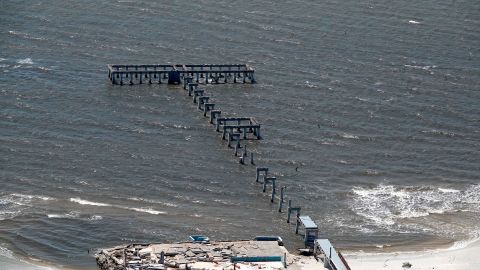
Particularly hard-hit was the area around the city of Fort Myers, about 125 miles south of Tampa and 150 miles northwest of Miami. The causeways connecting Pine Island and Sanibel Island to Florida's mainland both collapsed. The famed Fort Myers Fishing Pier was also wrecked.
Ironically, the cruel actions of Governor Ron DeSantis, a racist Republican who had dropped hints about running for President in 2024, to fly illegal immigrants out of Florida to States that had voted for President Joe Biden in 2020, may have been the right thing to do, because it got them out of the path of the hurricane. Ian was significantly reduced by the time it got up to the Northeast, where I live: We got 4 straight days of rain, but no flooding.

*

September 29, 2022 was a Thursday. There was an NFL game played that day, and a Florida team was in it, on the road. But that didn't mean it would be safe for that team.

The Miami Dolphins lost to the Cincinnati Bengals, 27-15 at Paycor Stadium (formerly Paul Brown Stadium) in Cincinnati, but the result wasn't the worst of it. The preceding Sunday, they pulled off a big upset against the Buffalo Bills, 21-19 at Hard Rock Stadium in Miami Gardens, Florida. But their quarterback, Tuanigamanuolepola "Tua" Tagovailoa, who led the University of Alabama to the 2017 National Championship, suffered a concussion and had to be removed from that game.

In this game against the Bengals, just 4 days later, Tua got sacked by Josh Tupou, and hit the back of his head on the artificial turf. At first, it looked like he was paralyzed. He did not move for 8 minutes until the ambulance came onto the field. He was taken to the University of Cincinnati Medical Center, regained full movement, was discharged, and was allowed to fly back to Miami with his teammates.

Still, the Dolphins fired their medical staff. That was not enough. Too many players have suffered and eventually died as a result of football-inflicted head trauma. Usually, the effects are long-term. But five players have died as a result of playing in professional football games in this country, the last being Chuck Hughes of the Detroit Lions in 1971. Six if you count Darryl Stingley, who lived nearly 30 years after his 1978 paralysis which did, indirectly, lead to his death. I don't want there to be another.

There were also Major League Baseball games played on this day:

* The Boston Red Sox beat the Baltimore Orioles, 5-3 at Fenway Park in Boston.

* The Cleveland Guardians beat the Tampa Bay Rays, 2-1 at Progressive Field in Cleveland.

* The Detroit Tigers beat the Kansas City Royals, 10-3 at Comerica Park in Detroit.

* The Chicago Cubs beat the Philadelphia Phillies, 2-0 at Wrigley Field in Chicago. Javier Assad and 2 relievers pitched a 6-hit shutout.

* The Miami Marlins beat the Milwaukee Brewers, 4-2 at American Family Field in Milwaukee.

* The Chicago White Sox beat the Minnesota Twins, 4-3 at Target Field in Minneapolis.

* The Los Angeles Dodgers beat the San Diego Padres, 5-2 at Petco Park in San Diego.

* The Los Angeles Angels beat the Oakland Athletics, 4-2 at Angel Stadium in Anaheim. Shohei Ohtani pitched 8 innings to raise his record to 15-8, allowing only 2 hits and 1 walk, striking out 10; and he went 2-for-4 with an RBI.

* The San Francisco Giants beat the Colorado Rockies, 6-4 at Oracle Park in San Francisco.

* And the Seattle Mariners beat the Texas Rangers, 10-9 at T-Mobile Park in Seattle. The Mariners had the longest Playoff drought in MLB, having not made it in 21 years. The Mariners blew a 7-4 lead going into the 7th inning. Each team scored a run in the 10th. The Rangers scored a run in the 11th, but the "ghost runner" of Jarred Kelenic and 3 straight singles by Dylan Moore, Luis Torrens and J.P. Crawford gave the M's the win and clinched a Playoff berth.

Wednesday, September 21, 2022

September 21, 1938: The New England Hurricane of 1938

September 21, 1938: The Northeastern United States is hit by one of the most damaging hurricanes in the nation's history. Hurricanes didn't start to be identified with girls' names until 1953, and with boys' names until 1979. This one was the 5th of the Atlantic hurricane season, so its name would have started with an E.

For the New York Tri-State Area, it's known as the Long Island Express Hurricane. When New York newscasters warn about coming hurricanes, they're not nearly as concerned about them hitting the New Jersey shore, which runs north-to-south. They're much more concerned with east-to-west shorelines: The South Shore of Staten Island, Coney Island in Brooklyn, the Rockaways in Queens, and the shores of Long Island Sound, less the North Shore of Long Island than its South Shore and the Sound Shore of Connecticut.

It was an Autumnal Equinox, resulting in higher tides than usual even without the storm. Having gained strength on the morning of September 21, by passing over only water, no land, as it passed Florida, Georgia, the Carolinas and the Chesapeake Region, this hurricane ripped up the Jersey Shore, putting Wildwood under 3 feet of water, wrecking much of the Atlantic City Boardwalk, destroying the Brigantine Bridge, and ripping up the boardwalks in Bay Head and Point Pleasant Beach.

At 3:45 PM, it made landfall at Bellport, Suffolk County, and it quickly laid waste to both Long Island and Connecticut. The East River overflowed and flooded a Consolidated Edison plant at 133rd Street, producing New York City's biggest blackout between the Blizzard of 1888 and "The Night the Lights Went Out" in 1965. A Staten Island Ferry boat got stuck in a terminal. All the bridges and tunnels were shut down.

Long Island lost all power, although that had nothing to do with Con Ed's issues. Montauk Point, at the eastern tip of Long Island, was turned into an island by flooding. Long Island's fishing industry and its apple crop were ruined for the year.

The hurricane turned east, and the danger topped out in Rhode Island, as it moved into Narragansett Bay. Houses on the bay were swept out to see. A school bus was blown into Mackerel Cove in Jamestown, killing 7 children. The Whale Rock Lighthouse was torn off its base, causing it to fall into the sea, and it has never been replaced. The body of lighthouse keeper Walter Eberle was never found. Downtown Providence, the State capital, was flooded, and some people drowned in their cars.

Massachusetts, especially the islands of Martha's Vineyard and Nantucket, was hit hard as well. The Connecticut River flooded in Springfield. New Bedford was left under 8 feet of water, and 2/3rds of its harbor's boats were lost. The foundations of houses swept away in Fall River can still be seen on the beach. Gloucester got the tallest wave of the storm, 50 feet.

We may never know how many people died as a result of the storm: Estimates range from 600 to 800, but it is generally believed that 100 of them were outside Rhode Island. Over 4,500 homes and 26,000 cars were destroyed, and 20,000 electrical poles were torn down. Over 2 billion trees were uprooted in New York State and New England, as New England lost 35 percent of its total forest area.

This hurricane stands out partly because it hit 2 major media centers, New York and Boston; but also because it struck at a setback period in the Great Depression, and at a time when news of war clouds was coming over from Europe, as Adolf Hitler had his designs on Czechoslovakia. It was news that, literally, hit home for thousands of people, on top of the seemingly endless bad news they already had.

*

September 21, 1938 was a Wednesday. There were 5 baseball games played that day. Somehow, one of them was at National League Park, formerly and soon again to be Braves Field, in Boston, and they got all 9 innings in before the storm arrived. The St. Louis Cardinals beat the Boston Bees, the once-and-future Braves, 4-0. Paul "Daffy" Dean pitched a 7-hit shutout, backed by a home run by Joe Medwick.

The Boston Red Sox were not affected, as they were playing the St. Louis Browns at Sportsman's Park in St. Louis. Jimmie Foxx hit his 47th home run of the season, and ended it with 50. When the Sox got home, they found that Fenway Park had been spared major damage.

No games were played in New York City. The storm didn't affect the New York Yankees, as they were playing the Chicago White Sox at Comiskey Park in Chicago. The White Sox won, 5-2, as Thornton Lee, later to be a 2-time All-Star, outpitched eventual Hall-of-Famer Lefty Gomez. Lou Gehrig went 2-for-4 with a solo home run, while Joe DiMaggio went 0-for-3, although he did draw a walk.

New York's National League teams weren't so lucky. The New York Giants had already home games on September 13 and 16 pushed back a day by rain. Their games with the Cincinnati Reds at the Polo Grounds on the 20th and the 21st were turned into a doubleheader on the 22nd, which the Giants swept, 6-1 and 2-1. Then they had to go to Boston to play the Bees, and while their ballpark wasn't damaged, they got rained out on the 23rd. They played a doubleheader on the 24th (the Giants swept) and another on the 25th (the Bees swept).

The Brooklyn Dodgers were also rained out at Ebbets Field on September 13 and 16, and made up an earlier rainout as part of a doubleheader on the 18th, and were scheduled to do so again on the 22nd. They were able to do that. They got rained out with the Pittsburgh Pirates on the 21st, but their schedule got backed up anyway. The Giants were supposed to play the Dodgers at Ebbets Field on the 26th, and got rained out again, forcing a doubleheader for the 27th, which was split.

The Chicago Cubs and the Philadelphia Phillies were supposed to play at Shibe Park in Philadelphia on the 21st and the 22nd. Both games got pushed back, as the field was still too wet to play on for the 22nd. They played a doubleheader on the 23rd, and the Cubs swept, 3-2 and 7-6. This was crucial: While the Yankees were running away with the American League Pennant, the National League went to the wire. When dawn came on the 21st, the Pirates led the Cubs by 3 1/2 games, the Reds by 5, and the Giants by 6 1/2. The Cubs went on a tear, and taking 2 of 3 against the Pirates late in the month helped them to win the Pennant by 2 games over the Pirates, 5 over the Giants, and 6 over the Giants.

Also on the 21st, the Detroit Tigers played a doubleheader against the Philadelphia Athletics at Briggs Stadium (later Tiger Stadium). The Tigers won the 1st game, 8-6, and were winning the 2nd game, 3-0, when it was called due to darkness after 5 innings. Hank Greenberg went 3-for-5 with 6 RBIs in the 1st game, including his 54th of what turned out to be 58 home runs, but was 0-for-3 in the 2nd game when it was called.

The Cleveland Indians and the Washington Senators were not scheduled.

Sunday, September 18, 2022

September 18, 1926: The Great Miami Hurricane

September 18, 1926: What becomes known as the Great Miami Hurricane makes landfall. Hurricanes didn't start to be identified with girls' names until 1953, and with boys' names until 1979. This one was the 7th of the Atlantic hurricane season, so its name would have started with a G.

The extension of passenger rail service to Key West in 1912, and the development of commercial air-conditioning in the early 20th Century, made living in Florida palatable. In the 1920s, particularly from 1924 onward, the "Florida Land Boom" was underway, taking advantage of the "paper prosperity" of the "Roaring Twenties," leaving behind entirely new, planned developments incorporated into towns and cities. Of course, being that Florida was a Southern State, these places were racially segregated.

This helped to make Miami and surrounding South Florida a major tourist destination. It gave Miami a rare status, enjoyed by possibly no other city in the Eastern U.S., besides New Orleans: It was a "major city" without having a major league baseball team.

But a lack of knowledge about storm frequency, and poor building standards, made these buildings, including houses, as susceptible to hurricanes as many buildings in San Francisco were to earthquakes and fires prior to that city's 1906 disaster.

There was warning, as the hurricane had already devastated the Bahamas, and Turks and Caicos. When it made landfall on September 18, the waves were as high as 15 feet. Although South Florida would be hit by damaging hurricanes in the interim, these would remain the highest waves there until Hurricane Andrew in 1992.

Miami and Miami Beach were flooded, knee-deep. The County Causeway, connecting the two since 1920 (and later renamed for General Douglas MacArthur), was submerged under 6 feet of water. Yachts and other large vessels were carried out to sea. Power lines were downed, cutting off communication with the rest of the country. Most wooden buildings were either blown down or lost their roofs. Concrete and steel buildings were warped at their bases.

The hurricane moved inland, and caused damage on the Gulf Coast of Florida, Alabama, Mississippi and Louisiana. The number of deaths is uncertain, but is believed to be over 500. With inflation factored in, it remains the most damaging hurricane in American history.

And that's just in the short term. In the long term, Florida took a long time to recover, economically and culturally. The land speculators went bankrupt. Historians in Florida have suggested that the State fell into a depression 3 years sooner than the country as a whole did. Additional hurricanes in 1928 and 1935 didn't help.

Among the structures ruined by the hurricane was one on which construction was begun just the previous day: A new 8,000-seat football stadium for the University of Miami, on its campus in suburban Coral Gables.

By October 30, a temporary structure was in place at Tamiami Park, and, coached by former University of Wisconsin and Green Bay Packers star Howard "Cub" Buck, "The U" was ready to play its 1st game: At home, they beat Rollins College, 7-0.

The team was, naturally, named the Hurricanes, and went 8-0 that first season. In 1937, they left Tamiami Park for the new Burdine Stadium, which was renamed in 1959 for its best-known event, the Orange Bowl.

Rollins, in nearby Winter Park, Florida, dropped its football program in 1949, and now competes in other sports in NCAA Division II.

*

September 18, 1926 was a Saturday. These baseball were played that day:

* The New York Yankees lost to the Cleveland Indians, 3-1 at League Park in Cleveland. George Uhle outpitched Urban Shocker. Indians player-manager Tris Speaker went 1-for-3 with a walk. So did Babe Ruth. Lou Gehrig went 0-for-2 with 2 walks.

* The New York Giants beat the Cincinnati Reds, 5-4 at the Polo Grounds. Bill Terry went 2-for-4 with an RBI. Frankie Frisch went 1-for-3 with a walk and an RBI.

* The Brooklyn Robins (as the Dodgers were known when Wilbert Robinson managed them from 1914 to 1931) beat the Pittsburgh Pirates, 3-1 at Ebbets Field. Paul Waner went 3-for-4, while the Robins as a team only got 4 hits, but errors doomed the Bucs.

* A doubleheader was split at Braves Field in Boston. The Boston Braves won the opener, 3-2. The Chicago Cubs won the nightcap, 6-0. Joe "Sheriff" Blake pitched a 5-hit shutout.

* A doubleheader was split at Baker Bowl in Philadelphia. The St. Louis Cardinals won the 1st game, 7-3. The Philadelphia Phillies won the 2nd game, 3-2, with Hal Carlson outpitching Grover Cleveland Alexander, although Art Reinhardt was the losing pitcher. Rogers Hornsby 1-for-8 with a walk and an RBI.

* The Detroit Tigers beat the Washington Senators, 6-5 at Navin Field (later Briggs Stadium and Tiger Stadium) in Detroit. With the Senators leading, 5-4 in the bottom of the 9th, Tigers player-manager Ty Cobb sent himself up as a pinch-hitter, and he tripled Johnny Neun home with the tying run. Harry Heilmann then singled Cobb home with the winning run.

* The Chicago White Sox beat the Boston Red Sox, 6-3 at Comiskey Park in Chicago.

* And the Philadelphia Athletics beat the St. Louis Browns, 9-4 at Sportsman's Park in St. Louis. George Sisler went 1-for-4 with an RBI.

And there were 4 college football games:

* Virginia Military Institute (VMI) beat Wofford College, 20-0 at Alumni Field in Lexington, Virginia.

* Davidson College beat Elon University, 26-0 at Richardson Field in Davidson, North Carolina.

* Clemson College (now Clemson University) beat Erskine College, 7-0 at Riggs Field in Calhoun, South Carolina.

* And Stanford University beat Fresno State, 44-0 at the old, but then-new, Stanford Stadium in the San Francisco suburb of Palo Alto, California.

Wednesday, September 7, 2022

September 8, 1900: The Galveston Hurricane

September 8, 1900: A hurricane strikes Galveston, Texas. It turns out to be the worst national disaster in American history.

The City of Galveston is on Galveston Island, on the Gulf of Mexico, about 50 miles southeast of Houston. This has made it particularly susceptible to tropical storms. Nevertheless, it is a popular destination for beachgoers, with a large amusement park.

It was even more so in the late 19th Century, a period known as the Golden Era. Some of the largest hotels in the country were there, and Reconstruction even permitted more participation for African-Americans and Mexican-Americans than would be seen in the 20th Century. They even had a successful professional baseball team: The Galveston Sand Crabs won the Texas League Pennant in 1890, 1897 and 1899. At the time, the population was about 37,000.

But on September 4, 1900, a tropical storm was detected, and it headed straight for the Gulf Coast of Texas. The National Weather Service had been established in 1870, and did issue a warning. But hardly anybody took it seriously enough to take the bridges back to the mainland.

By 12:00 Noon on September 8, part of the island was already flooded. By 4:00, wind speeds were up to 125 miles per hour (by definition, a hurricane is a storm with sustained winds of at least 75 MPH), and waves were 15 feet high.

Many of the houses on the island were made of wood, and, with no high ground to protect them, were just plain flattened. At least 6,000 people were killed, making it the deadliest natural disaster in American history. For comparison's sake: In 2005, Hurricane Katrina killed about 1,800; and in 2012, Hurricane Sandy, despite its widespread damage, killed a comparatively low 233.

By 1904, the City of Galveston had completed a permanent concrete seawall along the beachfront. By 1910, the entire city was raised 17 feet behind the wall. It has been hit by hurricanes since, but nothing as deadly as the 1900 hurricane, or Katrina, or Sandy. Today, it is home to about 50,000 people.
It wasn't until 1947 that hurricanes began to be named, using the military phonetic alphabet in use at the time: Able, Baker, Charlie, Dog, and so on. (In 1956, that was changed to Alpha, Bravo, Charlie, Delta, and so on.) In 1955, America adopted the use of girls' names for hurricanes, starting with Alice. In 1979, boys' names began to alternate with girls' names: Ana, Bob, Claudette, David.

*

September 8, 1900 was a Saturday. Most college football teams hadn't yet started their season. Basketball and hockey were still all-amateur. But the entire National League, for the moment the only major league in baseball, was in action:

* The New York Giants lost to the St. Louis Cardinals, 6-5 at the 1890-1911 version of the Polo Grounds.

* A doubleheader was split at the 1898-1912 version of Washington Park in Brooklyn. The Pittsburgh Pirates won the opener, 15-7. The Brooklyn Superbas won the nightcap, 6-5. They were managed by Ned Hanlon, and named for a circus troupe, Hanlon's Superbas. They became the Dodgers in 1911.

* The Cincinnati Reds beat the Boston Beaneaters, 2-1 at the 1894-1914 version of the South End Grounds in Boston. The Beaneaters became the Braves in 1912.

* And the Chicago Orphans beat the Philadelphia Phillies, 5-2 at National League Park (later renamed Baker Bowl) in Philadelphia. Since Cap Anson, also known as "Pop" retired, the Chicago team formerly known as the White Stockings and the Colts were called the Orphans because "they missed their Pop." They became the Cubs in 1903.

Being a Saturday, it was also a matchday in English soccer. Woolwich Arsenal, then playing at the Manor Ground in Plumstead, Southeast London, played Walsall at home, to a 1-1 draw. Walsall are in the West Midlands, outside Birmingham. In 1933, by which point Arsenal were in North London and the best team in England, Walsall famously shocked them in the FA Cup. In 1983, they beat Arsenal in the League Cup.

Friday, September 2, 2022

September 2, 1935: The Labor Day Hurricane

September 2, 1935: The Great Labor Day Hurricane of 1935 hits the Florida Keys. It remains the most intense Atlantic hurricane in American history. Its winds reached as high as 185 miles per hour, making it the 1st measured hurricane that achieved Category 5 status, at least 158 miles per hour.

The town of Islamorada, which occupied 5 islands in the Keys, was totally flattened, and had to be rebuilt. The Key West Extension of the Florida East Coast Railway was seriously damaged. The storm also damaged work camps for the construction workers extending the Overseas Highway to Key West, killing many of them.

Further damage was done on mainland Florida, Georgia, and both South and North Carolina before the storm drifted off to sea. A total of 423 deaths was attributed to the storm.

Hurricanes didn't start to be identified with girls' names until 1953, and with boys' names until 1979. The Labor Day Hurricane was the 3rd of the Atlantic hurricane season, so its name would have started with a C.

*

September 2, 1935, being Labor Day, was a Monday. Being a holiday, baseball teams tended to stage doubleheaders, including these games:

* A doubleheader was split at Fenway Park in Boston. The Boston Red Sox won the opener, 9-8. Jack Wilson won it with a home run in the bottom of the 11th inning. The Washington Senators won the nightcap, 3-2. Red Kress singled home the winning run in the top of the 13th inning. So anyone who showed up paid for 9 innings, expected to get 18 innings, and got 24 innings.

* A doubleheader was split at League Park in Cleveland. The St. Louis Browns won the 1st game, 4-1. The Cleveland Indians won the 2nd game, 7-2.

* The Detroit Tigers swept a doubleheader from the Chicago White Sox at Navin Field (later renamed Briggs Stadium and Tiger Stadium), 6-1 and 5-0. In the 1st game, pitcher Lynwood "Schoolboy" Rowe not only went the distance for the win, but hit a home run. In the 2nd game, "submarine" pitcher Eldon Auker pitched a 7-hit shutout. Hank Greenberg went 0-for-6 on the day, but did draw 2 walks in the 2nd game.

* A doubleheader was split at Wrigley Field in Chicago. The Chicago Cubs won the 1st game, 3-1. The Cincinnati Reds won the 2nd game, 4-2.

* The St. Louis Cardinals swept a doubleheader from the Pittsburgh Pirates at Sportsman's Park in St. Louis. The 1st game went 16 innings before James "Ripper" Collins singled home Joe Medwick off Waite Hoyt. The Cards were leading the 2nd game 4-1 after 5 innings, when the game was called due to darkness. The home fans couldn't complain too much, as they still got 21 innings for the price of 9.

* The New York Yankees and the Philadelphia Athletics were rained out at Shibe Park in Philadelphia. The game was never made up.

* The New York Giants and the Philadelphia Phillies were rained out of their holiday doubleheader at the Polo Grounds, likely from the northern edge of the hurricane. Both games were made up on a common off day, September 24. The Giants won both games, 6-0 and 7-6. Al Smith allowed 9 hits in the 1st game, but kept the shutout. Harry "the Horse" Danning won the 2nd game with a sacrifice fly in the bottom of the 9th. Over the 2 games, Mel Ott went 2-for-8 with a walk, a home run and 2 RBIs. 

* The Brooklyn Dodgers and the Boston Braves were supposed to play a doubleheader at Ebbets Field, but that, too, was rained out. These games were also made up on September 24. And, as with the Giants, the New York City-based team swept, with a walkoff in the finale. The Dodgers won the 1st game, 5-3 in the usual 9 innings. They won the 2nd game, 6-5, when Nick Tremark singled home Vince Sherlock on the bottom of the 11th.

December 31, 1999 & January 1, 2000: The Millennium

December 31, 1999:  The Millennium arrives. The people of planet Earth survived. At a terrible cost. But we hadn't destroyed ourselves. ...