Showing posts with label kansas city municipal auditorium. Show all posts

Sunday, November 13, 2022

November 13, 1979: Darryl Dawkins Breaks a Backboard

November 13, 1979: The Kansas City Kings beat the Philadelphia 76ers, 110-103 at the Kansas City Municipal Auditorium. (Their usual home, the Kemper Arena, now known as the Hy-Vee Arena, was under repairs, due to the roof collapsing in June.) Phil Ford of the Kings led all players with 34 points.

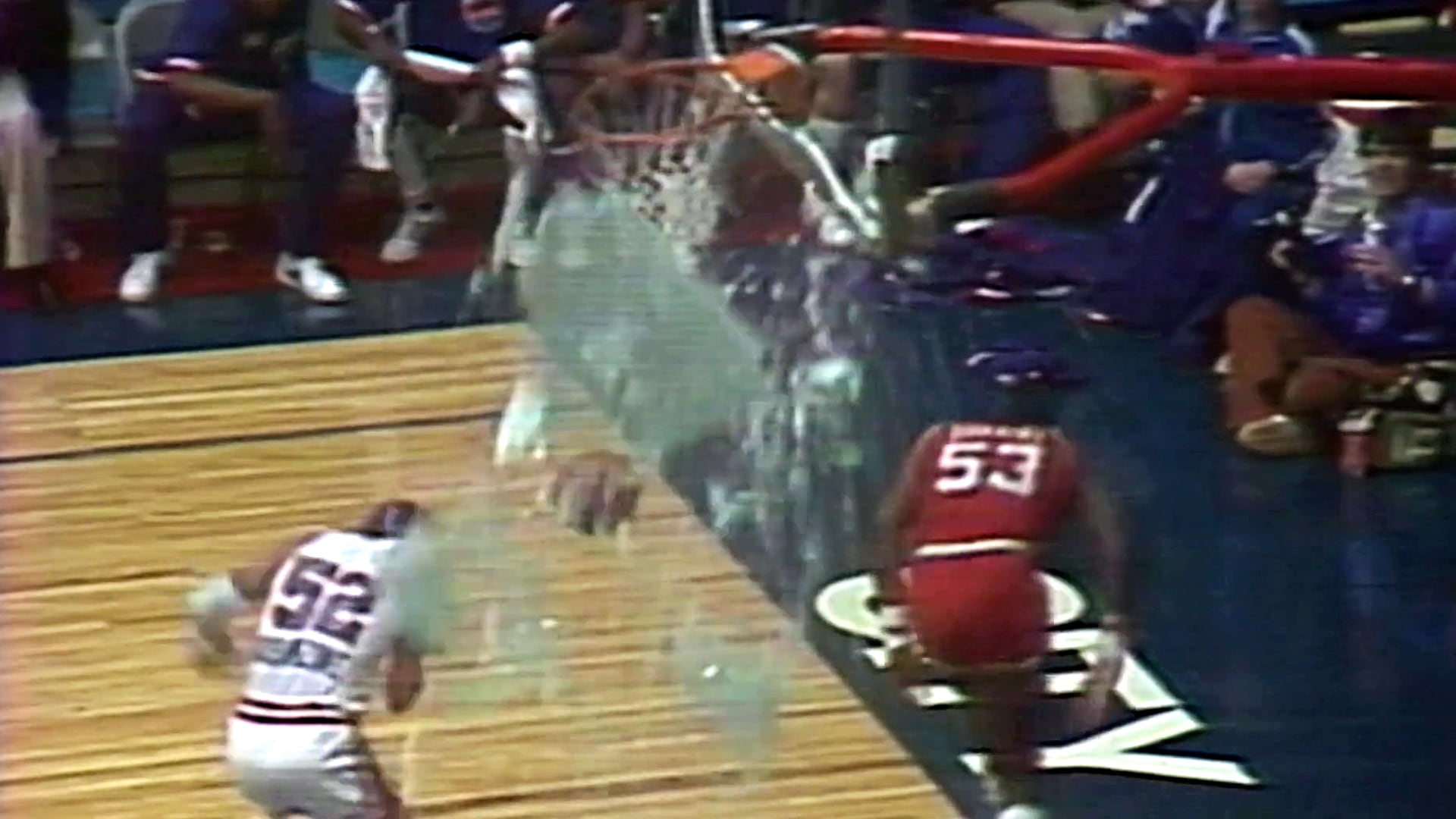
But the Sixers produce a highlight: Darryl Dawkins, the man claiming to be from the planet Lovetron, scores a dunk so hard it breaks the glass backboard.

No one is injured by the falling glass. Fortunately, the Kings player guarding him ducked, so the glass only fell on his back. His name was Bill Robinzine, and Dawkins, nicknamed Chocolate Thunder by singer Stevie Wonder, named the dunk, "The Chocolate-Thunder-Flying, Robinzine-Crying, Teeth-Shaking, Glass-Breaking, Rump-Roasting, Bun-Toasting, Wham-Bam, Glass-Breaker-I-Am-Jam." He also invented the dunking term, "In-Your-Face Disgrace." And, while Dawkins didn't come up with this one himself, thereafter, any player looking bad during an opposing player's highlight, something worthy of being put on a poster, was said to have gotten "posterized."

Dawkins was not the 1st man to break a backboard in the NBA. During pregame warmups for one of the first games ever played by the Boston Celtics in 1946, Chuck Connors -- who also played baseball and became much more famous as an actor -- accidentally broke a wooden backboard with a warmup shot, forcing a delay in the tipoff, as a backboard was brought in from another arena in town.

Gus Johnson of the Baltimore Bullets, one of the NBA's earliest dunk artists, supposedly broke 3 in the late 1960s and early 1970s, which would make him the 1st to do it with a dunk in a game, but no film footage is known to survive.

A native of Orlando, Florida, Dawkins was the 1st player to go directly from high school to the NBA, the ABA having beaten them to it with Moses Malone. He broke a 2nd backboard just a few weeks later, on December 5, 1979, this time pulling the rim down, too.

He helped the 76ers reach the NBA Finals in 1977, 1980 and 1982, but he was traded to the New Jersey Nets, and they brought Malone in, and he led the Sixers to a title in 1983 without Dawkins.
Dawkins, like baseball great Satchel Paige naming his vast array of pitches, started naming his dunks, including the Rim Wrecker, the Spine-Chiller Supreme, and, creating an expression that became a description for big dunks in general, the In-Your-Face Disgrace.

He also gained nicknames for himself. Added to "Chocolate Thunder" were "Sir Slam" and "Doctor Dunkenstein." That last one, however, would become better remembered for Utah Jazz star Darrell Griffith.

Like the aforementioned Paige, his baseball contemporary Dizzy Dean, and Dawkins' own contemporary, football quarterback Terry Bradshaw, Dawkins figured out that if you've got a certain image, use it to your advantage before others can use it to theirs. Possibly inspired by the man known as Doctor Funkenstein, rock bandleader George Clinton and his "P-Funk Empire," with his "Mothership Connection" stage set, Dawkins began telling people he was from the planet Lovetron, where he had a girlfriend named Juicy Lucy, and practiced "interplanetary funkmanship."

(As far as I know, he never explained what "interplanetary funkmanship" meant. I would have liked to have found out. Clinton and James Brown were probably mad that they didn't think of it first.)

He played 14 seasons in the NBA, mostly for the Sixers and the New Jersey Nets, and won a title in his last season, as a backup with the 1989 Detroit Pistons. He played a season with the Harlem Globetrotters, played a few seasons in Europe, and retired in 2000, going into coaching.

By that point, dunking became not the province of enormous centers -- despite the backboard-wrecking actions of Shaquille O'Neal -- but quick guards like Michael Jordan and Vince Carter, and forwards like Dominique "the Human Highlight Reel" Wilkins.

But the legend of Darryl Dawkins never faded away, not even after he died of a heart attack in 2015, only 58 years old. Bill Robinzine wasn't even that lucky: In 1982, only 29 years old, still an active player, he took his own life.

*

November 13, 1979 was a Tuesday. There were 7 other games in the NBA that night:

* The New York Knicks lost to the Washington Bullets, 111-107 at Madison Square Garden.

* The New Jersey Nets beat the Atlanta Hawks, 101-82 at the Rutgers Athletic Center (now the Jersey Mike's Arena) in Piscataway. Calvin Natt scored 33 points for the Nets.

* The Houston Rockets beat the Chicago Bulls, 128-127 at the Chicago Stadium. The aforementioned Moses Malone scored 45 for the Rockets.

* The San Antonio Spurs beat the Golden State Warriors, 131-127 in overtime at the HemisFair Arena in San Antonio. George Gervin led all scorers on the night with 47.

* The Denver Nuggets beat the Cleveland Cavaliers, 116-110 at the McNichols Arena in Denver.

* The Los Angeles Lakers beat the San Diego Clippers, 137-91 at the San Diego Sports Arena (now the Pechanga Arena).

* And the Milwaukee Bucks beat the Portland Trail Blazers, 101-92 at the Portland Memorial Coliseum. Marques Johnson scored 34.

Baseball was out of season. Football was in midweek. There were 5 games in the NHL:

* The New York Islanders beat their arch-rivals, the New York Rangers, 10-5 at the Nassau Coliseum. Denis Potvin, Bryan Trottier and Billy Harris each had 2 goals. The Rangers had reached the Stanley Cup Finals the season before, beating the Isles in the Semifinals, but, this season, the Isles went on to win the whole thing, start a dynasty, and take over New York Tri-State Area hockey -- for a few years, anyway.

* The Edmonton Oilers beat the Washington Capitals, 5-3 at the Capital Centre in the Washington suburb of Landover, Maryland.

* The Vancouver Canucks beat the Atlanta Flames, 5-3 at The Omni in Atlanta.

* The Montreal Canadiens beat the St. Louis Blues, 5-2 at the St. Louis Arena, then known as the Checkerdome.

* And the Los Angeles Kings beat the Colorado Rockies, 4-1 at The Forum outside Los Angeles in Inglewood, California.

Friday, March 25, 2022

March 25, 1961: Cincinnati Basketball Triumphant

March 25, 1961: Ohio State University, which won the National Championship of college basketball the year before with super sophomores Jerry Lucas and John Havlicek, is dethroned in the Final but a cross-State rival, the University of Cincinnati, 70-65 at the Kansas City Municipal Auditorium.

Coached by Ed Jucker, the Bearcats reached what the NCAA now calls the Final Four in 1959 and 1960, with guard Oscar Robertson playing as well, all-around, as any basketball player ever has. Jucker reloaded, and won the title in 1961, and again in 1962, with Paul Hogue, Bob Wiesenhahn, and Tom Thacker.
Ed Jucker

Despite Cincinnati being a border-on-the-South city, and segregated until the Civil Rights Act of 1964, Jucker was able to bring in black players like Robertson, Hogue and Thacker. Hogue was a native of Knoxville, Tennessee, the son of the principal of his all-black high school, who was not recruited by major Southern schools because he was black.
Paul Hogue

Hogue's pro career was undistinguished: He played 2 seasons in the NBA, for the Knicks and the Baltimore Bullets (the team now known as the Washington Wizards), and in a minor league for Delaware's Wilmington Blue Bombers. He later became an official in the U.S. Postal Service, and served on the Village Council in the Cincinnati suburb where he lived. He died in 2009, and is buried at the same Cincinnati cemetery as Yankee legends Miller Huggins (a Cincinnati native) and Waite Hoyt (who broadcast for the Reds).

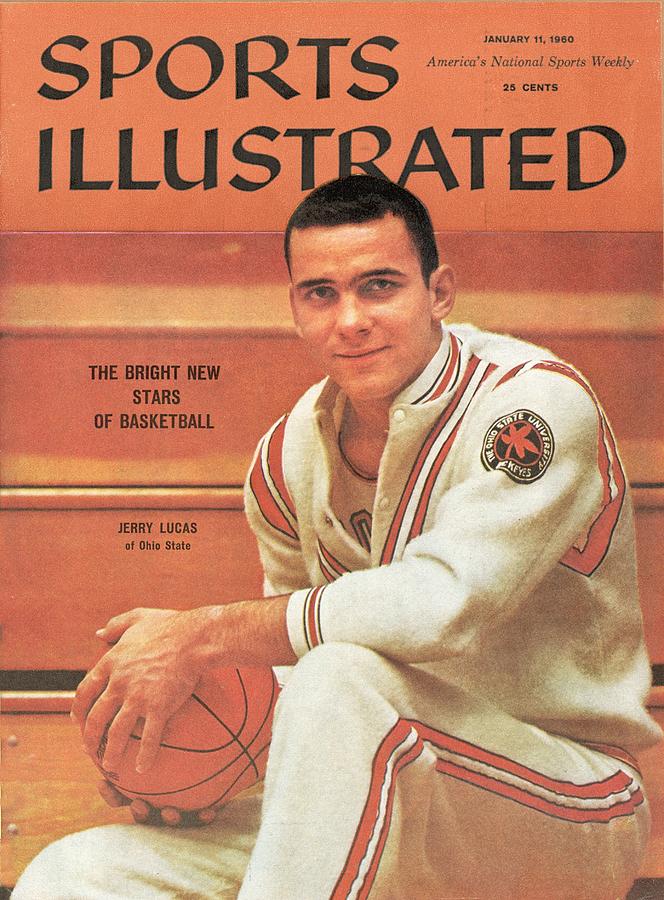
Despite Ohio State's defeat, Sports Illustrated named Lucas its Sportsman of the Year, as a good example of a scholar-athlete. They would use the same reason to name Oregon State football and basketball star Terry Baker the next year.
Jerry Lucas

The Bearcats would win the title again the next year, before losing the 1963 Final to Loyola of Chicago. (Sister Jean was just 43 at the time.) They have reached the Final Four only once since, in 1992.

The Queen City of the Midwest got an NBA team in 1957, the Cincinnati Royals. That team would have Hall-of-Famers Robertson, Lucas, Jack Twyman (another University of Cincinnati star) and Maurice Stokes. Despite all that talent, they could never seem to get past the Boston Celtics, getting as far as the Eastern Division Finals in 1963 and 1964, but never into the Finals. In 1972, they moved to Kansas City. Since that city already had a team called the Royals, the NBA team became the Kansas City Kings. In 1985, they moved again, becoming the Sacramento Kings.

Thacker would win a title with the Celtics, in 1968.

*

March 25, 1961 was a Saturday. Baseball was in Spring Training. Football was out of season. There were 2 games in the NBA. The Boston Celtics beat the Syracuse Nationals, 120-107 at the Onondaga County War Memorial, now called the Upstate Medical University Arena, in Syracuse, New York.

And the St. Louis Hawks beat the Los Angeles Lakers, at the gymnasium of what was then Los Angeles City College. In 1972, it became California State University at Los Angeles. The Forum in Inglewood wasn't built until 1967. Apparently, the Los Angeles Memorial Sports Arena, where the Lakers had been playing home games that 1st season in California, wasn't available. And using another college site was out: UCLA's pre-Pauley Pavilion Men's Gym seated only 2,400 people, while USC didn't have an on-campus gym, using the Shrine and Pan-Pacific Auditoriums, neither of which was very suitable to basketball.

There was 1 game in the NHL, a Stanley Cup Playoffs game: The Detroit Red Wings beat the Toronto Maple Leafs, 4-2 at Maple Leaf Gardens in Toronto.

And in English soccer, East London team West Ham United crossed town, to play Arsenal, at the Arsenal Stadium, a.k.a. Highbury, named for its neighborhood in North London. They played to a 0-0 draw.

Monday, March 21, 2022

March 21, 1964: The UCLA Dynasty Begins

March 21, 1964: The University of California at Los Angeles beat Duke University, 98-83, at the Municipal Auditorium in Kansas City, in the Final of the NCAA Men's Basketball Tournament. It is the 1st National Championship for UCLA. It will not be the last.

UCLA coach John Wooden had been good enough of a player at Purdue University in the early 1930s that he eventually became the 1st person elected to the Basketball Hall of Fame separately as a player and as a coach. He became UCLA's head coach in 1948, and took them to what would later be called the Final Four for the 1st time in 1962.

In 1963-64, with guards Walt Hazzard and Gail Goodrich, forwards Keith Erickson and Jack Hirsch, and center Fred Slaughter, he guided the Bruins to an undefeated season, 30-0. Goodrich and Erickson would star with the Los Angeles Lakers, and Goodrich would join Wooden in the Basketball Hall of Fame.

Ironically, considering that Wooden would later have Kareem Abdul-Jabbar (then known as Lew Alcindor) and Bill Walton, the '64 UCLA team not only didn't have a dominating center, they had the shortest roster ever to win the NCAA Tournament.

The closest they came to losing in the regular season was a 2-point win away to the main campus of the University of California in Berkeley in February, a 3-point win away to Kansas State early in the season, 4 over Illinois in the L.A. Classic (at the Memorial Sports Arena, not on their own campus), and 5 away to Washington State.

In the tournament, they won their regional games at Oregon State in Corvallis, beating Seattle University, 95-90; and the University of San Francisco, 76-72. In Kansas City, they faced Kansas State again, this time winning, 90-84, before beating a Duke team that featured future Golden State Warriors star Jeff Mullins.

UCLA made it back-to-back titles in 1965. These titles raised enough money that the Bruins could move out of their 2,400-seat Men's Gym, and also stop using the Sports Arena, which they were sharing with their arch-rivals, the University of Southern California (like the next-door Coliseum, it was on USC's campus), and into a large on-campus building, which became Pauley Pavilion. Wooden would eventually lead UCLA to 10 National Championships in 12 seasons. The school won an 11th in 1995, under Jim Harrick.

Duke had reached the Final Four in 1963, and would again in 1966. But they would not do so again until 1978, and then not again until 1986, the 1st of 14 times they would do so under Mike Krzyzewski. "Coach K" finally got them their 1st National Championship in 1991.

By another weird twist of fate, on March 21, 2014, on the 50th Anniversary of the event, Duke lost its first-round NCAA Tournament game -- not to a traditional power like UCLA, but to lightly-regarded Mercer University of Macon, Georgia. "March Madness."

*

March 21, 1964 was a Saturday. Baseball was in Spring Training. Football was out of season. There was 1 game in the NBA: The St. Louis Hawks beat the Los Angeles Lakers, 115-104 at the Kiel Auditorium in St. Louis. Jerry West scored 35 points in defeat.

There was 1 game in the NHL: The Montreal Canadiens beat the Boston Bruins, 5-1 at the Montreal Forum.

And in English soccer, Arsenal crossed from North London to the East End, and played West Ham United to a draw, 1-1 at Upton Park.

December 31, 1999 & January 1, 2000: The Millennium

December 31, 1999:  The Millennium arrives. The people of planet Earth survived. At a terrible cost. But we hadn't destroyed ourselves. ...