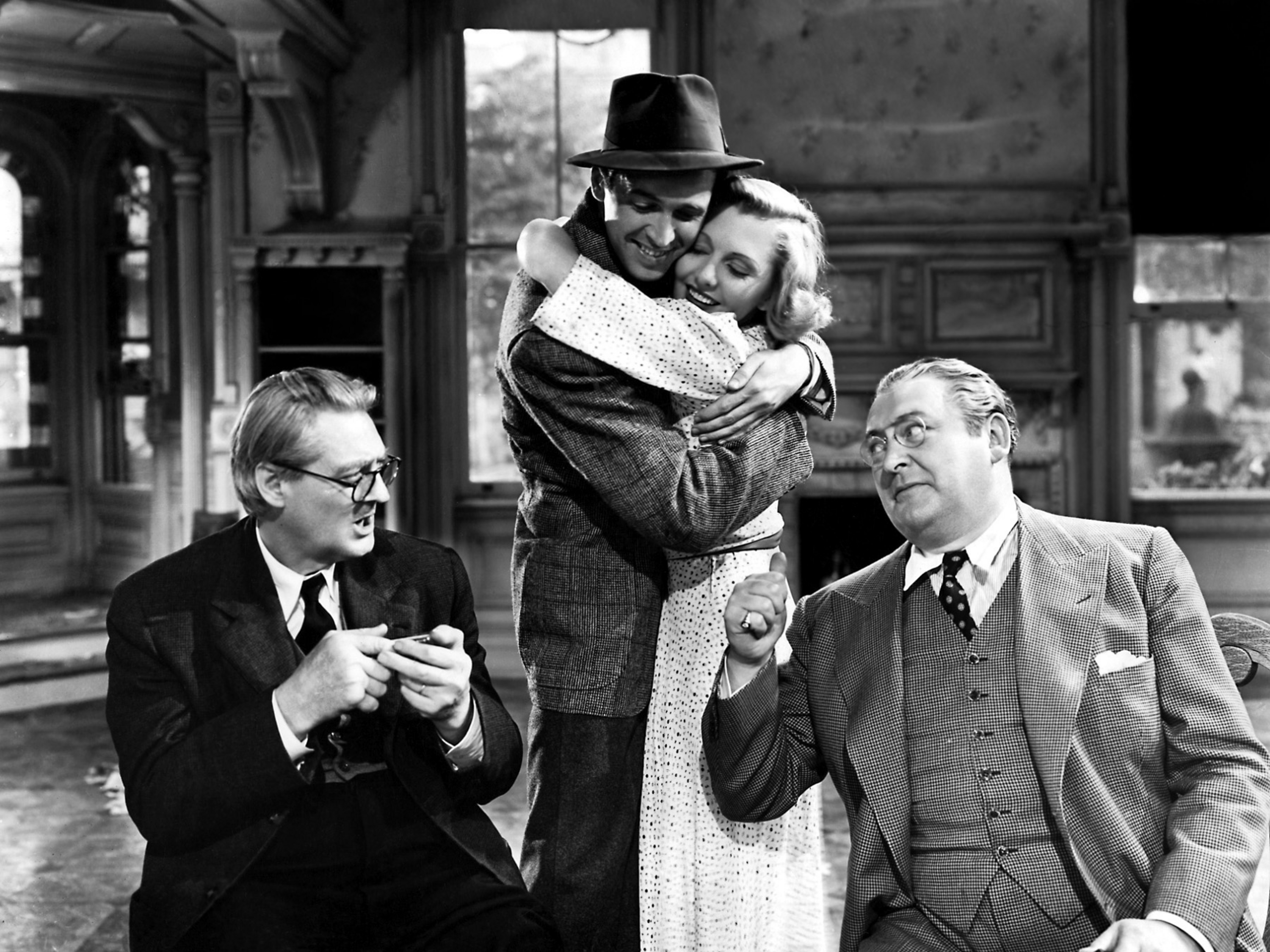
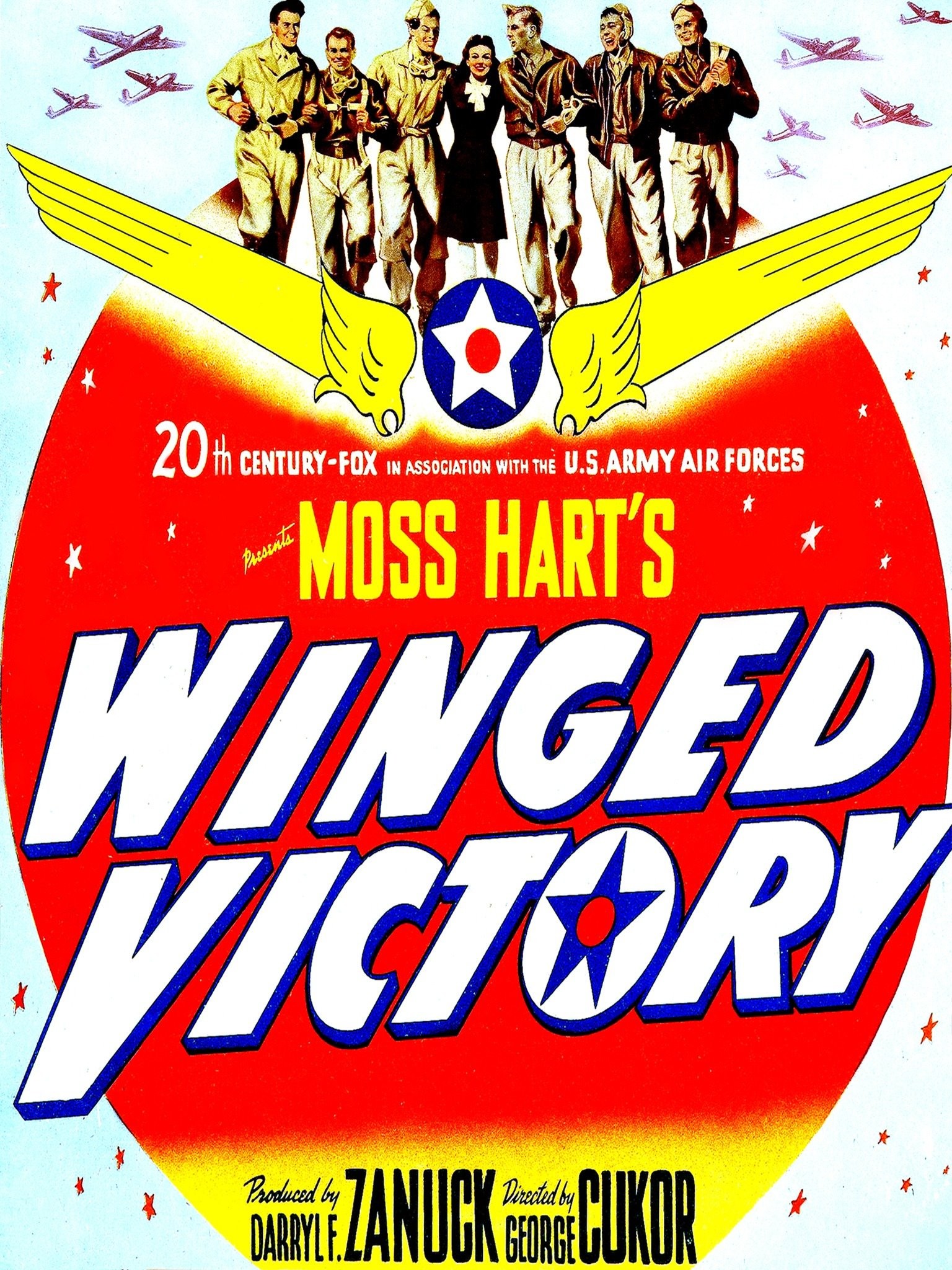
Poster for the film version
November 20, 1943: Moss Hart's war-effort play Winged Victory premieres at the Forty-Fourth Street Theatre in New York. The theater, at 216 W. 44th Street, was demolished in 1945.
The story is about 5 friends who enlist in the U.S. Army Air Forces in the hopes of becoming pilots. (The Air Force would not be separated from the Army until 1947.) One fails the eye test, and becomes a gunner instead. One crashes and dies in a test flight. The others are still alive at the end of the play -- but, of course, in real life, World War II was ongoing, so we don't know if they survived the war in full.
A staggering amount of future stars would appear in the play during its run, including Red Buttons, Lee J. Cobb, Mario Lanza, Brad Dexter (of The Magnificent Seven), John Forsythe, Karl Malden, Kevin McCarthy (of Invasion of the Body Snatchers), Gary Merrill, Barry Nelson (the first man to play James Bond, in a 1955 U.S. TV production), George Reeves (the Superman of 1950s TV), Martin Ritt, and Victor Sen Yung (Hop Sing on Bonanza).
In 1944, it was made into a film, starring Lon McCallister, Jeanne Crain and Edmond O'Brien, and also including Cobb, Buttons, Nelson, Merrill and Reeves.
*
November 20, 1943 was a Saturday. Actress Veronica Hamel was born. So was Suze Rutolo, who appeared on the cover of the album The Freewheelin' Bob Dylan, as she and Bob were then dating.
Ordinarily, the 3rd Saturday in November would begin 8 days of college football's major rivalries. But World War II was on, so this was, as the First Lady at the time, Eleanor Roosevelt, put it, it was no ordinary time. Military bases had teams that took on college teams. These were among the games played that day:
* Number 1 Notre Dame beat Number 2 Iowa Pre-Flight, 14-13 at Notre Dame Stadium in South Bend, Indiana. Iowa Pre-Flight was a U.S. Navy flight school, operated on the University of Iowa campus in Iowa City. But not as a substitute for the Iowa team (or Iowa State's). This was the only game that IPF lost all season, as they beat Big Ten schools Iowa, Illinois, Ohio State and Minnesota; and also Iowa State. They also beat Missouri, who lost their coach, and eventually the namesake of their stadium, Don Faurot, to IPF.
With their quarterback, Angelo Bertelli, being awarded the Heisman Trophy, Notre Dame lost the next week, to another military team, Great Lakes Naval Training Station, located in the northern suburbs of Chicago. This ruined Notre Dame's undefeated season. And they didn't go to a bowl game, refusing all invitations, as they always did between the seasons of 1925 and 1968. They were still awarded the National Championship.
* Rivalry: Number 3 Purdue beat Indiana, 7-0 at the original Memorial Stadium in Bloomington, Indiana. (That facility was replaced by the current one in 1960.)
* Rivalry: Number 4 Michigan beat Ohio State, 45-7 at Michigan Stadium in Ann Arbor.
* Number 5 Navy did not play that week. Number 7 Army beat Brown, 59-0 at Michie Stadium in West Point, New York. The Air Force had not yet been separated from the Army, let alone given its own academy, with its own football team.
* Rivalry: Number 6 Duke beat North Carolina, 27-6 at Kenan Stadium in Chapel Hill, North Carolina.
* Number 8 USC and Number 10 Washington had the week off. Due to wartime travel restrictions, for once, the Rose Bowl featured 2 West Coast teams, and USC beat Washington, having not played them during the regular season.
* Rivalry: Number 9 Northwestern beat Illinois, 53-6 at Dyche Stadium in the Chicago suburb of Evanston, Illinois.
* Number 14 Texas had the week off. In the Cotton Bowl, they were held to a tie by Randolph Field, an Army Air Forces team based in San Antonio.
* Number 15 Georgia Tech beat Clemson, 41-6 at Grant Field in Atlanta. Number 19 Tulsa had the week off. Tulsa went into the Sugar Bowl undefeated with a tie, but Georgia Tech beat them.
* Rivalry: Villanova beat Temple, 34-7 at Temple Stadium in Philadelphia.
* Rivalry: Penn State beat the University of Pittsburgh, 14-0 at Pitt Stadium in Pittsburgh.
* Rivalry: Minnesota beat Wisconsin, 25-13 at Memorial Stadium in Minneapolis.
* Rivalry: Tulane University beat Louisiana State University, 27-0 at Tulane Stadium in New Orleans. Texas A&M had the week off. Texas A&M went on to beat LSU in the Orange Bowl.
* Rivalry: Kansas beat Missouri, 7-6 at Memorial Stadium in Lawrence, Kansas.
* Rivalry: Iowa beat Nebraska, 33-13 at Memorial Stadium in Lincoln, Nebraska. While Iowa Pre-Flight had a fine season, this was the only game that Iowa won all season.
* Columbia was the only New York City school playing that season, and they lost to Colgate, 41-0 at Baker Field in Upper Manhattan. Fordham, NYU and CCNY suspended their programs for the season.
* And among the New Jersey schools, Princeton lost to Number 20 Dartmouth, 42-13 at Palmer Stadium in Princeton; and Rutgers lost to Lafayette, 9-2 at Fisher Field in Easton, Pennsylvania. Due to wartime travel restrictions, Rutgers played both Lafayette and Lafayette's arch-rivals, Lehigh, twice -- and they played each other twice. All of this was done again in 1944.
Baseball was out of season. The NBA hadn't been founded yet. There was 1 game in the NHL: The Montreal Canadiens beat the Toronto Maple Leafs, 7-2 at Maple Leaf Gardens in Toronto.