Showing posts with label health care reform. Show all posts

Tuesday, July 5, 2022

July 5, 1948: Britain's National Health Service Goes Into Operation

July 5, 1948: The United Kingdom's National Health Service goes into operation. It comprises the NHS in England, NHS Scotland and NHS Wales. Health and Social Care in Northern Ireland was created separately, and is often locally referred to as "the NHS."

It was instituted by the Labour Party government, led by Prime Minister Clement Attlee, as a reward for Britain having survived World War II and participated on the winning side. President Harry Truman tried to do the same thing for America at the same time. In both countries, the insurance business tried to stop it. The difference is, in America, they were able to combine with racists to torpedo the idea, because white Southern hospitals didn't want to admit black patients. That was not an issue in Britain, whose NHS is considered "socialized medicine" by American conservatives.
Clement Attlee

The true founder of the NHS was Attlee's Minister of Health, Aneurin Bevan. The last in a long line of coal miners in his family, he was elected to Parliament from a district in southern Wales in 1929, he was inspired by the Tredegar Medical Aid Society in his hometown. He should not be confused with the older politician Ernest Bevin, who served as Minister of Labour under Winston Churchill during World War II, and Foreign Secretary under Attlee.
Despite resistance from opposition parties and the British Medical Association, the National Health Service Act 1946 was passed on November 6, 1946, and came into effect on July 5, 1948, nationalizing more than 2,500 hospitals within the U.K.

The founding principles were that services should be comprehensive, universal and free at the point of delivery; a health service based on clinical need, not ability to pay. Each service provides a comprehensive range of health services, provided without charge for people ordinarily resident in the United Kingdom, apart from dental treatment and optical care. In England, NHS patients have to pay prescription charges. Some, such as those aged over 60, or those on certain state benefits, are exempt.

"Nye" Bevan held his seat in Parliament until his death in 1960. NHS proved so popular that his death was deeply mourned throughout Great Britain. In 2004, a vote for a TV program called 100 Welsh Heroes ranked him 1st, ahead of such personalities as medieval leader Owain Glyndŵr, World War I Prime Minister David Lloyd George, World War I hero T.E. Lawrence (a.k.a. Lawrence of Arabia), writer Dylan Thomas, actor Richard Burton and singer Tom Jones.

Britain loves its NHS so much that, despite the Conservative Party winning elections in 1951 (with Churchill returning to power and dethroning Attlee), 1955, 1959, 1970, 1979, 1983, 1987, 1992, 2010, 2015, 2017 and 2019, no Prime Minister of that Party has ever tried to repeal it. Not the Socialism-hating Churchill, not the patrician Alec Douglas-Home, not the pure evil Margaret Thatcher, not the insane Boris Johnson. The NHS, which goes much farther than America's Social Security System, is to Britain what Social Security is to America: The "third rail of politics." Touch it, and you die.

*

July 5, 1948 was a Monday. Because the previous day, the 4th of July, was a Sunday, the Monday was a federal holiday, meaning many people had the day off. So, for the 2nd day in a row, there were doubleheaders in baseball:

* The New York Yankees were swept by the Boston Red Sox, 6-5 and 8-7 at Fenway Park in Boston. In the opener, Jack Kramer (no relation to his contemporary, the tennis champion of the same name) outpitched Vic Raschi. In the nightcap, both starters, Spec Shea and Mickey Harris, were mediocre. The Red Sox led 5-4 after 5 innings. The Yankees took a 7-5 lead in the top of the 8th, but the Sox tied it in the bottom of the 8th, and Dom DiMaggio, Joe's brother, singled Wally Moses home off Joe Page to win it in the bottom of the 9th.

Over the 2 games, Joe DiMaggio went 3-for-8 with a walk, and Ted Williams went 0-for-7, but in the 2nd game, drew a walk, and had RBIs from 2 sacrifice flies. Bobby Doerr hit a home run in the opener, and 2 in the nightcap.

* There was a split at the Polo Grounds. The New York Giants won the 1st game, 6-5. Bobby Thomson singled Les Layton home with the winning run in the bottom of the 13th inning. The Boston Braves won the 2nd game, 4-1.

* The Brooklyn Dodgers swept the Philadelphia Phillies, 4-3 and 10-1 at Shibe Park in Philadelphia. Gene Hermanski doubled Jackie Robinson home in the top of the 10th inning to win the 1st game. Robinson went 2-for-9 with a walk over the 2 games.

* There was a split at Griffith Stadium in Washington. The Washington Senators won the 1st game, 3-1. The Philadelphia Athletics won the 2nd game, 12-5.

* There was a split at Forbes Field in Pittsburgh. The Pittsburgh Pirates won the 1st game, 10-3. The Cincinnati Reds won the 2nd game, 6-4.

* There was a split at Cleveland Municipal Stadium. The Cleveland Indians won the 1st game, 6-3. Bob Lemon outpitched Art Houetteman. The Detroit Tigers won the 2nd game, 7-5. Fred Hutchinson outpitched Bob Feller.

* The Chicago White Sox swept the St. Louis Browns, 3-2 and 5-4 at Comiskey Park in Chicago. Cass Michaels singled Jack Wallaesa home with the winning run in the 13th inning of the 2nd game.

* And the St. Louis Cardinals swept their arch-rivals, the Chicago Cubs, 6-3 and 5-2 at Sportsman's Park in St. Louis. The 2nd game was called due to rain after 6 innings. Stan Musial went 4-for-7 with 2 RBIs on the day.

Wednesday, March 23, 2022

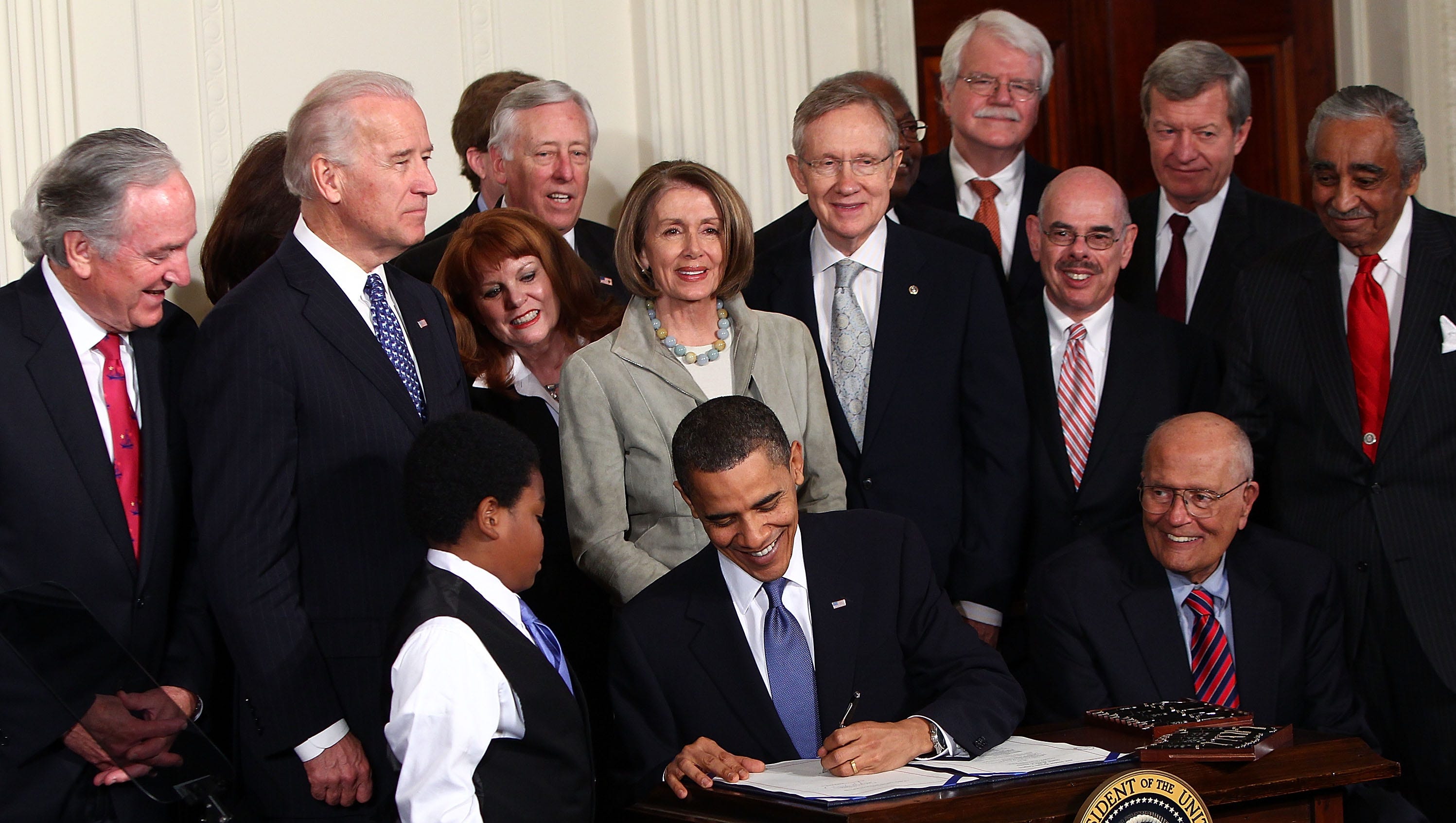
March 23, 2010: The Affordable Care Act Becomes Law

March 23, 2010: President Barack Obama signs the Affordable Care Act into law.

The path to health care reform in America has been long and slow. President Theodore Roosevelt could have gotten it passed during his Presidency (1901-09), but the thought didn't occur to him until he tried to regain the office in 1912. He proposed universal coverage then, and it was one reason he was all but thrown out of the Republican Party. His cousin, President Franklin D. Roosevelt, got Social Security passed in 1935, but even he, even with the biggest Congressional advantage ever in 1937-38, didn't go all the way to universal coverage.

FDR's successor, President Harry Truman, tried to get a payroll-tax-financed, government run insurance system passed in 1949, as part of his "Fair Deal," seeing a Gallup poll that said 59 percent of Americans supported it. Then the American Medical Association stepped in, worried about their profits, and told Southern hospitals that this plan meant that all-white hospitals would have to start accepting black patients. Suddenly, a whole lot of Southern Democrats started acting like a whole lot of Northern Republicans, and the plan dropped to 24 percent in the polls. Truman later wrote, "There are a lot of people in Congress who jump when the American Medical Association cracks the whip."

In 1960, John F. Kennedy ran for President on a platform that included expanding Social Security to include Medicare for people age 65 and up, and won. He tried to get it passed in 1962, but couldn't. In 1965, with the biggest numerical advantage in Congress since FDR in 1937-38, JFK's successor, President Lyndon B. Johnson, as part of his "Great Society," signed a law that not only expanded Social Security to include Medicare, but also included Medicaid for the poor. Maybe he could have gone farther. Maybe he would have if he had gotten a 2nd full term in 1968, and a peace deal in Vietnam. But he couldn't do those things.

In the early 1970s, several Democrats, in both houses of Congress, saw that President Richard Nixon, despite being a Republican, was open to reform. In February 1974, Nixon proposed an employer mandate to offer private health insurance if employees volunteered to pay 25 percent of premiums, replacement of Medicaid by state-run health insurance plans available to all with income-based premiums and cost sharing, and replacement of Medicare with a new federal program that eliminated the limit on hospital days, added income-based out-of-pocket limits, and added outpatient prescription drug coverage.

This plan was further to the left than anything proposed in 1993 and 2009. And yet, it was left-of-center groups like labor unions, consumer organizations, and senior citizen advocacy groups that denounced it, because of their substantial cost sharing. Ultimately, it failed because its 2 biggest advocates had to resign their offices later in 1974: Nixon, due to Watergate; and Representative Wilbur Mills of Arkansas, the powerful Chairman of the House Committee on Ways and Means, due to a sex scandal.

In 1992, Bill Clinton was elected President because part of his plan to fight the country's recession was universal health coverage. He submitted his plan to Congress in September 1993, and in January 1994, during his State of the Union, he threatened to veto any plan that hit his desk without covering everybody.

The Republicans refused to give even one vote, in either house of Congress, to his plan, or any other plan that included universal coverage, calling that "socialism." But, unlike in 2009, they did produce an alternative, with an employee mandate. It didn't go nearly far enough, but it would still have been a huge improvement. If Clinton had swallowed his pride and his threat, and supported that bill? Maybe the Republicans would have kept their word and supported it, and millions more people would have been covered from 1995 to 2010.

Instead, Clinton stood by his plan, and the Chairman of the Senate Committee on Finance, Pat Moynihan of New York, refused to even give it a hearing. Officially, he was a Democrat, but had worked in Nixon's Administration. After this disgusting refusal to move, I began to call any member of either house of Congress who tended to vacillate between the parties "the winner of the Daniel Patrick Moynihan Memorial Award for Political Transvestism."

In 2008, an even nastier recession led to the election of Barack Obama. As President, he was determined to do what Clinton wouldn't: Get some kind of health care reform passed. He remembered the Republican plan of 1993, and offered that as a compromise. Most Democrats now supported it. This time, though, the Republicans did not keep their word: No matter what plan was proposed, with even the slightest of improvements, they would oppose it. "Pro-life," my ass: They, not anything in what was being called "Obamacare," were the "death panel."

Under the name "the Patient Protection and Affordable Care Act," it barely passed both houses of Congress, pushed by the Speaker of the House, Nancy Pelosi of California; and the Senate Majority Leader, Harry Reid of Nevada. (Reid remains the highest-ranking native of his State in American politics.) Obama signed it into law. At the signing ceremony, over a microphone that he didn't realize was open, Vice President Joe Biden was caught telling Obama, "This is a big fucking deal."

It's been suggested that 24 million Americans not previously covered now were. I was one of them. Through it, I was able to get my arthritic hips replaced. With that insurance, I can walk with hardly any pain. Without it, I would now probably be in a wheelchair, and in an ungodly amount of pain.

The Republicans regained control of both houses of Congress after the 2010 election, and, over the next 10 years, they submitted over 60 bills repealing the ACA. Most of them passed the House. The few that passed the Senate were vetoed by Obama.

Donald Trump made repeal of Obamacare a main part of his 2016 campaign for President. People began to joke that Trump's ego was so big (How big was it?), if Congress passed a bill repealing the ACA, and, in the same bill, passed the ACA again, word-for-word, but called it "Trumpcare" instead of "Obamacare," Trump would sign the exact same thing into law, and claim victory.

Legal challenges to the ACA have gone all the way to the U.S. Supreme Court 3 times, but the Court has upheld the law all 3 times.

Somebody on Facebook asked a question: "How has your life improved under President Trump?" I answered, and I told the truth: My life has improved because I got my hips replaced, and I didn't have to pay a penny for it. In other words, the reason my life improved under Trump is because of something that Obama did, and Trump tried to get rid of. Beat that with a stick!

*

March 23, 2010 was a Tuesday. Baseball was in Spring Training. Football was out of season. There were 4 games played in the NBA that night:

* The New York Knicks beat the Denver Nuggets, 109-104 at Madison Square Garden. Carmelo Anthony, not yet a Knick, scored 36 points in defeat for the Nuggets.

* The Charlotte Hornets beat the Washington Wizards, 95-86 in overtime at the Verizon Center in Washington. (It's now named the Capital One Arena.)

* The Indiana Pacers beat the Detroit Pistons, 98-83 at The Palace in the Detroit suburb of Auburn Hills, Michigan.

* And the Dallas Mavericks beat the Los Angeles Clippers, 106-96 at the American Airlines Center in Dallas.

There were 10 games played in the NHL:

* The New Jersey Devils beat the Columbus Blue Jackets, 6-3 at the Prudential Center. (The New York Rangers and the New York Islanders were not scheduled.)

* The Ottawa Senators beat the Philadelphia Flyers, 2-0 at Scotiabank Place in the Ottawa suburb of Kanata, Ontario. (It's now named the Canadian Tire Centre.)

* The Florida Panthers beat the Toronto Maple Leafs, 4-1 at the Air Canada Centre in Toronto. (It's now named the Scotiabank Arena. Scotiabank traded Ottawa for Toronto. They don't seem to be better off.)

* The Boston Bruins beat the Atlanta Thrashers, 4-0 at the Philips Arena in Atlanta. (It's now named the State Farm Arena.)

* The Tampa Bay Lightning beat the Carolina Hurricanes, 3-2 at the St. Pete Times Forum in Tampa. (It's now named the Benchmark International Arena.) Martin St. Louis scored the winning goal, just 29 seconds into overtime.

* The Dallas Stars beat the Nashville Predators, 3-1 at the Sommet Center in Nashville. (It's now named the Bridgestone Arena.)

* The Chicago Blackhawks beat the Phoenix Coyotes, 2-0 at the United Center in Chicago.

* The San Jose Sharks beat the Minnesota Wild, 4-1 at the Xcel Energy Center in St. Paul.

* The Calgary Flames beat the Anaheim Ducks, 3-1 at the Saddledome in Calgary.

* And the Edmonton Oilers beat the Vancouver Canucks, 3-2 at Rexall Place in Edmonton. (That was a temporary name for the Northlands Coliseum.)

Also, in the Premier League, Arsenal beat West Ham United, 2-0 at the Emirates Stadium in North London.

Friday, March 11, 2022

March 11, 1949: President Truman's Health Care Reform Effort Dies

March 11, 1949: A Gallup poll reveals that only 33 percent of Americans favor the health care reform plan issued by President Harry S Truman. The plan is, for all intents and purposes, dead.

Twice, Truman thought he had a mandate to reform America's health care system. The 1st time was in the wake of the victory in World War II. On November 19, 1945, he sent a Special Message to Congress, recommending the adoption and funding of "a comprehensive and modern health program for the Nation, consisting of five major parts":

1. Construction of hospitals and related facilities.
2. Expansion of public health, maternal, and child care services.
3. Medical education and research.
4. Prepayment of medical costs through a compulsory national health insurance program, covering medical, hospital, nursing, and laboratory services.
5. Protection against loss of wages through sickness and disability through a national disability insurance program.

Senator Robert F. Wagner of New York -- whose son, also named Robert F., would be elected Mayor of New York in 1953, '57 and '61 -- had written the bill creating Social Security. He wrote a bill containing the legislative provisions to enact Truman's plan into law. But it got debated to death in committees, and never came up for a vote.

Truman did eventually get Numbers 1, 2 and 3 on that list, including an expansion of the National Institutes of Health, and the creation of the Centers for Disease Control and Prevention (the NIH and the CDC). Number 5 took until Lyndon Johnson, with his 1965 act expanding Social Security, including the creation of Medicare and Medicaid. It was Number 4 that was the sticking point: The national health insurance program.

But the American Medical Association, which was dedicated not to better treatment of patients but to increasing profits for hospitals, spread propaganda. The AMA bought advertising space in newspapers and magazines, and advertising time on radio stations, saying that the plan would result in an increase in taxes. This was true. They also said the plan was "Communist." This was a lie.

There was also a competing bill, submitted by Senator Robert Taft of Ohio, son of a President, and the Senate's leading conservative, to the point where he was known as "Mr. Republican." His bill would have allowed States to make healthcare private. As Republicans regained control of both houses of Congress in the 1946 election, Truman's health care bill died.

But in 1948, Truman not only won what amounted to a 2nd term, but swept the Democratic Party back into power in both houses of Congress. And Britain's National Health Service had begun operation, and had proved popular. Thus, for the 2nd time, Truman had a mandate. Theodore Roosevelt had his "Square Deal" programs, Franklin Roosevelt his "New Deal," so Truman called his program the "Fair Deal": Submitting a revised version of his health care reform plan, and improvements in civil rights, welfare, labor, education, housing, and more. He ended up getting most of it.

But, except for his desegregation of the armed forces, which he had already done in 1948, he wouldn't get much in the realm of civil rights. During his 1st term, Jackie Robinson had desegregated baseball. Joe Louis retired after 12 years as Heavyweight Champion of the World. But, as they always do when gains are made in civil rights, white supremacists fought back.

This time, they had an ally: The AMA. They told the all-white hospitals of the South that Truman's plan would mean they would have to take black patients as well as white patients. Which was true, but devastating to their sense of self. Never mind that they could have had "separate but equal" wings for blacks and whites in said hospitals: They didn't want black patients to even be in the same building.

And so, white Southern hospitals, who donated to conservative Democratic politicians in the South, let those politicians know, in no uncertain terms, that they had to abandon the plan, or else they would lose those campaign contributions. Pretty soon, word spread throughout the South, and the common people also turned against it. Truman later wrote, "There are a lot of people in Congress who jump when the American Medical Association cracks the whip."

The Gallup poll of March 11, 1949 told the tale: With 90 percent of white Southerners against it, and nearly half of the rest of the country against it, it didn't have a chance. Truman continued to fight for it until the end of his Presidency on January 20, 1953, but considered it his greatest failure.

On July 30, 1965, President Lyndon B. Johnson went to the Harry S Truman Presidential Library in Independence, Missouri. In front of Harry and Bess Truman, he signed the Social Security Amendments of 1965 into law, creating Medicare for the elderly, Medicaid for the indigent, and Supplemental Security Income (SSI) for the disabled. LBJ handed the former President Medicare Card Number 1, and the former First Lady Medicare Card Number 2.

In 1974, President Richard Nixon submitted a health care reform plan. If he thought it would make Democrats want to keep him in office, he was wrong.

In 1992, Governor Bill Clinton of Arkansas ran for President. His campaign included the argument that there were only 2 "industrialized nations" in the world that didn't have a national health service. America was one, and Clinton vowed to make it happen. The other was South Africa, which, at the time, was not a country you wanted your own to be compared to.

In 1994, Clinton's health care reform plan was killed in a Congressional Committee. A few months earlier, Nelson Mandela won South Africa's 1st all-races election. The first bill he signed into law as President was for the establishment of a national health service. That left only one such country.

"God bless America."

*

March 11, 1949 was a Friday. Baseball was in Spring Training. Football was out of season. There were no games scheduled for the NHL. One game was played in the Basketball Association of America, which would become the NBA the next season: The Boston Celtics beat the Philadelphia Warriors, 108-100 at the Boston Garden.

December 31, 1999 & January 1, 2000: The Millennium

December 31, 1999:  The Millennium arrives. The people of planet Earth survived. At a terrible cost. But we hadn't destroyed ourselves. ...