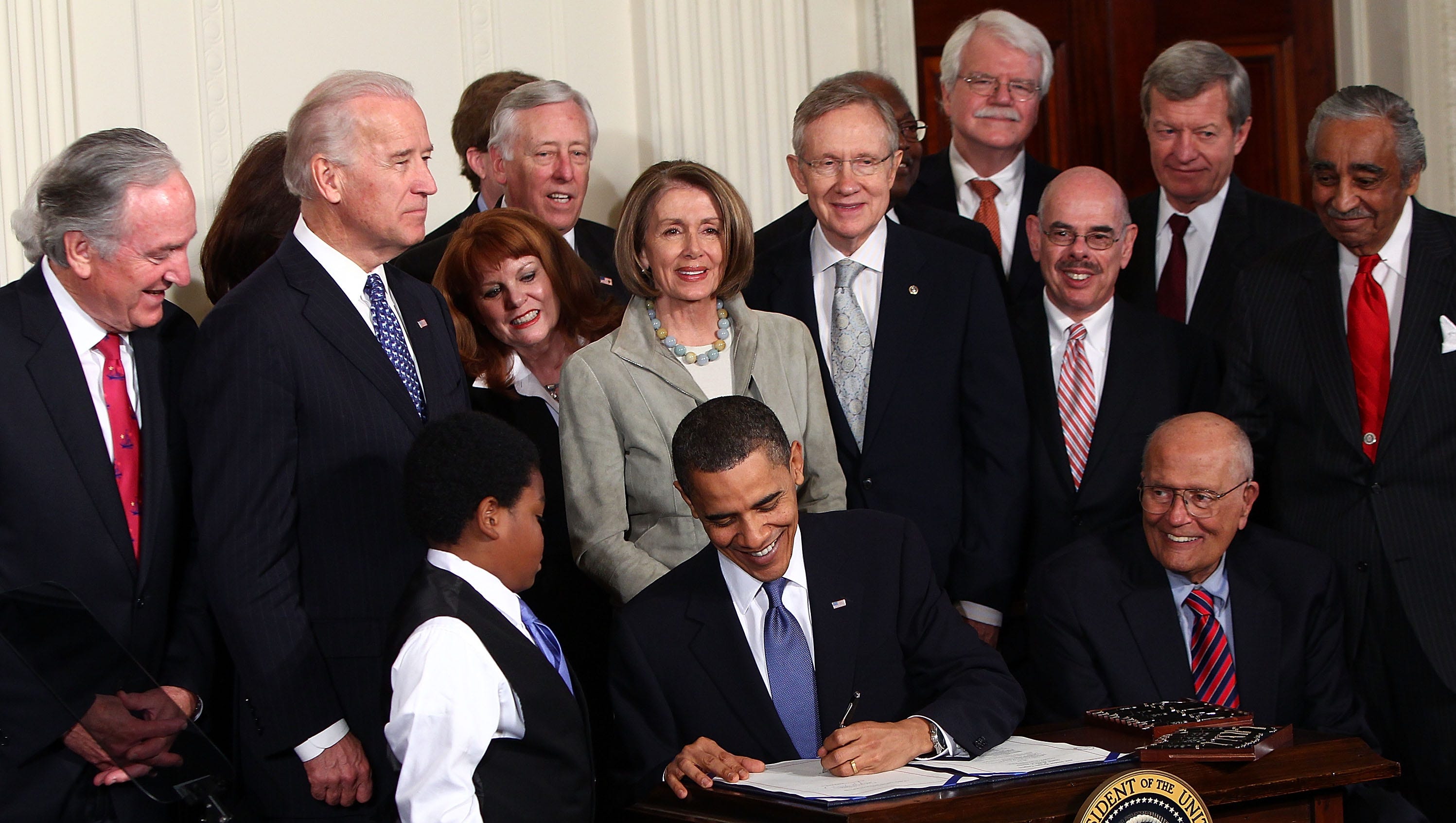
March 23, 2010: President Barack Obama signs the Affordable Care Act into law.
The path to health care reform in America has been long and slow. President Theodore Roosevelt could have gotten it passed during his Presidency (1901-09), but the thought didn't occur to him until he tried to regain the office in 1912. He proposed universal coverage then, and it was one reason he was all but thrown out of the Republican Party. His cousin, President Franklin D. Roosevelt, got Social Security passed in 1935, but even he, even with the biggest Congressional advantage ever in 1937-38, didn't go all the way to universal coverage.
FDR's successor, President Harry Truman, tried to get a payroll-tax-financed, government run insurance system passed in 1949, as part of his "Fair Deal," seeing a Gallup poll that said 59 percent of Americans supported it. Then the American Medical Association stepped in, worried about their profits, and told Southern hospitals that this plan meant that all-white hospitals would have to start accepting black patients. Suddenly, a whole lot of Southern Democrats started acting like a whole lot of Northern Republicans, and the plan dropped to 24 percent in the polls. Truman later wrote, "There are a lot of people in Congress who jump when the American Medical Association cracks the whip."
In 1960, John F. Kennedy ran for President on a platform that included expanding Social Security to include Medicare for people age 65 and up, and won. He tried to get it passed in 1962, but couldn't. In 1965, with the biggest numerical advantage in Congress since FDR in 1937-38, JFK's successor, President Lyndon B. Johnson, as part of his "Great Society," signed a law that not only expanded Social Security to include Medicare, but also included Medicaid for the poor. Maybe he could have gone farther. Maybe he would have if he had gotten a 2nd full term in 1968, and a peace deal in Vietnam. But he couldn't do those things.
In the early 1970s, several Democrats, in both houses of Congress, saw that President Richard Nixon, despite being a Republican, was open to reform. In February 1974, Nixon proposed an employer mandate to offer private health insurance if employees volunteered to pay 25 percent of premiums, replacement of Medicaid by state-run health insurance plans available to all with income-based premiums and cost sharing, and replacement of Medicare with a new federal program that eliminated the limit on hospital days, added income-based out-of-pocket limits, and added outpatient prescription drug coverage.
This plan was further to the left than anything proposed in 1993 and 2009. And yet, it was left-of-center groups like labor unions, consumer organizations, and senior citizen advocacy groups that denounced it, because of their substantial cost sharing. Ultimately, it failed because its 2 biggest advocates had to resign their offices later in 1974: Nixon, due to Watergate; and Representative Wilbur Mills of Arkansas, the powerful Chairman of the House Committee on Ways and Means, due to a sex scandal.
In 1992, Bill Clinton was elected President because part of his plan to fight the country's recession was universal health coverage. He submitted his plan to Congress in September 1993, and in January 1994, during his State of the Union, he threatened to veto any plan that hit his desk without covering everybody.
The Republicans refused to give even one vote, in either house of Congress, to his plan, or any other plan that included universal coverage, calling that "socialism." But, unlike in 2009, they did produce an alternative, with an employee mandate. It didn't go nearly far enough, but it would still have been a huge improvement. If Clinton had swallowed his pride and his threat, and supported that bill? Maybe the Republicans would have kept their word and supported it, and millions more people would have been covered from 1995 to 2010.
Instead, Clinton stood by his plan, and the Chairman of the Senate Committee on Finance, Pat Moynihan of New York, refused to even give it a hearing. Officially, he was a Democrat, but had worked in Nixon's Administration. After this disgusting refusal to move, I began to call any member of either house of Congress who tended to vacillate between the parties "the winner of the Daniel Patrick Moynihan Memorial Award for Political Transvestism."
In 2008, an even nastier recession led to the election of Barack Obama. As President, he was determined to do what Clinton wouldn't: Get some kind of health care reform passed. He remembered the Republican plan of 1993, and offered that as a compromise. Most Democrats now supported it. This time, though, the Republicans did not keep their word: No matter what plan was proposed, with even the slightest of improvements, they would oppose it. "Pro-life," my ass: They, not anything in what was being called "Obamacare," were the "death panel."
Under the name "the Patient Protection and Affordable Care Act," it barely passed both houses of Congress, pushed by the Speaker of the House, Nancy Pelosi of California; and the Senate Majority Leader, Harry Reid of Nevada. (Reid remains the highest-ranking native of his State in American politics.) Obama signed it into law. At the signing ceremony, over a microphone that he didn't realize was open, Vice President Joe Biden was caught telling Obama, "This is a big fucking deal."
It's been suggested that 24 million Americans not previously covered now were. I was one of them. Through it, I was able to get my arthritic hips replaced. With that insurance, I can walk with hardly any pain. Without it, I would now probably be in a wheelchair, and in an ungodly amount of pain.
The Republicans regained control of both houses of Congress after the 2010 election, and, over the next 10 years, they submitted over 60 bills repealing the ACA. Most of them passed the House. The few that passed the Senate were vetoed by Obama.
Donald Trump made repeal of Obamacare a main part of his 2016 campaign for President. People began to joke that Trump's ego was so big (How big was it?), if Congress passed a bill repealing the ACA, and, in the same bill, passed the ACA again, word-for-word, but called it "Trumpcare" instead of "Obamacare," Trump would sign the exact same thing into law, and claim victory.
Legal challenges to the ACA have gone all the way to the U.S. Supreme Court 3 times, but the Court has upheld the law all 3 times.
On September 23, 2017, the brothers Charles D. and David H. Koch, libertarians known for their hatred of liberal causes, pledged $400 million to Republican Congressional candidates if they could repeal Obamacare.
I knew that conservatives considered human life cheap. Now, we had a definitive number: 400,000,000 dollars, divided by 32,000,000 people who will lose health insurance = $12.50. Therefore, to the Koch Brothers, one life was worth twelve dollars and fifty cents. So much for conservatives being "pro-life."
A few years later, somebody on Facebook asked a question: "How has your life improved under President Trump?" I answered, and I told the truth: My life has improved because I got my hips replaced, and I didn't have to pay a penny for it. In other words, the reason my life improved under Trump is because of something that Obama did, and Trump tried to get rid of. Beat that with a stick!
*
March 23, 2010 was a Tuesday. Baseball was in Spring Training. Football was out of season. There were 4 games played in the NBA that night:
* The New York Knicks beat the Denver Nuggets, 109-104 at Madison Square Garden. Carmelo Anthony, not yet a Knick, scored 36 points in defeat for the Nuggets.
* The Charlotte Hornets beat the Washington Wizards, 95-86 in overtime at the Verizon Center in Washington. (It's now named the Capital One Arena.)
* The Indiana Pacers beat the Detroit Pistons, 98-83 at The Palace in the Detroit suburb of Auburn Hills, Michigan.
* And the Dallas Mavericks beat the Los Angeles Clippers, 106-96 at the American Airlines Center in Dallas.
There were 10 games played in the NHL:
* The New Jersey Devils beat the Columbus Blue Jackets, 6-3 at the Prudential Center. (The New York Rangers and the New York Islanders were not scheduled.)
* The Ottawa Senators beat the Philadelphia Flyers, 2-0 at Scotiabank Place in the Ottawa suburb of Kanata, Ontario. (It's now named the Canadian Tire Centre.)
* The Florida Panthers beat the Toronto Maple Leafs, 4-1 at the Air Canada Centre in Toronto. (It's now named the Scotiabank Arena. Scotiabank traded Ottawa for Toronto. They don't seem to be better off.)
* The Boston Bruins beat the Atlanta Thrashers, 4-0 at the Philips Arena in Atlanta. (It's now named the State Farm Arena.)
* The Tampa Bay Lightning beat the Carolina Hurricanes, 3-2 at the St. Pete Times Forum in Tampa. (It's now named the Benchmark International Arena.) Martin St. Louis scored the winning goal, just 29 seconds into overtime.
* The Dallas Stars beat the Nashville Predators, 3-1 at the Sommet Center in Nashville. (It's now named the Bridgestone Arena.)
* The Chicago Blackhawks beat the Phoenix Coyotes, 2-0 at the United Center in Chicago.
* The San Jose Sharks beat the Minnesota Wild, 4-1 at the Xcel Energy Center in St. Paul.
* The Calgary Flames beat the Anaheim Ducks, 3-1 at the Saddledome in Calgary.
* And the Edmonton Oilers beat the Vancouver Canucks, 3-2 at Rexall Place in Edmonton. (That was a temporary name for the Northlands Coliseum.)
Also, in the Premier League, Arsenal beat West Ham United, 2-0 at the Emirates Stadium in North London.


No comments:
Post a Comment