Showing posts with label supreme court. Show all posts

Monday, December 12, 2022

December 12, 2000: Bush v. Gore

December 12, 2000: The Supreme Court of the United States overrules the Supreme Court of the State of Florida. It is the case of Bush v. Gore.

In the Presidential election of November 7, the Democratic nominee for President of the United States, the then Vice President of the United States, Albert Arnold Gore Jr., got more popular votes than the Republican nominee, the Governor of Texas, George Walker Bush: Gore 50,999,897, Bush 50,456,002, a margin of 543,895 votesRalph Nader, famous as a consumer advocate since the 1960s, ran as the nominee of the Green Party. He got 2,882,955 votes. Gore got 48.4 percent of the popular vote; Bush, 47.9 percent, Nader, 2.7 percent.

Bush's brother, Governor John Ellis "Jeb" Bush of Florida, saw how close the vote was in his State, and tampered with the voting process, and that one State held everything up for 5 weeks. The best attempt at a recount, in downtown Miami, was interrupted on November 22 by what became known as the Brooks Brothers Riot. As a result, there were votes that were never counted. I don't mean they weren't recounted, I mean they were never counted, not even once.

On December 8, the Florida Supreme Court ruled that all 61,000 "undervotes" had to be counted. Had that happened, Gore surely would have won. The Bush campaign immediately appealed to the U.S. Supreme Court. SCOTUS ruled on December 12:

* Four Justices ruled that the recount had to go forward: John Paul Stevens, appointed by Republican President Gerald Ford; David Souter, appointed by Republican President George H.W. Bush, the current Republican nominee's father; Ruth Bader Ginsburg, appointed by the current President, Democrat Bill Clinton; and Stephen Breyer, also appointed by Clinton.

* Five Justices ruled that the recount had to stop immediately, all of them appointed by Republican Presidents: William Rehnquist, appointed by Richard Nixon, and promoted to Chief Justice by Ronald Reagan; Sandra Day O'Connor, appointed by Reagan; Antonin Scalia, appointed by Reagan; Anthony Kennedy, appointed by Reagan; and Clarence Thomas, appointed by the elder George Bush.

It was pretty easily guessed that all 4 Justices who voted to keep the recount going would do so; and that 3 Justices known for being archconservatives -- Rehnquist, Scalia and Thomas -- would vote to stop it.

The question marks were 2 moderates, both known as "swing votes": O'Connor and Kennedy. If either of them had voted to keep the recount going, it would have been kept going, and Gore would have won. Instead, both voted to stop it.

And so, in an election where over 104 million votes had been accepted as counted, only two votes ended up mattering: Those of O'Connor and Kennedy.

It may have been the ghastliest decision in the Court's history, aside from the 1857 decision in Dred Scott v. Sandford, that said that black people weren't citizens (a decision remedied by the 14th Amendment to the Constitution). It also marked perhaps the 1st time in the nation's history that political conservatives overruled a case based in part on a State's rights.

The editors of Time magazine announced that they were waiting for a winner to be certified before they named their Person of the Year. They named Bush. Had Gore been certified as the winner, they would have chosen him.

UPDATE: It may have been surpassed as the ghastliest decision in the Court's history by Trump v. United States in 2024, when the Court ruled that Presidents have immunity from criminal prosecution.

Gore conceded the election the next day, forever doomed to be "the 42nd 1/2 President of the United States" -- a President-elect, but never a President. On January 6, 2001, in his role as the outgoing Vice President, Gore properly read the Electoral Votes, including the 25 of the State of Florida. Whether those votes were properly arrived at is another matter. Congress then certified the Electoral Votes.

On that January 6, no Democrats stormed the U.S. Capitol Building in an attempt to stop that process.

Twenty years later, of course, when it was Republicans who didn't like the result, they did storm the Capitol, and attempt to stop the process. They only delayed the inevitable.

Rehnquist died in office in 2005. O'Connor retired right before that. Souter retired in 2009. Stevens retired in 2010, and died in 2019. Scalia died in office in 2016. Kennedy retired in 2018. Ginsburg died in office in 2020. Breyer retired in 2022. As of December 12, 2022, O'Connor, Kennedy, Souter, Thomas and Breyer are still alive; while Thomas is the only 1 of the 9 who is still on the Court. (UPDATE: O'Connor died in 2023. Souter died in 2025.)

Bush's 2 terms in office were an unmitigated disaster, both domestically (especially economically) and internationally. Had Gore been allowed to accept his victory, he would have governed completely differently, and most Americans, including the conservatives, would have been better off.

There are elementary schools named after Bush in St. Paul, Texas; and Stockton, California. His Presidential Library is on the campus Southern Methodist University, his wife Laura's Alma Mater, in Dallas. It opened on April 25, 2013.
Statue of the George Bushes,
at George W.'s Presidential Library

Bush remains the only President born in Connecticut. He and his father are the only ones who have lived in Connecticut, not counting time spent attending Yale University, although both also did so. And they are the only ones who lived in Maine. Nevertheless, the State each represented in politics was Texas.

Bush has been played by Timothy Bottoms in a comedic fashion on That's My Bush! in 2001 and The Crocodile Hunter: Collision Course in 2002, and in the deadly serious DC 9/11: Time of Crisis in 2003. Steve Bridges played him on JAG in 2002, and in the pilot episode of its spinoff, NCIS, in 2003.

He was played by James Adomian in Harold & Kumar Escape from Guantanamo Bay in 2008, Josh Brolin (himself the son of someone much better in his profession) in Oliver Stone's film W. in 2008, Connor Trinneer in American Made in 2017, and Sam Rockwell in Vice (a film about his Vice President, Dick Cheney) in 2018.

On Saturday Night Live, he was played by Will Ferrell from 2000 to 2002, Chris Parnell in 2002-03, Will Forte from 2004 to 2006, and Jason Sudeikis thereafter. On rival show MADtv, he was played by Christian Duguay in 2000-01, Will Sasso in 2001-02, and Frank Caliendo thereafter.

*

December 12, 2000 was a Tuesday. Baseball was in its off-season, and the NFL doesn't play on Tuesday. But there were 8 NBA games played that day. The New York Knicks were not in any of them:

* The New Jersey Nets beat the Minnesota Timberwolves, 116-94 at the Brendan Byrne Arena in the New York suburb of East Rutherford, New Jersey. Stephon Marbury led all scorers with 27 points.

* The Atlanta Hawks beat the Sacramento Kings, 107-99 at the Philips Arena (now the State Farm Arena) in Atlanta. Jason Terry scored 38 points.

* The Toronto Raptors beat the Indiana Pacers, 104-90 at the Air Canada Centre (now the Scotiabank Arena) in Toronto. Vince Carter led all scorers with 33.

* The Cleveland Cavaliers beat the Dallas Mavericks, 92-87 at the Gund Arena in Cleveland. (It is now named the Rocket Arena.)

* The Miami Heat beat the Denver Nuggets, 96-85 at the Pepsi Center in Denver. (It is now named the Ball Arena.)

* The Milwaukee Bucks beat the Los Angeles Lakers, 109-105 at the Staples Center in Los Angeles. Ray Allen scored 35 in victory, Shaquille O'Neal 26 and Kobe Bryant 25 in defeat.

* The Portland Trail Blazers beat the Golden State Warriors, 101-93 at the Oakland Coliseum Arena (then named The Arena in Oakland). Antawn Jamison scored 30 for the Dubs, but Rasheed Wallace's 29 sent the Blazers to victory.

* And the Seattle SuperSonics beat the Orlando Magic, 97-92 at the Key Arena in Seattle.

And there were 4 NHL games played. The New Jersey Devils were not scheduled: 

* The New York Rangers lost to the San Jose Sharks, 3-2 at the HP Center in San Jose. (It is now named the SAP Center.)

* The New York Islanders beat the Washington Capitals, 3-2 at the Nassau Coliseum in suburban Uniondale (Hempstead), Long Island, New York.

* The Buffalo Sabres beat the Boston Bruins, 3-0 at the FleetCenter in Boston. (It is now named the TD Garden.)

* And the Philadelphia Flyers and the Nashville Predators played to a tie, 2-2 at the Gaylord Entertainment Center in Nashville. (It is now the Bridgestone Arena.) 

Monday, November 21, 2022

November 21, 1969: The Haynsworth Rejection

November 21, 1969: Judge Clement Haynsworth, President Richard Nixon's nominee to succeed Abe Fortas on the U.S. Supreme Court, is rejected by a Senate vote of 55-45. The South Carolina native was seen as having made judicial rulings unfair to black people and organized labor. It was the Senate's 1st rejection of a Supreme Court nominee since 1930. Strike one for Nixon.

Nixon would then nominate Harrold Carswell. He would also be rejected by the Senate, on April 8, 1970, because he was a segregationist and an anti-Semite. Strike two for Nixon.
Nixon would then nominate Harry Blackmun. He would be approved on May 12, 1970, but would join the unanimous ruling that would force the release of Nixon's Oval Office tapes in 1974, forcing his resignation 4 days later. Strike three, Tricky Dick, you're out.
Ironically, Nixon died in 1994, just a few days after Blackmun announced his retirement from the Court.

*

November 21, 1969 was a Friday. Baseball Hall-of-Famer Ken Griffey Jr. was born outside Pittsburgh in Donora, Pennsylvania. Eventually, his father, George Kenneth Griffey Sr., despite becoming a 3-time All-Star and a 2-time World Series winner, would become only the 3rd-best baseball player from that town. He was surpassed by his son, and it's debatable as to who was better, Junior or Stan Musial -- who was also born on a November 21, in 1920. The town was home to about 14,000 people at the time, only about 5,000 now.

Baseball was out of season. Two college football games were played. The University of Miami beat Wake Forest, 49-7 at the Orange Bowl in Miami. And the University of Chattanooga beat The Citadel, the military school in Charleston, South Carolina, by the unusual score of 10-5 at The Citadel's Johnson Hagood Stadium.

There were 7 games played in the NBA:

* The New York Knicks beat the Philadelphia 76ers, 98-94 at The Spectrum in Philadelphia.

* The Baltimore Bullets beat the Phoenix Suns, 126-116 at the Baltimore Civic Center (now the CFG Bank Arena).

* The Cincinnati Royals beat the Chicago Bulls, 133-119 at the Cincinnati Gardens. Oscar Robertson scored 41 points.

* The Atlanta Hawks beat the Detroit Pistons, 118-106 at Cobo Hall (now Huntington Place) in Detroit.

* The Los Angeles Lakers beat the San Diego Rockets, 100-98 at The Forum outside Los Angeles in Inglewood, California.

* The San Francisco Warriors beat the Boston Celtics, 118-115 at the Cow Palace in the San Francisco suburb of Daly City, California.

* And the Milwaukee Bucks beat the Seattle SuperSonics, 117-115 at the Seattle Center Coliseum. Bob Rule scored 35 points in defeat for the Sonics.

There were 4 games played in the American Basketball Association:

* The New York Nets beat the Los Angeles Stars, 94-83 at the Island Garden in West Hempstead, Long Island, New York.

* The Carolina Cougars beat the Washington Capitols, 122-112 at the Greensboro Coliseum in Greensboro, North Carolina.

* The Pittsburgh Pipers beat the Kentucky Colonels, 112-108 at the Civic Arena in Pittsburgh.

* And the Denver Rockets beat the Dallas Chaparrals, 103-100 at the Moody Coliseum in Dallas.

There was 1 game played in the NHL: The Boston Bruins played the Chicago Black Hawks to a tie, 2-2 at the Chicago Stadium.

Sunday, October 23, 2022

October 23, 1987: Robert Bork Is Rejected for the Supreme Court

October 23, 1987: The U.S. Senate rejects the nomination of federal Judge Robert H. Bork to the Supreme Court of the United States, by a vote of 58-42, the sharpest rejection of a nominee in the High Court's history. It is a stinging rebuke for the President who nominated him, Ronald Reagan.

Reagan had been elected President in 1980, and re-elected in 1984, in a landslide each time, which he considered mandates to reshape the federal judiciary for conservative means: Restricting civil rights, loosening regulations on business, and pandering to an evangelical brand of Christianity that Jesus would never have recognized as his own.

During his time in the White House, 4 seats opened up on the Court. In 1981, Justice Potter Stewart retired, and Reagan nominated Sandra Day O'Connor for his seat, the 1st woman ever nominated to the Court. Although she was very conservative, she had no problem getting confirmed, receiving a 99-0 vote, and a written apology from the one Senator who was unable to be present for the vote, Max Baucus, Democrat of Montana.

In 1986, Chief Justice Warren Burger retired, and Reagan decided on a 2-at-once deal: He promoted Justice William Rehnquist to Chief Justice, and appointed Antonin Scalia to Rehnquist's former seat. Both men were more conservative than O'Connor, let alone Burger. But while Rehnquist's vote was closer, 65-33, Scalia was confirmed, 98-0.

1987, Lewis Powell retired. This was Reagan's chance to make nearly half of the Court his appointees. His choice was Bork. Born in 1927 in Pittsburgh, and a Marine veteran of the Korean War, he left private practice in 1962 to join the faculty of Yale Law School. Among his students were Bill Clinton, Hillary Rodham (the couple met in the Yale Law Library), Clinton's Secretary of Labor Robert Reich, future California Governor Jerry Brown, future U.S. Ambassador to the United Nations John Bolton, and Anita Hill, whose testimony would feature in another Supreme Court confirmation hearing.

Bork left Yale in March 1973, when President Richard Nixon appointed him to be the Solicitor General of the United States. The Solicitor General is the Number 3 official in the U.S. Department of Justice, with the job of arguing the federal government's side of cases before the Supreme Court, when the federal government is sued. The role of Solicitor General is often seen as a stepping-stone for the Supreme Court.

On October 20, 1973, with Watergate Special Prosecutor Archibald Cox closing in, President Richard Nixon decided that, in order to survive in office, he had to fire Cox. So he instructed Attorney General Elliot Richardson, the man who had hired Cox and had the power to fire him, to fire him. Richardson refused, because he thought it would spark a Constitutional crisis. Nixon said to do it, or you're fired. Richardson did the honorable thing, and resigned his post.

So Nixon went to the next man in line, Richardson's Deputy Attorney General, William Ruckelshaus.  He also refused to fire Cox, and Nixon fired him. So with the top 2 men in the U.S. Department of Justice now gone, Nixon went to the Number 3 man, Bork, now the Acting Attorney General, and he fired Cox, because he valued Nixon more than he valued the Constitution. The series of events became known as "The Saturday Night Massacre."

Bork stayed on as Solicitor General for the rest of the Presidential term, after Nixon's 1974 resignation and Gerald Ford's defeat to Jimmy Carter. He returned to Yale Law, and stayed until 1982, when Reagan appointed him to the Court of Appeals for the District of Columbia Circuit -- another occasional stepping stone to the Supreme Court.

Reagan did appoint him to the Supreme Court, on July 1 -- right in the middle of the Iran-Contra hearings, when he needed help shoring up his conservative base. Bork's selection pleased them. But it horrified liberals, and they were determined to make it horrify moderates, too.

Republicans were worried that Democrats would bring up Bork's role in the Saturday Night Massacre, thus questioning his commitment to the Constitution. Which they did. But Republicans were hoping Bork's status as one of America's leading "Constitutional scholars" would overcome that.

Maybe it would have, but it ended up not being the key issue. Senator Ted Kennedy of Massachusetts, a member and former Chairman of the Senate Judiciary Committee, fired the Democrats' opening shot:

Robert Bork's America is a land in which women would be forced into back-alley abortions, blacks would sit at segregated lunch counters, rogue police could break down citizens' doors in midnight raids, schoolchildren could not be taught about evolution, writers and artists could be censored at the whim of the Government, and the doors of the Federal courts would be shut on the fingers of millions of citizens for whom the judiciary is, and is often the only, protector of the individual rights that are the heart of our democracy...

The damage that President Reagan will do through this nomination, if it is not rejected by the Senate, could live on far beyond the end of his Presidential term. President Reagan is still our President. But he should not be able to reach out from the muck of Irangate, reach into the muck of Watergate, and impose his reactionary vision of the Constitution on the Supreme Court and the next generation of Americans. No Justice would be better than this injustice.

Bork had clearly stated that the Constitution did not grant a "general right to privacy," which suggested that not only would he vote to overturn Roe v. Wade, the Supreme Court's decision accepting a woman's right to an abortion, but also Griswold v. Connecticut, the Court's decision accepting a woman's right to birth control. Suddenly, for millions of women of child-bearing years, Bork's nomination was downright scary.

A political cartoon showed the Chairman of the Judiciary Committee, Joe Biden of Delaware, with a chunkier-than-in-reality Kennedy sitting next to him, telling Bork, "Your views are from another century!" And Bork said, "Precisely." In his hand was a piece of paper that read, "U.S. CONSTITUTION, 1787." The cartoonist blew it with the date: There was no Bill of Rights, added 1789.

The Judiciary Committee voted to not send a recommendation for confirmation to the full Senate. On October 23, the Senate voted 58 to 42 against Bork's confirmation. The 42 votes for included 2 Democrats: Ernest "Fritz" Hollings of South Carolina and David Boren of Oklahoma. The 58 votes against included 6 Republicans: Robert Stafford of Vermont, John Chafee of Rhode Island, Lowell Weicker of Connecticut, Arlen Specter of Pennsylvania, John Warner of Virginia and Bob Packwood of Oregon.

Never had a Justice-Appointive lost by such a numerical margin. Not since 1845, when George Washington Woodward was rejected 29-20, had one lost by such a proportional margin.

On October 29, Reagan appointed Douglas H. Ginsburg, another D.C. Court of Appeals Judge, who had been on that bench for only a year, and whose resumé was otherwise rather thin. It got out that he had used marijuana when he was younger, including while as a professor at Harvard Law School, which was still considered a big deal in 1987. He could have weathered that storm, but a conflict of interest from his earlier job as Assistant Attorney General for the Antitrust Division was exposed, and he withdrew his name from consideration on November 7.

On November 11, Reagan's 3rd time turned out to be the charm: He nominated Anthony M. Kennedy (no relation to Ted and his family), from the U.S. Court of Appeals for the Ninth Circuit, which includes the West Coast and some Rocky Mountain States. On February 3, 1988, Kennedy was confirmed by a vote of 97-0.

Judge Bork resigned from the federal bench shortly thereafter, and worked at right-wing think tanks, the American Enterprise Institute and the Hudson Institute. He wrote several books, most of them doom-and-gloom tomes about how America's morality was going down the tubes, with titles like The Tempting of America, Slouching Towards Gomorrah: Modern Liberalism and American Decline, and A Country I Do Not Recognize: The Legal Assault on American ValuesHe died in 2012, at the age of 85.

Judge Ginsburg remained on the federal bench until 2011, and, as of October 23, 2022, teaches at George Mason University, in the Virginia suburbs of Washington, at a law school named for Justice Scalia. Justice Kennedy retired from the Supreme Court in 2018, having been a "swing vote," and was replaced when Donald Trump appointed Brett Kavanaugh, an alcoholic rapist who committed perjury during his confirmation hearing.

In 2000, the Supreme Court, with Kennedy (holding the seat intended for Bork) voting with 4 other Justices appointed by Republican Presidents, voted in Bush v. Gore to stop the recount of the Florida Presidential votes, installing George W. Bush as President even though he lost the popular vote.

In 2010, the Supreme Court, with Kennedy (holding the seat intended for Bork) voting with 4 other Justices appointed by Republican Presidents, voted in Citizens United v. Federal Election Commission to strike down campaign finance laws. 

In 2022, the Supreme Court, with Justice Clarence Thomas appointed by George H.W. Bush; Chief Justice John Roberts and Samuel Alito appointed by George W. Bush; and Kavanaugh (holding the seat intended for Bork), Neil Gorsuch and Amy Comey Barrett appointed by Trump, giving it a 6-3 archconservative majority, voted in Dobbs v. Jackson to overturn Roe v. Wade. Thomas has already said that the Court needs to overturn Griswold v. Connecticut and the case that struck down laws against same-sex marriage, Obergefell v. Hodges.

In the end, the 1987 rejection of Robert Bork did not prevent what has already happened, it merely delayed it.

*

October 23, 1987 was a Friday. It was a travel day in the World Series, with the St. Louis Cardinals leading the Minnesota Twins 3 games to 2. But the Twins won the last 2 games to win the Series.

Football was in midweek. The NBA season started 14 days later. There were 6 games played in the NHL:

* In an "Original Six" matchup, the New York Rangers beat the Chicago Blackhawks, 7-3 at Madison Square Garden. Ulf Dahlén scored a hat trick for the Rangers.

* The New Jersey Devils beat the New York Islanders, 5-3 at the Brendan Byrne Arena at the Meadowlands. Claude Loiselle scored 2 goals for the Devils.

* The Buffalo Sabres beat the Montreal Canadiens, 5-3 at the Buffalo Memorial Auditorium.

* The Detroit Red Wings beat the Pittsburgh Penguins, 5-2 at the Joe Louis Arena in Detroit.

* The Winnipeg Jets beat the Los Angeles Kings, 4-3 at the Winnipeg Arena.

* And the Edmonton Oilers beat the Vancouver Canucks, 5-4 at the Pacific Coliseum in Vancouver. The Oilers blew a 4-1 lead in the 3rd period, but won anyway when Charlie Huddy scored with 2:09 left in overtime.

Saturday, October 15, 2022

October 15, 1991: Clarence Thomas Is Confirmed for the U.S. Supreme Court

October 15, 1991: The U.S. Senate votes to confirm Clarence Thomas to the U.S. Supreme Court, by a very close vote of 52-48. He got the support of 41 Republicans and 11 Democrats, while 46 Democrats and 2 Republicans voted against him.

He had been appointed by President George H.W. Bush, to fill the seat of the retiring Thurgood Marshall, who had been the 1st black Justice on the Court. Thomas was the 2nd, and, at the time, his record was so thin, liberals alleged that Bush was only appointing him because he was a black conservative. I am of the firm belief that had he been, pardon the choice of words, judged solely on his qualifications, he would have been rejected.

But women came forward to allege that he had sexually harassed them, and the Republicans on the Senate Judiciary Committee -- especially Orrin Hatch of Utah, Alan Simpson of Wyoming, and, more than any of them, Arlen Specter of Pennsylvania -- attacked the credibility of these women.

Especially ill-treated by those Senators was the most compelling witness, Anita Hill, who had recently been appointed the 1st black professor at the University of Oklahoma College of Law. Thomas had been Chairman of the Equal Employment Opportunity Commission (EEOC) under President Ronald Reagan, and Hill testified under oath that she and other subordinates had been harassed by Thomas.

He, also under oath, denied the charges. One of them was lying; therefore, one of them was committing perjury, a federal felony. Given that Hill's testimony was calm, and Thomas' was one step below a full-on rant, it appeared that Thomas was the one lying, which not only should have disqualified him on the spot, but put him under criminal investigation.

I think the charges against Thomas made the Republicans dig their heels in, and do whatever it took to get his nomination confirmed, just for the sake of angering Democrats. Or, as would be said in the 21st Century, "to own the libs."

Thomas has been part of the conservative bulwark of the Court that gave us such unacceptable decisions as Bush v. Gore (stopping the recount of the Florida votes in the 2000 Presidential election), Citizens United vs. Federal Election Commission (the 2010 case that struck down campaign finance laws), and Dobbs v. Jackson Women's Health Organization (the 2022 case that repealed Roe v. Wade and took away a woman's Constitutionally established right to decide for herself if and when to have a child). Until Justice Antonin Scalia died in 2016, Thomas was notorious for simply voting the exact same way Scalia did, doing so 91 percent of the time.

Although no further allegations of sexual harassment have been leveled at Thomas, he may well be the worst Justice of the last 100 years -- and, with the death of Scalia and the retirement in 2018 of Anthony Kennedy, he is now the seniormost Justice. His wife, Ginni -- white, and flat-out crazy -- had an active role in the Capitol Insurrection of 2021.

*

October 15, 1991 was a Tuesday. This was an off-day in baseball's postseason. Two days earlier, the Minnesota Twins had won the American League Pennant, beating the Toronto Blue Jays in the AL Championship Series.

It was a travel day in the National League Championship Series, with the Pittsburgh Pirates leading the Atlanta Braves, 3 games to 2, with Game 6 and, if necessary, Game 7 in Pittsburgh. But the Braves won both of those games, to take their 1st Pennant in 23 years, since 1958, when they were still in Milwaukee. The Twins went on to beat the Braves in 7 games, in one of the best World Series ever played.

Football was in midweek. The NBA season didn't start until November 1. There were 4 games played in the NHL, only 1 involving a New York Tri-State Area team:

* The New York Islanders lost to the defending Stanley Cup Champions, the Pittsburgh Penguins, 7-6 at the Nassau Coliseum. The Isles blew a 6-2 lead. Mario Lemieux scored a hat trick, and Phil Bourque scored the winning goal with 2:30 left in overtime.

* The Detroit Red Wings beat the Edmonton Oilers, 3-1 at the Joe Louis Arena in Detroit.

* The St. Louis Blues beat the Toronto Maple Leafs, 5-1 at the St. Louis Arena.

* And the Calgary Flames beat the Minnesota North Stars, 6-3 at the Saddledome in Calgary.

Friday, October 7, 2022

October 7, 1935: The U.S. Supreme Court Building Opens

October 7, 1935: It is the 1st Monday in October, the beginning of the annual session of the Supreme Court of the United States. They had just moved into a new building.

Following the ratification of the Constitution of the United States in 1788, the United States government was based in New York City, where the Supreme Court met in the Merchants Exchange Building. When the capital was moved to Philadelphia, the Court moved with it, and began meeting in Independence Hall, before settling in Old City Hall at 5th and Chestnut Streets from 1791 until 1800.

At that point, the federal government moved to Washington, D.C, the Court had no permanent meeting location until 1810. When the architect Benjamin Latrobe had the second U.S. Senate chamber built directly on top of the first U.S. Senate chamber, the Supreme Court took up residence in what is now referred to as the Old Supreme Court Chamber from 1810 through 1860. It remained in the Capitol until 1935, with the exception of a period from 1812 to 1819, during which the Court was absent from Washington because of the British invasion and the damage done to the Capitol during the War of 1812.

The proposal for a separate building for the Supreme Court was suggested in 1912 by President William Howard Taft, who became Chief Justice in 1921. In 1929, Taft successfully argued for the creation of the new building, but died the next year. Physical construction began in 1932, and was officially completed in 1935. The building was designed by architect Cass Gilbert, a friend of Taft. The building serves as an unofficial "Taft Memorial."

At the time, there were 3 factions on the Court:

* The Four Horsemen were ultraconservative: Willis Van Devanter, appointed by William Howard Taft, a Republican; James McReynolds, appointed by Woodrow Wilson, a Democrat but a Southern one; and George Sutherland and Pierce Butler, both appointed by Warren Harding, a Republican.

* The Three Musketeers were liberal: Louis Brandeis, the 1st Jewish Justice on the Court, appointed by Wilson and considerably more liberal than McReynolds; Harlan Stone, appointed by Calvin Coolidge, a Republican; and Benjamin Cardozo, appointed by Herbert Hoover, a Republican. But both Stone and Cardozo tended to vote FDR's way.

* The swing votes were Charles Evans Hughes, once an Associate Justice appointed by Taft, a predecessor of FDR's as Governor of New York, the 1916 Republican nominee for President, very nearly beating Wilson, and appointed Chief Justice by Hoover, to replace Taft, who had been appointed by Harding; and Owen Roberts, another Hoover appointee.
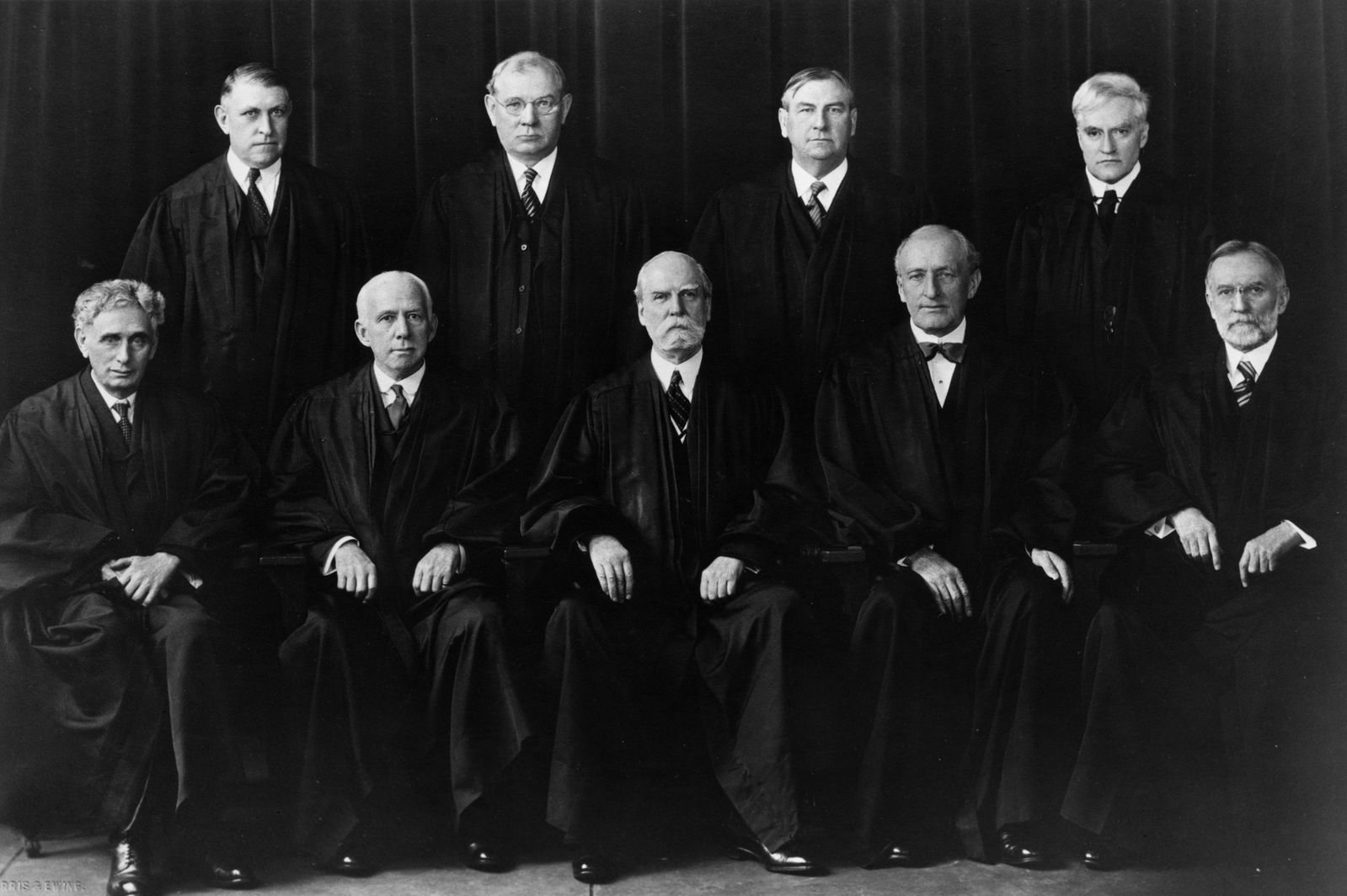
The Supreme Court, 1935. Top row, left to right:
Pierce Butler, Harlan Stone, Owen Roberts, Benjamin Cardozo.
Bottom row, left to right: Louis Brandeis, James McReynolds,
Chief Justice Charles Evans Hughes, Willis Van Devanter, George Sutherland.


The Supreme Court, 1935. Top row, left to right:
Pierce Butler, Harlan Stone, Owen Roberts, Benjamin Cardozo.
Bottom row, left to right: Louis Brandeis, James McReynolds,
Chief Justice Charles Evans Hughes, Willis Van Devanter, George Sutherland.

In this new Supreme Court building, the nation's highest cases have been decided: Civil liberties, civil rights, the rights of the accused, voting rights, privacy rights. The Court took a liberal turn in 1953 with Earl Warren becoming Chef Justice, and a conservative one in 1986 with William Rehnquist occupying the Chief's chair.

Major decisions in the 21st Century have hurt civil liberties, and the 6-3 conservative majority of the early 2020s, with 5 Justices appointed by Presidents who lost the popular vote but won the Electoral Vote, has led some liberals to cast doubt on its legitimacy, calling it "The Extreme Court."

*

October 7, 1935 was, as I said, a Monday. The Detroit Tigers beat the Chicago Cubs to win Game 6 and clinch the World Series, 4-3 at Navin Field in Detroit. (The ballpark would be renamed Briggs Stadium in 1938, and Tiger Stadium in 1961.) But the World Series clincher was the only score on this historic day. The NBA hadn't been founded yet, the NHL season's start was a few days away, and the NFL did not play. There would be no Monday Night Football for another 35 years.

Wednesday, September 21, 2022

September 21, 1981: The 1st Female Justice On the U.S. Supreme Court

September 21, 1981: Sandra Day O'Connor is confirmed by a vote of the U.S. Senate for the Supreme Court of the United States. She becomes the Court's 1st female Justice.

Born in on March 26, 1930 in El Paso, Texas, she grew up on a cattle ranch in Arizona. Sandra entered Stanford University at only 16 years old, graduated at 20, and stayed there and got her law degree at 22. In 1969, she was elected to the Arizona State Senate, where she served until 1975, when she was appointed a Judge for Maricopa County, which includes the State capital of Phoenix. Her younger sister, Ann Day, would also be elected to the State Senate, serving from 1990 to 2000.

Sandra Day O'Connor served nearly 5 years as a County Judge, then nearly 2 years as a Judge of the Arizona Court of Appeals. She supported the Presidential campaign of Ronald Reagan, whose pre-politics life as a handsome actor convinced many women, who wouldn't otherwise think of voting for a Republican, to do so.

Reagan had seemed hostile to women's rights in America, including opposing the Equal Rights Amendment. But he had promised to appoint the 1st female Justice to the U.S. Supreme Court, something no other major-party nominee, Democratic or Republican, had ever said he would do. He kept his word: When Potter Stewart retired, Reagan appointed O'Connor on July 7.

In his diary for the day before, Reagan wrote the following: "Called Judge O'Connor and told her she was my nominee for supreme court. Already the flak is starting and from my own supporters. Right to Life people say she is pro abortion. She declares abortion is personally repugnant to her. I think she'll make a good justice." He believed she had sufficient judicial -- and conservative -- credentials.

Timing is often said to be everything, and Reagan would have appreciated that life was imitating art -- or, perhaps, the other way around. The film First Monday In October, the title based on the annual commencement of the term of the Supreme Court, had been finished before Reagan appointed O'Connor, and premiered on August 21.

Jill Clayburgh starred as Ruth Loomis, an archconservative judge from Orange County, California. In real life, it was the home County of former President Richard Nixon, and a stronghold for conservatives, to the point that the voters chose to name their airport after an actor even more conservative than Reagan: John Wayne.

In the film, Loomis is appointed and confirmed, and clashes with a liberal Justice, Daniel Snow, played by Walter Matthau, until a case comes up that suggests a conflict of interest between a case and the widowed Loomis' late husband. She offers to resign her seat, but Snow, having come to respect her, talks her out of it, because the legal ramifications of the case mean that both Justices' principles can be upheld.

If either O'Connor or Reagan was worried about the confirmation process, those worries soon dissolved. On September 12, the Senate's Committee on the Judiciary sent her nomination to the full Senate by a vote of 17-0, with 1 vote of "present." On September 21, she was confirmed by a vote of 99-0.

It is nearly impossible to get 99 U.S. Senators to agree on anything, but they agreed on her. The 1 Senator not voting for her was Max Baucus, a Democrat from Montana, who was unable to be present for the vote. When he got back to Washington, he personally apologized to her for not being able to vote for her.

O'Connor served 24 years, and was often a "swing vote" on the Court. Her vote in Planned Parenthood v. Casey in 1992 upheld the right to reproductive freedom set forth in Roe v. Wade in 1973. But her vote in Bush v. Gore effectively canceled out every other vote in the 2000 Presidential election, and is a black mark on her record. She later wrote that she regretted that the Court heard the case at all, saying that it should have sent it back to the Supreme Court of the State of Florida, which had ruled the other way -- but she did not say that she regretted her final vote on the case.

Upon her retirement from the Court, President George W. Bush appointed Samuel Alito to her seat, which he still holds. She was named Chancellor of the College of William and Mary in Williamsburg, Virginia, succeeding former U.S. Secretary of State Henry Kissinger. She held this post until 2012. In 2009, President Barack Obama awarded her the Presidential Medal of Freedom.

As of September 21, 2022, Sandra Day O'Connor is still alive, but has lived in an assisted-living facility since 2018, due to back problems and Alzheimer's disease, which also afflicted her husband, John O'Connor, also a lawyer. They had 3 children, all sons, none of them lawyers like their parents: Scott and Brian work in commercial real estate, while Jay is a software industry executive.

Ruth Bader Ginsburg became the 2nd female Justice on the Supreme Court, serving from 1993 until her death in 2020. There are now 4 female Justices: Sonia Sotomayor, Elena Kagan, Amy Comey Barrett and Ketanji Brown Jackson.

*  

September 21, 1981 was a Monday. On ABC Monday Night Football, the Dallas Cowboys beat the New England Patriots, 35-21 at what was then named Schaefer Stadium in the Boston suburb of Foxborough, Massachusetts.

And these Major League Baseball games were played:

* The New York Yankees lost to the Cleveland Indians, 5-0 at Yankee Stadium. Rick Waits, a lefthander who always seemed to give the Yankees trouble, pitched a 6-hit shutout, beating Rudy May. Reggie Jackson went 0-for-3.

* The New York Mets beat the Pittsburgh Pirates, 4-3 at Shea Stadium. With Brian Giles -- no relation to the later Pirates outfielder of the same name -- at bat, Mark Lee threw a wild pitch that allowed John Stearns to score the winning run in the bottom of the 13th inning. Willie Stargell appeared as a pinch-hitter, and drew a walk. And that wasn't even the longest game of the day:

* The Montreal Expos beat the Philadelphia Phillies, 1-0 in 17 innings at the Olympic Stadium in Montreal. Mike Schmidt went 2-for-5 with 5 walks. Pete Rose went 0-for-6 for the Phillies, and Tim Wallach did the same for the Expos. Steve Carlton and Ray Burris each pitched 10 shutout innings, to no avail. Andre Dawson singled home Rodney Scott with the winning run off Jerry Reed, to make a winning pitcher out of Bryn Smith.

* The Detroit Tigers beat the Baltimore Orioles, 5-1 at Memorial Stadium in Baltimore. Eddie Murray went 1-for-3 with a walk.

* The Boston Red Sox beat the Milwaukee Brewers, 9-3 at Fenway Park in Boston. Carl Yastrzemski of the Red Sox and Robin Yount of the Brewers each went 2-for-4 with an RBI. Paul Molitor was injured, and did not play for the Brewers.

* The St. Louis Cardinals beat their arch-rivals, the Chicago Cubs, 2-0 at Wrigley Field in Chicago. Joaquín Andújar pitched 8 innings of 3-hit shutout ball, and Bruce Sutter pitched a perfect 9th to end it.

* The Minnesota Twins beat the Kansas City Royals, 7-2 at Royals Stadium (now Kauffman Stadium) in Kansas City. George Brett went 1-for-5.

* The Texas Rangers beat the Seattle Mariners, 4-1 at Arlington Stadium in the Dallas suburb of Arlington, Texas.

* The San Diego Padres beat the Cincinnati Reds, 6-0 at Jack Murphy Stadium. Chris Welsh pitched a 3-hit shutout. Johnny Bench went 1-for-4.

* The California Angels beat the Chicago White Sox, 6-3 at Anaheim Stadium (now Angel Stadium of Anaheim). Rod Carew did not play.

* The Oakland Athletics and the Toronto Blue Jays got rained out at Exhibition Stadium in Toronto. The game was made up as part of a doubleheader the next day. The A's swept, 3-2 and 4-2. In the opener, Keith Drumright singled home the winning run in the top of the 13th inning. Over the 2 games, Rickey Henderson went 2-for-7 with 4 walks, 4 stolen bases and an RBI, while Jim Spencer went 4-for-9 with a home run in the nightcap.

* And the Atlanta Braves, the Houston Astros, the Los Angeles Dodgers and the San Francisco Giants, were not scheduled.

Tuesday, August 30, 2022

August 30, 1967: The 1st Black Justice On the U.S. Supreme Court

August 30, 1967: President Lyndon B. Johnson appoints Thurgood Marshall to the Supreme Court of the United States. This made him its 1st black Justice.

Most new Justices are not familiar to the general public before their appointments. Marshall was: He was a man whose story would have to be told even if he had never received this appointment.

He was born on July 2, 1908 in Baltimore. On my 1st visit to that city, in 1987, my hotel was across the street from the Federal Courthouse. Although it was named for the recently-deceased Congressman Edward Garmatz, there was a statue of Marshall outside. It was the 1st time I had ever seen a statue of someone still living. In his case, he was even still serving on the Supreme Court. (Although a check of the facts shows that Garmatz was also still alive when the Courthouse was named for him.)

He attended Lincoln University, the country's oldest school for black students, outside Philadelphia in Chester, Pennsylvania, where he was a classmate of writer Langston Hughes. With the University of Maryland School of Law segregated, he went to the one at Howard University in Washington, D.C., known as "The Black Harvard."

In 1935, working as assistant to his former Howard professor, Charles Hamilton Houston, who was now the director-counsel for the Legal Defense and Educational Fund of the National Association for the Advancement of Colored People (NAACP), he won the case of Donald Gaines Murray, which ordered the desegregation of... the University of Maryland School of Law.

Key to this decision was the fact that the State of Maryland did not provide funding for, to use the expression used by the U.S. Supreme Court in its 1896 Plessy v. Ferguson case, "separate by equal" facilities: It was funding a law school for white residents of the State, but not black ones. In 1936, Marshall, again working under Houston, won a similar case with the University of Missouri.

Houston, a Washington native and a graduate of Harvard University School of Law, became known as "The Man Who Killed Jim Crow." This was a bit premature, but he had found a way around the segregation laws known as "Jim Crow": "If you want it 'separate but equal,' I will make it so expensive for it to be separate that you will have to abandon your separateness." He returned to Howard in 1938, with Marshall succeeding him as director-counsel of the NAACP Legal Fund. Houston died in 1950, before seeing Marshall's greatest success.

The full name of the case was Oliver Brown et al. v. The Board of Education of Topeka, Kansas. The named plaintiff, Oliver Brown, was a welder working for a railroad, and an assistant pastor. His daughter, Linda Carol Brown, was in the 3rd grade, and had to walk 6 blocks to her school bus stop to ride to Monroe Elementary School in Topeka, an all-black school, 1 mile away. Sumner Elementary School, all-white, was just 7 blocks away -- 1 block longer than the walk to the bus.

Thurgood Marshall led the legal team for the Browns. The defense counsel was John W. Davis, a former Congressmen from West Virginia, a former Solicitor General of the U.S., a former U.S. Ambassador to Britain, the Democratic Party's nominee for President in 1924, and a staunch segregationist. Davis was 81 years old, and spoke in flowery prose to support segregation. (He would be dead within a year, and is largely forgotten today.)

Marshall was 45, at the height of his powers, and spoke plainly: "The only possible justification for segregation is an inherent determination that the people who were formerly in slavery, regardless of anything else, shall be kept as near that stage as possible. And now is the time, we submit, that this Court should make clear that that is not what our Constitution stands for."

In a unanimous 9-0 ruling, the Supreme Court overturned the case of Plessy v. Ferguson in 1896, which ruled that "separate but equal" facilities be provided in public places. In Brown v. Board, the Supreme Court ruled that "separate educational facilities are inherently unequal." In 58 years, SCOTUS had gone from 1-8 in favor of integration to 9-0.

In 1961, President John F. Kennedy appointed Marshall to be a Judge of the U.S. Court of Appeals for the Second Circuit, covering the States of New York, Connecticut and Vermont. In 4 years, he authored 98 majority opinions. Not one of them has ever been overturned.

In 1965, President Lyndon B. Johnson appointed Marshall to be the 1st black U.S. Solicitor General, whose job is to argue in favor of the federal government when it is a party in a case before the Supreme Court. 

Not only had his 1954 opponent Davis held that post, but so had William Howard Taft, later to become the only man to serve as President and as a Justice of the Supreme Court. So had former Justices Stanley Reed and Robert H. Jackson. This was a signal that LBJ was preparing to make Marshall the 1st black Justice on the Supreme Court.

For 2 years, SCOTUS had no vacancy. So LBJ decided to create one: He got Nicholas Katzenbach, his Attorney General, to take a post as an Under Secretary of State, and appointed Ramsey Clark to be the new Attorney General. In order to avoid a conflict of interest, LBJ convinced Clark's father, Justice Tom Clark, to retire.

On June 13, LBJ announced Marshall's appointment. On August 30, the U.S. Senate confirmed by by a vote of 69-11. Which means that 20 Senators didn't vote. These were all Southern Democrats, and Johnson personally asked them not to vote at all, and they agreed. Not that it would have mattered, but it certainly made them look better than the 11 who did vote against him.

Marshall became a reliable member of a liberal coalition on the Court, under Chief Justices Earl Warren (1967-69) and Warren Burger (1969-86). But when William Rehnquist was promoted from Associate Justice to Chief Justice by President Ronald Reagan in 1986, the Court took a much more conservative turn. The retirement of William J. Brennan, a fellow liberal, in 1990 left him feeling depressed about the Court's progress.

By 1991, Marshall had had enough, and retired. At the press conference where he announced it, a reporter, concerned about his health, asked, "What's wrong with you, sir?" Marshall said, "What's wrong with me? I'm old! I'm getting old, and coming apart." He died on January 25, 1993, at the age of 84.

He had been married twice, and had 2 sons: Thurgood Marshall Jr. worked in the Clinton Administration and chaired the Board of Governors of the U.S. Postal Service in the Obama Administration; and John W. Marshall served as Director of Public Safety for the Commonwealth of Virginia for 8 years, making him the longest-serving person in the history of the Cabinet of Virginia's Governors.

*

August 30, 1967 was a Wednesday. These baseball games were played that day:

* The New York Yankees lost to the Boston Red Sox, 2-1 at Yankee Stadium. The American League Pennant race was incredibly tight: The Red Sox came into this game just half a game ahead of Minnesota and Detroit, and 2 1/2 ahead of Chicago. In contrast, the Yankees were 15 1/2 games back, and were struggling to avoid a repeat performance of the previous season's last-place finish. So every win was key for the Red Sox in what became known as their "Impossible Dream" season.

And the most key player was Carl Yastrzemski, on the way to winning the AL's Triple Crown. In the top of the 11th inning, he hit a home run off Al Downing, who had gone the distance for the Pinstripes. This made a winning pitcher of John Wyatt, who pitched 4 innings in relief of Jerry Stephenson. Mickey Mantle did not play in this game.

* The New York Mets lost to the St. Louis Cardinals, 2-0 at Busch Memorial Stadium. Larry Jaster took a 4-hit shutout into the 9th inning, and Ron Willis finished it. Tim McCarver, who would later broadcast for the Mets (and the Yankees) hit a home run for the Cardinals.

* The Chicago White Sox beat the Washington Senators, 5-1 at District of Columbia Stadium in Washington. (It was renamed Robert F. Kennedy Memorial Stadium in 1969.)

* The Pittsburgh Pirates beat the Atlanta Braves, 11-9 at Atlanta Stadium (It was renamed Atlanta-Fulton County Stadium in 1975.) Roberto Clemente went 2-for-5 with 2 RBIs. Willie Stargell went 2-for-4 with a home run and 4 RBIs. Joe Torre went 3-for-5 with a home run and 3 RBIs. Hank Aaron went 1-for-4, and did not hit a home run.

A year earlier, in the Braves' 1st game in Atlanta, Torre hit the 1st major league home run at the stadium, but Stargell hit one that won the game.

* The Cincinnati Reds beat the Philadelphia Phillies, 2-1 at Crosley Field in Cincinnati. Pete Rose went 2-for-4 with an RBI. Johnny Bench, who made his major league debut 2 days earlier, got his 1st major league RBI, a sacrifice fly off Chris Short in the 2nd inning; and his 1st major league hit, a single off Short in 7th.

* The Chicago Cubs beat the Houston Astros, 4-1 at Wrigley Field in Chicago. Ernie Banks went 0-for-4 with an RBI groundout. Joe Morgan went 2-for-5 for the Astros.

* The Kansas City Athletics beat the Cleveland Indians, 6-5 at Kansas City Municipal Stadium. (Both teams played at facilities named Municipal Stadium.) Danny Cater singled home the winning run in the bottom of the 12th inning.

* The Baltimore Orioles beat the Minnesota Twins, 4-2 at Metropolitan Stadium in the Minneapolis suburb of Bloomington, Minnesota. Brooks Robinson and Frank Robinson each went 1-for-4, and Frank's hit was a 2-run home run, off Dean Chance in the top of the 10th inning. Like Downing, Chance had pitched an entire extra-inning game but lost. Harmon Killebrew went 0-for-3 with a walk, and eventual Rookie of the Year Rod Carew went 1-for-3 with a walk and an RBI.  

* The California Angels beat the Detroit Tigers, 3-2 at Anaheim Stadium (now Angel Stadium of Anaheim). Al Kaline went 1-for-4.

* And the Los Angeles Dodgers beat their arch-rivals, the San Francisco Giants, 9-3 at Candlestick Park in San Francisco. Ron Fairly hit a home run in support of Don Drysdale. Willie Mays went 1-for-4 with a walk.

Friday, July 22, 2022

July 22, 1937: FDR's Court-Packing Plan Fails

July 22, 1937: The U.S. Senate sends The Judicial Procedures Reform Bill of 1937 back to its Committee on the Judiciary, effectively dooming it. President Franklin D. Roosevelt's "court-packing plan" will not pass.

In his 1st term in office, from March 4, 1933 to January 20, 1937, FDR did not have a chance to appoint a new Justice to the U.S. Supreme Court. And the Justices on the Court, nicknamed "The Nine Old Men," struck down several pieces of "New Deal" legislation he'd lobbied for and signed into law.

Typical of this was the case of A.L.A. Schechter Poultry Corporation v. United States, in which the Court struck down the National Industrial Recovery Act of 1933 in its entirety. In a unanimous 9-0 vote on May 27, 1935, known to the Roosevelt Administration as "Black Monday," the Court ruled that the NIRA was in violation of both the Due Process Clause of the 5th Amendment, and also of the Commerce Clause of the Constitution (Article I, Section 8, Clause 3.) Four days later, in a rare objection, FDR held a press conference, saying the Schechter decision had "relegated the nation to a horse-and-buggy-definition of interstate commerce.

At the time, there were 3 factions on the Court:

* "The Four Horsemen" were ultraconservative: Willis Van Devanter, appointed by William Howard Taft, a Republican; James McReynolds, appointed by Woodrow Wilson, a Democrat but, like McReynolds, a Southern one; and George Sutherland and Pierce Butler, both appointed by Warren Harding, a Republican.

* "The Three Musketeers" were liberal: Louis Brandeis, the 1st Jewish Justice on the Court, appointed by Wilson and considerably more liberal than McReynolds; Harlan Stone, appointed by Calvin Coolidge, a Republican; and Benjamin Cardozo, appointed by Herbert Hoover, a Republican. But both Stone and Cardozo tended to vote FDR's way.

* The swing votes were Charles Evans Hughes, once an Associate Justice appointed by Taft, a predecessor of FDR's as Governor of New York, the 1916 Republican nominee for President, very nearly beating Wilson, and appointed Chief Justice by Hoover, to replace Taft, who had been appointed by Harding; and Owen Roberts, another Hoover appointee.

FDR knew that the Four Horsemen were a threat to his legislation, and that the two swing votes were both Republicans. But he didn't expect a unanimous vote against the NIRA -- which his coming plan wouldn't have done anything to prevent, anyway.

After being re-elected in a massive landslide in 1936, including getting the greatest Congressional majorities any party has ever had, FDR figured he could get just about anything passed through Congress. He proposed what became known as "the Court-packing plan," allowing the President to appoint a Justice to the Supreme Court without there being a vacancy, one such Justice for every member of the Court that was at least 70 years old. In the Spring of 1937, that would have meant six, for a total of 15.

Incidentally, the Constitution never says how many Justices should be on the Supreme Court of the United States, only that it should exist, and what it should do. The number has been fixed at 9 since the Judiciary Act of 1869, mainly because there are 9 "circuits" in the federal court system, although it's not traditional to have 1 Justice from each of the 9 circuits.

To use the 1937 Court as an example: McReynolds and Brandeis (though philosophical opposites) were both from Kentucky, Cardozo and Hughes were both from New York, Van Devanter was from Indiana, Sutherland was from in Utah, Butler was from Minnesota, Stone was from Massachusetts, and Roberts was from Pennsylvania.

Even the Democrats in Congress wouldn't go along with FDR on this one. It was too much of an overreach, and it seemed like a power grab, upsetting the separation of powers between the branches of the federal government.

When FDR asked Vice President John Nance Garner, a former Speaker of the House, how the plan was going, Gardner asked, "You want it with the bark on or off, Captain?" FDR knew then what the answer would be. He said, "The rough way, bark on." Garner said, "All right: You're licked. You haven't got the votes."

FDR didn't get what he wanted, but he got the next-best thing: The plan struck fear into the Justices, and led them to look at his New Deal legislation more closely. On March 29, 1937, Justice Roberts (no relation to current Chief Justice John Roberts) voted with Hughes and the Three Musketeers in West Coast Hotel Company v. Parrish, upholding minimum wage laws. He had been expected to vote the other way, striking all such laws down.

It became known as "The Switch In Time That Saved Nine," and was a sign that the Court -- or, at least, Roberts -- had gotten FDR's message.
FDR hadn't gotten a chance to replace any of the Justices in his 1st term. Starting with his 2nd, his chances began to come:

1. In 1937, Van Devanter retired, and was replaced by Senator Hugo Black of Alabama. Despite having once been a member of the Ku Klux Klan, the inaptly-named Black became one of the Court's leading voices for the forward movement of civil rights.

2. In 1938, Sutherland retired, and was replaced by Stanley Reed, FDR's Solicitor General, the person who argues before the Supreme Court on behalf of the federal government -- in other words, FDR had appointed the man who lost the Black Monday cases to the Court. This appointment was not unusual, because 5 Solicitors General have gone on to the Supreme Court, including Taft, and the 1st black Justice on the Court, 1967 appointee Thurgood Marshall, and current Justice Elena Kagan. Justice Hughes' son, Charles Evans Hughes Jr., also served as Solicitor General, although he resigned when his father was appointed Chief Justice, to avoid a conflict of interest.

3. Also in 1938, Cardozo died, and was replaced by Felix Frankfurter, a founder of the American Civil Liberties Union, and a longtime professor at Harvard Law School, FDR's alma mater.

4. In 1939, Brandeis retired, and was replaced by the Chairman of the Securities and Exchange Commission, William O. Douglas, who served longer on the Court than anyone yet has: 36 years.

5. Also in 1939, Butler died, and was replaced by Frank Murphy, who had been FDR's Attorney General, and, before that, Governor of Michigan and Mayor of Detroit.

6. In 1941, McReynolds retired, and was replaced by Senator James F. Byrnes of South Carolina. In 1942, with World War II on, FDR decided Byrnes was more valuable in a different role, and replaced him with federal Judge Wiley Rutledge.

7. Also in 1941, Hughes retired, and FDR promoted Stone to Chief Justice.

8. To replace Stone as Associate Justice, FDR appointed Robert H. Jackson, who had replaced Murphy as U.S. Attorney General, and had replaced Reed as U.S. Solicitor General, and before that had been an Assistant Attorney General in the Tax and Antitrust Divisions.

FDR appointed 9 Justices -- but only replaced 8 of those he inherited. With some appropriateness, the only Justice he didn't replace was Roberts, who retired from the Court on July 31, 1945, 3 months after FDR died. President Harry Truman replaced him with Harold Burton, a Senator from Ohio and former Mayor of Cleveland, and a Republican, as a bipartisan gesture in the closing days of World War II.

*

July 22, 1937 was a Thursday. These baseball games were played that day:

* The New York Yankees lost to the St. Louis Browns, 13-4 at Sportsman's Park in St. Louis. This was unusual, as the Yankees went on to go 102-52 and win the World Series, while the Browns finished 46-108, 56 games behind the Yankees. Lou Gehrig and rookie Tommy Henrich hit home runs, as Bump Hadley couldn't get out of the 2nd inning, and Frank Makosky couldn't get out of the 3rd.

* The New York Giants beat the Cincinnati Reds, 6-5 at the Polo Grounds. Mel Ott went 2-for-3 with a walk.

* The Brooklyn Dodgers beat the Pittsburgh Pirates, 10-1 at Ebbets Field.

* The Boston Bees beat the St. Louis Cardinals, 2-0 at National League Park in Boston. This was during the experiment of trying to erase the memory of a lousy 1935 season by changing the name of the team and the ballpark. It didn't take, and in 1941, the team was once again the Boston Braves, and the ballpark was once again Braves Field. Danny MacFayden -- known for his glasses and his calm demeanor as "Bespectacled Deacon Danny MacFayden" -- pitched a 6-hit shutout against the team known for their scrappy play as "The Gashouse Gang."

* The Philadelphia Phillies beat the Chicago Cubs, 7-4 at Baker Bowl in Philadelphia.

* The Cleveland Indians beat the Philadelphia Athletics, 5-1 at League Park in Cleveland.

* The Detroit Tigers beat the Boston Red Sox, 17-4 at Navin Field in Detroit. That ballpark was renamed Briggs Stadium the next season, and Tiger Stadium in 1961. The Tigers got home runs from Hank Greenberg (who had 5 RBIs), Rudy York, Charlie Gehringer and Chet Laabs.

* And the Chicago White Sox and the Washington Senators were not scheduled to play.

Thursday, June 30, 2022

June 30, 1921: The Job Taft Really Wanted

June 30, 1921: President Warren G. Harding appoints former President William Howard Taft to be the Chief Justice of the Supreme Court of the United States. He had wanted the job for as long as he could remember.

A graduate of Yale Law School, the son of former Attorney General Alphonso Taft, and, like his father, the U.S. Secretary of War, Taft wanted to be on the Supreme Court. He had served as U.S. Solicitor General under President Benjamin Harrison. That wouldn't have been an omen at the time, but he did go on to become the 1st holder of that office to be appointed to the Supreme Court. He has been followed as such by Stanley Reed, Robert H. Jackson, Thurgood Marshall and Elena Kagan. Another, Robert Bork, was appointed to the Court, but rejected by the Senate.

Taft and his wife Helen were invited to the White House by President Theodore Roosevelt early in 1908. TR had already announced he would not run for what would have amounted to a 3rd term, and kiddingly told Taft that he could see the future. He saw a large man taking a great job -- but was it the Presidency, or the Chief Justiceship?

Will Taft said, "Let it be the Chief Justiceship."

Helen Taft, always more ambitious than her husband, said, "Let it be the Presidency."

The Presidency it was, and Will Taft was easily nominated at the 1908 Republican Convention in Chicago, and was elected in a landslide. But he took a more conservative course than TR did, and TR tried to regain the Republican nomination for President in 1912. When he failed, he ran a 3rd-party campaign, and, having said some very nasty things about Taft, finished ahead of him, but was unable to defeat the Democratic nominee, Woodrow Wilson. Taft and TR made up before the latter's death in 1919.

In 1920, Senator Warren G. Harding was elected President. A fellow Republican from Ohio, Harding invited Taft to his home in Marion after the election, and promised him a Supreme Court appointment. Taft knew that Edward D. White, whom he had appointed Chief Justice in 1910, was ill, and told Harding that he didn't want to be an Associate Justice, only the Chief Justice.

White died in office on May 19, 1921. Harding was a weak man, who basically did everything his 1920 campaign manager, Harry Daugherty, told him to do, including to make Daugherty himself the U.S. Attorney General. Taft knew this, and lobbied Daugherty for the post. It worked: On June 30, 1921, Harding appointed Taft to be the new Chief Justice of the United States. Without holding a single hearing, and with a brief debate, the U.S. Senate confirmed him that very same day. The vote was 61-4, the "Nay" votes coming from a Southern Democrat and 3 progressive Republicans who had supported Roosevelt over him in 1912.

He was sworn in on July 11, and, to this day, he remains the only person to serve as both President of the United States and a Justice of the Supreme Court of the United States, let alone the Chief Justice.

Charles Evans Hughes was unsuccessfully nominated by the Republicans in 1916, after he was an associate Justice but before he was Chief Justice. Earl Warren ran for the Republican nomination in 1944 and 1948, and was unsuccessfully nominated for Vice President in 1948, and was later named Chief Justice.

Taft led the Court through the 1920s, a very conservative period that saw very conservative decisions by the Court. He was a great deal happier in his new job, and his weight, once a Presidential record 340 pounds -- possibly broken by Donald Trump, but his Administration wouldn't tell us the truth -- dropped to 244 by 1929.

However, by that point, his heart and liver were failing. He had delivered the Oath of Office correctly to President Calvin Coolidge when he was inaugurated for a full term on March 4, 1925: "...and will, to the best of my ability, preserve, protect and defend the Constitution of the United States." But at President-elect Herbert Hoover's Inauguration on March 4, 1929, Taft, as great a constitutional scholar as was alive at that point, misquoted the Oath as stated in the Constitution: "and will, to the best of your ability, that you will preserve, and maintain, and defend the Constitution of the United States?"

(Hoover, unusually, instead of repeating the Oath entirely, as Franklin D. Roosevelt did the next 4 times, or phrase by phrase as given him by the Chief Justice, as every President since has done, simply said, "I do.") 

Taft realized his mind was no longer sharp. A trip home to Cincinnati for his brother Charles' funeral in January 1930 damaged his physical health further. He asked Hoover to promise him that his replacement as Chief Justice would be Hughes, who had been Secretary of State under Harding and Coolidge, rather than the more liberal Harlan Stone, a Coolidge appointee. Hoover agreed, and Taft resigned on February 3.

He died on March 8, 1930, at the age of 72. Because he was still living in Washington, he became the 1st President -- and also the 1st Supreme Court Justice -- to be buried in Arlington National Cemetery. (The only President so honored since has been John F. Kennedy. Presidents tend to be buried in their hometowns, or at their Presidential Libraries -- usually, the Library is in their hometown.) His wife Helen lived on until 1943.

Taft is regarded as one of the better Chief Justices, but not as one of the better Presidents. He would have agreed with both assessments.

His son, Robert A. Taft, would serve Ohio in the U.S. Senate, and run for President 3 times, though he never got the Republican nomination. He was so conservative, he would be known as "Mr. Republican." He died in 1953, in office as Senate Majority Leader. His son, Robert Taft Jr., served Ohio in both houses of Congress. And his son, Bob Taft, served 2 terms as Governor of Ohio.

*

June 30, 1921 was a Thursday. There were 4 baseball games played that day:

* The Pittsburgh Pirates beat the Cincinnati Reds, 5-3 at Forbes Field in Pittsburgh.

* The Detroit Tigers beat the Cleveland Indians, 6-3 at League Park in Cleveland. Ty Cobb went 3-for-4 with a walk and 2 RBIs. Tris Speaker went 1-for-4 with a walk. Each man was now his team's player-manager.

* And the St. Louis Browns swept a doubleheader from the Chicago White Sox, 6-1 and 1-0 at Sportsman's Park in St. Louis. Ray Kolp pitched a 4-hit shutout in the nightcap. Eddie Collins made only 1 plate appearance, as an unsuccessful pinch-hitter in the nightcap. Over the 2 games, George Sisler went 4-for-8.

December 31, 1999 & January 1, 2000: The Millennium

December 31, 1999:  The Millennium arrives. The people of planet Earth survived. At a terrible cost. But we hadn't destroyed ourselves. ...