Showing posts with label museum of modern art. Show all posts

Thursday, July 28, 2022

July 29, 1890: Vincent van Gogh Dies By Suicide

The only known photograph of him

July 29, 1890: Vincent van Gogh dies in Auvers-sur-Oise, France, 2 days after shooting himself in the chest. He was only 37 years old.

Vincent Willem van Gogh was born on March 30, 1853 in Zundert, the Netherlands, near Breda, and only 2 miles from the border with Belgium. He began drawing at an early age, and briefly served as a Protestant missionary in Belgium. In 1886, he moved to Paris, where he fell in with a group of artists rebelling against the Impressionist phase of art, including Paul Gauguin.

He had long suffered from depression, and began to have psychotic episodes. He seemed to subsist on alcohol, cigarettes and coffee. In 1888, he moved to Arles, in the south of France, about halfway between Montpellier and Marseille. It was there that he created his greatest works, including the flower paintings Irises and Sunflowers.

Jeanne Calment, the Frenchwoman born in 1875 and died in 1997, at age 122 the oldest authenticated person in human history, claimed to have met Vincent van Gogh in Arles in 1888. She said he was "ugly" and "disagreeable," and "reeked of alcohol."

On December 23, 1888, he and Gauguin, rooming together in Arles, had another in a series of arguments. Gauguin later claimed that van Gogh came at him with a straight razor. The next morning, a policeman came to the hotel, and found van Gogh unconscious, with blood everywhere. Most of his left ear had been cut off. He was taken to a hospital, and, since he had no memory of how he lost his ear, he was committed. He was released on January 7, 1889.

The traditional story is that he cut the ear off with a razor -- probably the same one Gauguin said van Gogh threatened him with -- in the middle of a psychotic attack. It has also been suggested that, also being a tempestuous personality, Gauguin challenged him to a duel with swords, and Gauguin himself cut the ear off. van Gogh painted at least 2 self-portraits with the ear bandaged, although both show the bandage on the right side, not the left. He may have been looking in a mirror while he painted.

His mental health remained precarious, and, on May 8, 1889, he was taken to the Saint-Paul-de-Mausole asylum, a former monastery in Saint-Rémy-de-Provence, 15 miles northeast of Arles. There, he painted many scenes of the interior of the hospital, scenes from its gardens including Lilacs, and, looking through his bedroom window, what became his best-known work, The Starry Night.

van Gogh did not think much of The Starry Night: In a letter to Émile Bernard, also a member of the "Post-Impressionist" group that included van Gogh and Gauguin, he wrote, "I allowed myself to be led astray into reaching for stars that are too big -- another failure -- and I have had my fill of that."

In March 1890, while he was at Saint-Paul-de-Mausole, his painting The Red Vineyard was sold at an auction in Brussels, Belgium, for 400 francs -- in 2022 American money, about $2,646. It would be the only one of his paintings to sell while he lived. It is now in the Pushkin Museum in Moscow, along with some of his other paintings.

He left the monastery/asylum in May 1890, and moved to the Auberge Ravoux in Auvers-sur-Oise, about 20 miles northwest of Paris, to be closer to his younger brother Theo, an art dealer who had long supported him financially, and Theo's family. But he couldn't escape his depression, and, on July 27, he took a 7-millimeter Lefaucheux pinfire revolver, and shot himself in the chest.

He was able to walk back to the Ravoux, and the doctors determined that they could not remove the bullet, but also that he did not seem to be in immediate danger. Theo arrived on the morning of the 28th, and, he later wrote to others, found him in good spirits. But while the bullet hadn't hit any major organs, the wound had become infected, and he died in the middle of the night on the 29th. Theo wrote that Vincent's last words were, "The sadness will live forever."

He was buried the next day, in the Auvers-sur-Oise cemetery. Theo suffered from a brain infection, and died only 6 months later, on January 25, 1891, at 33. He was buried in Utrecht, the Netherlands. In 1914, Theo's coffin was exhumed, and buried next to Vincent's.

Theo had saved the letters that Vincent wrote him, and that's how we know of Vincent's feelings about things, including his own work and that of other painters. In 1914, the same year that Theo's widow Johanna had his body moved next to Vincent's, she had the letters published, and Vincent's posthumous reputation grew from this. She married again, was widowed again, and died in 1925.

Vincent never married, although he seemed to have fallen in love with a first cousin, with the family preventing the marriage, not because of the close relationship, but because he wouldn't be able to support her. Although he was accused (without proof) of forcing himself on one of his models and fathering her child, he is not known to have had any children.

Theo's line does continue. One of his grandsons, also named Theo, became a Dutch resistance fighter who was captured and executed by the Nazis. His brother named his son, the original Theo's great-grandson, after him, and this Theo van Gogh became a film director. After directing Submission: Part 1, which strongly criticized the treatment of women in Islam, in 2004, he was assassinated by a Muslim extremist.

In 1934, Irving Stone wrote Lust for Life, a novel imagining the relationship between Vincent van Gogh and Paul Gauguin. In 1956, director Vincente Minnelli (ex-husband of Judy Garland and father of Liza Minnelli) made a film version of it, starring Kirk Douglas as van Gogh and Anthony Quinn as Gauguin, the latter winning an Academy Award for Best Supporting Actor for the role. James Donald played Theo.

In 1990, on the 100th Anniversary of Vincent's death, the film Vincent & Theo premiered, with the brothers played by English actor Tim Roth and Welsh actor Paul Rhys, respectively. The same year, Japanese director Akira Kurosawa released Dreams, and cast another legendary director, Martin Scorcese, as van Gogh. In 1991, Jacques Dutronc played him in Vincent, and won the French equivalent of the Oscar, the César, for the role.

On a 2010 episode of Doctor Who, van Gogh was played by Scottish actor Tony Curran. In the 2018 film At Eternity's Gate, which suggests that his death was an accident, caused by a gunshot among children at play, he was played by Willem Dafoe.

In 1971, on his album American Pie, Don McLean included a song titled "Vincent," with each of 3 verses beginning with the words, "Starry, starry night." Regarding his treatment by others at the time, McLean wrote, "They did not listen. They did not know how. Perhaps they'll listen now." He wrote of the suicide in the bridge, and moved on to a last verse where people go to museums and look at the art, without thinking of the artist: "They would not listen. They're not listening still. Perhaps they never will."

Since 1941, The Starry Night has been on display at the Museum of Modern Art, at 11 W. 53rd Street in Midtown Manhattan.
The author of this blog, with The Starry Night at MoMA, March 23, 2022.
This was 2 years after the COVID outbreak,
and the museum was still insisting on masks.

*

July 29, 1890 was a Tuesday. It was the year of the Players' League revolt in baseball, 1 of only 4 seasons -- 1884, 1914 and 1915 being the others -- that what we now call Major League Baseball had 3 leagues.

In the National League:

* The Brooklyn Bridegrooms beat the Cleveland Spiders, 12-3 at National League Park in Cleveland. This ballpark was replaced by a new League Park in 1891, which was replaced by another League Park in 1910, which became home of the team that became the Cleveland Indians until 1946. The Spiders folded after the 1899 season, by which point the Bridegrooms -- so named because several players got married in the 1887-88 off-season -- had become the Superbas. In 1911, they became the Dodgers.

* The Chicago Colts beat the Philadelphia Phillies, 8-6 at West Side Park in Chicago. The Colts became the Cubs in 1903.

* The Cincinnati Reds beat the Boston Beaneaters, 11-3 at League Park in Cincinnati. The Beaneaters became the Braves in 1912.

* The New York Giants were supposed to play the Pittsburgh Pirates at Recreation Park in Pittsburgh, but the game was rained out. It was rescheduled for September 22, and for some reason was played 60 miles to the southwest, in Wheeling, West Virginia. The Giants won, 8-3.

In the American Association:

* The Philadelphia Athletics beat the Toledo Maumees, 7-0 at the Jefferson Street Grounds in Philadelphia. Both of these teams folded with the AA after 1 more season. This Philadelphia team wasn't the 1st to be named the Athletics, and it wouldn't be the last. As you'll see in a moment, it wasn't even the only one at the time.

* The St. Louis Browns beat the Syracuse Stars, 5-3 at Star Park in Syracuse, New York. The Stars were among the losers in the "Players' League War," and folded after the season. Syracuse previously had a team called the Stars in the NL in 1879. These are, to date, the only 2 seasons in MLB for the city.

* The Rochester Broncos beat the Louisville Colonels, 6-3 at Culver Field in Rochester, New York. This would be the only season in MLB for Rochester. The Colonels would join the NL in 1892, after the AA folded, but would fold themselves after the 1899 season.

* The Brooklyn Gladiators and the Columbus Solons appear not to have been scheduled. The Gladiators finished a distant last in the AA, and folded after the season. In contrast, the Solons finished 2nd in the AA, albeit 10 games behind the Colonels, but still lost money, and folded with the league after the 1891 season.

In the Players' League, none of those teams survived its folding after the season:

* The Brooklyn Ward's Wonders lost to the Chicago Pirates, 8-3 at South Side Park in Chicago. This is not the same South Side Park that would later be the 1st home of the American League's Chicago White Sox and the Negro Leagues' Chicago American Giants. The Brooklyn team was named after their star shortstop, the PL's founder, John Montgomery Ward.

* The PL's version of the Philadelphia Athletics beat the Buffalo Bisons, 9-3 at Olympic Park in Buffalo. Although the names of each of these teams would be applied to later teams, these teams died with the PL.

* The Cleveland Infants beat the Boston Reds, 17-6 at Brotherhood Park in Cleveland. I can find no record of why the Cleveland team was called the Infants. Maybe they wanted to emphasize that their league was new and unconnected to what they saw as the corruption in established baseball. Or maybe they once reacted poorly to a loss, and were called "crybabies," and "Infants" came from that.

* As with their NL counterparts, the PL's version of the New York Giants were supposed to play the PL's Steel City team, the Pittsburgh Burghers. I know: Not much imagination in these teams' names, the "Infants" aside. As with their NL counterparts, they were rained out. This game was rescheduled as part of a doubleheader the next day. The PL Giants swept, 10-2 and 12-9.

Tuesday, May 10, 2022

May 10, 1939: The Museum of Modern Art Opens

May 10, 1939: The Museum of Modern Art opens, at 11 West 53rd Stret, between 5th and 6th Avenues in Midtown Manhattan. It was the brainchild of Abby Aldrich Rockefeller, wife of John D. Rockefeller Jr. The Rockefeller family has always had art collections, and Abby made substantial donations from her own collection.

There would later be donations from her children, including Nelson, later Governor of New York and Vice President of the United States; and David, longtime director of Chase Manhattan Bank. Nelson was president of the museum from 1939 until his 1st election as Governor in 1958, and David succeeded him.

The original "MoMA" opened on November 7, 1929, in the Hecksher Building (now the Crown Building) at 730 5th Avenue and 57th Street. It stayed until 1932, then moved to temporary locations until the current building opened. As seen above, the building itself is a work of modern art, in contrast to many of the surrounding buildings, which, typical of post-World War II architecture in New York, are really bland.

Among the legendary paintings on display, in chronological order: The Bather by Paul Cézanne, Starry Night by Vincent van Gogh, Les Demoiselles d'Avignon by Pablo Picasso, The Dance I by Henri Matisse, I and the Village by Marc Chagall, and Campbell's Soup Cans by Andy Warhol. Each of those painters has other works on display there.

MoMA is the 4th-most-visited museum in America, behind the Smithsonian Institution's National Museum of Natural History and National Gallery of Art in Washington, and the Metropolitan Museum of Art uptown.

And yet, despite living close to New York my whole life, I never visited until 2022. I should have gone years earlier. 
The author, in front of van Gogh's Starry Night.
This was 2 years after the COVID outbreak,
and the museum was still insisting on masks.

*

May 10, 1939 was a Wednesday. These baseball games were played:

* The New York Yankees beat the St. Louis Browns, 7-1 at Sportsman's Park in St. Louis. Lefty Gomez was injured after getting the 1st out, and ended up missing his next 2 starts. Bump Hadley went the rest of the way for the win. Joe DiMaggio did not play, and Lou Gehrig had taken himself out of the lineup (for the last time, though that wasn't yet known) 8 days earlier. But Bill Dickey and George Selkirk hit home runs.

* The New York Giants lost to the Pittsburgh Pirates, 5-0 at the Polo Grounds. Rip Sewell pitched a 6-hit shutout, and helped his own cause with a home run. Paul and Lloyd Waner each went 1-for-4 with a walk, and Lloyd added an RBI. Mel Ott went 1-for-3 with a walk.

* The Brooklyn Dodgers beat the Cincinnati Reds, 10-5 at Ebbets Field.

* The Boston Bees beat the Chicago Cubs, 6-2 at National League Park in Boston. After a disastrous 1935 season, the Boston Braves, as we would say today, "rebranded" as the Boston Bees, and Braves Field was renamed National League Park, and nicknamed the Bee Hive. The new names never caught on, and in 1941, they switched back.

* The St. Louis Cardinals beat the Philadelphia Phillies, 4-3 at Shibe Park in Philadelphia.

* The Cleveland Indians beat the Philadelphia Athletics, 7-4 at league Park in Cleveland. Bob Feller went the distance for the win.

* The Detroit Tigers beat the Washington Senators, 5-1 at Briggs Stadium (now Tiger Stadium) in Detroit. Hank Greenberg went 0-for-4, but had an RBI on a groundout.

* And the Boston Red Sox and the Chicago White Sox were postponed at Comiskey Park in Chicago. According to Baseball-Reference.com, it wasn't due to rain, but to "cold" -- on May 10. The game was made up as part of a doubleheader on July 18. The Red Sox won the opener, 13-10. Elden Auker didn't get out of the 2nd inning, but hit a home run, and Boston won, anyway.

The White Sox won the nightcap, 8-5. Over the 2 games, Jimmie Foxx went 4-for-9 with a home run, a walk, and 3 RBIs, and rookie Ted Williams went 6-for-10 with a home run and 4 RBIs.

Thursday, March 24, 2022

March 25, 1907: Pablo Picasso Completes "Les Demoiselles d'Avignon"

March 25, 1907: Pablo Picasso completes his painting Les Demoiselles d'Avignon -- The Young Ladies of Avignon. As documentary filmmaker Ken Burns put it, it "shattered the art world," and becomes the defining work of the art movement known as Cubism.

(Avignon is a city of about 93,000 people in the south of France, 427 miles southeast of Paris, and 64 miles northwest of Marseille.)

Pablo Diego José Francisco de Paula Juan Nepomuceno María de los Remedios Cipriano de la Santísima Trinidad Ruiz y Picasso was born on October 25, 1881 -- the day before the gunfight at the O.K. Corral in Tombstone, Arizona -- in Málaga, Andalusia, on the Mediterranean coast of southern Spain. He wanted to draw from the very beginning: According to his mother, his first words were "piz, piz", a shortening of lápiz, the Spanish word for "pencil."

He first visited Paris in 1900, and lived there on and off for the rest of his life. In 1901, a friend, the Catalan painter Carles Casagemas, committed suicide, and Picasso became deeply depressed over this. His paintings took on a somber tone, with poor subject matter: Prostitutes, beggars, drunks, blind people, old people. It became known as his Blue Period, and lasted until 1904. Probably the best-known painting from this period is The Old Guitarist, from 1903.

But in 1904, he met Fernande Olivier, a French painter and model, who awakened his sense of joy, and began his Rose Period. He began to paint happier figures, like clowns and dancers. The colors red, pink and orange became more common, as seen in Les Demoiselles d'Avignon. Supposedly, 1 of the 5 women in that painting is Fernande, although the faces are so twisted, it's hard to tell which one.
Fernande Olivier. Compare the pictures, and you tell me.

Les Demoiselles seemed to be the result of his rivalry with French painter Henri Matisse, whose Blue Nude had already caused a sensation. But while the woman in that painting seemed a more natural representation of the female body, Picasso's 5 Demoiselles were oddly posed and had, as I said, twisted faces, which would become a theme of his paintings for the rest of his long life.

No, images such as these were not realistic. Picasso once said, "Art is a lie that brings us closer to the truth."

In response, Matisse painted Bathers with a Turtle. You've never heard of it? Or of Blue Nude? That's not surprising, in spite of Matisse's fame. Neither of those is his best-known work. But even if you don't know the title Les Demoiselles d'Avignon, you've probably seen the image.
Pablo Picasso, 1908

Picasso would continue to go through phases, and muses/lovers, throughout his life, which lasted until April 8, 1973, at age 91, in Mougins, on the French Riviera. A museum dedicated to him is there -- just 4 miles northeast of the French film festival city of Cannes; 30 miles southwest of Monte Carlo, Monaco; 36 miles southwest of the French-Italian border -- and 16 miles southwest of Nice, where there is a museum dedicated to his rival, Matisse. An intrepid art fan of some means could visit both in one day.

Picasso had 2 sons, Paulo, a ballet dancer and his only legitimate child, and Claude, a graphic designer; and 2 daughters, Maya, a journalist, and Paloma, a fashion designer. He had 5 grandchildren, and his genetic line continues. Paulo died in 1975. As of March 25, 2022, the other 3 children are still alive. (UPDATE: Maya died on December 20, 2022; Claude on August 24, 2023. That left Paloma as the only survivor.) 

Picasso was played as a young man by Danny Webb in 2 episodes of The Young Indiana Jones Chronicles, in 1992 and 1993; as an old man by Anthony Hopkins in the 1996 film Surviving Picasso; as an old man by "Epic" Lloyd Ahlquist on a 2013 episode of Epic Rap Battles of History; and all through his adult life by Antonio Banderas, a fellow Málaga native, in the 2018 season of Genius on the National Geographic Network.

Since 1937, the original version of Les Demoiselles d'Avignon has been on display at the Museum of Modern Art, at 11 W. 53rd Street in Midtown Manhattan. On March 23, 2022, I finally visited MoMA for the first time, and saw it -- although I didn't know it was there. I figured some of Picasso's work would be, and some of his well-known works are. But I was there to see Starry Night by Vincent van Gogh. (van Gogh died when Picasso was 8 years old, and they never met.)

In a 2013 episode of the YouTube series Epic Rap Battles of History, "Epic" Lloyd Ahlquist played Picasso, against "Nice" Peter Shukoff, who played Bob Ross.

*

March 25, 1907 was a Monday. Baseball was in Spring Training. Football was out of season. Pro basketball barely existed.

But hockey's Stanley Cup was won that day, by the Montreal Wanderers, the team known as "the Little Men of Iron." Champions of the Eastern Canada Amateur Hockey Association, they beat the Kenora Thistles, Champions of the Manitoba Hockey Association, in a 2-game, total-goals series, winning 7-2 on March 23, and losing 6-5 on March 25, with both games at the Winnipeg Auditorium. That gave the Wanderers a 12-8 win on aggregate, reclaiming the Cup from the Thistles, who had won it from them the preceding January 21.

Lester Patrick, later to coach and manage the New York Rangers, and become the namesake of one of the NHL's divisions and its award for the advancement of hockey in America, played for the Wanderers at this time. Art Ross, later to coach and manage the Boston Bruins, and become the namesake of the NHL's trophy for its annual leading scorer, played for the Thistles, but was later signed by the Wanderers. Both men were defensemen.

Although members of a Manitoba-based league, and playing their "home games" in this series in Winnipeg, the city of Kenora -- known until 1905 as Rat Portage -- is in western Ontario, about 30 miles east of the Manitoba Provincial line, 130 miles east of Winnipeg, and a whopping 1,157 miles from Toronto. (Canada is huge, and Ontario is a big part of it. Minneapolis is the closest major American city, 430 miles to the south.)

Kenora is home to 15,000 people, making it, by far, the smallest city ever to win one of North American sports' 4 major championships. (East Rutherford, New Jersey has about 10,000, but the Giants, Jets and Devils have never used the name "East Rutherford" -- and the Jets haven't won a title there, anyway.)

Friday, January 28, 2022

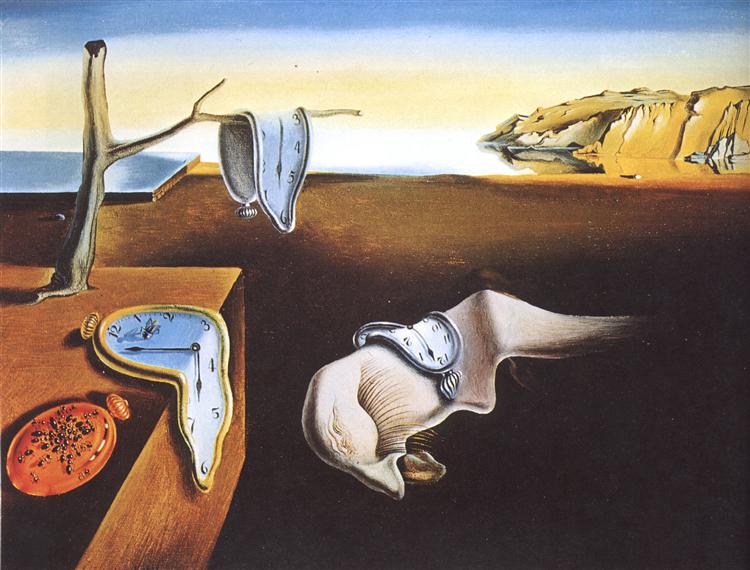
January 29, 1932: Salvador Dalí's "The Persistence of Memory" Is Introduced

January 29, 1932: La persistència de la memòria -- "The Persistence of Memory" -- a painting by Salvador Dalí is first publicly displayed, at the Julien Levy Gallery, at 602 Madison Avenue at 58th Street.

Levy was an art dealer from New York, and had opened his gallery the year before. He could do this because he had befriended many European painters, including Dalí, then 27, and a native of Figueres, Catalonia, in eastern Spain. He had previously introduced photographer Henri Carter-Bresson to America, and would later do the same for the Mexican painter Frida Kahlo.

On January 29, 1932, Levy opened America's first multi-media exhibition of "Surrealist" work. He had bought The Persistence of Memory, and displayed it along with works by Pablo Picasso, Marcel Duchamp, Max Ernst, Joseph Cornell, and others.

The Persistence of Memory is certainly surreal: It shows a coastline with four pocket watches that all appear to be melting. The one in the middle is draped over a human-looking (but not that human-looking) facial profile with its eye closed. Dalí claimed that this was a "self-portrait," and that the closed eye and the fact that the figure isn't clearly formed is meant to suggest that both he and the viewer are "in a dream state," and that he (Dalí) was trying hard to remember what the figure actually looked like -- hence, "the persistence of memory."

The watch in the lower left corner is orange, and covered with ants. Dalí often used ants in his paintings as a symbol of decay. The watch next to it has a fly on it, perhaps as a symbol of uncleanliness. And another watch is draped over a branch of a dead tree in the upper left.

The painting is often called "The Soft Watches" or "The Soft Clocks." Ilya Prigoine, a Russian chemist who defected to Belgium and won the Nobel Prize, once asked Dalí if the soft watches were inspired by Albert Einstein's Theory of Relativity. Dalí said no, that the real inspiration was a Camembert cheese, melting in the Sun.

Dalí had painted it the year before Levy introduced it, which was also the year that the Spanish Republic was established, overthrowing the centuries-old monarchy of Spain. This was also the era after World War I, in which Spain was neutral, but most of Europe had suffered terribly, and this suffering was often depicted in art, especially in Germany the nation that was the war's main aggressor and biggest loser. (Unless you consider Russia to be a bigger loser, which might be accurate.)

It was also during the Great Depression, which would lead to, among other things, the Spanish Civil War of 1936 to 1939, which would lead to, among other things, the fall of the Republic and the establishment of a Fascist state that lasted until 1975. Picasso, a native of Málaga in Andalusia, in southern Spain, whose painting Guernica depicted the horrors of the aerial bombing of that city, did not live to see the fall of Fascism in Spain, but Dalí, who praised Franco's Falangists and returned to Spain in 1948, did.
Dalí kept up his surreal work, and his surreal lifestyle, including walking unusual pets such as an ocelot or an anteater around whatever city he was in, until his death in 1989, at age 84. From 1929, marrying her in 1934, until her death in 1982, he lived with Elena Ivanovna Diakonova, a Kazakh known as Gala Dal. They had no children together, but she had a daughter from her previous marriage, Cécile Éluard, who lived until 2016. 

Julien Levy died in 1981. Today, a men's clothing store named Always In Vogue is on the site of the Levy Gallery.

Since 1934, The Persistence of Memory has been on display at the Museum of Modern Art, at 11 W. 53rd Street in Midtown Manhattan. On March 23, 2022, I finally visited MoMA for the first time, and saw it -- although I didn't know it was there. I figured some of his work would be, and some of his well-known works are. But I was there to see Starry Night by Vincent van Gogh. (van Gogh died 14 years before Dalí was born.)

*

January 29, 1932 was a Friday. English soccer player Tommy Taylor, one of the Manchester United "Busby Babes" who died in the Munich Air Disaster of 1958, was born on this day.

Baseball and football were out of season. The NBA hadn't been founded yet. And there were no games scheduled in the NHL. So there were no scores on this historic day.

I could have done an entry for the date on which Dalí finished the painting, to get some scores, but I couldn't find an exact date for that.

December 31, 1999 & January 1, 2000: The Millennium

December 31, 1999:  The Millennium arrives. The people of planet Earth survived. At a terrible cost. But we hadn't destroyed ourselves. ...