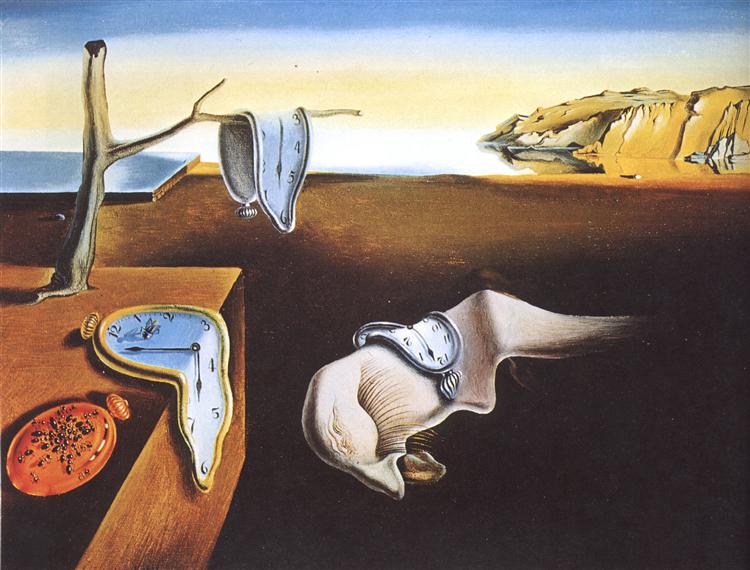
January 29, 1932: La persistència de la memòria -- "The Persistence of Memory" -- a painting by Salvador Dalí is first publicly displayed, at the Julien Levy Gallery, at 602 Madison Avenue at 58th Street.
Levy was an art dealer from New York, and had opened his gallery the year before. He could do this because he had befriended many European painters, including Dalí, then 27, and a native of Figueres, Catalonia, in eastern Spain. He had previously introduced photographer Henri Carter-Bresson to America, and would later do the same for the Mexican painter Frida Kahlo.
On January 29, 1932, Levy opened America's first multi-media exhibition of "Surrealist" work. He had bought The Persistence of Memory, and displayed it along with works by Pablo Picasso, Marcel Duchamp, Max Ernst, Joseph Cornell, and others.
The Persistence of Memory is certainly surreal: It shows a coastline with four pocket watches that all appear to be melting. The one in the middle is draped over a human-looking (but not that human-looking) facial profile with its eye closed. Dalí claimed that this was a "self-portrait," and that the closed eye and the fact that the figure isn't clearly formed is meant to suggest that both he and the viewer are "in a dream state," and that he (Dalí) was trying hard to remember what the figure actually looked like -- hence, "the persistence of memory."
The watch in the lower left corner is orange, and covered with ants. Dalí often used ants in his paintings as a symbol of decay. The watch next to it has a fly on it, perhaps as a symbol of uncleanliness. And another watch is draped over a branch of a dead tree in the upper left.
The painting is often called "The Soft Watches" or "The Soft Clocks." Ilya Prigoine, a Russian chemist who defected to Belgium and won the Nobel Prize, once asked Dalí if the soft watches were inspired by Albert Einstein's Theory of Relativity. Dalí said no, that the real inspiration was a Camembert cheese, melting in the Sun.
Dalí had painted it the year before Levy introduced it, which was also the year that the Spanish Republic was established, overthrowing the centuries-old monarchy of Spain. This was also the era after World War I, in which Spain was neutral, but most of Europe had suffered terribly, and this suffering was often depicted in art, especially in Germany the nation that was the war's main aggressor and biggest loser. (Unless you consider Russia to be a bigger loser, which might be accurate.)
It was also during the Great Depression, which would lead to, among other things, the Spanish Civil War of 1936 to 1939, which would lead to, among other things, the fall of the Republic and the establishment of a Fascist state that lasted until 1975. Picasso, a native of Málaga in Andalusia, in southern Spain, whose painting Guernica depicted the horrors of the aerial bombing of that city, did not live to see the fall of Fascism in Spain, but Dalí, who praised Franco's Falangists and returned to Spain in 1948, did.

Dalí kept up his surreal work, and his surreal lifestyle, including walking unusual pets such as an ocelot or an anteater around whatever city he was in, until his death in 1989, at age 84. From 1929, marrying her in 1934, until her death in 1982, he lived with Elena Ivanovna Diakonova, a Kazakh known as Gala Dal. They had no children together, but she had a daughter from her previous marriage, Cécile Éluard, who lived until 2016.
Julien Levy died in 1981. Today, a men's clothing store named Always In Vogue is on the site of the Levy Gallery.
Since 1934, The Persistence of Memory has been on display at the Museum of Modern Art, at 11 W. 53rd Street in Midtown Manhattan. On March 23, 2022, I finally visited MoMA for the first time, and saw it -- although I didn't know it was there. I figured some of his work would be, and some of his well-known works are. But I was there to see Starry Night by Vincent van Gogh. (van Gogh died 14 years before Dalí was born.)
*
January 29, 1932 was a Friday. English soccer player Tommy Taylor, one of the Manchester United "Busby Babes" who died in the Munich Air Disaster of 1958, was born on this day.
Baseball and football were out of season. The NBA hadn't been founded yet. And there were no games scheduled in the NHL. So there were no scores on this historic day.
I could have done an entry for the date on which Dalí finished the painting, to get some scores, but I couldn't find an exact date for that.


No comments:
Post a Comment