Showing posts with label 27 club. Show all posts

Tuesday, October 4, 2022

October 4, 1970: Janis Joplin Dies

October 4, 1970: Janis Joplin dies of a heroin overdose at the Landmark Motor Hotel in Los Angeles. She was 27 years old.

She had starred at the Monterey Pop Festival in California in 1967, became a symbol of the Hippie era, and had also played Woodstock. Jimi Hendrix had done each of these things as well. He died on September 16, as a result of mixing drugs and alcohol. When asked for her thoughts on his death, Janis said, "There but for the grace of God go I."

She wasn't kidding. She died just 16 days later.

When he found out about Jimi's death, Jim Morrison, the lead singer of The Doors, himself a hippie icon with a booze problem and a drug problem, asked his friends, "Do you believe in omens?" Like Janis, he didn't take the hint. When Janis died, Jim told his friends, "Believe it or not, you're drinking with number three."

If any of those friends tried to get him to stop, it didn't take. Nine months after Jimi and Janis, Jim Morris was dead, too. All 3 of them died at the age of 27, giving rise to the idea of rock and roll's "27 Club."

*

October 4, 1970 was a Sunday. The NBA, the ABA and the NHL were still a few days away from starting their new seasons. But Major League Baseball had begun its Playoffs:

* In Game 2 of the American League Championship Series, the Baltimore Orioles beat the Minnesota Twins, 11-3 at Metropolitan Stadium in the Minneapolis suburb of Bloomington, Minnesota. It was only 4-3 O's going into the 9th inning, but the Birds scored 7 runs to put it away. Frank Robinson and David Johnson hit home runs for Baltimore, and Harmon Killebrew and Tony Oliva did so for Minnesota.

* In Game 2 of the National League Championship Series, the Cincinnati Reds beat the Pittsburgh Pirates, 3-1 at Three Rivers Stadium in Pittsburgh. Bobby Tolan hit a home run for the Big Red Machine. Pete Rose went 0-for-4, and Johnny Bench went 0-for-3 with a walk, but they weren't needed. Roberto Clemente went 1-for-4 with an RBI, and Willie Stargell went 0-for-4.

Baltimore and Cincinnati would clinch their Leagues' respective Pennants the next day, each completing a 3-game sweep.

*

And there were NFL games that day: 

* The New York Giants lost to the New Orleans Saints, 14-10 at Tulane Stadium in New Orleans. It was 1 of only 2 games the Saints would win all season, the other coming on November 8, when they beat the Detroit Lions at home, on the last play of the game, a record-setting 63-yard field goal by Tom Dempsey.

* The New York Jets lost to the Buffalo Bills, 34-31 at War Memorial Stadium in Buffalo.

* The Baltimore Colts beat the Boston Patriots, 14-6 at Harvard Stadium in Boston. The next season, the Patriots would move to Foxborough, Massachusetts, and change their name to the New England Patriots.

* The Washington Redskins beat the Philadelphia Eagles, 33-21 at Franklin Field in Philadelphia.

* The Atlanta Falcons beat the San Francisco 49ers, 21-20 at Atlanta (later Atlanta-Fulton County) Stadium.

* The Houston Oilers beat the Cincinnati Bengals, 13-10 at Riverfront Stadium in Cincinnati.

* The Green Bay Packers beat the Minnesota Vikings, 13-10 at Milwaukee County Stadium.

* The St. Louis Cardinals beat the Dallas Cowboys, 20-7 at Busch Memorial Stadium in St. Louis.

* The Denver Broncos beat the Kansas City Chiefs, 26-13 at Mile High Stadium in Denver.

* The Los Angeles Rams beat the San Diego Chargers, 37-10 at the Los Angeles Memorial Coliseum.

You'll notice that this accounts for 20 of the 26 teams then in the newly-merged NFL. On Saturday, October 3, the Miami Dolphins beat the Oakland Raiders, 20-13 at the Orange Bowl in Miami. And the Cleveland Browns beat the Pittsburgh Steelers, 15-7 at Cleveland Municipal Stadium.

And, on October 5, in the new phenomenon of ABC Monday Night Football, which had begun just 2 weeks earlier, the Detroit Lions beat the Chicago Bears, 28-14 at Tiger Stadium in Detroit.

Sunday, September 18, 2022

September 18, 1970: Jimi Hendrix Dies

September 18, 1970: Jimi Hendrix dies in his apartment at the Samarkand Hotel in London. He was just 27 years old. Often called the greatest guitarist in rock and roll history, he made the mistake of mixing alcoholic beverages and barbiturates.

Just 15 months earlier, just 3 miles away across Hyde Park, Judy Garland had made the same mistake, and died at age 47. She had already been through tough times for most of her life, little of which was of her own making, and looked considerably older. It wasn't hard to imagine that her story had come to an end.

But Hendrix was still in his prime, and apparently healthy. He had released 4 albums, all of them considered "instant classics." With the Jimi Hendrix Experience, he had released Are You Experienced and Axis: Bold as Love in 1967, and Electric Ladyland in 1968. With Band of Gypsys, he had released an album of the same title only 6 months earlier.

I have never been a fan of his -- the version of "The Star-Spangled Banner" he played as he closed the Woodstock festival a year earlier particularly bothers me -- but it's clear that he had more to say. It's not hard to imagine him going through the 1970s, working, experimenting, finding new things that worked (and some things that didn't), much in the same way that Miles Davis, David Bowie and Lou Reed did. It's also easy to imagine him approaching age 50, in 1992, by making a cultural shift like Davis and Paul Simon did. (Indeed, Miles attended his funeral in Seattle.) But we'll never know.

When asked for her thoughts on the death of Hendrix, who had starred at the Monterey Pop Festival in California in 1967, became a symbol of the Hippie era, and had also played Woodstock, all things she had also done, Janis Joplin said, "There but for the grace of God go I."

She wasn't kidding: She, too, had a drug problem. She died just 16 days later.

When he found out about Jimi's death, Jim Morrison, the lead singer of The Doors, himself a hippie icon with a booze problem and a drug problem (but hadn't played either Monterey or Woodstock), asked his friends, "Do you believe in omens?" Like Janis, he didn't take the hint. When Janis died, Jim told his friends, "Believe it or not, you're drinking with number three."

If any of those friends tried to get him to stop, it didn't take. Nine months after Jimi and Janis, Jim Morrison was dead, too. All 3 of them died at the age of 27, beginning the idea of rock and roll's "27 Club."

I've read that Jimi Hendrix liked football, but I can't find any reference as to whether he was a baseball fan. He grew up in Seattle, which had a team in the Pacific Coast League, but only played 1 season in the major leagues during his lifetime, 1969, with the American League's Seattle Pilots. They quickly went bankrupt, and moved to become the Milwaukee Brewers in 1970. The Queen City of the Northwest didn't rejoin the major leagues until the AL added the Seattle Mariners in 1977.

I once read a list that somebody made up of the best-dressed and worst-dressed athletes. This was in 1980, and Rich Gossage of the Yankees was then one of the top relievers in baseball. Whoever was writing it put the Goose on his worst-dressed list, saying he "has one tie that could have doubled as Jimi Hendrix's headband."

*

September 18, 1970 was a Friday. Actress Aisha Tyler was born.

The NFL played games 2 days later, and the NBA, the ABA, and the NHL started new seasons a few weeks later. But there was an entire slate of Major League Baseball games: 

* The New York Yankees beat the Detroit Tigers, 5-0 at Tiger Stadium in Detroit. A 4-run 1st inning, including a 3-run home run by John Ellis, was all Ron Klimkowski needed, as he pitched 3-hit shutout in one of the best hitter's parks in baseball history.

* The New York Mets lost to the Pittsburgh Pirates, 3-2 at Shea Stadium. Steve Blass outpitched Jim McAndrew.

* The Chicago Cubs swept a doubleheader from the Montreal Expos at Jarry Park in Montreal. In the opener, Fergie Jenkins won his 20th game of the season, and the Cubs won 3-2. In the nightcap, Ron Santo singled in the winning run in the top of the 10th, and the Cubs won 5-4. Ernie Banks did not appear in the 1st game, and only appeared in the 2nd as a pinch-hitter, unsuccessfully.

* The Baltimore Orioles beat the Cleveland Indians, 4-3 at Memorial Stadium in Baltimore. Don Baylor singled home a run in the bottom of the 11th inning to win it for the Birds. Neither Brooks Robinson nor Frank Robinson played.

* The Cincinnati Reds beat the Atlanta Braves, 11-6 at Atlanta (later Atlanta-Fulton County) Stadium. For the Reds, Pete Rose went 1-for-5 with 2 RBIs, Johnny Bench went 1-for-3 with 4 RBIs, and each hit a home run. For the Braves, Hank Aaron went 0-for-2, but did draw 2 walks.

* The Minnesota Twins beat the Chicago White Sox, 5-4 at Comiskey Park in Chicago. Neither Harmon Killebrew nor Rod Carew entered the game.

* The Milwaukee Brewers beat the Kansas City Royals, 4-3 at Milwaukee County Stadium.

* The Philadelphia Phillies beat the St. Louis Cardinals, 9-7 at Busch Memorial Stadium in St. Louis.

* The San Francisco Giants beat the San Diego Padres, 3-2 at San Diego Stadium. Ken Henderson drove in the winning run with a double in the top of the 10th. Willie Mays went 2-for-5.

* The Los Angeles Dodgers beat the Houston Astros, 3-2 at Dodger Stadium in Los Angeles.

* And the Oakland Athletics beat the California Angels, 3-2 at the Oakland Coliseum. Cliché Alert: Walks can kill you, especially the leadoff variety. The bottom of the 9th began with the game tied and Ken Tatum walking Don Mincher, included a wild pitch that got Mincher, kind of chunky and not fleet of foot, to 3rd base, and intentional walks to Reggie Jackson and Frank Fernandez to load the bases. After Dave LaRoche was brought in to relieve, he struck out Dick Green. But with the bases still loaded, he walked Gene Tenace, and the A's had beaten the Halos.

Tuesday, August 16, 2022

August 16, 1938: The Death of Robert Johnson

August 16, 1938: Robert Johnson dies. As with everything that happened in his life, his death comes under mysterious circumstances.

Robert Leroy Johnson was born on May 8, 1911 in Hazlehurst, Mississippi. At least, that's what his mother said, having lived long enough to be interviewed by music historians. He was not listed among her children in the 1910 Census, which supports her version of events. But in the 1920 Census, he is listed as 7 years old, suggesting a birthdate in late 1912 or early 1913.

His mother moved him around various places in the Mississippi Delta, including Memphis, Tennessee, where the Delta is often said to begin. (Traditionally, it's the part of northwestern Mississippi between the Mississippi and Yazoo Rivers.) He married a 16-year-old girl when he was 18, but she died in childbirth, as did the baby. A 2nd marriage also ended when his wife died quickly. (Foul play has never been suggested in either case.) After this, he figured there was no reason to live out his life as a poor sharecropper, and committed himself to music.

He was described as pleasant and outgoing in public, but reserved in private; descriptions like "well mannered" and "soft spoken" were used. Blues guitarist Son House later told an interviewer that, when he met Johnson, he was a competent harmonica player, but an embarrassingly bad guitarist. He recalled that Johnson left town, came back a few weeks later, and was playing guitar better than anyone had ever seen.

In a 1966 interview with Down Beat, a jazz magazine, House provided an explanation, and it has become the story that everybody thinks they know about Robert Johnson: He made a deal with the Devil. He met the Devil at a rural crossroads, offering his soul in exchange for becoming the world's greatest guitar player.

Several towns have claimed to be the site of the crossroads in question. The one most often accepted is in Clarksdale, Mississippi, at the intersection of U.S. Routes 49 and 61. This may have been a rural area at the time, but it's pretty well developed now, to the point where Route 49 has been diverted around the town, and there is a memorial at the site, now labeled North State Street and DeSoto Avenue. The Delta Blues Museum is a mile to the north.

Route 61, a.k.a. the Blues Highway, runs from Wyoming, Minnesota south to New Orleans. Its run through his hometown of Hibbing, Minnesota, and its connection with Johnson, may be why Bob Dylan wrote a song titled "Highway 61 Revisited," and he even used that as the title for its album. But instead of suggesting a meeting with the Devil, Dylan cites a meeting with God in his song.

It's been suggested that the real reason that Johnson got good at guitar is, as it usually is in cases like these, not a deal with the Devil, but an old trinity: "Practice, practice, practice." Another legend suggests that he practiced in graveyards, so he wouldn't disturb anyone, or be disturbed.

He had 2 recording sessions, both in Texas: In San Antonio in 1936, and in Dallas in 1937, leaving 29 songs. Most were not released during his lifetime.

In 1938, Columbia Records producer John Hammond wanted to bring Johnson to New York, for his "From Spirituals to Swing" concert at Carnegie Hall. In 1941, Alan Lomax, who recorded many singers he'd heard about in the South, white and black alike, including Huddie Ledbetter, a.k.a. Lead Belly, went to Mississippi to record Johnson. Neither knew until it was too late that Johnson had died.

And how did that happen? Again, the stories conflict. In 1966, music historian Gayle Dean Wardlow found his death certificate, which gave the date as August 16, 1938, No one seems to dispute that date. If the May 8, 1911 birthdate is correct, then Johnson was 27 years old -- making him, perhaps, the earliest known member of what became known as rock and roll's "27 Club." (There had been earlier creative artists to die at that age, most notably poet Rupert Brooke.)

But the cause of death, who caused it (if it was anything other than natural causes), and where it happened are in dispute. It seems to have been in, or at least near, Greenwood, Mississippi. The death certificate does not list a cause.

The most common story, although the specifics differ, is that he was murdered by the husband of a woman he was flirting with. Aleck Miller, the 2nd and better-known blues singer to use the name Sonny Boy Williamson, said that the husband gave Johnson a bottle of whiskey he'd poisoned, and that it took Johnson 3 terribly painful days to die.

Music historian Robert "Mack" McCormick claimed that he'd determined the identity of the killer, tracked him down, and interviewed him, getting a confession, on the condition that he not reveal the man's name. He never did. He may have been making it up.

Non-murder suggestions have included syphilis, certainly possible given Johnson's womanizing; and Marfan syndrome, which would explain Johnson's long, thin appearance, including long, thin fingers, which would have aided him in playing guitar, but would also have damaged his heart. To me, this sounds like the most logical explanation for his skill (besides a lot of practice), and for his death.

Presuming the death certificate is correct about the date of death, then Robert Johnson, "the King of the Delta Blues," died on an August 16 -- as would, 10 years later, Babe Ruth, "the Sultan of Swat"; and, 29 years after that, Elvis Presley, "the King of Rock and Roll." But no one has ever suggested that the Babe or Elvis made a deal with the Devil for their great talents.

At its 1st induction ceremony, in 1986, the Rock and Roll Hall of Fame made Johnson one of its charter inductees in the "Early Influence" category, calling him "the first ever rock star."

It is not clear if Johnson had any children. In 1998, the Mississippi Supreme Court ruled that Claud Johnson, a retired truck driver who claimed to be the result of a 1931 relationship between Robert Johnson and Vergie Mae Smith, was his son, and thus his legal heir. But Robert's half-sister, Carrie Harris Thompson, and her children disputed this. Claud Johnson died in 2015, leaving his shares of his apparent father's royalties to his 6 children.

*

August 16, 1938 was a Tuesday. These baseball games were played that day:

* The New York Yankees swept a doubleheader from the Washington Senators at Griffith Stadium in Washington, 16-1 and 6-2. Lefty Gomez went the distance in the opener, and Red Ruffing did so in the nightcap. In the 1st game, Lou Gehrig went 4-for-4 with a home run and 5 RBIs, and Joe DiMaggio went 0-for-4, although he drew 2 walks. In the 2nd game, it was the other way around: The Iron Horse went 0-for-5, but the Yankee Clipper went 3-for-5 with a home run and 3 RBIs.

* The Brooklyn Dodgers beat their arch-rivals, the New York Giants, 7-3 at the Polo Grounds. Ernie Koy hit a home run for the Dodgers. Mel Ott went 0-for-2 with 2 walks for the Giants.

* The Philadelphia Athletics beat the Boston Red Sox, 14-11 at Fenway Park in Boston. Yes, that's baseball, not football. For the A's, Clarence "Ace" Parker, a decent baseball player but a Hall of Fame quarterback in the NFL, went 3-for-5 with 4 RBIs; while Wally Moses and Frankie Hayes also had 3 hits, 1 of Hayes' being a home run. For the Red Sox, former A's slugger Jimmie Foxx hit 2 home runs, and Roger "Doc" Cramer went 2-for-6 with 4 RBIs.

* The Philadelphia Phillies beat the Boston Bees (a name the Braves used from 1936 to 1940), 7-6 in 11 innings at Shibe Park in Philadelphia. (It was renamed Connie Mack Stadium in 1953.) Baseball-Reference.com does not have a play-by-play for this game, so I can't tell you how the winning run was scored.

* The Pittsburgh Pirates beat the Cincinnati Reds, 10-0 at Forbes Field in Pittsburgh. Cy Blanton allowed 8 hits, but pitched a shutout.

* The Cleveland Indians beat the St. Louis Browns, 9-6 at League Park in Cleveland.

* A doubleheader between arch-rivals was split at Wrigley Field in Chicago. The Chicago Cubs won the 1st game, 5-4. Frank Demaree tripled home the winning run in the bottom of the 11th. The St. Louis Cardinals won the 2nd game, 5-2.

* And the Chicago White Sox and the Detroit Tigers were rained out at Briggs Stadium in Detroit. (It was renamed Tiger Stadium in 1961.) The game was made up the next day, as part of a doubleheader. The Tigers swept, 4-3 and 3-2. Hank Greenberg would hit 58 home runs that season, but didn't even get a hit that day, going 0-for-8 in the twinbill.

Tuesday, July 5, 2022

July 5, 1969: The Brian Jones Memorial Concert

July 5, 1969: A concert is held in Hyde Park, in London, in memory of Brian Jones, who had died 2 days earlier.

Lewis Brian Hopkin Jones was born on February 28, 1942 in Cheltenham, Gloucestershire, in England's West Country. In 1962, living in London, and already the father of 3 children by 3 different women, he placed an ad in a trade paper for musicians to form a band. It was answered by singer Mick Jagger and guitarist Keith Richards. They later added bass guitarist Bill Wyman and drummer Charlie Watts.

They were all fans of American blues performers, including Muddy Waters, and Jones named the group after one of Waters' songs: "Rollin' Stone Blues." It was later adjusted to "The Rolling Stones." By 1963, they were having hits in Britain. By 1964, they were having hits in America, and touring there. In 1965, they topped the American charts with "(I Can't Get No) Satisfaction."

They were promoted as the "bad boys" of "The British Invasion," as opposed to The Beatles being "good boys." It was closer to the other way around: The Stones were middle-class kids, poseurs, who became genuine bad boys, while The Beatles were already pill-popping womanizers, though this was hidden from the public.

Jones was the best musician in the band: A good guitarist, he played the sitar on "Paint It, Black," the recorder on "Ruby Tuesday," and the piano on "Let's Spend the Night Together." But he developed a serious drug problem, as marijuana use led him to try heroin, and he became addicted.

On June 9, 1969, he made a public statement that he was leaving the band. It wasn't his choice: Because of a drug conviction, he was denied a visa to enter the U.S. for the band's tour. He was replaced by Mick Taylor from John Mayall's Bluesbreakers. (In 1974, Taylor was replaced, under far less controversial circumstances, by Ron Wood of The Faces.)

On July 3, 1969, Jones was found drowned in the swimming pool at his home at Cotchford Farm in East Sussex, formerly the home of Winnie-the-Pooh creator A.A. Milne. He was 27 years old, and this was before there was such a recognized thing as a "27 Club," making him one of the earliest rock stars to have died at that age.

Drugs were not a direct cause of his death, but an autopsy showed he had an enlarged heart and an enlarged liver, as a result of drug use. So he might not have lived a great deal longer, anyway. There is a theory that he was murdered, but this has never been proven.

The Rolling Stones had been scheduled to perform a free concert in Hyde Park two days later. The concert had originally been promoted weeks earlier as Taylor's public debut with the band. At the beginning of the concert, Jagger took the stage to read excerpts from "Adonais," a poem by Percy Bysshe Shelley, written in 1821 about the death of his friend and fellow poetic giant, John Keats. (Keats was 25. Shelley died the next year, at 29.) Stagehands then released hundreds of white butterflies from the stage area as a tribute to Jones.
A crowd of 500,000 is said to have attended the show. The same number that was alleged to have attended the Woodstock concert in New York State 6 weeks later. But, given the population difference between America and Britain, this was, proportionally, a far larger crowd.

When asked if he felt guilty about Jones's death, Mick Jagger told Rolling Stone magazine (named for the Bob Dylan song "Like a Rolling Stone," not the band) in 1995, "No, I don't really. I do feel that I behaved in a very childish way, but we were very young, and in some ways we picked on him. But, unfortunately, he made himself a target for it; he was very, very jealous, very difficult, very manipulative, and if you do that in this kind of a group of people you get back as good as you give, to be honest. I wasn't understanding enough about his drug addiction. No one seemed to know much about drug addiction."

Within the band, that would change.

*

July 5, 1969 was a Saturday. Hockey star John LcClair was born on this day. And these Major League Baseball games were played that day:

* The New York Yankees lost to the Cleveland Indians, 4-2 at Yankee Stadium. Steve Hargan outpitched Stan Bahnsen.

* A doubleheader was split at Fenway Park in Boston. The Washington Senators won the 1st game, 6-2. The Boston Red Sox won the 2nd game, 11-4. Carl Yastrzemski went 1-for-8 with a walk and an RBI.

* The Montreal Expos beat the Philadelphia Phillies, 6-4 at Connie Mack Stadium in Philadelphia.

* The Baltimore Orioles beat the Detroit Tigers, 9-3 at Tiger Stadium in Detroit. Brooks Robinson went 1-for-5 with a home run and 2 RBIs. Frank Robinson went 1-for-3 with 2 walks and 2 RBIs. Al Kaline went 3-for-4 with an RBI.

* The Chicago White Sox beat the California Angels, 4-3 at Comiskey Park in Chicago.

* The Minnesota Twins beat the Oakland Athletics, 13-1 at Metropolitan Stadium in the Minneapolis suburb of Bloomington, Minnesota. Harmon Killebrew hit 2 home runs, and Rod Carew went 1-for-5 with a walk and 2 RBIs. The A's only run came on a home run by Reggie Jackson.

* The St. Louis Cardinals beat their arch-rivals, the Chicago Cubs, 5-1 at Busch Memorial Stadium in St. Louis. Ernie Banks did not play.

* The Kansas City Royals beat the Seattle Pilots, 6-4 at Kansas City Municipal Stadium. Fans of Jim Bouton's book Ball Four, take note: Mike Marshall did not get out of the 4th inning. I guess he didn't smoke 'em inside. Bouton pitched a scoreless 5th and 6th innings. Mike Hegan and Don Mincher each had 2 hits.

* The San Diego Padres beat the Houston Astros, 9-8 at San Diego Stadium (later renamed Jack Murphy Stadium and Qualcomm Stadium). The game went to extra innings, and each team scored a run in the 10th. The Astros scored 4 in the top of the 12th, but the Padres scored 5 in the bottom of the 12th. Walt Hriniak, later one of the game's great hitting instructor, singled home the winning run.

* The Los Angeles Dodgers beat the Cincinnati Reds, 6-5 at Dodger Stadium in Los Angeles. Pete Rose went 2-for-4 with 2 RBIs, and Johnny Bench went 0-for-2 as a pinch-hitter.

* The Atlanta Braves beat the San Francisco Giants, 7-1 at Candlestick Park in San Francisco. Hank Aaron did not play. Willie Mays went 0-for-3 with a walk.

* And the New York Mets and the Pittsburgh Pirates were rained out at Forbes Field in Pittsburgh. The game was made up as part of a doubleheader on September 12. The Mets won each game by a 1-0 score. In the opener, Jerry Koosman pitched a 3-hit shutout. In the nightcap, Don Cardwell outpitched Dock Ellis. And each Met pitcher singled home the only run of the game. Roberto Clemente went 2-for-4 in the opener, and pinch-hit without reaching base in the nightcap. 

Sunday, July 3, 2022

July 3, 1971: Jim Morrison Dies

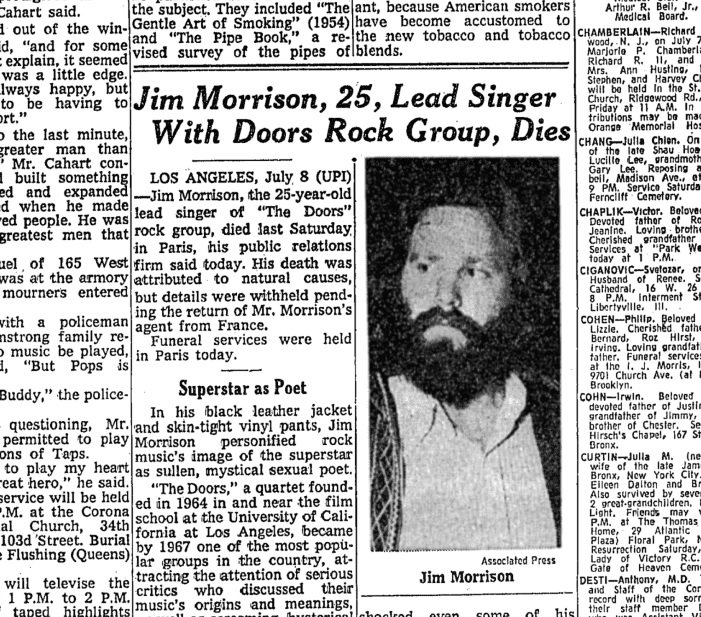
July 3, 1971: Jim Morrison, lead singer of rock band The Doors, dies in Paris. It wasn't publicly announced until July 8, as the circumstances of his death were unusual.

With the release of their self-titled debut album on January 4, 1967, The Doors -- lead singer Morrison, keyboardist Ray Manzarek, guitarist Robbie Krieger and drummer John Densmore -- merged the influences of rock and roll, jazz and classical music, and Morrison's interest in older literature and poetry for their lyrics, to form one of the most spectacular bands of all time.

Morrison's looks, stage presence and lyrics made them stand out. Krieger wrote the lyrics to their hits "Light My Fire," "Love Me Two Times," "Touch Me" and "Love Her Madly," but Morrison wrote most of the others.
The Doors during their controversial appearance
on The Ed Sullivan Show, September 17, 1967.
L to R: John Densmore, Robbie Krieger, Jim Morrison, Ray Manzarek.

But Morrison was an alcoholic and a user of psychedelic drugs, and as they went along -- releasing Strange Days later in 1967, Waiting for the Sun in 1968, The Soft Parade in 1969, Morrison Hotel/Hard Rock Cafe in 1970, and L.A. Woman in 1971 -- he became more controversial and less reliable.

Much like a later Los Angeles-based band, Guns N' Roses, a Doors concert was unpredictable: You never knew when the lead singer was going to join with the others to give you a transcendent experience, or when he was going to start a riot, or whether he was going to show up at all.

On September 18, 1970, another of the icons of psychedelic rock, Jimi Hendrix, died as a result of mixing drugs and alcohol. When asked for her thoughts on it, bluesy rock singer Janis Joplin said, "There but for the grace of God go I." She wasn't kidding. She died just 16 days later.

When he found out about Jimi's death, Morrison asked his friends, "Do you believe in omens?" Like Janis, he didn't take the hint. When Janis died, Jim told his friends, "Believe it or not, you're drinking with number three."

In March 1971, Morrison left Los Angeles for Paris, the adoptive home of so many writers and composers he'd admired, in the hopes of getting away from L.A., clearing his mind, and getting ready to make great art again. By this point, he had gotten fat, and had started using harder drugs like heroin. He was joined by Pamela Courson, his longtime girlfriend.

At first, the sabbatical seemed to work. He wrote of taking long walks through the great city. He lost weight, including some of the puffiness in his face that had led him to grow a beard.

But on July 3, at around 6:00 AM local time, Pam found Jim in the bathtub, dead. She said he seemed to be looking up, with a smile and a look of peace on his face. He had seemed to celebrate death in some of his songs, and now he had achieved it. He seemed not to have found peace in life. I hope he found it in the afterlife.

No autopsy was performed. The official cause of death was heart failure, which was possible, considering his weight gain and his heavy drinking. It has been speculated that the real cause was an accidental heroin overdose. It has also been rumored that his death was faked, and that he went elsewhere, to live out his years in obscurity, away from prying eyes. Pam definitely died from heroin, 3 years later.

Jimi Hendrix, Janis Joplin, Jim Morrison. All 3 of them, dead within 10 months. All of 3 of them, dead at the age of 27. (The New York Times, who relegated Jim's death to a minor Page 1 story, mistakenly listed him as 25.) This gave rise to the idea of rock and roll's "27 Club."
Pamela died on April 25, 1974, from a heroin overdose in Los Angeles. She, too, was 27 years old. Ray Manzarek died of cancer in 2013, at the age of 77. As of July 3, 2022, the other 2 Doors are still alive: Robbie Krieger is 76, while John Densmore is 77.

*

July 3, 1971 was a Saturday. Actor Benedict Wong was born. So was arch-criminal Julian Assange.

It was the off-season for the NFL, the NBA, the ABA and the NHL. But there was a full slate of Major League Baseball games that day:

* The New York Yankees beat the Boston Red Sox, 2-1 at Fenway Park in Boston. Luis Tiant allowed only 3 hits, but 1 was a home run by Roy White. Fritz Peterson was the winning pitcher.

* The New York Mets beat the Atlanta Braves, 7-1 at Shea Stadium. Hank Aaron went 1-for-4 with an RBI, and Mike Lum hit a home run to help knock Gary Gentry out of the box in the 1st inning.

* The Philadelphia Phillies beat the Montreal Expos, 6-3 at Jarry Park in Montreal.

* The Washington Senators beat the Cleveland Indians, 4-3 at Cleveland Municipal Stadium.

* The Baltimore Orioles beat the Detroit Tigers, 8-1 at Tiger Stadium in Detroit. Merv Rettenmund hit a home run, Brooks Robinson went 2-for-4 with an RBI, Frank Robinson went 0-for-4 but drew a walk, and Paul Blair went 2-for-2 with 2 walks and 4 RBIs. For the Tigers, Jim Northrup hit a home run, but Al Kaline went 0-for-4.

* The Chicago Cubs beat the Pittsburgh Pirates, 3-1 at Wrigley Field in Chicago. Ernie Banks did not play for the Cubs, but Don Kessinger hit a home run. For the Pirates, Roberto Clemente went 1-for-4, but Willie Stargell went 0-for-3.

* The Minnesota Twins beat the Milwaukee Brewers, 7-1 at Milwaukee County Stadium. Harmon Killebrew went 0-for-4, but had an RBI on a groundout. Rod Carew went 2-for-5 with an RBI.

* The Chicago White Sox beat the Kansas City Royals, 1-0 at Kansas City Municipal Stadium. Tommy John pitched a 6-hit shutout.

* The Houston Astros beat the Cincinnati Reds, 4-3 at the Astrodome in Houston. Jack Hiatt singled home the winning run in the 13th inning. Pete Rose went 3-for-4 with 2 walks, and Johnny Bench went 1-for-6.

* The Los Angeles Dodgers beat the San Diego Padres, 1-0 at San Diego Stadium. (It was later renamed Jack Murphy Stadium, Qualcomm Stadium and SDCCU Stadium.) Al Downing outdueled Dave Roberts, pitching a 6-hit shutout.

* The Oakland Athletics beat the California Angels, 5-3 at Anaheim Stadium (now Angel Stadium of Anaheim). Reggie Jackson went 1-for-4.

* And the San Francisco Giants beat the St. Louis Cardinals, 10-1 at Candlestick Park in San Francisco. For the Giants, Chris Speier, Bobby Bonds and Ken Henderson hit home runs; Willie Mays went 1-for-3 with 2 walks, and Willie McCovey did not play. Steve Carlton got knocked out in the 6th inning. Lou Brock went 0-for-3 with a walk, and Joe Torre went 0-for-4.

Friday, May 20, 2022

May 20, 1964: The Death of The Drifters' Rudy Lewis

May 20, 1964: Rudy Lewis dies of a drug overdose in Harlem. He was 27 years old, an early member of what became rock and roll's "27 Club."

Charles Rudolph Harrell was born on August 23, 1936 in Philadelphia. Like Sam Cooke did with The Soul Stirrers, he switched from gospel music to rock and roll, as 1 of only 2 men ever to sing with the otherwise all-female Clara Ward Singers.

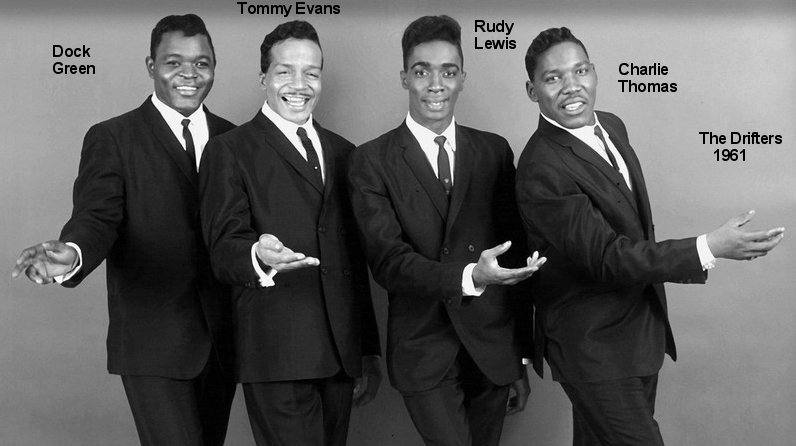
In 1961, he succeeded Ben E. King, who had begun a solo career, as the lead singer of The Drifters. He sang lead on such hits as "Some Kind of Wonderful," "Up On the Roof" and "On Broadway." He didn't sound much like King, but his voice worked well with groupmates Charlie Thomas, Dock Green and Elsbeary Hobbs, and the orchestral backing the group usually had, among the first rock and roll groups to mix with classical music.

In 1962, Hobbs was drafted into the U.S. Army, and Tommy Evans of the original Drifters was brought back. That same year, Dock Green left, and was replaced by Eugene Pearson of The Cleftones. In 1963, Evans left again, replaced by Johnny Terry, who had been one of James Brown's Famous Flames and had, with Brown, written Brown's 1st hit, "Please, Please, Please."

Lewis was found the morning after his death, the day the group was supposed to record a song that was something of a sequel to "Up On the Roof": "Under the Boardwalk." Johnny Moore, who had been in the group in its original version, led by Clyde McPhatter, was brought back to sing lead on that song.

In 1965, The Drifters appeared on a special hosted by New York disc jockey Murray "The K" Kaufman for NET, the predecessor of PBS. They sang "Up On the Roof" on an apartment rooftop in Lower Manhattan. But it was Johnny Moore singing lead for that recording, not Rudy Lewis.

The group had one more notable hit, "Saturday Night at the Movies," later in 1964. George Treadwell, who had managed the group from its 1953 start, died in 1967. Without his control, it got to the point where pretty much every man who had ever been in The Drifters was going around the country with his own group, and calling it "The Drifters," whether it was legal or not.

Clyde McPhatter died in 1972, Tommy Evans in 1984, Dock Green in 1989, Elsbeary Hobbs in 1996, Johnny Moore in 1998, Jimmy Lewis in 2004, Johnny Terry in 2005, Bill Pinkney (last survivor of the original Drifters) in 2007, Ben E. King in 2015, and Bobby Hendricks early in 2022. As of May 20, 2022, Charlie Thomas is the last surviving key member. (UPDATE: He died in 2023.)

*

May 20, 1964 was a Wednesday. These baseball games were played that day:

* The New York Yankees lost to the Minnesota Twins, 7-4 at Yankee Stadium. Camilo Pascual outpitched Ralph Terry. Harmon Killebrew hit 2 home runs, and Tony Oliva hit 1. For the Yankees, Johnny Blanchard hit a home run. Mickey Mantle went 1-for-3 with a walk. Roger Maris went 2-for-4.

* The New York Mets lost to the Los Angeles Dodgers, 4-1 at Dodger Stadium in Los Angeles. Nick Willhite outpitched Ron Locke. 

* The Boston Red Sox beat the Los Angeles Angels, 4-3 at Fenway Park in Boston. Carl Yastrzemski went 0-for-2 with 2 walks.

* The Baltimore Orioles beat the Kansas City Athletics, 8-3 at Memorial Stadium in Baltimore. Brooks Robinson went 1-for-3 with 3 RBIs.

* The Washington Senators beat the Detroit Tigers, 10-3 at District of Columbia Stadium (later Robert F. Kennedy Stadium) in Washington. John Kennedy (a black player, and no relation to JFK or RFK) hit 2 home runs. Al Kaline went 2-for-4.

* The Milwaukee Braves beat the Cincinnati Reds, 7-3 at Crosley Field in Cincinnati. Joe Torre hit a home run. Hank Aaron went 1-for-3 with 2 walks. Frank Robinson hit a home run.

* The St. Louis Cardinals beat their arch-rivals, the Chicago Cubs, 1-0 at the 1st Busch Stadium (formerly the last Sportsman's Park) in St. Louis. Bob Gibson allowed 4 hits and no walks, striking out 12, to outpitch Larry Jackson. 

* The Pittsburgh Pirates beat the Houston Colt .45s, 4-3 at Colt Stadium in Houston. Roberto Clemente did not play. The Colts became the Houston Astros the next season.

* The Philadelphia Phillies beat the San Francisco Giants, 7-2 at Candlestick Park in San Francisco. Dick Allen, Johnny Callison and Wes Covington hit home runs for the Phillies. For the Giants, Willie Mays went 0-for-3 with a walk.

* And the Chicago White Sox and the Cleveland Indians were not scheduled.

Sunday, April 24, 2022

April 24, 1975: The Death of Pete Ham of Badfinger

April 24, 1975: Pete Ham, the lead singer of the British rock band Badfinger, commits suicide. Like a few other rock stars, he was dead at the age of 27.

Badfinger were formed in Swansea, Wales in 1961, when the members were in their early teens. They were comprised of Ham, bass guitarist Tom Evans, rhythm guitarist Joey Molland, and drummer Mike Gibbins. Ham and Evans wrote most of the group's hits.

In 1970, Badfinger had their 1st hit, "Come and Get It," which Beatle Paul McCartney had written for the film The Magic Christian." Later in the year, the band released their album No Dice. It contained the hit "No Matter What," and a song that would later be a Number 1 hit for Harry Nilsson, and again 20 years later for Mariah Carey: "Without You."

Their next album, Straight Up, in 1971, produced the big hit ballad "Day After Day." After a dispute with the Beatles' Apple Records, their last album with them, in 1973, was titled Ass, and featured a donkey on the cover. It contained the cheekily-titled single "The Apple of My Eye." The band then signed with Warner Brothers Records.

Depressed over money troubles, Ham hanged himself in his studio in Woking, Surrey, England. He was 3 days short of turning 28, and thus, at the very least, avoiding the "27 Club." Evans, who fell out with Molland over the group's royalties, also hanged himself, in his garden in London in 1983. Gibbins died of a brain aneurysm in 2005. As of April 24, 2022, Molland is the last survivor.

UPDATE: Molland died on March 1, 2025, of diabetes, in the Minneapolis suburb of St. Louis Park, Minnesota. He was 77, and had moved to the Twin Cities after marrying an area native.

*

April 24, 1975 was a Thursday. These 7 games were played in Major League Baseball:

* The Cincinnati Reds beat the Atlanta Braves, 11-3 at Atlanta-Fulton County Stadium. Jack Billingham outpitched Phil Niekro. Pete Rose went 1-for-5. Johnny Bench went 2-for-5 with 3 RBIs.

* The Chicago Cubs beat the Philadelphia Phillies, 4-1 at Wrigley Field in Chicago. Steve Stone outpitched Jim Lonborg. Mike Schmidt went 0-for-4.

* The Chicago White Sox beat the Minnesota Twins, 4-3 at Metropolitan Stadium in the Minneapolis suburb of Bloomington, Minnesota. Rod Carew did not play.

* The San Francisco Giants beat the Houston Astros, 6-5 at the Astrodome in Houston.

* The Texas Rangers beat the California Angels, 5-0 at Anaheim Stadium (now Angel Stadium of Anaheim). Jackie Brown pitched a 5-hit shutout, outpitching Nolan Ryan, who struck out 8 and walked 4. In other words, a typical game for Ryan.

* The Los Angeles Dodgers beat the San Diego Padres, 11-6 at San Diego Stadium (later Jack Murphy Stadium and Qualcomm Stadium). Dave Winfield went 4-for-5 with a home run and 5 RBIs.

* And the Oakland Athletics beat the Kansas City Royals, 3-2 at the Oakland Coliseum. Reggie Jackson went 2-for-4 with an RBI. Harmon Killebrew, playing out the string with the Royals, went 0-for-3 with a walk. George Brett went 1-for-4.

Football was out of season. There were 2 games in the NBA Playoffs. The Boston Celtics beat the Houston Rockets, 128-115 at the Boston Garden. And the Golden State Warriors beat the Seattle SuperSonics, 105-96 at the Seattle Center Coliseum.

And there was 1 game in the ABA Playoffs: The Indiana Pacers beat the Denver Nuggets, 118-112 at the Market Square Arena in Indianapolis. George McGinnis had 33 points and 21 rebounds.

There was one game in the NHL's Stanley Cup Playoffs: The New York Islanders beat the Pittsburgh Penguins, 4-1 at the Nassau Coliseum.

And there was one game in the World Hockey Association's Playoffs: The Minnesota Fighting Saints beat the Quebec Nordiques, 5-3 at Le Colisée de Québec.

Saturday, April 23, 2022

April 23, 1915: The Death of Rupert Brooke

April 23, 1915: Rupert Brooke, already an admired poet, dies in the service of the Royal Navy, on a hospital ship in the Aegean Sea -- not from combat injuries, but from an infected mosquito bite. This was the era before antibiotics. He was only 27, and was buried on the nearby Greek island of Skyros.

Rupert Chawner Brooke was born on August 3, 1887 in Rugby, Warwickshire, England -- the town with the private school of the same name, where the sport of the same name was allegedly invented. Brooke attended the Rugby School, and King's College of Cambridge University.

At Cambridge, the Bloomsbury Group of writers was formed in 1912. Many of them, including Brooke, E.M. Forster and Virginia Woolf, were gay, some of them entering marriages of convenience that both parties understood to be open marriages.

He enlisted in the Royal Navy when World War I broke out in 1914. Having already had poems published in The Westminster Gazette, The Times Literary Supplement -- with the approval of the British government, which might have censored them had they not been complementary to the nation and its troops -- began publishing his war poems.

Brooke sailed with the British Mediterranean Expeditionary Force on February 28, 1915, but developed severe gastroenteritis while stationed in Egypt, followed by streptococcal sepsis from an infected mosquito bite. Antibiotics, which could have saved so many in World War I, had not yet been discovered.

French surgeons carried out two operations to drain the abscess, but he died of septicemia on April 23, on a French hospital ship. As the expeditionary force had orders to depart immediately, Brooke was buried in an olive grove on Skyros. His brother, William Alfred Cotterill Brooke, was killed on the Western Front on June 14.

Yes, that photo really is of Brooke. It's not Hugh Grant playing him in a movie. In fact, as of 2022, there is no film biography of him. Which is a little odd, since he was one of the earliest well-known creative artists to have died at the specific age of 27.

Among those that preceded him in the "27 Club" were Brazilian composer Alexandre Levy, of an unknown illness in 1892; Louis Chauvin, a ragtime composer from St. Louis, of neurosyphilitic sclerosis in 1908; and George Trakl, an Austrian poet, of a cocaine overdose in 1914.

*

April 23, 1915 was a Friday. This was early in the 2nd of the 2 seasons of 3 major leagues. In the American League:

* The Detroit Tigers beat the Cleveland Indians, 8-4 at League Park in Cleveland. Ty Cobb went 1-for-3 with 2 walks and a stolen base. Shoeless Joe Jackson went 0-for-5 for the Indians.

* The Chicago White Sox beat the St. Louis Browns, 4-3 at Comiskey Park in Chicago. Eddie Collins went 0-for-1 with 3 walks.

* The Boston Red Sox and the Philadelphia Athletics were rained out at Fenway Park in Boston. The game was made up as part of a doubleheader on June 30. The Sox swept, 10-5 and 10-7. Over the 2 games, Tris Speaker went 4-for-6 with 3 walks and an RBI. Babe Ruth, a rookie at the time, did not appear in either game.

* And the New York Yankees and the Washington Senators were rained out at the Polo Grounds. The game was made up as part of a doubleheader on July 3. The Senators won the opener, 8-7. George McBride hit a home run in the top of the 11th inning, and Walter Johnson came in to pitch the bottom of the 11th, getting the save, not that anybody knew what a "save" was back then. Johnson then started the nightcap, which the Yankees won, 4-1, as "The Big Train" was outpitched by Ray Caldwell.

In the National League:

* The Philadelphia Phillies beat the Boston Braves, 2-1 at Baker Bowl in Philadelphia. George "Possum" Whitted went 3-for-3, but both Phils runs came in the 3rd inning, on a double by Fred Luderus.

It was the Phillies' 8th straight win to open the season. The Braves beat them the next day, but the Phils went on to win their 1st Pennant, succeeding the Braves as NL Champions.

* The Cincinnati Reds beat the Pittsburgh Pirates, 2-1 at Forbes Field in Pittsburgh. Ivan "Ivy" Olson went 3-for-3 with a walk. Honus Wagner went 1-for-3 with a walk and a stolen base. He was 41 years old.

* The Chicago Cubs beat the St. Louis Cardinals, 8-4 at Robison Field in St. Louis. The interregnum where the Cubs' biggest rivals were the Giants had ended, and the Cards retook their former place as such.

* The Brooklyn Robins (as the Dodgers were known during Wilbert Robinson's managing of them, 1914 to 1931) and their arch-rivals, the New York Giants, were rained out at Ebbets Field. The game was made up as part of a doubleheader on July 3. The Robins won the 1st game, 2-1. The Giants won the 2nd game, 4-3.

And in the Federal League:

* The FL's 2 New York Tri-State Area teams played each other, with the Brooklyn Tip-Tops beating the Newark Peppers, 9-5 at Harrison Park in Harrison, New Jersey, across the Passaic River from Newark. Steve Evans went 3-for-5 with 2 RBIs for Brooklyn.

* The Baltimore Terrapins beat the Buffalo Blues, 6-5 at Federal League Park in Buffalo.

* The Pittsburgh Rebels beat the St. Louis Terriers, 5-2 at Handlan's Park in St. Louis. Former Detroit Tigers star Davy Jones went 3-for-5 with an RBI.

* And the Chicago Whales and the Kansas City Packers were rained out at Gordon and Koppel Field in Kansas City. The game was made up as part of a doubleheader 2 days later, a Sunday. The Whales won the 1st game, 10-3. The Packers won the 2nd game, 4-2.

Saturday, February 12, 2022

February 12, 1944: The Tragedy of "Mairzy Doats"

February 12, 1944: Joe McMichael dies in service in World War II. Not in combat: He was ill, and given an accidental overdose of Sulfa, which had become one of the wonder drugs of the war, saving lives that would ordinarily have been lost. This time, it backfired. He was 27 years old -- not quite the earliest member of "The 27 Club" (blues singer Robert Johnson died in 1938), but close.

You've probably never heard of Joe McMichael. Or of his brothers, Judd and Ted. Or of the female singer they added in 1933, Cheri McKay. Together, the Minneapolis natives sang as the Merry Macs. They had a series of "girl singers": In 1936, McKay was replaced by Helen Carroll; in 1939, Mary Lou Cook; in 1942, Marjory Garland; in 1946, Imogene Lynn; and in 1947, Garland returned.

They sang on some of the biggest hits of the World War II years: 1939 versions of "Down By the Old Mill Stream" and "I'm Forever Blowing Bubbles," the 1942 version of "Deep In the Heart of Texas," "Praise the Lord and Pass the Ammunition," and backing up Doris Day on the 1945 Number 1 hit "Sentimental Journey."

By that point, the Macs had recorded the song by which they would be best known, but had also lost Joe.

In 1943, Milton Drake, Al Hoffman and Jerry Livingston wrote "Mairzy Doats." Hoffman gave the song to Al Trace, a friend who led the Silly Symphonists, who recorded it. The Merry Macs also recorded it, and had the biggest hit version.

The lyrics make no sense, at first: 

Mairzy doats and dozy doats and liddle lamzy divey
A kiddley divey too, wouldn't you?

But the narrator goes on to explain:

If the words sound queer and funny to your ear, a little bit jumbled and jivey,
Sing, "Mares eat oats and does eat oats and little lambs eat ivy.
A kid will eat ivy, too; wouldn't you?"
In this case, a "kid" is a baby goat.

So the Macs had a huge hit with it, but Joe was already in the service. After Joe's death, he was replaced by Clive Erard, then Dick Baldwin, and finally Vern Rowe. The foursome of Judd, Ted, Marjory, and Vern continued performing until Judd retired from show business in 1964.

Drake also wrote "Java Jive." Among Hoffman's other songs were "I'm Gonna Live Until I Die," "I Apologize," "Hot Diggity" and "Allegheny Moon." Livingston wrote several songs for Disney films, including "Bibbidi-Bobbidi-Boo" for Cinderella. Among his other hits were "It's the Talk of the Town," "Wake the Town and Tell the People" and "The Twelfth of Never." He and Hoffman wrote a song titled "Close to You" for Frank Sinatra, which should not be confused with the later song of that title, written by Hal David and Burt Bachrach, and sung by The Carpenters.

Al Hoffman lived until 1960, Jerry Livingston until 1987, Judd McMichael until 1989, Marjory Garland until 1991, Ted McMichael until 2001, Imogene Lynn until 2003, Milton Drake until 2006, Mary Lou Cook until 2008, and Helen Carroll until 2011. I can't find a date of death for Cheri McKay, though.

*

February 12, 1944 was a Saturday. Baseball and football were out of season. The NBA hadn't been founded yet. There was 1 game in the NHL: The Montreal Canadiens beat the Toronto Maple Leafs, 3-2 at Maple Leaf Gardens in Toronto.

Tuesday, February 1, 2022

February 1, 1995: The Disappearance of Richey Edwards

February 1, 1995: Richey Edwards leaves his apartment in Cardiff, Wales, and is never definitively seen again. The guitarist for the band Manic Street Preachers was 27. (Yes, there's that age, claiming a rock star again.) He had been dealing with depression through alcoholism and self-harm, and the leading theory, disputed by many, is that he jumped off a bridge.

He may not have died that day. A taxi driver reported picking up a man who fit his description on February 7. On February 14, his car, apparently lived in, was ticketed at the Severn View services (rest area) on the M48 motorway in Gloucestershire, England, across the Severn Bridge from his hometown of Cardiff. The bridge had been known for its suicide jumpers. But he might not have jumped. There have been reported sightings of him in Spain's Canary Islands and in India.

Manic Street Preachers, or just "The Manics," released their debut album, Generation Terrorists, in 1992. Their 1st single was "Stay Beautiful" -- which came out 15 years before Taylor Swift had a song by the same title. (See also: "Carey, Mariah, 'Shake It Off'"; "Sedaka, Neil, 'Bad Blood'")

The Manics were about to tour America in support of their 3rd album, The Holy Bible, for which Edwards had written the majority of the lyrics, when Edwards disappeared. They became considerably more famous outside Britain as a result of his disappearance: Their best-known song, "If You Tolerate This Your Children Will Be Next" came in 1998, so Edwards had nothing to do with it... unless somebody's keeping a big secret.

*

February 1, 1995 was a Wednesday. Baseball was out of season. Football season ended the preceding Sunday, with the San Francisco 49ers beating the San Diego Chargers in the Super Bowl. There were 10 games played in the NBA:

* The New Jersey Nets beat the Milwaukee Bucks, 95-77 at the Brendan Byrne Arena at the Meadowlands.

* The Charlotte Hornets beat the Boston Celtics, 100-93 at the Boston Garden.

* The Philadelphia 76ers beat the Washington Bullets, 98-89 at The Spectrum in Philadelphia.

* The Atlanta Hawks beat the Golden State Warriors, 111-99 at The Omni in Atlanta.

* The Miami Heat beat the Detroit Pistons, 98-75 at the Miami Arena.

* The Indiana Pacers beat the Cleveland Cavaliers, 101-82 at the Market Square Arena in Indianapolis.

* The Dallas Mavericks beat the Minnesota Timberwolves, 104-83 at the Target Center in Minneapolis.

* The Utah Jazz beat their arch-rivals, 129-88 at the Delta Center in Salt Lake City, Utah.

* The Phoenix Suns beat the Los Angeles Lakers, 118-109 at the America West Arena (now the Mortgage Matchup Center) in Phoenix.

* And the San Antonio Spurs beat the Portland Trail Blazers, 111-107 at the Veterans Memorial Coliseum in Portland, Oregon. David Robinson scored 34 points and grabbed 19 rebounds.

And there were 6 games played in the NHL:

* The New York Rangers lost to the Pittsburgh Penguins, 4-3 at the Civic Arena in Pittsburgh.

* The Hartford Whalers lost to the Ottawa Senators, 2-1 at the Ottawa Civic Centre (now the TD Place Arena).

* The Dallas Stars beat the Mighty Ducks of Anaheim, 9-2 at the Reunion Arena in Dallas.

* The Calgary Flames beat the Detroit Red Wings, 2-1 at the Saddledome in Calgary.

* The Chicago Blackhawks beat the Edmonton Oilers, 7-0 at the Northlands Coliseum in Edmonton.

* And the Toronto Maple Leafs and the Vancouver Canucks played to a tie, 4-4 at the Pacific Coliseum in Vancouver.

And Arsenal, the North London soccer team I would eventually come to support, played the 1st leg of the European Super Cup, between the holders of the European Cup, the UEFA Champions League, AC Milan, and the holders of the European Cup Winners' Cup, Arsenal, at the Arsenal Stadium, a.k.a. Highbury for its North London neighborhood. The Gunners and the Rossoneri played to a 0-0 draw. The following week, at the San Siro in Milan, Milan won, 2-0, to take the Cup.

December 31, 1999 & January 1, 2000: The Millennium

December 31, 1999:  The Millennium arrives. The people of planet Earth survived. At a terrible cost. But we hadn't destroyed ourselves. ...