Showing posts with label woodstock. Show all posts

Tuesday, October 4, 2022

October 4, 1970: Janis Joplin Dies

October 4, 1970: Janis Joplin dies of a heroin overdose at the Landmark Motor Hotel in Los Angeles. She was 27 years old.

She had starred at the Monterey Pop Festival in California in 1967, became a symbol of the Hippie era, and had also played Woodstock. Jimi Hendrix had done each of these things as well. He died on September 16, as a result of mixing drugs and alcohol. When asked for her thoughts on his death, Janis said, "There but for the grace of God go I."

She wasn't kidding. She died just 16 days later.

When he found out about Jimi's death, Jim Morrison, the lead singer of The Doors, himself a hippie icon with a booze problem and a drug problem, asked his friends, "Do you believe in omens?" Like Janis, he didn't take the hint. When Janis died, Jim told his friends, "Believe it or not, you're drinking with number three."

If any of those friends tried to get him to stop, it didn't take. Nine months after Jimi and Janis, Jim Morris was dead, too. All 3 of them died at the age of 27, giving rise to the idea of rock and roll's "27 Club."

*

October 4, 1970 was a Sunday. The NBA, the ABA and the NHL were still a few days away from starting their new seasons. But Major League Baseball had begun its Playoffs:

* In Game 2 of the American League Championship Series, the Baltimore Orioles beat the Minnesota Twins, 11-3 at Metropolitan Stadium in the Minneapolis suburb of Bloomington, Minnesota. It was only 4-3 O's going into the 9th inning, but the Birds scored 7 runs to put it away. Frank Robinson and David Johnson hit home runs for Baltimore, and Harmon Killebrew and Tony Oliva did so for Minnesota.

* In Game 2 of the National League Championship Series, the Cincinnati Reds beat the Pittsburgh Pirates, 3-1 at Three Rivers Stadium in Pittsburgh. Bobby Tolan hit a home run for the Big Red Machine. Pete Rose went 0-for-4, and Johnny Bench went 0-for-3 with a walk, but they weren't needed. Roberto Clemente went 1-for-4 with an RBI, and Willie Stargell went 0-for-4.

Baltimore and Cincinnati would clinch their Leagues' respective Pennants the next day, each completing a 3-game sweep.

*

And there were NFL games that day: 

* The New York Giants lost to the New Orleans Saints, 14-10 at Tulane Stadium in New Orleans. It was 1 of only 2 games the Saints would win all season, the other coming on November 8, when they beat the Detroit Lions at home, on the last play of the game, a record-setting 63-yard field goal by Tom Dempsey.

* The New York Jets lost to the Buffalo Bills, 34-31 at War Memorial Stadium in Buffalo.

* The Baltimore Colts beat the Boston Patriots, 14-6 at Harvard Stadium in Boston. The next season, the Patriots would move to Foxborough, Massachusetts, and change their name to the New England Patriots.

* The Washington Redskins beat the Philadelphia Eagles, 33-21 at Franklin Field in Philadelphia.

* The Atlanta Falcons beat the San Francisco 49ers, 21-20 at Atlanta (later Atlanta-Fulton County) Stadium.

* The Houston Oilers beat the Cincinnati Bengals, 13-10 at Riverfront Stadium in Cincinnati.

* The Green Bay Packers beat the Minnesota Vikings, 13-10 at Milwaukee County Stadium.

* The St. Louis Cardinals beat the Dallas Cowboys, 20-7 at Busch Memorial Stadium in St. Louis.

* The Denver Broncos beat the Kansas City Chiefs, 26-13 at Mile High Stadium in Denver.

* The Los Angeles Rams beat the San Diego Chargers, 37-10 at the Los Angeles Memorial Coliseum.

You'll notice that this accounts for 20 of the 26 teams then in the newly-merged NFL. On Saturday, October 3, the Miami Dolphins beat the Oakland Raiders, 20-13 at the Orange Bowl in Miami. And the Cleveland Browns beat the Pittsburgh Steelers, 15-7 at Cleveland Municipal Stadium.

And, on October 5, in the new phenomenon of ABC Monday Night Football, which had begun just 2 weeks earlier, the Detroit Lions beat the Chicago Bears, 28-14 at Tiger Stadium in Detroit.

Sunday, September 18, 2022

September 18, 1970: Jimi Hendrix Dies

September 18, 1970: Jimi Hendrix dies in his apartment at the Samarkand Hotel in London. He was just 27 years old. Often called the greatest guitarist in rock and roll history, he made the mistake of mixing alcoholic beverages and barbiturates.

Just 15 months earlier, just 3 miles away across Hyde Park, Judy Garland had made the same mistake, and died at age 47. She had already been through tough times for most of her life, little of which was of her own making, and looked considerably older. It wasn't hard to imagine that her story had come to an end.

But Hendrix was still in his prime, and apparently healthy. He had released 4 albums, all of them considered "instant classics." With the Jimi Hendrix Experience, he had released Are You Experienced and Axis: Bold as Love in 1967, and Electric Ladyland in 1968. With Band of Gypsys, he had released an album of the same title only 6 months earlier.

I have never been a fan of his -- the version of "The Star-Spangled Banner" he played as he closed the Woodstock festival a year earlier particularly bothers me -- but it's clear that he had more to say. It's not hard to imagine him going through the 1970s, working, experimenting, finding new things that worked (and some things that didn't), much in the same way that Miles Davis, David Bowie and Lou Reed did. It's also easy to imagine him approaching age 50, in 1992, by making a cultural shift like Davis and Paul Simon did. (Indeed, Miles attended his funeral in Seattle.) But we'll never know.

When asked for her thoughts on the death of Hendrix, who had starred at the Monterey Pop Festival in California in 1967, became a symbol of the Hippie era, and had also played Woodstock, all things she had also done, Janis Joplin said, "There but for the grace of God go I."

She wasn't kidding: She, too, had a drug problem. She died just 16 days later.

When he found out about Jimi's death, Jim Morrison, the lead singer of The Doors, himself a hippie icon with a booze problem and a drug problem (but hadn't played either Monterey or Woodstock), asked his friends, "Do you believe in omens?" Like Janis, he didn't take the hint. When Janis died, Jim told his friends, "Believe it or not, you're drinking with number three."

If any of those friends tried to get him to stop, it didn't take. Nine months after Jimi and Janis, Jim Morrison was dead, too. All 3 of them died at the age of 27, beginning the idea of rock and roll's "27 Club."

I've read that Jimi Hendrix liked football, but I can't find any reference as to whether he was a baseball fan. He grew up in Seattle, which had a team in the Pacific Coast League, but only played 1 season in the major leagues during his lifetime, 1969, with the American League's Seattle Pilots. They quickly went bankrupt, and moved to become the Milwaukee Brewers in 1970. The Queen City of the Northwest didn't rejoin the major leagues until the AL added the Seattle Mariners in 1977.

I once read a list that somebody made up of the best-dressed and worst-dressed athletes. This was in 1980, and Rich Gossage of the Yankees was then one of the top relievers in baseball. Whoever was writing it put the Goose on his worst-dressed list, saying he "has one tie that could have doubled as Jimi Hendrix's headband."

*

September 18, 1970 was a Friday. Actress Aisha Tyler was born.

The NFL played games 2 days later, and the NBA, the ABA, and the NHL started new seasons a few weeks later. But there was an entire slate of Major League Baseball games: 

* The New York Yankees beat the Detroit Tigers, 5-0 at Tiger Stadium in Detroit. A 4-run 1st inning, including a 3-run home run by John Ellis, was all Ron Klimkowski needed, as he pitched 3-hit shutout in one of the best hitter's parks in baseball history.

* The New York Mets lost to the Pittsburgh Pirates, 3-2 at Shea Stadium. Steve Blass outpitched Jim McAndrew.

* The Chicago Cubs swept a doubleheader from the Montreal Expos at Jarry Park in Montreal. In the opener, Fergie Jenkins won his 20th game of the season, and the Cubs won 3-2. In the nightcap, Ron Santo singled in the winning run in the top of the 10th, and the Cubs won 5-4. Ernie Banks did not appear in the 1st game, and only appeared in the 2nd as a pinch-hitter, unsuccessfully.

* The Baltimore Orioles beat the Cleveland Indians, 4-3 at Memorial Stadium in Baltimore. Don Baylor singled home a run in the bottom of the 11th inning to win it for the Birds. Neither Brooks Robinson nor Frank Robinson played.

* The Cincinnati Reds beat the Atlanta Braves, 11-6 at Atlanta (later Atlanta-Fulton County) Stadium. For the Reds, Pete Rose went 1-for-5 with 2 RBIs, Johnny Bench went 1-for-3 with 4 RBIs, and each hit a home run. For the Braves, Hank Aaron went 0-for-2, but did draw 2 walks.

* The Minnesota Twins beat the Chicago White Sox, 5-4 at Comiskey Park in Chicago. Neither Harmon Killebrew nor Rod Carew entered the game.

* The Milwaukee Brewers beat the Kansas City Royals, 4-3 at Milwaukee County Stadium.

* The Philadelphia Phillies beat the St. Louis Cardinals, 9-7 at Busch Memorial Stadium in St. Louis.

* The San Francisco Giants beat the San Diego Padres, 3-2 at San Diego Stadium. Ken Henderson drove in the winning run with a double in the top of the 10th. Willie Mays went 2-for-5.

* The Los Angeles Dodgers beat the Houston Astros, 3-2 at Dodger Stadium in Los Angeles.

* And the Oakland Athletics beat the California Angels, 3-2 at the Oakland Coliseum. Cliché Alert: Walks can kill you, especially the leadoff variety. The bottom of the 9th began with the game tied and Ken Tatum walking Don Mincher, included a wild pitch that got Mincher, kind of chunky and not fleet of foot, to 3rd base, and intentional walks to Reggie Jackson and Frank Fernandez to load the bases. After Dave LaRoche was brought in to relieve, he struck out Dick Green. But with the bases still loaded, he walked Gene Tenace, and the A's had beaten the Halos.

Monday, August 29, 2022

August 29, 1952: John Cage's "Composition," "4'33"," Premieres

August 29, 1952: David Tudor premieres John Cage's composition 4'33" at the Maverick Concert Hall in Woodstock, Ulster County, New York.

According to Cage, the piece is not "silent": The directions call for it to be for any instrument or combination of instruments, and the score instructs performers to not play their instruments during the entire duration of the piece, throughout the three movements: 4 minutes and 33 seconds. Cage said it "consists of the sounds of the environment that the listeners hear while it is performed."

Since the Town of Woodstock refused to give a permit for the 1969 concert festival that nonetheless bore its name, this remains the biggest musical event ever to take place in the Town.

Cage died in 1992, shortly before his 80th birthday. Peter MacNichol played a lawyer named John Cage on the TV series Ally McBeal, but there appeared to have been no connection: It just sounded like a good name for a lawyer.

*

August 29, 1952 was a Friday. Actress Deborah Van Valkenburgh, who played Mercy in The Warriors Jackie Rush on Too Close for Comfort, was born.

And these 5 baseball games were played:

* The New York Yankees lost to the Washington Senators, 3-2 at Yankee Stadium. Walt Masterson outpitched Vic Raschi. Gil Coan and Jim Busby hit home runs. Johnny Mize hit one for the Yankees. Mickey Mantle went 0-for-3 with a walk, and Yogi Berra went 1-for-4.

* The Brooklyn Dodgers lost to the Chicago Cubs, 4-1 at Wrigley Field in Chicago. Warren Hacker outpitched Preacher Roe. The Dodger run came on a home run by Roy Campanella. Jackie Robinson went 1-for-4.

* The Philadelphia Athletics swept a doubleheader from the Boston Red Sox, 6-1 and 7-5 at Shibe Park in Philadelphia. Ted Williams was serving in the Korean War, and unavailable for the Red Sox.

* And the Cleveland Indians beat the Detroit Tigers, 4-2 at Briggs Stadium (later Tiger Stadium) in Detroit. Bob Lemon outpitched Virgil Trucks, who fell to 5-16 on the season. He would finish 5-19. But 2 of his 5 wins that season were no-hitters. In his previous start, he had pitched the 2nd of them, against the Yankees.

Saturday, August 20, 2022

August 20, 1972: The Wattstax Concert, the Black Woodstock

The Rev. Jesse Jackson (left) and Issac Hayes

August 20, 1972: Stax Records, based in Memphis, hosts a benefit concert at the Los Angeles Memorial Coliseum, to benefit the black community of Los Angeles, centered around the South Central neighborhood of Watts. It is publicized as "Wattstax."

All seats were reserved and priced at only $1.00 each, as Stax wanted to make it possible for anyone to attend. Pre-sales were quite successful, easing concerns about the financial viability of the concert. The crowd was estimated at over 112,000, counting on-field seating.

Dale Warren, the main arranger for Stax Records, began the show at 2:38 PM Pacific Time (5:38 U.S. Eastern), with a composition titled "Salvation Symphony." Kim Weston, formerly of Motown Records, sang "The Star-Spangled Banner."

The Rev. Jesse Jackson gave an invocation, and included a poem, written in 1950, by the Rev. William Holmes Borders, Sr. He paused to allow the crowd to chant, "I am... Somebody!" along with him. "I may be poor... young... on welfare... small... I may have made mistakes... My clothes... my face... my hair is different, but I am... Somebody! I am black, brown, or white. I speak a different language. But I must be respected, protected, never rejected. I am God’s child!"

Having sung the actual National Anthem, Weston then sang "Lift Every Voice and Sing," by James Weldon Johnson, known as "The Black National Anthem." The Staple Singers were the first act. Deborah Manning sang the hymn "Precious Lord, Take My Hand." A few other performers took the stage, leading up to Eddie Floyd singing his 1966 hit "Knock On Wood."

David Porter, who wrote several Stax classics with Isaac Hayes, sang "Reach Out and Touch (Somebody's Hand)," written by Nickolas Ashford and Valerie Simpson as the 1st solo hit for Diana Ross. The Bar-Kays, the reconstituted band of ill-fated Stax singer Otis Redding, played. Carla Thomas, daughter of disc jockey and soul singer Rufus Thomas, and duet partner of Redding's, sang. Blues guitarist Albert King followed her, and he was followed by Rufus Thomas. Luther Ingram sang his current hit "(If Loving You Is Wrong) I Don't Want to Be Right."

As darkness fell, Hayes came on to close the show. It was his 30th birthday. Stripped to the waist, but draped with chains, as he was when he performed the song at the Academy Awards, he performed the theme from the film Shaft. It was the highlight of the show. He followed it with "Soulsville," and "Never Can Say Goodbye," written by minister-actor Clifton Davis, already a hit for The Jackson 5, and later a disco hit for Gloria Gaynor.

Months after the festival, Stax released a double LP of the concert's highlights, Wattstax: The Living Word. The concert was filmed by David L. Wolper's film crew, and was made into the 1973 film titled Wattstax, directed by Mel Stuart. Between the show and the subsequent album and film, It was as close to a "black Woodstock" as the world was going to get.

Wolper would also stage the Opening and Closing Ceremonies of the 1984 Olympics at the Coliseum.

*

August 20, 1972 was a Sunday. These Major League Baseball games were played:

* The New York Yankees beat the Texas Rangers, 2-0 at Arlington Stadium in the Dallas suburb of Arlington, Texas. Bobby Murcer grounded into a fielder's choice in the top of the 10th inning, scoring relief pitcher Sparky Lyle with the winning run. Between them, Rob Gardner and Lyle allowed 6 hits over a 10-inning shutout.

* The New York Mets lost to the Cincinnati Reds, 8-1 at Shea Stadium. Pete Rose went 3-for-5 with a walk and 2 RBIs. Johnny Bench did not play. Willie Mays did, going 1-for-3.

* The Montreal Expos beat the Atlanta Braves, 1-0 at Jarry Park in Montreal. Bill Stoneman pitched a 2-hit shutout. Hank Aaron went 0-for-3 with a walk.

* The Houston Astros beat the Philadelphia Phillies, 3-1 at Veterans Stadium in Philadelphia.

* The Minnesota Twins beat the Baltimore Orioles, 4-1 at Memorial Stadium in Baltimore. Harmon Killebrew did not play. Rod Carew went 1-for-5. Brooks Robinson went 1-for-4.

* The Cleveland Indians beat the Oakland Athletics, 3-1 at Cleveland Municipal Stadium. Reggie Jackson did not play.

* The Detroit Tigers beat the California Angels, 11-9 at Tiger Stadium in Detroit. Al Kaline went 1-for-3 with a walk and an RBI.

* A doubleheader was split at Comiskey Park in Chicago. The Chicago White Sox won the opener, 9-7. The Boston Red Sox won the nightcap, 5-4. Carl Yastrzemski did not play in the opener, but went 1-for-4 with 3 RBIs in the nightcap.

* The Milwaukee Brewers beat the Kansas City Royals, 2-1 at Kansas City Municipal Stadium.

* The Pittsburgh Pirates swept a doubleheader from the San Diego Padres, 9-3 and 5-2 at San Diego Stadium (later Jack Murphy Stadium and Qualcomm Stadium). Roberto Clemente did not play in either game. Willie Stargell went 3-for-7 with a walk and 3 RBIs.

* The Chicago Cubs beat the Los Angeles Dodgers, 5-3 at Dodger Stadium in Los Angeles. In his only season with the Dodgers, Frank Robinson did not play.

* And the San Francisco Giants beat the St. Louis Cardinals, 5-3 at Candlestick Park in San Francisco.

Wednesday, August 17, 2022

August 17, 1969: Woodstock, Day 3

August 17, 1969: The Woodstock Music & Art Fair wraps up on Max Yasgur's dairy farm outside Bethel, Sullivan County, New York.

At 12:30 AM, Creedence Clearwater Revival took the stage. As Bruce Springsteen said when giving their induction speech for the Rock and Roll Hall of Fame, "They were never the coolest band in America, just the best."

Janis Joplin came on at 2:00, not with her original band, Big Brother & The Holding Company, but with The Kozmic Blues Band. Having become famous at the Monterey Pop Festival in California 2 years earlier, here, she cemented her legend for all time.

As did Sly & The Family Stone, who came on at 3:30, and played 50 minutes of psychedelic soul. It was footage of this performance that led jazz legend Miles Davis, already 43 years old, to shift gears, and incorporate rock and roll and psychedelic ideas into his music, giving him one of the great second acts in music history.

Billy Joel was at Woodstock -- not as a performer, but as a fan. A very dissatisfied fan:

I went to Woodstock, and I hated it. I think a lot of that "community spirit" was based on the fact that everybody was so wasted. Because everybody was stoned. Everybody was passing around pot and acid, and I wasn't into it.

There'd been a lot of rain, it was all muddy, and you couldn't go to the bathroom unless you stood up and went right where you were. I was there for a night and a day, and then I left just before The Who went on. I really wanted to see them, but it was very hard to, because everybody was hopping up and down and banging into you. So I walked out and hitched a ride home.

The Who came on at 5:00 in the morning, and gave one of the earliest live performances of songs from their "rock opera," Tommy. By this point, with The Beatles bringing their story to a close, The Rolling Stones were already getting people to call them "The World's Greatest Rock and Roll Band." The Who blew that idea over the Catskills.

According to their lead guitarist and main songwriter, Pete Townshend, at the end of the band's gig at 2 weeks later, at the 1969 Isle of Wight Festival, the field was covered in rubbish left by fans, which inspired the line "teenage wasteland" in their 1971 song "Baba O'Riley." In another interview, Townshend said the song was also inspired by "the absolute desolation of teenagers at Woodstock, where audience members were strung out on acid and 20 people had brain damage. The irony was that some listeners considered the song a teenage celebration: 'Teenage Wasteland, yes! We're all wasted!'

The Sun came up, and so did The Jefferson Airplane. In an interview with Rolling Stone magazine for the Festival's 20th Anniversary in 1989, lead singer Grace Slick said it was the worst performance of her career, and that, "The music was better at Altamont." A sacrilege? Maybe, but she was at both, and was in as good a position as anyone to know.

A break was taken. The show resumed at 2:00 PM, with Joe Cocker and The Grease Band. Among the songs Cocker sang was The Beatles' "With a Little Help From My Friends." They left at 3:25, and then, the rain came back. For 3 hours, no one wanted to take the risk of going on. There was nothing for people to do but endure the rain and the mud -- or, perhaps, play in it.

Country Joe & The Fish played from 6:30 to 8:00. By this point, the show should have been wrapping up, but several acts hadn't yet gone on, and wanted to. Ten Years After then played for an hour. The Band started at 10:00, and lasted 50 minutes.

Come Midnight, Monday, August 18, Johnny Winter, the albino Texas blues guitarist, went on, and played for over an hour, including 3 songs with his brother Edgar, also an albino, and a master of several instruments, as he would prove on his 1973 chart-topping instrumental "Frankenstein," on which he played guitar, keyboards and saxophone. At 1:30, Blood, Sweat & Tears came on, and played for an hour.

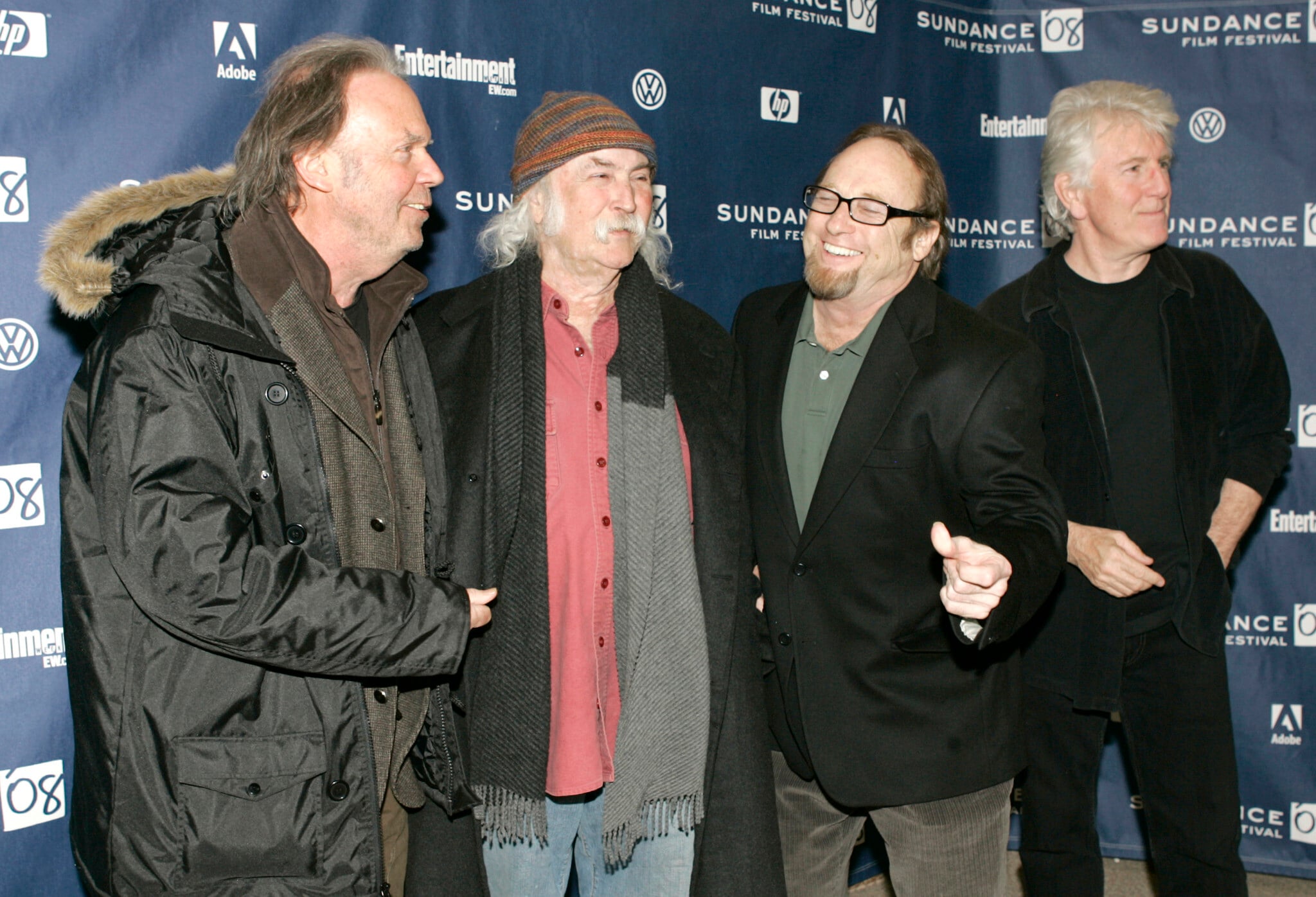
At 3:00, in only their 2nd performance together, came Crosby, Stills, Nash & Young: David Crosby from The Byrds (whose current lineup were invited to play, but turned it down), Graham Nash from The Hollies, and Stephen Stills and Neil Young from The Buffalo Springfield. They played an electric set, then Young left, and Crosby, Stills and Nash sang an acoustic set. In later years, when asked about their signature show, Crosby would call it "The W Word."

People began to drift off. The Paul Butterfield Blues Band started at 6:00, with the Sun coming up. At 7:30, a bunch of Columbia University students who loved doo-wop, calling themselves Sha Na Na, took the stage, and sang for half an hour. Nobody knew it yet, but Woodstock, the ultimate 1960s event, had just given birth to the 1950s nostalgia movement.

By 9:00 AM, there were maybe 200,000 people left, most of them there because they were still waiting for access roads to be open so they could get out. And Jimi Hendrix came on, and played the National Anthem, "The Star-Spangled Banner," like nobody had ever heard it before: A loud, screechy, even ugly performance, which sounded more like the bombing of Vietnam than an expression of American pride. At 11:10 AM, he, and the festival, were done.

The immediate reports on the mainstream news said the whole festival was a disaster, full of rain, mud, drugs, naughty behavior, and bad music. But in the middle of the final full day, the venue's host, dairy farmer Max Yasgur, a proud Republican small businessman, addressed the crowd, and said:

I'm a farmer. I don't know how to speak to twenty people at one time, let alone a crowd like this. But I think you people have proven something to the world. Not only to the Town of Bethel, or Sullivan County, or New York State. You've proven something to the world.

This is the largest group of people ever assembled in one place. We have had no idea that there would be this size group, and because of that you've had quite a few inconveniences as far as water, food, and so forth. Your producers have done a mammoth job to see that you're taken care of... They'd enjoy a vote of thanks.

But above that, the important thing that you've proven to the world is that a half a million kids — and I call you kids because I have children that are older than you are — a half million young people can get together and have three days of fun and music, and have nothing but fun and music, and I God bless you for it!

The legend was born. The reality was... better seen in the movie theaters the following Spring, and experienced on television, and now on the Internet, than live. The cover for the film's soundtrack became a classic. The names of the couple in the blanket were Bobbi Kelly and Nick Ercoline. They married shortly thereafter, and as of August 17, 2022, they are still together. (UPDATE: Bobbi died on March 18, 2023, at age 78.)
Seattle Pilots pitcher Jim Bouton did not mention the Festival in his diary of the 1969 season, published the next year as Ball Four. But in Dog Days: The New York Yankees' Fall from Grace and Return to Glory, 1964-1976, Philip Bashe wrote:

Woodstock forced mainstream America to swallow its antipathy and reexamine some of the counterculture's utopian ideals. Maybe, just maybe, these kids were on to something.

Interestingly, in the process of lauding the festival-goers' conduct, commentators drew frequent comparisons to spectators at sporting events, nothing that if you assembled an equal number of beery bleacherites under similar conditions, they'd probably dismantle the stage and cart off every square inch of turf as souvenirs -- once the brawls subsided, that is.

Though many professional ballplayers belonged to the same generation as the Woodstock crowd, the majority of major-leaguers no more identified with this group and its concerns than did your average middle-age Republican from Peoria. Anytime the Yankees team bus pulled up on a red light in some American League city and someone spied a longhair on the street corner, insults inevitably came hurling out the window.

And Bashe quoted Bouton himself as saying:

Many of the players were feeling the social earthquakes going on in the country. But like a lot of our leaders and politicians, they tended to blame things on these longhaired people with bare feet who didn't bathe and smoked pot.

They said, "That's what's wrong with this country. If it weren't for those hippies, Communists and agitators, the war would be going okay and we wouldn't have civil-rights problems." They saw those people as the problem.

A 10th Anniversary show was held in 1979. The times, they had a-changed too much: Only 1,000 people showed up. The whole world was getting more conservative: Israel elected Menachem Begin and his Likud Party in 1977, the first time a right-of-center party had won there. China, under new "paramount leader" Deng Xiaoping, began its move toward a free-market economy in 1978.

In 1979 alone, Iran had its Islamic Revolution, Britain elected Margaret Thatcher and her Conservatives, and Canada voted out Pierre Trudeau and Liberal Party and voted in Joe Clark, though Clark's Conservative Party government (as in Britain, nicknamed the Tories) quickly fell apart, and Trudeau was voted back in the following year. France elected François Mitterand and his Socialist Party in 1981, but West Germany elected Helmut Kohl and his Christian Democratic Union in 1982.

But, as they always do, the times changed again. The Woodstock organizers tried again in 1994, for the 25th Anniversary, but, ironically, couldn't get the original site. This time, 25 years after rejecting them, the Town of Saugerties said, "Yes," and 250,000 people saw a nice show, with a combination of Woodstock veterans, acts from that period that hadn't played the original show (including Bob Dylan), and more recent acts. By this point, people knew how to properly stage a concert of that size or larger, and there were no logistical issues. There was enough food, enough restroom facilities, enough medical facilities, and no rain.

That should have been the last attempt. Another was made in 1999, on the 30th Anniversary, with mostly current acts, and it was another mess, including several women claiming to have been assaulted. There was no attempt at a 40th Anniversary show in 2009, and an attempt at a 50th Anniversary show in 2019 was canceled in mid-preparation.

In 2006, on the site of Yasgur's Farm, a 15,000-seat outdoor amphitheater opened, the Bethel Woods Center for the Performing Arts. Next-door, the Museum at Bethel Woods tells the story of the area, including the Woodstock Festival. It is 103 miles northwest of Midtown Manhattan -- and 60 miles southwest of Woodstock, New York, the original intended site of the Festival.

In 1988, after a game, I came out of Yankee Stadium, and heard what sounded like the Hendrix version of "The Star-Spangled Banner." It was, and there was a guy on 157th Street, in front of the parking deck, dressed like Hendrix, and playing guitar lefthanded like Hendrix. He was playing it perfectly. But when the song got close to the end, it went back to the beginning. It was a looped tape, and he was faking. The busker still got some change tossed into his guitar case.

*

August 17, 1969 was a Sunday. It was also the day that Hurricane Camille crashed into America's Gulf Coast, and the day the New York football teams, the Giants and the Jets, played each other for the 1st time. I have separate entries for those events. Also, basketball star Christian Laettner and New Kids On The Block singer turned actor Donnie Wahlberg were born on this day.

And these Major League Baseball games played:

* New York Yankees 5, Chicago White Sox 2 at Comiskey Park in Chicago. Jimmie Hall hit a home run for the Bronx Bombers. Stan Bahnsen started, and Mike Kekich won it in relief.

* Another doubleheader at Shea Stadium: The New York Mets beat the San Diego Padres 3-2 in each game. Duffy Dyer hit a home run in support of Jerry Koosman in the opener, and Ed Kranepool and Bud Harrelson each got 2 hits in support of Don Cardwell in the nightcap.

* Houston Astros 3, Philadelphia Phillies 2 at Connie Mack Stadium in Philadelphia.

* Minnesota Twins 4, Washington Senators 3 at Robert F. Kennedy Stadium in Washington. Tony Oliva's RBI single won it in the top of the 13th inning.

* Los Angeles Dodgers 9, Montreal Expos 3 at Jarry Park in Montreal.

* St. Louis Cardinals 5, Atlanta Braves 3 at Atlanta Stadium (later Atlanta-Fulton County Stadium). Hank Aaron, Bob Tillman and Rico Carty hit home runs for the Braves, but all were solo blasts, and Steve Carlton was the winning pitcher for the Cards, as Lou Brock went 2-for-5, and Joe Torre went 1-for-4 with an RBI.

* Pittsburgh Pirates 8, Cincinnati Reds 5 at Crosley Field in Cincinnati. Gene Alley, Al Oliver and Willie Stargell hit home runs. Roberto Clemente went 2-for-5. The Reds got homers from Pete Rose, Bobby Tolan, Johnny Bench and Tony Perez, but it wasn't enough.

* Boston Red Sox 1, Kansas City Royals 0 at Kansas City Municipal Stadium. Carl Yastrzemski went 0-for-4, but Vicente Romo, Sparky Lyle and Sonny Siebert combined for a 4-hit shutout.

* California Angels 7, Cleveland Indians 6 at Anaheim (now Angel) Stadium.

* Detroit Tigers 9, Oakland Athletics 4 at the Oakland Coliseum. Catfish Hunter was knocked out of the box in the 4th inning, as the Tigers got 2 homers from Al Kaline, and 1 each from Jim Northrup, Don Wert, former Yankee Tom Tresh and Mickey Stanley. Denny McLain went the distance, despite giving up a home run to Reggie Jackson.

* Doubleheader at Candlestick Park in San Francisco. 1st game: San Francisco Giants 5, Chicago Cubs 3. 2nd game, Cubs 3, Giants 1. Over the 2 games, Willie Mays went 2-for-4 with a home run and 3 RBIs. Ernie Banks only appeared in this game as a pinch-hitter, and did not reach base.

* Baltimore Orioles 4, Seattle Pilots 1 at Sick's Stadium in Seattle. Dave May (filling in at right field for Frank Robinson, who got the day off), Don Buford and Brooks Robinson homered for the O's, while Don Mincher hit one for the Pilots. Tom Phoebus won it, Fred Talbot lost it. Jim Bouton did not get into the game. A sweep for the Birds over the Pilots.

As Pilot manager Joe Schultz no doubt said, "Ah, shitfuck. Let's get 'em tomorrow, and then go pound some Budweiser." If Jim Bouton and his book Ball Four are to be believed, Joe Schultz would not have fit in well at Woodstock.

Tuesday, August 16, 2022

August 16, 1969: Woodstock, Day 2

John Sebastian. Although I'm a fan of his,
I chose this photo more for the panorama of the crowd.

August 16, 1969: The Woodstock Music & Art Fair resumes on Max Yasgur's dairy farm outside Bethel, Sullivan County, New York.

This is the day everybody remembers, but hardly anybody remembers the act that began the day's proceedings at 12:30 PM: Quill. The group had 5 members, and if you can name 1 of them, then you're 1 up on me.

Santana, the San Francisco-based psychedelic band led by Mexican-American guitarist Carlos Santana, had trouble getting their equipment together, so Joe McDonald, lead singer of Country Joe & The Fish, also from San Francisco, and scheduled for the next day, went on in their place.

He did "The Fish Cheer," asking the 500,000 or so people on hand, "Gimme an F!" They all yelled out, "F!" He then asked them for a U, a C, and a K, and they obliged. When he asked them, over and over again, "What's that spell?" they answered enthusiastically, every time. And then he launched into the one Fish song that everybody remembers, "I-Feel-Like-I'm-Fixin'-to-Die Rag," with its chorus:

And it's one, two, three, what are we fightin' for?
Don't ask me, I don't give a damn.
Next stop is Vietnam.
And it's five, six, seven, open up the Pearly Gates.
Well, ain't got time to wonder why.
Whoopee! We're all gonna die!

The last 2 lines were an homage to Alfred Tennyson's "Charge of the Light Brigade": "Theirs not to wonder why, theirs but to do and die."

At 2:00, Santana were ready, and made themselves legends. But several acts that were scheduled weren't ready: The traffic jam caused by the festival meant that Arlo Guthrie was right: The New York State Thruway was closed, man. Good thing it wasn't Induction Weekend for the Baseball Hall of Fame in Cooperstown, or a lot of baseball fans would have been really pissed at the Hippies.

John Sebastian of The Lovin' Spoonful was there, and at 3:30, someone handed him a guitar, and he started singing. He later said that it was the worst performance of his career, and on the film, he does both look and sound stoned.

The Keef Hartley Band went on at 4:45. The seriously-delayed Incredible String Band finally took the stage at 6:00. Canned Heat did so at 7:30, Mountain at 9:00, and The Grateful Dead at 10:30. They played for 1 hour and 35 minutes, the last half of which was one song, "Turn On Your Love Light."

It was now after midnight, Sunday, August 17.

*

Major League Baseball games played on Saturday, August 16:

* Chicago White Sox 5, New York Yankees 4 at Comiskey Park in Chicago. Bill Melton hit a home run off Jack Aker in the 8th inning, to win it for the Pale Hose. Horace Clarke hit a home run for the Yankees.

* Doubleheader at Shea Stadium. 1st game: New York Mets 2, San Diego Padres 0. Tom Seaver pitched 8 shutout innings, allowing 4 hits, and Rod Taylor pitched a perfect 9th. Bobby Pfeil went 3-for-4 with an RBI. 2nd game: Mets 2, Padres 1. Cleon Jones hit a home run in support of Jim McAndrew.

* Philadelphia Phillies 7, Houston Astros 0 at Connie Mack Stadium in Philadelphia. Rick Wise pitched a 4-hit shutout and hit a home run, foreshadowing the day 2 years later when he hit 2 home runs and pitched a no-hitter for the Phils. Dick Allen also hit a home run in this game.

* Washington Senators 6, Minnesota Twins 5 at Robert F. Kennedy Memorial Stadium in Washington. Graig Nettles and Rich Reese hit home runs for the Twins, Harmon Killebrew went 2-for-3 with an RBI, and Rod Carew did not play. Frank Howard hit a home run for the Senators.

* Los Angeles Dodgers 9, Montreal Expos 3 at Jarry Park in Montreal.

* St. Louis Cardinals 8, Atlanta Braves 1 at Atlanta (-Fulton County) Stadium. Joe Torre hit a home run, and Lou Brock went 1-for-4, in support of Bob Gibson. Hank Aaron went 1-for-3 with a walk.

* Cincinnati Reds 5, Pittsburgh Pirates 2 at Crosley Field in Cincinnati. For the Reds, Lee May hit a home run, Pete Rose went 2-for-4, and Johnny Bench went 1-for-3 with an RBI. For the Pirates, Willie Stargell hit a home run, and Roberto Clemente went 2-for-4. 

* California Angels 4, Cleveland Indians 0 at Anaheim Stadium (now Angel Stadium of Anaheim). Andy Messersmith pitched a 5-hit shutout, beating Luis Tiant.

* Doubleheader at Kansas City Municipal Stadium. 1st game: Boston Red Sox 10, Kansas City Royals 1. 2nd game: Royals 8, Red Sox 7. Carl Yastrzemski went 3-for-9 with a home run over the 2 games.

* Oakland Athletics 4, Detroit Tigers 3 at the Oakland Coliseum. For the Tigers, Norm Cash and Don Wert hit home runs, but Al Kaline didn't play. For the A's, Reggie Jackson went 1-for-4, and John "Blue Moon" Odom pitched 9 innings and hit a home run himself, but it went to extra innings. Rollie Fingers gave up Wert's homer in the top of the 10th. But in the bottom of the 10th, Reggie drew a walk, was singled over to 2nd by Sal Bando, and Danny Cater drove them both in with a walkoff double.

* Chicago Cubs 3, San Francisco Giants 0 at Candlestick Park in San Francisco. In a battle of Hall of Fame starters, Fergie Jenkins pitched a 3-hit shutout to defeat Gaylord Perry, who got 1 of the 3 hits. Willie Mays did not. Ernie Banks did not play.

* Baltimore Orioles 15, Seattle Pilots 3 at Sick's Stadium in Seattle. At different points in Jim Bouton's book Ball Four, Pilot pitcher Fred Talbot said, "We got no business scheduling these guys. This Baltimore outfit can sure fluff up your ERA," and somebody else tells the Pilots, "You guys are going to get killed in Baltimore." Apparently, it didn't matter whether the Pilots played the O's home or away.

In this game, Chico Salmon hit 2 homers for the O's, while 1 each was hit by Paul Blair and Boog Powell. Frank Robinson went 0-for-3, but did draw a walk. Brooks Robinson did the same. Tommy Davis had 2 hits for the Pilots. Dave McNally was the winning pitcher, Diego Seguí the loser. Bouton pitched the 7th and 8th innings for the Pilots, allowing 3 runs on 4 hits, walking 2 batters and hitting another.

Monday, August 15, 2022

August 15, 1969: Woodstock, Day 1

August 15, 1969: The Woodstock Music & Art Fair begins on Max Yasgur's dairy farm outside Bethel, Sullivan County, New York. Around 500,000 fans attended the 3-day event, a landmark in rock and roll history.

John P. Roberts and Joel Rosenman were New York entrepreneurs, and were building a recording studio in Woodstock, in Ulster County in the Catskill Mountains of New York. They thought of holding a rock concert to promote the studio. In the end, the studio became an afterthought, and was never built.

They contacted Michael Lang and Artie Kornfeld, who had organized the Miami Pop Festival the year before, bringing in 25,000 fans over 2 days. Between them, they began setting up what they had hoped would be an East Coast equivalent of the Monterey Pop Festival that had been held outside San Francisco in June 1967. Monterey Pop had gotten 50,000 people. The Woodstock promoters planned for 3 times that many, or 150,000.

Except they couldn't get a place to hold the show. The Town of Woodstock denied them a permit. So did Saugerties, and then so did Wallkill. Finally, Max Yasgur, a dairy farmer in Bethel, offered his farm as a site, as it had a slope which made for a natural amphitheater. It was 57 miles southwest of Woodstock, and 103 miles northwest of Times Square.

Tickets were $24 for the whole 3 days -- about $189, or $63 per day, in 2022 money. Sounds like a bargain. Maybe it would have been, if not for the rain and the mud.

Sure, it looked like a blast, if you saw the movie Woodstock, which was released on March 26, 1970, 7 months after the festival. Because that meant you didn't have to live through...

* The traffic jam, as bad as any as has ever hit the New York Tri-State Area. When Arlo Guthrie told the crowd, "The New York State Thruway's closed, man!" he wasn't kidding. The promoters expected around 150,000 people, and thought they had enough facilities, including the access roads, to handle that.

But, depending on whose figures you believe, anywhere from 300,000 (The New York Times on the day after) to 850,000 (cited by Richie Havens as a guest on The Oprah Winfrey Show 25 years later) showed up. The best-known figure is 500,000, due to the line in Joni Mitchell's song, "By the time we got to Woodstock, we were half a million strong." The next week's issue of Rolling Stone had the headline, "Woodstock: 450,000," and that is usually cited as the most accurate number.

(By the way, Joni wasn't there. Neither was Bob Dylan, whose supposed presence was said to be the reason so many people came -- the reasoning being that he actually lived in the town of Woodstock, which refused to host the festival. By the time they finally got the permit from the Town of Bethel, the posters with the name "Woodstock" had already been printed.)

In the 1970 Census, Buffalo was listed as having 462,768 people. If there were more than that at Woodstock (which is certainly possible), that would have made the Festival the 2nd-largest "city" in the State of New York, behind only the City of New York. And since about 3 times as many people as expected showed up, they had problems with...

* The food situation. There wasn't enough. To this day, there are nearby store owners who say they made a fortune selling sandwiches and soda to people going to the festival.

* The hygiene situation. Anyone who's ever been to a sold-out football game and had to use the bathroom, and has been foolish enough to wait until halftime, understands why baseball has 9 innings instead of 2 halves or 4 quarters. It's bad enough when 60,000 people want to use the john at once, in  a building designed to hold that many.

Now imagine that, out of 500,000 people, at any one time, 1 percent need to relieve themselves. That's 5,000. I don't know how many port-a-potties they had, but imagine that it was 100. That's 1 contained hole in the ground for every 50 people. That's not enough.

And I don't think there were shower facilities there, and lots of people stayed for the full 3 days. (Given the traffic, they may not have had much choice.) And remember, this was the middle of August in New York State. Hot. So even if it hadn't rained, producing all that dinginess and mud, those 600 acres must've given off some serious fumes, above and beyond anything that was being smoked. This, of course, gave rise to the myth of "the dirty hippie," which is also greatly exaggerated, but, at Woodstock, was bad enough.

* The medical situation. I don't know how many "bad trips" or overdoses there were. But the legend of someone getting on the microphone and warning Woodstockers about "the brown acid" (LSD, possibly laced with PCP, a.k.a. "angel dust") has been well-documented. Out of the 500,000 or so people who were there, it's been said that 3 died: One from an overdose, one from appendicitis, and one fool who decided to sleep under a tractor on a hill, and you can guess the result.

Now, there were almost certainly more murders, overdoses, accidents, medical miscues and "deaths by misadventure" that weekend in New York City, with all the modern medical facilities available, including some of the most honored hospitals in the world. But the men running Woodstock were woefully underprepared in this regard.

Anywhere from 1 to 3 births were said to have happened there (although no one has ever found a documented "Woodstock Baby"), to say nothing of the conceptions that happened there, and the couples that met and had children later on, so the deaths are probably more than balanced out. But then, if there were births at Woodstock, those required medical attention, too.

* The weather situation. Yeah, it rained. That's no myth. At one point, somebody onstage got all those people to chant, "No rain! No rain! No rain! No rain!" That worked about as well as chanting, "One, two, three, four, we don't want your fuckin' war!" As in, not at all.

No, on August 15, 16, 17 and 18, 1969, Max Yasgur's 600-acre dairy farm in Bethel Woods, Sullivan County, New York, where the festival was held, was not the place to be. In contrast, the next year, when the documentary about the festival was released, a movie theater showing it was the place to be. There, the millions of people who have said they were there could have a far better experience than the half a million or so who actually were there.

*

A band named Sweetwater was supposed to open the festival at 5:00 PM. But they were stopped by police en route. Richie Havens, who had made his name in the Greenwich Village folk revival of the early 1960s, was moved up. He looked out at the crowd, started strumming his acoustic guitar at warp speed, and just sang the word, "Freedom" over and over again, before segueing into "Motherless Child." He played until 5:54.

At 7:10, an invocation for the festival was given by a Hindu priest, Swami Satchidananda. At 7:30, Sweetwater finally went on. At 8:30, Bert Sommer -- not to be confused with Brett Somers -- took the stage, and got the first standing ovation of the festival for singing Simon & Garfunkel's song "America." (Neither Paul Simon nor Art Garfunkel attended, much less performed.)

At 9:20, Tim Hardin went on, and sang, among others, his 2 best-known compositions, "If I Were a Carpenter" and "Reason to Believe." Then it started to rain. Indian sitar master Ravi Shankar went on at 10:20, after 35 minutes of nobody wanting to play in the rain, and played 15 minutes. The Incredible String Band refused to go on, and at 11:00, Melanie Safka, another acoustic performer, was persuaded to go on, and played for 20 minutes. She later wrote "Lay Down (Candles In the Rain)" about the experience.

At 11:55, Arlo Guthrie, son of folk icon Woody Guthrie, came on, and said, "The New York State Thruway's closed, man!" At 12:55, another Greenwich Village folk music star, Joan Baez, came on. She was 6 months pregnant with her son, Gabriel Harris, who has since toured as her lead guitarist. At the time, her husband, David Harris, was in prison for draft evasion. Among her songs were the gospel tune "Swing Low, Sweet Chariot," and the civil rights anthem "We Shall Overcome," which she had previously sung at the 1963 Newport Folk Festival. She finished at 2:00 AM, and the show was closed for the night.

*

Major League Baseball games played on that Friday:

* New York Yankees 2, Chicago White Sox 1, at Comiskey Park in Chicago. Fritz Peterson outpitched Gary Peters. Bobby Cox, now much better known as the Hall of Fame manager for the Atlanta Braves, went 3-for-4 and hit a home run for the Yankees. 

* Philadelphia Phillies 1, Houston Astros 0, at Connie Mack Stadium in Philadelphia.

* Minnesota Twins 2, Washington Senators 0, at Robert F. Kennedy Stadium in Washington. The Twins achieved this despite Harmon Killebrew going 0-for-4 and Rod Carew not playing. But Tony Oliva went 1-for-4 with an RBI, in support of Jim Perry, who allowed 7 hits in 7 innings, followed by Ron Perranoski allowing 2 in 2 to finish the shutout.

* Los Angeles Dodgers 9, Montreal Expos 2, at Jarry Park in Montreal.

* Atlanta Braves 8, St. Louis Cardinals 2, at Atlanta (later Atlanta-Fulton County) Stadium. For the Braves, Tony Gonazalez hit a home run, and Hank Aaron went 1-for-3. For the Cards, Lou Brock went 1-for-4 with an RBI, but Joe Torre went 0-for-4.

* Pittsburgh Pirates 5, Cincinnati Reds 1, at Crosley Field in Cincinnati. The Buccos got home runs from Richie Hebner, Al Oliver, and 2 from Gene Alley. Roberto Clemente went 1-for-4, and Willie Stargell went 2-for-5. Pete Rose went 1-for-4, and Johnny Bench went 0-for-4.

* Cleveland Indians 2, California Angels 1, in 12 innings at Anaheim (now Angel) Stadium.

* Oakland Athletics 4, Detroit Tigers 0, at the Oakland Coliseum. Lew Krausse pitched a 4-hit shutout, and hit a home run, to outpitch Mickey Lolich. Reggie Jackson and Al Kaline both went 1-for-4.

* San Francisco Giants 9, Chicago Cubs 0, at Candlestick Park in San Francisco. Willie Mays and Dick Dietz hit home runs. Ernie Banks went 1-for-4.

* Baltimore Orioles 2, Seattle Pilots 1, at Sick's Stadium in Seattle. Brooks Robinson went 1-for-4, and Frank Robinson went 1-for-5. Mike Cuellar outpitched Gene Brabender. While Pilots pitcher Jim Bouton (who did not get into this game) did mention the Moon landing in Ball Four, and also provided several discussions each on the subjects of music, fashion and hair, he did not mention Woodstock at all.

* Rained out, to play doubleheaders the next day: The New York Mets and the San Diego Padres at Shea Stadium in New York; and the Boston Red Sox and the Kansas City Royals at Kansas City Municipal Stadium.

Also on this day, John Fetterman was born, later to be elected as a Democrat to be a U.S. Senator from Pennsylvania.

Sunday, May 29, 2022

May 29, 1969: The Album "Crosby, Stills & Nash" Is Released

Left to right: Stephen Stills, David Crosby,
Neil Young and Graham Nash

May 29, 1969: The album Crosby, Stills & Nash is released. It is part of the rise of rock and roll "supergroups."

David Van Cortlandt Crosby was born on August 14, 1941 in Los Angeles. He was a descendant of the old-line New York State Van Cortlandt and Van Rensselaer families, and the son of Academy Award-winning cinematographer Floyd Crosby. From 1965 to 1967, he was a guitarist with the rock band The Byrds.

Stephen Arthur Stills was born on January 3, 1945 in Dallas. His father was an Army officer, so he moved around a lot, never having a real hometown. After dropping out of Louisiana State University, he was in a band named The Continentals, which included future Eagles guitarist Don Felder. He became a part of the Greenwich Village folk music community in New York, where he met Richie Furay.

A subsequent band named The Company toured Canada, where Stills met Neil Young. He was born on November 12, 1945 in Toronto. Stills said that Young "was doing what I always wanted to do: Play folk music in a rock band." He convinced Furay to move to Los Angeles with him, and try out the West Coast music scene. He tried out to be one of The Monkees, but was rejected, allegedly because of his teeth. He recommended to his friend Peter Tork that he audition for the band and the show, and he was accepted.

Young and 2 fellow Canadians, bass guitarist Bruce Palmer and drummer Dewey Martin, joined Stills and Furay in Los Angeles, and formed The Buffalo Springfield. The group's name was taken from a brand of steamroller, made by the Buffalo-Springfield Roller Company. They only had one real hit, but it was unforgettable: "For What It's Worth (Stop, Hey, What's That Sound)," reaching Number 7 in the Spring of 1967. The group broke up early in 1968.

Graham William Nash was born on February 2, 1942 in Blackpool, Lancashire, England. In 1962, he and Allan Clarke founded The Hollies, named for Buddy Holly. Like The Byrds, the Hollies had some of the best harmonies of the 1960s, and had more hits than The Byrds and The Buffalo Springfield combined.

Nash met Crosby and Stills on The Hollies' 1966 U.S. tour. In 1968, that band moved to Los Angeles, and the 3 men came into contact again. Coming together at a party hosted either by Joni Mitchell, whom Nash was dating, or Cass Elliot of The Mamas & the Papas (they couldn't get their stories to agree as to which of them it was), they ended up singing together, and seeing how good their harmonies were.

Nash quit The Hollies, and the men formed a new group. The album Crosby, Stills & Nash was released, including Nash's "Marrakesh Express" and Stills' tribute to Judy Collins, "Suite: Judy Blue Eyes." Their 1st concert together was on August 16, at the Auditorium Theatre in Chicago. Their 2nd was the next day, at Woodstock, and it came to define them, to the point where Crosby began to refer to "The W-Word."

Neil Young was brought in as a 4th member, and their 2nd/1st album, Déjà Vu, was released on March 11, 1970. It included the song "Woodstock" -- written by Mitchell, who wasn't even there -- "Teach Your Children" and "Our House." Within 2 months of its release, the Kent State Massacre happened, and Young wrote "Ohio." The live album 4 Way Street was released on April 4, 1971.

The various members appeared together in various combinations as long as they were all still alive, even though there was the occasional feud, to the point where the band became known as "Crosby, Stills, Nash and Sometimes Young" -- alternately, CSN, CSNY, or CSN and Sometimes Y, reflecting the fact that the vowels of the English language conclude with "and sometimes Y."

Elections to the Rock and Roll Hall of Fame: Crosby, with The Byrds, in 1991; Young, as a soloist, in 1995; Crosby, Stills and Nash as a trio, but not with Young, in 1997; Stills and Young with Buffalo Springfield, also in 1997; Nash, with The Hollies, in 2010. In other words, all 4 men are "double inductees."

On December 22, 2016, I saw this question on Twitter: "Whose fault is it that streaming pays so little to the artist? The record companies, the artists, or the streamers?" Crosby said, "Not us.. we are the ones getting short changed"

Which led me to respond: "Apparently, the one constant in the music business since Bach's time, 300 years ago." David Crosby liked my tweet.

It was amazing that he was still alive at all, given how much he had harmed himself, to the point of needing a liver transplant. In a 1995 interview, he said of his fellow Hippies, "We were right about a lot of things. We were right that peace is better than war. We were right that love is better than hate. We were not right, as it turned out, about drugs." But, as of May 29, 2022, he, Stills, Nash and Young are all still alive.
Reuniting against Spotify, February 2, 2022:
Young, Crosby, Stills and Nash.
This turned out to be their last meeting.

And on a 1997 episode of Politically Incorrect with Bill Maher, Crosby managed to perfectly sum up the difference between 1960s hippies and modern conservatives: Conservatives say they believe in freedom, the hippies actually did believe in it. Conservatives don't want you to tell them how to live, but they want to tell you how. Crosby said, "We didn't say you had to smoke pot and dress funny, we said that you could."

UPDATE: As it turned out, Crosby was the 1st to die, on January 18, 2023. He was 81.

*

May 29, 1969 was a Thursday. These 4 Major League Baseball games were played:

* The Los Angeles Dodgers beat the Montreal Expos, 5-3 at Jarry Park in Montreal.

* The Cincinnati Reds beat the Pittsburgh Pirates, 10-4 at Crosley Field in Cincinnati. Johnny Bench hit a home run, and Pete Rose, oddly, did not play. For the Pirates, Roberto Clemente hit a home run, and Willie Stargell went 1-for-4.

* The Boston Red Sox beat the Kansas City Royals, 8-6 at Kansas City Municipal Stadium. Carl Yastrzemski went 0-for-4 with a walk.

* And the Detroit Tigers beat the Oakland Athletics, 8-4 at the Oakland Coliseum. Al Kaline did not play. Reggie Jackson went 1-for-5.

December 31, 1999 & January 1, 2000: The Millennium

December 31, 1999:  The Millennium arrives. The people of planet Earth survived. At a terrible cost. But we hadn't destroyed ourselves. ...