Showing posts with label harvey milk. Show all posts

Sunday, November 27, 2022

November 27, 1978: The Moscone-Milk Assassination

Harvey Milk (left) and George Moscone

November 27, 1978: A city still reeling from losing hundreds of its citizens in a cult suicide the week before suffers a shocking double assassination.

On November 18, nearly 1,000 people, most of them from the San Francisco Bay Area, died in a mass suicide ordered by the Rev. Jim Jones in the South American nation of Guyana. By the 27th, there were still funerals to conduct, when the next awful thing happened.

Before his descent into paranoia, Jones had been active in city politics, and had been helpful in the election of George Moscone as Mayor in 1975, and that of Harvey Milk to the Board of Supervisors, San Francisco's version of a City Council, in 1977.

Moscone served in the U.S. Navy in the Korean War, became a lawyer, and an ally of the Burton family's Democratic political machine in San Francisco. He was elected to the Board of Supervisors in 1962, and to the State Senate in 1966, rising to the rank of Majority Leader.

He was known for his support of poor people, minorities, small business owners, and, before most politicians dared, gay rights. He also helped block construction of a freeway that would have cut the city in half and destroyed Golden Gate Park and some neighborhoods. He sponsored bills creating a State school lunch program and legalizing abortion in the State. And both of these bills were signed into law by Governor Ronald Reagan.

He wanted to run for Governor of California in 1974, but was talked out of it, in favor of Jerry Brown, who won. (Jerry's father, Pat Brown, had been elected in 1958, and had beaten Richard Nixon in 1962, but had lost to Reagan in 1966.) Moscone was rewarded for this by being elected Mayor in 1975. Within weeks of taking office, he was instrumental in preventing the San Francisco Giants from moving to Toronto.

He also led the move away from the Board of Supervisors having all at-large seats to having neighborhood seats. This led to the 1977 election of Milk, the 1st openly gay elected official in America; Gordon Lau, the 1st Asian-American elected official in San Francisco; and Dan White, a cop-turned-fireman.

Milk was Jewish, and a native of Bay Shore, Long Island, outside New York City. Like Moscone, he served in the Navy during the Korean War. Unlike Moscone, he was gay, and this was discovered, so had to accept an "other than honorable" discharge. He returned to Long Island and taught in high school, then worked as an insurance actuary in Manhattan.

In 1970, he left New York, and arrived in San Francisco. In 1973, he opened a camera shop on Castro Street, the center of the Castro District, the city's premier gay neighborhood. In 1973, he ran for the Board of Supervisors, but finished 10th among 32 candidates for the at-large seats. In 1975, he ran again, and finished 7th. Under the old system, he had to finish at least 6th.

But with the new system in place in 1977, he only had to finish 1st in his own District, and he did. Part of it was leading the fight against singer Anita Bryant's move to ban gay people from teaching in Florida's public schools. This meant a boycott of the product for which Bryant was a spokeswoman: Florida oranges.

In 1978, Milk was among the leaders of the fight to stop a similar move in California, Proposition 6. He began to get death threats. He made a public statement: "If a bullet should enter my brain, let that bullet destroy every closet door."

Milk had clashed with White on a few issues. White got more and more frustrated in his job, and, on November 10, he resigned, saying a salary of $9,600 -- $43,000 in 2022 money -- was not enough to support his family.

But on November 15, he changed his mind, and asked Moscone to reinstate him. At first, Moscone was willing. But the other Supervisors, including Milk and the Board's President (and thus next in line to be Mayor), Dianne Feinstein, talked him out of it.

The Peoples Temple suicide happened on November 18, and word reached San Francisco on November 19. White told his aides, "One day, I'm on the front page; and the next, I'm swept right off."

Moscone announced a press conference for November 27, at which he would announce his appointment to serve as an interim holder of White's seat, until a special election could be held. White went to City Hall, with its dome making it look more like a State Capitol, and got in through a basement window, avoiding metal detectors. Because he had a gun, his former police issue revolver.
San Francisco City Hall

He went to Moscone's office. People nearby heard shouting, then gunshots. White shot Moscone in the shoulder, then the chest, and then finished him off with 2 shots to the head. White then walked over to his former office, and reloaded his gun. He walked into the corridor, and came face to face with Milk. From her office, Feinstein heard gunshots, and called the police. She went into the corridor, and found Milk down, shot 5 times -- like Moscone, twice in the head.
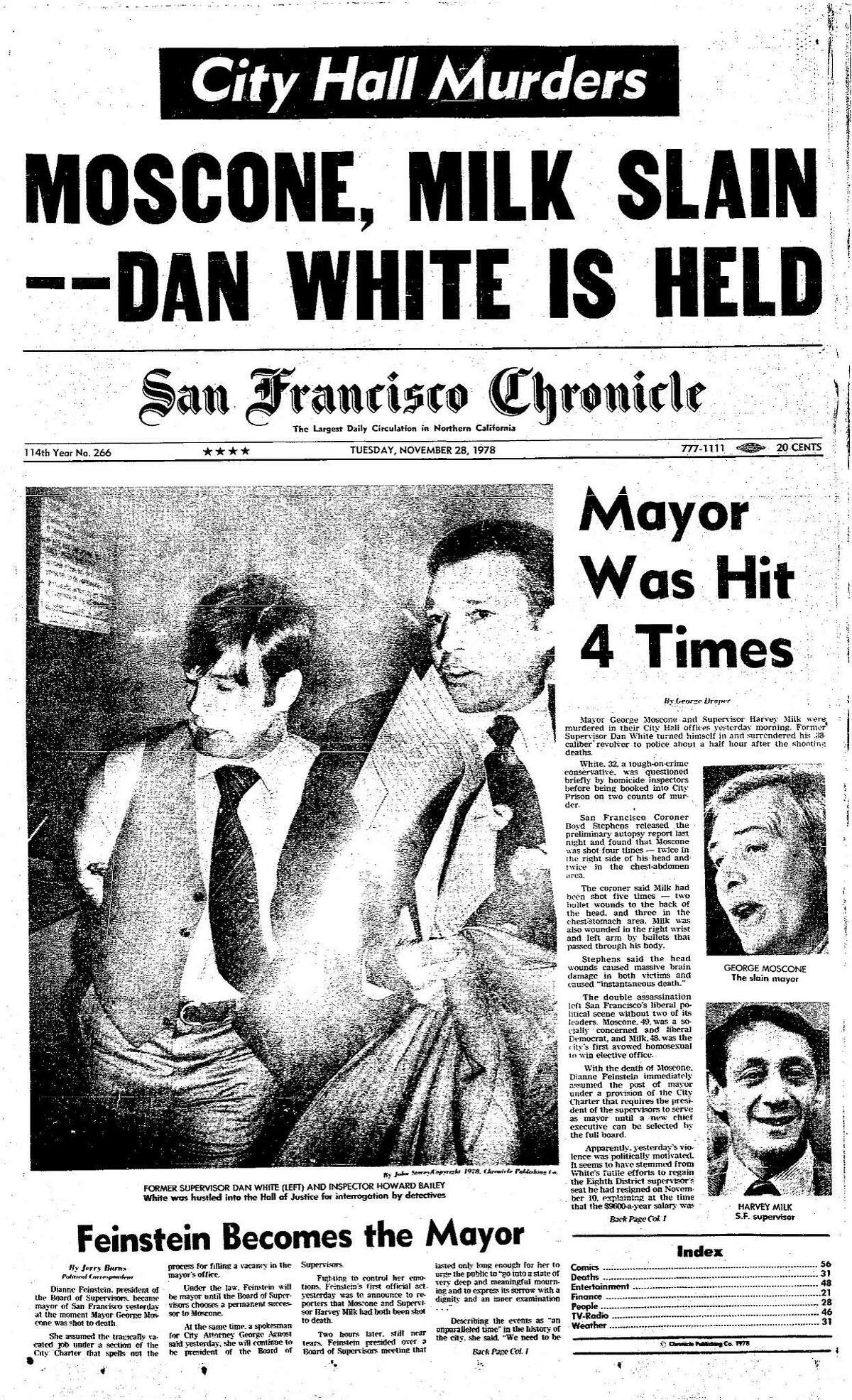
Moscone had just turned 49 years old. Milk was 48. Feinstein was 45. White was 33.

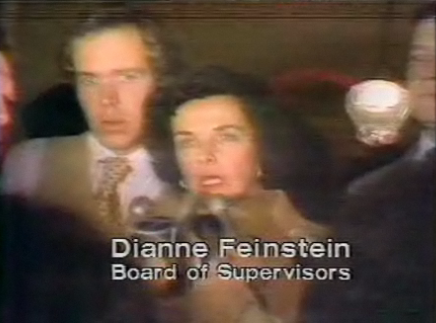
Now the Acting Mayor, the 1st woman and the 1st Jewish person to hold that post, Feinstein was forced to call a press conference to announce the assassinations, and say that White the suspect. White turned himself in after about an hour.
Flowers were left on the steps of City Hall, and when darkness fell, 40,000 people marched in a candlelight vigil from Castro Street to City Hall. The next day, both men lay in state in City Hall's rotunda.

White's trial was fixed. There were no gay people on the jury, nor any ethnic minorities, nor poor people. It was all white middle-class people, most of them Catholic. White's attorney blamed the dual assassination on his mistreatment by his colleagues, and also on a junk-food binge that messed with his blood sugar. Although Hostess' Twinkies were never mentioned, this became known as "the Twinkie defense." (This dovetailed with the Jonestown Massacre: The tainted drink was Flavor Aid, but everybody remembers it as Kool-Aid.)

On May 21, 1979, White was found not guilty on both counts of first degree murder, and found guilty on two counts of voluntary manslaughter. He was sentenced to 7 years in prison. Seven years for murdering two men -- and the Mayor and another major politician of his hometown, no less.

The sadness of the gay community 6 months earlier turned to rage. People began throwing rocks at the front doors of City Hall. Allies of Milk tried to reason with them, but there was no listening. Several downtown buildings were damaged, and a police car was set on fire. It became known as the White Night Riot. When a reporter asked a rioter why they were "destroying parts of the city," the rioter said, "Just tell people that we ate too many Twinkies."

San Francisco-based punk rocker Eric Boucher, taking the stage name Jello Biafra and fronting a band named for assassinated politicians, the Dead Kennedys, ran for Mayor in the 1979 election. A part of his platform was for a statue to be erected to Dan White, and to supply eggs, tomatoes and stones nearby, to give people something to throw at it. Apparently, despite being only 21 years old, he was serious about his campaign.

Appearing on the ballot with both his real name and his stage name, as "Eric 'Jello Biafra' Boucher," he actually finished 4th, with 6,591 votes, a little less than 4 percent of the vote, ahead of 6 other people who were on the ballot. Feinstein barely won, with 46.6 percent of the vote to the 44.7 of Supervisor Quentin Kopp, a margin of 3,331 votes. Kopp was later elected to the State Senate.

Things would get worse. The 1980s would bring the AIDS epidemic. It would take pretty much the entire decade for the disease to be stripped of its stigma as "gay cancer," or as "God's punishment for homosexuals." Per capita, San Francisco was hit harder by the disease than even the much larger cities of New York and Los Angeles.

In 1981, a Convention Center for which Moscone had lobbied was finished. It was named for him, and it hosted the 1984 Democratic National Convention. It remains the last building smaller than a professional sports arena to host a Democratic Convention.
The George R. Moscone Convention Center

Also in 1984, White was released from prison, having served a little over 5 years -- for murdering 2 men. On October 21, 1985, having won his case, but having lost pretty much everything else, including his wife to divorce, he committed suicide. He was 39 years old.

Feinstein was re-elected in 1983. Leaving office at the beginning of 1988, she ran for Governor in 1990, losing to Senator Pete Wilson. In 1992, she was elected to an unexpired term in the U.S. Senate, and was re-elected in 1994, 2000, 2006, 2012 and 2018. She is still alive, 89 years old, and still fighting for the rights of all Americans. It is not yet known if she will run for re-election in 2024, and people who hate her -- being female, Jewish, liberal, and outspoken, she pushes a lot of buttons -- claim that she has dementia. There is no reliable evidence of this. (UPDATE: She died in office in 2023.)

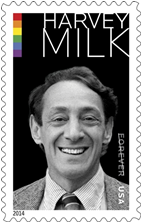
Milk has gone down in history as a pioneer of gay rights, a "Martin Luther Queen." In 2014, the U.S. Postal Service made him the 1st openly gay American politician to be honored with a postage stamp.
In 1980, Representative Robert Bauman, Republican of Maryland, was outed, making him the 1st member of Congress known to be gay. What's more, he was caught soliciting a teenage male prostitute. He was the 1st Republican politician, but by no means the last, to blame his indiscretion on alcoholism. He apologized for said indiscretion, but lost his bid for re-election. As of November 27, 2022, he is still alive.

In 1983, Representative Gerry Studds, Democrat of Massachusetts, was outed, and had his relationship with a 17-year-old Congressional page exposed. He was censured, but won re-election in 1984, making him the 1st openly gay person to win an election for Congress. He continued to serve his District -- which includes Cape Cod, which includes Provincetown, one of the most gay-friendly places in America -- until retiring in 1996, and died in 2006.

In 1998, Tammy Baldwin of Wisconsin was elected to Congress, the 1st openly gay non-incumbent to be elected, and the 1st openly gay woman to serve. In 2012, she became the 1st openly gay person elected to the U.S. Senate.

In 2004, Governor Jim McGreevey, Democrat of New Jersey, exposed as having appointed an unqualified lover to public office, came out, and resigned. He has never run for public office again. In 2018, Jared Polis, Democrat of Colorado, having previously been elected to Congress, was the 1st openly gay person elected Governor of any State. (UPDATE: In 2023, McGreevey announced that he was running for Mayor of his birthplace, Jersey City, in the 2025 election.)

In 2020, Mayor Pete Buttigieg of South Bend, Indiana became the 1st openly gay person to win delegates for a Presidential nomination. When Joe Biden was elected President, he appointed Buttigieg to be Secretary of Transportation, making him the 1st openly gay member of a President's Cabinet. And a few transgender politicians have been elected to local and State offices, though not yet to Congress or Governorships.

One last thing. I was 8 years old, almost 9, in November 1978. I remember seeing the Jonestown story on the news, dominating coverage for a few days, leading into Thanksgiving weekend, November 23 to 26. But I have no memory of seeing the national news cover the assassinations of Moscone and Milk on the 27th. I knew Moscone's name from having watched the 1984 Democratic Convention. But I don't recall hearing Milk's name until I was already out of high school. And I have no idea why that is.

*

November 27, 1978 was a Monday. The White Shadow, perhaps the best sports-themed TV show of all time, premiered on this night.

Baseball was out of season, although there was a notable event in the sport that day: Jimmy Rollins, Captain of the Philadelphia Phillies' 2007-11 quasi-dynasty, including the 2008 World Series win, was born, in Oakland, California, and grew up in neighboring Alameda.

There were no games scheduled that day for the NBA, the NHL, or the World Hockey Association. But Monday Night Football aired on ABC. And in the "You can't make this stuff up" department, the game that night happened to be set for Candlestick Park, between the San Francisco 49ers and the Pittsburgh Steelers.

Pete Rozelle, Commissioner of the NFL, and a former publicity director for the University of San Francisco, had been through this before. In 1963, President John F. Kennedy had been assassinated about 48 hours before NFL games were to kick off. Knowing that some teams scheduled to play on the road were already at their respective airports, and may even have been in the air, he decided to let the games go ahead as scheduled. He later called that his biggest mistake of his career.

This time, with only a few hours to make a decision, he decided to let the game be played, but ordered a moment of silence in memory of Moscone and Milk, to be held right before the National Anthem. But right between them, a truck backed into a wooden flagpole near the south end zone. The sound the pole made when it hit the ground unnerved many people who had been on edge, some for a few hours, some for a few days. At any rate, the Steelers, on their way to winning Super Bowl XIII, won the game, 24-7.

Tuesday, November 8, 2022

November 8, 1977: Ed Koch: Last Man Standing

November 8, 1977: Election Day in New York City. The City needed help. There was no money to pay for anything. Crime was rampant, and the police didn't have the manpower or the resources to properly fight it. (The shock isn't that it took over a year from the first killing to catch the Son of Sam, it's that they got him at all, and it took a lucky break.) The Subway system was a mess (although that was under the jurisdiction of the Metropolitan Transportation Authority, and the MTA is a State agency, not a City agency, something a lot of people still don't realize). The City's business climate was bad.

Everybody, from Wall Street to 42nd Street, from Riverdale to Coney Island, felt as if they were under siege. And Abe Beame, elected Mayor in 1973 as a financial whiz who could bail the City out, seemed unable to do anything, a good man in way over his head. (And that's not just a reference to him being only 5-foot-2.)

The 1977 Mayoral election was a fantastic story, and was detailed in Jonathan Mahler's book Ladies and Gentlemen, The Bronx Is Burning -- as was the Son of Sam case, the Yankees' turbulent Pennant race, and the City's pop culture scene, including disco, punk rock, art, and the struggles of women, racial minorities and gays.

There were 7 candidates on the Democratic side. In addition to Koch and the Brooklynite Beame, they were:

* Mario Cuomo, the crusading Queens lawyer who was then Secretary of State for the State under Governor Hugh Carey.

* Bella Abzug, a Bronx lawyer who'd become the 1st woman elected to Congress from the City.

* Percy Sutton, who had been Malcolm X's lawyer and was elected in Manhattan to become the 1st black Borough President in the City.

* Herman Badillo, a Bronx lawyer who was the 1st Hispanic elected to Congress from the City and the 1st Puerto Rican elected to Congress from anywhere.

* And Joel Hartnett, a Brooklyn advertising executive (the only non-lawyer in the race aside from former accountant Beame) who chaired a "watchdog group" that had accused the Beame Administration of corruption.

Sutton and Badillo pretty much split the minority vote in early polling, meaning that neither blacks nor Hispanics were going to decide the race unless there was a runoff. They and Hartnett never really had a chance.

The rest all went after the City's liberal vote, and all had reason to think they could get it: Beame because he'd been seen working hard, if not well, on their behalf; Koch because he'd been anti-war, pro-civil rights, and on President Richard Nixon's infamous Enemies List; Cuomo because he'd made his name fighting for fair housing and because he was the only candidate who seemed able to appear to the "Outer Boroughs" (The Bronx, Queens, Brooklyn and Staten Island); and Abzug because she was even more anti-war than Koch (the Vietnam War was over but the memory was still fresh), had proposed the first gay-rights bill ever brought before Congress, and because she was sure, as the biggest feminist ever elected to Congress, she could get the women's vote. (With 3 Jewish candidates in the race -- Beame, Koch and Abzug -- the Jewish vote figured to be pretty much split.)

But on July 13, there was a blackout, and the resulting riot put the City's crime and racial problems front and center. And Koch, figuring he'd already made his case that "Abe Beame is an incompetent Mayor," was smart enough to figure out that Beame should no longer be the target: The arch-liberals Cuomo and Abzug should be, as they were the strongest remaining candidates aside from himself.

Without really mentioning them by name, he got tough. He realized that he could be all things to all people. The race was full of brains, but only Koch's brain seemed to figure out that this election would not be won with brains. He knew it would be won in people's hearts.

And if those hearts were cold in the middle of the biggest heat wave New York City had seen in recent memory, so be it. He knew that the winner of the election would need the votes of the Archie Bunkers, as well as those of the Mike Stivics.

And he was not afraid to be the one candidate in the race to call for bringing back the death penalty (which isn't the call of the Mayor at all, but a lot of people were glad he was saying it), or the one candidate in the race to suggest that, if elected, he would crack down on the City's welfare fraud. Translation: "I'm not just the middle-class candidate, I'm the white man's candidate." Or, as the great columnist Jimmy Breslin put it in the Daily News: "Koch got the job as mayor because he promised whites that he could keep the blacks under control."

Once he began suggesting that, he was able to bring liberal-but-scared Jews away from Beame and Abzug, and angry Italians and other Catholics away from Cuomo, whom they might have supported simply because he was the only Italian in the race, and, with Badillo reduced to a fringe candidate, the only Catholic who had a chance.

When the primary was held on September 8, it was very close. Less than 30,000 votes separated 1st place from 4th: Koch got just under 20 percent of the vote, Cuomo nearly 19, Beame 18, and Abzug 16. Since the winner did not get 40 percent, a runoff between the top 2 would be held 10 days later, and it was between Koch and Cuomo. Beame, one of the City's leading politicians for a long time, just missed the runoff, and saw his career come to a sad end.

The runoff got ugly. Koch's appeals to working-class and middle-class whites were seen as terribly cynical. And someone in the Cuomo camp (it's still not clear who) dropped a public suggestion that Koch was gay. Signs appeared a Cuomo events saying "VOTE FOR CUOMO NOT THE HOMO."

Koch blunted this by appearing at events with Bess Myerson, who in 1945 became the 1st New Yorker and the 1st Jewish woman to be named Miss America, and later became a game show panelist and chaired the City's Commission on Consumer Affairs. Signs saying "BESS FOR FIRST LADY" began appearing.

Looking back, years later, Koch said most of the voters didn't care whether or not he was gay. In perhaps no other city, not even San Francisco (more about that in a moment), could that statement have been made. He never married (not Bess nor anyone else), but he never came out, either, and did once publicly deny that he was gay.

The race was decided when Badillo went to see Cuomo, and heard Cuomo talk for an hour, basically saying nothing; then went to see Koch, and heard Koch tell him that Hispanics would be represented in his administration.

Koch was smart enough to know that it was no longer enough to appeal to angry whites: He knew that now, with Sutton and Badillo no longer running, whoever won the minority vote would win the election. Cuomo was smart enough to know that, too, but he wasn't practical enough to get enough of those votes. Beame also threw the last of the old machine vote Koch's way, and even Governor Carey, who seemed to be supportive of Cuomo, endorsed Koch.

Koch won the runoff with 55 percent of the vote. Cuomo still ended up getting the Liberal Party nomination, but when the general election was held, Koch got just under 50 percent, Cuomo 41, and State Senator Roy Goodman, the Republican nominee, and radio talk-show host Barry Farber, nominated by the Conservative Party, got just 4 percent each.

Cuomo's career, of course, was not finished, or even seriously damaged. In 1978, when Carey ran for re-election, he ran with Cuomo as Lieutenant Governor. In 1982, Koch opposed him in the primary for Governor, but made ill-advised comments about the State's rural areas. Cuomo easily won the primary, and then won a close-fought general election against Republican investment banker Lew Lehrman.

Mario Cuomo would serve 3 terms, and his son Andrew also would. Mario once said that New York is the only City in the country where the Mayor wants to be Governor, and the Governor wants to be Mayor. But who's kidding who? Ed Koch never wanted to be Governor. He just liked the attention.

After losing the primary, Koch told his supporters gathered in the hotel ballroom, "It's not the end of the world." Dead silence. Then he gave a big grin and said, "And I'm still the Mayor!" Big cheers.

He would win 3 terms, and help bring the City back from economic ruin. But, despite his bold promises, crime would continue to be out of control -- including, as it turned out, in the City government, which ended up dooming his chances for a 4th term in 1989.

November 8, 1977 was also Election Day in New Jersey. Governor Brendan Byrne, a Democrat, was re-elected. He had been an Essex County Prosecutor and a Judge of the State Superior Court. The FBI had released a wiretap of a Mob boss calling him "the man who couldn't be bought," and Byrne used that in his 1973 campaign for Governor, and he won his 66 percent of the vote, against Charles Sandman, a Congressman from South Jersey, whose support of Nixon to the end of Watergate cost him his seat the next year.
Byrne, with the State House in Trenton behind him

But his signing of the State's 1st sales tax infuriated people, dropping him to 17 percent in the polls, and earning him the nickname "One-Term Byrne." The anger faded, and he won 56 percent of the vote against State Senator Ray Bateman.

In his 2nd term, he got the Meadowlands Arena built in 1981, just before he was term-limited out of office, and his name was placed on it. In 1996, the naming rights expired, and, still angry over his tax hike, a vengeful Republican legislators sold the name to Continental Airlines. "I was immortal for 15 years," Byrne said.

In San Francisco, where the city council is known as the Board of Supervisors, Harvey Milk was elected to a seat that includes the Castro district, along with New York's Greenwich Village then the most famous "gay neighborhood" in America. The 47-year-old Long Island native and camera store owner became the 1st openly gay public official to win elective office anywhere in America.
Milk thus became a gay icon, and many people hoped he would become their "Martin Luther Queen." Unfortunately, within a year, he faced the same end as Martin Luther King: Assassination and martyrdom.

Sandman lived until 1985, Abzug until 1998, Beame until 2001, Hartnett until 2006, Sutton until 2009, Carey until 2011, Koch until 2013, Badillo and Myerson until 2014, Cuomo until 2015, Bateman until 2016, and Byrne until 2018.

*

November 8, 1977 was, like most modern Election Days in America, a Tuesday. Baseball season was over. Football was in midweek. There were 4 games played in the NBA:

* The New York Knicks beat the San Antonio Spurs, 123-117 at Madison Square Garden. Despite the Spurs' loss, George Gervin led all scorers on the night with 35 points.

* The Chicago Bulls beat the Houston Rockets, 117-104 at the Chicago Stadium.

* The Denver Nuggets beat the Milwaukee Bucks, 111-101 at the Milwaukee Exposition, Convention Center and Arena, or "The MECCA." Since 2014, it has been named the UW-Panther Arena.

* And the Portland Trail Blazers beat the Kansas City Kings, 130-104 at the Portland Memorial Coliseum.

Only 1 game was played in the NHL: The Minnesota North Stars beat the Montreal Canadiens, 5-3 at the Montreal Forum.

There were 2 games played in the World Hockey Association. The Quebec Nordiques beat the Edmonton Oilers, 7-3 at the Colisée de Québec. And the New England Whalers beat the Birmingham Bulls, 4-3 at the Birmingham-Jefferson Civic Center in Birmingham, Alabama.

Thursday, September 22, 2022

September 22, 1975: President Gerald Ford Faces Another Assassination Attempt

September 22, 1975: Gerald Ford becomes the 1st President to face 2 close assassination attempts. And they happen just 18 days, and 86 miles, apart.

Ford, for 25 years a Republican Congressman from Michigan, had been nominated for Vice President by President Richard Nixon, seemingly because he was liked by everybody in Washington and offended hardly anybody. He replaced Spiro Agnew, who resigned the office on October 10, 1973, due to his conviction for income tax evasion. On August 9, 1974, Nixon resigned due to his role in the Watergate scandal, and Ford, who was planning to retire after the 1976 election if the Republicans didn't take Congress in 1974, which would have made him Speaker of the House, became the 38th President of the United States.

Ford started with a lot of goodwill, but, a month into his Presidency, he pardoned Nixon. This infuriated many people, and seemed to make him a lame duck before he even announced that he was running for a term of his own in 1976. A recession was underway, but people blamed him for it instead of Nixon (or the Democratic Party). Ford had nothing to do with causing the recession, but his efforts to fix it were, thus far, falling short.

On September 5, 1975, on his way to meet with Governor Jerry Brown at the California State Capitol in Sacramento, Lynette "Squeaky" Fromme, a member of Charles Manson's "Family" cult, tried to shoot him, but had forgotten to properly load the gun, and no shot came out. Ford was taken to safety.

It had been 3 years since Governor George Wallace had been shot and paralyzed while running for President, 5 years since Pope Paul VI had faced an assassin with a knife, 7 years since Dr. Martin Luther King and Senator Robert F. Kennedy were shot and killed, 10 years since Malcolm X was shot and killed, and 12 years since President John F. Kennedy and NAACP executive Medgar Evers were shot and killed. Still, Ford said he would not stop meeting with the people.

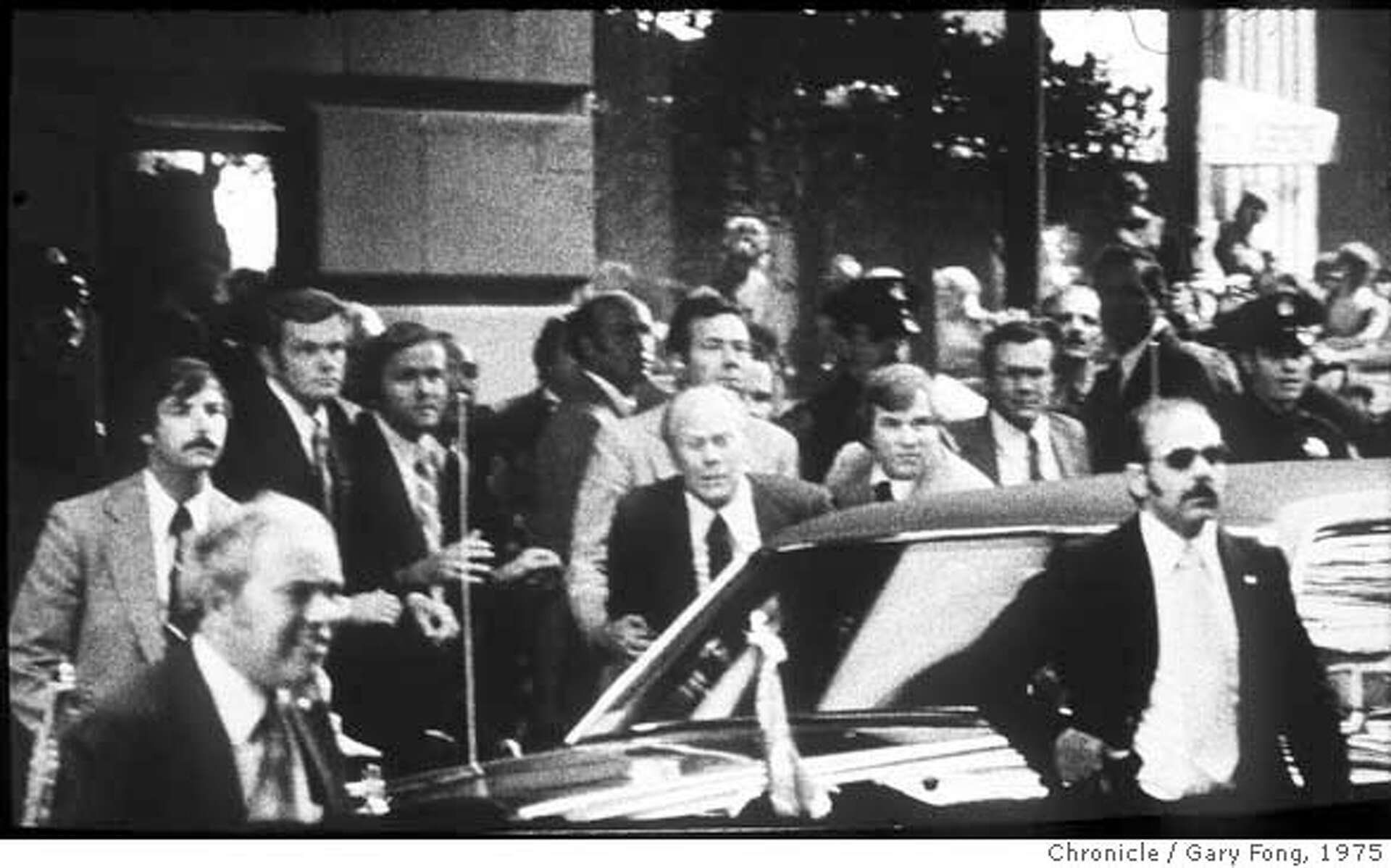
He made another trip to California on September 22. He was in San Francisco, for a meeting of the World Affairs Council. He returned to the city's famed St. Francis Hotel, off Union Square. At 3:30 PM, he walked out of the hotel's Post Street entrance, and stopped short of his limousine to wave the crowd, when a shot rang out.

The shot missed Ford's head by about 5 inches. On the film, he can be heard yelling, "Hey!" A bystander named Oliver Sipple grabbed the shooter's arm as she pulled the trigger a 2nd time. Her shot hit John Ludwig, a taxi driver standing outside the hotel. He also survived.

San Francisco Police Captain Timothy Hettrich grabbed the shooter, and pulled her gun away. The Secret Service shoved Ford into his limo. Donald Rumsfeld, then his White House Chief of Staff, covered him, and the limo was sped back to San Francisco International Airport, where Air Force One was waiting. After waiting for First Lady Betty Ford to arrive, the plane returned to Washington.

Had either attempt succeeded, Vice President Nelson Rockefeller would have become President. Next in line was the Speaker of the House of Representatives, Carl Albert of Oklahoma.

The shooter was Sara Jane Moore. Born on February 15, 1930, in Charleston, West Virginia as Sara Jane Kahn, the former accountant had been married and divorced 5 times, with 4 children. She had no connection to either Fromme or Manson, but had become fascinated by another crime in San Francisco, the kidnapping of Patty Hearst.
The day before the shooting, the San Francisco Police Department arrested her on an illegal handgun charge. They decided to call the Secret Service, and they evaluated her, they confiscated her .44 caliber revolver and 113 rounds of ammunition... and they told the SFPD to let her go, as they believed she posed no danger to the President's visit the next day.

They were wrong. The next day, September 22, she bought a new gun, a .38 caliber revolver, a cheap one, a Charter Arms Bulldog -- a smaller version of the one David Berkowitz began using in New York the next year, becoming known as the .44-Caliber Killer and the Son of Sam. The sight on Moore's gun was 6 inches off. That's why, despite being only 40 feet away, she missed Ford. She pleaded guilty.

Before her sentencing, she said, "Am I sorry I tried? Yes and no. Yes, because it accomplished little except to throw away the rest of my life. And, no, I'm not sorry I tried, because, at the time, it seemed a correct expression of my anger." She was sentenced to life in prison.

Ford was defeated for a term of his own in 1976, and lived until 2006. A year earlier, Moore was released from prison after serving 32 years. At that time, she said, "I am very glad I did not succeed. I know now that I was wrong to try." As of September 22, 2022, she is 92 years old, and lives in Northern California.
Oliver Sipple was a decorated Marine in the Vietnam War, but it was apparently saving Ford's life that made him a well-known hero. The Secret Service officially commended him, and Ford sent him a thank-you letter.
But the popular San Francisco Chronicle columnist Herb Caen was tipped off to the fact that Sipple was gay, and had worked for Harvey Milk, then running for the City's version of a City Council, the Board of Supervisors. (Milk would lose that election, but won in 1977, before being assassinated in 1978.)

Caen asked Milk if he should reveal this information, and Milk said yes, because the wider public needed to see that gay people could be heroes. Caen did not ask Sipple, whose life went into a tailspin. His parents, in Detroit, refused to see him for years. He sued for invasion of privacy, and lost. He started drinking heavily, and died in 1989, only 47 years old.

As for the other injured man, John Ludwig, he'd already been through a lot, having fled Nazi Germany, only to end up in Shanghai, China when it was occupied by Imperial Japan, and he was shot by a Japanese soldier. He survived, working with the Chinese resistance at the age of 12, and was reunited with his family in San Francisco in 1948. He became a taxi driver. retired to Sacramento (the site of the 1st assassination attempt, something of an irony), published a memoir in 2004, and died in 2015, age 81.

About Captain Timothy Hettrich, who grabbed Moore's gun, the only information I can find is that he was still alive as of 2006.

UPDATE: Sara Jane Moore died on September 24, 2025, 2 days after the 50th Anniversary of her attempt, at the age of 95.

*

September 22, 1975 was a Monday. On ABC Monday Night Football, the Oakland Raiders beat the Miami Dolphins, 31-21 at the Orange Bowl in Miami. And these Major League Baseball games were played:

* The New York Yankees lost to the Boston Red Sox, 6-4 at Yankee Stadium. Fred Lynn, soon to become the 1st player ever to win either League's Most Valuable Player and Rookie of the Year in the same season, and Deron Johnson each got 3 hits. Carl Yastrzemski went 1-for-5. Rick Wise outpitched a rookie named Ron Guidry. Thurman Munson hit a home run. The Red Sox went on to win the American League Pennant.

* A doubleheader was split at Jarry Park in Montreal. The St. Louis Cardinals won the opener, 6-4. Ted Simmons won it with a home run in the top of the 12th inning. The Montreal Expos won the nightcap, 8-5. After not playing in the opener, Lou Brock went 1-for-5.

* The Pittsburgh Pirates beat the Philadelphia Phillies, 11-3 at Three Rivers Stadium in Pittsburgh. Dave Parker hit a home run, and Willie Stargell went 3-for-3 with 2 walks, 2 RBIs, and 4 runs scored. Mike Schmidt went 0-for-4.

* The Cleveland Indians beat the Milwaukee Brewers, 7-6 at Cleveland Municipal Stadium. For the Indians, Charlie Spikes and George Hendrick hit home runs. Frank Robinson, MLB's 1st black manager and not yet retired as a player, did not put himself into the game.

For the Brewers, George Scott went 4-for-5 with 2 home runs. Robin Yount went 1-for-5. Hank Aaron appeared as a pinch-hitter, but struck out. Scott's 2nd homer gave the Brewers a 6-5 lead in the top of the 9th, but the Indians loaded the bases in the bottom of the 9th, and Oscar Gamble singled home the tying and winning runs.

* The Kansas City Royals beat the Texas Rangers, 2-1 at Royals Stadium (now Kauffman Stadium) in Kansas City. George Brett went 1-for-2 with 2 walks.

* The Houston Astros beat the Cincinnati Reds, 5-1 at the Astrodome in Houston. Pete Rose went 1-for-3. Johnny Bench got the night off.

* The San Diego Padres beat their arch-rivals, the Los Angeles Dodgers, 6-5 at San Diego Stadium (later Jack Murphy Stadium and Qualcomm Stadium). Hector Torres won it with a home run in the bottom of the 11th inning. Willie McCovey drove in a run with a sacrifice fly, and was later replaced in right field by Dave Winfield, who drew a walk in his only plate appearance.

* The California Angels beat the Chicago White Sox, 3-0 at Anaheim Stadium (now Angel Stadium of Anaheim). The game went 16 innings, and Adrian Garrett won it with a 3-run home run of Rich Gossage. To be fair, it was the 7th inning for "The Goose," after Jim Kaat had pitched shutout ball into the 9th. Frank Tanana pitched 13 shutout innings for the Angels, and Don Kirkwood pitched the last 3.

* The Minnesota Twins beat the Oakland Athletics, 2-1 at the Oakland Coliseum. Rod Carew went 1-for-4. Reggie Jackson went 0-for-4.

* And the New York Mets, the Atlanta Braves, the Chicago Cubs, the San Francisco Giants, the Baltimore Orioles and the Detroit Tigers were not scheduled.

Saturday, May 21, 2022

May 21, 1979: The "White Night" Riot

May 21, 1979: In San Francisco, former Supervisor (City Councilman) Dan White is sentenced to 7 years in prison for assassinating Mayor George Moscone and Supervisor Harvey Milk in their offices at City Hall 6 months earlier.

There was no question as to his guilt, but, according to psychiatrist Martin Blinder, his change in diet was considered a mitigating factor. Ever since, a lame excuse for a crime has become known as a "Twinkie Defense" in his (dis)honor. California State law was amended to put an end to such defenses.

Gay activists, outraged that the murderer of a tolerant Mayor and the country's 1st openly gay elected official got only 7 years, rioted. It became known as the White Night Riot. No one was killed, but there were 140 injuries.

White was released after only 5½ years. He was unable to rebuild his life – no one in San Francisco, including his wife, wanted anything to do with him – and committed suicide by carbon monoxide poisoning on October 21, 1985. He was 39, and as far as I know, he remains the only American politician ever to go to prison for killing another American politician.

*

May 21, 1979 was a Monday. The Stanley Cup was awarded that night, and I have a separate entry for that event: The Montreal Canadiens won Game 5 of the Stanley Cup Finals, beating the New York Rangers, 4-1 at the Montreal Forum. It was their 4th straight Cup. It was also the last game for goaltender Ken Dryden and center Jacques Lemaire, as they retired. So did right wing and former Captain Yvan Cournoyer, who had missed most of the season with a back injury.

The NBA Finals were between Games 1 and 2. The Seattle SuperSonics went on to reverse the result of the previous year's Finals, beating the Washington Bullets in 5 games. Football was out of season. And these 8 Major League Baseball games were played:

* The New York Yankees lost to the Detroit Tigers, 3-1 at Tiger Stadium in Detroit. Jack Billingham outpitched Ron Guidry. Lance Parrish hit a home run. Reggie Jackson went 1-for-2 with 2 walks.

* The Pittsburgh Pirates beat the Montreal Expos, 4-2 at the Olympic Stadium in Montreal. Willie Stargell hit a home run, which was not surprising. Omar Moreno and Ed Ott also hit home runs for the Pirates, which was surprising.

* The Philadelphia Phillies beat the St. Louis Cardinals, 5-3 at Veterans Stadium in Philadelphia. Steve Carlton outpitched John Denny, who would later win a Cy Young Award with the Phillies. Mike Schmidt hit a home run. Pete Rose went 3-for-4.

* The Atlanta Braves beat the Houston Astros, 7-5 at Atlanta-Fulton County Stadium.

* The Toronto Blue Jays beat the Cleveland Indians, 8-1 at Exhibition Stadium in Toronto.

* The Seattle Mariners beat the Kansas City Royals, 12-7 at Royals Stadium (later Kauffman Stadium) in Kansas City. George Brett went 3-for-5 with a home run and 3 RBIs.

* The Minnesota Twins beat the Texas Rangers, 7-6 at Arlington Stadium in the Dallas suburb of Arlington, Texas.

* And the San Diego Padres beat their arch-rivals, the Los Angeles Dodgers, 3-2 at San Diego Stadium (later Jack Murphy Stadium and San Diego Stadium).

December 31, 1999 & January 1, 2000: The Millennium

December 31, 1999:  The Millennium arrives. The people of planet Earth survived. At a terrible cost. But we hadn't destroyed ourselves. ...