Showing posts with label republican convention. Show all posts

Friday, August 19, 2022

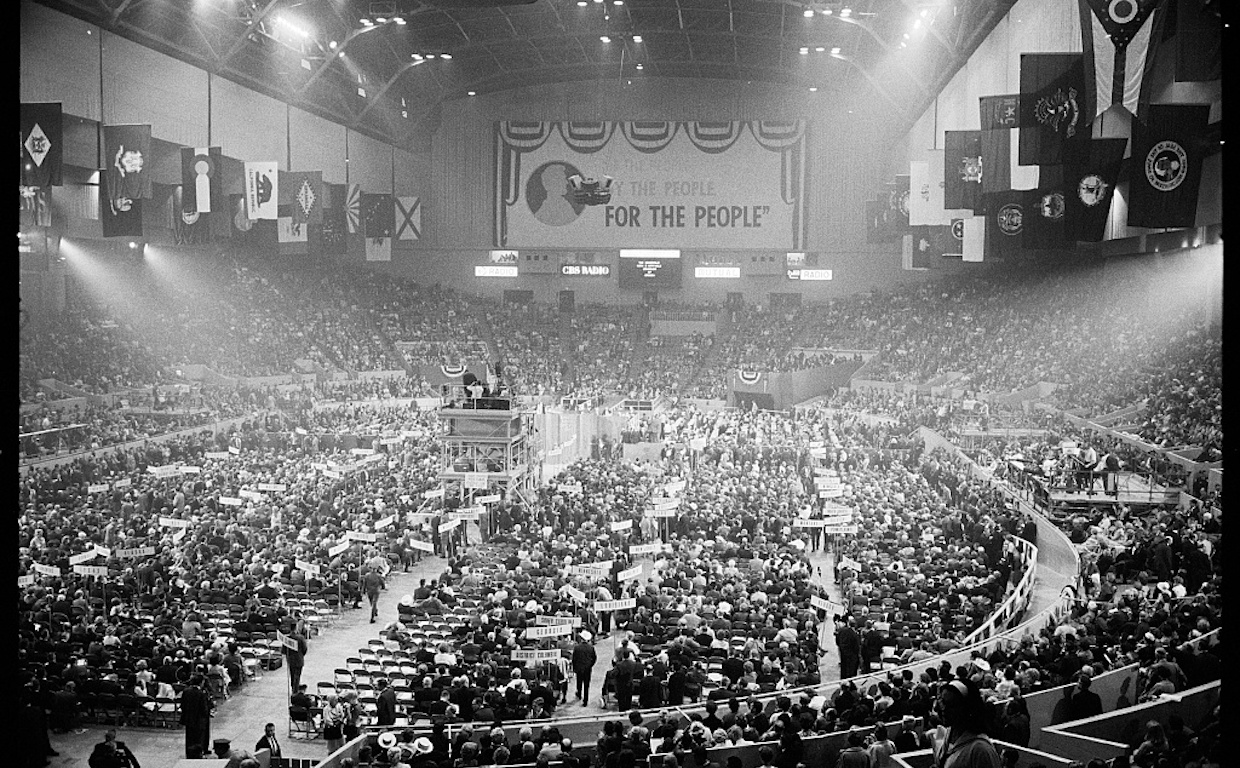
August 19, 1976: Regrets at the Republican Convention

Ford welcomes Reagan to the rostrum,
as Nancy Reagan (left) and Nelson Rockefeller (right) look on

August 19, 1976: The Republican National Convention wraps up, at the Kemper Arena in Kansas City, Missouri. Hearing the speakers talk of upcoming victory, in the Presidential election and in the Congressional elections, you'd never know they were 2 years out from a President of their Party having to resign in disgrace, a year and a half out from badly losing in the Congressional races, and looking at a country still in a recession. They were not only confident, they were arrogant.

Gerald Ford, who became President when Richard Nixon resigned, had been President for a shade over 2 years, with a hell of a mess dumped into his lap. The results had been mixed: Certainly, the country was better off than when he took office, but it was hardly in great shape. The month before, he had ridden the celebrations of the country's Bicentennial, which had helped him. But little else had gone his way.

His pardon of Nixon, just 1 month into his Presidency, had angered millions of Americans. His refusal to support a federal bailout of a bankrupt New York City had infuriated millions, and his reversal on that issue had angered millions of others, without winning many of the first group back.

Conservatives in the Republican Party hated that he had chosen former Governor Nelson Rockefeller of New York as his Vice President, and refused to support him for a term of his own if he ran with Rockefeller on the ticket. He could have reminded him that he was now the leader of the Party, and that he wouldn't be bullied. Instead, he was, telling Rockefeller that he would be dropped. He chose Senator Bob Dole of Kansas.

None of it was enough. Ronald Reagan, who had recently wrapped up 2 terms as Governor of California, was the darling of the conservative movement. He challenged Ford in the Primaries, and the final Delegate total was very close. This remains the last major-party convention at which the nominee was not absolutely certain. Ford got 1,187 Delegates, Reagan 1,070.

Ford's acceptance speech was too dull to quote here. And he kept making the mistake of pointing out the differences in the last 2 years, reminding everyone that he had succeeded Richard Nixon, a fellow Republican. He could have compared the current situation to 1968, the last full year under a Democratic Administration, with war abroad and riots at home, but he didn't.

And then, as the balloons were falling, and everybody was reacting with tepid applause, he made a gracious gesture. Reagan had not had the chance to make a speech on his own behalf. So Ford asked Reagan to come down and make a speech.

Standing behind the podium, with the Presidential seal still affixed, Reagan looked more like a President than Ford ever had. He sounded more like one, too: Whatever else could be said about either man, Reagan, who had been an actor, was a better public speaker than Ford, who had been a lawyer, but not a trial lawyer, used to addressing crowds. Ford had become a good politician, but until he actually got the office, he had never intended to run for President, and he was not made for moments like these.

Reagan was. He spoke of being asked to write a letter for a time capsule, to be opened in Los Angeles in 2076, America's Tricentennial. He spoke of the world in 1976 being a battle between freedom and tyranny, with nuclear missiles as the potential deciding factor:

Those who would read this letter a hundred years from now will know whether those missiles were fired. They will know whether we met our challenge. Whether they will have the freedom that we have known up until now will depend on what we do here. Will they look back with appreciation and say, "Thank God for those people in 1976 who headed off that loss of freedom? Who kept us now a hundred years later free? Who kept our world from nuclear destruction?"

And if we fail, they probably wont get to read the letter at all, because it spoke of individual freedom, and they wont be allowed to talk of that or read of it.

This is our challenge, and this is why were here in this hall tonight. Better than we've ever done before, we've got to quit talking to each other and about each other, and go out and communicate to the world that we may be fewer in numbers than we've ever been, but we carry the message they're waiting for. We must go forth from here united, determined and what a great general said a few years ago is true: There is no substitute for victory. Mr. President.

Reagan's speech got a standing ovation. But a lot of people left the Arena thinking, "We've nominated the wrong guy."

Ford began the Convention far behind the Democratic nominee, former Governor Jimmy Carter of Georgia. The Convention helped. He eventually closed the gap to a virtual dead heat on Election Day. Carter won a very close race.

Would Reagan have won? This time, the Republicans were still tainted with scandal and recession. Reagan's message of tax cuts and Cold War aggressiveness would not have flown in 1976.

Four years later, it was a different world. And while Reagan looked finished after 1976, in 1980, America was ready for him. All 3 men had their moment where they were the man of the moment. For Ford, it was 1974, but not 1976. For Carter, it was 1976, but not 1980. For Reagan, it was 1980, but not 1976.

The Kemper Arena still stands, right on the State Line with Kansas City, Kansas. Originally named for local banker and philanthropist Rufus Kemper, it is now named the Hy-Vee Arena, after a supermarket chain.

*

August 19, 1976 was a Thursday. These Major League Baseball games were played:

* The New York Mets lost to the Los Angeles Dodgers, 6-5 at Dodger Stadium in Los Angeles. After 7 innings, it was 1-0 Los Angeles, a duel between the Dodgers' Burt Hooton and the Mets' Mickey Lolich. But the Mets scored 4 runs in the top of the 8th, and the Dodgers scored a run in the bottom of the 8th, to make it 4-2 New York. The Mets made it 5-2 in the top of the 9th. In the bottom of the 9th, the Dodgers got singles from Ted Sizemore and Bill Buckner, and home runs from Steve Garvey and Ron Cey.

* The Philadelphia Phillies beat the Houston Astros, 7-1 at Veterans Stadium in Philadelphia. For the Phillies, it was "Win Day": Steve Carlton went the distance for the win. Mike Schmidt and Jay Johnstone hit home runs.

* The Cincinnati Reds beat the Atlanta Braves, 3-2 at Riverfront Stadium in Cincinnati. Mike Lum singled Tony Pérez home with the winning run in the bottom of the 11th inning. Pete Rose went 2-for-3 with 2 walks and an RBI. Johnny Bench went 0-for-5.

* The Detroit Tigers beat the California Angels, 4-3 at Tiger Stadium in Detroit.

* The Chicago White Sox beat the Boston Red Sox, 4-2 at Comiskey Park in Chicago. Carl Yastrzemski went 0-for-4.

* The Milwaukee Brewers beat the Kansas City Royals, 6-4 at Milwaukee County Stadium. Hank Aaron, in his last season as a player, was available for the Brewers, but did not get into the game. George Brett went 1-for-3 with a walk.

* The Minnesota Twins beat the Baltimore Orioles, 5-4 at Metropolitan Stadium in the Minneapolis suburb of Bloomington, Minnesota. Brooks Robinson, in his last full season as a player, was available for the Orioles, but did not get into the game. Reggie Jackson did, going 2-for-4 with a walk and an RBI. For the Twins, Rod Carew had a rare 0-for-5 game.

* The Cleveland Indians beat the Texas Rangers, 7-5 at Arlington Stadium in the Dallas suburb of Arlington, Texas. Indians manager Frank Robinson, in his last season as a player, did not put himself into the game. He did put his former Baltimore teammate, John "Boog" Powell, in, and he hit 2 home runs.

* The Pittsburgh Pirates beat the San Francisco Giants, 1-0 at Candlestick Park in San Francisco. John Candelaria allowed 9 hits, but kept the shutout, outpitching Jim Barr. The only run came in the top of the 5th, when Richie Zisk singled home Candelaria himself, who had reached base via a forceout. Willie Stargell went 1-for-4.

* And the New York Yankees, the Oakland Athletics, the Chicago Cubs, the Montreal Expos, the St. Louis Cardinals and the San Diego Padres were not scheduled.

Saturday, July 23, 2022

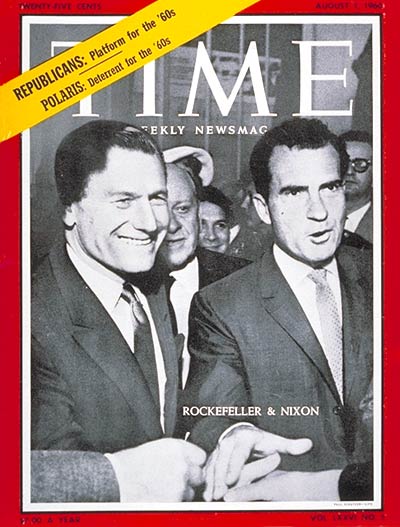
July 23, 1960: The Compact of Fifth Avenue

July 23, 1960: Vice President Richard Nixon and Governor Nelson Rockefeller of New York conclude a late-night meeting at Rockefeller's penthouse at 810 5th Avenue, at 62nd Street, on the Upper East Side of Manhattan, with an agreement on a platform for the upcoming Republican National Convention. A newspaper headline writer called it "The Compact of Fifth Avenue," although it has also been called "The Treaty of Fifth Avenue."
810 Fifth Avenue

Two days later, on July 25, the Republican Convention convened, at the International Amphitheatre in Chicago. Dwight D. Eisenhower is the 1st President limited to 2 terms by the 22nd Amendment to the Constitution, something the Republicans wanted as a swipe at the memory of Franklin Roosevelt, and now, it comes back to bite them. Though "Ike" might not have wanted to run for a 3rd term anyway.

With Rockefeller out of the way, the path for Nixon to be nominated for President was clear. For Vice President, the Party nominated the U.S.' Ambassador to the United Nations, Henry Cabot Lodge – who had been defeated for re-election to the Senate from Massachusetts in 1952 by the man the Democratic Party just nominated for President, John F. Kennedy.

The conservative wing of the Republican Party wasn't happy over Nixon's nomination, any more than they were about Wendell Willkie's in 1940, Thomas Dewey's in 1944 and 1948, and Eisenhower's in 1952. They wanted one of their own nominated. Never mind that conservatism was still identified with Herbert Hoover and the Great Depression. Senator Barry Goldwater of Arizona was the only other Presidential candidate to get any Delegates: 10, all of them from Louisiana, to Nixon's 1,321.

Before the vote tally, Goldwater spoke, and asked that his name be withdrawn from consideration, as a gesture of unity. He told his supporters, and any others who opposed Nixon's nomination, "We've had our chance. We've fought our battles. Now, let's put our shoulders to the wheel of Dick Nixon and push him across the line... Let's grow up, conservatives. If we want to take this party back, and I think we can someday, let's get to work." He had just published a political manifesto, The Conscience of a Conservative, and it became one of the defining texts of the movement.

Following Kennedy's win over Nixon, the Republican Party would follow Goldwater's lead in the next election. Rockefeller ran again in 1964, but the conservative wing never forgave him for getting in their way, and they treated him shabbily. Goldwater was nominated, but lost badly.

Rockefeller ran again in 1968, but so did Nixon, and there was no true conservative alternative. There wouldn't be until 1976, when Ronald Reagan nearly beat out incumbent President Gerald Ford, and Rockefeller, by then Ford's Vice President, was hounded off the ticket. In 1980, Reagan won, to the delight of Goldwater and the conservatives.

*

July 23, 1960 was a Saturday. These baseball games were played:

* The New York Yankees lost to the Chicago White Sox, 5-3 at Yankee Stadium. Bob Shaw outpitched Whitey Ford. Minnie Miñoso went 4-for-5 with 3 RBIs. Bill "Moose" Skowron hit a home run, Yogi Berra went 2-for-4 with an RBI, Roger Maris went 0-for-4, and Mickey Mantle only appeared as a pinch-hitter, and did not reach base.

* The Cleveland Indians beat the Boston Red Sox, 4-2 at Fenway Park in Boston. Ted Williams, in his final season, hit his 508th career home run.

* A doubleheader was split at Memorial Stadium in Baltimore. The Detroit Tigers won the opener, 4-1. The Baltimore Orioles won the nightcap, 4-3. Al Kaline sat it out, after going 1-for-4 in the opener. Over the 2 games, Brooks Robinson went 4-for-8 with an RBI.

* The Washington Senators beat the Kansas City Athletics, 8-3 at Griffith Stadium in Washington.

* The St. Louis Cardinals beat the Cincinnati Reds, 7-5 at Crosley Field in Cincinnati. Each team scored 2 runs in the 9th inning, but Walt "Moose" Moryn hit a home run in the top of the 10th inning to win it. Stan Musial appeared as a pinch-hitter, and did not reach base. Frank Robinson and Wally Post hit home runs for the Reds.

* The Milwaukee Braves beat the Chicago Cubs, 3-0 at Wrigley Field in Chicago. Juan Pizarro took a shutout into the 9th inning, striking out 12, but allowed 8 hits and 3 walks, and Ron Piché had to get the last 2 outs and preserve the shutout. Hank Aaron and Eddie Mathews both hit home runs. Ernie Banks went 0-for-4.

* The Los Angeles Dodgers beat the Philadelphia Phillies, 2-0 at the Los Angeles Memorial Coliseum. Roger Craig pitched a 3-hit shutout. Dallas Green went the distance for the Phils. Each man would go on to become a rare thing, a former pitcher who managed a team to a Pennant.

* And the San Francisco Giants beat the Pittsburgh Pirates, 3-1 at Candlestick Park in San Francisco. Juan Marichal outpitched Harvey Haddix. Willie Mays went 3-for-4 with a home run and 2 RBIs. Roberto Clemente went 0-for-2 with a walk.

Saturday, July 16, 2022

July 16, 1964: Extremism In the Defense of Liberty

July 16, 1964: Senator Barry M. Goldwater of Arizona accepts the Republican Party's nomination for President, at their National Convention, at the Grand National Livestock Pavilion, a.k.a. the Cow Palace, just outside San Francisco in Daly City, California.

The site of the 1964 Republican National Convention may surprise people who know San Francisco as the most liberal city in America, which might not even be accurate. But, like all cities, San Francisco has its "old money" conservative elite. And this was the 2nd time the Grand Old Party had held its convention at the Cow Palace, built in 1940 for rodeo shows but later adapted for professional sports and concerts. They had previously nominated Dwight D. Eisenhower for a 2nd term there in 1956.

Then 55 years old, Goldwater was a Presbyterian, but had a Jewish grandfather, as the family name was originally Goldwasser. This makes the 1964 Republican Convention the closest either major party has ever come to nominating a Jewish person for President.

He was also very Western, living on a ranch outside Phoenix, with a solar-powered flagpole: Every morning, when the Sun came up, it raised the Stars & Stripes; every evening, when the Sun went down, the mechanism lowered the flag into a box.

A bomber pilot in World War II, Goldwater had been elected to the Phoenix City Council, and in 1952 defeated an incumbent Democrat for the U.S. Senate. Re-elected in 1958, he thought he could be the conservative alternative in 1960 to Vice President Richard Nixon, once considered the anti-Communist hard right's man, but now widely seen as more moderate -- the very thing that gave him a legitimate chance of election.

What is a conservative? According to Franklin D. Roosevelt, who knew difficulty walking, "A conservative is a man who, despite having two good legs, has never learned to walk forward." Comedian Mort Sahl said, "A conservative is someone who believes in reform -- but not now." Educator John Holt said, "Conservatism is the worship of dead radicals -- emphasis on the 'dead.'" (That quote is one of many that has been misattributed to Mark Twain.) Years later, Robert Orban would say, "A conservative is someone who wants the rules changed so that no one can make a pile the way he did."

No true conservative had been elected President since 1928, and that was Herbert Hoover, on whose watch the Great Depression began, and whose policies were seen as having made it worse, leading to his landslide loss to FDR in 1932. Every Republican nominee since had basically said, "We accept the New Deal, but we can do it better, and more efficiently, and with fewer Communists."

But there was another alternative to Nixon in 1960: Governor Nelson Rockefeller of New York, who had replaced a previous holder of his office, 1944 and 1948 Presidential nominee Thomas Dewey, as the leader of the moderate-to-liberal Eastern wing of the GOP. He wanted to be President, too. But he also wanted to win. So he invited Nixon to his apartment, and made a deal where he would endorse Nixon to hold off any conservative challenge. It became known as "The Compact of Fifth Avenue."

So, at the 1960 Republican Convention in Chicago, Goldwater told his supporters that they could take their party back, if they were properly organized: "Let's grow up, conservatives!"

Whether the conservative movement, as it came to be known, "grew up" is debatable: Conservatism has often listed from side to side, from old and stuffy to very childish. But they were very well organized, and, on the morning of November 22, 1963, with Nixon branded as a "loser," Goldwater and Rockefeller were the 2 leaders for the Party's nomination in 1964.

That day, John F. Kennedy, who had beaten Nixon in 1960, was assassinated. In his memoir, Goldwater admitted that his chance of winning had died with Kennedy. The 2 men had been friendly rivals, and Goldwater had really looked forward to a clash of ideas with JFK.

But with Vice President Lyndon B. Johnson now President, and sure to be the Democratic nominee in 1964, any chance for a real clash of ideas was doomed: LBJ would do anything to win, including "making Kennedy's ghost his running mate." His actual Vice Presidential nominee turned out to be Senator Hubert Humphrey of Minnesota, but he essentially "ran with JFK" every bit as much as Harry Truman ran with Franklin Roosevelt in 1948.

Goldwater told his advisers that he didn't want to run against Johnson. They told him that he had to do it, anyway, as the best way to continue the building of the conservative takeover of the Republican Party. To use a sports analogy, they were asking him to sacrifice himself, to "take one for the team."

And so he ran. He ran his campaign as a moral crusade, to bring down government spending, to end welfare programs that encouraged "immoral behavior," and to stand up to the Communist world better than the Democrats had.

His supporters took the "morality" thing even further, citing the fact that Rockefeller had divorced his first wife and quickly remarried -- as if that had anything to do with his qualifications for the job. When Goldwater refused to campaign in the Oregon Primary, and Rockefeller went, accompanied by signs saying, "He cared enough to come," Goldwater knew that the California Primary was it: Win it, or you're out.

And when Margaretta "Happy" Rockefeller gave birth to Nelson Rockefeller Jr. just 3 days before the Primary, it bolstered the "morality" argument by reminding voters of Rocky's divorce and remarriage --and the fact that Happy gave up custody of the children she already had, in order to more quickly gain the divorce, in order to more quickly marry the Governor. Goldwater won California, and clinched the nomination.

But right after that came the Senate's vote on the Civil Rights Act of 1964. Most of those voting against it were Southern Democrats. A higher percentage of Republicans than Democrats voted for it, because the Senate Minority Leader, Everett Dirksen of Illinois, was for it, and all but the most conservative of Republican Senators followed his lead.

But Goldwater voted against it -- on constitutional grounds, he said. But the vote tarred him as a racist, even though he wasn't one. He had gone out of his way to appeal to black, Hispanic, and Native American voters in Arizona. But most people outside that State didn't know that. There was no social media for people from Arizona to tell the other 49 States, "Hey, he's not like that! Let me show you what he's doing here!"

The fact that Senator Strom Thurmond of South Carolina, the "States' Rights" Presidential nominee of 1948, switched from the Democratic Party to the Republican Party after LBJ signed the bill, and then endorsed Goldwater, didn't help Goldwater at all -- at least, not outside the Deep South.

Jackie Robinson, the 1st black player in modern baseball, had been a Republican because he believed their favoring of "self-reliance" would be good for African-Americans. He had worked with Rockefeller on civil rights-friendly initiatives, all over New York State, and that had helped Rockefeller win black voters over.

Starting with his role as a Delegate from New York to the 1964 Republican National Convention, Robinson never voted for another Republican nominee for President. He told journalist Roger Kahn, who once covered Robinson's team, the Brooklyn Dodgers, for the New York Herald Tribune, "It would make everything I've worked for meaningless if baseball were integrated, but America's political parties were segregated."

That 1964 Convention set the standard for future ugly GOP Conventions to come in 1992, 2004 and 2016. Goldwater chose Representative William E. Miller of Western New York, then also the Chairman of the Republican National Committee, as his Vice Presidential nominee, "Because he drives Lyndon Johnson nuts."
The Cow Palace during the Convention

There was a proposed plank for the Party platform denouncing "extremist groups," specifically mentioning, on the left, the Communist Party; and, on the right, the Ku Klux Klan and the John Birch Society. They did not specifically mention liberal groups like Americans for Democratic Action (ADA), Students for a Democratic Society (SDS), or the Student Nonviolent Coordinating Committee (SNCC). The Black Panther Party had not yet been founded, so they couldn't be mentioned.

The problem was, many of Goldwater's supporters were in the Birch Society, including Fred Koch, an oil baron whose sons Charles and David followed in his footsteps as major conservative/libertarian donors, hated by liberals as "The Koch Brothers."

When Rockefeller came on to speak in favor of the plank, Goldwater supporters in the seats tried to boo him off the stage. It was a disgraceful spectacle, but Rocky stood up to them, and finished his speech. The plank was easily voted down, making the GOP look like extremists.
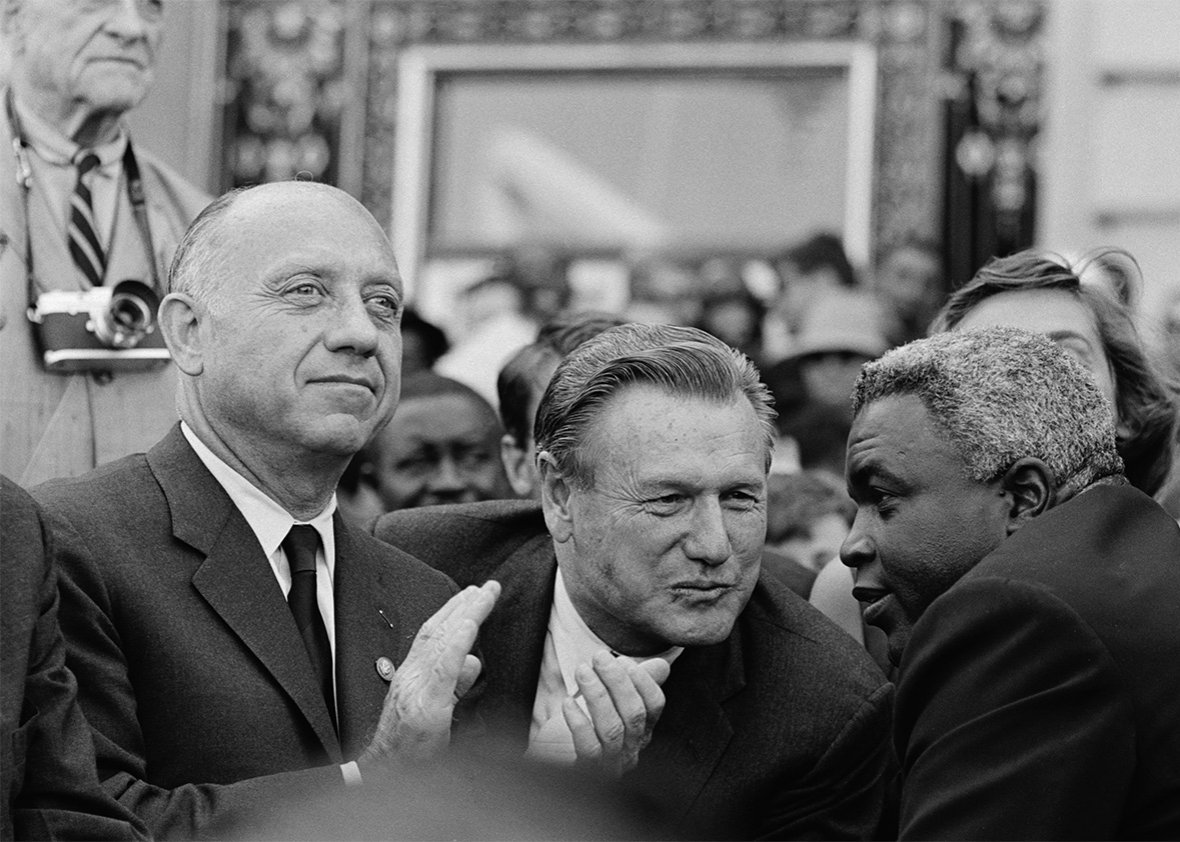
Three Delegates from New York. Left to right: Senator Jacob Javits,
Governor Nelson Rockefeller, and Jackie Robinson.

So, to use another sports analogy, Goldwater knew he needed a home run for his speech. He started off well: "This Party, with its every action, every word, every breath, and every heartbeat, has but a single resolve, and that is freedom. Freedom made orderly for this nation by our constitutional government. Freedom under a government limited by laws of nature and of nature's God. Freedom, balanced, so that order, lacking liberty, will not become the slavery of the prison cell; balanced, so that liberty, lacking order, will not become the license of the mob and of the jungle."

He knew that if he attacked the late President Kennedy and his policies, he had no chance. So he attacked the Democratic way in general: "During four futile years, the administration which we shall replace has distorted and lost that faith. It has talked and talked and talked and talked the words of freedom. Now, failures cement the wall of shame in Berlin. Failures blot the sands of shame at the Bay of Pigs. Failures mark the slow death of freedom in Laos. Failures infest the jungles of Vietnam."

This was a few days before what became known as the Gulf of Tonkin Incident. At the time, Berlin and Cuba were more familiar to Americans than Vietnam. At the time JFK took office, even Laos was more familiar.

Goldwater gave a few more platitudes about freedom, and fired a few more potshots at the Democrats. If he had then gone into his summation, it would have been a terrific speech. Instead, he addressed the need for unity within the Party's own ranks, and threw the Democrats a bone that they chewed on the rest of the way:

Anyone who joins us in all sincerity, we welcome. Those who do not care for our cause, we don't expect to enter our ranks in any case.

And let our Republicanism, so focused and so dedicated, not be made fuzzy and futile by unthinking and stupid labels.

Johnson would not go on to say it, but I can imagine a still-living Kennedy responding to this by saying, "I would remind you, my fellow Americans, that extremism in the defense of liberty is no defense of liberty."

What Johnson did go on to say was, "Extremism in the defense of liberty is an unpardonable vice. And moderation in the pursuit of justice is the highest virtue."

The Goldwater campaign produced buttons saying, "In your heart, you know he's right." The Johnson campaign produced buttons countering this, saying, "In your guts, you know he's nuts." And it produced other suggestions that he was too extreme to be President, including an ad known as the Daisy Spot.

Goldwater ended up winning only 6 States: His home State of Arizona, barely, and 5 Southern States who liked his apparent stance on civil rights, and may have been swayed by the Thurmond endorsement. In a few other Western States, embracing the idea of a Westerner becoming President, he came close.

But in most States, extremism was rejected as a defense of liberty. Richard Nixon, Ronald Reagan and both George Bushes learned from this campaign, and put a human face on conservative policies.

*

July 16, 1964 was a Thursday. Miguel Induráin, the Spanish (Basque) cyclist who won 5 straight Tours de France from 1991 to 1995, was born on this day.)

These baseball games were played:

* The New York Yankees lost to the Baltimore Orioles, 6-1 at Yankee Stadium. Steve Barber outpitched Jim Bouton, and helped his own cause with a home run. To counter the quote that Barber had in Bouton's later book Ball Four, Barber's arm wasn't sore, and it wasn't even a little stiff. Brooks Robinson went 1-for-2 with 2 walks. Mickey Mantle went 0-for-2 with 2 walks. Roger Maris went 0-for-4.

* The New York Mets lost to the Chicago Cubs, 11-1 at Wrigley Field in Chicago. Ernie Banks went 2-for-4 with 2 RBIs. The winning pitcher was Ernie Broglio, recently acquired for Curt Flood. For the rest of his tenure with the Cubs -- and in the major leagues -- he would go 9-15.

* The Chicago White Sox beat the Boston Red Sox, 9-3 at Fenway Park. Carl Yastrzemski and Tony Conigliaro both went 0-for-4.

* The Philadelphia Phillies beat the Pittsburgh Pirates, 7-5 at Forbes Field in Pittsburgh. Roberto Clemente went 2-for-5.

* The Cincinnati Reds beat the Houston Colt .45s, 3-2 at Crosley Field in Cincinnati. Frank Robinson went 0-for-4, and Pete Rose went 1-for-4. The Colt .45s became the Houston Astros the next year.

* The Milwaukee Braves beat the San Francisco Giants, 6-0 at Milwaukee County Stadium. Hank Fischer outpitches Gaylord Perry. Hank Aaron, Joe Torre and Denis Menke hit home runs for the Braves. Willie Mays went 1-for-4.

* The Washington Senators beat the Minnesota Twins, 7-2 at Metropolitan Stadium in the Minneapolis suburb of Bloomington, Minnesota. The only Twin runs came on solo homers by Bob Allison and Tony Oliva. Harmon Killebrew went 0-for-4.

* The Los Angeles Dodgers beat the St. Louis Cardinals, 10-2 at Busch Stadium (formerly Sportsman's Park) in St. Louis. Lou Brock went 2-for-4 in defeat.

* The Cleveland Indians beat the Kansas City Athletics, 12-9 at Kansas City Municipal Stadium. Woody Held won it with a home run in the top of the 10th inning.

* And the Detroit Tigers and the Los Angeles Angels were not scheduled to play.

Saturday, July 9, 2022

July 9, 1952: Dirksen vs. Dewey at the Republican Convention

Everett McKinley Dirksen

July 9, 1952: The Republican Convention is in progress at the International Amphitheatre in Chicago. The Eastern establishment wing of the Party, led by Governor Thomas Dewey of New York, their 1944 and 1948 nominee, is angry at losing 5 straight elections, and they want to win. So they want to nominate the most popular man in the country.

Unfortunately, while he is a Republican, Bing Crosby isn't available. So they settle for former General Dwight D. Eisenhower, whom they promote as the man who beat the Nazis (as if he didn't answer to President Franklin D. Roosevelt and Army Chief of Staff George C. Marshall), and is the best man to beat both the Communists and "the mess in Washington." They run on a formula they call "K1C2," for "Korea, Communism, and Corruption."

The conservative wing of the Party is angry at losing 4 straight nomination fights -- to Governor Alf Landon of Kansas in 1936, to Wall Street lawyer Wendell Willkie in 1940, and then to Dewey twice -- and they want one of their own to be nominated. They want Senator Robert Taft of Ohio: The son of a President, the grandson of an Attorney General, a mover and shaker on both domestic and foreign policy, and a man known so conservative, he is known as "Mr. Republican."

Senator Everett McKinley Dirksen of Illinois, who, like Taft, will one day be named the GOP's Senate floor leader, gives Taft's nominating speech. With a voice so low and a style so florid that it earned him the nickname "The Wizard of Ooze," he points at Dewey, saying, "We followed you before, and you took us down the road to defeat!"
Robert A. Taft

The conservatives had decided they would rather lose with Taft than win with a "liberal." And they launched a pro-Taft demonstration that lasted half an hour. This actually made the Delegate race close. But on the 1st ballot, Eisenhower had 595, leaving him 9 short of a majority. Taft had 500, and his team thought that, by denying Ike a majority on the 1st ballot, they had burst his bubble of invincibility.

Governor Earl Warren of California, Dewey's 1948 running mate, had 81 Delegates. Governor Harold Stassen of Minnesota, making the 2nd of his many runs for President, had 20. And General Douglas MacArthur, not actively running because he wanted to be seen as having been "drafted," had 10.

But Stassen, running as a "favorite son," with his own State as a Delegate base, had not received 10 percent of the Delegates. That freed Minnesota's Delegates from their pledge to support him, and, before the 1st ballot could be finalized, those Delegates changed their vote, all but 1 or them, giving Ike 614 and a majority.

There no longer were enough conservative Delegates to deny Eisenhower the nomination. But there were enough of them to stick "Ike" with one of their own as his Vice Presidential nominee. Senator Richard M. Nixon of California was only 39 years old, but already had a reputation as a Communist-hunting firebrand -- and also one as the biggest liar in either house of Congress.
Pat & Dick, Ike & Mamie, and the Chicago Tribune,
still billing itself as "The World's Greatest Newspaper,"
was, as usual, in the tank for the GOP.

Two nights later, on July 11, Ike was nominated. He had famously titled his postwar memoir Crusade in Europe. The Republicans had called their fight against Communism a "crusade." Ike told the Delegates, and told the nation, "I know something about leading a crusade. I have led one."

If the Democrats want to keep the White House for another 4 years, they will have to run against the Republicans as a whole, and against the man already known as "Tricky Dick," as much against Ike. Because running just against Ike, without the strength of the incumbent, but with the status as incumbents in an anti-incumbent year, would be a fool's errand. And, at this point, they don't even know who their nominee will be, only that it won't be outgoing President Harry Truman.

As it turned out, it was just as well that Taft was not nominated to be the 34th President of the United States: In April 1953, 3 months into his tenure as Majority Leader, he was diagnosed with cancer. He died on July 31, 1953, at the age of 63.

One thing is for certain: If Taft had won the nomination, it would have been the other wing of the party demanding a balanced ticket, and thus Nixon would not have been nominated for Vice President, and thus someone else would have been sworn in as the 35th President of the United States on July 31, 1953.

*

July 9, 1952 was a Wednesday. John Tesh, former co-host of the TV show Entertainment Tonight, and composer of "Roundball Rock," the theme song to NBC's NBA broadcasts, was born on this day.

But there were no games played: The only sport in season in North America at the time was baseball, and this was during the All-Star Break. The night before, the All-Star Game was played at Shibe Park in Philadelphia. This is the only time that game has ever been shortened due to rain: The National League was leading the American League, 3-2 after 5 innings, making it official, when it was called.

Jackie Robinson of the Brooklyn Dodgers and Hank Sauer of the Chicago Cubs, who would go on to be named the NL's Most Valuable Player despite the Cubs only finishing 5th, hit home runs. Among those selected for the 1st time, but not getting into the game, were 20-year-old Mickey Mantle of the New York Yankees and 46-year-old Leroy "Satchel" Paige, then with the St. Louis Browns.

Tuesday, June 28, 2022

June 28, 1940: Wendell Willkie Is Nominated for President

June 28, 1940: Wendell Willkie is nominated for President at the Republican National Convention, at the Philadelphia Civic Center. It was the 1st political convention broadcast on television -- the Democratic National Convention would follow, 4 weeks later -- but that's not what was historic about this Convention. Hardly anybody had television sets to watch it on, anyway.

Lewis Wendell Willkie was born on February 18, 1892 in Elwood, Indiana, 46 miles northeast of Indianapolis. The U.S. Army reversed his name to "Wendell Lewis" when he enlisted in World War I, and, since his family had always called him "Wendell," anyway, he never corrected the mistake, and later made that his legal name. He served, but did not see combat.

He dropped out of law school to enlist, and returned. He was hired by the law firm that represented Firestone Tire and Rubber Company in Akron, Ohio, but when he met company founder Harvey Firestone -- a friend of President Warren G. Harding, a Republican -- he was told he would never amount to anything because he was a Democrat.

In 1924, he was a Delegate to the Democratic Convention, the one that went to 103 ballots before Congressman John W. Davis was nominated. Despite being a Midwestern Protestant, Willkie had supported Governor Al Smith, because of Smith's opposition to the Ku Klux Klan, which had essentially taken over the Republican Party in Indiana. In 1925, Willkie got Klan members expelled from the Akron school board.

Willkie built a reputation as a great trial lawyer, representing public utilities. In 1932, he was a Democratic Delegate again, supporting Governor Franklin D. Roosevelt, who was elected President. But in 1935, with FDR at the height of his New Deal, Willkie broke with him to represent Commonwealth & Southern Corporation against the Tennessee Valley Authority. In 1936, Willkie voted for FDR's Republican opponent, Governor Alf Landon. In 1939, he switched parties, becoming a Republican, becoming perhaps the 1st ex-Democrat to say, "I did not leave my party, my party left me."

In 1940, the Republicans figured, after 8 years of the New Deal, the American people would want to go back to conservative leadership. They didn't expect FDR to run for a 3rd term. But with Adolf Hitler taking over most of Europe, and threatening Britain, FDR knew he was the only American politician experienced enough to handle the Nazi leader.

The elections of 1932, 1934 and 1936 had brought many Republican figures down to defeat. But the economic downturn of 1938 knocked a few potential Democratic successors to FDR out of contention. Neither party really had a wealth of contenders. The leading Republican contenders were Senators Robert Taft of Ohio (son of President William Howard Taft) and Arthur Vandenberg of Michigan; and the District Attorney of Manhattan, Thomas E. Dewey.

Dewey was just 38 years old, and, though nationally famous due to his prosecution of organized crime figures, would have been a poor choice as nominee against the veteran FDR. But Taft was in only his 2nd year in the U.S. Senate. More importantly, Taft and Vandenberg were isolationists: Had they been elected, they would have done everything they could to keep America from going to war with Hitler. Therefore, millions of Americans, in both parties -- none more so than FDR -- wanted the Republicans to nominate an internationalist.

After the Nazi invasion of Poland started The War, Willkie gave speeches, including on radio, about the threat to America and the need to aid its allies. He transformed his image: Before, he was mocked, including by Republicans, as "the barefoot boy of Wall Street." As Chicago Sun-Times columnist Steve Neal, who wrote books about both him and FDR (and also Harry Truman and Dwight D. Eisenhower), put it, his wartime speeches "transformed Willkie from a big-business critic of the New Deal into a champion of freedom. And it gave his candidacy new purpose."

Senator James E. Watson, of Willkie's home State of Indiana, was appalled that his candidacy was being taken so seriously. It wasn't because Willkie was the least-qualified Presidential nominee in GOP history. It was because he had so recently been a Democrat: "I may welcome the town whore into my church, but I wouldn't want him to lead the church choir." And Alice Roosevelt Longworth, daughter of President Theodore Roosevelt and widow of House Speaker Nicholas Longworth, owner of the sharpest tongue in Washington society, said that the Willkie campaign came "from the grass roots of ten thousand country clubs."

But Willkie had one key ally: Henry Luce, publisher of Time, Life and Fortune magazines. (Sports Illustrated came later, in 1954.) Luce was one of the biggest names in American conservatism, and he was an internationalist. Born in China as the son of Christian missionaries, he opposed the Nazis in large part because their Axis included the Empire of Japan, which was devastating China. He made sure the stands at the Civic Center were packed with people chanting, "We want Willkie!" This gave the "dark horse" the appearance of having more support than he actually did -- leading to more people switching their support to him, a self-fulfilling prophecy.

The brothers Gardner and John Cowles, publishers of Look magazine, and owners of the largest newspaper chain in the Midwest, sought to break the Taft/Vandenberg hold on the region. They figured Willkie could be the man to do it, and asked him to make a speech in St. Paul, the capital of Minnesota. For half an hour, Willkie read a very dry speech. At its end, he threw it to the ground, and said, "Some damn fool told me I had to read this speech. Now, let me tell you what I think." He did, and the audience perked up, and they loved it. The brothers published the speech, and it gained Willkie some support.

Furthermore, Hitler's victory in France, 2 weeks before the Convention, left only Britain between the Nazis and America. When the Delegates gathered in Philadelphia, they joked that Dewey was "the first American casualty of World War II."

Before a candidate could be nominated, a platform had to be approved. It split the difference between what the interventionists and the isolationists wanted: "We favor the extension of aid to all people fighting for liberty or whose liberty is threatened, as long as such aid is not in violation of international law or inconsistent with the requirements of our national defense."

Years later, someone discovered that the text was lifted, almost verbatim, from an ad that had appeared in several newspapers, including The New York Times, over the names of isolationist Congressmen, written and aid for by Nazi agents. But, even at the time, the nationally syndicated journalist H.L. Mencken, no stranger to epic put-downs, especially of the Republican Party, wrote that this was "so written that it will fit both the triumph of democracy and the collapse of democracy, and approve both the sending of arms to England and sending only flowers."

On the 1st ballot, Dewey led with 360 Delegates, to 189 for Taft, 105 for Willkie, 76 for Vandenberg, 74 for Governor Arthur James of Pennsylvania, and 196 scattered among other candidates. James' name was placed in nomination because, in the old days, before Primaries became the way nominees were selected, the Governor of the host city's State, should he be of the same party, was usually given the courtesy of being nominated as a "favorite son." Dewey led, but he was nowhere near a majority of the Delegates, so more ballots would be needed.

On the 2nd ballot, it was Dewey 338, Taft 203, Willkie 171, Vandenberg 73, James 66. On the 3rd ballot, it was Dewey 315, Willkie moving up to 2nd with 259, Taft gaining so that he also had 259, Vandenberg 72, James 59.

Willkie took the lead on the 4th ballot, with 306, to Taft 254, Dewey 250, Vandenberg 61, James 56. On the 5th ballot, Dewey's support collapsed, leaving only 2 contenders: Willkie with 429 Delegates, and Taft with 377. On the 6th ballot, Willkie clinched a majority, with 655 to Taft's 318. Charles McNary of Oregon, the Senate Minority Leader, was nominated for Vice President.
Charles McNary

FDR was relieved. Not because he thought Willkie, whom he'd met a few times, would be easy to beat. Nor because he thought, should Willkie beat him, he would be a good President. It was because FDR knew that, no matter what, whoever was President from 1941 onward would oppose Hitler, and that was Issue Number One, to the point where, whatever people thought Issue Number Two should be, it was far behind in consideration.

Indeed, over the next 4 months, Willkie gave several speeches supporting an internationalist outlook. He did, however, rip FDR's policies more strongly than Landon had in 1936, proving that Republican voters will vote for any Republican, as long as he sufficiently rips the Democratic nominee.

The election was closer than FDR would have liked: He won 55 percent of the popular vote, to Willkie's 45. The Electoral Vote gave the appearance of a landslide, as FDR won 36 States, beating Willkie 449 to 82.

After the election, Willkie made 2 foreign trips as Roosevelt's informal envoy. After the Japanese attack on Pearl Harbor brought America into The War, Willkie, as nominal leader of the Republican Party, gave the President his full support.

The War was serious enough that Vandenberg dropped his former isolationist policies, and became one of the leading advocates for building up the armed forces, to the point where one of the early bases of the U.S. Air Force, outside Santa Barbara, California, would be named for him. Taft supported the war effort in full, although, after The War, he opposed the formation of NATO. To his credit, Taft was opposed to the internment of Japanese Americans. To America's detriment, he was the only major American politician, of either party, who was.

Willkie had not entered the Republican Primaries in 1940. In 1944, he did enter the Primaries, but conservatives, angry at his being chummy with FDR, turned on him, and nominated Dewey, who had been elected Governor of New York in 1942.

Willkie died of a heart attack on October 8, 1944, before the election. His former running mate, McNary, had died earlier in the year. So, while the Republicans engaged in a whispering campaign that FDR was sick, or even dying, which turned out to be true, both of the Republicans' 1940 nominees failed to live to see the end of the term for which they had run.

After Willkie, the Republican Party took great care to nominate more qualified candidates for President: From 1944 to 2012, not counting the renomination of incumbent Presidents, they nominated 3 current or former Vice Presidents (Richard Nixon twice and George H.W. Bush), 5 current or former Governors (Dewey twice, Ronald Reagan of California, George W. Bush of Texas and Mitt Romney of Massachusetts), 3 Senators (Barry Goldwater and John McCain of Arizona, and Bob Dole of Kansas), and a 5-star General (Dwight D. Eisenhower).

They weren't always more qualified than their respective Democratic opponents, but, at least, they were qualified. Willkie may have been smart, but by no measure was he remotely qualified to be President. An advisor to the President, certainly: He proved that after the election. But the President himself, no. A nominee for the office must be qualified, or you risk having a disastrous Presidency.

In 2016, the Republican Party nominated Donald Trump, who had never previously run for elective office, and had never served in appointive office at any level of government. He and his supporters thought that was a plus. As it turned out, it was a huge minus.

*

June 28, 1940 was a Friday. Muhammad Yunus, the Bangladeshi financier who won the Nobel Peace Prize for his "microcredit" initiative, was born on this day.

These baseball games were played:

* The New York Yankees beat the Philadelphia Athletics, 4-1 at Yankee Stadium. Marius Russo went the distance for the win, Charlie Keller hit a home run, and Joe DiMaggio went 1-for-3.

* The Brooklyn Dodgers were leading the Boston Bees -- as the Braves had been known since 1936, but they would switch the name back the next season -- 2-1 at Ebbets Field, when the game was called due to rain after 8 innings.

* The Washington Senators beat the Boston Red Sox, 4-3 at Fenway Park in Boston. Charlie Gelbert doubled home the winning run in the top of the 10th inning. Jimmie Foxx went 2-for-4 with a walk and an RBI. Ted Williams went 0-for-4 with a walk.

* The St. Louis Cardinals beat the Pittsburgh Pirates, 8-2 at Forbes Field in Pittsburgh. Neither of the Waner brothers, Paul or Lloyd, played in this game.

* The Chicago Cubs beat the Cincinnati Reds, 3-2 at Crosley Field in Cincinnati.

* The Detroit Tigers and the St. Louis Browns were rained out at Sportsman's Park in St. Louis. The game was made up as part of a doubleheader 2 days later, on a Sunday. The Browns won the opener, 7-6. George McQuinn singled home the winning run in the bottom of the 11th inning. The Tigers led, 7-1 after 7 innings, when the game was called due to darkness. Over the 2 games, Hank Greenberg went 3-for-7 with a home run, 2 walks and 4 RBIs.

* And the New York Giants, the Chicago White Sox, the Cleveland Indians, and the Philadelphia Phillies were not scheduled.

Thursday, June 23, 2022

June 24, 1904: The Perdicaris Affair

Ion Perdicaris

June 24, 1904: What had become known as the Perdicaris Affair is resolved.

Ion Hanford Perdicaris was born in Athens, Greece in 1840, and grew up in Trenton, New Jersey. He became a journalist, and fought for the rights of the Moorish people in Morocco, then a French colony. In the 1870s, he and his wife Ellen established Place of the Nightingales, an estate in the Moroccan city of Tangier.

Mulai Ahmed er Raisuni -- for some reason, his name was usually written as "Raisuli" in the English-language press -- was born in Zinat, Morocco in 1871. He was a leader of the Jebala tribal confederacy in Morocco. Typical of nonwhite leaders of his time, he was viewed by his own people as a heroic figure, fighting against a tyrannical government of outsiders; and by the rest of the world as a villainous barbarian. 
Mulai Ahmed er Raisuni

The mansion on the Perdicaris estate was raided by 200 bandits on May 18, 1904. Ion and his stepson Cromwell Varley were kidnapped by Raisuni and brought to the mountains. Perdicaris broke his leg during the ordeal.

U.S. Consul Samuel R. Gummeré alerted the U.S. government about the incident. Ion was in the mountains for several weeks. Perdicaris and the kidnapper became very good friends, and the incident is regarded as an example of Stockholm syndrome. Raisuni demanded a ransom $70,000 -- about $2.3 million in 2022 money -- from the U.S. government.

Theodore Roosevelt had become President upon the assassination of William McKinley in 1901. To that point, no Vice President who had become President had ever won a term of his own. And, at the time, he was very popular, but it was hardly a given that he would win.

But the Perdicaris Affair played right into his hands. The Republican Party pushed the slogan "Perdicaris Alive or Raisuli Dead!" Due to Perdicaris' political background and wealth, by May 30, Roosevelt had sent the U.S. Navy's South Atlantic Squadron to Morocco.

The Republican National Convention began on June 21, 1904, at the Chicago Coliseum. Roosevelt was nominated for a full term. Senator Charles W. Fairbanks of Indiana was nominated for Vice President. Secretary of State John Hay did not speak at the Convention, but he sent a message to it, read on June 22 by the Convention Chairman, the Speaker of the House, Joseph Cannon of Illinois. The message was the established slogan: "This government wants Perdicaris alive or Raisuni dead." The delegates roared their approval.

What no one at the Convention yet knew was that the ransom had been paid. When the Convention adjourned on June 24, Perdicaris and Varley were already back at Place of the Nightingales. Everybody had gotten what they wanted: Roosevelt and the Republicans -- and Raisuli (and Varley) -- had gotten Perdicaris (and Varley) alive, and the political goodwill that came from it; while Raisuni had gotten his money and the prestige that had come from standing up to America.

The Democratic Party had its Convention at the St. Louis Music and Exposition Hall from July 6 to 10. They nominated perhaps the most obscure major-party nominee ever: Alton B. Parker, the Chief Judge of the New York Court of Appeals. With the popularity he already had, the successful resolution of the Perdicaris Affair, and the Democrats running a candidate that one historian called "colorless," Theodore Roosevelt won a landslide victory.

In 1910, Ion and Ellen Perdicaris moved to London. Ellen died in 1920, Ion in 1925. His Place of the Nightingales has become a public park. Cromwell Varley died in 1934.

In 1913, Raisuni led several Rif tribes in a bloody revolt against the Spanish, and continued a protracted guerilla war against them. His men were finally defeated in 1919, although Raisuni and most of his troops managed to slip away. After having been reported dead in 1914 and 1923, he was finally captured in 1925, and died of edema in captivity.

The film The Wind and the Lion was released in 1975. Sean Connery played Raisuli, but, to add a hint of "romance" to it, the character of Ion Perdicaris was changed to a woman, Eden Pedecaris, played by Candice Bergen. Brian Keith played Roosevelt, John Huston played Hay, and Geoffrey Lewis played Gummeré.

*

June 24, 1904 was a Friday. Phil Harris was born, leader of a "Big Band," music director for The Jack Benny Program, and husband of actress-singer Alice Faye.

These baseball games were played that day:

* The New York Highlanders, forerunners of the Yankees, beat the Washington Senators, 5-3 at American League Park in Washington.

* The New York Giants beat the Boston Beaneaters, forerunners of the Braves, 5-3 at the South End Grounds in Boston. "Iron" Joe McGinnity beat Irvin "Kaiser" Wilhelm.

* The Brooklyn Superbas, forerunners of the Dodgers, beat the Philadelphia Phillies, 4-3 at Washington Park in Brooklyn.

* The Philadelphia Athletics beat the Boston Americans, forerunners of the Red Sox, 8-4 at Columbia Park in Philadelphia.

* The Chicago White Sox beat the Detroit Tigers, 4-0 at Bennett Park in Detroit. Nick Altrock pitched a 4-hit shutout.

* The Pittsburgh Pirates beat the St. Louis Cardinals, 4-1 at Exposition Park in Pittsburgh. Patsy Flaherty outpitched Kid Nichols. Honus Wagner went 1-for-4 with an RBI.

* And the Chicago Cubs, the Cincinnati Reds, the St. Louis Browns and the Cleveland Naps -- forerunners of the Indians and the Guardians -- were not scheduled.

Tuesday, June 21, 2022

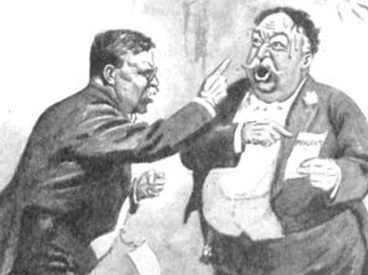
June 22, 1912: The Republicans Kick Theodore Roosevelt Out of the Party

June 22, 1912: The Republican National Convention wraps up at the Chicago Coliseum. It is embarrassing for the Republican Party, but they had no one to blame but themselves.

Theodore Roosevelt chose not to run for what would have amounted to a 3rd term in 1908. His handpicked successor was his Secretary of War, William Howard Taft, who would have preferred to be the Chief Justice of the U.S. Supreme Court. Taft won in a landslide.

But his Administration proved to be considerably more conservative than that of the progressive Roosevelt. And so, in 1912, Roosevelt ran to regain the Republican Party's nomination for President. It was the 1st time a sitting President running for re-election had been seriously challenged for his own Party's nomination.

For the 1st time, Presidential Primaries mattered -- but not as much as Roosevelt would have hoped. There were 13 States holding Primaries, and Roosevelt won 9 of them. Oddly, Roosevelt won Taft's home State of Ohio, but Taft won Roosevelt's home State of New York.

But three-quarters of the States, 36 out of 48, did not hold Primaries. Their Delegates were either members of Congress, or Presidential appointees, including postmasters. And Taft had managed to replace many Roosevelt appointees. So he had a hammerlock on the nomination.

Taft had the support of the Party's conservative wing. Roosevelt, who had one of the most progressive Administrations ever to that point, and was proposing even more progressive legislation, including improvements to labor law, old-age pensions, and even universal health care. He wasn't just 20 years ahead of his cousin Franklin Roosevelt and his New Deal: He was 50 years ahead of John F. Kennedy's New Frontier and Lyndon Johnson's Great Society, 80 years ahead of Bill Clinton, nearly 100 years ahead of Barack Obama.

The Taft and Roosevelt camps engaged in a fight for the delegations of various States, with Taft emerging victorious, and Roosevelt claiming that several delegations were fraudulently seated ,because of the machinations of conservative Party leaders. Roosevelt then accused Taft of steamroller tactics, and ordered his supporters to take no further part in the convention.

He would not have put it in these words, but the Republican Party, to which he had devoted his adult life, had kicked him and his supporters out, for not being conservative enough. This was the first time it had happened to a big chunk of the Republican Party. It would not be the last.

Following the seating of the anti-Roosevelt delegations, Governor Hiram Johnson of California, a Roosevelt supporter, proclaimed that progressives would form a new party to nominate Roosevelt. They did. Roosevelt ran a 3rd party campaign, as part of the Progressive Party, holding their own Convention at the Chicago Coliseum. This split in the Republican Party cost them the White House, and a plurality of voters gave an Electoral Vote landslide to the Democratic Party's nominee, Governor Woodrow Wilson of New Jersey.

It was the most disastrous Convention in Republican history. They would not have another one anywhere near that damaging until their hate-fest in the Astrodome in Houston in 1992.

Roosevelt and Taft later swallowed their differences, and resumed their formerly close friendship. The Party united behind Charles Evans Hughes, a Supreme Court Justice and a former Governor of New York, in 1916. Roosevelt wasn't crazy about the choice, but campaigned for him. So did Taft Wilson beat Hughes in a very close election.

By November 1918, when World War I ended and the Republicans won control of Congress in the election, Roosevelt was considered the front-runner for the Republican nomination for President in 1920. But he died on January 6, 1919. In 1920, Senator Warren Harding of Ohio was elected President. In 1921, Harding appointed Taft to be the Chief Justice, the job he always wanted. He held the job until 1930, retiring due to ill health, and dying soon thereafter.

*

June 22, 1912 was a Saturday. These baseball games were played that day:

* The New York Highlanders were swept in a doubleheader by the Boston Red Sox, 13-2 and 10-3 at Hilltop Park in Upper Manhattan. In the 2nd game, Duffy Lewis hit a home run. Over the 2 games, Tris Speaker went 4-for-8 with 2 walks and an RBI. The Highlanders had already been called the Yankees for a while, and made the name change official the next season.

* The New York Giants swept a doubleheader from the Boston Braves, 17-5 and 14-12 at the South End Grounds in Boston. In other words, the Braves scored 17 runs on the day, and went 0-2. In the opener, the Giants scored 10 runs in the top of the 7th inning, the kind of support Christy Mathewson was glad to get, but usually didn't need. Doc Crandall was the winning pitcher in the nightcap. Over the 2 games, Fred Merkle went 5-for-8 with 5 RBI, Beals Becker went 3-for-8 with a walk and 4 RBIs, and Fred Snodgrass went 6-for-9 with 2 walks and 2 RBIs.

* The Brooklyn Dodgers beat the Philadelphia Phillies, 9-8 at Washington Park in Brooklyn. The winning run came in the bottom of the 10th inning: Herbie Morgan singled, and Maury Kent scored on an error. Zack Wheat went 3-for-5 with 2 RBIs.

* The Washington Senators beat the Philadelphia Athletics, 12-4 at Shibe Park in Philadelphia.

* The Pittsburgh Pirates beat the Cincinnati Reds, 2-1 at Forbes Field in Pittsburgh. Honus Wagner went 1-for-3 with an RBI.

* The Cleveland Naps beat the Detroit Tigers, 11-3 at Navin Field in Detroit. That ballpark was renamed Briggs Stadium in 1938 and Tiger Stadium in 1961. For the Tigers, Ty Cobb went 1-for-4. 
Napoleon "Nap" Lajoie, the manager and 2nd baseman for whom the home team was named, went 3-for-5 with an RBI. Shoeless Joe Jackson went 2-for-4 with a walk and an RBI. The Naps became the Cleveland Indians in 1915, and the Cleveland Guardians in 2022. 

* The Chicago White Sox beat the St. Louis Browns, 8-1 at Comiskey Park in Chicago.

* And the Chicago Cubs beat the St. Louis Cardinals, 10-2 at Robison Field in St. Louis.

December 31, 1999 & January 1, 2000: The Millennium

December 31, 1999:  The Millennium arrives. The people of planet Earth survived. At a terrible cost. But we hadn't destroyed ourselves. ...