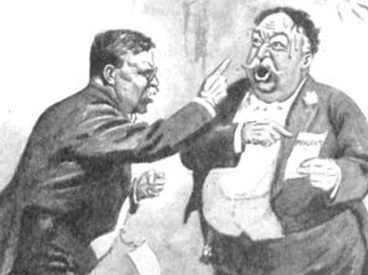
June 22, 1912: The Republican National Convention wraps up at the Chicago Coliseum. It is embarrassing for the Republican Party, but they had no one to blame but themselves.
Theodore Roosevelt chose not to run for what would have amounted to a 3rd term in 1908. His handpicked successor was his Secretary of War, William Howard Taft, who would have preferred to be the Chief Justice of the U.S. Supreme Court. Taft won in a landslide.
But his Administration proved to be considerably more conservative than that of the progressive Roosevelt. And so, in 1912, Roosevelt ran to regain the Republican Party's nomination for President. It was the 1st time a sitting President running for re-election had been seriously challenged for his own Party's nomination.
For the 1st time, Presidential Primaries mattered -- but not as much as Roosevelt would have hoped. There were 13 States holding Primaries, and Roosevelt won 9 of them. Oddly, Roosevelt won Taft's home State of Ohio, but Taft won Roosevelt's home State of New York.
But three-quarters of the States, 36 out of 48, did not hold Primaries. Their Delegates were either members of Congress, or Presidential appointees, including postmasters. And Taft had managed to replace many Roosevelt appointees. So he had a hammerlock on the nomination.
Taft had the support of the Party's conservative wing. Roosevelt, who had one of the most progressive Administrations ever to that point, and was proposing even more progressive legislation, including improvements to labor law, old-age pensions, and even universal health care. He wasn't just 20 years ahead of his cousin Franklin Roosevelt and his New Deal: He was 50 years ahead of John F. Kennedy's New Frontier and Lyndon Johnson's Great Society, 80 years ahead of Bill Clinton, nearly 100 years ahead of Barack Obama.

Chicago Coliseum
The Taft and Roosevelt camps engaged in a fight for the delegations of various States, with Taft emerging victorious, and Roosevelt claiming that several delegations were fraudulently seated ,because of the machinations of conservative Party leaders. Roosevelt then accused Taft of steamroller tactics, and ordered his supporters to take no further part in the convention.
He would not have put it in these words, but the Republican Party, to which he had devoted his adult life, had kicked him and his supporters out, for not being conservative enough. This was the first time it had happened to a big chunk of the Republican Party. It would not be the last.
Following the seating of the anti-Roosevelt delegations, Governor Hiram Johnson of California, a Roosevelt supporter, proclaimed that progressives would form a new party to nominate Roosevelt. They did. Roosevelt ran a 3rd party campaign, as part of the Progressive Party, holding their own Convention at the Chicago Coliseum. This split in the Republican Party cost them the White House, and a plurality of voters gave an Electoral Vote landslide to the Democratic Party's nominee, Governor Woodrow Wilson of New Jersey.
It was the most disastrous Convention in Republican history. They would not have another one anywhere near that damaging until their hate-fest in the Astrodome in Houston in 1992.
Roosevelt and Taft later swallowed their differences, and resumed their formerly close friendship. The Party united behind Charles Evans Hughes, a Supreme Court Justice and a former Governor of New York, in 1916. Roosevelt wasn't crazy about the choice, but campaigned for him. So did Taft Wilson beat Hughes in a very close election.
By November 1918, when World War I ended and the Republicans won control of Congress in the election, Roosevelt was considered the front-runner for the Republican nomination for President in 1920. But he died on January 6, 1919. In 1920, Senator Warren Harding of Ohio was elected President. In 1921, Harding appointed Taft to be the Chief Justice, the job he always wanted. He held the job until 1930, retiring due to ill health, and dying soon thereafter.
*
June 22, 1912 was a Saturday. These baseball games were played that day:
* The New York Highlanders were swept in a doubleheader by the Boston Red Sox, 13-2 and 10-3 at Hilltop Park in Upper Manhattan. In the 2nd game, Duffy Lewis hit a home run. Over the 2 games, Tris Speaker went 4-for-8 with 2 walks and an RBI. The Highlanders had already been called the Yankees for a while, and made the name change official the next season.
* The New York Giants swept a doubleheader from the Boston Braves, 17-5 and 14-12 at the South End Grounds in Boston. In other words, the Braves scored 17 runs on the day, and went 0-2. In the opener, the Giants scored 10 runs in the top of the 7th inning, the kind of support Christy Mathewson was glad to get, but usually didn't need. Doc Crandall was the winning pitcher in the nightcap. Over the 2 games, Fred Merkle went 5-for-8 with 5 RBI, Beals Becker went 3-for-8 with a walk and 4 RBIs, and Fred Snodgrass went 6-for-9 with 2 walks and 2 RBIs.
* The Brooklyn Dodgers beat the Philadelphia Phillies, 9-8 at Washington Park in Brooklyn. The winning run came in the bottom of the 10th inning: Herbie Morgan singled, and Maury Kent scored on an error. Zack Wheat went 3-for-5 with 2 RBIs.
* The Washington Senators beat the Philadelphia Athletics, 12-4 at Shibe Park in Philadelphia.
* The Pittsburgh Pirates beat the Cincinnati Reds, 2-1 at Forbes Field in Pittsburgh. Honus Wagner went 1-for-3 with an RBI.
* The Cleveland Naps beat the Detroit Tigers, 11-3 at Navin Field in Detroit. That ballpark was renamed Briggs Stadium in 1938 and Tiger Stadium in 1961. For the Tigers, Ty Cobb went 1-for-4.
Napoleon "Nap" Lajoie, the manager and 2nd baseman for whom the home team was named, went 3-for-5 with an RBI. Shoeless Joe Jackson went 2-for-4 with a walk and an RBI. The Naps became the Cleveland Indians in 1915, and the Cleveland Guardians in 2022.
* The Chicago White Sox beat the St. Louis Browns, 8-1 at Comiskey Park in Chicago.
* And the Chicago Cubs beat the St. Louis Cardinals, 10-2 at Robison Field in St. Louis.


No comments:
Post a Comment