Showing posts with label 1928. Show all posts

Sunday, December 4, 2022

December 4, 1928: “Makin' Whoopee!” On Broadway

December 4, 1928: Whoopee! premieres on Broadway, a musical based on the play The Nervous Wreck by Owen Davis. The story was written by William Anthony McGuire, with music by Walter Donaldson and lyrics by Gus Kahn. The producer is the man then in the process of taking over from George M. Cohan as the King of Broadway, Florenz Ziegfeld.

The show itself is forgettable, but 2 of its songs are remembered: "Makin' Whoopee," sung by the show's male lead, Eddie Cantor, for whom it would become his biggest hit song; and "Love Me Or Leave Me," by the show's female lead, Ruth Etting, and brought back as a hit in 1955 by Doris Day, who starred as Etting in a film of the same title. The show also features a pair of up-and-comers in its chorus: Buddy Ebsen and Paulette Goddard.

The venue is the New Amsterdam Theatre at 214 West 42nd Street. After many years as a derelict, it was bought and renovated by the Walt Disney Company, and reopened in 1997. Currently, it is showing a live-action version of Disney’s "Aladdin."

The show was filmed in 1930, as a musical with mostly different songs, but still starring Cantor.

In the years to come, "making whoopee" became code for "having sex," and in the 1970s would be used as a euphemism on TV games shows like Match Game and The Newlywed Game.

*

December 4, 1928 was a Tuesday. Baseball was out of season. Football was in midweek. The NBA hadn't been founded yet.

There were 2 games in the NHL. The Boston Bruins beat the New York Rangers, 2-0 at the brand-new Boston Garden. And the Toronto Maple Leafs beat the Montreal Canadiens, 3-1 at the Montreal Forum.

Tuesday, November 29, 2022

November 29, 1928: Providence, NFL Champions

Jimmy Conzelman

November 29, 1928: On this Thanksgiving Day, the people of Rhode Island have something to be thankful for: For the 1st time since the Providence Grays were baseball's World Champions in 1884, 44 years earlier, they have a World Championship team.

NOTE: Until 1939, America celebrated Thanksgiving Day on the last Thursday in November, regardless of whether it was the 4th Thursday or the 5th. From 1940 onward, it's been the 4th Thursday in November, whether it's the last one or not.

The Providence Steam Roller were established in 1916, by men working for the Providence Journal newspaper: Sports editor Charles Coppen and sportswriter Pearce Johnson. Three men shared in the ownership and management of the team: Coppen, Judge James Dooley, and sports promoter Peter Laudati. Johnson served as what would now be called the general manager.

The team soon became a regional power. In 1924, its schedule featured several NFL teams. The Steam Rollers posted a 3–2–1 record against those teams. The 1924 Steam Roller then went on to win the mythical "undisputed championship of the Northeast." The team's success that season was enough to make Steam Rollers management and fans start thinking about playing in the NFL.

They joined for the 1925 season, moving from their former home of Kinsley Park to a 10,000-seat cycling stadium called the Cycledrome, which wasn't quite big enough to hold a regulation football field, and so the corners of one end zone were cut off. Laudrati had both of these stadiums built. They went 6-5-1, then 5-7-1 in 1926.
The Providence Cycledrome
They hired star back Jimmy Conzelman, still only 29 years old and still playing, as head coach for 1927, and he improved the team to 8-5-1. Their other players included back Gus Sonnenberg, who went on to greater fame as a professional wrestler; and back George "Wildcat" Wilson, who had starred at the University of Washington.
They began the 1928 season by beating the football team named the New York Yankees, 20-7 at the Cycledrome. They lost at home to the Frankford Yellow Jackets, 10-6. They did not lose again that season: They beat the Dayton Triangles at home, 28-0; the Yankees at Yankee Stadium, 12-6; the Pottsville Maroons at home, 13-6; and the Detroit Wolverines at home, 7-0.
With Pennsylvania having "blue laws" prohibiting the playing of professional sports on Sundays, the Yellow Jackets would often schedule home-and-home series on back-to-back days: In Philadelphia on a Saturday, and then against the same team, at their stadium, on Sunday. On November 17, the Steam Roller went into Frankford Stadium in Northeast Philadelphia, and came away with a 6-6 tie. On November 18, at the Cycledrome, they beat the Yellow Jackets 6-0.
The following Sunday, they beat the football version of the New York Giants at home, 16-0. They were set to play the Maroons at Minersville Park in Pottsville, Pennsylvania. Jack Cronin rushed for a touchdown in the 2nd quarter, and that was it: Providence 7, Pottsville 0. With the Yellow Jackets already having lost 3 games, this game the Steam Roller the NFL Championship.
They closed the season on December 2, at home, playing the Green Bay Packers to a 7-7 tie. They finished 8-1-2, for a winning percentage of .889. The Yellow Jackets were 11-3-2, at .786; while the Wolverines were 7-2-1, at .778. (At the time, ties were not counted in winning percentage. If they had been, it would have been Providence .818, Frankford .750, Detroit .750, so it wouldn't have made a difference.)
Under the rules that began in 1933, Providence would have won the Eastern Division, and Detroit the Western Division, and they would have played each other in the NFL Championship Game. This being an even-numbered year, the Eastern Division winners would have hosted, so the Steam Roller would have done so. But this was still the pre-title game, single-division NFL, so the Steam Roller won the title outright.
But they couldn't hold it together. Conzelman could only guide them to 4-6-2 in 1929, and 6-4-1 in 1930. He left, and they finished 4-4-3 in 1931. Their last home game came on another Thanksgiving, November 26, a 38-7 loss to the Packers; and their last game, on November 29, was a 0-0 tie against the Giants at the Polo Grounds. The owners then turned the franchise back over to the NFL.
Providence has never gotten another NFL team. In 1971, the Boston Patriots changed their name to the New England Patriots, and moved to Foxborough, Massachusetts. It's almost exactly halfway between downtown Boston and downtown Providence. The Patriots have won 6 Super Bowls, but they do not claim New England's 1st NFL Championship, that of the 1928 Providence Steam Roller, as their own.
The Providence Journal, a.k.a. the ProJo, remains the largest-circulating newspaper in Rhode Island. A Peter Pan Bus Terminal now stands on the site of the Cycledrome.
*

November 29, 1928, being Thanksgiving, was a Thursday. There were 3 other NFL games that Thanksgiving Day:

* The Frankford Yellow Jackets beat the Green Bay Packers, 2-0 at Frankford Stadium in Philadelphia.

* The Detroit Wolverines beat the Dayton Triangles, 33-0 at Navin Field (the eventual Tiger Stadium) in Detroit.

* And the Chicago Bears beat the Chicago Cardinals, 34-0 at Wrigley Field in Chicago.

There were also 24 college football games on this day, but most of them were not the more familiar rivalries that would develop:

* Brown beat Colgate, 16-13 at Brown Stadium in Providence, Rhode Island.

* New York University (NYU) welcomed Oregon State to Yankee Stadium, and lost, 25-13 in front of a crowd of 40,000.

* Syracuse beat Columbia, 14-6 at Baker Field in Manhattan.

* The University of Pennsylvania beat Cornell, 49-0 at Franklin Field in Philadelphia.

* The University of Pittsburgh beat Penn State, 26-0 at Pitt Stadium in Pittsburgh.

* Maryland beat Johns Hopkins, 26-6 at Municipal Stadium in Baltimore.

* West Virginia beat Washington & Jefferson, 14-0 at the old Mountaineer Field in Morgantown, West Virginia.

* Virginia Military Institute (VMI) beat Virginia Polytechnic Institute (VPI, now usually called Virginia Tech), 16-6 at Maher Field in Roanoke, Virginia.

* North Carolina beat Virginia, 24-20 at Lambeth Field in Charlottesville, Virginia.

* North Carolina State beat South Carolina, 18-7 at Riddick Stadium in Raleigh, North Carolina.

* Mercer beat Wake Forest, 14-12 at Memorial Stadium in Asheville, North Carolina.

* Clemson beat Furman, 27-12 at Manly Field in Greenville, South Carolina. I guess Furman's home field wasn't manly enough.

* Georgia Tech beat Alabama Polytechnic (now Auburn University), 51-0 at Grant Field in Atlanta.

* Florida beat Washington & Lee University, 60-6 at Fairfield Stadium in Jacksonville.

* Alabama beat Georgia, 19-0 at Denny Stadium (now Bryant-Denny Stadium) in Tuscaloosa, Alabama.

* Kentucky and Tennessee played to a tie, 0-0 at Shields-Watkins Field (now Neyland Stadium) in Knoxville, Tennessee.

* Arkansas beat Southwestern College, 73-0 at Russwood Park in Memphis. Southwestern, in Memphis, is now known as Rhodes College, and competes at the NCAA Division III level.

* Mississippi (Ole Miss) beat Mississippi State, 20-19 at Scott Field (now Davis Wade Stadium) in Starkville, Mississippi.

* Louisiana State University (LSU) and Tulane played to a tie, 0-0 at Tulane Stadium in New Orleans.

* Oklahoma beat Missouri, 14-0 at Owen Field (now Gaylord Family Memorial Stadium) in Norman, Oklahoma.

* The University of Tulsa beat Oklahoma A&M (now Oklahoma State), 31-0 at McNulty Park in Tulsa, 
Oklahoma.

* Texas Christian University (TCU) beat Southern Methodist University (SMU), 15-6 at Ownby Stadium in Dallas.

* Texas beat Texas A&M, 19-0 at Memorial Stadium in Austin.

* Baylor beat Rice, 25-14 at Rice Field in Houston.

* The University of Detroit beat Georgetown, 33-13 at Titan Stadium in Detroit.

* Marquette beat Iowa State, 6-0 at Marquette Stadium in Milwaukee.

* Drake beat Creighton, 6-0 at Creighton Stadium in Omaha, Nebraska.

* Nebraska beat Kansas State, 8-0 at Memorial Stadium in Lincoln.

* The University of Colorado beat the University of Denver, 7-0 at Hilltop Stadium in Denver.

* New Mexico beat Colorado Mines, 32-13 at University Field in Albuquerque, New Mexico.

* Utah beat Utah A&M (now Utah State), 20-0 at Ute Stadium in Salt Lake City.

* Oregon beat UCLA, 26-6 at the Los Angeles Memorial Coliseum.

* Montana beat Gonzaga, 7-0 at Gonzaga Stadium in Spokane, Washington.

* And Washington beat Washington State, 6-0 at Husky Stadium in Seattle.

The NBA hadn't been founded yet, but there were 3 games played in the NHL:

* The New York Rangers beat the Chicago Black Hawks, 2-1 at the old Madison Square Garden, which was then new.

* The Montreal Canadiens and the Pittsburgh Pirates played to a tie, 1-1 at the Montreal Forum. The Pirates folded in 1930.

* And the Montreal Maroons and the Detroit Cougars played to a tie, 1-1 at the Olympia Stadium in Detroit. The Cougars became the Falcons in 1930, and the Red Wings in 1932. The Maroons folded in 1938.

Friday, November 18, 2022

November 18, 1928: "Steamboat Willie" Debuts Mickey Mouse

November 18, 1928: Steamboat Willie premieres, at Universal's Colony Theatre in New York. Although both characters had first appeared earlier in the year, in a test screening of the cartoon Plane Crazy, this was the 1st wide-release film to feature the characters of Mickey Mouse and his love interest Minnie Mouse.

The film was produced by the brothers Walt and Roy Disney. Walt and Ub Iwerks wrote it, drew it, and directed it. (An American of German descent, real name Ubbe Ert Iwwerks, Iwerks had a falling-out with Walt in 1930, and has been relegated to a secondary role in Mickey's creation.)

The cartoon lasts 7 minutes and 24 seconds. It begins with Mickey piloting a steamboat, suggesting that he is the captain. But the real captain appears, a big cat named Pete, who forces him off the bridge, causing a parrot to laugh at him. (Pete would go on to become a regular nemesis for Mickey.) Pete docks the boat to pick up livestock, and Minnie comes aboard. Using some of the livestock as "instruments," they play the song "Turkey in the Straw." Pete sees this, and puts Mickey to work peeling potatoes. The parrot laughs at Mickey again, and Mickey throws a potato at it, knocking it into the river.

Variety, the trade paper of show business, wrote of it, "Not the first animated cartoon to be synchronized with sound effects, but the first to attract favorable attention. This one represents a high order of cartoon ingenuity, cleverly combined with sound effects. The union brought forth laughs galore."

This was the beginning of the Disney empire. Mickey Mouse would become the most famous cartoon character of all time, and lead to Disney creating bigger and better cartoons, many of them musicals. It would lead to the Disney theme parks, especially Disneyland in Anaheim, California; and Walt Disney World outside Orlando, Florida. The Walt Disney Company is often called "The House of Mouse."
Walt Disney

A 2015 episode of the YouTube series Epic Rap Battles of History featured "Epic" Lloyd Ahlquist as Stan Lee, against "Nice" Peter Shukoff as Muppets creator Jim Henson, with Zach Sherwin stepping in as Walt Disney, "taking over" the battle the way his company bought out both Marvel and the Muppets franchise.

On January 1, 2024, the copyright on Steamboat Willie ran out. For the first time, a version of Mickey Mouse -- but only this specific version -- entered the public domain. For the first time, The Walt Disney Company lost control of a piece of their cornerstone character. And they had long dreaded the day: If there's one thing that a powerful corporation, especially Disney, values more than money, it's control.

Universal's Colony Theatre still stands, under the name of the Broadway Theatre, at 1681 Broadway at 53rd Street. In 1940, Disney would premiere Fantasia at the same theater. It would later host the original productions of the musicals This Is the Army, Carmen Jones, The Cradle Will Rock, High Button Shoes, Where's Charley?, The Most Happy Fella, Gypsy, The Wiz, Evita, Les Misérables, and Miss Saigon.

*

November 18, 1928 was a Sunday. Baseball, basketball and hockey were out of season. But there were 4 games played in the National Football League:

* The football team named the New York Giants lost to the Green Bay Packers, 7-0 at the Polo Grounds.

* The football team named the New York Yankees lost to the Detroit Wolverines, 13-0 at the University of Detroit Stadium.

* The Providence Steam Roller (always written without an S on the end) beat the Frankford Yellow Jackets of Northeast Philadelphia, 6-0 at the Providence Cycledrome.

* And the Chicago Bears beat the Pottsville Maroons, 13-6 at Wrigley Field in Chicago.

Thursday, November 17, 2022

November 17, 1928: The Boston Garden Opens

November 17, 1928: The Boston Madison Square Garden opens, on top of North Station, in Boston's North End. It was the 1st of 6 copies of Madison Square Garden in New York that boxing promoter and MSG owner George "Tex" Rickard had planned to build around the country. But Rickard died early in 1929, and this would be the only one that got built.

The 1st event was a boxing card, in which the main event was "Honey Boy" Dick Finnegan, a Boston native, defeating Andre Routis. Three days later, the NHL's Boston Bruins played their 1st game there, losing to the Montreal Canadiens, 1-0. Sylvio Mantha scored the arena's 1st goal, at the end of the 2nd period.
In 1934, the Madison Square Garden Corporation sold the building to the Boston Garden-Arena Corporation, which was bought out by Delaware North Corporation in 1975. From 1934 onward, it was "the Boston Garden," or, in the Boston accent, "the Gah-den."

The NBA was founded in 1946, and the Boston Celtics took up residence there. Both the Celtics and the Bruins remained in the Garden until 1995. From 1955 to 1995, the Beanpot Tournament was held, between 4 local college hockey teams: Boston College, Boston University, Northeastern University and Harvard. In 1978, a blizzard during the Tournament trapped fans inside the Garden. At least there were bathrooms and food, and the food was given out for free until plows could arrive to get the exits accessible.

The Bruins won the Stanley Cup in their 1st season there, 1929; and again in 1939, 1941, 1970 and 1972. The Celtics won the NBA Championship in 1957, 1959, 1960, 1961, 1962, 1963, 1964, 1965, 1966, 1968, 1969, 1974, 1976, 1981, 1984 and 1986.
In total, there were 19 NBA Finals and 16 Stanley Cup Finals played at the Boston Garden. In 1957 and 1958, both leagues' finals were held there.

There were lots of prizefights there, but never one for the Heavyweight Championship of the World. The rematch between Muhammad Ali and Sonny Liston was supposed to be there, on November 16, 1964. But 3 days before, Ali developed a hernia. Re-set for May 25, 1965, concerns over both Ali and Liston led City officials to drop sanction for the fight, and it was moved to Lewiston, Maine.

Since the Garden was designed by Rickard, the seating was set up primarily for boxing. It was not especially good for basketball or hockey. The NHL standard for rink size is 200 feet long by 85 feet wide, but that had not yet been put in place. The Garden's rink was only 191 by 83, and this smaller size gave rise to the rough-house style favored by the team that became known as "the Big Bad Bruins." And for all the advantages the Garden gave his Celtics, longtime coach and general manager Arnold "Red" Auerbach hated the place: "The seating's all cockeyed."

I only saw one event there, and had both horizontal and vertical obstruction: Under the upper-deck overhang and behind a pole. 

The Garden hosted political rallies, including hometown hero John F. Kennedy having his Election Eve rally there on November 7, 1960. Despite Boston being America's most Catholic city, the Garden hosted rallies not just by Bishop Fulton J. Sheen in 1953, but by evangelical Protestants Aimee Semple McPherson in 1931, Billy Graham in 1950, and Jimmy Swaggart in 1983.

And there were concerts. It was 1 of only 16 buildings to have hosted both The Beatles (on September 12, 1964) and Elvis Presley (on November 10, 1971). The most important concert there came on April 5, 1968. The day before, Dr. Martin Luther King Jr. was assassinated in Memphis. Many American cities broke out into riots. James Brown -- already one of America's biggest African-American singers, but a few months away from writing and recording "Say It Loud -- I'm Black and I'm Proud" -- was scheduled to perform at the Garden.

Kevin White, Mayor for just 3 months, was told he should cancel the concert, for fear that the mostly-black audience would riot. But he knew that a riot was more likely if the concert was canceled. He talked to Brown, and an idea was hatched: The concert would be broadcast live on public TV station WGBH-Channel 2, and anyone who didn't have a ticket was urged to stay home and watch it on TV. The concert went off without a hitch.

Other notable concerts included a "battle of the bands" between the orchestras of Rudy Vallée and Benny Goodman in 1938; an Alan Freed Show in 1956, the arena's 1st rock concert; a 1972 show where Stevie Wonder opened for The Rolling Stones, and had to play for hours because the Stones had been detained in Rhode Island, and needed Mayor White's intervention to get them to Boston, arriving around midnight; several shows by New Englanders Aerosmith and The J. Geils Band; and, more than any other act, 24 times from 1973 to 1994, The Grateful Dead.

The Garden seated 14,890 for basketball, and 14,448 for hockey. There was no air-conditioning, leading to the famous scene of Los Angeles Lakers star Kareem Abdul-Jabbar needing oxygen on the bench during Game 5 of the 1984 NBA Finals. And there were power outages during the Stanley Cup Finals of 1988 and 1990.

A new arena was badly needed. Massachusetts, and especially Boston, politics being what they are, it took a while to secure funding. Finally, in 1993, construction began on the replacement, still on Causeway Street above North Station, but behind the Garden.

The last Celtic game was on May 5, 1995, Game 4 of the 1st Round of the NBA Playoffs, losing to the Orlando Magic, 95-92. The last Bruin game that counted was on May 14, 1995, Game 5 of the NHL Eastern Conference Quarterfinals, losing to the New Jersey Devils, 3-2. The last goal was scored by the Bruins' Adam Oates.

On September 26, 1995, a preseason exhibition marked the Garden's last event. The Bruins played the same team they played in the opener, 67 years earlier, the Montreal Canadiens. The Bruins won, 3-0, and Cam Neely scored the real last goal. Afterward, there was "One Final Skate" by Bruin legends, including Bobby Orr, Phil Esposito, 1940s legend Milt Schmidt, and current stars Neely, Oates and Ray Bourque.

The Celtics and Bruins moved into the new arena, originally named the FleetCenter, now named the TD Garden. It took until 1998 for the old Garden to be demolished, because, had they not, it would have been ruined anyway due to construction of the tunnel for the new John F. Fitzgerald Expressway and the demolition of the old one, an elevated highway that was such an eyesore, it was nicknamed "Boston's Other Green Monster."

The site of the old Garden is now a retail development named The Hub on Causeway.

UPDATE: Neither the Celtics nor the Bruins have a team Hall of Fame, but each has retired several uniform numbers. Here they are, through the 2025-26 season:

* The Celtics retired Number 1 for founding owner Walter Brown, and 2 for longtime head coach and general manager Arnold "Red" Auerbach. Ed Macauley, Number 22, is the only honoree from before their 1st NBA Championship in 1957. They also "retired a microphone" for broadcaster Johnny Most.

* From their 1957-69 dynasty: 6, Bill Russell; 14, Bob Cousy; 15, Tommy Heinsohn; 16, Tom "Satch" Sanders; 17, John Havlicek; 19, Don Nelson; 21, Bill Sharman; 23, Frank Ramsey; 24, Sam Jones; 25, K.C. Jones. In addition, because he wore 18 like Dave Cowens did, Jim Loscutoff was honored on the retired number banner with "LOSCY."

* From their NBA Champions of 1974 and 1976: Heinsohn as coach, Havlicek, Nelson; 10, Jo Jo White; and 18, Dave Cowens.

* From their NBA Champions of 1981, 1984 and 1986: K.C. Jones as head coach, and Heinsohn as broadcaster; 00, Robert Parish; 3, Dennis Johnson; 31 Cedric "Cornbread" Maxwell; 32, Kevin McHale; 33, Larry Bird. Reggie Lewis, Number 35, came after this period.

* From their NBA Champions of 2008: Heinsohn as broadcaster; 5, Kevin Garnett; and 34, Paul Pierce.

* From the Bruins' 1929 Stanley Cup winners: 2, Eddie Shore; 3, Lionel Hitchman; 5, Aubrey "Dit" Clapper.

* From their 1939 Cup winners: Shore, Clapper; 15, Milt Schmidt.

* From their 1941 Cup winners: Clapper and Schmidt.

* From their 1958 Cup Finalists: 22, Willie O'Ree, the 1st black player in the NHL.

* From their 1970 and 1972 Cup winners: 4, Bobby Orr; 7, Phil Esposito; 9, Johnny Bucyk.

* From their 1974, 1977 and 1978 Cup Finalists: 16, Rick Middleton; 24, Terry O'Reilly.

* From their 1988 and 1990 Cup Finalists: 8, Cam Neely; 77, Ray Bourque.

* And from their 2011 Cup winners: 33, Zdeno Chara.

*

November 17, 1928 was a Saturday. Rance Howard was born on that day. Although he was an actor of note, he is more famous for his descendants: He was the father of actor-directors Ron Howard and Clint Howard, and the grandfather of actresses Bryce Dallas Howard and Paige Howard.

There were 3 NHL games played that day. The Bruins were in one of them, but not at home, which would, for 3 more days, by the Boston Arena, now known as the Matthews Arena, home of Boston University.

The Bruins played the Ottawa Senators to a 2-2 tie at the Ottawa Auditorium. The Montreal Maroons beat the Chicago Black Hawks, 4-2 at the Montreal Forum. And the Toronto Maple Leafs beat the Montreal Canadiens, 4-2 at the Mutual Street Arena in Toronto.

The baseball season was over. And the NBA wouldn't be founded for another 18 years. But there were football games:

* In the NFL, the Providence Steam Roller beat the Philadelphia-based Frankford Yellow Jackets, 6-0 at the Cycledrome in Providence, Rhode Island.

* In college games, Georgia Tech beat the University of Alabama, 33-13 at Grant Field in Alabama. On New Year's Day, they clinched the National Championship by beating the University of California in the Rose Bowl, due in part to a wrong-way run by Cal's Roy Riegels.

* The University of Pittsburgh and the University of Nebraska played to a 0-0 at Memorial Stadium in Lincoln, Nebraska. Nebraska won the Big Six Conference title.

* The University of Illinois beat the University of Chicago, 40-0 at Stagg Field in Chicago. Illinois won the Big Ten Conference title.

* The University of Texas beat Texas Christian University, 6-0 at Clark Field in Fort Worth, Texas.

* The University of Southern California beat Washington State University, 27-13 at the Los Angeles Memorial Coliseum. USC won the Pacific Coast Conference title.

* Carnegie Tech, the school now known as Carnegie-Mellon University, beat Notre Dame, 27-7 at Cartier Field in South Bend, Indiana.

* Army beat Carleton College, of Northfield, Minnesota, 32-7 at Michie Stadium in West Point, New York.

* Navy beat Loyola University of Baltimore, 57-0 at Thompson Stadium in Annapolis, Maryland.

* In New York City, New York University beat the University of Missouri, 27-6 at Yankee Stadium.

* Fordham lost to the University of Detroit, 19-0 at the Polo Grounds.

* Manhattan College beat City College of New York, 14-10 at Lewisohn Stadium, CCNY's home field at 138th Street and Amsterdam Avenue in Harlem. (It was torn down in 1973.)

* Columbia lost to Penn, 34-7 at Franklin Field in Philadelphia.

* As for New Jersey's teams, Rutgers beat Lehigh, 7-3 at Taylor Stadium in Bethlehem, Pennsylvania.

* And Princeton beat Yale, 12-2 at Palmer Stadium.

Also, Arsenal lost to Bury F.C., 1-0 at Gigg Lane in Bury, outside Manchester. 

Wednesday, November 9, 2022

November 10, 1928: Notre Dame Wins One for the Gipper

November 10, 1928: The football teams of the University of Notre Dame and the U.S. Military Academy, a.k.a. "Army," play at Yankee Stadium. A crowd of 78,188 see the Cadets lead the Fighting Irish 6-0 at halftime. It wasn't that surprising: Army was undefeated, 6-0, while Notre Dame was only 4-2.

In his halftime pep talk, instead of discussing strategy, Notre Dame coach Knute Rockne tells his players, who would have been in junior high school in 1920, about George Gipp. A back on both offense and defense, and a also a great kicker, Gipp had led Notre Dame to the National Championship that season.
But he had gotten sick -- how it happened depends on who's telling the story -- and, in those pre-antibiotic days, he was doomed to die at the age of 25. As Rockne told it, he went to see Gipp on his deathbed on December 14, 1920, and Gipp told him: 

I've got to go, Rock. It's all right. I'm not afraid. Some time, Rock, when the team is up against it, when things are wrong, and the breaks are beating the boys, ask them to go in there with all they've got, and win just one for the Gipper. I don't know where I'll be then, Rock. But I'll know about it, and I'll be happy.

Having told the 1928 players that story, Rockne concludes by saying, "Gentlemen, this is that game." And the players leave the locker room in tears, and come from behind, with Jack Chevigny and Johnny O'Brien scoring touchdowns, and beat Army 12-6.

That's the story. But it makes no sense. First of all, why choose this game? Because it was in New York? Because it was against Army? Certainly, Rockne didn't need to be afraid of losing his job: He was already an icon in South Bend, Indiana.

Second of all, they were only down by 6 points. Maybe if they needed a much bigger effort, to overcome a 2-touchdown deficit, such a speech might be warranted.

Third of all, like I said, those players were just kids when Gipp died. They never saw him play. It's not like there was television back then. The newsreels probably never showed Gipp. For all they knew, Rockne could have been lying, and Gipp could have walked into the room at that moment, and they wouldn't have recognized him. (Another coach, Edward "Slip" Madigan of St. Mary's in the San Francisco Bay Area, allegedly once tearfully told his players about his sick son, and said to win the game for him, when the son walked in, just fine.) Gipp's legend shouldn't have had any effect on the 1928 Fighting Irish.

And fourth of all, if the locker room speech did happen, Rockne probably made it up. As one sportswriter put it, decades later, If Gipp said anything to Rockne as he was dying, it was probably more along the lines of, "Put a hundred bucks on the 4 horse in tomorrow's 7th race at Arlington for me."

Rockne was killed in a plane crash near Bazaar, Kansas on March 31, 1931. On October 4, 1940, the film Knute Rockne, All-American premiered. Pat O'Brien played the coach. Ronald Reagan, who had played guard at Eureka College in Illinois, now an NCAA Division III school, played Gipp, and played the speech scene straight.

As Reagan went into politics in the 1960s, and was elected President in 1980, he often played up his connection to Notre Dame. His fans joyfully called him "the Gipper." At the 1988 Republican Convention, at the Superdome in New Orleans, knowing he couldn't run for a 3rd term, he told the new nominee, his Vice President, George H.W. Bush (who played baseball at Yale), "Go out there, and win one for the Gipper!" Meaning himself. Bush did win the election.

As Reagan fell victim to Alzheimer's disease, and could no longer make public appearances, campaign signs reading, "WIN ONE FOR THE GIPPER" appeared at rallies for Bob Dole in 1996 and George W. Bush in 2000. Reagan died in 2004, and during Bush's re-election campaign, there were more "Gipper" signs than ever before. They came up again for John McCain in 2008 and Mitt Romney in 2012. They were not used for Donald Trump in 2016 and 2020: Far be it from him to allow someone other than himself to be idolized.

Reagan's political career was built on many, many lies. The "Win one for the Gipper" story was the first. If the truth about Gipp had been widely known in 1966, when Reagan was making his 1st run for public office, for Governor of California, he might never have won an election. After all, the other movie people tended to remember him for was Bedtime for Bonzo, where he worked with a chimpanzee.

George Gipp was a real person, and he really was a great football player. But the thing everybody remembers about him almost certainly isn't true. But, like Reagan's campaign promises, Rockne's Gipper speech was a fraud -- or, as the actual Irish would say, it was blarney -- that worked very well.

*

November 10, 1928 was, like most college football days, a Saturday. There were no baseball games. The NHL season wouldn't start for another 5 days. The NBA wouldn't be founded for another 18 years. But there were NFL games played that day. Because Pennsylvania banned professional sports on Sunday until 1933, the Frankford Yellow Jackets played the Pottsville Maroons on this Saturday, and the Jackets won, 19-0 at Frankford Stadium in Northeast Philadelphia.

And there were other college football games played that day:

* Georgia Tech, 5-0, played Vanderbilt, 6-0, at Grant Field in Atlanta. Tech won, 19-7.

* The championship of the Big Six Conference, the league that would eventually become the Big Eight and 2/3rds of the Big XII, was decided when Nebraska renewed its rivalry with Oklahoma, and won 44-6 at Memorial Stadium in Norman, Oklahoma.

* New York University defeated Alfred University of Alfred, in Western New York State, at Ohio Field in The Bronx.

* Fordham did not play on that day. Instead, they had an Armistice Day (Veterans Day) matinee 2 days later, against Boston College at Fenway Park. BC won, 19-7.

* Rutgers lost to Lafayette, 17-0 at Neilson Field in New Brunswick.

* And Princeton beat Washington & Lee University, 25-12 at Palmer Stadium in Princeton.

Also, Arsenal beat Sheffield United, 2-0 at Highbury in North London.

Also on this day, Italian composer Ennio Morricone was born. He is best known for his collaborations with director Sergio Leone on his "Spaghetti Westerns." His theme for the 1966 Clint Eastwood epic The Good, the Bad, and the Ugly is considered one of the greatest in movie history.

Sunday, November 6, 2022

November 6, 1928: The "Zipper" Debuts at One Times Square

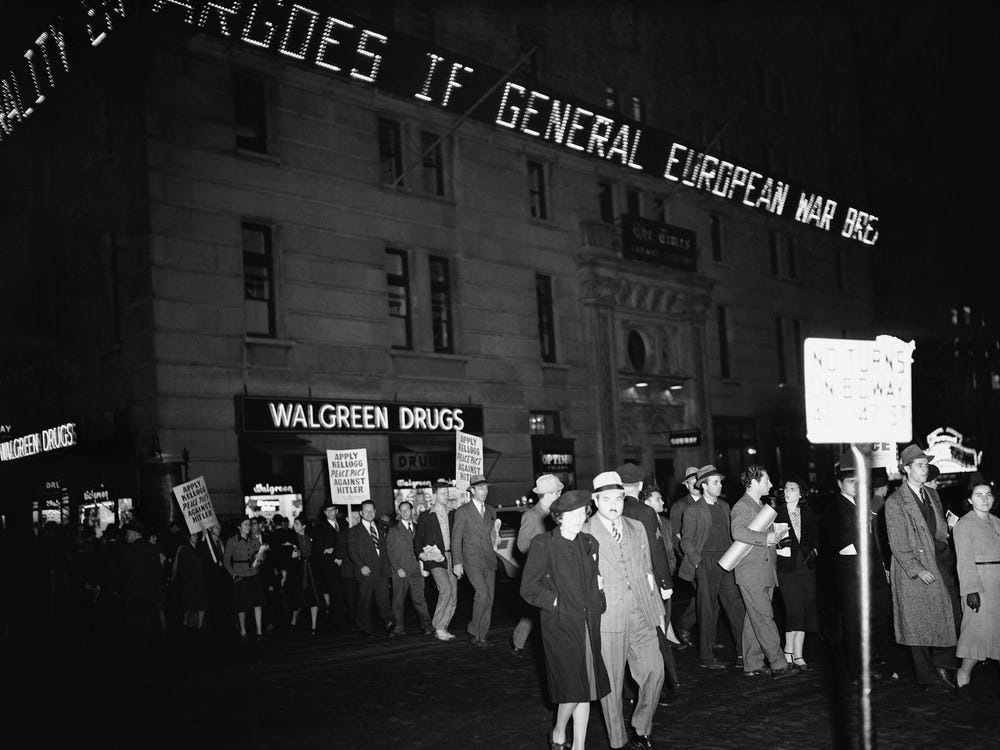
November 6, 1928: The Times Square "Zipper" goes into operation, bringing news headlines to people who don't have access to radios -- in this era before television.

Since the advent of the telegraph in the 1840s, newspapers commonly used their buildings to share the latest headlines. At first, simple chalkboard signs were used for bulletins. But limelight illumination, electric lights, magic lantern projections, and other novel techniques were later employed.

The method of using electric lights to spell out moving letters was invented by Frank C. Reilly, and patented in 1923. Reilly called his invention the Motograph News Bulletin. In 1928, The New York Times installed a Motograph News Bulletin to display news headlines on the sides of Times Tower, at 1 Times Square, where 42nd Street, 7th Avenue and Broadway come together. The 1st news story it announced was the election of Herbert Hoover as the 31st President of the United States. (I have a separate entry for that event.)

The display was 388 feet long, 5 feet high, and employed over 14,800 light bulbs. Popularly known as the "Zipper," the sign went on to feature in several newsreels, including those announcing Presidential elections and the surrenders of World War II, V-E Day and V-J Day.

It was darkened during World War II, to comply with wartime lighting restrictions. It operated continuously until 1961, when The New York Times moved out of the building. The tower was subsequently purchased by Allied Chemical in 1963. It was put back into service in 1965, but would only operate sporadically with some gaps lasting several years.
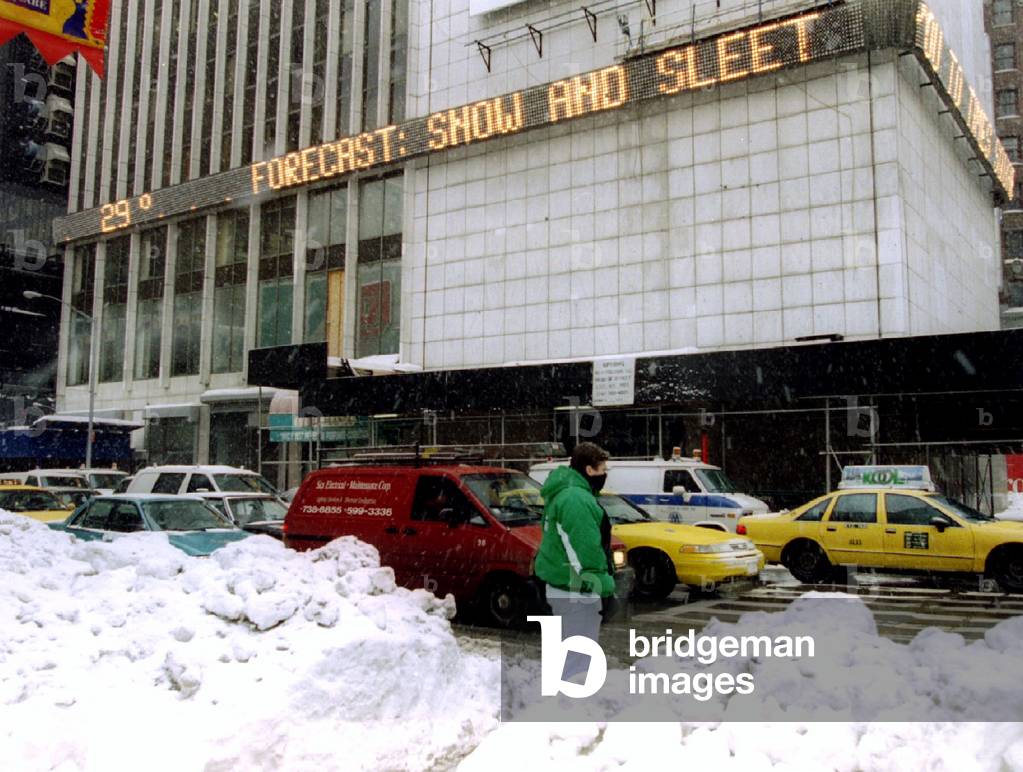
It also displayed sports scores and weather reports.

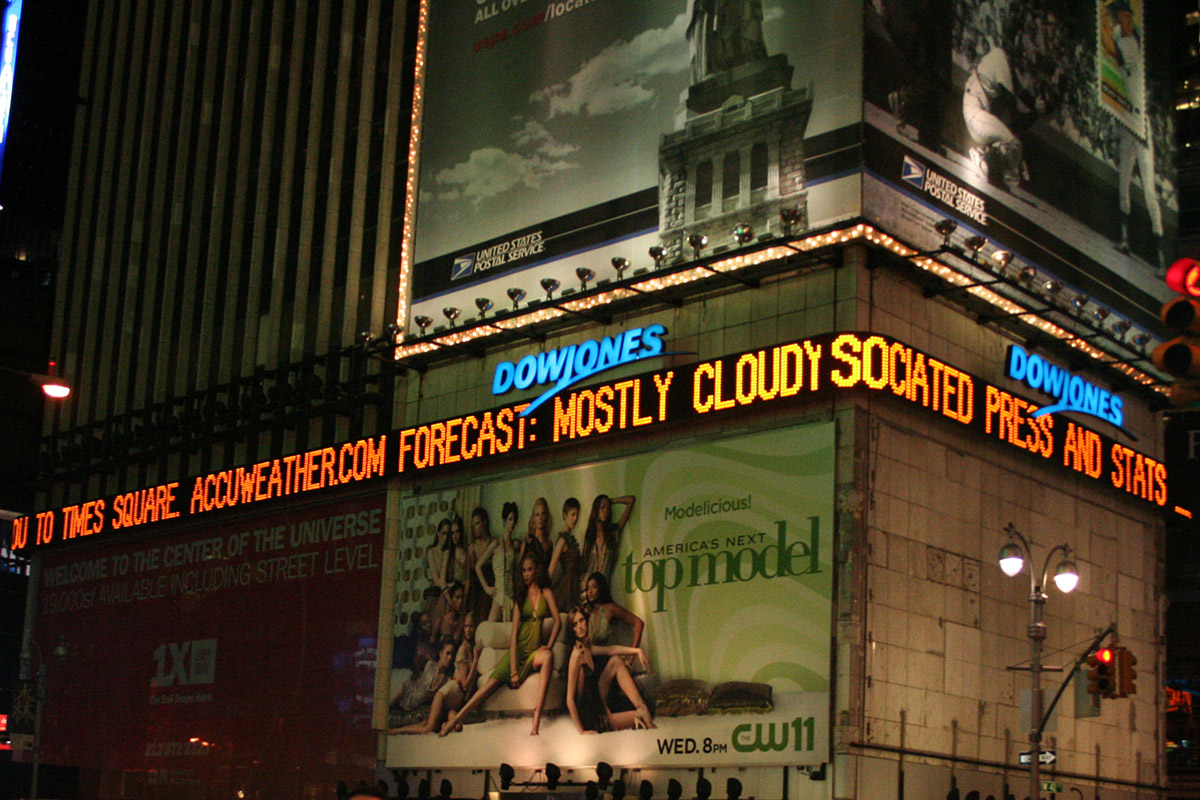
In 1975, the Motograph Zipper was extinguished and sat dark for 5 years. Newsday rented the display in 1980, putting it back into service once more. However, in December 1994, Newsday announced the lease would terminate at the end of the month.

It was replaced by an electronic version in 1995, which was in turn removed in 2018 due to the replacement of all individual screens on the front of One Times Square with a 350 foot-tall LED billboard in 2018.

*

November 6, 1928 was a Tuesday. This was also the day the news-flashing "Zipper" sign was introduced in Times Square. I have a separate entry for this event.

Baseball season was over. Football was in midweek. The NBA hadn't been founded yet. And the NHL season didn't start until November 15. So there were no scores on this historic day. 

November 6, 1928: Herbert Hoover Is Elected President

November 6, 1928: Secretary of Commerce Herbert Hoover is elected President. The Republican Party's nominee gets a whopping 58 percent of the vote, and 444 Electoral Votes.

The Democratic Party had nominated Governor Alfred E. Smith of New York, the 1st Catholic ever nominated by a major party. He won just 40.8 percent, a figure exceeded by all but 2 Democratic nominees since (George McGovern in 1972 and Walter Mondale in 1984), and took just 8 States, worth 87 Electoral Votes: South Carolina, Georgia, Alabama, Mississippi, Louisiana and Arkansas in the South; and the 2 most Catholic States in the nation, Massachusetts and Rhode Island. In total votes, Hoover won, 21.5 million to 15.0 million.

After a career that had seen him get rich in mining, lead a massive hunger relief program for Europe during and after World War I, and serve as Secretary of Commerce under Presidents Warren G. Harding and Calvin Coolidge, Hoover had even broken through in what was then known as "the Solid South": He won Virginia, North Carolina, Kentucky, Tennessee, Florida, Oklahoma and Texas.

That's how much anti-Catholic bias there was: Southerners, who normally would never have voted for the nominee of the party of Abraham Lincoln, did so. After all, the Ku Klux Klan hated Catholics nearly as much as they hated black people.

It was a massive landslide: Even if Smith had won every State in which he got between 45.0 and 49.9 percent of the vote -- Texas, New York, Tennessee, Virginia, Utah, Connecticut and North Carolina -- he still would have lost the Electoral Vote, 349-189.
Alfred E. Smith

In his nationally-syndicated newspaper column, humorist Will Rogers wrote that Smith's supporters "are going to be shocked at how much of the country lives west of the Hudson River." He was right, as Smith was too New Yorky for the rest of the country, including most of New York State. The term "the Big Apple" had already come into use, and Smith called the State north of The Bronx "Apple-knockers."

In the end, thought, it was never even about Smith. Had Smith been a Protestant, from a small town rather than the biggest city, with a pleasant voice instead of a N'Yawk accent, in favor of keeping Prohibition rather than repealing it, and not connected (however loosely) to the corrupt Tammany Hall political machine that dominated New York State and especially New York City, he still would have lost, as Hoover rode the Republican prosperity of the Roaring Twenties.

Hoover's running mate was Senator Charles Curtis of Kansas, a member of the Kaw Nation. His inauguration as Vice President made him, to this day, the highest-ranking Native American in the history of American politics.

Despite the Hoover landslide, Franklin D. Roosevelt, former Assistant Secretary of the Navy, 1920 Democratic nominee for Vice President, and cousin of the late former President Theodore Roosevelt, is narrowly elected to succeed Smith as Governor. Someone asked Smith if FDR, one of his biggest backers, was going to be a rival that would prevent him from getting the Democratic nomination again in 1932. Smith, noting that Roosevelt had been dealing with the effects of polio since 1921, said, "No, he will be dead within a year."

Within a year of the 1928 election, the stock market had crashed, and, barring a major scandal, the Democratic nominee was going to win in 1932. Smith tried for that nomination. He lost it. To FDR. FDR became President. Smith became one of his fiercest critics. And, in the end, in spite of FDR's health difficulties, Smith died 6 months before he did.

Hoover, on the other hand, was pretty much forgiven by Republican regulars, and was invited to speak at every Republican Convention from 1936 to 1964. Only in the last of these did he decline, due to the illness that brought his life to an end at 90 years shortly before the general election. As for his enemies, he said, "I outlived the bastards."

He also outlived every one of his fellow members of both Warren Harding's Cabinet and Calvin Coolidge's, and even his own: His last surviving Cabinet member was Patrick J. Hurley, his Secretary of War, who died in 1963. Hurley remains the highest-ranking native of Oklahoma in American political history.

Hoover also outlived his Vice President: Charles Curtis died in 1936, 13 months before what would have been the 2nd Hoover-Curtis term would have ended. However, Curtis was 74, making him 12 years old than Hoover.

And yet, at the time of his death, Herbert Hoover was less famous than the Director of the FBI, J. Edgar Hoover, who was not related to him. Nor was he related to Irwin "Ike" Hoover, the White House Chief Usher from 1904 to 1933, who died in that post a few months after Herbert Hoover was succeeded by FDR.

In 1931, a bill was passed by Congress to build a dam on the Colorado River, forming the Nevada-Arizona State Line. It was named the Hoover Dam. In 1935, a year before it opened, President Franklin D. Roosevelt renamed it for the closest town, Boulder City, Nevada: Boulder Dam. In 1947, a Republican Congress renamed it Hoover Dam. As Hoover was U.S. Secretary of Commerce, the U.S. Department of Commerce Building in Washington is named for him. His Presidential Library opened adjacent to his birthplace in West Branch, Iowa, outside Iowa City, on August 10, 1962.
Statue, West Branch, Iowa

Hoover remains the only President born in Iowa, and the only one to live in Oregon. He was the 1st one to represent California.

Hoover was played by Larry Gates in Backstairs at the White House in 1979. On the campus of his alma mater, Stanford University, the Hoover Institution is a conservative economic think tank. Yes, they named an economic think tank after the Depression President.

*

November 6, 1928 was a Tuesday. This was also the day the news-flashing "Zipper" sign was introduced in Times Square. I have a separate entry for this event.

Baseball season was over. Football was in midweek. The NBA hadn't been founded yet. And the NHL season didn't start until November 15. So there were no scores on this historic day.

Friday, November 4, 2022

November 4, 1928: Arnold Rothstein Is Rubbed Out

November 4, 1928: Arnold Rothstein is rubbed out. "The Brain," who led the Mob's fix of the 1919 World Series, was also the guy who figured out that Prohibition was the way to turn organized crime in America into big business, while Al Capone was still an up-and-comer.

But, like drug dealers who got hooked on their own product, the lure of his original line of work, gambling, proved too much for "The Big Bankroll." He lost $320,000 (about $5.47 million in 2022 money) in a 3-day high-stakes poker game. He said (O the irony) that the game was fixed, and refused to pay up.

He was shot at the Park Central Hotel in Midtown Manhattan (known as the Park Sheraton from 1948 until reverting to its original name in 1984), where a man then a rising star, Albert Anastasia, would see his reign as "the Boss of All Bosses" come to a similar end in 1957. It took Rothstein 2 days to die, and he refused to rat his killer out, telling the police, "You stick to your trade, I'll stick to mine." One source says that his last words were, "My mother did it."

He was 46, and he always knew he would come to such an end: A favorite saying of his was, "The odds on everything in life, including life itself, are six to five against."

A man was arrested for the murder, but was acquitted for lack of evidence, and they may have gotten the wrong guy anyway.

Rothstein was played by Robert Lowery (who played Batman in a 1949 film serial) in The Rise and Fall of Legs Diamond in 1960, future Fugitive star David Janssen in The Big Bankroll in 1961, Michael Lerner in Eight Men Out in 1988, F. Murray Abraham in Mobsters in 1991, and Michael Stuhlbarg on
Boardwalk Empire in the early 2010s.

In the 1974 film The Godfather Part II, Mario Puzo had Hyman Suchowsky, the character based on Meyer Lansky (played at that age by John Megna, when older by Lee Strasberg), give himself the "street name" Hyman Roth because he admired Rothstein.

In The Great Gatsby, F. Scott Fitzgerald used Rothstein as a character, giving him the name Meyer Wolfsheim, a man who managed to "play with the faith of 50 million people." The character does not appear in the 1926 and 1949 film versions, but was played by Howard Da Silva in 1974, and by Indian film superstar Amitabh Bachchan in 2013.

*

November 4, 1928 was a Sunday. Baseball was out of season. The NBA hadn't been founded yet. And the NHL season wouldn't start for another 11 days. But these NFL games were played:

* The football version of the New York Giants and the Frankford Yellow Jackets, based in Northeast Philadelphia, played to a tie, 0-0 at the Polo Grounds.

* The football version of the New York Yankees lost to the Chicago Bears, 27-0 at Wrigley Field in Chicago.

* The Providence Steam Roller beat the Detroit Wolverines, 7-0 at the Cycledrome in Providence, Rhode Island. The Steam Roller (they officially wrote it as 2 words, no S on the end) went on to win the NFL Championship that season, but the Great Depression knocked them out of business in 1931.

* The Green Bay Packers beat the Pottsville Maroons, 26-14 at Minersville Park in Pottsville, Pennsylvania.

* The Chicago Cardinals, the Dayton Triangles were not scheduled to play that weekend.

I have no way of knowing of Arnold Rothstein had bets on any of these games.

Friday, October 14, 2022

October 14, 1928: Ruth & Gehrig In Montreal

October 14, 1928: Fresh off their 3rd straight World Series appearance and 2nd straight win, Babe Ruth and Lou Gehrig of the New York Yankees bring their "barnstorming" tour to Delorimier Stadium, the new 20,000-seat home of the International League's Montreal Royals.
They would play for Ahuntsic, a semi-pro team from the north side of the city (Montréal-Nord), against the Chappies, a team of black American players led by George "Chappie" Johnson, the top catcher in black baseball in the 1900s and 1910s.
Bad weather held the crowd to 16,000, but they were thrilled when Ruth hit 5 balls over the fence in batting practice. The actual game was tight, and the Babe came in to pitch. In the top of the 9th, Gehrig hit a home run to give Ahuntsic the lead, and the fans rushed the field, making the bottom of the 9th unplayable.

People who favor the modern game of baseball -- and people who simply hate the Yankees -- love to point out that Ruth and Gehrig never played against black players, since black players weren't allowed in the major leagues until 1947. But tours like this render the argument a half-truth. They did face black players, albeit not in regular-season competition or in the World Series. But, on some occasions, it was on a black team's home field, in front of mostly-black crowds, in conditions that favored the all-black teams. And their pitchers couldn't stop the Sultan of Swat and the Iron Horse any more than the white pitchers could.

This ballpark, also known as Delorimier Downs, Montreal Stadium and Hector Racine Stadium, would be home to the Royals from 1928 until their dissolution after the 1960 season; and the Canadian Football League's Montreal Alouettes from 1946 to 1953. A survey was done to determine if it could be used as the home of the expansion Montreal Expos in 1969, but it was determined that the stadium was already in such bad shape, they might as well build a new one elsewhere. That became Jarry Park. The old one was torn down in 1971, and a high school was built on the site.

After Montreal, Ruth and Gehrig went on to Hull, Quebec, across the Ottawa River from the national capital of Ottawa, and, on October 15 at Dupuis Park, beat a team that included brothers Frank Boucher of the New York Rangers and Georges "Buck" Boucher of the Ottawa Senators, both members of the Hockey Hall of Fame.

Then they headed back to the U.S., touring the Midwest and the West, before their planned finale in Denver on Halloween was rained out. MLB rules said that barnstorming tours must be completed by October 31. This was before Bud Selig was born, allowing baseball games after that date.

*

October 14, 1928 was a Sunday. Héctor Rial was born that day. The Argentine forward helped Nacional win Uruguay's league in 1952, before being purchased by Real Madrid. With them, he won 5 La Liga titles, and the 1st 5 European Cups, 1956 to 1960.

And these games were played in the NFL:

* The football version of the New York Yankees (like the Giants, containing no players from the baseball team for whom they were named) lost to the Detroit Wolverines, 35-12 at Yankee Stadium.

* The New York Giants lost to the Chicago Bears, 13-0 at Wrigley Field in Chicago.

* The Providence Steam Roller beat the Dayton Triangles, 28-0 at the Providence Cycledrome in Rhode Island. Always without the S on the end ("Roller," not "Rollers"), Providence would win the NFL Championship that season. It would take another 73 years for another NFL team based in New England to take the title.

* And the Green Bay Packers beat the Chicago Cardinals, 20-0 at City Stadium in Green Bay, Wisconsin.

Thursday, October 6, 2022

October 6, 1928: Wisconsin's Victory In the Tall Grass

October 6, 1928: The football team at the University of Wisconsin hosted the University of Notre Dame at Camp Randall Stadium in Madison, Wisconsin. It becomes known as "The Tall Grass Game."

The host Badgers, coached by Glenn Thistlethwaite, were opening their season. The visiting Fighting Irish, coached by Knute Rockne, had opened theirs a week earlier, defeating Loyola University of New Orleans.

Notre Dame arrived in Madison, only to find that the grass on the football field at Camp Randall had not been mowed in a week. Rumor was that Thistlethwaite wanted to slow down the speedy Notre Dame players. Rockne demanded the field be trimmed, and Thistlethwaite refused. Rockne may have been all-powerful in South Bend, Indiana, but he had no power over the Badger State.

A raucous sellout crowd of 40,000 saw Wisconsin pull the upset, 22-6. Wisconsin fans still refer to the game as "The Victory In The Tall Grass." Notre Dame hadn't lost to a Big Ten Conference team in 7 years.

*

October 6, 1928 was a Saturday. Among the other college football games played that day were these:

* Michigan State were not yet members of the Big 10 -- eventually, they would replace the University of Chicago as such -- and, on this day, they were beaten by Albion College, 2-0 at College Field in East Lansing. It wasn't an upset, though: Albion, based in the Michigan city of the same name, went 8-0 that season, although Michigan State were the only team they played that would now be recognized as a major team. Albion now compete in NCAA Division III.

* The University of Michigan were members of the Big 10, but fared no better, losing to Ohio Wesleyan, 17-7 at Michigan Stadium in Ann Arbor.

* The service academies: Army beat Southern Methodist University (SMU), 14-13 at Michie Stadium in West Point, New York; and Navy lost to Boston College, 6-0 at Thompson Stadium in Annapolis, Maryland.

* Among New York City teams: Columbia beat Union College, 27-0 at Baker Field in Upper Manhattan; New York University (NYU) beat West Virginia Wesleyan, 26-7 at Ohio Field in The Bronx; City College of New York (CCNY) played Lebanon Valley College to a tie, 6-6 at Annville, Pennsylvania; and Fordham beat George Washington University, 20-0 at Fordham Field in The Bronx.

GWU dropped their football program after the 1966 season. West Virginia Wesleyan now compete in NCAA Division II. Union, based in Schenectady, New York, outside Albany, and Lebanon Valley both now compete in Division III.

* And in New Jersey: Princeton beat Vermont, 50-0 at Palmer Stadium in Princeton; while Rutgers beat Albright, 19-0 at Nielson Field in New Brunswick. Albright, in Reading, Pennsylvania, now compete in Division III. Vermont dropped football after the 1974 season.

This was a travel day for the World Series. The New York Yankees went on to sweep the St. Louis Cardinals in 4 straight games.

And in English soccer, the team I would eventually support, Arsenal, traveled from North London to Stanley Park in Liverpool, and lost to Everton, 4-2 at Goodison Park.
 

Saturday, October 1, 2022

October 1, 1928: Joseph Stalin Implements His 1st Five-Year Plan

1932 propaganda poster featuring Stalin:
"The Victory of Socialism in Our Country Is Guaranteed"

October 1, 1928: Soviet dictator Joseph Stalin institutes his first "five-year plan" for the Soviet Union's economy. It turns out to be great for him, as it increases his control over the economy, and thus over the lives of the people. It turns out to be disastrous for them.

This 1st plan was developed on the theory of the productive forces: Increasing industrial capacity to increase production, thus creating greater supply. Ironically, this leftist plan would also form the basis of the American right-wing's "supply-side economics."

When the plan began, the Soviet Union was 5th in the world in industrial production, despite being the world's largest country by land, and its 3rd by population, behind China and British-controlled India. When Stalin pronounced it completed on December 31, 1932 -- 9 months short of 5 years -- the country had moved to 2nd in industrial production, trailing only America.

But the plan led to a famine in the Winter of 1932-33, killing up to 7 million people, hitting western Russia, the Ukraine, and Belarus especially hard. Millions more were weakened to the point of permanent disability. Anti-Communists the world over considered this to be genocide, and made it part of their ideology that Communism killed more people than Fascism. Which is true, unless you bring proportion into play: In countries where Fascism ruled, greater percentages of the people were killed or imprisoned than under Communism.

But the industrial improvement meant that, when Nazi Germany invaded the Soviet Union in 1941, the industry was ready to fight them, even though Stalin had ordered the execution of many military leaders in his "Great Purge" of 1937-38. That nearly cost the Soviets to lose their front of World War II. But the sheer numbers of soldiers and equipment, and the Russian Winter, meant that the Nazis could be pushed back, giving America, Britain, France and the exile armies the chance to beat the Nazis in North Africa, Italy, and, eventually, Western Europe.

Stalin instituted a 2nd five-year plan almost immediately after pronouncing the 1st one a success. There would be several five-year plans approved by Soviet dictators, the last by Mikhail Gorbachev in 1991. But that plan died at the end of the year, along with the country.

*

October 1, 1928 was a Monday. Actors Laurence Harvey and George Peppard were born on this day.

Baseball's regular season had ended the day before, and the World Series would not begin until October 4. The New York Yankees went on to sweep the St. Louis Cardinals. The NFL was done with its games for the weekend. The NHL season wouldn't start for another 2 months. And the NBA hadn't been founded yet. So there were no scores on this historic day.

Thursday, September 8, 2022

September 9, 1928: The Death of Urban Shocker

September 9, 1928: Urban Shocker dies of heart failure. He was only 37 years old and, technically, still an active pitcher in baseball.

Today, a man with a name like "Urban Shocker" would be welcomed with open arms in New York sports. And every rapper would ask himself why he didn't think of that for a stage name. (New Orleans-based rapper Vyshonn King Miller named himself "Silkk the Shocker" -- instead of going with, oh, I don't know, "King Miller.")

He was of French-Canadian descent, born Urbain Jacques Shockcor in Cleveland, on September 22, 1890. He threw a breaking ball and a spitball with great success, and ended up as 1 of the 17 active pitchers who was allowed to continue throwing the spitball after the 1920 season.

In 1914, pitching for the Ottawa Senators of the Canadian League, he went 20-8; in 1915, 19-10. That led the New York Yankees to sign him, but he appeared in only 12 games, going 4-3, before going back to Canada, loaned to the Toronto Maple Leafs of the International League. (Both the Senators and the Maple Leafs would have their names borrowed by hockey teams that survived them.) There, he went 15-3 with a 1.31 ERA.

He went 8-5 for the Yankees in 1917, but the new manager, Miller Huggins, had little faith in him. On January 22, 1918, the Yankees traded Shocker, Fritz Maisel, Les Nunamaker, Nick Cullop, Joe Gedeon and $15,000 to the St. Louis Browns for Eddie Plank and Del Pratt.

From 1918 to 1924, Shocker went 126-80 for the Browns -- an average of 18-11. He won 27 games in 1921, leading the major leagues, and 24 in 1922, with 149 strikeouts, which doesn't sound like much today, but it was good enough to lead both Leagues that season.

Shocker's absence nearly cost the Yankees the Pennant in '22, may have cost them the Pennant in '20 (20-10) and '24 (16-13), and may have been a reason why they lost the World Series in '21 and '22. Never mind the other players the Yankees gave up: Getting rid of Shocker was a mistake.

What about what they got in return? Plank was a genuine Hall-of-Fame pitcher, with a career record of 326-194 before the trade. But he was 42, and never threw another professional pitch, retiring because the stress of the game had given him stomach problems. (The stress must have gotten worse: He died of a stroke in 1926, just 8 years after the trade.)

Pratt was a good 2nd baseman, and led the AL in RBIs in 1916. In 1920, he attained career highs while with the Yankees in batting .314 with 108 RBIs. But the Yankees traded him, anyway -- to the Red Sox for pitcher Waite Hoyt and catcher Wally Schang. That was a great trade.

In his 1979 book This Date In New York Yankees History, Nathan Salant called trading Shocker away the worst trade in Yankee history to that point. But there are 2 reasons why it isn't that bad: The fact that it was, essentially, Shocker for Hoyt (a Hall-of-Famer) and Schang (an All-Star-caliber player, had there been an All-Star Game back then); and the fact that the Yankees did get Shocker back from the Browns, on December 17, 1924, sending them another star pitcher, Bullet Joe Bush, and 2 other guys.

He was only 12-12 in 1925, as the Yankees were in transition: The hitting stars of their Pennant streak of 1921-23 had stopped hitting. They were replaced with new stars, like Lou Gehrig, Earle Combs and Tony Lazzeri, joining Babe Ruth. In 1926, Shocker went 19-11, and the Yankees won the Pennant. In 1927, the year the Yankees became known as "Murderers' Row" and "The Greatest Team Ever," Shocker went 18-6.

But he had a swollen heart, causing him constant pain. Supposedly, his condition was so severe, he had to sleep either sitting or standing up. He was too ill to appear in the 1927 World Series, and appeared in only 1 game in 1928, on May 30, pitching 2 innings in a mop-up role, as the Yankees lost to the Washington Senators, 5-0.

Like many people before him with either a bad heart or bad lungs, he went to Denver, Colorado, thinking that the thin mountain air would be good for him. He asked the Yankees for his release, and they gave it to him. On August 6, 1928, Shocker appeared in an exhibition tournament in Denver, and pitched in a game against a team from Cheyenne, Wyoming, but fared poorly. Shortly thereafter, he contracted pneumonia, and was hospitalized shortly thereafter.

The Yankees began September 9, 1928 half a game behind the Philadelphia Athletics. The Yankees had 19 games left in the regular season; The A's, 18. And they were about to face each other in a 4-game series at Yankee Stadium, starting with a Sunday doubleheader that brought 85,265 fans to the big ballyard in The Bronx. With the Stadium's triple-decked stands not curled around the right-field foul pole until 1936, newspaper accounts estimated that another 5,000 people were able to watch the games from rooftops on River Avenue.

The Yankees won the opener, 5-0. George Pipgras allowed 9 hits, but kept a shutout. Then the Yankees won the nightcap, 7-3, coming back from 3-0 down at the 7th inning stretch to score 2 runs in the 7th, and a grand slam by Bob Meusel meant 4 in the 8th. Hoyt beat Eddie Rommel, a knuckleballer about to turn 41.

Over the 2 games, Babe Ruth went 1-for-6 with 2 walks, and Lou Gehrig went 3-for-6 with a walk and an RBI. For the A's, Jimmie Foxx went 1-for-8, and Mickey Cochrane went 1-for-7 with a walk. With the A's at the end of long and glorious careers, Eddie Collins got a hit as a pinch-hitter in the 1st game, while Ty Cobb and Tris Speaker, both available, did not get into either game. Cobb played in the last game of the series, on September 11, a 5-3 Yankee win, popping up to shortstop as a pinch-hitter for Max Bishop. It was his last major-league appearance. Speaker had made his last on August 30. Collins played 16 more games over the 1928, '29 and '30 seasons, and retired.

The Yankees ended the day a game and a half ahead of the A's. They roared into their clubhouse, and were ready to celebrate, when they saw Mark Roth, the team's traveling secretary, standing by a telephone, and looking sad. He told them he had just heard that Shocker was dead. The players knew Shocker was sick, but they had no idea how sick. They ended the season 2 1/2 games ahead of the A's, and won the World Series again.

Urban Shocker compiled a record of 187-117 with an ERA of 3.17, and an ERA+ of 124. He's not in the Hall of Fame, but he should be.

*

September 9, 1928 was a Sunday. These other baseball games were played that day:

* The Brooklyn Dodgers beat the New York Giants, 3-2 at Ebbets Field. The Dodgers were actually called the Brooklyn Robins from 1914 to 1931, while Wilbert Robinson was their manager. In this game, Jake Flowers singled Babe Herman home with the winning run in the bottom of the 9th. Dazzy Vance, the best pitcher the Dodger franchise ever had until Sandy Koufax found his control, went the distance for the win.

* A doubleheader was split at Griffith Stadium in Washington. The Boston Red Sox won the 1st game, 3-2. The Washington Senators won the 2nd game, 5-3.

* The Chicago White Sox beat the Cleveland Indians, 10-1 at League Park in Cleveland.

* The St. Louis Browns beat the Detroit Tigers, 8-6 at Navin Field (later renamed Briggs Stadium and Tiger Stadium).

* The Chicago Cubs beat the Cincinnati Reds, 2-0 at Wrigley Field in Chicago. Guy Bush, later to become famous as the pitcher who gave up Babe Ruth's 714th and last career home run, pitched a 2-hit shutout.

* The Pittsburgh Pirates beat the St. Louis Cardinals, 8-7 at Sportsman's Park in St. Louis. The Cards scored 5 runs in the bottom of the 7th, but the Bucs scored 5 in the top of the 8th.

* And the Boston Braves and the Philadelphia Phillies took the day off. They didn't have a choice: The 2 previous days, they'd played at Baker Bowl in Philadelphia, but, until 1933, playing a professional sporting event on a Sunday was illegal in Pennsylvania. Come to think of it, 1928 was also the year Sunday ball was legalized in Massachusetts, so they couldn't move a game they wanted to play on this day to Braves Field in Boston, either.

December 31, 1999 & January 1, 2000: The Millennium

December 31, 1999:  The Millennium arrives. The people of planet Earth survived. At a terrible cost. But we hadn't destroyed ourselves. ...