Showing posts with label big band. Show all posts

Thursday, December 15, 2022

December 15, 1944: Glenn Miller Disappears

December 15, 1944: Glenn Miller, the biggest name of the "Big Band" era of music, disappears.

Miller was a trombonist, and led The Glenn Miller Orchestra. In 1939, they had hits with "Moonlight Serenade" and "In the Mood." In 1940, he would record "Tuxedo Junction" and "PEnnsylvania 6-5000." In 1941 came "Chattanooga Choo Choo." In 1 day, May 20, 1942, he recorded "At Last" (now better known for the 1961 version by Etta James) and "(I've Got a Gal in) Kalamazoo."

So in a span of a little over 3 years, he recorded 7 iconic songs, which led to his band being featured in some movies. They became the biggest band of the World War II years (I'm talking about popularity, not just in number of members) -- bigger than Benny Goodman's, bigger than either Tommy Dorsey's or Jimmy Dorsey's, and (no doubt helped by the fact that he and his band were white) bigger than Duke Ellington's and Count Basie's.

Miller's career came to what was expected to be a temporary interruption when he joined the war effort. He was ready to give up a civilian income of $20,000 per week -- about $339,000 in 2022 money, or around $17 million a year, so it was comparable to today's biggest stars -- to put on a uniform and serve his country.

At 38, he was too old to be drafted by the U.S. Army. So he volunteered for the U.S. Navy. They told him they didn't need him. So he wrote to an Army General, suggesting that he "be placed in charge of a modernized Army band."

This was done, as he was assigned to the U.S. Army Air Forces, the precursor to the U.S. Air Force. This allowed his band members -- not the same ones he had in his Orchestra -- to fly to various U.S. installations and perform for their fellow troops.

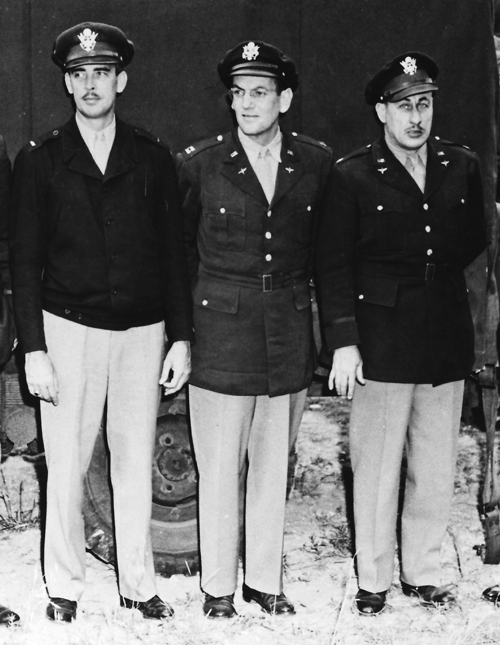
On December 15, 1944, Major Glenn Miller boarded a single-engine UC-64 Norseman at Clapham, England, heading for recently-liberated Paris, where he would establish the headquarters his band intended to have for the duration of the War. With him were 2 other officers: Lieutenant Colonel Norman Baessell, who would supervise the construction of the HQ; and the pilot, Flight Officer John Morgan.
Left to right: Morgan, Miller, Baessell

The weather was bad the day before, leading to all planes being grounded. Miller was expected to be in Paris on the 16th, but on the 15th, Baessell made a guess that there would be enough of a break in the weather to fly. So the plane took off at 1:55 PM Greenwich Mean Time (8:55 AM on the U.S. East Coast).

No one was expecting the plane to arrive in Paris that afternoon, and so, when it didn't show up, no one thought to look for it. It was only when the rest of the band arrived at Paris' Orly Airport on December 18, and Miller wasn't there to meet them, that anybody realized that anything was wrong. The intended hotel was called, and Miller hadn't checked in.

It was only on December 24, Christmas Eve, that it was announced by the Army that Miller's plane was missing and presumed lost. No trace of it has ever been found. The band's deputy leader, Technical Sergeant Jerry Gray, led the band in that evening's performance in Miller's place.

Investigations turned up nothing solid, but the most common theory is that, given the weather, the plane's carburetor iced up, causing a crash that would have killed everybody on impact with the water. Suggestions of the Nazis shooting the plane down, or a horrible mistake of "friendly fire," or Miller having made it to Paris, dying in a brothel, and having the Army cover it up were dismissed as impossible.

Miller was 39, and left behind a wife and 2 children. His wife, Helen, was given a Bronze Star awarded to him 3 months later.

Today, as with some of the other bands I mentioned, a "legacy band," authorized by the Miller estate, performs the Miller catalog. Trumpeter Ray Anthony was the last surviving member of the original Glenn Miller Orchestra. On January 20, 2022, he celebrated his 100th birthday.

*

December 15, 1944 was also the day the Battle of the Bulge began in the Ardennes Forest of France, Belgium and Luxembourg, Nazi Germany's last stand on the Western Front. On December 22, the Nazis sent an officer to deliver a surrender demand to the U.S. Army's 101st Airborne Division, then stationed in Bastogne, Belgium, and virtually surrounded. General Anthony McAuliffe, in command, sent him away with a one-word reply: "Nuts!"

The Nazis held the upper hand through Christmas, but the day after, the 4th Armored Division arrived with reinforcements, and turned the tide of the battle. Once that happened, the Nazis were doomed, both on the Western Front and overall.

It was also the day the first five-star Generals were promoted. I have a separate entry for that.

And it was the day the film Hollywood Canteen opened. I have a separate entry for that, too.

December 15, 1944 was a Friday. Baseball was in the off-season. The NFL Championship Game was played 2 days later, with the Green Bay Packers beating the New York Giants, 14-7 at the Polo Grounds in New York. The NBA hadn't been founded yet. And, while the NHL was in-season, no games were scheduled for that day. So there are no scores on this historic day.

Sunday, December 11, 2022

December 11, 1992: The End of the Big Band Era

William B. Williams

December 11, 1992: Perhaps it was fitting that the end of the era of "Big Band" music came while George H.W. Bush, the last President who served in World War II, was a "lame duck," and Bill Clinton, the 1st President born after The War, and the 1st President to grow up in the Rock and Roll Era, was President-elect.

Radio station WNEW debuted February 13, 1934, as "New York's newest radio station," at 1280 on the AM dial, and with new call letters representing its city of license: "NEWark, NEW Jersey."

In 1935, WNEW moved into a new studio in New York, at 501 Madison Avenue at 53rd Street. That year, pioneered the concept of a disc jockey when staff announcer Martin Block needed to fill time between news bulletins during his coverage of the trial of Bruno Hauptmann, accused (and eventually convicted) of kidnapping Charles Lindbergh Jr., a.k.a. "The Lindbergh Baby." Block did not have access to a live orchestra to play music during the breaks, as most network stations did, so he played records instead.

Soon afterward, he piloted a 15-minute experimental show called the Make Believe Ballroom, during which he played records from popular bands and singers, posed as a live performance in an imaginary ballroom. During Block's tenure as host of Make Believe Ballroom, the show attracted 25 percent of the listening audience in New York City.
Martin Block

Thus did WNEW -- its call letters eventually redefined, with retroactive irony, as "the NEWest thing in radio" -- become known for its popular adult music selection, as well as its staff of radio personalities including Block, Dee Finch, Gene Klavan, Al "Jazzbo" Collins, Ted Brown, William B. Williams, and, from 1948 to 1952, future TV game show host Gene Rayburn. From 1935 to 1959, its general manager was a woman, a rarity for that era: Bernice Judis.

In addition to its music and entertainment programming, WNEW featured an award-winning news staff and became "The Voice of New York Sports," for broadcasting games of the NFL's New York Giants, the NBA's New York Knicks, and the NHL's New York Rangers.

As an independent radio station, WNEW lacked the funds larger networks like NBC, CBS and Mutual Broadcasting System used to produce daily programming, such as comedy shows, soap operas, game shows and dramatic programs. However, Judis was not discouraged, and welcomed the opportunity to develop her own schedule of innovative programming that included creating the first all-night radio show, dubbed Stan Shaw's Milkman's Matinee, and cultivating a line-up of popular morning radio show personalities.

On November 12, 1941, WNEW moved to 1130 on the AM dial, where it remained. In 1957, the DuMont Broadcasting Company, having given up the ghost on television, tried to expand its radio base, and bought WNEW, making it a sister station of their TV station, WADB (named for founder Allen B. DuMont) on Channel 5. In 1958, DuMont was bought out by Metromedia, and Channel 5's call letters were changed to reflect the flagship radio station, WNEW.

The rise of rock and roll in the mid-1950s led some stations to change their formats, including New York's WINS, WMCA and WABC. Not WNEW: They continued to play popular adult standards, or softer hits from the current charts. People called them "Middle of the Road," or "MOR for short -- and while young rock and roll fans considered this an insult, grownups and the WNEW staff and executives did not. Martin Block kept playing it until his death in 1967.

By 1972, some radio stations, like WCBS-FM, were treating early rock and roll, from the mid-1950s to the early 1960s, essentially the pre-Beatles era, as "oldies." But WNEW kept on playing songs from the Big Band Era, the late 1920s (when it replaced "Tin Pan Alley") to the late 1950s (when rock and roll fully took over).

I remember a TV commercial with a woman dressed like a showgirl, complete with top hat and cane, dancing around a stage, with names of old-time bandleaders hung on a stage behind her. Nearly all of them were already dead. The refrain of her song was "Where the music is king!" (As if it wasn't on other stations?")

One of my grandmothers, who grew up on that kind of music, kept her radio on in her house, always tuned to 1130, no matter what, until her death. (The other grandmother was younger, but she liked music even older than that, the kind that Guy Lombardo and Mitch Miller played.)

But, as that story suggests, the core audience for WNEW was dying of old age. Symbolizing this, William B. Williams, who was to Big Band what "Cousin" Brucie Morrow was to early rock and roll, and appeared in some of the station's commercials, died in 1986. They began a "Sundays with Sinatra" show, trying to get the people who may have listened to both early rock and Frank Sinatra's peak music in the 1950s, hoping to peel off some people now in their 50s and 60s.

But Williams wasn't the only departure in 1986: Fox Broadcasting Company bought WNEW-Channel 5, converting it into a Fox Network station and switching the call letters to WNYW. In 1988, Metromedia sold WNEW 1130 to Westwood One. They convinced Larry King to do an overnight show, since he grew up on the Big Band music. This didn't work, so they went back to their 1960s format of playing softer songs current to that era. That alienated both those artists' fans and the station's aging fans, and they backed off from it in 1991.

Finally, on August 15, 1992, Westwood One sold the station to Michael Bloomberg's company, Bloomberg L.P. As a fan of that kind of music, but more a fan of business-themed programming on both radio and television, Bloomberg gave them a chance to say goodbye. On December 11, 1992, at 8:15 PM, with several former WNEW personalities by his side, Mark Simone played the last song: Sinatra's version of the World War II song "We'll Meet Again."

The station became WBBR, and remains at 1130 AM, broadcasting business news and business-themed talk shows.

A few Big Band Era performers outlived the station. Sinatra lived until 1998. The last of the old Big Band leaders, Artie Shaw, lived until 2004, having lived long enough to sit for an interview with Ken Burns for his 2001 documentary miniseries Jazz.

*

December 11, 1992 was a Friday. This was also the day the film version of Aaron Sorkin's play A Few Good Men premiered. I have a separate entry for that event.

Baseball was out of season. Football was in midweek. There were 8 games played in the NBA:

* The Seattle SuperSonics beat the Boston Celtics, 100-90 at the Boston Garden.

* The Los Angeles Clippers beat the Philadelphia 76ers, 125-110 at The Spectrum in Philadelphia. Jeff Hornacek led all scorers on the night with 36 in defeat for the Sixers.

* The Atlanta Hawks beat the Denver Nuggets, 112-107 in overtime at The Omni in Atlanta. Dominique Wilkins scored 33 points.

* The Phoenix Suns beat the Orlando Magic, 108-107 at the Orlando Arena.

* The Detroit Pistons beat the Cleveland Cavaliers, 107-103 at The Palace in the Detroit suburb of Auburn Hills, Michigan.

* The Houston Rockets beat the Chicago Bulls, 110-96 at the Chicago Stadium.

* The Los Angeles Lakers beat the Washington Bullets, 118-93 at The Forum outside Los Angeles in Inglewood, California.

* And the Indiana Pacers beat the Portland Trail Blazers, 134-124 in double overtime at the Veterans Memorial Coliseum in Portland. Detlef Schrempf scored 32 for the Pacers.

And there were 6 games in the NHL:

* The New York Rangers beat the Tampa Bay Lightning, 5-4 at the ThunderDome (now Tropicana Field) in St. Petersburg, Florida.

* The New Jersey Devils beat the Pittsburgh Penguins, 2-1 at the Brendan Byrne Arena at the Meadowlands.

* The Washington Capitals beat the Winnipeg Jets, 8-6 at the Capital Centre in the Washington suburb of Landover, Maryland. Teemu Selänne scored a hat trick in defeat for the Jets.

* The Calgary Flames beat the Toronto Maple Leafs, 6-3 at Maple Leaf Gardens in Toronto.

* The Buffalo Sabres beat the Hartford Whalers, 9-3 at the Buffalo Memorial Auditorium.

* And the Detroit Red Wings beat the Philadelphia Flyers, 4-2 at the Joe Louis Arena in Detroit.

Thursday, December 8, 2022

December 8, 1963: Frank Sinatra Jr. Is Kidnapped

December 8, 1963: Given the people he is alleged to have known, kidnapping Frank Sinatra's son was only slightly less stupid than kidnapping Liam Neeson's daughter in the 2008 film Taken. And yet, it happened.

Frank Sinatra Jr. is kidnapped.

Frank Sinatra had 3 children, all with his 1st wife, Nancy Barbato: Nancy Sandra Sinatra, born on June 8, 1940 in Jersey City, New Jersey, next-door to Frank's hometown of Hoboken; Francis Wayne Sinatra, a.k.a. Frank Sinatra Jr., born on January 10, 1944 in Jersey City; and Christina Sinatra (no middle name), a.k.a. Tina, born on June 28, 1948 in Los Angeles.

Because of Frank Sr.'s traveling, the children did not see him much growing up. Nevertheless, Nancy Jr. and Frank Jr. both wanted to be entertainers themselves. In 1960, Nancy Jr. married singer Tommy Sands, and was also involved in Frank Sr.'s TV special with Elvis Presley. She later made a film with him, Speedway -- not one of his good ones.

On December 8, 1963, Frank Jr., only 19 years old, was kidnapped from Room 417 at Harrah's Lake Tahoe in Nevada, and held for ransom. He was released 2 days later, after his father paid the $240,000 ransom demanded by the kidnappers -- about $2.3 million in 2022 money. Frank Sr. had offered $1 million, but the kidnappers declined the larger offer.

The kidnappers demanded that all communication be conducted by public telephone. During these conversations, Frank Sr. became concerned that he would not have enough coins, which prompted him to carry 10 dimes with him at all times for the rest of his life.

Frank Jr. was taken to Los Angeles, and released. He was found in Bel Air after walking a few miles and alerting a security guard. To avoid the press, he was put in the trunk of the guard’s patrol car and taken to his mother Nancy’s home. He described what he knew to FBI agents, but he had barely seen two of the kidnappers, and only heard the voice of the third conspirator.

In a 2002 interview with radio show host Ira Glass, the mastermind of the kidnapping, Barry Keenan, said that he initially intended to earn back the ransom over years, and pay it back to Frank Sr. His co-conspirators were Joe Amsler, like him 23 years old, and a high school classmate; and Johnny Irwin, a 42-year-old house painter.

Irwin broke first, spilling the beans to his brother, who called the FBI office in San Diego. Hours later, Keenan and Amsler were captured, and nearly all of the ransom was recovered.

Keenan was sentenced to life plus 75 years in prison, but was later adjudged to have been legally insane at the time of the crime, and hence not legally responsible for his actions. Each kidnapper served only 4 1/2 years.

Keenan went on to become a successful real estate developer, and died in 2022. Amsler died in 2006. I can find no evidence of whether Irwin is still alive as of December 8, 2022, but, if he is, he would be 91 years old.

Shortly after his release, Frank Jr. was hired as the vocalist for Sam Donahue's band. He also learned a lot about music and its business while working with Duke Ellington, a friend of his father's. He built his own band and appeared in Las Vegas, and crowds came to see him, knowing full well which Frank Sinatra they were seeing. Like his father, he turned to acting; like his father, he played men on each side of the law, including 3 episodes of Adam-12 as Officer Tom Boyd.

He never achieved the fame of his father Francis Albert, or even that of his sister Nancy. Musically speaking, though the man billed as Frank Sinatra Jr. may have been the most talented one in the family, to the point where, in 1988, Ol' Blue Eyes asked him to conduct his orchestra. As Rod McKuen put it:

As the senior Sinatra outlived one by one all of his conductors and nearly every arranger, and began to grow frail himself, his son knew he needed someone that he trusted near him. [Frank Jr.] was also savvy enough to know that performing was everything to his dad and the longer he kept that connection with his audience, the longer he would stay vital and alive.

In 1997, Frank Jr. was offered the role of holographic Las Vegas lounge singer Vic Fontaine on Star Trek: Deep Space Nine. He was a Trekkie, but he turned the role down, saying that he only wanted to play an alien. The role went to a contemporary of his, James Darren. In 2000, Frank Jr. played himself in an episode of The Sopranos, not objecting when Paul "Paulie Walnuts" Gualtieri called him "the Chairboy of the Board."
Francis Albert Sinatra died in 1998. Among the items he was buried with in Palm Springs, California were a bottle of Jack Daniel's whiskey, a pack of Camel cigarettes, a Zippo lighter, cherry Life Savers, Tootsie Rolls, a dog biscuit, and 10 dimes.
Francis Wayne Sinatra died in 2016. His sisters Nancy and Tina are still alive. Of Frank's descendants, only Nancy's daughter, A.J. Lambert, now 49, performs in his style.

*

December 8, 1963 was a Sunday. These games were played in the NFL:

* The New York Giants beat the Washington Redskins, 44-14 at Yankee Stadium.

* The Baltimore Colts beat the Minnesota Vikings, 41-10 at Memorial Stadium in Baltimore.

* The Detroit Lions beat the Cleveland Browns, 38-10 at Tiger Stadium in Detroit.

* The Chicago Bears beat the San Francisco 49ers, 27-7 at Wrigley Field in Chicago.

* The football version of the St. Louis Cardinals beat the Philadelphia Eagles, 38-14 at the 1st Busch Stadium, formerly the last Sportsman's Park, in St. Louis.

* The Pittsburgh Steelers beat the Dallas Cowboys, 24-19 at the Cotton Bowl in Dallas.

* And the night before, the Green Bay Packers beat the Los Angeles Rams, 31-14 at the Los Angeles Memorial Coliseum.

In the American Football League:

* The New York Jets lost to the Buffalo Bills, 45-14 at War Memorial Stadium in Buffalo.

* The Boston Patriots lost to the Houston Oilers, 46-28 at Jeppesen Stadium (later Robertson Stadium) in Houston.

* The Kansas City Chiefs beat the Denver Broncos, 52-21 at Kansas City Municipal Stadium.

* And the Oakland Raiders beat the San Diego Chargers, 41-27 at Frank Youell Field in Oakland.

There were 2 games in the NBA. The Philadelphia 76ers beat the Cincinnati Royals, 126-116 at the Cincinnati Gardens. And the San Francisco Warriors beat their arch-rivals, the Los Angeles Lakers, 114-112 at the Los Angeles Memorial Sports Arena.

And the NHL's entire "Original Six" were in action:

* The New York Rangers and the Boston Bruins played to a tie, 2-2 at the old Madison Square Garden.

* The Toronto Maple Leafs beat the Detroit Red Wings, 5-3 at the Olympia Stadium in Detroit.

* And the Chicago Black Hawks beat the Montreal Canadiens, 3-0 at the Chicago Stadium.

Monday, November 21, 2022

November 21, 1934: "Anything Goes" Premieres

November 21, 1934: The musical Anything Goes premieres at the Alvin Theatre in New York. Along with Kiss Me, Kate, Cole Porter called it "one of my two perfect musicals."

Cole Albert Porter was born on June 8, 1891 in Peru, Indiana, to a wealthy family. His mother, the daughter of a coal and lumber speculator who was believed to be the richest man in Indiana at the time, indulged his love of music. Together, they wrote his first operetta when he was only 10 years old.

He was valedictorian of his Massachusetts prep school, and his grandfather rewarded him with a trip to Europe and admission to Yale University, which made him a worldly young man. He joined the famed Whiffenpoofs a cappella singing group, and wrote "Bulldog," which is still Yale's fight song to this day.

His frequent trips to Manhattan on the New York, New Haven & Hartford Railroad (now the New Haven Line of Metro-North Commuter Railroad) indulged his love of musicals, but also indulged his love of nightlife, including gay liaisons.

To indulge his grandfather, he moved on to Harvard Law School, but the school's dean knew where his talent lay, and helped him switch to Harvard Music School. His mother was told, and supported it; his grandfather was not told. He staged musicals at Harvard, and by 1915, was staging them on Broadway.

He worked with the Duryea Relief organization during World War I, and hosted debauched parties in Paris. In 1918, he met Linda Lee Thomas, and their marriage gave both what they needed: She got security, and a man who adored her for her personality, if not lusting for her; he got the cover of a marriage to deflect public suspicion of what he really wanted in bed. The marriage lasted until her death in 1954.

His musicals were good enough to help him get by, if not to become famous, until 1928, when Paris became his 1st big hit show. His 1929 show Fifty Million Frenchmen included the song "You Do Something to Me," which truly launched him: Along with Irving Berlin, George & Ira Gershwin, Richard Rodgers & Lorenz Hart, and Johnny Mercer and his various collaborators, Cole Porter became one of the leaders of what became known as "The Great American Songbook." More than that, it kept him afloat during the Great Depression, when many writers, producers and theater owners went under.

In 1932, he staged a musical titled The Gay Divorce -- "gay" in its original sense of "happy," not as in "homosexual," no matter what the tendencies of Broadway in general and Porter in particular. It starred Fred Astaire, and it was his last show before he went to Hollywood, including the 1934 film version, The Gay Divorcee. It included "Night and Day," which remains Porter's best-known song.

In 1934, producer Vinton Freedley came up with a new approach to producing musicals. Instead of commissioning book, music and lyrics, and then casting the show, Freedley sought to create an ideal musical with stars and writers all engaged from the outset.

The stars he wanted were Ethel Merman, William Gaxton and comedian Victor Moore. He planned a story about a shipwreck and a desert island, and for the book he turned to P. G. Wodehouse and Guy Bolton. For the songs, he decided on Porter. By telling each of these that he had already signed the others -- in other words, lying to them -- Freedley gathered his ideal team together.

A drastic last-minute rewrite was necessitated by the Morro Castle fire off the coast of New Jersey in September, which dominated the news and made Bolton and Wodehouse's book seem tasteless. Nevertheless, the show, Anything Goes, was an immediate hit.

Its songs include the title number, "I Get a Kick Out of You," "All Through the Night" and, along with "Night and Day," probably the best-known Porter song, "You're the Top." (Often mis-listed and mis-sung as "You're the Tops.") It name-checks several current big names in the world: Mickey Mouse, Mahatma Gandhi (pronounced "GAN-dee," to rhyme with "Napoleon brandy"), Greta Garbo, Fred Astaire, Eugene O'Neill, Jimmy Durante, Irving Berlin, and "Mrs. Astor," although not specifying which one.

Anything Goes was filmed in 1936, with Merman, Bing Crosby and Ida Lupino. There was a remake in 1956, but with a seriously rewritten story, this time with Crosby and Mitzi Gaynor. Merman and Frank Sinatra starred in a made-for-TV version in 1954, for NBC's The Colgate Comedy Hour. A performance of a 2021 London revival, with Broadway (and TV show Younger) star Sutton Foster and British musical legend Robert Lindsay, was broadcast on PBS' Great Performances in 2022.

Anything Goes was the 1st of 5 Porter shows featuring Merman. He loved her loud, brassy voice, and wrote many numbers that displayed her strengths. Jubilee, written with Moss Hart in 1935, was not a major hit, but included the songs "Begin the Beguine" and "Just One of Those Things." He also wrote for movies, including "I've Got You Under My Skin" for Born to Dance in 1936, and "In the Still of the Night" for Rosalie in 1937. (This is not the doo-wop hit of The Five Satins in 1956, although Dion & the Belmonts had a hit with it in 1960.) He wrote "Don't Fence Me In" for a 1934 film musical that was never made, but it became a hit when Roy Rogers sang it in the 1944 film Hollywood Canteen.

On October 24, 1937, only 46 years old, Porter was riding a horse at Piping Rock Club in Locust Valley, Long Island, New York, when his horse rolled on him and crushed his legs, leaving him substantially crippled and in constant pain for the rest of his life. Though doctors told Porter's wife and mother that his right leg would have to be amputated, and possibly the left one as well, he refused to have the procedure. He remained in the hospital for seven months before being allowed to go home to his apartment at the Waldorf Towers.

He resumed work as soon as he could, finding it took his mind off his perpetual pain. In 1938, he staged Leave It to Me!, with Mary Martin singing "My Heart Belongs to Daddy." His 1939 show DuBarry Was a Lady starred Merman and Bert Lahr, but it was too risquĂ© for the censors, and some lines and songs had to be cut. "Friendship," one of Merman's best-known songs, was kept.

In 1940, Porter wrote Panama Hattie. Most of its songs have been forgotten, but it was his longest-running hit yet. It also led to one of the best jokes on The Muppet Show: In 1977, Merman guested, and, after she sang a medley of her hits, the camera panned to the box where the old hecklers Statler and Waldorf, both named for famous New York hotels, sat. Waldorf said, "I remember Ethel Merman in the opening of Panama Hattie!" Statler, apparently believing himself to be the younger of the two, told him, "You remember Teddy Roosevelt in the opening of the Panama Canal!" (In fact, while Roosevelt got the Canal built, it didn't open until 1914, when Woodrow Wilson was President.)

Composer biographies were common in 1940s films, even for still-living writers like Porter. In 1946, Cary Grant played Porter in Night and Day. Porter himself was at a commercial low point, but in 1948, he staged Kiss Me, Kate, a modernization of William Shakespeare's The Taming of the Shrew, which led to a rebound in his career. The following year, the Tony Awards debuted, and Kiss Me, Kate won the 1st-ever Tony for Best Musical.

After Porter resisted it for 20 years after the horseback accident, ulcers on his right leg finally forced its amputation in 1958. Broadway writer NoĂ«l Coward, a close friend, visited him, and saw how he was no longer in pain, and predicted that his musical output would get back to normal levels, and he would be a hit all over again.

Sadly, that turned out to be wishful thinking: He never wrote another song, and lived in seclusion until kidney failure ended his life on October 15, 1964 outside Los Angeles in Santa Monica, California. He was 73. Both the music industry, through rock and roll, and Broadway, with more sophisticated musicals like My Fair Lady and Fiddler On the Roof, had passed him by.

But not completely. The roster of singers who've recorded compilation albums of his songs is staggering: Ella Fitzgerald, Frank Sinatra, Rosemary Clooney, Anita O'Day, Julie London, Dionne Warwick, and, as recently as 2021, in his last album before being overtaken by Alzheimer's disease, Tony Bennett recorded Love for Sale, a series of Porter duets with Lady Gaga, born 22 years after Porter died.

In 1966, Frankie Valli & The Four Seasons had a Top 10 hit with "I've Got You Under My Skin." In a 1974 episode of M*A*S*H, set in 1951, "Trapper" John McIntire (played by Wayne Rogers) sang it during a surgery session. In a 1982 episode of the show, set in 1953, Hawkeye Pierce (played by Alan Alda), having lost a bet to Trapper's replacement, B.J. Hunnicutt (played by Mike Farrell), had to climb on top of a table in the mess tent, drop his pants (but not his underwear), and "sing 'You're the Tops' without your bottoms." Not long before her death in 1984, Merman recorded a new version of "Friendship" for Friendship brand margarine.

In 1989, interviewed for the CBS News show 48 Hours while on tour for his album Flowers In the Dirt, Paul McCartney, 47 years old and 19 years into his post-Beatles solo career, made no bones about his love for rock and roll, but also made the point that he didn't start out that way: He said, "I was out to be another Cole Porter. Still am, babe."

In 1990, noting that Porter was gay and that AIDS had devastated the gay community, including the gay overlap with the Broadway sub-community, the fundraising album Red Hot + Blue was recorded. It included David Byrne of Talking Heads on "Don't Fence Me In," Neneh Cherry on "I've Got You Under My Skin," and SinĂ©ad O'Connor on "You Do Something to Me."

The Alvin Theatre, where Anything Goes premiered, was at 250 West 52nd Street in Midtown Manhattan. In 1983, it was renamed the Neil Simon Theatre. It is still in operation. Oddly, no Broadway Theatre has yet been named for Cole Porter.

*

November 21, 1934 was a Wednesday. This was also the day that American newspapers broke the story of the "Business Plot," a proposed military coup that would be backed by some of America's richest men to depose President Franklin D. Roosevelt and install a fascist government, a plan torpedoed when their intended commander, Marine General Smedley Butler, blew the whistle on it in a Congressional committee hearing. I have a separate entry for that event.

This was also the day that the Yankees purchased the contract of Joe DiMaggio from the San Francisco Seals of the Pacific Coast League. I have a separate entry for that event.

Baseball was out of season. Football was in midweek. The NBA hadn't been founded yet. And while the NHL season began on November 8, there were no games scheduled for this day. So there were no scores.

Friday, November 18, 2022

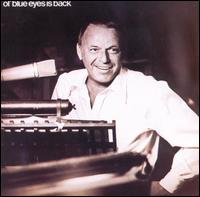
November 18, 1973: Frank Sinatra Releases "Ol' Blue Eyes Is Back"

November 18, 1973: Like a boxer who can't quit the ring, Frank Sinatra ends his retirement after 3 years, releasing his album Ol' Blue Eyes Is Back. Gordon Jenkins arranged it, and Don Costa conducted the orchestra.

Ol' Blue Eyes was up to date: The songs included compositions by Joe Raposo, Teddy Randazzo, Paul Anka, Paul Williams and Kris Kristofferson. The best-known song, although his was not the best-known version, was Stephen Sondheim's "Send In the Clowns." Give that he was about to turn 58 years old, one line was especially poignant: "Isn't it rich, isn't it queer, losing my timing this late in my career?"

The night of the release, NBC aired the special Magnavox Presents Frank Sinatra. Over 40 million people watched it. Nearly a year later, on October 12, 1974, Frank had a live album recorded at Madison Square Garden. With his love of boxing, it was titled The Main Event.

Eventually, Frank's 4th and last wife, Barbara, began calling herself "Lady Blue Eyes."

In 1991, Brent Spiner, who played the android Data on Star Trek: The Next Generation, recorded an album of standards. On the cover, he was in makeup, but wore a 1950s-style suit. The title was Ol' Yellow Eyes Is Back.

*

November 18, 1973 was a Sunday. Baseball was out of season. These games were played in the NFL:

* The New York Giants beat the football version of the St. Louis Cardinals, 24-13 at the Yale Bowl in New Haven, Connecticut. The Giants moved there after Yankee Stadium was closed for renovation. They wanted to use City-owned Shea Stadium until their new stadium was ready in the Meadowlands in East Rutherford, New Jersey, but Mayor John Lindsay, angry at the Giants for leaving the City, wouldn't let them use it. So they played the rest of their 1973 home games and all of 1974 at Yale. In 1975, new Mayor Abe Beame let them use Shea, and Giants Stadium opened in 1976.

* The New York Jets lost to the Cincinnati Bengals, 20-14 at Riverfront Stadium in Cincinnati.

* The New England Patriots beat the Green Bay Packers, 33-24 at Schaefer Stadium (later Sullivan Stadium and Foxboro Stadium) in the Boston suburb of Foxborough, Massachusetts.

* The Washington Redskins beat the Baltimore Colts, 22-14 at Robert F. Kennedy Stadium in Washington.

* The Miami Dolphins beat the Buffalo Bills, 17-0 at Rich Stadium (later Ralph Wilson Stadium) in the Buffalo suburb of Orchard Park, New York.

* The Denver Broncos beat the Pittsburgh Steelers, 23-13 at Three Rivers Stadium in Pittsburgh.

* The Detroit Lions beat the Chicago Bears, 30-7 at Soldier Field in Chicago.

* The Kansas City Chiefs beat the Houston Oilers, 38-14 at Arrowhead Stadium in Kansas City.

* The Dallas Cowboys beat the Philadelphia Eagles, 31-10 at Texas Stadium in the Dallas suburb of Irving, Texas.

* The San Diego Chargers beat the New Orleans Saints, 17-14 at San Diego Stadium (later Jack Murphy Stadium and Qualcomm Stadium).

* The Los Angeles Rams beat their arch-rivals, the San Francisco 49ers, 31-13 at the Los Angeles Memorial Coliseum.

* The Cleveland Browns beat the Oakland Raiders, 7-3 at the Oakland Coliseum.

* And the next night, on ABC Monday Night Football, the Atlanta Falcons beat the Minnesota Vikings, 20-14 at Atlanta Stadium (later renamed Atlanta-Fulton County Stadium).

Baseball was out of season. There were 4 games played in the NBA:

* The Buffalo Braves beat the Capital Bullets, 112-101 at the Cole Field House, on the campus of the University of Maryland, in the Washington suburb of College Park. The Bullets had been the Baltimore Bullets from 1963 to 1973, but had moved to the D.C. area. They were waiting for the Capital Centre to open in suburban Landover, Maryland. The following season, they renamed themselves the Washington Bullets. Bob McAdoo scored 43 points for the Braves.

* The Chicago Bulls beat the Detroit Pistons, 104-102 at Cobo Hall (now Huntington Place) in Detroit.

* The Los Angeles Lakers beat the Cleveland Cavaliers, 102-100 at The Forum outside Los Angeles in Inglewood, California.

* And the Seattle SuperSonics, 95-91 at the Seattle Center Coliseum.

There was 1 game in the American Basketball Association: The Utah Stars beat the San Antonio Spurs, 83-80 at the HemisFair Arena in San Antonio.

There were 4 games played in the NHL:

* The New York Rangers beat the Pittsburgh Penguins, 7-0 at Madison Square Garden.

* The Boston Bruins beat the Atlanta Flames, 5-2 at the Boston Garden.

* The California Golden Seals beat the Buffalo Sabres, 2-0 at the Buffalo Memorial Auditorium.

* And the Detroit Red Wings beat the Montreal Canadiens, 6-4 at the Olympia Stadium in Detroit.

And there were 6 games played in the World Hockey Association:

* The New York Golden Blades beat the Chicago Cougars, 5-3 at Madison Square Garden. A few days later, the Blades, formerly the New York Raiders, moved down the New Jersey Turnpike to the Philadelphia suburb of Cherry Hill, and became the Jersey Knights. They played out the 1973-74 season there, and moved across the country, becoming the San Diego Mariners.

* The Quebec Nordiques beat the Houston Aeros, 8-3 at the ColisĂ©e de QuĂ©bec.

* The Toronto Toros beat the Winnipeg Jets, 6-2 at Varsity Arena in Toronto.

* The Minnesota Fighting Saints beat the Edmonton Oilers, 5-2 at the Edmonton Gardens.

* The New England Whalers beat the Los Angeles Sharks, 5-2 at the Los Angeles Memorial Sports Arena.

* And the Vancouver Blazers beat the Cleveland Crusaders, 8-2 at the Pacific Coliseum in Vancouver.

Friday, November 11, 2022

November 11, 1944: The Musicians’ Strike Ends

November 11, 1944: The musicians' strike that began on July 31, 1942, prohibiting members of the American Federation of Musicians from making commercial records, ends. It remains the longest strike in the history of the American entertainment industry.

The strike did not affect musicians performing on live radio shows, in concerts, or, after October 27, 1943, on special recordings made by the record companies for V-Discs for distribution to the armed forces fighting World War II, because V-Discs were not available for sale to the general public.

However, the union did frequently threaten to withdraw musicians from the radio networks to punish individual network affiliates who were deemed "unfair" for violating the union's policy on recording network shows for repeat broadcasts.

The strike had a major impact on the American musical scene. At the time, union bands dominated popular music; after the strike, and partly as a result of it, the "Big Bands" began to decline, and vocalists began to dominate popular music. It was the dawn of the "Hit Parade" era, which lasted for about 10 years, until the dawn of rock and roll.

Shortly after the strike ended,, Les Brown & His Band of Renown, with Doris Day on lead vocal, record "Sentimental Journey." They would also record a song that would be a Number 1 hit for The Platters in 1958, "Twilight Time." 

*

November 11, 1944 was a Saturday. These notable college football games were played:

* The big game of the day, as it would be many times in the pre-television era, was Army, on this occasion ranked Number 1 in the country, against Notre Dame, this time ranked Number 5. In front of a crowd of 74,437 at Yankee Stadium, coach Earl "Red" Blaik's West Pointers walloped Frank Leahy's Fighting Irish, 59-0.

* Number 3 Navy beat Cornell, 48-0 at Municipal Stadium in Baltimore. Three weeks later, at the same stadium -- which was converted into Memorial Stadium in 1954 -- Army and Navy played for what amounted to the National Championship, and Army won in front of 70,000 people.

World War II meant that the service academies -- not yet counting the Air Force, which wasn't separated from the Army until 1947, didn't get its own Academy until 1954, and didn't start playing football until 1955 -- got better players than it normally would, this time including 2 future Heisman Trophy-winning running backs, Felix "Doc" Blanchard and Glenn Davis, a.k.a. "Mr. Inside" and "Mr. Outside," respectively. It also meant that military bases put teams together, and the NCAA let them play college teams on an equal basis.

* One of those military bases was Randolph Field, based near San Antonio, Texas. Their team was ranked Number 4, and they played the team from Maxwell Field, outside Montgomery, Alabama. Randolph Field won, 25-0 at Alamo Stadium in San Antonio.

In 2010, Randolph Air Force Base was merged with Lackland Air Force Base and Fort Sam Houston to form Joint Base San Antonio.

* Number 6 Bainbridge Naval Training Station was based at Port Deposit, Maryland, and its home games were played at Tome Field. They played Marine Corps Air Station Cherry Point, based in Havelock, North Carolina, and won, 50-7. Bainbridge NTS went undefeated in 1944. The base, near the Army's Aberdeen Proving Grounds, was closed in 1976.

* Number 7 Iowa Pre-Flight, like the University of Iowa located in Iowa City and playing home games at Iowa Stadium, later renamed Kinnick Stadium, played at home, and won, 12-10, over Bunker Hill Naval Air Station, based not in or near Boston, like him might expect, but in Kokomo, Indiana.

* Number 9 March Field, based in the Los Angeles suburb of Riverside, California, beat the University of Washington, 28-0 at Husky Stadium in Seattle.

* Number 14 Great Lakes Naval Training Station, playing at home, at Ross Field in Great Lakes, Illinois, north of Chicago, and coached by former Ohio State coach and future Cleveland Browns coach Paul Brown, played Morris Field, based in Charlotte, North Carolina. Great Lakes won, 12-10. Their baseball team, which once included Bob Feller and several other major leaguers, was so good, they were called "the 17th major league team."

* The Coast Guard Academy beat Dartmouth, 19-0 at Memorial Field in Hanover, New Hampshire. The Academy, based in New London, Connecticut, now play in NCAA Division III.

* Number 2 Ohio State beat the University of Pittsburgh, 54-19 at Ohio Stadium in Columbus, Ohio. Ohio State won the Big Ten Conference title, and finished the season undefeated. They did not, however go to a bowl game, and so only some minor polls named them, rather than Army, the National Champions.

* Number 8 Michigan beat Number 10 Illinois, 14-0 at Michigan Stadium in Ann Arbor.

* Number 11 University of Southern California were idle that week. USC won the Pacific Coast Conference title.

* Number 12 Wake Forest were upset by Number 20 Duke, 34-0 Duke Stadium (later Wallace Wade Stadium) in Durham, North Carolina. This decided the Southern Conference title.

* Number 13 Georgia Tech beat Tulane, 34-7 at Grant Field in Atlanta. Tech won the Southeastern Conference title, but, instead of the Sugar Bowl, as the SEC Champion usually does, they accepted a bid to the Orange Bowl.

* Number 16 Tennessee were idle. They were invited to the Rose Bowl, where they lost to USC.

* The University of Alabama were unranked, but beat the University of Mississippi (Ole Miss), 34-6 in a game played, for some reason (wartime travel restrictions, perhaps?) at Murphy High School in Mobile, Alabama. 'Bama went to the Sugar Bowl, where they lost to Duke.

* The University of Tulsa beat Southwestern University, 51-6 at Skelly Field in Tulsa, Oklahoma. Tulsa went on to beat Georgia Tech in the Orange Bowl.

* Texas Christian University beat Texas Tech, 14-0 at Amon G. Carter Stadium in Fort Worth, Texas. TCU won the Southwest Conference title.

* Oklahoma A&M (which became Oklahoma State in 1957) beat Texas, 1308 at Memorial Stadium in Austin, Texas. A&M won the Missouri Valley Conference title, and beat TCU in the Cotton Bowl.

* Penn State beat Temple, 7-6 at Temple Stadium in Philadelphia.

* In a major rivalry, Georgia beat Florida, 38-12 at Fairfield Stadium in Jacksonville, Florida.

* And in a rivalry no one outside Kansas cares about, Kansas State beat Kansas, 18-14 at Memorial Stadium in Manhattan, Kansas. (KSU's home field at the time. KU's home field was also, and remains, named Memorial Stadium.)

* Among the New York City teams, Fordham had suspended its program for the duration of The War; Columbia lost to the University of Pennsylvania, 35-7 at Franklin Field in Philadelphia; New York University (NYU) lost to Swarthmore, 21-0 at Ohio Field in The Bronx; and City College of New York (CCNY) lost to Bucknell, 78-0 at Memorial Stadium (since renamed for the school's most famous graduate, Baseball Hall-of-Famer Christy Mathewson) in Lewisburg, Pennsylvania.

* And among the New Jersey teams, Rutgers lost to Lafayette, 39-0 at Rutgers Stadium in Piscataway; and Princeton beat Muhlenberg, 16-6 at Palmer Stadium in Princeton.

Baseball was out of season. The NBA hadn't been founded yet. There were 2 games played in the NHL. The New York Rangers beat the Detroit Red Wings, 5-2 at the old Madison Square Garden. And the Toronto Maple Leafs beat the Montreal Canadiens, 3-1 at Maple Leaf Gardens in Toronto. The Boston Bruins and the Detroit Red Wings were not scheduled.

Thursday, November 3, 2022

November 3, 1951: The 1st "Crossover" Hit Song

November 3, 1951: Tony Bennett succeeds himself at Number 1, as "Because of You" gives way to "Cold, Cold Heart."

It was the first exposure outside the South for the song's writer, Hank Williams. Hank called Tony and asked, "Tony, why did you ruin my song?" Hank had to assure him he was only joking: He loved it.

Born in Queens on August 3, 1926, Anthony Benedetto served in the U.S. Army, and saw combat near the end of World War II. "Because of You" was his 1st big hit. After "Cold, Cold Heart," he hit Number 1 again in 1953 with "Rags to Riches," and kept singing standards in the "Big Band" style, even as rock and roll took over, becoming a regular on The Ed Sullivan Show.

In 1962, he recorded George Cory and Douglass Cross' song "I Left My Heart In San Francisco," and while it only reached Number 19 on Billboard's Hot 100 chart, it became one of the most beloved songs of the 1960s, and his signature song.

In 1970, upon the advice of Columbia Records' Clive Davis, he recorded Tony Sings the Great Hits of Today! It flopped. He spent the 1970s going around record companies, and developed a cocaine addiction. His son Danny realized that they had the opposite problem: Tony could sing, but couldn't handle the business side of things; Danny had a head for business, but had no luck performing with his rock band. So Danny became Tony's manager, got him clean, and by 1986 was back with Columbia and recording successful albums.

Tony began the trend of older singers recording standards in "Great American Songbook" albums, including one of songs associated with Frank Sinatra in 1992, titled Perfectly Frank. Sinatra returned the compliment by calling Tony his favorite singer. He began recording with up-to-date performers like Flavor Flav of Public Enemy, Red Hot Chili Peppers, and, in his final records, Lady Gaga. He and Gaga, both New Yorkers of Italian descent, born 60 years apart, adored each other.

He never intended to retire, but had to in 2021, at the age of 95, as he had become frail and had begun decline into dementia, having trouble remembering lyrics as he was recording them. (UPDATE: He died on July 21, 2023, shortly before what would have been his 97th birthday.)

*

November 3, 1951 was a Saturday. Among the college football games played on this day were these:

* Number 1 Tennessee beat North Carolina, 27-0 at Kenan Stadium in Chapel Hill, North Carolina. Tennessee went undefeated in the regular season.

* Number 2 Michigan State had the week off. They finished the season undefeated, and claimed the National Championship. However, they were not yet members of the Big Ten Conference, and thus were not invited to any of the bowl games.

* Number 3 Illinois beat Number 15 Michigan, 7-0 at Memorial Stadium in Champaign, Illinois.

* Number 4 Maryland beat Missouri, 35-0 at Byrd Stadium (now SECU Stadium) in the Washington suburb of College Park, Maryland. Maryland went undefeated in the regular season, and beat previously undefeated Tennessee in the Sugar Bowl. Both Tennessee and Maryland were awarded the National Championship by some of the deciders at the time, but, with Tennessee having lost the Sugar Bowl to Maryland, their claim is bogus.

* Number 5 Georgia Tech were held to a tie by Duke, 14-14 at Grant Field in Atlanta. It would be the only blot on Tech's record that season.

* Number 6 Princeton beat Brown, 12-0 at Palmer Stadium in Princeton. Led by two-way back Dick Kazmaier, who was awarded the Heisman Trophy, Princeton finished the season undefeated, but this was beyond the years when Ivy League schools accepted bowl bids. 

* Number 7 University of Southern California, USC, beat Army, 28-6 at Yankee Stadium.

* Number 8 Baylor were upset by Texas Christian University (TCU), 20-7 at Baylor Stadium in Waco, Texas. Baylor were invited to the Orange Bowl, where they lost to Georgia Tech, who claimed the National Championship. But, having a tie on their record, anyone recognizing them as such would have to contend with the perfect records of Maryland and Michigan State.

* Number 9 University of California are upset by the University of California at Los Angeles, UCLA, 21-7 at the Los Angeles Memorial Coliseum.

* Number 10 Wisconsin beat Indiana, 6-0 at Camp Randall Stadium in Madison, Wisconsin.

* Number 11 Stanford beat Number 16 Washington State, 21-13 at the original Stanford Stadium in the San Francisco suburb of Palo Alto, California. Stanford went to the Rose Bowl, where they lost to Illinois.

* Number 13 Notre Dame beat Navy, 19-0 at Municipal Stadium in Baltimore. Municipal Stadium was in the process of being converted into Memorial Stadium, as which it was dedicated when the Orioles debuted there on April 15, 1954.

* Number 14 Kentucky beat Number 19 Miami, 32-0 at McLean Stadium in Lexington, Kentucky. Kentucky went on to beat TCU in the Cotton Bowl.

* In a cross-State rivalry, Utah beat Utah State, 28-20 at Romney Stadium in Logan, Utah.

* And Rutgers beat Fordham, 13-7 at the old Rutgers Stadium in Piscataway, New Jersey.

Baseball was out of season. There were 4 games in the NBA:

* The New York Knicks beat the Milwaukee Hawks, 68-66 at the Milwaukee Exposition and Convention Center Arena. (Later nicknamed "The MECCA," it is now named the UW-Milwaukee Panther Arena).

* The Philadelphia Warriors beat the Fort Wayne Pistons, 70-69 at the Philadelphia Arena.

* The Indianapolis Olympians beat the Baltimore Bullets, 90-86 at the Baltimore Coliseum. The Olympians folded in 1953. The Bullets folded the next year, and the Baltimore Bullets that began play in 1963, now the Washington Wizards, have no connection to them.

* And the Minneapolis Lakers beat the Rochester Royals, 93-74 at the Edgerton Park Arena in Rochester, New York.

There were 2 games in the NHL. The New York Rangers beat the Toronto Maple Leafs, 2-1 at Maple Leaf Gardens in Toronto. And the Detroit Red Wings beat the Montreal Canadiens, 3-2 at the Montreal Forum. The Boston Bruins and the Chicago Black Hawks were not scheduled.

And in English soccer, Arsenal, the North London team I would eventually support, traveled to Yorkshire, and beat Middlesbrough, 3-0 at Ayresome Park in Middlesbrough.

December 31, 1999 & January 1, 2000: The Millennium

December 31, 1999:  The Millennium arrives. The people of planet Earth survived. At a terrible cost. But we hadn't destroyed ourselves. ...