Showing posts with label hungary. Show all posts

Friday, November 25, 2022

November 25, 1953: The Magnificent Magyars Stun England

Ferenc Puskás

November 25, 1953: Hungary defeat England, 6-3 at Wembley Stadium in West London, becoming the 1st team from outside the British Isles to defeat England on English soil.

Known as "the Golden Team," "the Magnificent Magyars" and "the Magical Magyars," from 1950 to 1956, they used an early form of what the Netherlands would later call "Total Football" to put up a record of 58 wins, 10 draws, and only 1 loss.

Manager Gusztáv Sebes built the team around forwards Ferenc Puskás, Sándor Kocsis and Nándor Hidegkuti; midfielders Zoltán Czibor and József Bozsik, and goalkeeper Gyula Grosics. Hidegkuti played his "club football" for MTK Hungária (now MTK Budapest), while the rest played for Budapest Honvéd.

There was no European Championship tournament for them to compete in until 1960. But they won the Gold Medal at the 1952 Olympics in Helsinki, Finland. In 1953, they won the Central European International Cup, competing against Austria, Czechoslovakia, Italy and Switzerland.

They won this game in front of 105,000 stunned spectators at London's Wembley Stadium. England were captained by right half Billy Wright of Wolverhampton Wanderers; and also included the pair of Stanley Matthews (a.k.a. the Wizard of Dribble) and Stan Mortensen, who had led Blackpool F.C. to the FA Cup earlier in the year; and right back Alf Ramsey and outside left George Robb, who had led Middlesex team Tottenham Hotspur to the 1951 Football League title.

Hungary had shown England what modern football looked like. Ramsey took notes, and eventually managed Ipswich Town to the English Football League title, and became the England manager who won the World Cup.

"Eventually" would not, however, come soon. A rematch in Budapest the next year was even less of a contest, a 7-1 loss that is still the heaviest that England's national team have ever faced. Puskás, known as the Galloping Major for his service in the Hungarian Army, was now considered the best player in the world.

He would lead them to the Final of the 1954 World Cup, but would play hurt in that game, and West Germany gave them their 1 and only defeat in that stretch, which was ended by the 1956 Hungarian Revolution. The national team was out of the country at the time, and many did not return home for many years. Puskás starred for Spanish team Real Madrid, while Kocsis and Czibor starred for Real's arch-rivals, FC Barcelona.

Times changed. Democracy returned to Hungary in 1989, and the national stadium in Budapest was named for Puskás in 2002. He died in 2006, and the old stadium was demolished in 2017, replaced in 2019 by the Puskás Aréna.

*

November 25, 1953 was a Wednesday. Baseball was out of season. Football was in midweek. There were 3 games played in the NBA:

* The New York Knicks lost to the Boston Celtics, 96-84 at the Boston Garden.

* The Baltimore Bullets beat the Syracuse Nationals, 66-58 at the Baltimore Coliseum. The Bullets folded a year later, and were eventually replaced in 1963, by the team that moved to the D.C. area in 1973, and are now known as the Washington Wizards. Also in 1963, the Nats moved, becoming the Philadelphia 76ers.

* And the Milwaukee Hawks beat the Fort Wayne Pistons, 64-58 at the Milwaukee Arena. In 1974, it was renamed the Milwaukee Exposition, Convention Center and Arena, or "The MECCA." Since 2014, it has been named the UW-Panther Arena. The Hawks moved to St. Louis in 1958 and Atlanta in 1968; the Pistons, to Detroit in 1957.

There was 1 game in the NHL: The New York Rangers beat the Boston Bruins, 5-3 at Madison Square Garden.

Friday, November 4, 2022

November 4, 1956: The Hungarian Revolution Is Crushed

Time with a collective "Man of the Year" for 1956.
Note the Communist seal cut out of the flag.

November 4, 1956: Soviet troops enter Hungary to end the Hungarian Revolution that started on October 23. Thousands are killed, more are wounded, and nearly a quarter of a million people leave the country. (Today, the population is about 10 million.)

Cardinal József Mindszenty, the leader of the Catholic Church in Hungary, having previously been imprisoned by the Nazis, was arrested in 1949, and imprisoned and tortured for his anti-Communist activities. He was freed during the Revolution, and given asylum in the U.S. Embassy in Budapest. He became a hero of the movement, remained there until 1971, and died in 1975.
József Mindszenty

The city of New Brunswick, New Jersey once had a large Hungarian community, and their St. Ladislaus Roman Catholic Church has a memorial to the Revolution and a statue of Mindszenty out front.

Imre Nagy, Chairman of the Council of Ministers (effectively, the Prime Minister) from July 4, 1953 to April 18, 1955, wasn't so lucky. He was forced out of office by hardliner András Hegedüs, who was forced out by the Revolution on October 24, fleeing to the Soviet Union. Nagy was reappointed, dissolved the secret police (ÁVH), and withdrew Hungary from the Warsaw Pact on November 1.
Imre Nagy

When the Soviet tanks rolled in, he fled to the Yugoslavian Embassy, hoping that country's leader, Josip Broz Tito, a fellow anti-Moscow Communist, could protect him. He was lured out of the embassy under false promises on November 22, was arrested, and was deported to Romania. On June 16, 1958, Nagy was tried and executed for treason alongside his closest allies, and his body was buried in an unmarked grave. His remains would be repatriated to Hungary after the 1989 revolution. (Hegedüs returned to Hungary thereafter, but taught at a university rather than return to governing, and lived until 1989.)

Soccer team Budapest Honvéd FC was out of the country at the time of the Revolution, playing Athletic Bilbao in the European Cup. Eliminated, they managed to get their families out of the country. Their stars, the bulk of the "Magnificent Magyars" team that won the 1952 Olympics, embarrassed England at Wembley Stadium in 1953, and reached the 1954 World Cup Final, went elsewhere, including some staying in Spain: Ferenc Puskás to Real Madrid, and Sándor Kocsis and Zoltán Czibor to FC Barcelona. 

Since that year's Olympics were given to Melbourne, Australia, in the Southern Hemisphere, they began on November 22 so the weather would be warm. Throughout the Olympics, Hungarian athletes were cheered by fans from the host nation and other countries. Many of them gathered in the boxing arena when Laszlo Papp won a Gold Medal.

A few days later, the crowd was with the Hungarian water polo team in its match against the Soviet Union which became known as "the Blood In the Water Match." The game became rough and, when a Hungarian player, Ervin Zador, was forced to leave the pool with blood streaming from a cut over his eye, a riot almost broke out. But police restored order, and the game was called early, with Hungary leading 4–0. The Hungarians went on to win the Gold Medal.

At the end of the calendar year, Time magazine named the Hungarian Freedom Fighters their Men of the Year. This was before they made the distinction "Person (or People) of the Year," although women had been recognized as such before.

At the same time as the Hungarian Revolution, the "Polish October" was taking place. President
Bolesław Bierut, a Stalinist dictator, had died on March 12. On June 28, a demonstration by workers in Poznań was crushed, leading to at least 57 and possibly more than 100 deaths. In October, a reform faction took over, led by Władysław Gomułka. However, Gomulka's administration ended up getting more and more repressive until his removal in 1970. As Hungary, Poland, and the rest of Eastern Europe found out, post-Stalin Communism was only a slight improvement over Stalinist Communism.

*

November 4, 1956 was a Sunday. These NFL games were played:

* The New York Giants beat the Pittsburgh Steelers, 17-14 at Forbes Field in Pittsburgh.

* The Chicago Cardinals beat the Philadelphia Eagles, 28-17 at Comiskey Park in Chicago.

* The Cleveland Browns beat the Green Bay Packers, 24-7 at Milwaukee County Stadium.

* The Chicago Bears beat the Los Angeles Rams, 35-24 at the Los Angeles Memorial Coliseum.

* The Detroit Lions beat the San Francisco 49ers, 17-13 at Kezar Stadium in San Francisco.

* And the Baltimore Colts and the Washington Redskins had a bye week.

Three games were played in the NBA:

* The New York Knicks beat the Fort Wayne Pistons, 96-83 at the Allen County War Memorial Coliseum in Fort Wayne, Indiana. (It still stands.)

* The St. Louis Hawks beat the Syracuse Nationals, 78-76 at the Onondaga County War Memorial in Syracuse, New York. (It still stands, as the Upstate Medical University Arena.) Dolph Schayes had 28 points and 25 rebounds for the Nats, but it wasn't enough.

* And the Minneapolis Lakers beat the Rochester Royals, 88-87 at the Minneapolis Auditorium. (This venue does not still stand.)

Two games were played in the NHL. The New York Rangers lost to the Boston Bruins, 4-1 at the Boston Garden. And the Montreal Canadiens beat the Chicago Black Hawks, 1-0 at the Chicago Stadium. The Toronto Maple Leafs and the Detroit Red Wings were not scheduled.

Saturday, October 29, 2022

October 29, 1956: The Suez Crisis

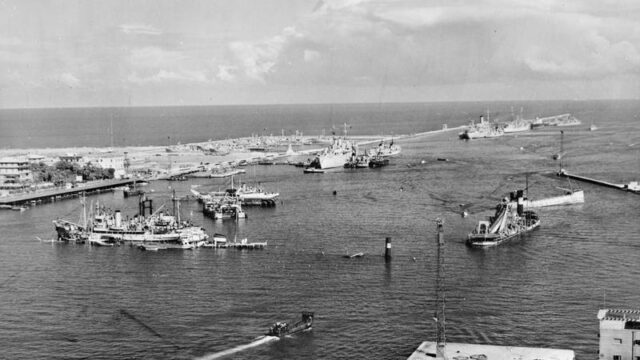
October 29, 1956: On the orders of dictator Gamal Abdel Nasser, Egypt closes the Suez Canal, triggering a crisis that could have blown up into World War III.
However, President Dwight D. Eisenhower refuses to take sides, hoping that isolating Britain and France will prevent war, and also prevent the crisis from affecting Israel. "Ike" turns out to be right, and this is often seen as the end of Britain and France as true world powers. The Suez Crisis was a major factor in the fall of France's Fourth Republic, and its replacement with the Fifth Republic, in 1958.
But stuff like this is why the rest of the Middle East doesn't trust Israel. Since 1974, even though it is on the continent of Asia, Israel's national sports teams have been denied entry into Asian tournaments, because Muslim countries in Asia refuse to allow Israeli athletes onto their soil. Since 1992, they have competed in European tournaments.
The Suez Crisis was a huge regional boost for Nasser. A key figure in the coup that overthrew King Farouk in 1952, he set the standard for Middle East dictators to follow, with his cult of personality, his prominent mustache, and his willingness to wear whatever was required for the occasion, be it business suit, military uniform or religious attire.
But he lost the next war with Israel, the Six-Day War of June 1967. And his health was poor: He was a heavy smoker, and by this point had arteriosclerosis and diabetes. He died in 1970, only 52 years old. He was succeeded by his Vice President, Anwar Sadat, who would launch yet another war against Israel in 1973, lose it, and then do something unthinkable to Nasser: Make peace.
Also on this day, NBC debuts its new evening news program, The Huntley-Brinkley ReportWith the Suez Crisis beginning that day, the Hungarian Revolution, and a Presidential election campaign entering its final stages, the timing was excellent.
*
October 29, 1956 was a Monday. Baseball season was over. There was no Monday Night Football in those days, nor were any college football games played. The NBA and NHL seasons had just started, but there were no games scheduled for this day in either league. So there were no scores on this historic day.

Boxer Wilfredo Gómez was born on that day. The Puerto Rican known as "Bazooka" was the Super Bantamweight Champion from 1979 to 1983, the Featherweight Champion in 1984, and the Super Featherweight Champion in 1985 and 1986.

Saturday, August 27, 2022

August 27, 1939: The Polish Soccer Team's Greatest Win -- and Almost Its Last

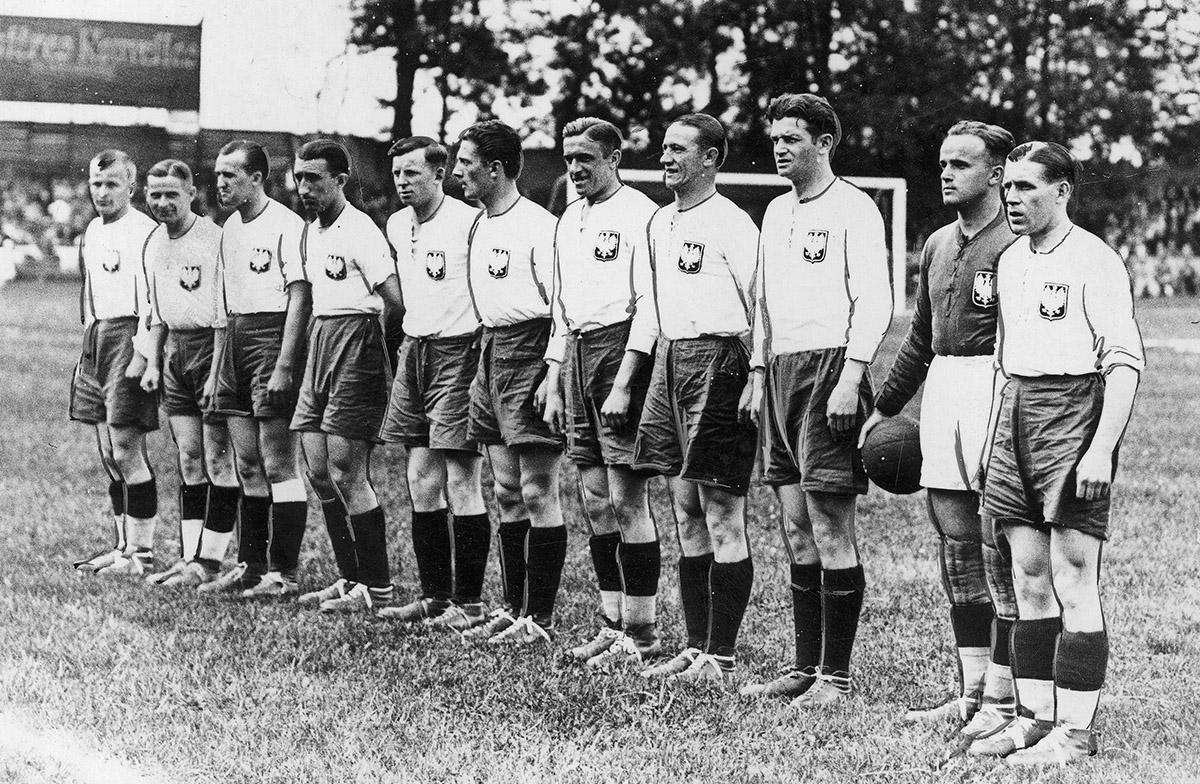
August 27, 1939: The national soccer team of Poland defeats Hungary, runners-up at the previous year's World Cup, 4-2 at Stadion Wojska Polskiego (the Polish Army Stadium) in Warsaw. Ernest "Ezi" Wilimowski scored 3 goals in the game.

Poland had never beaten Hungary in 8 previous tries, and it is considered the greatest victory in team history. Indeed, Alex James, the now-retired Scotsman who had captained the Arsenal champions earlier in the decade, had been advising the Poland team, and had told them to concentrate on defense, and "hope for a lucky draw."

It is the last game played by Poland for many years. Four days later, Nazi Germany will invade from the West, and the Soviet Union will invade from the east. Rumors of such invasions abounded, but a sellout crowd of 20,000 attended, anyway. But James had fled back to Britain.

A game had been scheduled for the following Sunday, September 3, hosting Bulgaria. The following Wednesday, September 6, Poland were scheduled to play Yugoslavia in Belgrade. On September 24, Poland were to play Romania in Warsaw. All of these games were canceled after the invasion on September 1.

Manager Jozef Kaluza did not survive the War, although his death was due to illness, not combat or imprisonment. Every one of his players, in the 2-3-5 formation common at the time, survived the War: Goalkeeper Adolf Krzyk; right back Wladyslaw Szczepaniak, left back Edmind Giemsa; midfielders Wilhelm Gora, Edward Jablonski and Ewald Dytko; and forwards Henruk Jaznicki (the last survivor, living until 2004), Ewald Cebula, Leonard Piontek, Ernst Wilimowski, Pawel Cyganek, and Stanislaw Baran, who came on as a substitute for Jaznicki.

On June 11, 1946, the Poland national team played again, losing 3-1 in a friendly against Norway, at the Ulleval Stadium in Oslo.

Built in 1930, the Polish Army Stadium has been home to the country's most successful team, Legia Warsaw, ever since. In 2010, the stadium was reconstructed, stand-by-stand, and reopened, officially renamed for both the team and the founding father of the Polish Republic: Marshall Józef Piłsudski Legia Warsaw Stadium. 

It was the home of the national team until 1993, when games were moved to Stadion Śląski (the Silesian Stadium) in Chorzów. In 2011, the 58,580-seat Stadion Narodowy (National Stadium) was opened, and Poland have played most of their national team games there since.

To my regret as an American soccer fan of Polish descent, Poland's record in international competition is poor. Out of 21 World Cups staged from 1930 to 2018, they have played in only 8, having withdrawn in 1934 and 1954, and refusing to enter in 1930 and 1950. They reached the Semifinals in 1974 and 1982; the Quarterfinals in 1978; the Round of 16 in 1938 and 1986; and the Group Stage in 2002, 2006 and 2018. (UPDATE: They reached the Round of 16 in 2022, but did not qualify in 2026.)

The European Championships were established in 1960, and they didn't qualify until 2008. They qualified as co-hosts with Ukraine in 2012, and reached the knockout stage for the 1st time in 2016, getting to the Quarterfinals.

*

August 27, 1939 was a Sunday. Edward Patten, Gladys Knight's cousin and one of her Pips, was born. So was travel writer William Least Heat-Moon.

These Major League Baseball games were played:

* The New York Yankees beat the Detroit Tigers, 13-3 at Briggs Stadium (later Tiger Stadium) in Detroit. Charles "Red" Ruffing advanced to 20-4 on the season, outpitching Lynwood "Schoolboy" Rowe. Frank Crosetti, Bill Dickey and Red Rolfe hit home runs. Joe DiMaggio went 1-for-5 with an RBI. Hank Greenberg did not play.

* The New York Giants lost to the Cincinnati Reds, 7-2 at the Polo Grounds. Paul Derringer outpitched Carl Hubbell. Ival Goodman went 2-for-5 with a home run and 4 RBIs. Mel Ott went 0-for-4.

* A doubleheader was split at Ebbets Field. The Brooklyn Dodgers won the opener, 3-2. Freddie Fitzsimmons outpitched Mace Brown. The Pittsburgh Pirates won the nightcap, 9-5. Cy Blanton outpitched Al Hollingsworth. Over the 2 games, Joseph "Arky" Vaughan went 6-for-10 with 2 RBIs; Paul Waner went 3-for-8 with a walk and 2 RBIs; while Lloyd Waner went 0-for-5 in the 1st game, and did not play in the 2nd game.

* A doubleheader was split at National League Park in Boston. The Boston Bees won the 1st game, 10-4. The St. Louis Cardinals were leading the 2nd game, 6-5 in the bottom of the 8th, when the game was called due to a quirk in the law that allowed professional sports on Sundays in Massachusetts: A curfew that cut off all games at 6:00 PM.

This was during the former Boston Braves' "rebrand" (as we would call it today), following their awful 1935 season: They renamed themselves the Bees, and Braves Field was renamed National League Park. The new names never caught on, and, in 1941, the previous names were restored. (At least they didn't go back to their 1883-1906 name, the Boston Beaneaters.

* The Philadelphia Phillies swept a doubleheader from the Chicago Cubs, 4-3 and 3-2 at Shibe Park in Philadelphia. Pennsylvania also had a curfew put into their recent laws legalizing professional sports on Sundays, but both of these games came in under the wire.

* The Cleveland Indians swept a doubleheader from the Boston Red Sox, 1-0 and 5-3 at Cleveland Municipal Stadium. Bob Feller pitched a 4-hit shutout in the 1st game, outpitching Denny Galehouse. Willis Hudlin outpitched Fritz Ostermueller in the 2nd game. After going 0-for-4 in the 1st game, Hal Trosky went 2-for-4 with a home run and 4 RBIs in the 2nd game.

Over the 2 games, Lou Boudreau went 1-for-8, Jimmie Foxx went Jimmie Foxx went 3-for-8, and rookie Ted Williams went 1-for-8.

* The Philadelphia Athletics beat the Chicago White Sox, 2-0 at Comiskey Park in Chicago. Bill Beckmmann pitched a 7-hit shutout.

* And the Washington Senators swept a doubleheader from the St. Louis Browns, 8-7 and 4-3 at Sportsman's Park in St. Louis. In the 2nd game, the Senators scored 3 runs in the top of the 11th inning, and the Browns could only come back with 2 in the bottom half.

Monday, July 4, 2022

July 4, 1954: The Miracle of Bern

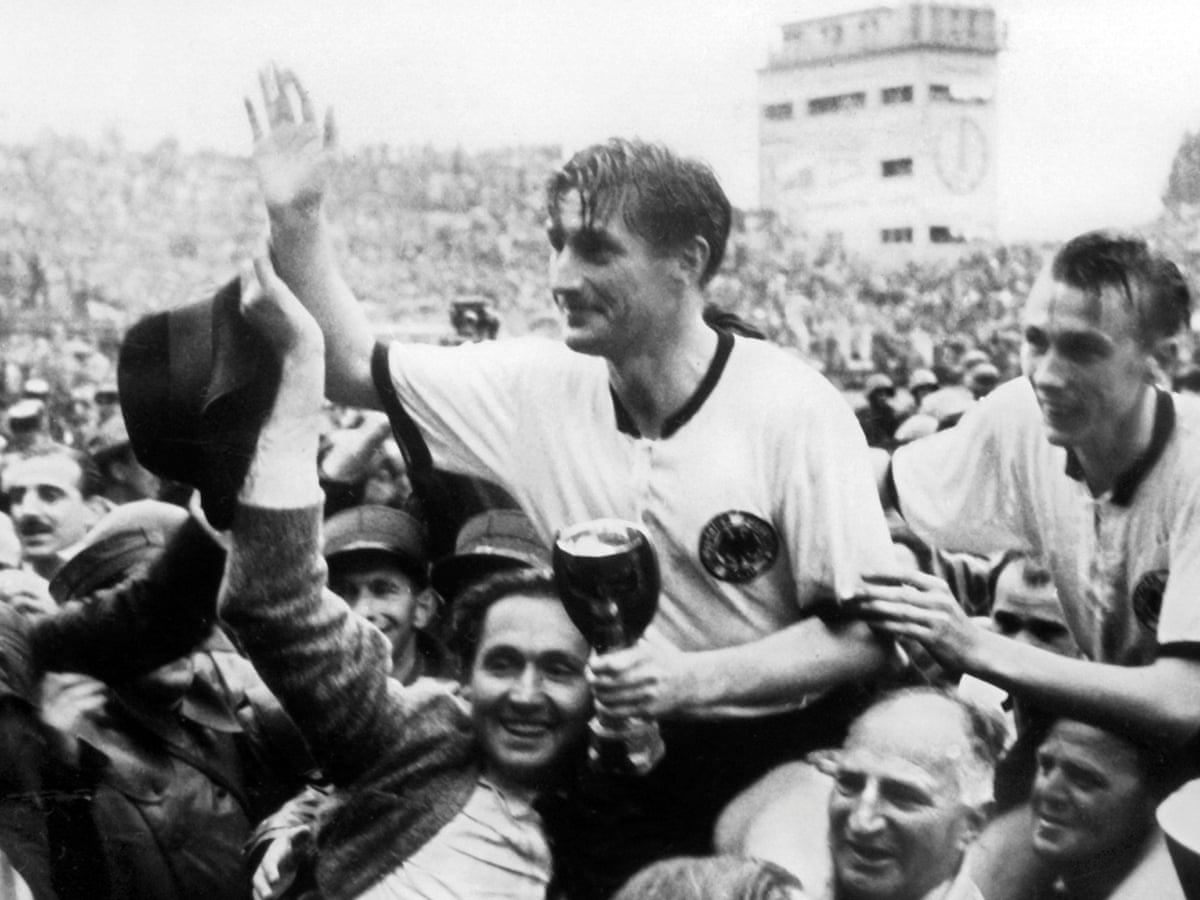
West German Captain Fritz Walter,
with the Jules Rimet Trophy

July 4, 1954: The World Cup Final is held at the Wankdorf Stadium in Bern (sometimes written as "Berne"), the capital of Switzerland. Due to the cancellations of the tournament for 1942 and 1946, and the 1950 edition being held in Brazil, it is the 1st World Cup held in Europe since 1938.

It is also the 1st time the tournament is held in a country where the predominant language is German. Western Switzerland, bordering France, uses French as its main language (about 23 percent of the country's population); some southern and eastern regions, bordering Italy, use Italian (about 8 percent); and a few eastern parts of the country speak a language called Romansh (about 0.5 percent). But most of the country (68 percent) uses German. Germany would eventually host the World Cup in 1974 and 2006, while Austria has never hosted it, although they co-hosted Euro 2008 with Switzerland.

Among the Quarterfinals, played in 104-degree heat in Stade Olympique de la Pointaise in Lausanne, was a match between hosts Switzerland and neighboring Austria. The players' feet were as hot as the weather, and the game ended 7-5 to Austria. It remains the highest-scoring game in World Cup history.

Also among the Quarterfinals was Uruguay eliminating England, 4-2 at Basel. England’s starting lineup included Billy Wright of Wolverhampton Wanderers, Stanley Matthews Blackpool FC, Nat Lofthouse of Bolton Wanderers and Tom Finney Preston North End, each of whom now has a statue outside his stadium; plus Roger Byrne of Manchester United, memorialized outside Old Trafford as one of the victims of the Munich Air Disaster.

Not in England's starting lineup, or even anywhere in its squad, were any players from North London team Arsenal FC, even though Arsenal had won the League the year before, and came close to the Double the year before that. No room on this England squad, apparently, for Cliff Holton, Doug Lishman or Don Roper. Joe Mercer had finished the season with an injury, so he wouldn't have been available, anyway. And, of course, Alex Forbes and Jimmy Logie couldn't play for England, being Scots; while Walley Barnes and Jack Kelsey were Welsh.

Fittingly, West Germany were one of the teams in the Final. Among the punishments for its predecessor state, Nazi Germany, after World War II was a slower integration into postwar Europe. The Federal Republic of Germany, a.k.a. West Germany, allied with the Western democracies; while the German Democratic Republic (which was neither democratic nor a republic), a.k.a. East Germany, were controlled by the Soviet Union. Both were formed in 1949, and neither was admitted to FIFA, the governing body for world soccer, in time for qualifying for the 1950 World Cup.

Josef "Sepp" Herberger had managed the national team, known in Germany as Die Mannschaft, from 1936 until its 1942 disbanding due to the war. In spite of having been a member of the Nazi Party, there seemed to be no one more qualified to rebuild the team than he. He built the team around players from 1. FC Kaiserslautern, in the western Rhineland, including star forward Fritz Walter (who was named national team Captain) and his brother Ottmar Walter.
Sepp Herberger

In the Group Stage, they beat Turkey, but lost to Hungary, forcing a playoff with Turkey to get into the knockout stage, which West Germany won. They beat Yugoslavia in the Quarterfinal and Austria in the Semifinal.

No one was surprised that they lost to Hungary, or even that the score was 8-3. Known as "the Golden Team," "the Magnificent Magyars" and "the Magical Magyars," from 1950 to 1956, they used an early form of what the Netherlands would later call "Total Football" to put up a record of 58 wins, 10 draws, and only 1 loss.

Manager Gusztáv Sebes built the team around forwards Ferenc Puskás, Sándor Kocsis and Nándor Hidegkuti; midfielders Zoltán Czibor and József Bozsik, and goalkeeper Gyula Grosics. Hidegkuti played his "club football" for MTK Hunagaria (now MTK Budapest), while the rest played for Budapest Honvéd.

There was no European Championship tournament for them to compete in until 1960. But they won the Gold Medal at the 1952 Olympics in Helsinki, Finland. In 1953, they won the Central European International Cup, competing against Austria, Czechoslovakia, Italy and Switzerland.

Later that year, they became the 1st team from outside the British Isles to defeat England on English soil, 6-3 in front of 105,000 stunned spectators at London's Wembley Stadium. A rematch in Budapest the next year was even less of a contest, a 7-1 loss that is still the heaviest that England's national team have ever faced. Puskás, known as the Galloping Major for his service in the Hungarian Army, was now considered the best player in the world.
Ferenc Puskás

Hungary beat South Korea and West Germany in the Group Stage, to top their group. However, in the West Germany game, Puskás was kicked in the ankle by Germany centerback Werner Liebrich, and sustained a hairline fracture. It didn't seem to matter much, as Hungary then beat both 1950 Finalists: Brazil in the Quarterfinal, and defending Champions Uruguay in the Semifinal. They were heavy favorites for the Final against the Germans, especially after it was announced that Puskás was ready to play.

But the night before the Final, a village fair took place in front of the hotel that lasted until the early morning hours, and disrupted the players' sleep. By contrast, the German team resided in the tranquil lake town of Spiez, where it was unaffected from such disturbances. The Spirit of Spiez became proverbial in Germany for describing the team's morale and comradeship.

West Germany came back quickly. In the 10th minute, Fritz Walter fired a shot that was deflected by midfielder József Zakariás, but it went right to Max Morlock, a forward from 1. FC Nürnberg (Nuremberg), who closed Die Mannschaft to within 2-1. In the 18th minute, Helmut Rahn of Rot Weiss Essen (Red and White, of Essen) tied the game.

In the 23rd minute, Hidegkuti nearly scored, but German goalkeeper Toni Turek, of Fortuna Düsseldorf, made a spectacular save. Four minutes later, Hidegkuti hit the goalpost. Early in the 2nd half, Turek made a save on Puskás, and then Kocsis hit the crossbar. In the 72nd minute, Grosics made a great save on Rahn.

In the 84th minute, Rahn pretended to pass to Ottmar Walter, then fired past Grosics. Herbert Zimmerman, calling the game for German national radio, yelled, "Aus dem Hintergrund müßte Rahn schießen. Rahn schießt! Tor! Tor! Tor! Tor!" (Meaning, "Rahn should shoot from deep. Rahn shoots! Goal! Goal! Goal! Goal!" "Tor" can also mean "gate": The native name for the Brandenburg Gate in Berlin is Brandenberger Tor.)
Helmut Rahn
After 8 seconds of letting the roar of the crowd tell the story, Zimmerman resumed: "Tor für Deutschland! Drei zu zwei führt Deutschland. Halten Sie mich für verrückt, halten Sie mich für übergeschnappt!" (Goal for Germany! Germany lead 3-2. Call me mad, call me crazy!" Shades of 3 years earlier, in New York, when Russ Hodges broadcast, "The Giants win the Pennant!")
But the game was not over, and Hungary did not give up. Just 2 minutes later, Puskás appeared to have tied the game when he converted a pass from forward Mihály Tóth. But the goal was controversially ruled offside. In the 90th and last minute of regular time, Turek made one more save, on Czibor. 
West Germany won, 3-2. I mentioned that the Magnificent Magyars only lost 1 game from 1950 to 1956. This was it, at the worst possible time.

It became known as "The Miracle of Bern." In his book Tor! The Story of German Football -- named in part for Zimmerman's call -- Uli Hesse wrote that it was the 1st time since the end of the war that the German people were allowed to feel good about themselves and their country again, and helped to make Die Mannschaft a vital part of German cultural life.

West Germany reached the Final again in 1966, losing to England; in 1974, beating the Netherlands on home soil; in 1982, losing to Italy; in 1986, losing to Argentina; and in 1990, beating Argentina. Shortly after that World Cup, the country was reunified. A united Germany reached the Final in 2002, losing to Brazil; hosted the tournament in 2006, but lost a Semifinal to Italy; and beat Argentina in the Final in 2014, for their 4th World Cup win, matching Italy's total, and trailing only Brazil's 5.

Hungary, however, have never been a soccer power again. The Soviets' crushing of the 1956 Revolution shattered the national team, forcing its players to play in other countries. They reached the Quarterfinals of the World Cup in 1962 and '66, but haven't done even that well since. They last qualified for the tournament in 1986.

The Wankdorf Stadium, or Wankdorfstadion, was built in the Bern neighborhood of Wankdorf in 1925, as the home of the team BSC Young Boys. It later hosted the 1961 European Cup Final, where Benfica beat Barcelona. It was torn down in 2001, and was replaced by a new stadium of the same name on the same site in 2008.
The Wankdorf Stadion

Kaiserslautern's home was renamed Fritz-Walter-Stadion in 1985, and was one of the host venues for the 2006 World Cup. Walter died in 2002. That year, Budapest's Népstadion (People's Stadium), which had opened as a showcase for Hungary's national team in 1953, at the height of its powers, was renamed Puskás Ferenc Stadion. (Hungarian naming convention puts the surname first). Puskás died in 2006. In 2016, the stadium named for him was demolished, and replaced with the new Puskás Aréna on the same site in 2019.

Jenő Buzánszky was the last surviving player from Hungary's "Magnificent Magyars," living until 2015. Horst Eckel was the last surviving player from the West German team that won, living until 2021.

UPDATE: An article for ESPN.com, published after the 2026 World Cup, ranking all 23 tournaments, rated this one tied for 8th, suggesting that, after the struggles of the pre-World War II tournaments and the difficulties of the 1950 edition, the World Cup had finally become what it was supposed to be.

*

July 4, 1954 was a Sunday. These baseball games were played that day, including 2 doubleheaders, which had usually been customary for the 4th of July:

* The New York Yankees beat the Washington Senators, 3-0 at Yankee Stadium. Bob Grim pitched a 3-hit shutout, and would be named that season's American League Rookie of the Year. He later converted to a relief pitcher, much like a later Yankee Rookie of the Year, Dave Righetti. Mickey Mantle went 0-for-4, and no home runs were hit. Yogi Berra singled home 2 runs in the bottom of the 6th inning, and Andy Carey doubled one home in the 7th.

* A doubleheader was split at the Polo Grounds. The New York Giants won the opener, 9-2. The Pittsburgh Pirates won the nightcap, 7-6. Willie Mays went 4-for-10 over the 2 games.

* The Brooklyn Dodgers beat the Philadelphia Phillies, 5-3 at Connie Mack Stadium in Philadelphia. Jackie Robinson did not play. In the top of the 10th inning, the Dodgers got a triple from Jim Gilliam, a triple by Walt "Moose" Moryn, an intentional walk to Duke Snider, a double by Gil Hodges, and a double by Carl Furillo, his 3rd hit of the game, to score 4 runs. Stan Lopata hit a 2-run home run in the bottom of the 10th, but Carl Erskine hung on for the win, outpitching Robin Roberts.

* The Boston Red Sox beat the Philadelphia Athletics, 8-0 at Fenway Park in Boston. Leo Kiely allowed 8 hits, but kept the shutout. Ted Williams went 1-for-4 with a walk.

* The Baltimore Orioles beat the Detroit Tigers, 3-1 at Memorial Stadium in Baltimore.

* The Cleveland Indians beat the Chicago White Sox, 2-1 at Cleveland Municipal Stadium.

* A doubleheader between arch-rivals was split at Wrigley Field in Chicago. The Chicago Cubs won the 1st game, 4-2. The St. Louis Cardinals won the 2nd game, 7-0, with Royce Lint pitching an 9-hit shutout. Stan Musial went 3-for-10 with an RBI. Ralph Kiner, then playing for the Cubs, went 3-for-7. Ernie Banks, in his 1st full season in the white major leagues, went 4-for-6 with an RBI.

* And the Cincinnati Redlegs -- in the 1st of 5 seasons with that name, before dropping the stupid anti-Communist hysteria and switching back to "Reds" -- beat the Milwaukee Braves, 4-3 at Milwaukee County Stadium. Rookie Hank Aaron went 0-for-4 for the Braves.

Sunday, June 19, 2022

June 19, 1938: Italy's Back-to-Back World Cups

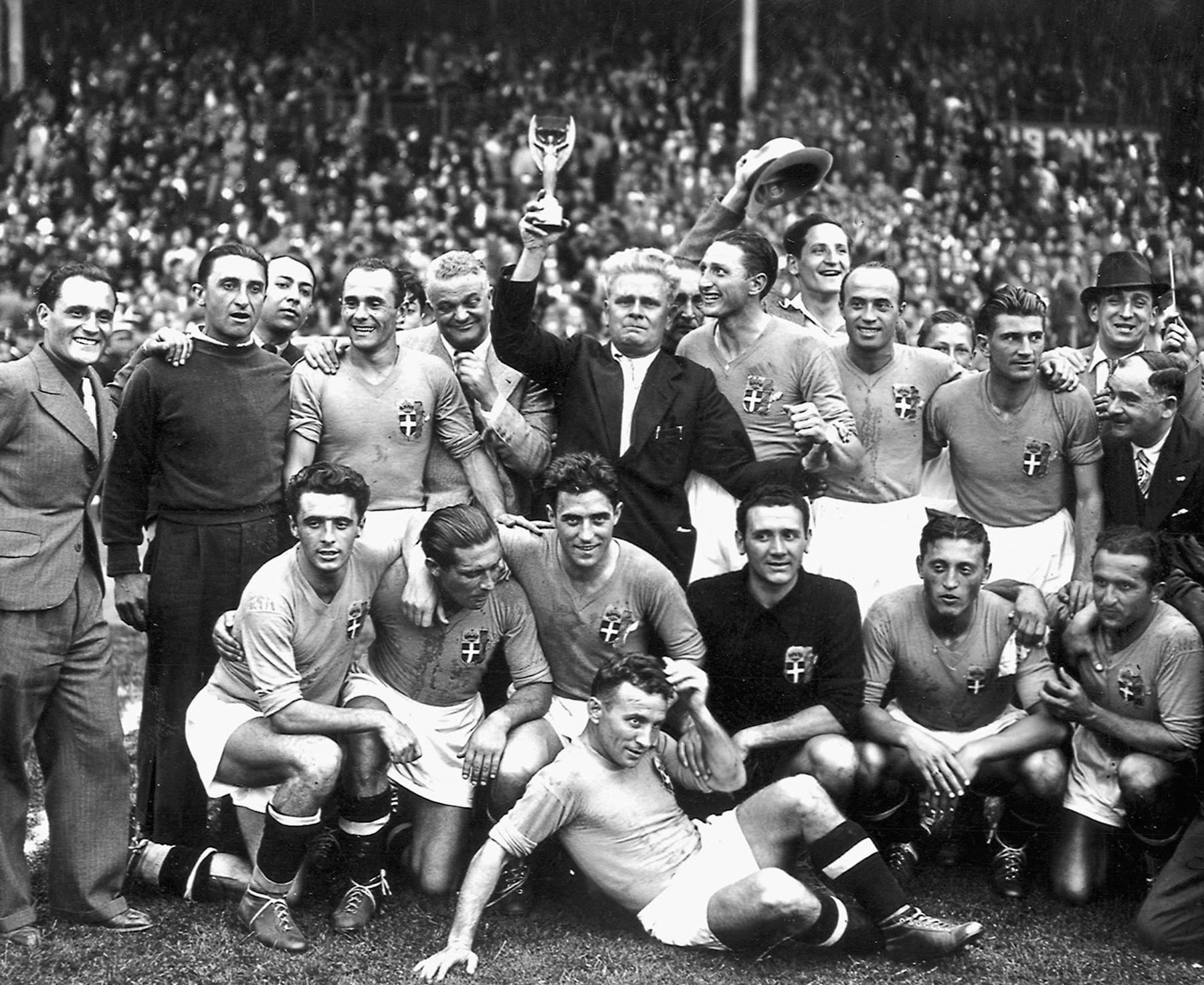
The 1938 Italy World Cup team. Manager Vittorio Pozzo
holds up what would become known as the Jules Rimet Trophy.

June 19, 1938: The Final of the 3rd FIFA World Cup is played, at the Stade Olympique de Colombes, in the Paris suburb of Colombes, France. It had previously been the main stadium for the 1924 Olympics.
There were 16 teams that qualified, including Austria, which might have then had the best team in Europe. However, due to the Anschluss with Nazi Germany, earlier in the year, Austria withdrew. This left:

* From Europe, hosts France, defending Champions Italy, Germany, Belgium, Czechoslovakia, Hungary, the Netherlands, Romania, Sweden, Switzerland, and World Cup debutantes Norway and Poland.

* From South America, Brazil. 1930 winners Uruguay boycotted, as they had in 1934, and Argentina also refused to participate.

* From the Caribbean, debutantes Cuba; and from Asia, debutantes the Dutch East Indies, one day to the be known as Indonesia.

Despite having reached the Semifinals in the 1st World Cup, in 1930, and qualifying again in 1934, the United States not only did not qualify for the 1938 edition, they chose not to send a team to the qualifying competition.

So a Round of 16 was held, starting on June 4, with Sweden advancing automatically, since they were set to play Austria in Lyon. France beat Belgium in Colombes. Italy beat Norway in Marseille. Czechoslovakia beat the Netherlands in Le Havre. Hungary beat the Dutch East Indies in Reims. 

Playing in Strasbourg, Poland and Brazil were tied 4-4 at full-time, and it went to extra time, with Brazil winning, 6-5. It was the highest-scoring game in World Cup play until 1954, when Austria beat Switzerland, 7-5, which remains the highest-scoring.

Two replays were needed, due to matches ending in draws: Germany vs. Switzerland in Paris, and Cuba vs. Romania in Toulouse. Each replay was at the site of its original match. In spite of the addition of the Austrian players, Germany blew an early 2-0 lead. Switzerland scored 3 goals in a 14-minute stretch in the 2nd half, and won, 4-2. And Cuba beat Romania, 2-1.

The Quarterfinals featured the roughest match in World Cup history to that point, which became known as the Battle of Bordeaux. A Brazilian player was sent off for a hard foul in the 14th minute. The Czechs suffered 3 injuries: A broken right arm for Captain and goalkeeper František Plánička, a broken right leg for Oldřich Nejedlý, and a punch in the stomach for Josef Košťálek. Substitutes were not allowed, but while Nejedlý left the field, the others played on: Each team had 10 men, but the Czechs had only 8 of them fully fit.

Brazil took the lead in the 30th minute, on a goal by Leônidas da Silva, but their dirty play led to a handball in the box, and a penalty converted by the Czechs. Leônidas and José Perácio would be injured. Just before full time, there was a fight, and a player from each team was sent off. It was the 1st World Cup match with 3 sendoffs, which would be matched in 1954, but not surpassed until 2006. So the game ended 1-1, with Brazil having 8 men on the pitch, Czechoslovakia 9, but 7 of them healthy. Brazil won the replay.

In the other Quarterfinals, Italy eliminated hosts France, 3-1 at Colombes; Sweden obliterated Cuba, 8-0 at Antibes; Hungary beat Switzerland, 2-0 at Lille. In the Semifinals, Italy beat Brazil, 2-1 in Marseille, while Hungary beat Sweden, 5-1 at the Parc des Princes in Paris.

For the Italy, Italy manager Vittorio Pozzo fielded nearly a completely different team from the one he sent out that won the 1934 Final on home soil: Only inside right Giuseppe Meazza and inside left Giovanni Ferrari, both then with Internazionale Milano, were holdovers.

The game got off to a fast start: Gino Colaussi, of Trieste team Triestina, scored for Italy in the 6th minute, but Pál Titkos of MTK Budapest equalized for Hungary in the 8th. (Titkos would later coach Egypt to win the 1959 Africa Cup of Nations.) Silvio Piola, star of Rome team Lazio, scored in the 16th. Colaussi scored again in the 35th.

György Sárosi of Ferencvárosi was Hungary's Captain, and considered their best all-around player until Ferenc Puskás came along a few years later. He able to play almost any position, but was mainly used as a "second striker." He scored in the 70th, the close the gap to 3-2. Ironically, he would manage in Italy after World War II, winning Serie A with Turin team Juventus in 1952. 

Piola scored again in the 82nd minute, to clinch the win for Italy, 4-2. They became the 1st 2-time winners, and the 1st back-to-back winners, a feat accomplished since only by Brazil in 1958-62. Their Fascist dictator, Benito Mussolini, was pleased.

World War II would force the cancellation of the 1942 World Cup, and the war ended too late to begin the qualification process for the 1946 World Cup, which was also canceled. The next World Cup wouldn't be held until 1950, meaning that Italy's 16-year old of the World Cup -- a period that included their invasions of Libya, Ethiopia and Somalia, their losses of those countries, their liberation by the Allies, the fall and execution of Mussolini, and their postwar rebuilding as a democracy -- remains a record.

Pietro Rava of Juventus was the last survivor of this Italy team, living until 2006.

Built in 1907, the Stade Olympique de Colombes still stands, under the name Stade Olympique Yves-du-Manoir, named for a French rugby star who was killed in a plane crash in 1928. Since it opened, it has been the home of Racing Club de France Football. Once one of the powers of French soccer, it went into decline due to a financial crisis in the 1960s, and is now in France's 4th division. Rugby team Racing 92 also play there. Both will play elsewhere in the 2023-24 season, as the stadium is renovated to be a venue for the 2024 Olympics.

UPDATE: An article for ESPN.com, published after the 2026 World Cup, ranking all 23 tournaments, rated this one 20th. 

*

June 19, 1938 was a Sunday. These baseball games were played:

* The New York Yankees played a doubleheader with the St. Louis Browns at Sportsman's Park in St. Louis. The Browns won the opener, 10-9. Starting pitcher Steve Sundra didn't get out of the 2nd inning, and Bobo Newsom went the distance for the Browns, despite allowing 9 runs on 9 hits and 8 walks, though he struck out 7. The Yankees almost came from behind in the 9th inning, but 4 runs was 1 run short.

The Yankees were leading the nightcap, 7-6 in the bottom of the 8th, when Red Kress doubled home the tying run, making it 7-7, and, those days when most ballparks did not yet have lights, the game was called due to darkness. Over the 2 games, Mel Almada and future Yankee George McQuinn each got 5 hits. Lou Gehrig went 3-for-9 with a walk and 3 RBIs, and Joe DiMaggio went 2-for-8 with 2 walks and an RBI.

* The New York Giants were swept by the St. Louis Cardinals, 8-7 and 4-2 at the Polo Grounds. Joe Stripp, a former Dodger from nearby Harrison, New Jersey, and thus known as Jersey Joe, singled Pepper Martin home in the top of the 12th inning to win the 1st game. Harry "The Horse" Danning hit 2 home runs. Over the 2 games, Mel Ott went 4-for-8 with 2 walks and 4 RBIs.

* A doubleheader was split at Ebbets Field. The Brooklyn Dodgers won the 1st game, 6-2. The Chicago Cubs won the 2nd game, 4-3.

* The Cincinnati Reds beat the Boston Bees, 14-1 at National League Park in Boston. This was after the awful 1935 season led to the Boston Braves undergoing a "rebranding" that also renamed Braves Field. The new names never caught on, and the old names were restored in 1941. Frank McCormack went 4-for-5, and Harry Craft and former Braves star Wally Berger hit home runs for the Reds.

* The Pittsburgh Pirates swept the Philadelphia Phillies, 14-4 and 16-3 at Baker Bowl in Philadelphia. That's right: The Pirates scored 27 runs in 1 day, although it should be noted that Baker Bowl had a 280-foot right field fence. At the end of the month, the Phillies, unable to pay for its maintenance, abandoned it, and began groundsharing with the Athletics at Shibe Park.

Each Pirate starting pitcher helped his own cause with 2 hits: Jim Tobin and, also with an RBI, Cy Blanton. The Bucs used different catchers in each game, too: Al Todd went 3-for-5 with 2 RBIs, and Ray Berres went 2-for-4 with a walk. Left fielder Johnny Rizzo hit a home run in the 1st game, and 2 in the 2nd game, going 6-for-10 with a walk and 7 RBIs over the 2 games.

As for their 3 future Hall-of-Famers: Paul "Big Poison" Waner went 7-for-12, including a homer in each game, for 8 RBIs; his brother Lloyd "Little Poison" Waner went 3-for-10 with an RBI; and Joseph "Arky" Vaughan went 3-for-7 with 4 walks and an RBI.

* The Cleveland Indians beat the Philadelphia Athletics, 5-4 at Cleveland Municipal Stadium. All the scoring was in the 3rd inning.

* The Washington Senators beat the Detroit Tigers, 10-6 at Briggs Stadium (later Tiger Stadium) in Detroit. Hank Greenberg went 1-for-2 with 2 walks.

* And a doubleheader was split at Comiskey Park in Chicago. The Chicago White Sox won the 1st game, 3-2. The Boston Red Sox won the 2nd game, 6-1. Jimmie Foxx went 5-for-8 with a walk and 2 RBIs.

Wednesday, June 15, 2022

June 15, 1938: Johnny Vander Meer's 2nd Straight No-Hitter

June 15, 1938: For the 1st time, a major league baseball game is played at night in New York City, at Ebbets Field in Brooklyn. It doesn't go so well for the home team. But it goes very well for a local boy, who does something no other player had ever done, and none has since.

John Samuel Vander Meer was born on November 2, 1914 in Prospect Park, Passaic, County, New Jersey, and grew up in nearby Midland Park, Bergen County. Among several interesting things about him is that he was a switch-hitter who threw lefthanded. Most switch-hitters are righthanders who try batting lefty to gain a hitting edge.

The Brooklyn Dodgers signed him out of Midland Park High School, and he would make history at Ebbets Field -- but not with the Dodgers. After the 1934 season, he was sold to the Boston Braves, and was not considered good enough to make the roster of the 1935 Braves -- who lost 115 games, giving them the most losses in the National League between 1899 and 1962, and the lowest winning percentage in the NL since 1899. (Yes, worse than the 1962 Mets: At 38-115,  their .248 was worse than the Mets' 40-120 for .250.) Then again, he was only 20. But he would make history involving the Braves -- just not with them.

After the 1935 season, the Cincinnati Reds purchased him from the Braves' system. After a 19-6 season with the Durham Bulls in 1936, the Reds called Johnny up. He made his major league debut on April 22, 1937, and from then until the morning of June 11, 1938, he was just an average young pitcher (just 23). He spent most of that season with the Syracuse Chiefs before being called back up in September.

On June 11, 1938, he took the mount at Crosley Field in Cincinnati against the Braves -- who, trying to remove the infamy of the 1935 disaster, immediately changed their name to the Boston Bees. (The experiment also removed the memory of the 1914 World Champion "Miracle Braves," and the Braves name was restored in 1940. However, the Bees name survives in the fake newspaper headlines made for the movie The Natural, set in 1939.)

That season, Vander Meer wore the Number 57 -- the Reds being one of the few teams in those days to give out such high numbers. On this day, despite it being a warm Saturday afternoon, only 5,214 fans came out. Pitching for the Dodgers was Danny MacFayden -- "bespectacled Deacon Danny MacFayden," as the sportswriters of the era frequently called him. He pitched decently, and deserved better than to have been betrayed by his defense: The Reds scored in the 4th inning when 2nd baseman Tony Cuccinello made an error. In the 6th, Ernie Lombardi, the Reds' Hall of Fame catcher, hit a 2-run homer to make it 3-0.

Vander Meer didn't even need that much: He walked Cuccinello, right fielder Gene Moore and 3rd baseman Gil English, and that was it. He pitched a no-hitter, striking out 4. As the saying goes, he had "achieved baseball immortality."

Or had he? After all, a no-hitter isn't all that rare. There's usually 2 or 3 pitched every season. From their 1882 founding through 1937, the Reds had 5 no-hitters, an average of 1 every 11 years. From June 1938 to June 2022, 10, an average of 1 every 8 years.

No, pitching a no-hitter doesn't guarantee you "baseball immortality." But 4 days later -- on 3 days' rest, mind you -- Vander Meer took the hill at Ebbets Field, against the team that had originally signed him, the Dodgers. It was a very special day: The 1st night game at any of the 3 New York big-league ballparks. A crowd of 38,748 jammed into the Flatbush ballyard, although with a seating capacity of 31,497, a lot of them must have been standing. No stadium or arena fire laws in those days.

Ironic that, on this occasion, Vander Meer "pitched lights-out." It helped tremendously that the Reds unloaded for 6 runs in the 3rd inning on Dodger starter Max Butcher, including a home run by Frank McCormick. Vander Meer took that 6-0 lead into the 9th. It wasn't pretty: Although he struck out 7, he walked 8.

But he got it done, becoming the 1st pitcher ever to pitch back-to-back no-hitters. For the rest of his life, he was known as "Double No-Hit Johnny Vander Meer," and, occasionally, "the Dutch Master."

The achievement convinced New York Giants manager Bill Terry, as manager of the defending Pennant winners, to start him in the All-Star Game -- although the fact that Cincinnati was hosting it may also have played a part. He pitched 3 scoreless innings, and the NL won, 4-1. Vander Meer finished the season 15-10.

Many years later, Vander Meer was interviewed by a reporter for the Chicago Daily News for the anthology book My Greatest Day In Baseball. He said, "It would seem natural for me to name the second successive no-hitter I pitched in 1938 as my biggest day in baseball, and I'll have to explain why it isn't. I was still just a novelty, a kid who had done a freakish thing."

He had trouble the next year (he'd been switched to Number 33, which he wore for the rest of his Reds' tenure) -- "I was sick that spring and never did seem to regain my stride. My confidence went, too" -- and, while the Reds won the Pennant, he was not called on to pitch in the 1939 World Series, which the Reds lost to the Yankees. He got sent back to the minors in 1940. "I knew that was what I needed. At the same time it made me realize just how quickly a fellow can fall from the pedestal."

He pitched solidly for the Indianapolis Indians, then the Reds' Triple-A team (and whose ballpark stood in for the long-demolished Crosley Field when the movie Eight Men Out was filmed in 1987), and was called back up. On September 18, 1940, he started what could have been the Pennant-clinching game for the Reds, against the Philadelphia Phillies at Shibe Park. The game went 13 innings, and he pitched 12 innings. He batted in the top of the 13th and doubled, was sacrificed to 3rd, and Ival Goodman hit a sacrifice fly to get him home. He was relieved by Joe Beggs for the bottom of the 13th, and the Reds won, 4-3. The Reds won the Pennant, and Vander Meer had his greatest day in baseball.

This time, he pitched in the World Series, tossing 3 scoreless innings against the Detroit Tigers in Game 5. The Reds won in 7 games, and he had his ring.

On June 6, 1941, he nearly pitched a 3rd no-hitter, as Eddie Joost dropped a grounder and didn't throw to 1st in time, and the batter got credit for a hit. Vander Meer believed he was robbed. He went 16-12 that year. He peaked at 18 wins the next year, and led the NL in strikeouts in 1941, '42 and '43. He was a 4-time All-Star, so he wasn't just a guy who caught lightning in a bottle for 5 days.

He served in the U.S. Navy in World War II. Although he missed the entire seasons of 1944 and '45, at ages 29 and 30, prime years, he said that pitching on a Navy team helped his control, and the statistics do back that up somewhat. He won 17 in 1948, but that was it, and after a stint with the Chicago Cubs, he last pitched in the majors in 1951 with the Cleveland Indians. In 1952, pitching for the Tulsa Oilers of the Texas League, he pitched another no-hitter, at age 37.

Much like a later no-hit hero, Don Larsen, Vander Meer was actually slightly under .500 for his career: In his case, 119-120. Had he allowed so much as 1 hit in each of those 1938 games, he might be remembered today for that feat, but not nearly as well.

Instead, for 84 years, every time a pitcher has thrown a no-hitter, the name of Johnny Vander Meer has come up, with people wondering if the new no-hit hero can match his feat. None ever has -- at least, not in the major leagues. I have heard that 1 pitcher did it in the minors since 1938, but I can find no reference to this achievement.

The closest any major league pitcher has come was another Reds pitcher: In 1947, Ewell Blackwell pitched 1, and was within 2 outs of another, by an amazing twist of fate also against the Dodgers. If you know anything about the 1947 Dodgers, but aren't familiar with Blackwell, you're probably expecting me to say that Jackie Robinson broke it up. Nope: It was Eddie Stanky, who hit a line drive through Blackwell's legs. Blackwell later said that he could handle it because he was so tall and his arms were so long -- giving him a pitching motion that gave him the nickname The Whip -- but that he simply couldn't get his hands down in time. He ended up allowing a 2nd hit before winning the game. This was in the middle of a streak of 16 straight wins for him.

Vander Meer became a minor league manager in the Reds' organization for 10 seasons, before retiring in 1962. He then worked for a brewing company. He was inducted into the Reds Hall of Fame in 1958. He retired to Tampa, where the Reds long had their Spring Training complex, threw out ceremonial first balls at 6 World Series for the Reds (1961, 1970, 1972, 1975, 1976 and 1990), sat for an interview for the Reds' 100th Anniversary team video in 1992, and lived until October 6, 1997, suffering an abdominal aneurysm. He was 82.

I can't say he was the greatest pitcher New Jersey has ever produced, and he certainly wasn't a Hall-of-Famer. But Johnny Vander Meer is a baseball legend, who was not only a very good pitcher in his time, but achieved a unique feat in baseball history.

*

June 15, 1938 was a Wednesday. These other games were played that day:

* The New York Yankees beat the Chicago White Sox, 6-4 at Comiskey Park in Chicago. Lou Gehrig hit a home run, and Joe DiMaggio went 2-for-5, in support of Joe Beggs.

* The New York Giants lost to the Pittsburgh Pirates, 2-0 at the Polo Grounds. Mel Ott went 1-for-3, 1 of 5 hits that Jim Tobin allowed in a shutout.

* The Boston Bees beat the Chicago Cubs, 2-0 at National League Park in Boston. (The name of the ballpark had also been changed, but when the name of the team changed back in 1941, so did the name of the ballpark: Braves Field. Nicknaming it "The Bee Hive" also didn't take.) Danny MacFayden bounced back from his loss to Vander Meer 4 days earlier, with a 5-hit shutout.

* The St. Louis Cardinals beat the Philadelphia Phillies, 9-8 at Baker Bowl in Philadelphia. Enos Slaughter hit a home run, Pepper Martin had 3 RBIs, and Joe Medwick and Johnny Mize each had 3 hits.

* The Cleveland Indians beat the Washington Senators, 6-4 at League Park in Cleveland.

* The Philadelphia Athletics beat the Detroit Tigers, 7-6 at Briggs Stadium in Detroit. (It was renamed Tiger Stadium in 1961.) Hank Greenberg went 2-for-4.

* And the Boston Red Sox beat the St. Louis Browns, 7-4 at Sportsman's Park in St. Louis. Joe Cronin and Jimmie Foxx hit homers.

At this time, the 1938 World Cup was in progress in France, but no games were played on this day. The Semifinals were played the next day: Hungary beat Sweden, 5-1 in Paris; and defending Champions Italy beat Brazil 2-1, in Marseille. In the Final, on June 19, at the 1924 Olympic Stadium, outside Paris in Colombes, Italy beat Hungary, 4-2.

Sunday, February 13, 2022

February 14, 1896: Theodor Herzl Publishes "Der Judenstaat"

February 14, 1896: Theodor Herzl publishes his pamphlet Der Judenstaat, meaning The Jewish State, in Leipzig, Germany.

Born on May 2, 1860 in Pest, in the Austrian Empire -- now the east bank of the Danube River in Budapest, Hungary -- Herzl had a brief legal career in the Austrian capital of Vienna. He became the Paris correspondent for the Viennese newspaper Neue Freie Press (The New Free Press). Confronted with anti-Semitic events in Vienna, he reached the conclusion that anti-Jewish sentiment would make Jewish assimilation impossible, and that the only solution for Jews was the establishment of a Jewish state.

The term "Zionism" had been coined by Austrian journalist Nathan Birnbaum in 1890, to mean the struggle for a secure homeland for the Jewish people. Ironically, later in life, Birnbaum became an Orthodox Jew, and a fervent anti-Zionist. It would be Herzl who popularized the term.

In Der Judenstaat, Herzl elaborated his visions of a Jewish homeland. He envisioned the founding of a future independent Jewish state at some point during the coming 20th Century, thinking it the best way to avoid anti-Semitism in Europe. He encouraged Jews to purchase land in the land then known as Palestine, the historic homeland of the Jews, then controlled by the Ottoman Empire. His ideas attracted international attention, and rapidly established him as a major figure in the Jewish world.

The book was published while the Dreyfus Affair was ongoing in France. So Herzl was being direct when he wrote:

The Jewish question persists wherever Jews live in appreciable numbers. Wherever it does not exist, it is brought in together with Jewish immigrants. We are naturally drawn into those places where we are not persecuted, and our appearance there gives rise to persecution. This is the case, and will inevitably be so, everywhere, even in highly civilised countries -- see, for instance, France -- so long as the Jewish question is not solved on the political level.

He concluded the book as follows:

Therefore I believe that a wondrous generation of Jews will spring into existence. The Maccabeans will rise again.

Let me repeat once more my opening words: The Jews who wish for a State will have it.

We shall live at last as free men on our own soil, and die peacefully in our own homes.

The world will be freed by our liberty, enriched by our wealth, magnified by our greatness.

And whatever we attempt there to accomplish for our own welfare, will react powerfully and beneficially for the good of humanity.

Herzl planned to deliver his pamphlet as a speech to the Rothschild family, well-known throughout the world as bankers and among world's the best-known Jews, then based in Boulogne, France. But, though himself a Zionist, Baron Edmond de Rothschild rejected Herzl's plan, feeling that it threatened Jews in the Diaspora. He also thought it would put his own settlements in Palestine at risk.

In 1897, Herzl convened the First Zionist Congress at the Stadtcasino in Basel, Switzerland, and was elected president of the Zionist Organization. He began a series of diplomatic initiatives to build support for a Jewish state, appealing unsuccessfully to German Kaiser Wilhelm II and Ottoman Sultan Abdul Hamid II.

He sought out seemingly friendly ears in the South American nation of Argentina and the African nation of Uganda -- which will sound ironic to people familiar with the former's welcome of Nazi war criminals after World War II and the latter's dictatorship of Idi Amin and his alliance with the Palestine Liberation Organization. Neither country was willing to listen.

On January 26, 1904, Herzl visited Rome, and met with Pope Pius X. The Pope received Herzl with respect, but declined to help. Herzl was soon diagnosed with a heart ailment, and died on July 3, only 44 years old. In Reichenau an der Rax, Austria. He was buried in Vienna.

Further Zionist attempts to negotiate with the Ottoman authorities failed, but with the collapse of the Ottoman Empire at the end of World War I, and the subsequent creation of Mandatory Palestine under the control of Britain, the Zionists gained success: Britain issued the Balfour Declaration that supported the creation of a Jewish homeland in Palestine.

In 1948, the British Mandate of Palestine ran out, and the State of Israel was declared. Ever since, "Zionism" has meant the protection of what that country already had, and the repatriation of formerly Jewish lands nearby, which was satisfied with the Six-Day War of 1967. In 1949, Herzl's remains were taken to Israel, and reinterred on a location renamed Mount Herzl.

*

February 14, 1896 was a Friday. Baseball and football were out of season, and basketball barely existed. But there was 1 notable hockey game played: The Winnipeg Victorias beat the Montreal Victorias, 2-0 at the Victoria Skating Rink in Montreal, and won the Stanley Cup.

December 31, 1999 & January 1, 2000: The Millennium

December 31, 1999:  The Millennium arrives. The people of planet Earth survived. At a terrible cost. But we hadn't destroyed ourselves. ...