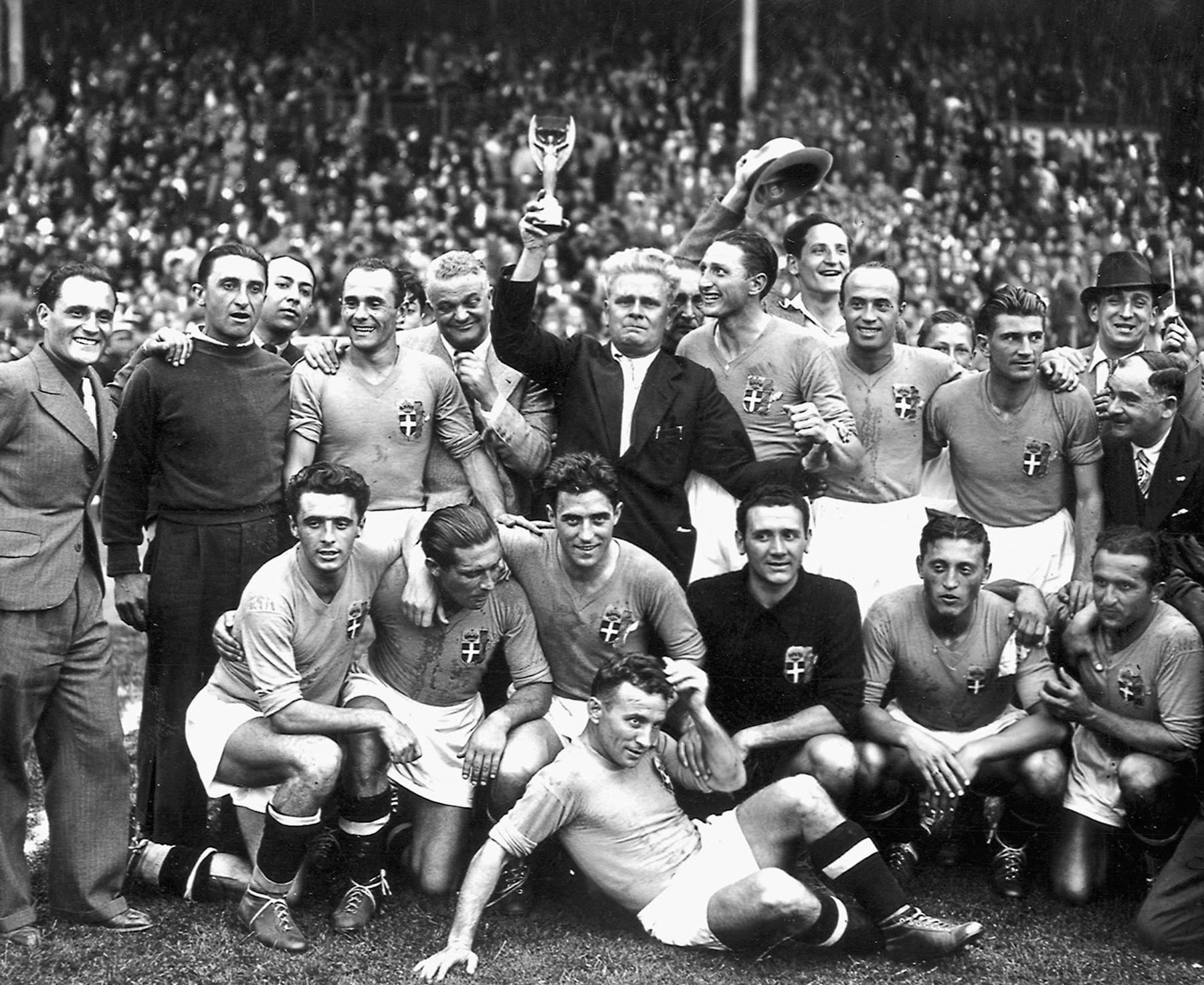
The 1938 Italy World Cup team. Manager Vittorio Pozzo
holds up what would become known as the Jules Rimet Trophy.
June 19, 1938: The Final of the 3rd FIFA World Cup is played, at the Stade Olympique de Colombes, in the Paris suburb of Colombes, France. It had previously been the main stadium for the 1924 Olympics.

There were 16 teams that qualified, including Austria, which might have then had the best team in Europe. However, due to the Anschluss with Nazi Germany, earlier in the year, Austria withdrew. This left:
* From Europe, hosts France, defending Champions Italy, Germany, Belgium, Czechoslovakia, Hungary, the Netherlands, Romania, Sweden, Switzerland, and World Cup debutantes Norway and Poland.
* From South America, Brazil. 1930 winners Uruguay boycotted, as they had in 1934, and Argentina also refused to participate.
* From the Caribbean, debutantes Cuba; and from Asia, debutantes the Dutch East Indies, one day to the be known as Indonesia.
Despite having reached the Semifinals in the 1st World Cup, in 1930, and qualifying again in 1934, the United States not only did not qualify for the 1938 edition, they chose not to send a team to the qualifying competition.
So a Round of 16 was held, starting on June 4, with Sweden advancing automatically, since they were set to play Austria in Lyon. France beat Belgium in Colombes. Italy beat Norway in Marseille. Czechoslovakia beat the Netherlands in Le Havre. Hungary beat the Dutch East Indies in Reims.
Playing in Strasbourg, Poland and Brazil were tied 4-4 at full-time, and it went to extra time, with Brazil winning, 6-5. It was the highest-scoring game in World Cup play until 1954, when Austria beat Switzerland, 7-5, which remains the highest-scoring.
Two replays were needed, due to matches ending in draws: Germany vs. Switzerland in Paris, and Cuba vs. Romania in Toulouse. Each replay was at the site of its original match. In spite of the addition of the Austrian players, Germany blew an early 2-0 lead. Switzerland scored 3 goals in a 14-minute stretch in the 2nd half, and won, 4-2. And Cuba beat Romania, 2-1.
The Quarterfinals featured the roughest match in World Cup history to that point, which became known as the Battle of Bordeaux. A Brazilian player was sent off for a hard foul in the 14th minute. The Czechs suffered 3 injuries: A broken right arm for Captain and goalkeeper František Plánička, a broken right leg for Oldřich Nejedlý, and a punch in the stomach for Josef Košťálek. Substitutes were not allowed, but while Nejedlý left the field, the others played on: Each team had 10 men, but the Czechs had only 8 of them fully fit.
Brazil took the lead in the 30th minute, on a goal by Leônidas da Silva, but their dirty play led to a handball in the box, and a penalty converted by the Czechs. Leônidas and José Perácio would be injured. Just before full time, there was a fight, and a player from each team was sent off. It was the 1st World Cup match with 3 sendoffs, which would be matched in 1954, but not surpassed until 2006. So the game ended 1-1, with Brazil having 8 men on the pitch, Czechoslovakia 9, but 7 of them healthy. Brazil won the replay.
In the other Quarterfinals, Italy eliminated hosts France, 3-1 at Colombes; Sweden obliterated Cuba, 8-0 at Antibes; Hungary beat Switzerland, 2-0 at Lille. In the Semifinals, Italy beat Brazil, 2-1 in Marseille, while Hungary beat Sweden, 5-1 at the Parc des Princes in Paris.
For the Italy, Italy manager Vittorio Pozzo fielded nearly a completely different team from the one he sent out that won the 1934 Final on home soil: Only inside right Giuseppe Meazza and inside left Giovanni Ferrari, both then with Internazionale Milano, were holdovers.
The game got off to a fast start: Gino Colaussi, of Trieste team Triestina, scored for Italy in the 6th minute, but Pál Titkos of MTK Budapest equalized for Hungary in the 8th. (Titkos would later coach Egypt to win the 1959 Africa Cup of Nations.) Silvio Piola, star of Rome team Lazio, scored in the 16th. Colaussi scored again in the 35th.
György Sárosi of Ferencvárosi was Hungary's Captain, and considered their best all-around player until Ferenc Puskás came along a few years later. He able to play almost any position, but was mainly used as a "second striker." He scored in the 70th, the close the gap to 3-2. Ironically, he would manage in Italy after World War II, winning Serie A with Turin team Juventus in 1952.
Piola scored again in the 82nd minute, to clinch the win for Italy, 4-2. They became the 1st 2-time winners, and the 1st back-to-back winners, a feat accomplished since only by Brazil in 1958-62. Their Fascist dictator, Benito Mussolini, was pleased.
World War II would force the cancellation of the 1942 World Cup, and the war ended too late to begin the qualification process for the 1946 World Cup, which was also canceled. The next World Cup wouldn't be held until 1950, meaning that Italy's 16-year old of the World Cup -- a period that included their invasions of Libya, Ethiopia and Somalia, their losses of those countries, their liberation by the Allies, the fall and execution of Mussolini, and their postwar rebuilding as a democracy -- remains a record.
Pietro Rava of Juventus was the last survivor of this Italy team, living until 2006.
Built in 1907, the Stade Olympique de Colombes still stands, under the name Stade Olympique Yves-du-Manoir, named for a French rugby star who was killed in a plane crash in 1928. Since it opened, it has been the home of Racing Club de France Football. Once one of the powers of French soccer, it went into decline due to a financial crisis in the 1960s, and is now in France's 4th division. Rugby team Racing 92 also play there. Both will play elsewhere in the 2023-24 season, as the stadium is renovated to be a venue for the 2024 Olympics.
UPDATE: An article for ESPN.com, published after the 2026 World Cup, ranking all 23 tournaments, rated this one 20th.
*
June 19, 1938 was a Sunday. These baseball games were played:
* The New York Yankees played a doubleheader with the St. Louis Browns at Sportsman's Park in St. Louis. The Browns won the opener, 10-9. Starting pitcher Steve Sundra didn't get out of the 2nd inning, and Bobo Newsom went the distance for the Browns, despite allowing 9 runs on 9 hits and 8 walks, though he struck out 7. The Yankees almost came from behind in the 9th inning, but 4 runs was 1 run short.
The Yankees were leading the nightcap, 7-6 in the bottom of the 8th, when Red Kress doubled home the tying run, making it 7-7, and, those days when most ballparks did not yet have lights, the game was called due to darkness. Over the 2 games, Mel Almada and future Yankee George McQuinn each got 5 hits. Lou Gehrig went 3-for-9 with a walk and 3 RBIs, and Joe DiMaggio went 2-for-8 with 2 walks and an RBI.
* The New York Giants were swept by the St. Louis Cardinals, 8-7 and 4-2 at the Polo Grounds. Joe Stripp, a former Dodger from nearby Harrison, New Jersey, and thus known as Jersey Joe, singled Pepper Martin home in the top of the 12th inning to win the 1st game. Harry "The Horse" Danning hit 2 home runs. Over the 2 games, Mel Ott went 4-for-8 with 2 walks and 4 RBIs.
* A doubleheader was split at Ebbets Field. The Brooklyn Dodgers won the 1st game, 6-2. The Chicago Cubs won the 2nd game, 4-3.
* The Cincinnati Reds beat the Boston Bees, 14-1 at National League Park in Boston. This was after the awful 1935 season led to the Boston Braves undergoing a "rebranding" that also renamed Braves Field. The new names never caught on, and the old names were restored in 1941. Frank McCormack went 4-for-5, and Harry Craft and former Braves star Wally Berger hit home runs for the Reds.
* The Pittsburgh Pirates swept the Philadelphia Phillies, 14-4 and 16-3 at Baker Bowl in Philadelphia. That's right: The Pirates scored 27 runs in 1 day, although it should be noted that Baker Bowl had a 280-foot right field fence. At the end of the month, the Phillies, unable to pay for its maintenance, abandoned it, and began groundsharing with the Athletics at Shibe Park.
Each Pirate starting pitcher helped his own cause with 2 hits: Jim Tobin and, also with an RBI, Cy Blanton. The Bucs used different catchers in each game, too: Al Todd went 3-for-5 with 2 RBIs, and Ray Berres went 2-for-4 with a walk. Left fielder Johnny Rizzo hit a home run in the 1st game, and 2 in the 2nd game, going 6-for-10 with a walk and 7 RBIs over the 2 games.
As for their 3 future Hall-of-Famers: Paul "Big Poison" Waner went 7-for-12, including a homer in each game, for 8 RBIs; his brother Lloyd "Little Poison" Waner went 3-for-10 with an RBI; and Joseph "Arky" Vaughan went 3-for-7 with 4 walks and an RBI.
* The Cleveland Indians beat the Philadelphia Athletics, 5-4 at Cleveland Municipal Stadium. All the scoring was in the 3rd inning.
* The Washington Senators beat the Detroit Tigers, 10-6 at Briggs Stadium (later Tiger Stadium) in Detroit. Hank Greenberg went 1-for-2 with 2 walks.
* And a doubleheader was split at Comiskey Park in Chicago. The Chicago White Sox won the 1st game, 3-2. The Boston Red Sox won the 2nd game, 6-1. Jimmie Foxx went 5-for-8 with a walk and 2 RBIs.


No comments:
Post a Comment