Showing posts with label world war iii. Show all posts

Monday, November 7, 2022

November 7, 1983: Able Archer 83

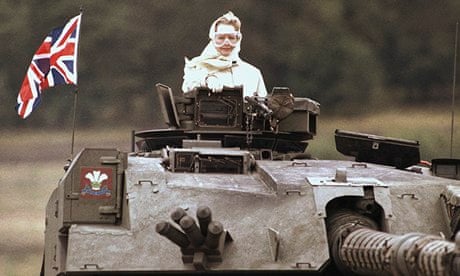
A Welsh tank unit (note the Union Jack and the daffodil logo)
taking part in Able Archer 83

November 7, 1983: Able Archer 83 begins. It is the codename for wargames by the North Atlantic Treaty Organization (NATO), which had been an annual event for a few years. The purpose was to simulate a period of conflict escalation between NATO and the Warsaw Pact, meaning the Soviet Union and their satellite nations in Eastern Europe. It was coordinated from NATO headquarters in Casteau, Belgium.

This came while President Ronald Reagan was placing Pershing II missiles in Western Europe; 8 months after he made a speech declaring the Soviet Union to be "an evil empire"; 67 days after the Soviets shot down Korean Air Lines Flight 007; 42 days after Soviet Lieutenant Colonel Stanislav Petrov figured out that the detection of 2 U.S. nuclear missiles heading for Russia were a false alarm, and refused to give the order to launch a retaliation, thus becoming known (years later, once the world found out) as "The Man Who Saved the World"; and would be followed, 13 days later, with ABC airing the TV-movie The Day After, which imagined a nuclear attack on the U.S.

Able Archer 83 included some steps forward that previous exercises had not. These, on top of everything else that had happened in 1983, led the Soviet government to consider that this was a setup for an actual war. So they placed their military units on the highest possible alert.

Able Archer 83 ended on November 11 -- appropriately enough, the anniversary of the Armistice that ended World War I -- and so the Warsaw Pact forces, seeing that nothing further had happened, were ordered to stand down. This may have been the closest the world came to nuclear war, except for the Cuban Missile Crisis of 1962 and Col. Petrov's moment.

The 1980s -- especially the Autumn of 1983 -- were not "a simpler time." Not even for those of us who were kids at the time.

*

November 7, 1983 was a Monday. Actor Adam DeVine, known for his roles in the Pitch Perfect films and his role as Andy Bailey on the TV show Modern Family, was born on this day. And this was also the day a bomb exploded in the U.S. Senate. Despite the lucky fact that there were no injuries, I have a separate entry for this event.

The baseball season was over. There were no NBA or NHL games scheduled. On ABC Monday Night Football, the Detroit Lions beat the New York Giants, 15-9 at the Silverdome in the Detroit suburb of Pontiac, Michigan.

Tuesday, November 1, 2022

November 1, 1952: The 1st Hydrogen Bomb

November 1, 1952: America successfully detonates the 1st hydrogen bomb, at Eniwetok Atoll in the Marshall Islands in the central Pacific Ocean.
thermonuclear weaponfusion weapon or hydrogen bomb -- H-bomb -- is a second-generation nuclear weapon design. Its greater sophistication affords it vastly greater destructive power than first-generation nuclear bombs (fission bombs), a more compact size, a lower mass, or a combination of these benefits.
Characteristics of nuclear fusion reactions make possible the use of non-fissile depleted uranium as the weapon's main fuel, thus allowing more efficient use of scarce fissile material such as uranium-235 or plutonium-239.

Edward Teller, a Hungarian-born Jewish physicist who won a power struggle with A-bomb pioneer J. Robert Oppenheimer within the American government, is considered "The Father of the Hydrogen Bomb." Late in life, he admitted in an interview, "I think the world has enough nuclear weapons."
He was more than right: The H-bomb was supposed to give the U.S. a leg up on the Soviet Union, but they detonated their 1st H-bomb on August 12, 1953, only 9 months later.

*

November 1, 1952 was a Saturday. Baseball season was over. These were among the college football games played:

* Number 1 Michigan State beat Number 8 Purdue, 14-7 at Ross-Ade Stadium in West Lafayette, Indiana. MSU finished 9-0, but, in this, their last season before joining the Big Ten (which was officially the Big Nine since 1940, when the University of Chicago dropped out), they were not invited to the Rose Bowl, or to any other bowl game. Nonetheless, after the season, they were voted the consensus National Champion.

* Number 2 Maryland beat Boston University, 34-7 at Fenway Park in Boston. Previously undefeated, Maryland lost its last 2 games, and didn't even get invited to a bowl game.

* Number 3 Oklahoma beat Iowa State, 41-0 at Clyde Williams Stadium in Ames, Iowa. Oklahoma won the Big Seven Conference title, but did not go to a bowl game.

* Number 4 Georgia Tech beat Number 5 Duke, 28-7 at Duke Stadium (later Wallace Wade Stadium) in Durham, North Carolina. Tech went on to win the Southeastern Conference title. However, they did not play the University of Mississippi during the regular season, and, despite 2 ties, and despite not even being ranked in the Top 20 until the week after this, "Ole Miss" were also undefeated. So the teams were paired up in the Sugar Bowl, and Tech won, earning National Championship honors from some minor polls.

Duke won the Southern Conference title, but were already on their way out of that league: The next season, they were charter members of the Atlantic Coast Conference (ACC).

* Number 6 USC, the University of Southern California, had the week off. Number 7 UCLA, the University of California at Los Angeles, beat Number 11 Cal, the main campus of the University of California, 28-7 at California Memorial Stadium in Berkeley. Three weeks later, USC beat UCLA for the Pacific Coast Conference title.

* Rivalry: Number 9 Kansas beat Kansas State, 26-6 at Memorial Stadium in Manhattan, Kansas. The Jayhawks lost 2 of their last 3 games, knocking themselves out of league title honors and bowl consideration. Most people there didn't care, as they were still basking in their National Championship in basketball, won in March.

* Number 12 Tennessee beat North Carolina, 41-14 at Shields-Watkins Field (later renamed Neyland Stadium) in Knoxville, Tennessee.

* Number 13 Notre Dame beat Navy, 17-6 at Cleveland Municipal Stadium. This was the end of an 0-2-1 stretch that saw Navy fall out of the Top 20. They were still invited to the Orange Bowl, but declined. Notre Dame declined all bowl invitations between the 1925 and 1969 seasons.

* Number 14 Texas beat Southern Methodist University (SMU), 31-14 at Memorial Stadium in Austin, Texas. Texas won the Southwest Conference title, then beat Tennessee in the Cotton Bowl.

* Number 15 Michigan were upset by Illinois, 22-13 at Michigan Stadium in Ann Arbor.

* Number 16 Virginia were upset by South Carolina, 21-14 at Scott Stadium in Charlottesville, Virginia.

* Number 17 University of Pennsylvania were upset by Pennsylvania State University, a.k.a. Penn State, 14-7 at Franklin Field in Philadelphia. The night before, another of Philadelphia's "Big 5" college basketball schools failed to win in football despite being nationally ranked: Number 10 Villanova were held to a tie by to the Parris Island Marines, 20-20 at Villanova Stadium in the Philadelphia suburb of Villanova, Pennsylvania. The Marines had their ranks swelled by volunteers to fight in the Korean War.

* Number 18 Wisconsin beat Rice University, 21-7 at Rice Stadium in Houston. It sounds like a bowl game, but it was in the regular season. Wisconsin did go on to win the Big Ten Conference title, but USC beat them in the Rose Bowl.

* Number 19 Alabama beat Georgia, 34-19 at Legion Field in Birmingham, Alabama. Losses to Tennessee and Georgia Tech cost 'Bama the SEC title, but they were still invited to the Orange Bowl, where they played Syracuse, who were idle on November 1. Alabama won, 61-6, and those 61 points stood as a record for the most points in a bowl game until 2008.

* Rivalry: Minnesota beat Iowa, 17-7 at Memorial Stadium in Minneapoli.s.

* Rivalry: Montana beat Montana State, 35-12 at Dornblaser Field in Missoula. (Montana State is in Bozeman.)

* Army beat Virginia Military Institute (VMI), 42-14 at Michie Stadium in West Point, New York.

* Among New York City teams, NYU beat Lafayette, 14-7 at Fisher Field in Easton, Pennsylvania. Fordham lost to the University of Detroit, 28-20 at Triborough Stadium (later Downing Stadium) on Randall's Island in the East River. And Columbia lost to Cornell, 21-14 at Baker Field in Upper Manhattan.

* And in New Jersey, Rutgers beat Temple, 40-28 at Rutgers Stadium in Piscataway; while Princeton beat Brown, 39-0 at Palmer Stadium in Princeton.

There were 5 games played in the NBA:

* The New York Knicks beat the Baltimore Bullets, 69-53 at the old Madison Square Garden.

* The Philadelphia Warriors beat the Syracuse Nationals, 86-84 in overtime at the Philadelphia Civic Center.

* The Rochester Royals beat the Fort Wayne Pistons, 94-82 at the Rochester War Memorial Arena (now the Blue Cross Arena) in Rochester, New York.

* The Milwaukee Hawks beat the Indianapolis Olympians, 73-71 at the Milwaukee Arena. In 1974, it was renamed the Milwaukee Exposition, Convention Center and Arena, or "The MECCA." Since 2014, it has been named the UW-Panther Arena.

* And the Minneapolis Lakers beat the Boston Celtics, 94-91 at the Minneapolis Auditorium. Ed Macauley scored 37 in defeat for Boston.

There were 2 games played in the NHL. The New York Rangers lost to the Montreal Canadiens, 4-1 at the Montreal Forum. And the Toronto Maple Leafs beat the Boston Bruins, 3-2 at Maple Leaf Gardens in Toronto. The Detroit Red Wings and the Chicago Black Hawks were not scheduled.

And in English soccer, North London team Arsenal went to the Birmingham area, and lost 2-0 to West Bromwich Albion at The Hawthorns. Arsenal went on to win the Football League title for the 1952-53 season, anyway.

Friday, October 28, 2022

October 28, 1962: The Cuban Missile Crisis Is Resolved

Herbert Block (Herblock) cartoon in The Washington Post,
November 1, 1962: JFK says, "Let's get a lock for this thing."

October 28, 1962: The Cuban Missile Crisis is resolved, as Soviet leader Nikita Khrushchev
announces that he has ordered the removal of Soviet missile bases in Cuba, as demanded by President John F. Kennedy.

In a secret deal between them, JFK agrees to the withdrawal of U.S. missiles from Turkey. The fact that the Turkey part of the deal is not made public makes it look like the Soviets have backed down, rather than that the deal was a true compromise.

On October 25, Adlai Stevenson, the former 2-time Democratic nominee for President who was now the U.S. Ambassador to the United Nations, attended an emergency session of the U.N.'s Security Council. The Soviet Ambassador, Valerian Zorin, said, "Falsity is what the United States has in its hands, false evidence."

Except it wasn't false. Unlike Colin Powell, addressing the threat of Iraq in the same room 40 years later, Stevenson actually had proof that America's would-be opponent had weapons of mass destruction, only 90 miles from the coast of Florida.

He forcefully asked Zorin if his country was installing missiles in Cuba. Like every delegate, he was wearing a headset, into which someone who spoke both his language and that of the speaker was translating. But Stevenson knew that Zorin spoke English, and demanded an answer, his voice rising:

All right, sir, let me ask you one simple question: Do you, Ambassador Zorin, deny that the U.S.S.R. has placed, and is placing, medium- and intermediate-range missiles and sites in Cuba? Yes or no? Don’t wait for the translation! Yes or no?

Zorin refused to answer. Stevenson said, "I am prepared to wait for my answer until Hell freezes over, if that's your decision. And I am also prepared to present the evidence in this room." Zorin remained silent. Stevenson passed the photos around -- taken by a U-2 "spy plane." It had been nearly 2 1/2 years since the Soviets had shot one down over their territory, casting a pall over the last year in office of President Dwight D. Eisenhower. But "Ike" and JFK had both kept the U-2s flying, and it's a good thing they did.

Everyone was on edge. My mother was a junior in high school, and on the Friday, October 26, one of her teachers gave homework, and said that if you didn't want to do it, that's okay, because we might not have school on Monday -- or ever again. 

There were at least 3 false alarms at U.S. military bases, including a bear that had wandered on and touched a fence, setting off an intruder alert.

Much of the world thought that this was it, that World War III was assured, that the NFL and AFL games of this day might be the last sporting events that they'd ever see, or even that they would be prevented. They weren't, because Kennedy and Khrushchev both understood that nobody "wins" a nuclear war, they settled the Crisis on terms acceptable to both countries, and the world moved on.

One event the world moved on to was the Nuclear Test Ban Treaty, signed on July 26, 1963 by JFK, Khrushchev, and British Prime Minister Harold Macmillan, banning nuclear testing in the atmosphere -- including above the Arctic Circle.

Another was the establishment of the Hot Line, a direct connection between the White House and the Kremlin, to make for quicker diplomacy, in the hope that something like the Cuban Missile Crisis would never happen again. The Hot Line has been used a few times since, and nothing like the Cuban Missile Crisis has.

*

October 28, 1962 was a Sunday. The baseball season ended on October 16, as the New York Yankees beat the San Francisco Giants 1-0 in Game 7 of the World Series, the 1st Series to be between a team on the Atlantic Coast and a team on the Pacific Coast. (The Dodgers had already been in a World Series since their move from Brooklyn to Los Angeles, in 1959, but their opponent was the Chicago White Sox, not a coastal team. The Dodgers won it.)

There was 1 NBA game played that day. The Cincinnati Royals beat the San Francisco Warriors, 131-130 at the Cincinnati Gardens. The Warriors were in their 1st season on the Coast, after playing in Philadelphia. They changed their name to the Golden State Warriors in 1971.

Wilt Chamberlain scored 53 points and grabbed 27 rebounds. Just another day at the office for the greatest basketball player who ever lived. But Oscar Robertson, himself a serious contender for that title, scored 36 to lead the team now named the Sacramento Kings to victory.

For the NHL, this was the "Original Six" era, and 4 of the 6 played. The New York Rangers lost to the Chicago Black Hawks, 5-3 at the old Madison Square Garden. And the Detroit Red Wings beat the Toronto Maple Leafs, 2-0 at the Olympia Stadium in Detroit. The Montreal Canadiens and the Boston Bruins did not play.

And there was football. In the NFL, at the original Yankee Stadium. Y.A. Tittle tied an NFL record with 7 touchdown passes, and the New York Giants beat the Washington Redskins 49-34.

Tittle is 1 of 8 NFL quarterbacks to have thrown 7 touchdown passes in a single game. Sid Luckman of the Chicago Bears did it against the Giants in 1943. Adrian Burk of the Philadelphia Eagles did it against the Redskins in 1954. Although it was in the AFL, the NFL counts George Blanda of the Houston Oilers doing it against the New York Titans (the Jets) in 1961. Joe Kapp of the Minnesota Vikings did it against the Baltimore Colts in 1969.

It was done twice in 2013, by Peyton Manning of the Denver Broncos against the Baltimore Ravens, and by Nick Foles of the Philadelphia Eagles against the Oakland Raiders. In 2015, the Giants were victimized again, by Drew Brees of the New Orleans Saints.

Also on October 28, 1962:

* The Green Bay Packers beat the Baltimore Colts, 17-6 at Memorial Stadium in Baltimore. Johnny Unitas was the greatest quarterback of the era, but Vince Lombardi was the best coach and the best general manager, and had built the best team. From September 24, 1961 to September 13, 1964, the Packers went 38-5-1, including winning the 1961 and 1962 NFL Championship Games.

* The Cleveland Browns beat their arch-rivals, the Pittsburgh Steelers, 41-14 at Forbes Field in Pittsburgh.

* The St. Louis Cardinals beat the Dallas Cowboys, 28-24 at the Cotton Bowl in Dallas.

* The Detroit Lions beat the Chicago Bears, 11-3 at Tiger Stadium in Detroit.

* The Philadelphia Eagles beat the Minnesota Vikings, 31-21 at Metropolitan Stadium in the Minneapolis suburb of Bloomington, Minnesota.

* And the Los Angeles Rams beat their arch-rivals, the San Francisco 49ers, 28-14 at Kezar Stadium in San Francisco.

In the upstart American Football League:

* The New York Titans beat the San Diego Chargers, 23-3 at the Polo Grounds in New York. The Titans changed their name to the New York Jets the next year.

* The Boston Patriots beat the Oakland Raiders, 26-16 at Boston University Field. The stadium would be renamed Nickerson Field in 1964, and the team would be renamed the New England Patriots upon their move to suburban Foxborough, Massachusetts in 1971.

* The Dallas Texans beat the Houston Oilers, 31-7 at Jeppesen Stadium in Houston. The teams would meet again in the AFL Championship Game, and the Texans won. The next year, though, tired of trying to compete for attention with the NFL's Cowboys, they moved, becoming the Kansas City Chiefs.

* The Buffalo Bills beat the Denver Broncos, 45-38 at Bears Field in Denver. Bears Field would be expanded and turned into the original Mile High Stadium.

And actress Daphne Zuniga was born.

Saturday, October 22, 2022

October 22, 1962: "The First Family" Is Recorded Amid the Cuban Missile Crisis

October 22, 1962: Eight days after finding out that the Soviet Union has set up missiles in Cuba, which could reach the United States, and debating what to do about it, President John F. Kennedy addresses the nation from the Oval Office at the White House.

Obviously, JFK couldn't simply do nothing, and let the missiles stay there. It would have been nuclear extortion on America and its allies. He also knew that standard diplomacy, trying to get the Soviets to remove the missiles that way, or to convince Castro to refuse them, wouldn't work.

Most of the President's military advisors had recommended a first strike on Cuba -- not nuclear, but with conventional weapons, meaning planes and bombs. This would be followed by a land invasion.

JFK knew that this would be considered an act of war, not just on Cuba, but on Cuba's ally, the Soviet Union, and might lead to that country launching its missiles on the West, including any missiles that the hypothetical bombing raid failed to take out. If ever there was a President who, as Donald Trump once suggested he did, "knew more than the Generals do," it was Kennedy.

Secretary of Defense Robert McNamara suggested a naval blockade, preventing any more Soviet supplies from arriving in Cuba by sea -- including aircraft carriers whose planes could enforce the blockade by air.

But this, too, was problematic: According to international law, a blockade is an act of war. Admiral George Anderson, Chief of Naval Operations, told JFK to, instead, call it a "quarantine." JFK's Attorney General, his brother, Robert F. Kennedy, told him that this would provide legal justification, under the Rio Treaty, effectively establishing the Organization of American States (OAS) as a NATO for the Western Hemisphere, and also backing up the Monroe Doctrine, prohibiting European interference in the Hemisphere. And so, JFK announced the "quarantine."

For the next week, the world was terrified that this is it: World War III is coming, and, as JFK had said before, "The living would envy the dead."

And while this speech was being broadcast, among the few people not seeing it were in Fine Recording Studio in Manhattan, watching the recording of the comedy album The First Family, a parody of the Kennedy family. Presidents had been portrayed before, and comedians had made jokes about incumbent Presidents. But comedian Vaughn Meader, a fellow New Englander (from Waterville, Maine) had already made a name for himself impersonating JFK, including the accent, the phrasing and the gestures.
Unlike some later Presidential parodies, this was mostly in good fun, riffing on various facets of Kennedy life: JFK's comparative youth and inexperience, his reliance on his brother Bobby's counsel and their father Joe's money, his bad back and the rocking chair he used instead of a stiffer chair, his affinity for cigars, Jackie's redecoration of the White House, the raising of daughter Caroline and baby John Jr., and the family's love of sports, including football and water-skiing.

Naomi Brossart played Jackie. She was a model, and this album was her recording debut. Canadian actress Norma McMillan, an experienced cartoon voice actress, and older than either Meader or Brossart, ironically provided the voices of both Caroline and "John-John."

Also among the cast were Earle Doud and Bob Booker, who co-produced the album; and Chuck McCann, a comedian known for his commercials ("Hi, guy!" for Right Guard antiperspirant, and he was the voice of Sonny the Cuckoo Bird who went "cuckoo for Cocoa Puffs" cereal). McCann also starred in a kids' science-fiction comedy, Far Out Space Nuts, with a post-Gilligan's Island John Denver. That show, too, was produced by Earle Doud, for the Krofft Superstars, as was another McCann vehicle, Magic Mongo. Also for Sid & Marty Krofft, Doud created and produced Wonderbug.

Meader later said, "A lot of people don't know this, but we recorded The First Family on the night of October 22, 1962, the same night as John F. Kennedy's Cuban Missile Crisis Speech. The audience was in the studio and had no idea of the drama that was taking place. But the cast had heard the speech and our throats almost dropped to our toes, because if the audience had heard the Cuban Missile Speech, we would not have received the reaction we did."

"Mr. President, we recently learned that you sent an agent into Cuba.
Did he return with any useful information?"
"Well, I didn't send him for information. I sent him for cigars!"

Cadence Records almost cancelled the distribution of the record, assuming America would be going to war. But the crisis was resolved on October 28, so the album was released a few days later. It rode JFK's post-crisis popularity to became the fastest-selling record in American history, until The Beatles came along a year later, and in 1963 it won the Grammy Award for Album of the Year. Since the music business is a copycat's business, Jewish comedians Buck Henry, Joan Rivers and George Segal recorded The Other Family, imagining the Khrushchevs at home.


On November 22, 1963, JFK was assassinated. The night before, Meader had done a show in character in Milwaukee. Right after the news of the assassination hit the media, he hailed a taxi to take him to the airport. The driver recognized him, and said, "Did you hear about Kennedy in Dallas?" Since Meader hadn't heard, he presumed this was the setup for a joke, and said, "No, how does it go?" The driver told him, and turned on the radio so Meader could hear.


That night, a far more controversial comedian, Lenny Bruce, was due to go onstage at a nightclub in New York's Greenwich Village. He wondered if it were possible to be funny that night. He wondered if anybody would even show up. He decided to go out, and there were 12 people in the audience. He sat on a stool for a moment, and then, his usual bad taste kicked in, and he said, "Boy, is Vaughn Meader fucked!" And the 12 people laughed like crazy. Bruce walked offstage, knowing it wouldn't get any better than that, and collected his pay from a satisfied club owner.


Sadly, Bruce was right: Nobody wanted to hear from Meader anymore. He couldn't do JFK material anymore, but anything else he tried reminded people of the sadness of those 4 days in November. He went back to Maine, and ran a bar.


Earle Doud, who produced the original album, tried again, with Welcome to the LBJ Ranch and Lyndon Johnson's Lonely Hearts Club Band. But instead of impressionists, they did it as a "cut-in" album, in the style of Dickie Goodman's "Flying Saucer" records: They would ask a question, and then use a recording of LBJ, a figure in his Administration, or another politician, the result intending to be funny. It didn't work.


David Frye was an amazing impressionist, who managed to not only sound like, but use his facial expressions to even look like, not just LBJ, but also Robert Kennedy, Richard Nixon, Nelson Rockefeller, and even William F. Buckley. Sometimes, he would play talk show host David Susskind, interviewing each of them. He recorded the albums I Am the President and Radio Free Nixon.


Of course, once Nixon's own recordings were released, the paradigm was changed: Since the world had heard just how mean a President of the United States could be, it was okay to really skewer him in comedy routines.


Meader had a brief revival in 1981, with The First Family Rides Again! But Doud made him just a supporting player on that album: Rich Little provided the voice of Ronald Reagan. Meader died in 2004, at the age of 68. Norma MacMillan died in 2001, Chuck McCann in 2018. As of October 22, 2022, Earle Doud, Bob Booker and Naomi Brossart are still alive.


*


October 22, 1962 was a Monday. Actor Bob Odenkirk was born.

The baseball season ended 6 days earlier, with the New York Yankees winning Game 7 of the World Series over the San Francisco Giants. Football was in midweek: There wouldn't be Monday Night Football until 1970. The NBA and NHL seasons were underway, but no games were scheduled for either. So there were no scores on this historic day.

Sunday, September 25, 2022

September 25, 1965: "Eve of Destruction" Hits Number 1

September 25, 1965: "Eve of Destruction" by Barry McGuire hits Number 1 on Billboard magazine's Hot 100 chart.

Barry McGuire (no middle name) was born on October 15, 1935 in Oklahoma City, and joined the folksinging group The New Christy Minstrels, co-writing, and singing lead on, their song "Green, Green," a Top 10 hit for them in 1963. But he left them in early 1965, looking for something more.

Philip Gary Schlein was born on September 18, 1945 in Manhattan, and grew up in Los Angeles, where his father changed the family name to Sloan, and Philip became known as "P.F." or "Flip" Sloan. The songs he wrote and recorded himself didn't go too far.

He began to write songs with Steven Barry Lipkin, a.k.a. Steve Barri, born on February 23, 1942, and also a New Yorker who went west to Los Angeles before the Brooklyn Dodgers did. Together, they would write such hits as "A Must to Avoid" by Herman's Hermits, "Secret Agent Man" by Johnny Rivers, and "You Baby" by The Turtles.

Early in 1965, "Eve of Destruction" was offered to The Byrds, who turned it down, and then The Turtles, who recorded it, but dropped the 3rd verse, in the hopes that it would get more airplay if it were a shorter song. It wasn't a hit for them.

Around that time, McGuire met with Sloan, and asked if he had any material. Sloan showed him some light fare, potential pop hits. McGuire said, "No, I'm looking for something that means something." Sloan showed him he songs that he thought "meant something." McGuire grabbed him by the face, kissed him, and said, "You're exactly what I'm looking for."

McGuire recorded "Eve of Destruction," and the album, on Dunhill Records, would carry the same title. Also on the album were "Sins of a Family," "Mr. Man on the Street" and "What's Exactly the Matter with Me," credited to Sloan alone; "You Never Had It So Good" and "Ain't No Way I'm Gonna Change My Mind," credited to Sloan and Barri; "Why Not Stop and Dig It While You Can," which McGuire wrote himself; and covers of Bob Dylan's "She Belongs to Me" and "It's All Over Now, Baby Blue," The We Five's "You Were On My Mind," "Try to Remember" from the Broadway musical The Fantasticks, and the folk song "Sloop John B."

"Eve of Destruction" was recorded on July 13, 1965, in Los Angeles. Only 3 musicians were on it: Sloan himself played guitar and harmonica, and, from Phil Spector's "Wrecking Crew," Larry Knechtel played bass guitar and Hal Blaine played drums. Sloan, Barri, and Dunhill owner Lou Adler were listed as the song's producers.

The lyrics referenced the Vietnam War, whose first major protest march had been held in New York in April; the fact that, a man could be drafted at age 18, but couldn't vote until he was 21, a fact that wouldn't be changed until the 26th Amendment was ratified in 1971; trouble in the Middle East; the threat of nuclear annihilation; Southern Senators' attempts to block civil rights legislation; a comparison of "all the hate there is in Red China" with that of the police of Selma, Alabama the preceding March; a comparison of being an astronaut to living on Earth; and the hypocrisy of American Christianity: "Hate your next-door neighbor, but don't forget to say 'Grace.'"

By some standards, it seemed like the high point of liberalism and progress in America. The Civil Rights Act of 1964 had been passed. Martin Luther King Jr. was the current holder of the Nobel Peace Prize. Of course, the Voting Rights Act of 1965, Medicare and Medicaid hadn't been signed into law yet, but would be as the song climbed the charts. Then again, the Watts race riot also happened right after that.

Blaine's drum opening, the spare arrangement, and Sloan's harmonica added to the song's hopeless atmosphere. A performance on ABC's variety show The Hollywood Palace showed McGuire singing in a junkyard while somber-looking dancers moved very slowly, with little of the joy associated with 1960s rock and roll dancing.

vocal track was thrown on as a rough mix, and was not intended to be the final version. But a copy of the recording "leaked" out to a disc jockey. The song was an instant hit, and as a result, the more polished vocal track that was at first envisioned was never recorded. Many radio stations, thinking the song "un-American" or "anti-American," banned it. But it sold so many copies that, in its issue dated September 25, 1965, Billboard magazine ranked it Number 1 on its Hot 100 anyway.

The backlash affected McGuire more after the song came down the charts: He never had another Top 40 hit. The Spokesmen, including David White of Danny & The Juniors, and John Medora, who co-wrote "At the Hop" with White, recorded an answer song, "Dawn of Correction." It praised civil rights advances, decolonization, the Peace Corps and the United Nations, so it wasn't a straight-ahead right-wing response. Country singer Johnny Seay, under the name "Johnny Sea," also recorded a spoken-word piece, "Day for Decision," which acknowledged the problems, but suggested that patriotism was the answer, when it clearly wasn't. Both songs became hits, though not big ones.

In 1966, Staff Sergeant Barry Sadler, who had been a combat medic in Vietnam, recorded "The Ballad of the Green Berets." It wasn't an intentional answer song, but many people treated the considerably more patriotic song as such, and it hit Number 1.

In 1970, The Temptations recorded "Ball of Confusion." Being a Motown production, it was much more slickly-produced. It hit many of the same ideas, and used the words "eve of destruction." More a sequel than an answer song, it hit Number 3. In 1972, Don McLean's "American Pie" hit some of the same themes, and hit Number 1.

McGuire appeared in the original Broadway production of Hair in 1968. In 1971, he became a born-again Christian, and began recording Christian rock. By the 1990s, he was again willing to play his former hits. After a 1999 school shooting, McGuire took the line about China and Alabama, and changed it to, "Then take a look around at Columbine, Colorado."
Barry McGuire, 2023

Larry Knechtel died in 2009, Phil Sloan in 2015, and Hal Blaine in 2019. As of September 25, 2022, Barry McGuire, Steve Barri and Lou Adler are still alive, and McGuire is still performing.

*

September 25, 1965 was a Saturday. Basketball Hall-of-Famer Scottie Pippen was born.

These baseball games were played that day:

* The New York Yankees were swept by the Chicago White Sox in a doubleheader, 3-1 2-0 at Comiskey Park in Chicago. In the opener, not only did future Yankee Tommy John outpitch Bill Stafford, he hit a home run, the 1st of 5 he hit in a long career. Roy White, who made his major league debut 18 days earlier, went 1-for-3. Bobby Murcer, who made his major league debut 17 days earlier, went 3-for-4 with an RBI.

In the nightcap, Gary Peters (6 2/3rds innings) and Hoyt Wilhelm combined on a 6-hit shutout. White and Murcer didn't play. Roger Maris was injured, and didn't play in either game. Over the 2 games, Mickey Mantle went 1-for-7 with a walk.

* The New York Mets split a doubleheader with the Philadelphia Phillies at Connie Mack Stadium in Philadelphia. The Phils won the opener, and Mets won the nightcap, and both games ended 4-1. Dick Stuart and Clay Dalrymple hit home runs in the 1st game. Greg Goossen and Jim Hickman homered in the 2nd game.

* The Baltimore Orioles swept a doubleheader from the California Angels, 2-1 and 2-0 at Memorial Stadium in Baltimore. Brooks Robinson went 2-for-6 with 2 walks and an RBI over the 2 games. In the 2nd game, Milt Pappas pitched a 3-hit shutout. He pitched 1 more game for the Orioles, and was then traded to the Cincinnati Reds for Frank Robinson, in the greatest trade in Oriole history.

* The Minnesota Twins swept a doubleheader from the Washington Senators, 5-0 and 5-3 at District of Columbia Stadium (later Robert F. Kennedy Stadium) in Washington. In the opener, Jim "Mudcat" Grant allowed only 1 hit, a 3rd-inning double by Don Blasingame. Zoilo Versalles went 4-for-5 with a home run, on his way to winning the American League's Most Valuable Player award. Harmon Killebrew went 1-for-7 with 2 walks over the doubleheader.

The next day, the Twins clinched their 1st Pennant in Minnesota, the franchise's 1st since 1933 -- as the previous (though not first) franchise to be known as the Washington Senators.

* The Detroit Tigers beat the Cleveland Indians, 4-1 at Tiger Stadium in Detroit. Al Kaline did not play.

* The Chicago Cubs beat the Pittsburgh Pirates, 6-3 at Wrigley Field in Chicago. Ernie Banks went 0-for-2 with a walk, but had an RBI on a sacrifice fly. Roberto Clemente went 1-for-4. Bill Mazeroski hit a home run. Willie Stargell got a hit as a pinch-hitter.

* The Boston Red Sox beat the Kansas City Athletics, 5-2 at Kansas City Municipal Stadium. Carl Yastrzemski went 2-for-4. Tony Conigliaro went 2-for-3 with a home run, a walk and 2 RBIs. Satchel Paige started the game for the A's, at 59 years old. He was the oldest player ever to appear in a Major League Baseball game. He went 3 innings, allowed no runs, 1 hit, no walks, striking out 1. It was the K.C. bullpen -- Diego Seguí, Don Mossi and John Wyatt -- who lost the game. I have a separate entry for this event.

* The Cincinnati Reds beat the Houston Astros, 1-0 at the Astrodome in Houston. Jim Maloney pitched a 2-hit shutout.

* The Los Angeles Dodgers beat the St. Louis Cardinals, 2-0 at Dodger Stadium in Los Angeles. Sandy Koufax pitched a 5-hit shutout.

* And the San Francisco Giants beat the Milwaukee Braves, 7-5 at Candlestick Park in San Francisco. Willie Mays hit his 50th home run of the season. He would finish with 52, and the National League's MVP, although the Dodgers would edge the Giants for the Pennant. Eddie Mathews hit what turned out to be his last home run for the Braves before they moved to Atlanta the next season. Hank Aaron did not hit a home run, going 1-for-5.

Among the college football games played that day were these:

* Number 1 Notre Dame were upset by Number 6 Purdue, 25-21 at Ross-Ade Stadium in West Lafayette, Indiana.

* Number 2 Nebraska beat Air Force, 27-17 at Falcon Stadium in Colorado Springs, Colorado.

* Number 3 Texas beat Texas Tech, 33-7 at Memorial Stadium in Austin, Texas.

* Number 4 Michigan beat the University of California, 10-7 at Michigan Stadium in Ann Arbor.

* Number 5 Arkansas beat the University of Tulsa, 20-12 at Razorback Stadium in Fayetteville, Arkansas.

* Number 7 Louisiana State (LSU) beat Rice, 42-14 at Tiger Stadium in Baton Rouge, Louisiana.

* Number 9 Syracuse were upset by the University of Miami, 24-0 at Archbold Stadium in Syracuse, New York.

* Number 10 Kentucky beat Mississippi, 16-7 at McLean Stadium in Lexington, Kentucky.

* With the other service academies, Army beat Virginia Military Institute (VMI), 21-7 at Michie Stadium in West Point, New York; and Navy played Stanford to a tie, 7-7 at the old Stanford Stadium in the San Francisco suburb of Palo Alto, Cailfornia.

* And in New Jersey, Princeton beat Rutgers, 32-6 at Palmer Stadium in Princeton, Mercer County.

In New Jersey high school football, East Brunswick of Middlesex County, the school that would one day be my Alma Mater, lost away to Steinert, 13-12 at Steinert High School Football Field (the only name the facility has ever had) in Hamilton, Mercer County (the school is often called "Hamilton East").

And in English soccer, Arsenal beat Manchester United, 4-2 at the Arsenal Stadium, a.k.a. Highbury, in North London.

Sunday, September 11, 2022

September 11, 1967: Tom Lehrer In Copenhagen

September 11, 1967: Tom Lehrer performs at the Students' Club in Copenhagen, Denmark. While considered "lost" for nearly half a century, the recording of this performance, black and white and for Danish television, remains the best display of the work of the greatest American satirist of the 20th Century.

Born on April 9, 1928 on Manhattan's Upper West Side, Thomas Andrew Lehrer grew up there, and learned to play both classical music and show tunes on piano. During the show in question, he lamented that the piano did not lend itself well to folk music, so he asked the audience to imagine he was playing an 88-string guitar.

He was a brilliant math student, enough to enter Harvard University at age 15, graduate magna cum laude at 18, and get a Master of Arts degree at 19. He began teaching math to Harvard students, some older than he, and was already writing satirical songs, including "Fight Fiercely, Harvard," "New Math," and, to the tune of Gilbert & Sullivan's "The Major-General's Song," "The Elements."

In 1953, paying $15 for the studio time, he recorded his first album, Songs by Tom Lehrer. The songs themselves had considerably more imagination than the album's title. 

They included "Fight Fiercely, Harvard"; "I Hold Your Hand In Mine," which the narrator explains as having kept it after killing his girlfriend; "The Hunting Song," in which a hunter claims he shot no deer, but "There's ten stuffed heads in my trophy room right now: Two game wardens, seven hunters, and a pure-bred Guernsey cow"; and "The Irish Ballad," with its "nonsense phrase," "Rickety-tickety-tin" and its tale of a girl who murdered her whole family, and confessed, because she knew lying was a sin.

Lehrer was drafted into the U.S. Army in 1955, worked at the National Security Agency, and later claimed to have invented the Jello shot as a way of getting around his base's ban on alcoholic beverages.

His experiences serving in official peacetime, but also at a rather chilly point in the Cold War, led to the songs "It Makes a Fellow Proud to Be a Soldier," "So Long, Mom (A Song for World War III)," and "We Will All Go Together When We Go."

In 1959, he recorded More of Tom Lehrer, with "The Elements," "Poisoning Pigeons in the Park," "It Makes a Fellow Proud to Be a Soldier," "The Masochism Tango," and "We Will All Go Together When We Go."

Radio stations with a conventional format wouldn't play his songs, because of the subject matter. In an interview in 2008, he said, "Lacking exposure in the media, my songs spread slowly. Like herpes, rather than ebola."

Science fiction writer Isaac Asimov, who saw him in concert in Boston in 1954, said his songs couldn't have been played outside of a nightclub, such was the uptightness of the 1950s. It would take nightclub tours, the growth of FM radio, and the knowledge that Princess Margaret, sister of Britain's Queen Elizabeth II, was a fan, to make Lehrer a star.

In 1960, the satirical TV show That Was The Week That Was, a.k.a. TW3, hired him as its musical director. This led to such songs as "The Vatican Rag," whose success probably made comedian Lenny Bruce jealous; "Who's Next," as in, to get nuclear weapons; and "Wehrner von Braun," whose rockets bombed London in World War II, and would soon, as Lehrer put it in the Copenhagen concert, "allow America to put some idiot on the Moon."

In 1969, according to pitcher Jim Bouton's book Ball Four, the Houston Astros had turned "It Makes a Fellow Proud to Be a Soldier" into "It Makes a Fellow Proud to Be an Astro." And in 1986, at the annual Senior Variety Show at my Alma Mater, East Brunswick High School, Glenn Slater, later to be a successful Broadway songwriter, played "The Masochism Tango." And didn't get in trouble for it. Oddly, Lehrer played neither of these songs in the acclaimed Copenhagen concert, part of a European tour.

Despite being popular all over the world, he quit touring in the early 1970s, tired of the travel and of doing the same songs all the time. He also said the market for what he was doing had declined: "Satire died when they gave Kissinger the Nobel Peace Prize." He went back to teaching.

He and songwriter Joe Raposo tried to collaborate on a musical about the fictional murderer Sweeney Todd. It never happened, and, a fee years later, Stephen Sondheim succeeded with one.

But the Lehrer-Raposo collaboration bore fruit when Raposo was hired as the musical director for the Children's Television Workshop, including for the TV show The Electric Company. For animated sequences, he got Lehrer to write and sing songs about the L-Y and S-N sounds, and "Silent E." Millions of kids who might have gone their entire lives without hearing Lehrer's name, much less "The Masochism Tango," were exposed to his work.

He continued to teach at various colleges, including the University of California at Santa Cruz, where he was living at the time, and retired from this in 2001. As of September 11, 2022, he is still alive.

At some point, the videotape of the Copenhagen concert was found, and introduced Lehrer to a new generation. It is occasionally shown on PBS -- during pledge drives. Lehrer might have something to say about that.

UPDATE: Tom Lehrer died on July 26, 2025 in Cambridge, Massachusetts. He was 97 years old.

*

September 11, 1967 was a Monday. Singer-actor Harry Connick Jr. was born. And The Carol Burnett Show premiered on CBS on this day. I have a separate entry for that event.

These baseball games were played:

* The Minnesota Twins beat the Washington Senators, 13-5 at District of Columbia Stadium in Washington. (It was renamed Robert F. Kennedy Memorial Stadium in 1969.) Harmon Killebrew went 3-for-5 with a walk and 2 RBIs. Rookie Rod Carew went 2-for-5 with 2 RBIs.

* The Cincinnati Reds beat the Pittsburgh Pirates, 4-3 at Crosley Field in Cincinnati. Pete Rose singled Dick Simpson home with the winning run in the bottom of the 9th inning. Lehrer appears never to have written about baseball, but I'd like to see what he could have written about Rose.

Rookie Johnny Bench went 0-for-3. For the Pirates, Roberto Clemente went 0-for-4, but Willie Stargell went 2-for-4 with a home run and all of the Pirates' RBIs.

* The Baltimore Orioles beat the Chicago White Sox, 6-1 at Comiskey Park in Chicago. Frank Robinson went 2-for-4 with a home run and 3 RBIs. Brooks Robinson went 2-for-4 with an RBI.

* The St. Louis Cardinals beat the Philadelphia Phillies, 5-1 at Busch Memorial Stadium in St. Louis. 

* The Houston Astros beat the Chicago Cubs, 11-10 in a rare shootout at the normally pitcher-friendly Astrodome in Houston. The Astros got home runs from the 5-foot-8 Joe Morgan and the 5-foot-7 Jimmy Wynn, known as the Toy Cannon. The Cubs hit no homers. Ernie Banks went 1-for-4 with a walk and 2 RBIs.

* The San Francisco Giants beat their arch-rivals, the Los Angeles Dodgers, 4-0 at Dodger Stadium in Los Angeles. Ron Herbel pitched an 8-hit shutout to beat Don Drysdale. Willie Mays went 3-for-4 with an RBI.

* And the New York Yankees, the Boston Red Sox, the California Angels, the Cleveland Indians, the Detroit Tigers, the Kansas City Athletics, the New York Mets, the Atlanta Braves were not scheduled to play.

Wednesday, September 7, 2022

September 7, 1964: The Daisy Spot Is Aired

September 7, 1964: The most famous political advertisement ever runs. It only runs the once, but it was enough.

The Cuban Missile Crisis of October 1962 scared the world. The following year, a public opinion survey showed that 90 percent of respondents believed that a nuclear war was possible, and 38 percent thought it was likely.

Having resolved the Missile Crisis without going to nuclear or any other kind of war, President John F. Kennedy and Soviet Premier Nikita Khrushchev worked toward a Nuclear Test Ban Treaty, that took effect in September 1963. This seemed like a big step forward. Then Kennedy was assassinated in November, and Vice President Lyndon B. Johnson became President. A Democrat like Kennedy, he immediately took steps to run for a full term in 1964.

The Republican Party nominated Senator Barry M. Goldwater of Arizona for President. An archconservative, he and his supporters didn't want Communism "contained" to where it already was, they wanted it "rolled back."

In hindsight, LBJ is considered -- not completely fairly -- the man who started the Vietnam War, but it was the Republican Administration of President Dwight D. Eisenhower (with Nixon as Vice President) that started the U.S. role in what had been a civil war in Vietnam. Republicans supported that war all the way, to the point where, in 1992, Republican President George H.W. Bush ripped Democratic nominee Bill Clinton for having opposed the war, 17 years after the last U.S. troops left -- and it made Bush look ridiculous, and it was one of the reasons (although hardly the biggest reason) that Clinton won.

But in the Summer of 1964, most Americans weren't hearing much about Vietnam. Many couldn't find it on a map. It didn't look like it would be a major issue.

But Goldwater had been 1 of 14 Senators to vote against the Test Ban Treaty. And on May 24, with 9 days left before the crucial California Primary, he appeared on Issues and Answers, ABC's Sunday morning news roundup show. (In 1981, it was renamed This Week.) Interviewer Howard K. Smith asked him about the possibility of using nuclear weapons in the Vietnam War.

Goldwater could have ducked the question with a "No comment," or used doubletalk to obscure his position. But he was a "shoot from the lip" man. He did not advocate using the weapons against enemy troops, but did say that enemy supply lines could be made unusable if the cover offered by rain forests and jungles was removed.

He said, "Defoliation of the forests by low yield atomic weapons could well be done. When you remove the foliage, your remove the cover. The major supply lines too, I think, would have to be interdicted where they leave Red China. According to my studies of the geography, it would not be difficult to destroy these routes."

He quickly added, "I don't think we would ever use them." But that's not what people remembered: They were too shocked at the suggestion to "see" the denial. All they remembered was that Goldwater said that using nuclear weapons in Vietnam might be a good idea. And, except for a few far-right nuts, nobody wanted that. He had given LBJ a tremendous opening.

And so, the Johnson campaign took Goldwater's slogan, "In your heart, you know he's right," and twisted it. "Yeah, far right." "In your guts, you know he's nuts." And a campaign pin with a red button and a finger pointed right at it, with the inscription, "In your heart, you know he might."

The Goldwater campaign struck back, showing a group of children reciting the Pledge of Allegiance, until their voices are drowned out by a voice pretending to be Khrushchev: Of course, Khrushchev didn't say it in English -- as far as I can tell, he didn't speak it -- but the actor quoted him directly: "We will bury you" and "Your children will be Communists!"

So the LBJ campaign worked with the famed advertising agency Doyle Dane Bernbach (now known as DDB Worldwide Communications Group) to make a devastating ad. Written by Tony Schwartz, it is officially titled, "Peace, Little Girl." It is on black-and-white film, and shows a 3-year-old girl, sitting in Highbridge Park in Upper Manhattan, with the Henry Hudson Parkway behind her. She's pulling the petals off a daisy, hence it became known as "The Daisy Spot" or "The Daisy Ad."

As she pulls the petals, and birds chirp, she counts, not quite right, and this was left in because it made her seem more innocent: "One, two, three, four, five, seven, six, six, eight, nine... " And then she runs out of petals, and says, "Nine" one more time. Then, a heavily-echoed adult male voice yells, "Ten!" And starts counting down. When he gets to eight, the girl looks up, as if she hears him. Her image freezes, and the camera zooms in on her right eye.

As her iris fills the screen, the countdown reaches, "Zero!" And there's a flash of light. It's a nuclear explosion. And the voice of LBJ is heard, saying, "These are the stakes: To make a world in which all of God's children can live, or to go into the dark. We must either love each other, or we must die."

The screen then goes black except for these words, in white: "VOTE FOR PRESIDENT JOHNSON ON NOVEMBER 3." And a 3rd male voice -- I can find no record of whose it was, and the LBJ Presidential Library responded to my request by saying it was probably a Doyle Dane Bernbach employee -- says, ominously, "Vote for President Johnson on November 3rd. The stakes are too high for you to stay at home."

The ad aired only once. The program chosen was The NBC Monday Movie, in this case a Biblical epic, the 1951 film David and Bathsheba, starring Gregory Peck and Susan Hayward. (This was before ABC began showing Monday Night Football.) The time chosen was 9:50 PM, a time at which it would be expected that children would be in bed, so they would be less likely to be scared by it, but parents would still be watching, and would imagine their children in place of the little girl.

White House Press Secretary Bill Moyers later told LBJ, who wanted it shown again, that it accomplished its purpose in one showing. He was right: Goldwater had been gaining in the polls, but the ad finished him, even though it never even mentioned his name. This became rather common: Most of Richard Nixon's ads in 1972 didn't mention George McGovern; and when Ronald Reagan ran for re-election in 1984, neither his "Morning In America" ad nor his "Bear In the Woods" ad mentioned Walter Mondale.

Republicans blaming the media for an election defeat, or for a bad poll that suggests an upcoming election defeat, began 2 years earlier, when Nixon lost his election for Governor of California. But now, conservatives blamed the media for distorting what Goldwater meant by his statement on nuclear weapons: The common cry was, "Don't quote what he says, say what he means!"

Would such an ad running today work? Probably not: The huge number of channels available today would mean that fewer people would see it -- at first. But by the next morning, the news channels would have shown it, and, unlike in 1964, analyzed the hell out of it. This would include exposing its flaws, real and perceived. And somebody supporting the targeted candidate would be interviewed, explaining that it totally distorts the candidate's position.

But in 1964, with NBC having a much larger market share, and there being no CNN, MSNBC, Fox News, etc., the one-time showing, without quick comeback analysis, allowed the ad to make a far greater impression. And it totally worked: Goldwater was seen as a "mad bomber," while Johnson was seen as "the peace candidate."

On Election Day, November 3, Johnson set a record that still stands with 61.1 percent of the popular vote. Goldwater won only 6 States: His home State of Arizona (barely), and 5 Southern States, not so much happy with him for having opposed the Civil Rights Act of 1964 as they were angry with Johnson for supporting and signing it.

Few people yet realized just how deep America was into Vietnam's civil war. By the time the 1968 election cycle began in 1967, a joke was making the rounds: "I was told that if I voted for Goldwater, we would be at war, and there would be riots in the streets. Well, I voted for Goldwater, and we are at war, and we do have riots in the streets."

Johnston dropped out of the race for a 2nd full term in 1968, and died in 1973. Goldwater returned to the Senate in the 1968 election, and served 3 more terms, living until 1998. Tony Schwartz, creator of the ad, went on to create Presidential campaign ads for Hubert Humphrey, George McGovern, Jimmy Carter and Ted Kennedy. He also hosted a radio show on WNYC, New York City's public radio station, and lived until 2008.

The girl in the ad? Her name was Monique Corzilius, and she and her family lived in Pine Beach, on the New Jersey shore, across the Toms River from the town of the same name. Her mother took her into New York to audition for commercials. Most commercials from that era are forgotten, but the Daisy Spot lives on. Her parents were paid $105 for the ad -- a shade over $1,000 in 2022 money.

In 1975, the Corzilius family moved to Philippsbourg, France. In 1983, at age 22, Monique married Manuel Luiz, a Portuguese citizen, and they moved to Phoenix, Arizona -- ironically, Goldwater's hometown. She became a human resources supervisor at a bank, and claimed she never saw the ad until searching for it on the Internet in the 2000s.

In 2016, she appeared in a campaign ad for Hillary Clinton, showing Donald Trump acting like a lunatic on the subject of nuclear weapons. She said, "The fear of nuclear war that we had as children, I never thought our children would ever have to deal with that again. And to see that coming forward in this election is really scary." She even closed the ad with nearly the same words that the 1964 ad used: "Vote for Hillary Clinton on November 8th. The stakes are too high for you to stay home." This time, it didn't work, and Trump became President anyway.
As of September 7, 2022, she is still alive, age 61.

*

September 7, 1964 was a Monday, Labor Day. Eric Wright, who under the name Eazy-E led the rap group N.W.A., was born on this day.

These baseball games were played that day, including several holiday doubleheaders:

* The New York Yankees beat the Minnesota Twins, 5-4 at Metropolitan Stadium in the Minneapolis suburb of Bloomington, Minnesota. Tony Kubek and Roger Maris hit home runs in support of Jim Bouton. Mickey Mantle went 0-for-4, but drew 2 walks. Harmon Killebrew went 0-for-5.

* The New York Mets swept a doubleheader from the Houston Colt .45s, 7-5 and 6-4 at Shea Stadium. (The Colts became the Astros the next season.)

* A doubleheader was split at Connie Mack Stadium in Philadelphia. The Philadelphia Phillies won the 1st game, 5-1. The Los Angeles Dodgers won the 2nd game, 3-1. 

* The Washington Senators swept a doubleheader from the Chicago White Sox, 3-0 and 6-2 at District of Columbia Stadium in Washington. (It was renamed Robert F. Kennedy Stadium in 1969.) Bennie Daniels pitched a 3-hit shutout in the opener.

* The San Francisco Giants swept the Pittsburgh Pirates, 6-4 and 9-6 at Forbes Field in Pittsburgh. Willie Mays, Orlando Cepeda and Roberto Clemente homered in the opener, as Gaylord Perry outpitched Joe Gibbon. Appearing as a pinch-hitter in the nightcap, Mays homered again.

* The Cleveland Indians beat the Detroit Tigers, 7-2 at Cleveland Municipal Stadium. Al Kaline only appeared as a pinch-hitter, and did not reach base.

* The Milwaukee Braves swept the Chicago Cubs, 10-9 and 8-7 at Wrigley Field in Chicago. As Wrigley didn't have lights, the 2nd game was called due to darkness after 8 innings. Hank Aaron did not play in either game. Joe Torre went 6-for-9 with 5 RBIs, including a homer in the nightcap. For the Cubs, Ellis Burton hit 2 homers in the opener, and Billy Williams homered in each game, while Ernie Banks went 4-for-10 with an RBI.

* A doubleheader was split at Kansas City Municipal Stadium. The Baltimore Orioles won the opener, 6-1. The Kansas City Athletics won the nightcap, by the same score. Over the 2 games, Brooks Robinson went 2-for-8 with an RBI.

* The St. Louis Cardinals swept the Cincinnati Reds at Busch Stadium (formerly Sportsman's Park) in St. Louis, taking each game by a 3-2 score. Ken Boyer, who had succeeded Stan Musial as the Cardinals' Captain, homered in the opener, on his way to being named National League Most Valuable Player. Lou Brock went 2-for-6 with an RBI. Frank Robinson went 2-for-7 with a walk and an RBI.

* The Los Angeles Angels swept a doubleheader from the Boston Red Sox at Dodger Stadium in Los Angeles. (The Angels groundshared with the Dodgers from 1962 to 1965, before their stadium in Anaheim opened.) Carl Yastrzemski went 2-for-8 in the doubleheader.
December 31, 1999 & January 1, 2000: The Millennium

December 31, 1999:  The Millennium arrives. The people of planet Earth survived. At a terrible cost. But we hadn't destroyed ourselves. ...