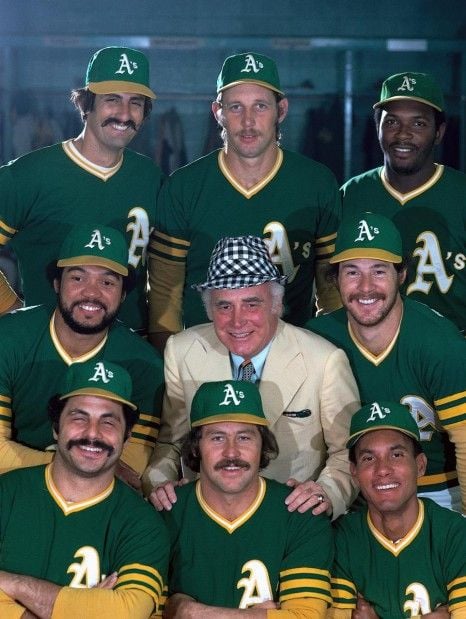
Top row: Rollie Fingers, Joe Rudi, Vida Blue.
Middle: Reggie Jackson, Charlie Finley, Gene Tenace.
Bottom: Sal Bando, Catfish Hunter, Bert Campaneris.
Among this team's many talents: Faking smiles.
October 17, 1974: Game 5 of the World Series is played at the Oakland Coliseum. Vida Blue of the Oakland Athletics and Don Sutton of the Los Angeles Dodgers are tied 2-2 going into the bottom of the 6th inning, when Mike Marshall relieves Sutton and retires the side.
In the 7th‚ a shower of debris from the fans halts the game for 15 minutes. When play is resumed‚ Joe Rudi hits Marshall's 1st pitch for a home run to give the A's a 3rd 3-2 win‚ clinching a 3rd straight World Championship for the team.
The A's thus become only the 2nd major league franchise to win 3 straight World Series, and remain the only one other than the New York Yankees to have done it. This was also the 1st all-California World Series, or even the 1st with both teams playing more than a few blocks west of the Mississippi River (take note, fans of St. Louis and Minnesota).
After the 1974 season, A's owner Charles Oscar Finley reneged on a clause in his contract with ace pitcher Hunter, who was then declared a free agent, and signed with the Yankees. The A's still won the American League Western Division in 1975, but lost the AL Championship Series to the Boston Red Sox.
The A's thus become only the 2nd major league franchise to win 3 straight World Series, and remain the only one other than the New York Yankees to have done it. This was also the 1st all-California World Series, or even the 1st with both teams playing more than a few blocks west of the Mississippi River (take note, fans of St. Louis and Minnesota).
After the 1974 season, A's owner Charles Oscar Finley reneged on a clause in his contract with ace pitcher Hunter, who was then declared a free agent, and signed with the Yankees. The A's still won the American League Western Division in 1975, but lost the AL Championship Series to the Boston Red Sox.
Then the reserve clause was struck down. Free agency, and thus much higher salaries, were coming, and Finley didn't want to pay them. First, he traded Reggie to the Baltimore Orioles, where he played out his contract. Then he sold Blue to the Yankees for $1.5 million, and Fingers and Rudi to the Red Sox for $1 million each. He figured, better to get as much money for them now, than to lose them to free agency and get nothing for them.
Commissioner Bowie Kuhn voided those sales. This benefited the Yankees, as they didn't have to deal with Blue's worsening drug problem, and the Red Sox did not get the improvement that Fingers and Rudi would have given them. But was it really, as Kuhn put it, in "the best interests of baseball"?
When the 1976 season came to an end, with the A's finishing 2nd, a mere 2 1/2 games behind the Kansas City Royals, Finley didn't lift a finger to sign any of the players who went for the big money. He didn't try to bring Reggie back, and Reggie signed with the Yankees. Fingers and Tenace were signed by the San Diego Padres. Rudi was signed by the team then known as the California Angels. Campaneris was signed by the Texas Rangers, and would join Rudi on the Angels 2 years later. Team Captain Bando was signed by the Milwaukee Brewers.
Finally, after an attempt to trade Blue to the Cincinnati Reds after the 1977 season fell through, Finley traded him across the Bay to the San Francisco Giants. The A's crashed to last place in 1977, losing 98 games, behind even the expansion Seattle Mariners. They lost 93 games in 1978, and bottomed out at 108 losses and just 306,763 fans for the entire season.
Finley threatened to move the team to Seattle for the 1976 season, came within inches of moving them to Denver for 1978, tried to move them to New Orleans in 1979, and finally sold the team in 1980. They instantly got better. He died in 1996. He is still not in the Baseball Hall of Fame, while Reggie, Catfish and Fingers are.
Pretty much everybody who's studied 1970s baseball -- and several books have been written about the period, all of them examining the A's, the Team of the Decade -- agree that if Charlie O. hadn't been so cheap, and otherwise so vindictive, and had paid his players what they were worth, and had otherwise treated them well enough to make them want to stay in Oakland, the dynasty could have continued, getting in the way of the Big Red Machine, George Steinbrenner's Yankees and Whitey Herzog's Royals.
But Finley broke up his dynasty.
The debate over the Team of the Decade for the 1970s comes down to the A's and the Cincinnati Reds. The argument for "the Big Red Machine" is that their 1975 team was the best single-season team of the decade, while their 1976 team went 7-0 in the postseason.
But the Reds didn't win 3 World Series in the decade. The A's won 3, all in a row. What's more, the 1st of these, in 1972, was over the Reds, clinching in Cincinnati, and doing it without their best player, because Reggie Jackson was injured in the Pennant-clincher.
Reds fans will argue that they had the edge at nearly every position: 1st base, Tony Pérez over Gene Tenace; 2nd base, Joe Morgan over Dick Green; shortstop, Dave Concepción over Bert Campaneris; 3rd base, Pete Rose over Sal Bando; left field, George Foster over Joe Rudi; center field, César Gerónimo over Billy North; and catcher, Johnny Bench over Ray Fosse. The one exception they'll make is that Reggie Jackson was better than Ken Griffey Sr. in right field.
What they did in their respective careers aside: At the time, Tenace was on the same level as Pérez, Campaneris was on at least the same level as Concepción, North was on at least the same level as Gerónimo, Bando was a better all-around player than Rose, and Foster was not yet a better player than Rudi. Then there's the pitching: The A's clearly had better starting pitching; and, while the bullpen was a Cincinnati strength, so was it a strength for Oakland, and the Reds didn't have a closer like Rollie Fingers.
The Team of the 1970s was "The Swingin' A's," not "The Big Red Machine."
It is noteworthy that, from the Giants' Pennant of October 3, 1962 to the 49ers' NFC Championship of January 10, 1982, the City of San Francisco had no league champions in any sport, while the City of Oakland had 8: The 1967 AFL Champion Raiders; the 1969 ABA Champion Oaks; the 1972, 1973 and 1974 World Series Champion Athletics; the 1975 NBA Champion Warriors; and the 1976 and 1980 NFL Champion Raiders.
One more note, as the A's won the last title of calendar year 1974: In his book about types of sports fans, True Believers, journalist Joe Queenan wrote about a friend of his, whose favorite teams were the A's, the Miami Dolphins, the Boston Celtics, the Philadelphia Flyers, the Notre Dame football team and the North Carolina State basketball team. Why? Because they all won championships when he was 8 years old, in calendar year 1974.
Except the guy has stuck with those teams all this time, and every one of them has since won at least one more title by 2022 (except the Dolphins, and the Flyers just barely, in 1975), but has also given him some misery. Indeed, the A's might end up moving, although since he doesn't live in the Bay Area, his loyalty isn't to Oakland. His loyalty cannot be questioned. I have more respect for him than the guy who roots for whatever team LeBron James plays for, or the guy wearing a Golden State Warriors T-shirt who doesn't know that the Warriors (and the A's, for that matter) used to play in Philadelphia.
UPDATE: The A's did move after the 2024 season, with John Fisher, their owner since 2005, doing what Finley threatened to do, but never did: Take them out of Oakland.
*
October 17, 1974 was a Thursday. Football was in midweek. There were 2 games in the NBA. The New York Knicks beat the expansion New Orleans Jazz, 89-74 at Madison Square Garden. This was the 1st regular season game ever played by the Jazz, who moved to Salt Lake City in 1979, becoming the Utah Jazz. And the Phoenix Suns beat the Seattle SuperSonics, 114-97 at the Arizona Veterans Memorial Coliseum in Phoenix.
The American Basketball Association opened its season the next day. There were 4 games played in the NHL:
* The Boston Bruins beat the Philadelphia Flyers, 4-1 at The Spectrum in Philadelphia.
* The Washington Capitals beat the Chicago Black Hawks, 4-3 at the Capital Centre in the Washington suburb of Landover, Maryland.
* The Buffalo Sabres beat the California Golden Seals, 6-1 at the Buffalo Memorial Auditorium.
* And the St. Louis Blues beat the Montreal Canadiens, 3-2 at the St. Louis Arena.
One game played in the World Hockey Association: The Michigan Stags beat the Indianapolis Racers, 4-2 at the Market Square Arena in Indianapolis. The Stags thought they could compete with the now-struggling Detroit Red Wings, but they didn't have a TV contract, and moved in mid-season, becoming the Baltimore Blades, and folded at the end of the season.


No comments:
Post a Comment