October 3, 1951: Along with the Bucky Dent Game of 1978, the Bobby Thomson Game may be the most written-about single game in the history of baseball. And if you have to ask why, then you don't know the history of baseball.
Funny thing: Life was imitating art. Just a month earlier, on August 29, 1951, a film titled Rhubarb premiered, based on the novel by H. Allen Smith. The owner of a Brooklyn baseball team dies, and leaves ownership of the team to his cat, which he had named "Rhubarb," an old baseball term for an argument, often used by Dodger broadcaster Walter "Red" Barber.
The plot has the Brooklyn team playing the New York team in a Playoff for the Pennant. It was only the 2nd film role for 20-year-old Leonard Nimoy, and the future Star Trek star was not credited. The most unfair thing about this movie, if not the most illogical.
In real life...
The New York Gothams began play in the National League in 1883. In 1886, after a particularly rousing victory, their manager, Jim Mutrie, called them "my big boys, my giants," and they were the New York Giants from then on. In 1925, a football team would be named after them, and they still use that name.
Their first home had been a polo field in what became known as the East Harlem section of Manhattan. In 1890, they moved to 155th Street and 8th Avenue, where Harlem meets Washington Heights, with a cliff called Coogan's Bluff overlooking it. The stadiums that would be built there, first one, then another on the same site after a 1911 fire, would carry the name "the Polo Grounds" from their previous home, even though polo was one of the few outdoor sports capable of being played outdoors that the place never hosted.
Up until 1898, New York and Brooklyn were separate cities. In 1883, a team was founded in the American Association. It would eventually become known as the Trolley Dodgers, due to Brooklyn being covered with trolley lines and locals having to dodge them. Eventually, this was shortened to "Dodgers."
In 1913, their owner, Charles Hercules Ebbets, built a ballpark on a spot near Prospect Park, where the neighborhoods of Bedford-Stuyvesant, Crown Heights and Flatbush come together. Someone suggested he name it for himself, and Ebbets Field was born.
The separate cities of New York and Brooklyn, and after 1898 the Boroughs of Manhattan and Brooklyn, developed a rivalry above and beyond baseball. But the rivalry between the Giants and the Dodgers was nasty, even more so than the one that eventually developed between the 3rd team established in New York, the American League's Yankees, and the Boston Red Sox.
After all, not only were the Polo Grounds and Ebbets Field just 13 miles apart, but, with the 154-game schedule and 8-team Leagues of the time, they played each other 22 times a year. Like the old saying goes, "Familiarity breeds contempt." As Keith Jackson would later say of certain college football rivalries, "These two teams just don't like each other." And the fans, who had to live together, side-by-side, sometimes even in the same family, in the City, and in the nearby suburbs, didn't like each other, either.
The Giants always had money, and the Dodgers rarely did. The Giants won the Pennant in 1904, 1905, 1911, 1912, 1913, 1917, 1921, 1922, 1923, 1924, 1933, 1936 and 1937; and the World Series in 1905, 1921, 1922 and 1933. The Dodgers didn't win nearly as much: The Pennant in 1916 and 1920.
Because of a messy divorce, Charlie Ebbets died broke in 1925. At his rainy funeral, another part-owner, Ed McKeever, caught a cold and, in those pre-antibiotic days, developed pneumonia and died. As if the team's finances weren't precarious enough, the Great Depression came. Eventually, one-quarter ownership of the team came into possession of a bank, the Brooklyn Trust.
(In 1950, Brooklyn Trust became part of Manufacturer's Trust. In 1961, after another merger, it became Manufacturer's Hanover, or "Manny Hanny." In the 1970s and '80s, it was one of the few companies that advertised on the television broadcasts of both the Yankees and the Mets. In 1991, it was bought out by Chemical Bank. In 1996, Chemical bought Chase Manhattan Bank, and adopted its name. In 2000, Chase merged with J.P. Morgan & Co., so the little bank that once owned a key piece of the Brooklyn Dodgers is now part of JPMorgan Chase Bank, N.A., tying Charlie Ebbets to the Morgan and Rockefeller families.)
In 1934, the Giants were leading the NL, and, in a radio interview, someone asked Bill Terry, the Giants' manager and 1st baseman, about the upcoming series with Brooklyn. He mockingly said, "Brooklyn? Is Brooklyn still in the league?" Down the stretch, the Dodgers beat the Giants enough times that a surge by the St. Louis Cardinals cost the Giants another Pennant. The Dodgers, already known in the Brooklyn dialect as "Dem Bums," couldn't win, but they could spoil things for the "Jints."
In 1938, Ed's brother and fellow part-owner, Steve McKeever, died. Ownership of the Dodgers was now divided as follows: 1/8th, Grace Ebbets, Charlie's widow; 1/8th, Joseph Gilleaudeau, Charlie's son-in-law; 1/8th, Elizabeth "Dearie" Mulvey, daughter of Steve McKeever; 1/8th, James Mulvey, Dearie's husband; 1/4, a trust set up by Ed McKeever before his death; and 1/4, Brooklyn Trust.
The bank hired Larry MacPhail away from the Cincinnati Reds, and installed him as team president. He renovated Ebbets Field, brought broadcaster Red Barber with him from Cincinnati, and rebuilt the team. By 1941, they were Pennant winners again. But, as the Giants did in 1923, '36 and '37 (after beating them in '21 and '22), the Dodgers lost the World Series to the Yankees. The words "WAIT 'TIL NEXT YEAR" appeared in a headline of the Borough's newspaper, The Brooklyn Eagle.
Except "Next Year" never seemed to come. The Dodgers had replaced the Giants as New York's 2nd team, but the Yankees had already replaced the Giants as New York's 1st team. The Dodgers fell 2 games short of the Pennant in 1942. Then came World War II. MacPhail left, and St. Louis Cardinals general manager Branch Rickey was hired as team president and GM. Rickey and Pfizer executive John L. Smith bought out the Ebbets and Ed McKeever trusts, and were now each a 25 percent owner, as were the Mulveys and Brooklyn Trust.
Meanwhile, Giants ownership had been fairly steady. John T. Brush, who rebuilt the Polo Grounds, died in 1912. He left the team to his son-in-law, Harry Hempstead. In 1919, Hempstead sold the team to Charles Stoneham. In 1936, Stoneham died, leaving the Giants to his son, Horace Stoneham.
In the 1st season back from The War, 1946, the Dodgers finished in a tie with the Cardinals, but lost a Playoff. In 1947, the Dodgers desegregated baseball with Jackie Robinson, and won the Pennant -- but lost the Series to the Yankees. After missing out in 1948, they won again in 1949, but lost the Series to the Yankees. In 1950, they lost the Pennant on the final day of the season, to the Philadelphia Phillies.
In 1942, Brooklyn Trust chose one of its lawyers to manage its quarter share of the Dodgers. They could have chosen William A. Shea -- yes, the man for whom Shea Stadium would be named, as the team that played there would have been impossible without him -- but he was a Giants fan. So they chose someone who cared not at all about baseball, only money: Walter Francis O'Malley.
In 1950, John L. Smith died. O'Malley saw his chance. He bought Brooklyn Trust's share. He bought Smith's share. He knew he could intimidate the Mulvey's into approving whatever he did. All he had to do was buy Rickey out. While they had a few things in common, Rickey and O'Malley hated each other's guts, and Rickey knew the game was up, but, also being a clever lawyer, found a way to make O'Malley pay through the nose. If there's one thing a rich man values more than money, it's control, and O'Malley paid the price to get 75 percent ownership, and 100 percent control, of the Dodgers.
So, going into the 1951 season, the Dodgers were financially secure. But, competitively speaking, there were successful, not not enough: They'd already had 3 recent World Series losses, were 0-5 in the Series overall, and had 3 nasty near-misses for the Pennant.
But they were loaded: 1st baseman Gil Hodges was a slugger and a fine fielder; 2nd baseman Robinson excelled in all aspects of the game, especially baserunning; shortstop Harold "Pee Wee" Reese and 3rd baseman Billy Cox were slick fielders; center fielder Edwin "Duke" Snider might have been the best all-around player in the NL; right fielder Carl Furillo was a terrific hitter with a great arm; catcher Roy Campanella was a slugger who was the best game-caller in the NL; and the starting rotation was strong with Don Newcombe, Elwin "Preacher" Roe, Carl Erskine and Ralph Branca. Oddly, they could never settle on a regular left fielder.
The Giants? The infield was Whitey Lockman, Eddie Stanky, Alvin Dark and Hank Thompson; the outfield was Monte Irvin, Bobby Thomson and Don Mueller; the catcher was Wes Westrum; and the rotation was Sal Maglie, Larry Jansen, Jim Hearn and Dave Koslo. Pretty much every regular was good, and Irvin and Maglie were genuine stars. But, aside from Irvin in left field, I don't think most Dodger fans would have swapped players with the Giants at any position.
The players on each team didn't like each other. To make matters weirder, the Giants manager was the man who had managed the Dodgers to the Pennant in 1941, Leo Durocher, a nasty man in so many ways, including his arguments with umpires that got him nicknamed "Leo the Lip."
He had been suspended for the entire 1947 season by Commissioner Albert "Happy" Chandler, for what he called "conduct detrimental to the game." It was Burt Shotton who managed the Dodgers to that Pennant. Durocher was reinstated for 1948, but Rickey, a moralist, was tired of Durocher and his amorality.
When Horace Stoneham fired Mel Ott, one of the Giants' most popular players ever but a poor manager, he called Rickey, and asked if he could hire Durocher. One man's trash being another man's treasure, Rickey told Durocher about the idea, and Durocher, knowing that Rickey was a cheapskate and Stoneham would pay him more, went for it. Dodger fans considered him a traitor, and hated him above all other Giant personnel, not knowing that it wasn't his idea.
Shotton returned, and managed the Dodgers through the 1950 season, winning the 1949 Pennant. He was replaced by Charlie Dressen for 1951.
The Dodgers started the season just 11-10, but then won 29 of their next 39, and led the NL by 7 games on June 23. Early on, the Giants had an 11-game losing streak, for a 2-12 start. Then they won 9 out of 11, but it still took them until May 28, Memorial Day, to get back to .500, at 20-20. An 8-1 run got them to 35-27 on June 19, 5 games behind the Dodgers.
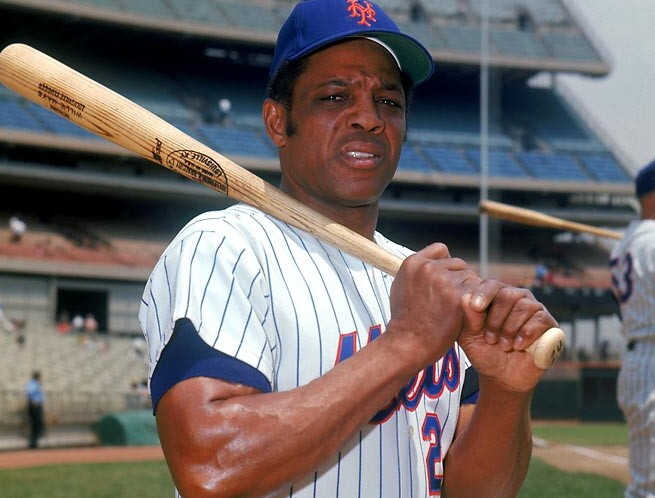
Part of the reason the Giants got going is that, on May 25, they called up a black kid from an industrial town outside Birmingham, Alabama, who was tearing up Class AAA ball: A center fielder named Willie Mays. With Hank Thompson not hitting, Bobby Thomson was moved to 3rd base, and Mays turned out to be the NL Rookie of the Year.
But the Dodgers went 10-2 from June 30 to July 13, to lead the NL by 9 games. Then they went 1-6 after the All-Star Break, but still led by 7 1/2. On July 20, they started a 10-game winning streak, and were 9 1/2 up when it ended on July 31. On August 8, they swept a doubleheader from the Giants. The next day, they made it a 3-game sweep.
Someone on the Dodgers declared, "The Giants is dead." The quote hit the newspapers. While grammatically incorrect, it sure seemed accurate: On August 11, the Giants were 13 1/2 games behind the Dodgers, and the rest of the NL was behind the Giants. It looked like another Yankees vs. Dodgers "Subway Series."
A funny thing happened on the way to the Subway Series. The Giants started cheating. They had a sign-stealing system at the Polo Grounds, and it allowed them to go 50-12 down the stretch, including 20-3 at home.
Meanwhile, the Dodgers coasted: From September 9 to 28, they went just 7-11, and fell into a tie for 1st place, blowing their huge lead. On the scheduled last day of the regular season, they needed to beat the Phillies in Philadelphia just to force a best-2-out-of-3 Playoff for the Pennant against the Giants, and while it took them 14 innings, and both fielding and hitting heroics by Robinson, they did it.
There was a coin toss to decide home-field advantage. The Dodgers won. But Dressen chose to open the series at home, assuming that taking an early lead would give them a psychological edge for the rest of the matchups at the Polo Grounds. So Game 1 of the Playoff was set for October 1, at Ebbets Field. Hearn outpitched Branca, who gave up a home run to Thomson in the 4th inning, a foreshadowing. Irvin also homered, and the Giants won, 3-1. So much for Dressen's strategy.
Game 2 was played on October 2, at the Polo Grounds. The Dodgers bounced back in a big way, with home runs from Robinson, Hodges, Andy Pafko (finally, they found a left fielder) and Rube Walker, who was catching in place of Campanella, who was injured, ending a season in which he would be named the NL's Most Valuable Player. (Home runs on the season: Hodges 40, Pafko 30, Robinson 19, Walker... 4.) Clem Labine pitched a 6-hit shutout, and the Dodgers beat the Giants 10-0.
Dressen stuck with Labine the whole way, making it next to impossible for him to pitch in the deciding game the next day, also at the Polo Grounds. My grandmother was a Dodger fan from Queens, and she told me, "That Dressen was so stupid!"
October 3, 1951. It was cloudy that Wednesday, and there was a threat of rain, so only 34,320 fans came to the 55,987-seat Harlem Horseshoe. Among those in attendance, sitting next to each other, were a pair of Dodger fans: A comedian from Brooklyn named Jackie Gleason, and a singer from Hoboken, New Jersey named Frank Sinatra.
Also in attendance were 2 of the American League Champion Yankees: Campanella's main competitor for the title of the best catcher in baseball, Lawrence "Yogi" Berra; and right fielder Hank Bauer. Watching on television on NBC, with Ernie Harwell as the announcer, was Mays' main competitor for the title of the most exciting rookie in baseball, center fielder Mickey Mantle.
Mickey had asked Yogi who they should root for. Yogi said they should root for the Giants, because the Polo Grounds seated nearly twice as many people as Ebbets Field, meaning the gate receipts for the World Series would be larger if their opponents were the Giants, which meant that the World Series shares for the players would be higher. The Yankees would get almost as much money from losing to the Giants as they would from beating the Dodgers.
At 1:30 PM, home plate umpire Lou Jorda signaled to Giant starter Sal Maglie, and said, "Play ball!" Maglie struck Furillo out. He walked Reese and Snider. Robinson singled Pee Wee home. 1-0 Dodgers. Pafko grounded out, and Hodges popped up. In the bottom of the 1st, Stanky flied out, Dark popped up, and Mueller lined out.
Top of the 2nd inning: Cox grounded out. Walker struck out. Newcombe popped up. Bottom of the 2nd: Irvin grounded out. Lockman and Thomson singled, but Mays lined out. 1-0 Dodgers.
Top of the 3rd inning: Furillo grounded out. Reese popped up. Snider struck out. Bottom of the 3rd: Westrum walked. Maglie bunted him over. Stanky grounded into a double play. 1-0 Dodgers.
Top of the 4th inning: Robinson grounded out. Pafko struck out. Hodges grounded out. Bottom of the 4th: Dark popped up. Mueller lined out. Irvin grounded out. 1-0 Dodgers.
Top of the 5th inning: Cox bunted for a hit. Walker struck out. Newcombe grounded out. Furillo flied out. Bottom of the 5th: Lockman grounded out. Thomson doubled. Mays struck out. Westrum was intentionally walked, to set up a force play. Maglie struck out. Still 1-0 Dodgers.
Top of the 6th inning: Reese struck out. Snider singed, but was caught stealing. Robinson walked. Pafko popped up. Bottom of the 6th: Stanky flied out. Dark grounded out. Mueller popped up. Still 1-0 Dodgers.
Top of the 7th: Hodges popped up. Cox grounded out. Walker singled. Newcombe grounded out. But as the Dodgers took the field for the bottom of the 7th, Newcombe was beginning his 270th inning of the season. He gave up a double to Irvin. Lockman grounded into a fielder's choice that advanced Irvin to 3rd. Thomson hit a sacrifice fly that scored Irvin with the tying run.
A mound conference was convened. Dressen, Walker, and the entire Dodger infield surrounded Newcombe. This included Jackie Robinson. He was the 1st black man to play in the major leagues since 1884. Newcombe was the 2nd black man to become a successful major league pitcher, after Leroy "Satchel" Paige with the Cleveland Indians.
Jackie knew that, if Newk couldn't get the job done, people would say a black pitcher couldn't do it. Newk had already given up what would now be called a walkoff home run to Tommy Henrich in Game 1 of the 1949 World Series, and the home run to Dick Sisler that won the 1950 Pennant for the Phillies. To use another phrase that wasn't yet in use, Newk "couldn't win the big one."
New York Herald Tribune sportswriter Roger Kahn, Jackie's best friend in the media, once wrote that he could converse with Eleanor Roosevelt and curse with Leo Durocher in equal measure. In a high-pitched voice that belied his imposing physical form and his massive moral authority, Jackie told Newk, "You keep pitching until your fucking arm falls off."
The batter was Mays. Lockman was still on 1st. Newk, at this point running on fumes, pitching on brains and guts, got Mays to ground to Dark, who started an inning-ending double play. It was 1-1.
Top of the 8th: Top of the order up. Furillo lined back to Maglie. Then, as if they had sensed his courage, or maybe as if they didn't want to incur Robinson's wrath, the Dodgers began to pick Newcombe up. Reese singled. Snider singled Reese over to 3rd. Maglie threw a wild pitch that advanced the runners, scoring Reese. With 1st base open, Robinson was walked. No good: Pafko singled Snider home. Hodges popped up. But Cox singled Robinson home. Walker grounded out. 4-1 Brooklyn.
In the years to come, Yankee shortstop Phil Rizzuto became a broadcaster, and joked about leaving the game early, to get home to New Jersey, over the George Washington Bridge. "I gotta get over that bridge!" he would tell his broadcast partners. Well, at this point, thinking the Dodgers had the game in the bag, Berra and Bauer left, got in the car, and headed for the Bridge.
Bottom of the 8th: The 3-run cushion helped settle Newcombe down. He struck out Bill Rigney, who was pinch-hitting for Westrum. Hank Thompson was sent up to pinch-hit for Maglie, and grounded out. And Stanky popped up. End of 8: Dodgers 4, Giants 1. Dem Bums needed 3 more outs.
Top of the 9th. Larry Jansen was now pitching for the Giants, and Ray Noble replaced Westrum as catcher. Dressen should have pinch-hit for Newcombe. He didn't, possibly because it was already known that, for a pitcher, Newcombe was a very good hitter. But he grounded out. So did Furillo. And Reese flew out.
Bottom of the 9th. It is an inning we are still talking about, more than 70 years later. The Dodgers went into it with a 4-1 lead. Just 3 more outs, allowing 2 or fewer runs, and they would face the Yankees in Game 1 of the World Series, the next day, at Yankee Stadium.
But Newcombe was gassed. He allowed a single to Dark. He allowed a single to Mueller. Now, the tying run was at the plate, in the form of a future Hall-of-Famer, Irvin. Newk got him to pop up to Hodges. But Lockman doubled to left, scoring Dark, and sending Mueller to 3rd.
There was a break in the action, because there was a sprain in Mueller's ankle. He was replaced on 3rd base by Clint Hartung.
Dressen knew he finally had to take Newcombe out. He got on the bullpen phone. Clyde Sukeforth, the pitching coach, previously the scout who found Robinson, answered. Dressen could choose between Erskine and Branca, 2 righthanders, to face, potentially, the next 2 batters, both righthanded, Thomson and Mays.
As soon as Sukeforth picked up the phone, Erskine threw a pitch in the dirt. Sukeforth told Dressen this, and told him that Branca was pitching well. Dressen said, "Send in Branca."
The announcement came over the public address system, "Now coming in to pitch for Brooklyn, Number 13, Ralph Branca." Number 13, the traditional unlucky number. Thomson was a good hitter against a fastball, but only against a fastball. And Branca had only a fastball. And he'd already given up a home run to Thomson in Game 1 of the Playoff.
Red Barber was broadcasting the game for the Dodgers, over WMGM, 1050 on the AM dial. My grandmother, then living with my grandfather and mother on the Lower East Side of Manhattan, knew the details. She knew that Branca was the wrong choice in a big situation, especially to face Thomson. She turned off the radio. John Sterling was then 13 years old, and living on the Upper East Side. In his long career as the Yankees' radio announcer, he liked to say, "You just can't predict baseball." That day, Grandma predicted baseball. Because, in this case, it wasn't that hard to do.
Thomson was at bat. Mays was on deck. He may have been Willie Mays, but he was 20, a rookie, and, by his own later admission, very nervous. There's no guarantee that Mays would have done anything good. Had Branca gotten Thomson out, Mays could have made the last out.
Thomson stepped into the box. Branca's 1st pitch was a strike call on the outside corner. It was 3:58 PM.
Russ Hodges had the call on the Giants' radio station, WMCA, 570 AM:
Bobby hitting at .292. He's had a single and a double, and he drove in the Giants' first run with a long fly to center. Brooklyn leads it, 4–2. Hartung down the line at third, not taking any chances. Lockman with not too big of a lead at second, but he'll be runnin' like the wind if Thomson hits one.
Branca throws.
There's a long drive, it's gonna be, I believe... (dramatic pause) The Giants win the Pennant! The Giants win the Pennant! The Giants win the Pennant! The Giants win the Pennant! (Three seconds of crowd noise)
Bobby Thomson hits into the lower deck of the left-field stands! The Giants win the Pennant! And they're goin' crazy! They're goin' crazy! Hey-oh! (Seven seconds of nothing but crowd noise) I don't believe it! I don't believe it! I do not believe it! Bobby Thomson hit a line drive into the lower deck of the left-field stands! And this blamed place is goin' crazy! The Giants! Horace Stoneham has got a winner! The Giants won it, by a score of 5-4, and they're pickin' Bobby Thomson up, and carryin' him off the field!
More than any home run, more than Bill Mazeroski's in 1960, more than Carlton Fisk's in 1975, more than Bucky Dent's in 1978, more than Kirk Gibson's in 1988, more than Joe Carter's in 1993, more than any hit by David Ortiz in 2004, this is the most talked-about home run in baseball history. The only other serious contender for the title is Babe Ruth's apparent called shot in the 1932 World Series.
It was Thomson's 32nd homer of the season. The last one may have been the shortest in physical distance, maybe 320 feet. But it has traveled the longest in memory.
Sinatra said that Gleason was so drunk and distraught that he threw up on Frank's shoes. Asked on the 50th Anniversary about having left early, Berra said, "I guess we should have stayed." It would be 1973, and he would be the manager of a team which did not exist in 1951, before Yogi delivered his most famous quote, which would have been appropriate on that cloudy long-ago Wednesday afternoon: "It ain't over 'til it's over."
There's a picture taken from center field, as Thomson touched home plate. Jackie Robinson was standing behind 2nd base, making sure Thomson did, in fact, touch the plate. Was he thinking about the moment in 1908, at 2nd base, on that plot of land (if not at that stadium, which replaced the former Polo Grounds in 1911), when Fred Merkle failed to touch the base, costing the Giants the Pennant?

It didn't matter: Thomson did touch all the bases, including the plate. On the film, Robinson can be seen ripping the cap off his head. He made the long walk, all the way back to the blockhouse in center field, with the Giants' clubhouse on one side and the visiting team's on the other.
There's another photo, showing Branca sprawled on the steps up to the clubhouse, with former Dodger star, now coach, Harry "Cookie" Lavagetto, sitting next to him, a cigarette in his hand.
A priest was in the Dodger locker room, Father Pat Rowley. Branca asked him, "Why me?" Rowley told him, "Because God knew your faith would be strong enough to bear this cross." Rowley was there because his cousin was Branca's girlfriend, Ann Mulvey. Who was also the daughter of Dodger part-owners John and Dearie Mulvey. Ralph and Ann were soon married. Branca lost the Pennant, but got the girl.
The game, and the Giants' comeback to get there, are called "The Miracle of Coogan's Bluff." They could have been expected to flop in the World Series against the Yankees, having expended so much emotion. Instead, they almost kept it going, taking 2 of the 1st 3 games. But the Yankees took the next 3 for the title.
Taking a line from "Concord Hymn," Ralph Waldo Emerson's 1837 poem about the Battle of Lexington and Concord in 1775 that started the American Revolution, Thomson's homer became known as "The Shot Heard 'Round the World."
The day after the game, October 4, 1951, the New York Daily News ran a front-page game recap under the headline, "The Shot Heard 'Round the Baseball World"; and a New York Times editorial that same day called Thomson's homer "the home run heard round the world." According to baseball historian Jules Tygiel, "These two phrases merged in the popular memory," and the Thomson blast became "The Shot Heard 'Round the World."
Indeed, it was, literally, heard around the world: American troops, fighting in the Korean War, and stationed in various bases in Europe and Asia, and on ships at sea, heard it on Armed Forces Radio. So did writer George Plimpton, a Giants fan studying at Cambridge University in England.
Giant fans were happier about this than they were about winning the World Series 3 years later, because it was against the hated Dodgers. Dodger fans were more crushed by this than they were about losing any World Series to the Yankees, because they hated the Giants more. And, more than 70 years later, Dodger fans now elderly are still hearing about it.
Now it is done. Now the story ends. And there is no way to tell it. The art of fiction is dead. Reality has strangled invention. Only the utterly impossible, the inexpressibly fantastic, can ever be plausible again.
-- Walter Wellesley "Red" Smith, in the next day's New York Herald Tribune. If Red wasn't the greatest sportswriter ever, this paragraph certainly shows why he's a contender for that title.
The Dodgers did recover, at least competitively. They won the Pennant in 1952. They lost the World Series to the Yankees. They won the Pennant in 1953. They lost the World Series to the Yankees. The Giants won another Pennant in 1954, and beat the Cleveland Indians in the World Series, due in large part to the Game 1 heroics of a catch in the 8th inning by Mays and a walkoff pinch-hit home run in the 10th inning by James "Dusty" Rhodes. It would be the team's last until 2010, as they developed a habit of painful close calls similar to those that the Dodgers had faced.
Finally, in 1955, after going 0-7 in World Series play, 0-5 against the Yankees, "Next Year" finally came for Brooklyn. The Dodgers beat the Yankees in the World Series, thanks to a great catch by Sandy Amoros -- a left fielder -- and a shutout by Johnny Podres in Game 7 at Yankee Stadium. They won another Pennant in 1956, but the Yankees, needing revenge over the Dodgers for the 1st time, got it.
After the 1957 season, the Dodgers moved to Los Angeles. The move was made by Walter O'Malley, who had been the lawyer that the Brooklyn Trust Company had hired to manage their share of the team's ownership. He had bought the bank's share, and either bought out or dominated the remaining part-owners.
He needed another team in California, to save money on travel costs. Giants owner Stoneham, as unhappy with the condition of the Polo Grounds and its neighborhood as O'Malley was with the size of Ebbets Field and the condition of its neighborhood, was going to move the team to Minneapolis, where their top farm team was. When O'Malley suggested San Francisco, Stoneham went for it. The rivalry went to the West Coast, and while they're now 425 miles apart, it has been every bit as nasty as it was when the gap was 13 miles.
Back in New York, the teams' bereaved fans were united in 1962, by a new team, the New York Mets, whose fans, those old enough to remember the Giants and Dodgers as New York teams and not, hated the Yankees every bit as much as the older fans among them hated each other.
Ebbets Field hosted "midget auto" races for 2 years, and was torn down in 1960. The Polo Grounds hosted a Heavyweight Championship fight between Floyd Patterson and Ingemar Johansson, then became the home of the AFL's New York Titans from 1960 to 1963 (they became the Jets in 1963), and the home of the Mets in 1962 and '63. It was torn down in 1964, just days before its replacement as the Mets' and Jets' home, Shea Stadium, opened. The same demolition crew that tore down Ebbets Field tore down the Polo Grounds, with the same wrecking ball, painted to look like a baseball.
The Dodgers have since won the World Series in 1959, 1963 (over the Yankees), 1965, 1981 (over the Yankees), 1988 and 2020; and won Pennants but lost the World Series in 1966, 1974, 1977 (to the Yankees), 1978 (to the Yankees), 2017 and 2018.
The Giants won Pennants in 1962 (history repeating itself, a Playoff won over the Dodgers, although there was no dramatic home run, and then they lost the World Series to the Yankees), 1989 and 2002, before winning the World Series in 2010, 2012 and 2014. And there have been times from 1962 onward that the Giants have spoiled Playoff berths for the Dodgers, and the Dodgers have done it for the Giants.
In 2014, Travis Ishikawa hit a bottom-of-the-9th home run to win the NL Championship Series for the Giants, echoing Thomson's homer. But it was against the St. Louis Cardinals, not the Dodgers; and it was in Game 5, not a deciding Game 7. Fox broadcaster Joe Buck used the phrase "The Giants win the Pennant!" only once.
The rivalry continues: In 2021, the Giants won 107 games, winning the National League Western Division, while the Dodgers won 106, to reach the NL Wild Card Game. They won it, and faced the Giants in the NL Division Series. It went to a deciding Game 5 in San Francisco, and a 9th inning run gave the Dodgers a 2-1 win and the series, although they lost the NLCS to the Atlanta Braves.
Branca, a native of Mount Vernon, Westchester County, New York, eventually found out about the Giants' cheating, and was upset about it. Thomson always claimed he never saw a signal about what pitch was coming. He didn't have to: He knew that Branca only had a fastball.
Nevertheless, Branca and Thomson became friends, and often did autograph sessions at memorabilia shows together.
Thomson, born in Glasgow, Scotland and raised in Staten Island (hence his nickname, "The Staten Island Scot"), died in 2010. He was 86. He was cremated, and there is no gravesite. Branca died in 2016, at 90, and was buried at Gate of Heaven Cemetery in Hawthorne, Westchester County, the same cemetery as Babe Ruth and Billy Martin.
As of October 3, 2022, Willie Mays, who became one of the greatest players who ever lived, is the only player from the game still alive. (UPDATE: He died on June 18, 2024.)
But the Bobby Thomson Game, and the Shot Heard 'Round the World that won it, will live forever. Indeed, some people consider this the greatest baseball game of all time. In 1981, baseball historian John Thorn published Baseball's 10 Greatest Games. He included this game as one of them.
*
October 3, 1951 was a Wednesday afternoon. There were no other games in any other sports, so there were no other scores on this historic day. But it was a historic day in baseball for another reason, although that wouldn't be known for many years to come: Dave Winfield, who would be elected to the Hall of Fame, was born on this day, in St. Paul, Minnesota.