
March 26, 1928: The Philadelphia Museum of Art opens, at 2600 Benjamin Franklin Parkway, at 26th Street, at the western end of the Parkway, on the banks of the Schuylkill River.
It had originally been established at Memorial Hall, part of the Centennial Exhibition of 1876, That building now hosts a children's museum, the Please Touch Museum, at 4231 Avenue of the Republic, 2 miles away across the Schuylkill River.
A larger museum had been planned since 1895, but one thing led to another, and it was delayed. It took until 1907 to decide on a site, Fairmount, a high point in the city, surrounded by Fairmount Park, where the city's main reservoir was then located. So then, they had to find a location for a new reservoir.
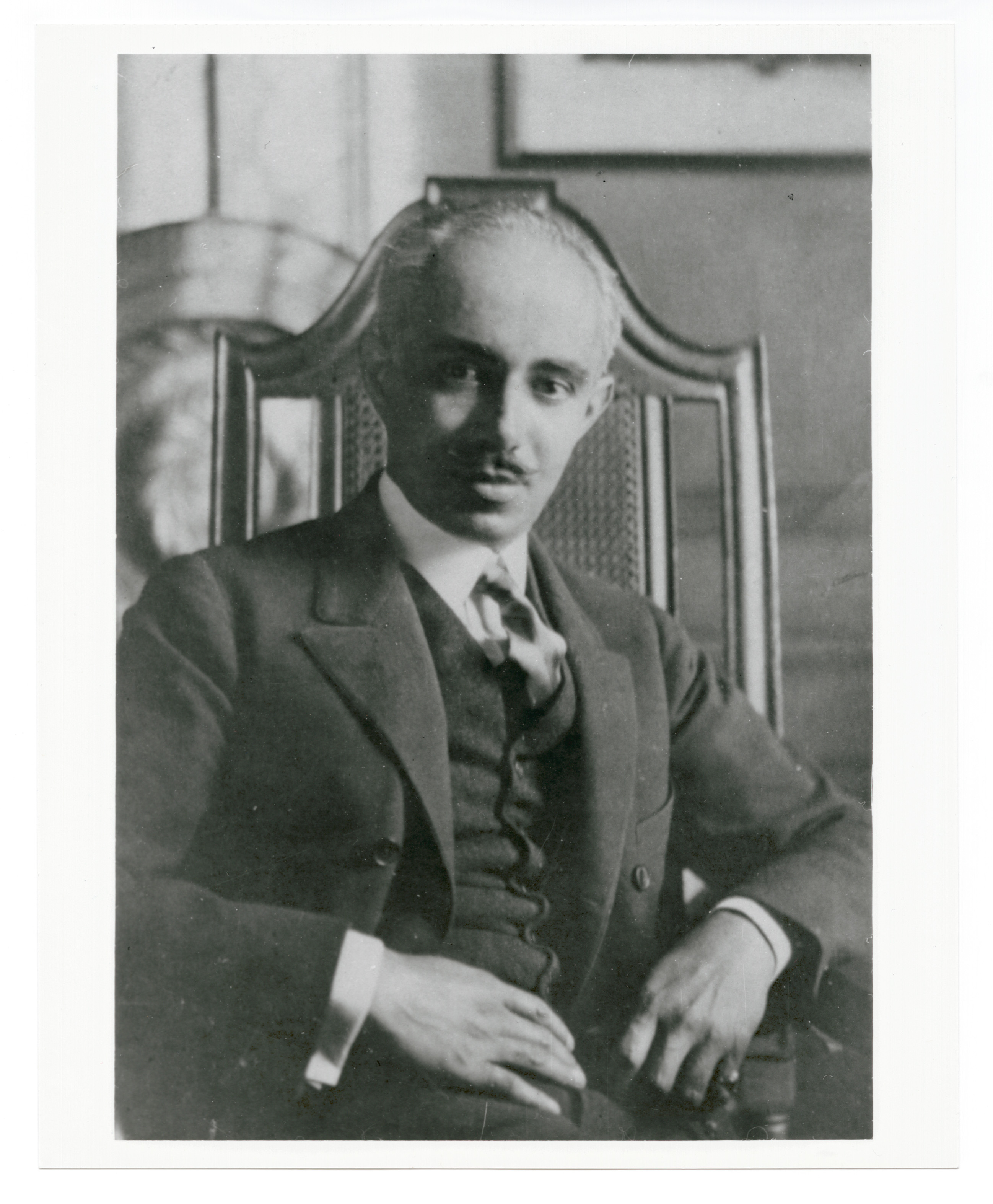
Julian Abele, the 1st black graduate of the University of Pennsylvania's School of Design, had his design for the building accepted in 1914. He later designed the Free Library of Philadelphia, 6 blocks away; then joined the faculty of Duke University, designing their 2 best-known buildings: University Chapel and what became Cameron Indoor Stadium.
But the city still wasn't home free: World War I interfered with the gaining of building materials, and it took until 1928 to build and open the place. A major renovation was completed in 1976, and an expansion in 2004.
The Museum of Art houses more than 240,000 objects, highlighting the creative achievements of the Western world and those of Asia, in more than 200 galleries spanning 2,000 years. Modern artwork includes works by Pablo Picasso, Marcel Duchamp and Salvador Dalí. The expanding collection of contemporary art includes major works by Agnes Martin, Cy Twombly, Jasper Johns and Sol LeWitt, among many others.
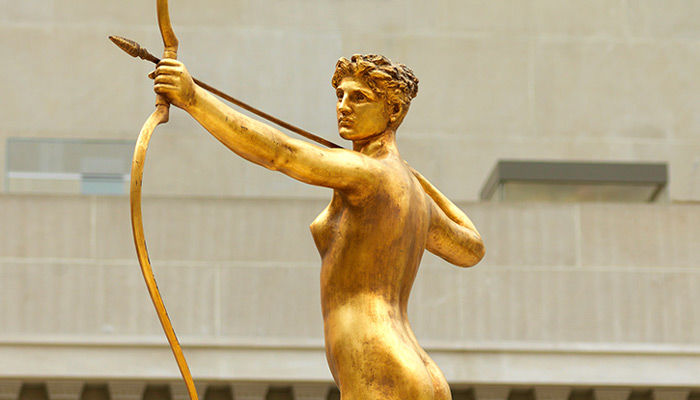
A Philadelphia art critic said rotten things about the statue of Diana, sculpted by Augustus Saint-Gaudens, atop the 2nd Madison Square Garden from 1891 to 1925. Where is that statue today? Of course, on display at the Philadelphia Museum of Art.
Every year, on Thanksgiving Day, the floats in the nation's oldest continuously-running Thanksgiving Day Parade go up the Ben Franklin Parkway, and put on a televised spectacle in front of the Art Museum at the end.
But if there's one thing anyone outside Philadelphia knows about the Museum of Art, it's the connection to the Rocky films. In the 1976 film Rocky, Sylvester Stallone, playing boxer Rocky Balboa, ran up the Museum's 72 steps as part of his training. When he got to the top, he had a great view of the city. As the City Council eliminated the "unwritten law" that said that no building in the city could be higher than the statue of William Penn atop City Hall, the view from the Art Museum Steps changed, to show the new skyscrapers.

I've done it. I don't mind telling you,
72 is a lot of steps.
In the 1982 film Rocky III, a statue of Rocky was unveiled on the Art Museum Steps. For a while, it was moved to the city's main sports arena, The Spectrum. It was moved back to the Art Museum Steps every time they had to film there, and is now at the bottom right of the Steps, permanently.
Since those films began, there have been certain things that tourists must do in Philadelphia: See the Liberty Bell, eat a cheesesteak sandwich, and run up "the Rocky Steps." At the end of the 1991 film Rocky V, Stallone and his real-life son, Sage, playing Rocky Jr., spoke for so many:
Rocky Sr.: "I been runnin' up an' down these steps for 20 years, and I never knew there was valuable pictures in this building, y'know?"
Rocky Jr.: "Well, you're never too old to learn something new. You're gonna love Picasso."
Rocky Sr.: "Yeah, well, I love almost everybody."
*
March 26, 1928 was a Monday. Baseball was in Spring Training. Football was out of season. The NBA hadn't been founded yet. And the NHL was between the end of the regular season and the start of the Stanley Cup Playoffs. So there were no scores on this historic day.


No comments:
Post a Comment